

Chain of custody is the unbroken, chronological record of who handled an asset, when, where, and what they did with it from pickup through final disposition. In an ITAD audit, that record is what decides whether your data destruction holds up, because a wipe claim or shred receipt means very little if you can't prove the same device stayed accounted for at every handoff.
If you're the compliance officer signing off on laptop retirement, server disposal, or a healthcare refresh, you're usually not standing on the loading dock, riding in the truck, and watching every drive hit the shredder. You see manifests, signatures, scan logs, certificates, and exception notes. That's why what is chain of custody matters so much in business recycling and IT asset disposal. It turns physical control into a record someone else can verify later.
For enterprise teams in Atlanta, Georgia, that matters across electronics recycling, computer recycling, data center decommissioning, medical equipment disposal, laptop disposal, laboratory equipment disposal, and product destruction. A chain of custody isn't courtroom theater. It's field discipline.
Table of Contents
- What Chain of Custody Actually Means in ITAD
- The Eight Stages of an Unbroken Custody Chain
- What Every Handoff Record Must Capture
- Where Chain of Custody Meets FTC, HIPAA, FACTA, and GDPR
- When a Broken Chain Still Holds Up in an Audit
- How Beyond Surplus Builds Audit-Ready Custody Records
- Custody Checklist and Sample Handoff Template
What Chain of Custody Actually Means in ITAD
A hospital closes a refresh project and sends out a fleet of laptops. The pallets are wrapped, tagged, and moved from the loading dock to a locked truck. Mid-route, one driver swaps with another. At the processing facility, the seals are checked, the serials are scanned, and the devices move into wipe or destruction lanes.
That whole trip needs a documented history. Chain of custody is the formal, chronological record of evidence handling that documents seizure, custody, control, transfer, analysis, and disposition from collection to final return or disposal, and NIST defines it as a chronological record of transfer, handling, and storage in its glossary.
Why ITAD borrows from evidence handling
In ITAD, the “evidence” is usually a serialized device or storage media that may still contain regulated data. Auditors don't watch the process happen. They review whether the record shows the same asset moved through collection, safeguarding, and analysis without unexplained gaps. NIST describes chain of custody as a process that tracks evidence through collection, safeguarding, and analysis by documenting every handler and transfer detail in its CSRC glossary entry.
Practical rule: If your paperwork can't show who had the device, when they had it, and why it moved, your destruction claim is only an assertion.
New compliance teams get tripped up. They think “custody” means the truck had the assets. It doesn't. Custody means the truck movement was tied to named people, dates, times, and transfer reasons.
For teams dealing with both hardware and modern key management, this MPC and HSM custody comparison is a useful side read because it shows the same control idea in digital asset environments. Different asset class, same operational problem: prove who controlled what, and when.
If you need the ITAD context first, Beyond Surplus has a plain-language overview of IT asset disposition that connects retirement, value recovery, recycling, and destruction into one lifecycle.
What makes the record defensible
In forensic practice, the record typically must capture each handler, the date and time of transfer, the purpose of transfer, and the identity of the item, with missing documentation risking inadmissibility in court, as reflected in the NIST definition above. In business terms, that same standard is what lets an auditor decide whether a NIST 800-88 wipe statement or destruction certificate is attached to the right machine.
The Eight Stages of an Unbroken Custody Chain
Most custody failures don't happen because someone forgot the final certificate. They happen because an earlier handoff was treated casually.
The operational chain from dock to disposition
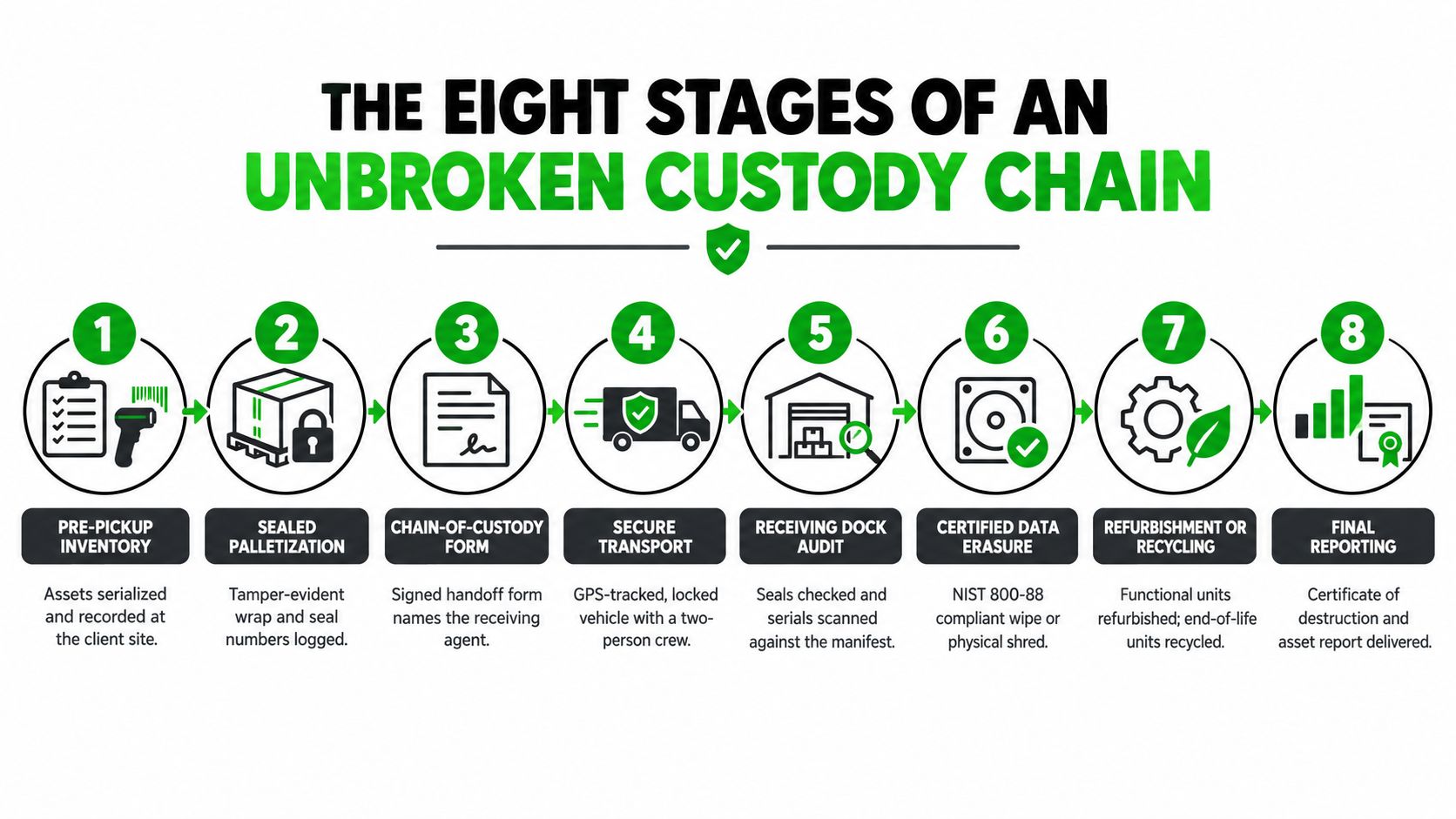
Pre-pickup inventory. Record the asset tag, serial number, device type, and client reference before anything leaves the site. If the item isn't uniquely identified at origin, every later record gets weaker.
Sealed palletization. Wrap pallets or containers and log seal or bag numbers. Add photos when possible. This creates a visible checkpoint between site release and facility receipt.
Pickup signature. The receiving driver signs the chain-of-custody form. The NIJ notes that each person who touches an item should sign for possession in its typical checklist. That's the handoff that establishes personal accountability.
Transport logging. Record departure, route exceptions, and any driver-to-driver transfer. If a shift changes, the chain needs a handoff entry, not just a dispatch note.
What gets checked at the facility
Receiving dock verification. Confirm the arriving seals match the outbound log. If they don't, the exception should be documented immediately.
Intake reconciliation. Scan serials, compare them to the manifest, log condition, and note missing accessories or visible damage. For server work, a practical server disposal checklist for IT managers helps define what should be checked before and after intake.
Sanitization or destruction. Log what happened to the asset. That might be data erasure, shredding, or preparation for resale. The entry should identify the technician and the action performed.
Final reporting. Issue a certificate tied back to the same serialized list used earlier in the process. If the certificate can't be traced to the original pickup records, it's just a standalone document.
A gap at any one stage is usually what auditors notice first. They don't start with the certificate. They start with continuity.
Why these eight stages matter
NIST's evidence-management guidance says chain of custody begins at first recognition or collection and must remain unbroken through storage, transfer, analysis, and final disposition, with the record capturing chronological movement, location, custodial status, and every person who handled the item in NIST IR 7928. That lifecycle model maps cleanly to ITAD because a retired device doesn't stop being risky when it leaves the customer's dock.
What Every Handoff Record Must Capture
A handoff record fails when it answers only “we picked it up.” A usable one answers who, when, what, and condition. That framework lines up with CASRAI's guidance that each handoff should answer who had the item, when, what they did, and the item's condition at receipt and release, as summarized in this forensic chain of custody overview.
The minimum fields that matter
| Field | What It Records | ITAD Example |
|---|---|---|
| Handler identity | The specific person taking or releasing possession | Driver name and employee ID |
| Date and time | The moment custody changed | Pickup timestamp at loading dock |
| Action taken | Why the transfer happened | Received for transport, scanned into intake, wiped, shredded |
| Condition | State of the item at handoff | Seal intact, cracked screen, drive present |
| Asset identifier | Which item moved | Laptop serial number or client asset tag |
| Container reference | Which sealed unit held it | Pallet ID or tote seal number |
| Photo reference | Supporting visual evidence | Dock photo or seal image ID |
| Client reference | Internal business linkage | Ticket number or purchase order |
Why generic entries create trouble
“Received by vendor” isn't enough. A defensible record names the person. “Moved to processing” isn't enough either. The record should say whether the device was scanned into intake, routed for wipe, or sent for shredding.
That's also why the final certificate matters less than people assume. The stronger document is often the event log behind it. If you're reviewing outputs, this guide on a certificate of data destruction is useful because it shows what the certificate should confirm, and what it can't prove by itself.
The field design is part of the control design. Bad fields create blind spots long before an audit finds them.
Why these fields became standard
A major standardization milestone came with ISO 22095:2020, published in 2020, which provides a cross-industry framework for custody tracking. In parallel, forensic documentation practice commonly includes a unique identifier, collector name and signature, recipient name, laboratory address, date and time of collection, analysis requested, signatures of everyone in the custody chain, and the delivery method, as summarized in this chain of custody reference.
Where Chain of Custody Meets FTC, HIPAA, FACTA, and GDPR
Regulations rarely say “use this exact handoff form.” They do expect records strong enough to show assets were controlled, data was protected, and disposal happened the way the organization says it did.
Where the overlap sits
| Regulation | Scope | Required Custody Evidence | Key Document |
|---|---|---|---|
| FTC Disposal Rule | Consumer information disposal | Proof data was rendered unreadable and vendor handling was documented | Destruction or sanitization record |
| HIPAA | ePHI on devices and media | Device tracking, restricted handling, documented safeguards | Asset log plus destruction documentation |
| FACTA | Consumer report information | Reasonable disposal steps and accountable handling | Serialized destruction trail |
| GDPR | Personal data processing and erasure | Evidence supporting confidentiality and deletion claims | Controller and processor records tied to disposition |
What auditors usually ask for
The common artifacts are familiar: serial numbers, timestamps, signatures, intake records, and final certificates. The differences are in emphasis. HIPAA teams usually care about media control and administrative safeguards. GDPR reviews often focus more heavily on whether the controller can demonstrate what the processor did.
For teams building those files, a centralized set of compliance documentation helps keep pickup records, data destruction proof, and disposition reports connected.
Why chain of custody sits underneath all four
The National Institute of Justice says a proper chain of custody is designed to prevent substitution, tampering, misidentification, damage, alteration, contamination, misplacement, or falsification of evidence, and that the record verifies where evidence traveled and who handled it before trial in its chain of custody guidance. In ITAD, replace “evidence” with “serialized device containing regulated data,” and the same control logic applies.
When a Broken Chain Still Holds Up in an Audit
A missing signature doesn't automatically destroy the record. That's one of the biggest misconceptions new compliance officers bring over from oversimplified legal articles.
What reviewers actually weigh
Auditors and courts usually look at the whole file. The practical question is whether the item can still be shown to be the same item, and whether the gap creates a believable integrity problem. Neutral guidance on broken custody makes the point that gaps often affect evidential weight more than admissibility unless the break raises real concerns about substitution or tampering in this discussion of chain-of-custody gaps.
A reconstructable gap might look like this:
- Missing signature: The outbound form lacks one driver signature.
- Corroborating trail: GPS movement, dock CCTV, receiving scans, and technician logs still match the same serialized lot.
- Result: The record is damaged, but still credible.
A fatal gap looks different:
- No serial linkage: Pickup paperwork lists only “miscellaneous laptops.”
- No sealed container trail: No tote or pallet reference ties origin to receipt.
- Result: The certificate can't be tied back to the actual devices.
A practical threshold for review
If several independent records support the same handoff, most audits can still proceed with confidence. That's why many IT teams use a data destruction audit checklist that looks beyond the certificate and checks scans, transport records, exception logs, and asset matching.
Missing paperwork is a problem. Missing identity is a much bigger problem.
How Beyond Surplus Builds Audit-Ready Custody Records
The operational question isn't whether chain of custody matters. It's whether the process creates records that stay connected from pickup to final outcome.
The mechanics on the ground
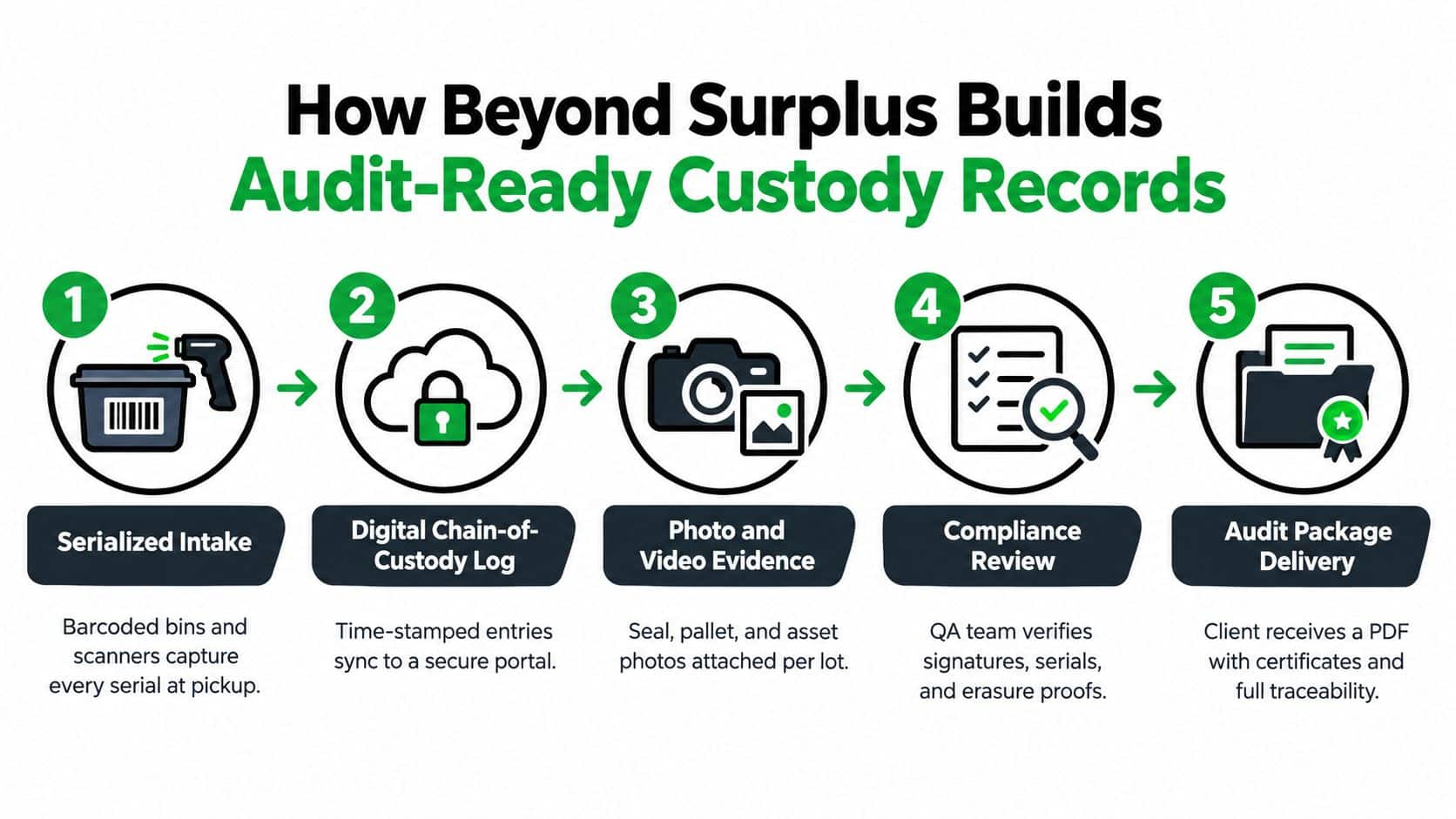
At pickup, barcoded bins or serialized manifests establish the first identity layer. The receiving crew signs for possession, not just the company name. If pallets or locked containers are used, the seal numbers become part of the lot record.
During transport, the useful controls are simple. Keep the vehicle assignment, route event, and transfer record tied to the same shipment reference. If custody moves between drivers or facilities, log it as a new event.
What turns records into an audit package
At intake, the receiving dock reconciles what arrived against what left. That means scan-in, seal verification, condition notes, and exception handling if something doesn't match. On the destruction floor, the key event is the technician action record. It needs to tie the specific asset or lot to the actual wipe or physical destruction event.
One practical option in this market is Beyond Surplus, which documents secure ITAD, hard drive shredding, and electronics recycling with chain-of-custody records and final certificates for business clients. The value of that model isn't the paper alone. It's that pickup, transport, receipt, and disposition stay linked to the same asset history.
Why the final certificate works only when the earlier records do
CASRAI describes chain of custody as every person who collected, transferred, stored, analyzed, or otherwise accessed the evidence until final disposition in its forensic science guide. In ITAD terms, that full-lifecycle view is what turns a certificate into a summary of a proven history instead of a standalone promise.
Custody Checklist and Sample Handoff Template
If you need to operationalize this fast, start with a field checklist your dock, driver, and receiving team can all follow the same way.
A practical pre-pickup checklist
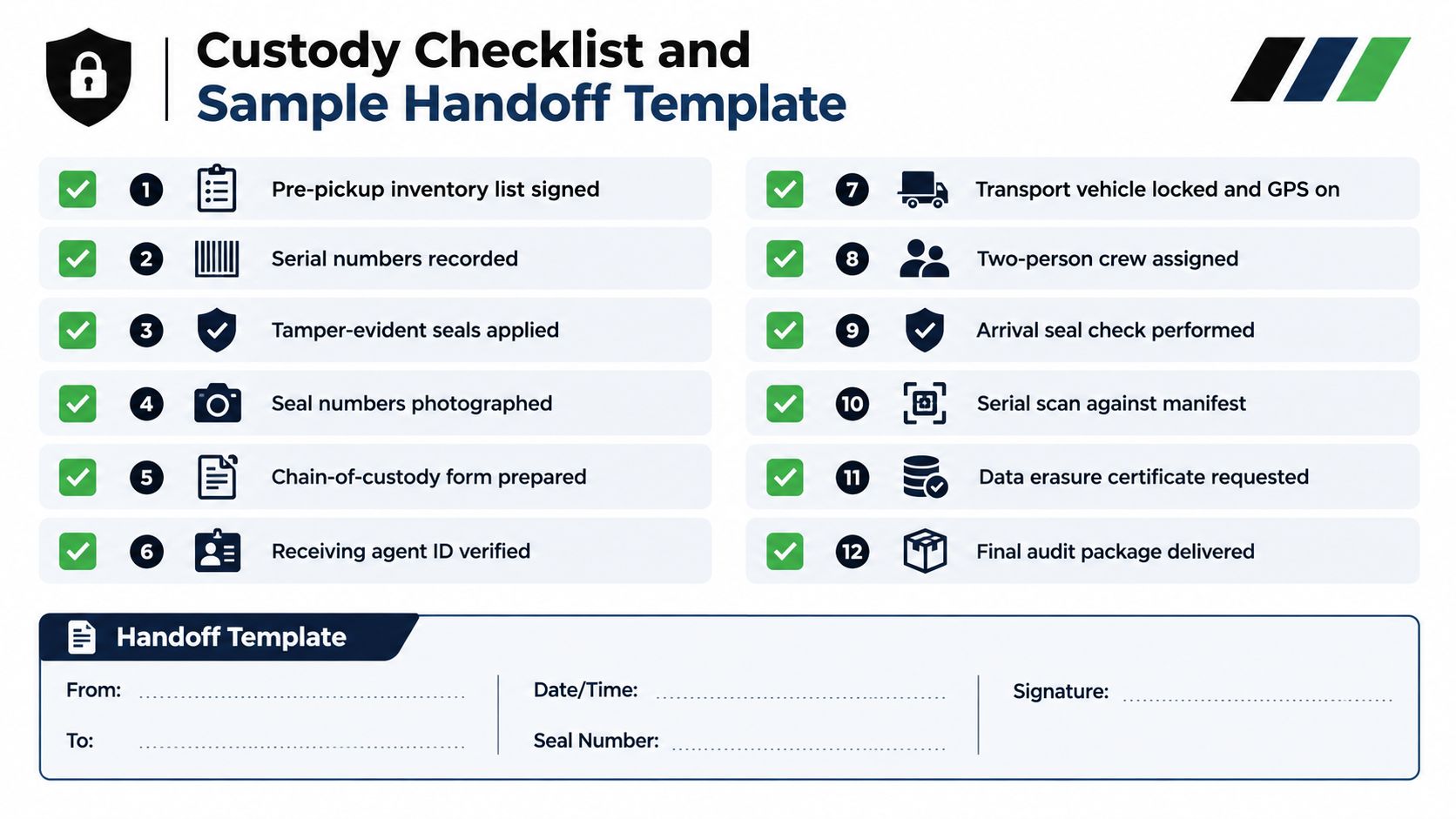
- Inventory signed: Pre-pickup asset list approved by the client.
- Serials recorded: Each device or media item tied to an identifier.
- Seals applied: Tamper-evident tags placed on pallets, bins, or bags.
- Seal photos captured: Image references attached to the lot.
- Form prepared: Chain-of-custody document ready before loading starts.
- Receiver verified: Named agent confirmed for the handoff.
- Vehicle secured: Locked transport confirmed before departure.
- Crew assigned: Responsibility clearly placed with designated handlers.
- Arrival check completed: Seals inspected at receiving.
- Manifest matched: Scans reconciled against the origin list.
- Disposition method confirmed: Wipe, shred, resale, or recycling route noted.
- Audit package requested: Final reporting requirement logged up front.
Sample handoff template
Use a handoff log that captures the same structure every time:
| Field | Example Entry |
|---|---|
| From | Client facilities manager |
| To | Receiving driver |
| Date and time | Time of custody transfer |
| Location | Loading dock or receiving bay |
| Asset IDs | Serial list or attached manifest |
| Seal number | Tote or pallet seal reference |
| Condition | Intact, damaged, incomplete, drive present |
| Reason for transfer | Pickup, intake, wipe, shred, resale release |
| Signature | Releasing and receiving handlers |
| Witness initials | Optional witness confirmation |
This is the simplest way to answer the audit questions: who had it, when they had it, where it changed hands, what happened next, and whether the condition changed.
Beyond Surplus provides commercial electronics recycling, secure IT asset disposal, data destruction, product destruction, and audit-ready reporting built around documented custody events. If your team needs serialized pickup, defensible handoff records, and final certificates that support enterprise compliance, visit Beyond Surplus.


