
An IT director has just received a thick envelope after a storage refresh. Inside are pages labeled Certificate of Data Destruction. One lists a batch number, another says “equipment processed,” and a third has a signature but no serial numbers. The immediate question is practical: does this paperwork prove the company’s data was securely destroyed, or does it only prove that a vendor completed a job?
A certificate can become valuable evidence, but only when it connects each storage device to a documented sanitization or destruction event. This guide explains what to review, which fields matter, how destruction methods differ, and why a certificate doesn’t automatically transfer legal responsibility from the original data owner.
Table of Contents
- What a Certificate of Data Destruction Actually Is
- Why the Certificate Matters for Compliance and Risk
- Required Elements of an Audit-Ready Certificate
- Wiping Versus Shredding and Other Destruction Methods
- Chain of Custody and Recordkeeping Best Practices
- Sample Certificate Language and Verification Checklist
- Common Misconceptions and How Beyond Surplus Delivers Certificates
What a Certificate of Data Destruction Actually Is
A Certificate of Data Destruction is a formal, signed record from an IT asset disposition provider confirming that identified information storage media was sanitized or destroyed on a specified date, using a specified method. It’s the closing receipt for a device’s data lifecycle, not a marketing brochure and not merely a statement that a truckload of electronics was received.
The document should answer four basic questions:
- Which device was handled?
- What happened to its data?
- When and where did the action occur?
- Who performed and verified the work?
That distinction matters because several documents may appear together in an ITAD project. An asset inventory identifies equipment collected from the client. A NIST sanitization report records the technical result of wiping or another sanitization process. A recycling or weight ticket documents material processing. The certificate connects the relevant media to its final destruction or sanitization outcome.
NIST Special Publication 800-88 Rev. 2 says a certificate of sanitization should be completed for each sanitized information storage medium under the organization’s policies. The same publication’s reporting practice calls for device-level details such as the manufacturer, model, serial number, media type, source, sanitization method, technique, tool, verification method, and personnel information. See the NIST SP 800-88 data destruction standards and compare those expectations with the vendor’s form.
What the certificate does not replace
A certificate isn’t the same thing as a chain-of-custody log, a wipe report, an asset register, or an environmental recycling record. Each artifact answers a different risk question. Together, they let an auditor map a device from controlled pickup through processing and final disposition.
Practical rule: Treat every certificate as an evidence record tied to an asset, not as proof that an entire project was handled correctly.
For an overview of the broader lifecycle, review what IT asset disposition means. A well-formed certificate can remain useful years after disposal, when an auditor, regulator, customer, or breach counsel asks how a particular device was handled.
Why the Certificate Matters for Compliance and Risk
The certificate exists because secure disposal must be demonstrable. Under the FTC Disposal Rule, businesses that maintain consumer reports or related records for a business purpose must take appropriate measures to dispose of sensitive information. A certificate supports that showing, but it doesn’t replace written procedures, vendor oversight, access controls, or a documented disposal program.
The evidence may be reviewed from several angles. Regulators may ask whether the company used reasonable disposal measures. Internal auditors may test whether retired assets were tracked and sanitized consistently. Breach counsel may examine whether a compromised device was still in the organization’s custody, whether it had been sanitized, and whether the claimed action can be matched to a serial number.
IBM’s 2026 Cost of a Data Breach Report analyzed 602 breached organizations and reported a global average breach cost of USD 4.99 million, up 12% year over year. The report placed the U.S. average at USD 11.5 million and said AI-enabled malicious breaches represented one in four incidents, with an average cost of about USD 6 million. These figures come from the report summary published by Security Boulevard. They don’t establish that a certificate prevents a breach, but they show why residual data risk and missing evidence deserve executive attention.
Evidence is stronger when the record is specific
A strong certificate can support:
- Regulatory reviews: It helps demonstrate that disposal followed a defined process.
- Internal control testing: It lets reviewers match assets, dates, methods, and operators.
- Contractual obligations: It supplies evidence for customer or partner data-deletion requirements.
- Incident response: It helps determine whether a retired device could still contain readable information.
- Insurance documentation: It may support a broader file showing that the organization followed its disposal controls.
A vague certificate can create the opposite result. If it says only “hard drives destroyed,” the company may still need to reconstruct which drives were included, who handled them, and whether the stated method was suitable for the media.
Outcomes with versus without an audit-ready certificate
Read the NIST 800-88 explanation from Beyond Surplus when aligning vendor documentation with your internal policy.
Required Elements of an Audit-Ready Certificate
NIST’s device-level approach gives IT teams a useful review standard. The certificate should identify the data owner, the media, the action taken, and the people responsible for performing and verifying it. If a field is irrelevant, the vendor should explain the exception rather than omit it.
Identity and asset fields
Start with the administrative information. Look for the customer or data owner name, service address, work order, unique certificate ID, and issue date. The asset record should identify the manufacturer, model, serial number, capacity where available, media type, and internal asset tag.
“Equipment processed” is not an adequate media description. A defensible entry might identify a Dell server drive by manufacturer, model, serial number, capacity, and HDD type. For mixed fleets, the record should distinguish HDDs, SSDs, tapes, mobile devices, and removable flash media.
Process and verification fields
The method must be precise. NIST SP 800-88 Rev. 2 organizes sanitization outcomes around Clear, Purge, and Destroy, while the selected technique should match the medium and the organization’s data sensitivity. The certificate should also record the standard followed, the date, location, technician or operator identifier, tool or equipment used, and verification result.
A signature alone doesn’t establish verification. The reviewer should be able to see whether a wipe passed, whether a physical destruction process was completed, or whether an exception moved the device into another controlled workflow.
Weak versus defensible certificate fields
| Certificate Field | Weak Entry | Defensible Entry |
|---|---|---|
| Asset identity | Equipment processed | Manufacturer, model, serial number, capacity, and asset tag |
| Media type | Storage device | HDD, SSD, tape, mobile device, or other identified medium |
| Method | Destroyed | NIST-aligned Destroy, physical shredding, or another named technique |
| Standard | Company procedure | Named standard and applicable policy reference |
| Verification | Completed | Pass result, inspection record, or documented destruction verification |
| Date and location | Service date | Destruction date, processing site, and relevant time record |
| Personnel | Technician | Named or uniquely identified operator, plus signer or verifier |
| Exception | None stated | Verbatim explanation of any deviation, failure, or substitution |
Accreditations such as R2v3, e-Stewards, ISO 14001, or NAID AAA can help procurement teams evaluate a vendor’s broader controls, but an accreditation logo doesn’t replace asset-level evidence. Request a contact who can verify the certificate and reconcile it with the manifest.
Wiping Versus Shredding and Other Destruction Methods
The destruction method is a technical decision, not a stylistic preference. The right choice depends on the storage medium, the sensitivity of the information, whether the equipment will be reused, and whether the device can be reliably sanitized.
Software wiping may suit functional drives intended for redeployment or resale. The certificate should identify the tool, technique, device, and verification result. A failed or unreadable drive shouldn’t remain in a wiping workflow because it was listed on the original manifest.
Physical shredding is used when the media is end-of-life, damaged, or unsuitable for reuse. For SSDs, flash translation layers and wear-leveling make a generic overwrite claim difficult to evaluate, so the certificate should show an SSD-appropriate sanitization decision or physical destruction. If shredding is performed, record the method and any applicable particle-size requirement.
Degaussing applies to magnetic media such as suitable HDDs and tapes. It generally makes the media unusable, so it’s a poor fit when the organization expects resale or redeployment. Cryptographic erase can be appropriate for self-encrypting drives when the encryption architecture and key-destruction event are verified and documented.
NIST explains that clearing, purging, and destroying produce different outcomes, which is why the method must be linked to each device rather than represented by a batch-level checkbox. Use this hard-drive shredding versus data wiping comparison when reviewing a vendor’s proposed workflow.
Destruction methods compared
| Method | Best For | NIST 800-88 Control | Reuse Possible | Certificate Must Record |
|---|---|---|---|---|
| Software sanitization | Functional media planned for reuse | Clear or Purge, as applicable | Often possible | Tool, technique, serial number, and verification result |
| Physical shredding | End-of-life or failed media | Destroy | No | Destruction method, device identity, date, location, and verification |
| Degaussing | Appropriate magnetic media | Purge or Destroy, according to the process | Generally no | Magnetic-media suitability, equipment, serial number, and result |
| Cryptographic erase | Verified self-encrypting media | Purge, where applicable | Potentially possible | Key-destruction event, device identity, tool, and verification |
A certificate that says “wiped or shredded” leaves the most important decision unresolved. The record should state what happened to each serial number.
Chain of Custody and Recordkeeping Best Practices
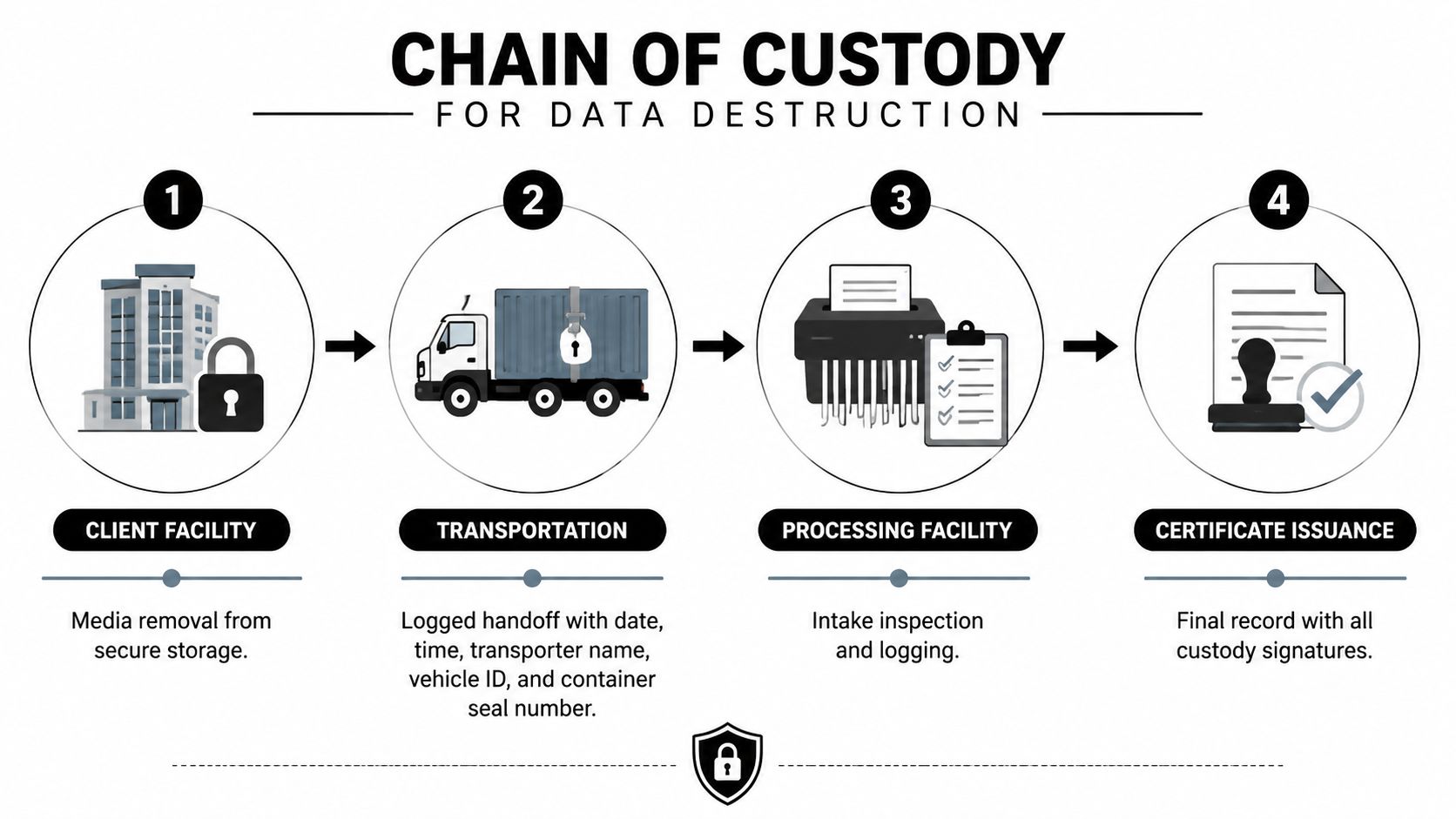
A certificate is only as credible as the custody trail behind it. Once media leaves a client’s controlled area, every handoff should identify who released it, who received it, when the transfer occurred, what container was used, and whether the seal remained intact.
The chain-of-custody documentation guide should connect the certificate to a signed manifest, tamper-evident packaging, secure transport, intake inspection, and final processing verification. A unique custody ID makes that connection practical during an audit.
Build the file around the certificate
Keep the certificate with the original asset list, purchase or inventory reference, work order, pickup record, method report, destruction date, and downstream disposition. Downstream outcomes may include reuse, parts harvesting, material recovery, or another documented disposition. The certificate proves the claimed sanitization or destruction event, while the surrounding records prove how the media reached that event.
Retention should follow the longest applicable obligation in the organization’s policy and contracts. Healthcare, financial, defense, and public-sector programs may impose different requirements, so IT, legal, compliance, and procurement should agree on a retention schedule rather than relying on a vendor’s default.
Audit practice: Store final records in controlled digital storage with change protection or equivalent immutability, then test retrieval before an auditor asks for it.
Paper certificates can be scanned, but the original electronic record should remain protected from silent edits. Access logs, version controls, and a consistent naming convention make it easier to retrieve one device record without exposing an entire customer file.
Sample Certificate Language and Verification Checklist
A useful certificate reads like a concise technical attestation. It names the client, identifies the media, states the method, records verification, and links the event to custody documentation.
A practical model could read:
Client: [Full legal name and physical address]
Certificate ID: [Unique identifier]
Chain-of-custody ID: [Linked manifest or custody record]
Media: [Manufacturer, model, serial number, capacity, and media type]
Action: [Clear, Purge, or Destroy, with named technique]
Standard: [Applicable NIST SP 800-88 Rev. 2 method and organizational policy]
Date and location: [Destruction or sanitization date, time, and facility]
Operator: [Technician name or identifier and certification record]
Verification: [Pass result, inspection, or destruction confirmation]
Witness and authorization: [Signature, digital authentication, or vendor stamp]
Disposition: [Reuse, material recovery, or destruction outcome]
Questions for the reviewer
Use the certificate as an audit checklist, not a filing formality.
- Media match: Does the selected NIST control fit the medium, especially for SSDs, flash devices, and tapes?
- Serial reconciliation: Does every listed serial number appear on the original manifest and final certificate?
- Shredding detail: If physical destruction occurred, does the record identify the process and any required particle specification?
- Cryptographic erase: Does the record connect the action to an actual key-destruction event and verification result?
- Custody link: Does the certificate ID match the transport and intake records?
- Exception handling: Are failed wipes, missing labels, or substitutions described in exact language?
- Authentication: Can the signer, technician, or verification contact be identified later?
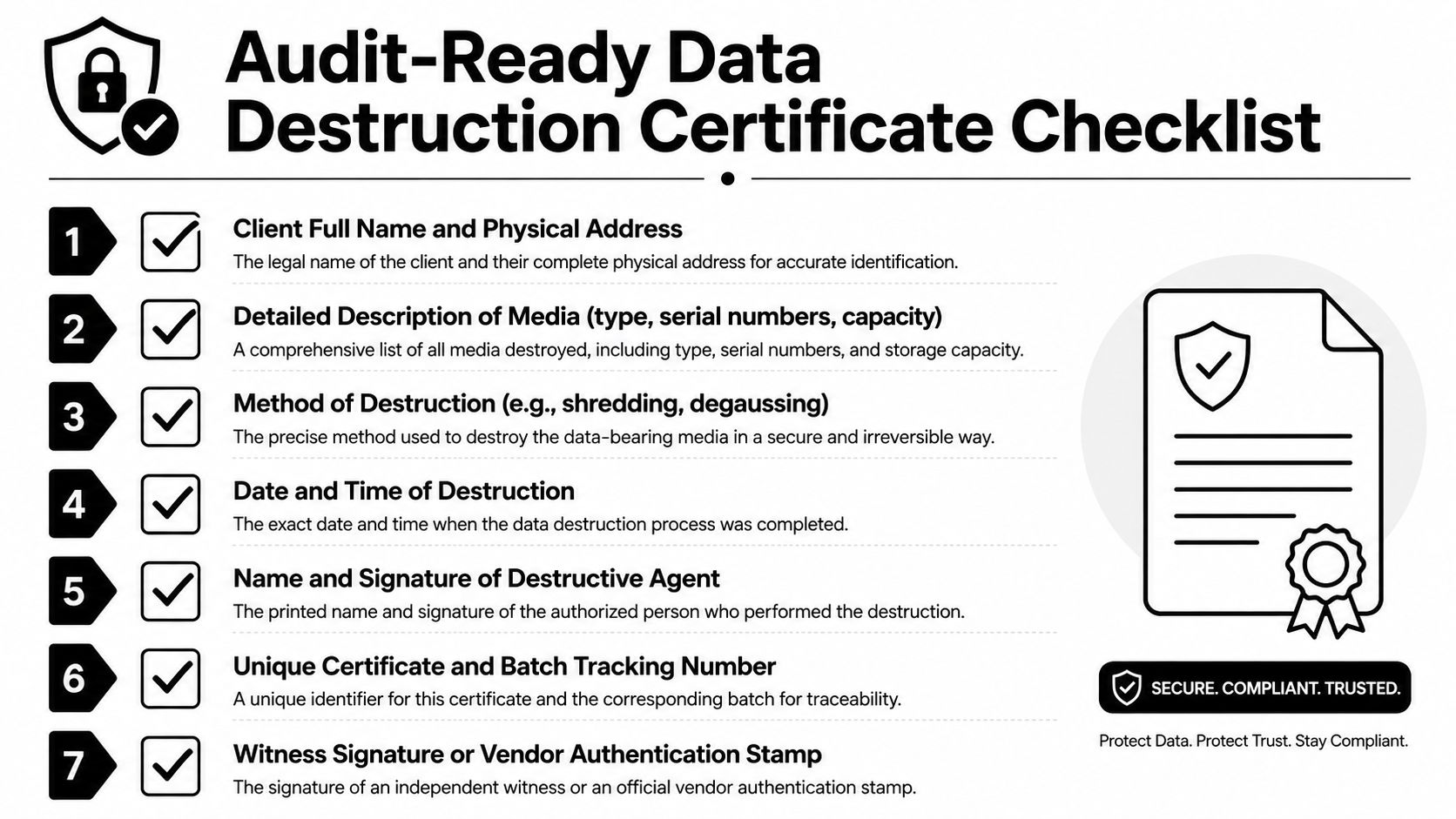
If fields are missing, ask for a corrected certificate while the work order and custody records are still accessible. Escalate unresolved gaps through procurement or compliance, and consider withholding final approval when the vendor can’t reconcile the document with the asset list. The data destruction certificate format guide can help your team establish a consistent review template.
Common Misconceptions and How Beyond Surplus Delivers Certificates
A certificate documents the service performed. It doesn’t automatically transfer statutory responsibility away from the organization that owned or controlled the data. The FTC Disposal Rule focuses on whether the business took appropriate disposal measures, so vendor paperwork supports the compliance file but doesn’t eliminate the need for internal policies, due diligence, and contractual controls.
That distinction is easy to miss. Contractual indemnity may allocate certain financial obligations between the parties, but it doesn’t erase a regulator’s interest in the original data holder’s conduct. The FTC Disposal Rule responsibility overview also reflects the practical point that the original owner remains responsible for protecting personally identifiable information until permanent destruction.
Four assumptions that create audit gaps
- Any signed paper is sufficient: A signature without serial numbers, method details, and verification may be difficult to defend.
- Shredding is always the answer: SSDs and other modern media require a device-appropriate sanitization decision.
- A batch certificate covers every asset: NIST’s per-medium approach makes serialized records more useful.
- Certificates never need review: Organizations should verify records against policy, custody documentation, and contractual requirements.
Beyond Surplus provides ITAD services that include serialized hard-drive destruction and certified data wiping, with certificates documenting relevant asset identifiers, methods, dates, and locations. As one option for commercial electronics recycling and IT equipment disposal, a provider should be evaluated on the complete evidence package, including custody records and exception handling, not on the certificate title alone.
Ask the vendor for a sample certificate before scheduling a destruction engagement. Then test whether your team can match one sample device to its asset record, custody history, method result, and final certificate without relying on assumptions.
Beyond Surplus supports business electronics recycling, secure IT asset disposal, certified data wiping, hard-drive shredding, and documented chain-of-custody workflows for commercial equipment. Visit Beyond Surplus to request a sample certificate or schedule a secure destruction engagement.


