

The world generated 62 billion kilograms of electronic waste in 2022, but only 22.3% was formally collected and recycled in an environmentally sound manner, so Cisco equipment recycling in Atlanta requires documented chain of custody and asset-level data sanitization, not a physical drop-off alone. Secure disposal means identifying every data-bearing component, proving what happened to it, and routing the remaining materials through responsible recycling.
An Atlanta IT director may be looking at a rack of retired Cisco switches after a network refresh, with routers, firewalls, wireless controllers, power supplies, and removable media waiting in a staging area. The equipment may look obsolete, but configuration files, credentials, VPN information, topology details, logs, flash storage, and eMMC can remain relevant long after the hardware leaves service. Recycling is a materials process. Data destruction is a security control. A defensible Cisco Equipment Recycling Atlanta program must manage both.
Table of Contents
- Understanding Cisco Equipment Disposal Requirements
- Preparing Your Network Inventory for Secure Handoff
- Choosing the Right Data Sanitization Method
- Meeting Compliance with Certificates of Destruction
- Scheduling Pickup and Logistics Options
- Recovering Value Through IT Buyback Programs
- Frequently Asked Questions About Secure Disposal
Understanding Cisco Equipment Disposal Requirements
A conventional electronics recycler may focus on separating circuit boards, plastics, metals, and cables. That work supports material recovery, but it doesn't automatically address information stored in a Cisco device. A factory reset may not cover every storage area, and a processor that issues a bulk recycling certificate may not reconcile each chassis serial number with a sanitization record.
The Cisco network equipment disposal guide should be treated as a security-first workflow. Start with the equipment as an asset, not as scrap. Record its identity, determine whether it contains storage, preserve approved business records before erasure, and select a method appropriate to the data and reuse plan.
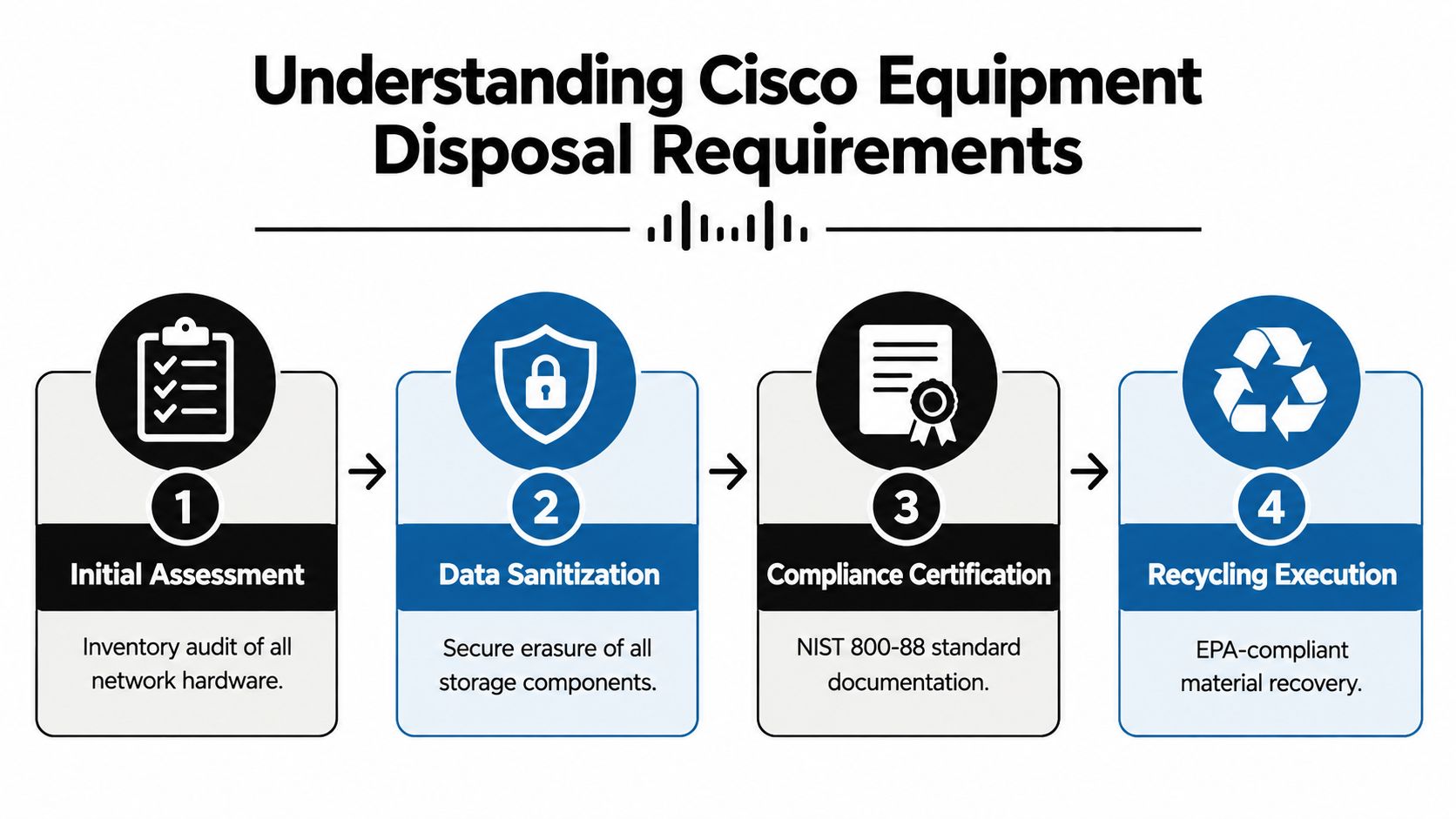
Recycling and IT asset disposition are different controls
Physical recycling answers what happens to the equipment's material. IT asset disposition, or ITAD, also answers who handled the unit, which data-bearing parts were present, which sanitization method was used, whether the outcome was verified, and where the unit ultimately went.
That distinction matters because the United Nations Global E-waste Monitor 2024 reports that global e-waste rose from 34 billion kilograms in 2010 to 62 billion kilograms in 2022, while documented formal recycling increased from 8 billion to approximately 13.8 billion kilograms. The same report projects 82 billion kilograms by 2030, with the documented recycling rate potentially declining to about 20%. More equipment is entering end-of-life channels, while the formal pathway still doesn't capture everything.
For Atlanta businesses, the practical standard is straightforward:
- Identify the asset: Capture model, chassis serial number, ownership, and installed storage.
- Protect the data: Preserve required configurations or logs, then use a supported sanitization process.
- Prove the outcome: Record the operator, method, date, verification result, and final disposition.
- Recover materials responsibly: Route electronics, batteries, and other components through appropriate downstream channels.
Practical rule: A recycling certificate without serial-number-level data evidence doesn't prove that every Cisco storage component was handled correctly.
Preparing Your Network Inventory for Secure Handoff
The strongest disposal projects begin before a recycler arrives. An incomplete inventory creates reconciliation problems later, especially when a facility has mixed Cisco families, spare line cards, removed flash modules, and equipment stored in different rooms.
Build the intake record at the level used for the final certificate. At minimum, associate each unit with its chassis serial number, model, ownership status, physical location, installed storage, and intended disposition. Note whether the unit is being reused, remarketed, recycled for materials, or held for physical destruction.
Capture evidence before erasure
Cisco documentation warns that secure-erase operations can remove configurations, software images, logs, operational history, and other stored information. That makes sequencing important. If the network team needs a configuration archive or operational record, preserve it in an approved offline repository before running the erase procedure.
A practical intake sequence looks like this:
- Create the baseline. Export the asset list from your management system, then validate it against the physical equipment.
- Inspect the device family. Identify whether the unit is a router, switch, firewall, controller, server, or appliance, and confirm the software version.
- Locate storage. Check internal flash, eMMC, bootflash, secure-storage areas, removable memory, and attached drives where applicable.
- Classify the information. Mark credentials, keys, logs, customer configurations, and other sensitive content that may require stronger treatment.
- Record exceptions. Flag missing labels, damaged chassis, failed boot processes, inaccessible storage, and units that can't complete verification.
- Seal the handoff. Match containers, pallets, or rack groups to an itemized manifest before transportation.
The server disposal checklist for IT managers provides a useful model for extending this discipline across adjacent infrastructure. Cisco equipment shouldn't be isolated from the broader decommissioning record when servers, storage, wireless systems, or security appliances leave the same facility.
Reconcile the chain of custody
Every transfer needs an accountable handoff. Record the releasing employee, receiving party, date, location, container or shipment identifier, and condition of the equipment. If a unit is separated from its storage module, give the module its own record rather than assuming the chassis certificate covers it.
This approach prevents a common failure: the outgoing count matches the pickup count, but the final certificate lists only a bulk quantity. Asset-level reconciliation closes that gap and gives security, procurement, and facilities teams the same record.
Choosing the Right Data Sanitization Method
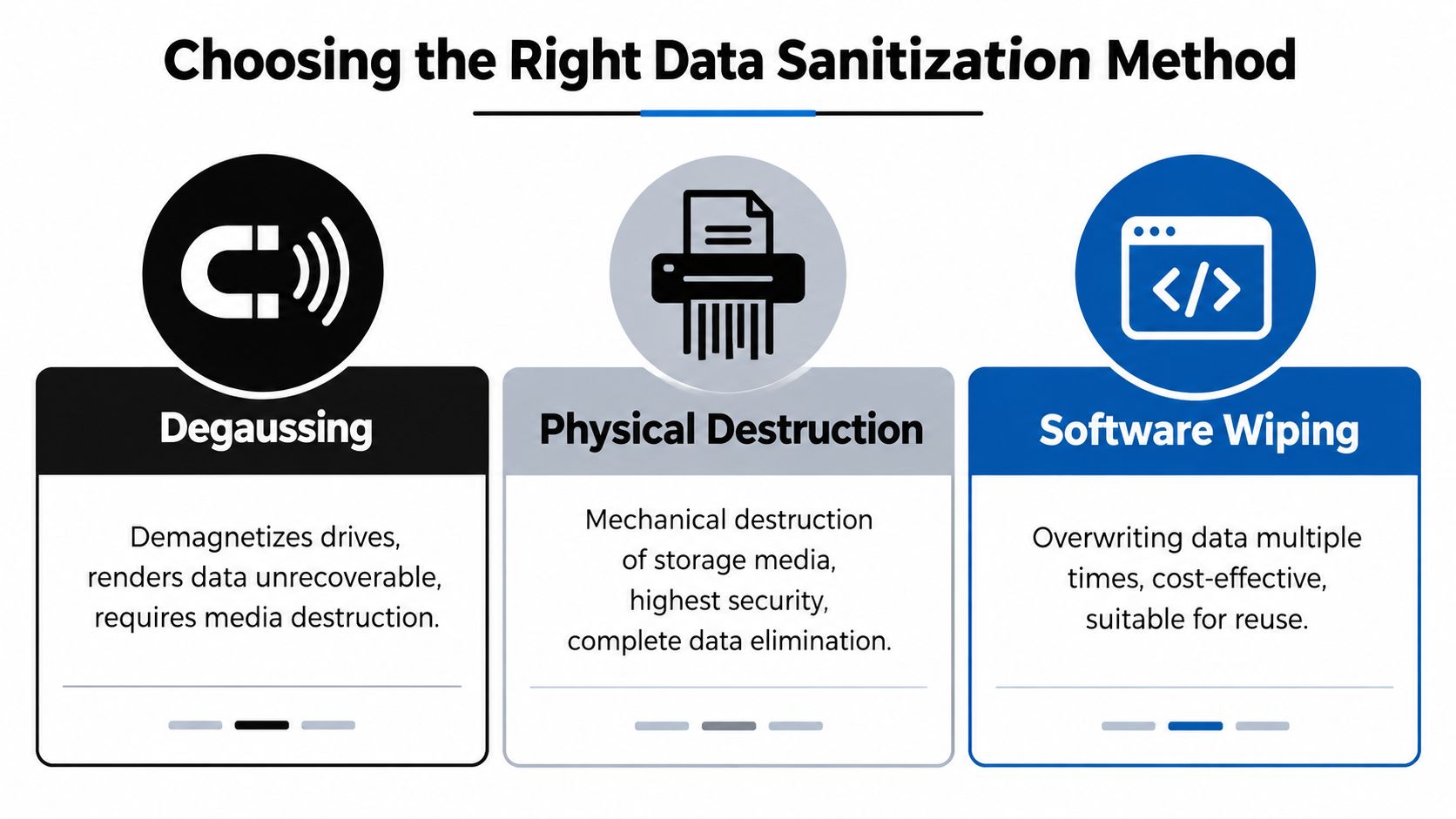
NIST separates sanitization outcomes into Clear, Purge, and Destroy. The choice depends on the storage technology, information sensitivity, equipment condition, and whether the hardware will be reused. A factory reset isn't a universal answer, and physical destruction isn't always necessary for equipment that can be securely prepared for another deployment.
| Outcome | What it does | Appropriate use |
|---|---|---|
| Clear | Uses logical techniques to address user-accessible storage and basic recovery methods | Lower-risk data and supported reuse scenarios |
| Purge | Uses logical or physical techniques intended to make recovery infeasible with state-of-the-art laboratory methods | Sensitive data where the equipment may remain usable |
| Destroy | Makes recovery infeasible and leaves the media unable to store data | High-risk data, failed devices, or inaccessible storage |
The NIST SP 800-88 guidance gives IT teams a practical framework for selecting the outcome rather than applying one method blindly to every asset.
Match the method to Cisco storage
For supported Nexus platforms, Cisco Secure Erase is designed to remove customer information during return, replacement, upgrade, or end-of-life processing. Cisco IOS XE secure-data-wipe guidance identifies configuration files, passwords, internal flash, eMMC, ROMMON variables, and secure-storage areas as potential data targets. The device family and software version must be checked before execution.
A logical wipe may support reuse when the device operates normally, the storage areas are known, and verification succeeds. It may not be enough when the unit has failed, the storage is inaccessible, the firmware doesn't support the required procedure, or the risk classification demands physical destruction.
Physical destruction has a clear trade-off. It offers a decisive outcome for inaccessible or highly sensitive media, but it removes reuse and value-recovery options. Degaussing is also not a universal answer for modern flash or eMMC, because the method must match the storage technology. The responsible decision is to document why the selected outcome fits the asset.
Verify instead of assuming
NIST recommends verification after sanitization whenever practical. Its detailed guidance supports pseudorandom checks across user-addressable and reserved areas where technically applicable, with each sampled subsection covering at least 5% without overlap. When representative sampling is used, the guidance also recommends secondary verification with a different tool and full verification of at least 20% of sanitized media. See the NIST SP 800-88 revision for the verification framework.
For Cisco fleets, verify every device containing removable or nonvolatile storage, credentials, keys, logs, or customer data. Sampling should be reserved for homogeneous, low-risk populations with a validated device and firmware baseline. Failed verification belongs in quarantine, not in the recycling stream.
Meeting Compliance with Certificates of Destruction
A certificate matters only when it connects the claim to the asset. “All equipment wiped” doesn't tell an auditor which serial numbers were processed, which method was used, whether verification passed, or how exceptions were handled.
The FTC Disposal Rule became effective on June 1, 2005, under the Fair and Accurate Credit Transactions Act of 2003. It applies to large and small organizations that use consumer reports and requires reasonable, appropriate measures to prevent unauthorized access to or use of consumer-report information during disposal. The FTC explanation of the Disposal Rule identifies destroying or erasing electronic files or media so information can't be read or reconstructed as an example of a reasonable safeguard.
What an audit-ready record contains
A useful certificate package should tie together:
- Asset identity: Manufacturer, model, chassis serial number, and any separately handled storage.
- Sanitization result: Clear, Purge, or Destroy outcome, plus the platform-specific method.
- Verification evidence: Test result, tool or procedure, operator identity, and exception status.
- Chain of custody: Pickup, transport, receiving, processing, and final disposition events.
- Environmental disposition: Recycling, reuse, resale, component recovery, or physical destruction.
- Completion details: Date, facility, authorized signatory, and certificate reference.
The FTC permits organizations to use a destruction contractor after due diligence, including reviewing independent audits, checking references, requiring recognized certification, and evaluating information-security policies. That doesn't eliminate the customer's responsibility to define the data risk and retain evidence. It does create a defensible basis for selecting and supervising the provider.
The certificate of data destruction guide helps teams distinguish a meaningful asset record from a generic recycling receipt. For regulated environments, procurement should require the evidence format before the project starts, not after equipment has disappeared from the facility.
Scheduling Pickup and Logistics Options
A small Atlanta office may have a few switches and firewalls staged in a locked room. A data center operator may need rack-level removal, palletization, transport, and processing while adjacent systems remain live. Both projects need chain-of-custody controls, but they don't need identical logistics.
Local drop-off can work when the business controls the inventory, has secure transport, and can deliver directly to an approved processing location. It becomes less attractive when equipment is heavy, spread across multiple floors, mixed with batteries, or awaiting serial-number reconciliation. A pickup team can preserve the process at the point of removal by scanning assets, sealing containers, and documenting the transfer before the load leaves the site.
Choose the transport model that fits the site
For a single facility, coordinate three points: the release window, the inventory manifest, and the receiving appointment. Don't stage unidentified equipment in a shared loading area. Keep data-bearing units separated from general scrap until sanitization or destruction is complete.
For a multi-site refresh, use one standardized manifest and one exception process across locations. National pickup requires consistent packaging, approved carriers or transportation partners, and a defined liability-transfer point. Beyond Surplus provides business pickup and logistics coordination for IT equipment, including its own fleet and transportation partners, so Atlanta projects can be connected to broader enterprise moves.
The trade-off is between simplicity and control. A casual drop-off may reduce scheduling effort, but it can weaken custody evidence. A planned pickup requires more preparation, yet it gives facilities and IT teams a clearer record from removal through receiving.
Protect continuity during de-installation
Schedule removal after the network team confirms that configuration preservation, service migration, and change records are complete. Separate live equipment from retired equipment with clear staging zones, and label every container before it reaches the loading dock.
A good logistics closeout reconciles the number of assets released, the number received, units sent for exception handling, and final certificates issued. If those counts don't agree, stop the closeout and investigate before approving the invoice or reporting the project complete.
Recovering Value Through IT Buyback Programs
Cisco retirement doesn't always mean material recycling. Functional routers, switches, firewalls, optical equipment, and security appliances may have residual value, but only after the organization confirms that reuse is permitted and data sanitization has passed.
Start by dividing the inventory into three groups: equipment suitable for redeployment, equipment suitable for resale, and equipment that should be recycled or destroyed. Condition, completeness, licensing status, support restrictions, age, firmware, and demand all affect the result. Avoid treating a preliminary estimate as guaranteed revenue.
Build the value case carefully
A practical buyback workflow includes:
- Describe accurately: Provide model numbers, serials, quantities, condition, accessories, and known faults.
- Separate sensitive parts: Identify removable media, storage modules, and components requiring individual sanitization.
- Confirm ownership: Resolve leases, customer-owned assets, and contractual return obligations before sale.
- Require secure processing: Make sanitization and verification a condition of resale, not an optional add-on.
- Reconcile payment and disposition: Match the final valuation to the units accepted and the records issued.
The IT equipment buyback service is one available model for combining value recovery with secure disposition. The commercial objective isn't to maximize a quoted number at the expense of control. It is to recover reasonable value while preserving evidence that the equipment was safe to re-enter the secondary market.
A recycling-first provider may be appropriate for failed or obsolete assets. A buyback-capable ITAD provider can evaluate reusable equipment separately, which may reduce the net cost of the retirement project. Either way, data security comes before resale.
Frequently Asked Questions About Secure Disposal
Does Georgia require every business to recycle all electronics?
Georgia doesn't have a broad statewide requirement to recycle all business electronics. That doesn't make unrestricted disposal a sound practice. Federal hazardous-waste obligations can apply to particular components, and organizations still need reasonable safeguards when equipment contains protected or consumer-report information.
Can Cisco equipment travel with batteries installed?
Treat batteries as a separate handling decision. UPS batteries, lithium-ion packs, swollen batteries, and damaged units may require special packaging, labeling, routing, or removal before transport. Ask the provider who classifies the component, whether it can travel installed, and what happens when the battery is damaged.
Don't place a swollen or leaking battery into ordinary equipment packaging. Isolate it according to the carrier and processor's hazardous-material procedure, document the condition, and keep it linked to the asset record.
What happens to cross-border shipments?
First determine whether the equipment will remain in domestic processing channels or leave the country. International e-waste movement can involve additional controls, permits, and downstream documentation, so the provider should disclose the destination, routing decision, and applicable compliance process before pickup.
What proves that inaccessible storage was handled correctly?
The record should identify the failed or inaccessible component, explain why logical sanitization couldn't be verified, document the selected Purge or Destroy outcome, and show the final disposition. A bulk statement that the chassis was recycled doesn't answer what happened to its flash, eMMC, removable memory, or attached drive.
The key question isn't whether Cisco equipment can be recycled. It's whether the organization can prove that every storage-bearing component was identified, handled, verified, and reconciled.
Beyond Surplus supports Atlanta businesses with Cisco network equipment disposal, secure data wiping or physical destruction, asset-level chain-of-custody records, recycling documentation, IT buyback, and coordinated pickups. Visit Beyond Surplus to plan a documented Cisco recycling and secure IT asset disposition project.


