A rack is being cleared after a technology refresh. The switches are powered down, the firewall has been removed, and a contractor is waiting at the loading dock. Then someone asks the question that should have been answered before the first cable was pulled: where are the configurations, credentials, logs, and embedded storage now?
That is the operational risk behind a serious Network Equipment Disposal Guide. Routers, switches, firewalls, wireless controllers, telecom appliances, and network servers aren't ordinary scrap. They can hold recoverable configuration artifacts and customer information, while their resale value and environmental impact depend on how carefully the equipment is handled.
This guide treats disposal as a controlled triage decision between reuse, resale, recycling, and destruction. The process covers inventory, media-specific sanitization, secure logistics, chain of custody, compliance evidence, and value recovery for commercial and enterprise environments.
Table of Contents
- Why Network Equipment Disposal Needs Its Own Process
- Inventory and Risk Assessment Before You Unplug Anything
- Choosing the Right Data Sanitization Method for Each Media Type
- De-Installation Packaging and Secure Logistics With Chain of Custody
- Certifications Recordkeeping and Compliance You Must Prove
- Value Recovery Recycling and Your Next Steps With Beyond Surplus
Why Network Equipment Disposal Needs Its Own Process
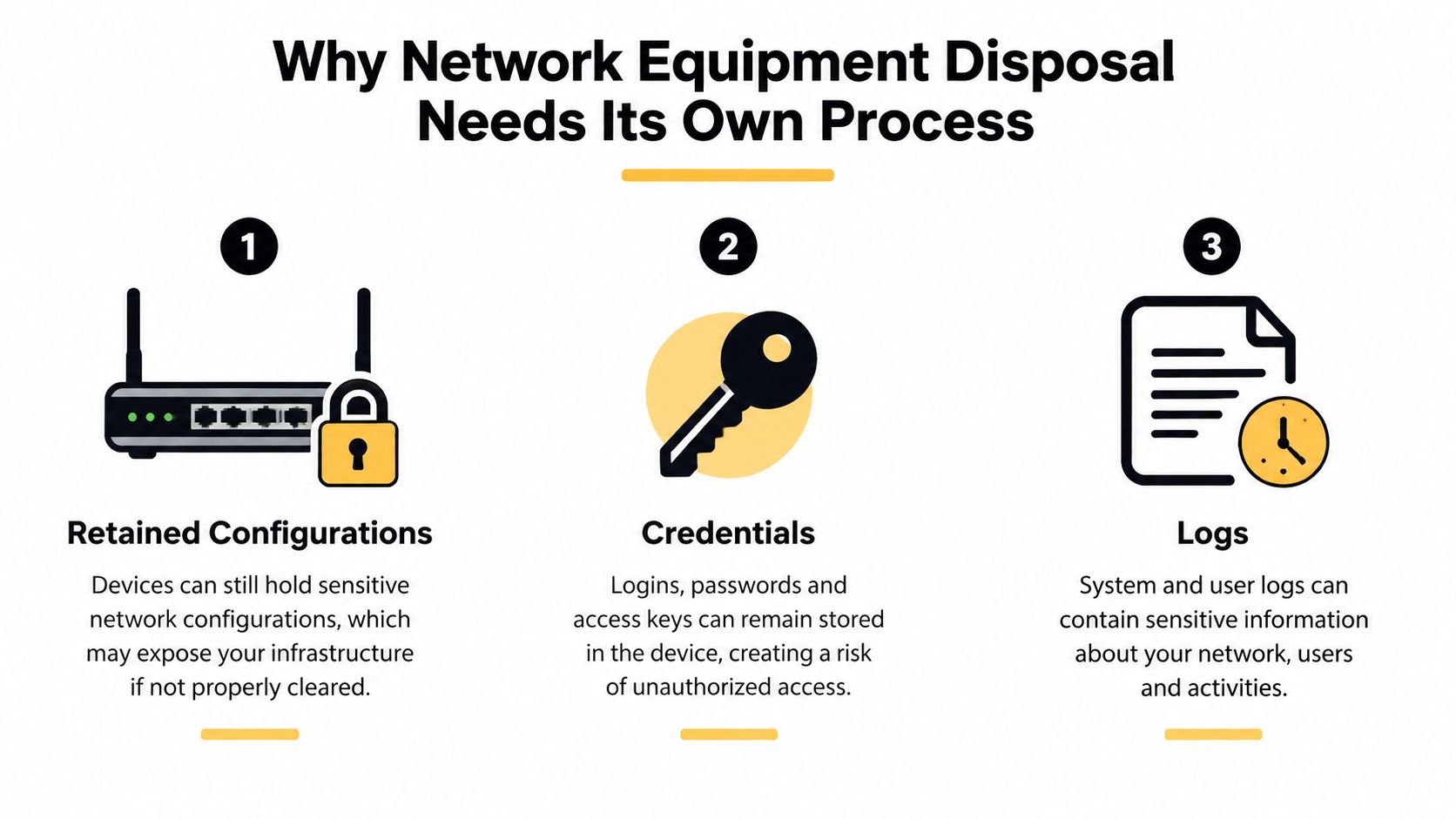
A network closet can look empty after decommissioning while still containing sensitive information. A router may retain running configuration details. A firewall can contain credentials, logs, certificates, or policy data. A wireless controller may preserve information about access points and connected environments. Treating those devices like ordinary metal or mixed e-waste creates a security gap before the recycler ever receives them.
The hidden exposure in a routine refresh
The field failure is usually procedural, not technical. A team exports a configuration for migration, assumes the device has been cleared, places the unit on a mixed pallet, and loses the connection between the serial number and the final disposition. That sequence makes it difficult to prove which asset was sanitized, which was destroyed, and who controlled it at each handoff.
Global scale makes downstream discipline more important. The world generated 62 million tonnes of e-waste in 2022, equal to about 7.8 kg per person, while only 22.3% was formally collected and recycled in an environmentally sound manner, according to the Global E-waste Monitor 2024. The monitor projects annual generation could reach 82 million tonnes by 2030, a further 32% increase from 2022, so network equipment is entering a waste stream that already has substantial control challenges.
The material value is also significant. The raw materials embedded in 2022 e-waste were estimated at about US$91 billion, while environmentally sound recycling recovered only US$19 billion, as reported by the Global E-waste Monitor. A careless process can therefore lose both information security and recoverable value.
Operational rule: Never move a network device into a recycling stream until its identity, media type, ownership, sanitization path, and final destination are recorded.
A defensible workflow
A practical enterprise workflow separates assets into clear paths:
- Reuse: The unit remains operational, supported, and suitable for another approved environment after verified sanitization.
- Resale or refurbishment: The hardware has residual market value, but needs testing, grading, configuration removal, and controlled transfer.
- Destruction: The media is damaged, non-rewriteable, highly sensitive, or otherwise unsuitable for reuse.
- Certified recycling: The remaining equipment goes to controlled downstream processors for material recovery and compliant final handling.
The ITU recommendation on e-waste management emphasizes controlled collection, transport, dismantling, valorization, and final disposal. That model fits network equipment better than a simple “put it in the electronics bin” instruction. For business customers, Beyond Surplus is one ITAD option that coordinates secure data destruction, electronics recycling, equipment recovery, and documented handling for enterprise decommissioning.
Inventory and Risk Assessment Before You Unplug Anything
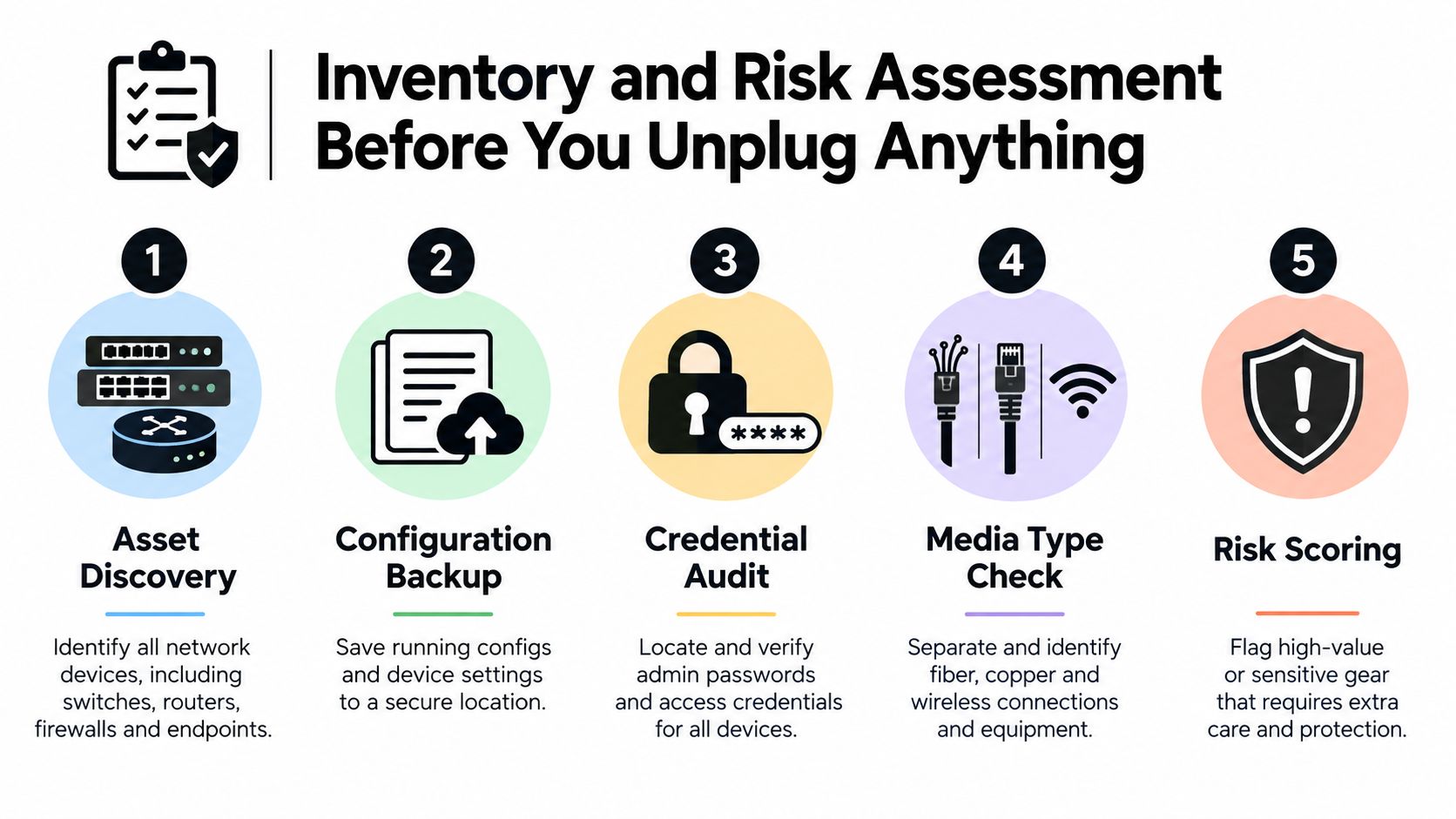
The strongest disposal project starts before the rack is touched. Build a register that connects each physical asset to its owner, location, function, media, risk level, and planned disposition. If the asset record starts after removal, the team has already lost useful evidence.
Build the register at the rack
Capture the manufacturer, model, serial number, asset tag, rack position, site, owner, and condition. Photograph front and rear panels before disconnecting cables. Record removable drives, compact flash cards, solid-state modules, internal storage, and appliances with embedded flash. A switch with no visible hard drive can still have configuration storage that requires a deliberate sanitization decision.
Use a working register in your asset management system rather than relying on handwritten notes. Inventory optimization for IT assets can help teams structure the discovery and reconciliation work around asset identity, location, and disposition status.
Confirm ownership and data scope
Ownership errors create avoidable disputes. Check whether the equipment is owned, leased, supplied by a carrier, managed by a customer, or subject to a return obligation. Confirm that backups and migration records are complete before removing the production unit, but don't treat a successful backup as proof that the device itself is clean.
Flag systems that handled regulated, confidential, or customer-related information. Finance, healthcare, government, education, and managed-service environments often require stronger evidence than a basic internal retirement note. The inventory should identify who approved the disposition and which sanitization outcome is required.
Separate media before choosing a method
Media type determines the safe path. Separate appliances with magnetic hard drives from SSD-based systems and equipment that relies on embedded flash. Keep removable media in its own controlled container. Don't group equipment only by model or rack location, because similar-looking appliances can use different storage technologies.
Assign a preliminary disposition grade:
- Reuse candidate: Complete, supported, testable, and suitable for an approved destination.
- Recovery candidate: Functional or repairable equipment with potential resale or refurbishment value.
- Destruction candidate: Damaged, inaccessible, non-rewriteable, or too sensitive for reuse.
- Recycling candidate: Hardware with no practical recovery route after data controls are complete.
That classification can change after testing, but it gives the de-installation crew a safe starting point. It also prevents intact equipment from being mixed with scrap, a common mistake that weakens both value recovery and audit evidence.
Choosing the Right Data Sanitization Method for Each Media Type
NIST SP 800-88 defines three outcomes for media sanitization: Clear, Purge, and Destroy. Clear uses logical techniques to protect against non-invasive recovery. Purge makes recovery infeasible using state-of-the-art laboratory techniques. Destroy makes subsequent data storage impossible, according to the NIST SP 800-88 guidance.
The correct choice depends on the media, the data, the device condition, and the planned destination. A reusable unit may justify a validated logical or device-level process. A failed appliance with inaccessible storage may require physical destruction instead.
Match the outcome to the hardware
| Sanitization Outcome | Best Fit Media | When to Use |
|---|---|---|
| Clear | Accessible HDDs or supported logical storage | Use when the organization permits logical sanitization and the media remains suitable for controlled reuse. |
| Purge | HDDs, SSDs, and supported storage devices | Use when stronger protection is required and the device or manufacturer method supports a validated purge process. |
| Destroy | Damaged, non-rewriteable, inaccessible, or highly sensitive media | Use when recovery must be made impossible or reuse cannot be defended. |
For magnetic drives, recognized options can include secure erase, degaussing, shredding, disintegration, pulverizing, or licensed-facility incineration. NIST also states that overwrite isn't suitable for damaged or non-rewriteable media in its media sanitization guidance.
Why SSDs and embedded flash need special handling
A single overwrite pass isn't a universal answer for flash storage. SSD wear leveling and controller remapping can prevent software from addressing every physical location in the way an operator expects. Embedded flash in a router, firewall, or controller can also require a manufacturer-specific process, secure erase command, purge method, or destruction decision.
A large enterprise dataset recorded 15,776 unsuccessful erasure attempts. Failures occurred at 12.7% for HDDs, representing 12,048 of 94,643 attempts, and 16% for SSDs, representing 3,728 of 23,339 attempts, for a combined failure rate of 13.37%, as described in the media erasure analysis. The operational lesson is simple: never mark an asset clean because a wipe job started or returned a generic success message.
Verify the result against the asset record. Record the tool, method, media type, operator, timestamp, verification outcome, and exception handling. For physical destruction, record the destruction event and retain the associated certificate. Teams that manage removable optical media separately can also use appropriate storage for media discs while awaiting processing.
For a practical explanation of how the standard maps to business workflows, see NIST 800-88 data destruction standards. The final decision should always be approved by the data owner or security authority, not made solely by the person packing the equipment.
De-Installation Packaging and Secure Logistics With Chain of Custody
A sanitized device can still become an audit problem if the team can't prove where it went. De-installation is a controlled physical operation, especially in a live data center where one mislabeled cable or premature power action can interrupt service.
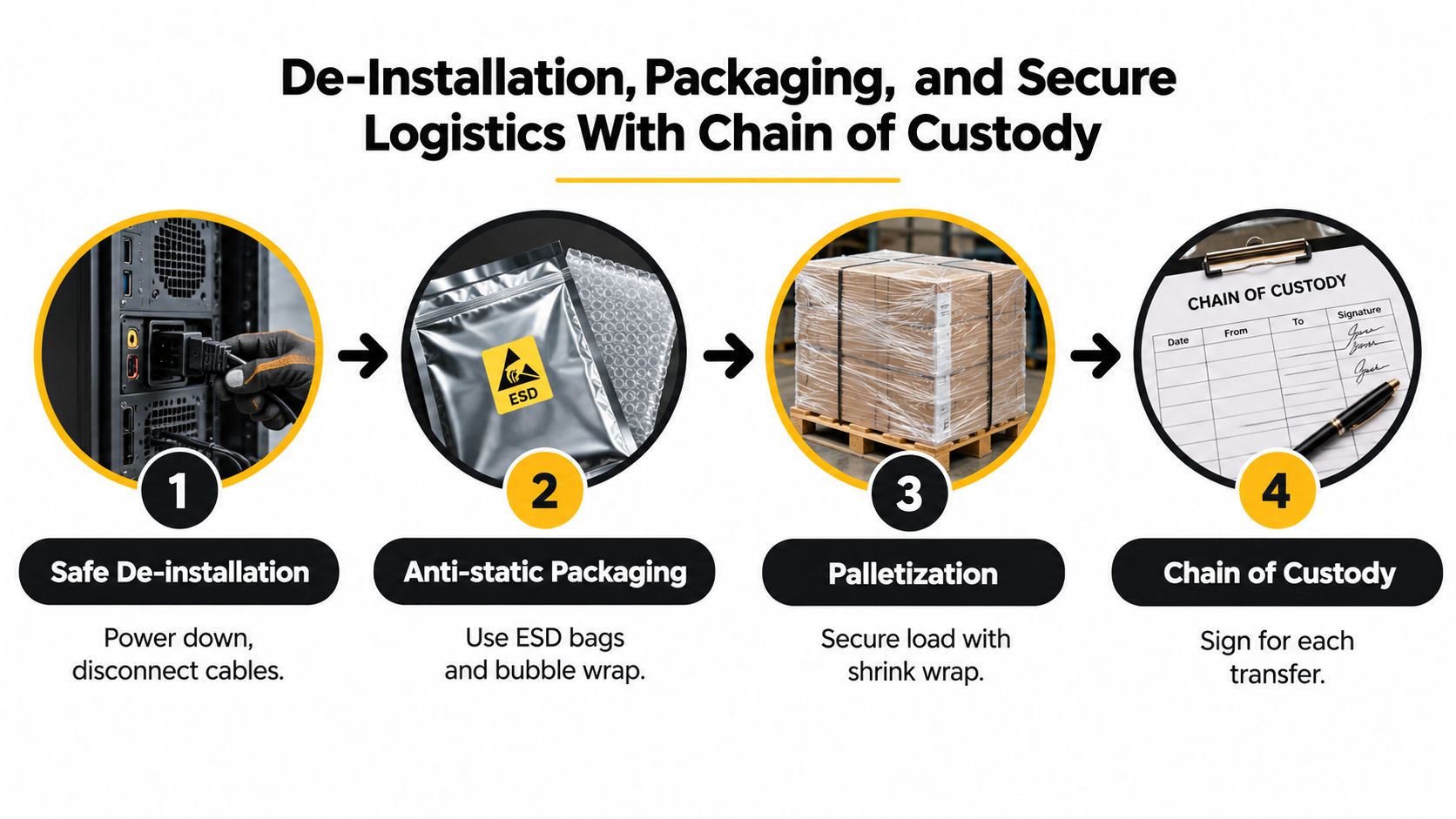
Remove equipment without losing identity
Start with an approved change window, rack diagram, and device list. Photograph cable positions, label both ends, and record the person who performed the removal. Power down according to the operating procedure, remove optics and removable media under control, and match the serial number to the manifest before placing the unit in a staging area.
Don't stack data-bearing equipment with scrap. Use separate cages, carts, totes, or pallet zones for reuse candidates, destruction candidates, and recycling material. Segregation protects residual value and stops a recoverable switch from being processed as low-value material.
Package for condition and evidence
Use anti-static bags or ESD-safe packaging for equipment intended for testing or resale. Protect ports, fans, optics, rails, and removable components from impact. Palletize heavy equipment with stable weight distribution, use corner protection where needed, and secure the load with appropriate wrap and strapping.
Place a serialized manifest inside the shipment and keep a controlled copy outside the packaging. Tamper-evident seals can show whether a container was opened between handoffs. The seal number should match the transfer record, not just a handwritten note on a box.
Chain-of-custody control: Every transfer should identify the asset group, seal or container identifier, releasing party, receiving party, date, time, location, and exception status.
Document each handoff
The chain of custody starts at the rack and continues through staging, transport, processing, resale, destruction, and recycling. A carrier receipt alone isn't enough if the equipment was grouped without a serial-level manifest. Record exceptions immediately, including damaged packaging, missing labels, count mismatches, or an opened seal.
Business programs may use internal fleet resources, vetted transportation partners, or a combination of both. Nationwide pickup is practical only when the provider can coordinate site access, loading requirements, secure staging, and downstream documentation across locations. The chain-of-custody process for IT asset disposal provides a useful reference for structuring those controls.
Certifications Recordkeeping and Compliance You Must Prove
Disposal work isn't complete when the truck leaves. It ends when the organization can retrieve a coherent evidence packet and show what happened to every asset. Auditors and security reviewers typically care about the relationship between the original inventory, the sanitization record, the final disposition, and the responsible parties.

Assemble an asset-level record packet
A defensible packet should connect the physical item to its final outcome. Retain:
- Asset manifest: Model, serial number, asset tag, owner, site, and disposition status.
- Approval record: Business owner, security decision, and authorized disposition path.
- Sanitization evidence: Method, media type, tool or process, operator, verification result, and exception notes.
- Destruction certificate: Date, asset identifiers, destruction method, and processor details where physical destruction occurred.
- Recycling certificate: Final material disposition and downstream processor information.
- Logistics history: Pickup records, container or seal identifiers, transport details, and signed handoffs.
- Resale or reuse record: Test results, grade, recipient, transfer authorization, and configuration removal confirmation.
Certificates help transfer responsibility, but they don't replace a complete internal record. If the certificate lists only a pallet count while the inventory lists individual serial numbers, the organization may still struggle to prove that a particular firewall was handled correctly.
The FTC Disposal Rule is relevant when disposed equipment contains consumer information. Cross-border movement requires further attention because the Basel Convention's e-waste materials guidance notes that the 2019 Ban Amendment entered into force in 2019, reinforcing controls on certain hazardous waste movements.
Keep evidence retrievable
Store records according to the organization's retention policy, access controls, and legal requirements. A secure document repository is preferable to a collection of email attachments and local spreadsheets. Teams that also manage paper compliance records may find Exeter document storage services useful as a reference for structured document retention, although electronic disposal evidence should remain governed by the organization's information security controls.
The compliance documentation resources from Beyond Surplus can help define the record categories a commercial ITAD program should expect. The key test is retrieval: an authorized reviewer should be able to select an asset and follow its complete path from rack removal to final disposition without relying on personal memory.
Value Recovery Recycling and Your Next Steps With Beyond Surplus
The final decision shouldn't be “recycle everything” or “destroy everything.” It should reflect data sensitivity, equipment condition, residual value, contractual ownership, and the organization's sustainability requirements.
Major operators are demonstrating why reuse and recycling deserve a controlled place in the workflow. Vodafone reported that 3,258 metric tonnes of network equipment e-waste were managed in FY25, with 96% recycled and 0% disposed, according to its reported sustainability information. Telefónica reported 4 million devices reused and recycled in 2025, representing 95% of its waste stream, showing how large programs can pursue circularity without abandoning security controls.
Use a practical disposition matrix
| Condition | Data Risk | Preferred Path |
|---|---|---|
| Working, supported, and sanitizable | Controlled | Reuse, resale, or refurbishment after verification |
| Working but obsolete or unsupported | Controlled | Test, grade, recover value, then recycle residuals |
| Damaged or inaccessible storage | High or uncertain | Physical destruction followed by certified recycling |
| No practical resale value | Sanitized | Certified downstream recycling |
The guide to selling used network switches and routers can help procurement and IT teams evaluate recovery before sending functional equipment to scrap. Testing should cover power, ports, fans, management access, error indicators, and included components. Remove organizational configurations before transfer, and document the grade.
Before pickup, reconcile the manifest, approve the disposition paths, isolate data-bearing assets, and identify site access requirements. After processing, reconcile certificates to the original register, close ownership records, and preserve exceptions with the corrective action.
Commercial providers may support secure on-site or off-site shredding, certified wiping, data center de-installation, business pickup, electronics recycling, product destruction, and IT buyback. Residential drop-off and mail-in programs are separate service models and don't replace the controlled logistics required for enterprise network equipment.
Beyond Surplus provides commercial ITAD services for network equipment, including certified data wiping, hard drive shredding, electronics recycling, value recovery, data center de-installation, and documented chain of custody. Visit Beyond Surplus to schedule a secure business pickup and establish a reuse, destroy, or recycle plan for your retired routers, switches, firewalls, and related IT assets.