

Your Dallas office adds staff, moves more workflows into cloud platforms, opens a small warehouse operation outside the core, and suddenly the network is the bottleneck. Voice quality dips during peak hours. A circuit order slips. A backup link fails the first real test. Then someone asks a harder question: what happens to the retired phones, switches, routers, and storage once the refresh is done?
That's the shape of telecommunications services in Dallas for enterprise teams. It isn't just internet access. It's a chain of decisions that affects resilience, compliance, productivity, and total cost of ownership across the full asset lifecycle.
Dallas puts extra pressure on those decisions. The metro economy is heavily concentrated in finance, business services, IT, and distribution, and business services employed 17.3% of the workforce in 2023 according to the Dallas Fed's Dallas metro cluster analysis. That concentration creates a demanding customer base for network, voice, and cloud communications. In other words, if your telecom stack is average, your operating risk probably isn't.
Setting the Stage for Connectivity in Dallas
A Dallas company rarely outgrows its telecom stack in one dramatic event. It happens in layers. A second site gets added. Remote users need reliable voice and application access. Security tools increase latency. Old PRI or coax assumptions no longer fit a business that runs on SaaS, UC, cloud backups, and distributed operations.
That's why telecom planning in Dallas should be treated as business infrastructure, not a monthly utility bill. The city's concentration in finance, business services, IT, and distribution means many local firms depend on stable connectivity not just for email and web browsing, but for customer interactions, cloud platforms, branch coordination, and time-sensitive data exchange.
Why Dallas raises the bar
The Dallas market rewards organizations that buy telecom with operational discipline. A cheap connection that can't support cloud voice, site failover, or clean handoffs to a data-center environment becomes expensive fast. The invoice may look smaller. The downstream cost shows up in support tickets, failed calls, delayed transactions, and rushed replacement projects.
Practical rule: Buy for business continuity first, bandwidth second.
A strong telecom plan in Dallas usually needs to answer four questions early:
- What traffic matters most: Voice, ERP, cloud apps, surveillance, guest Wi-Fi, backups, and replication don't belong in the same priority class.
- Where failure hurts: Headquarters, warehouse floors, executive teams, call queues, and field operations all have different outage tolerances.
- How growth changes topology: A single-site design won't hold if you add branches or move infrastructure into colocation.
- What happens at end of life: Retired telecom hardware still carries security, chain-of-custody, and disposal risk.
Decoding the Modern Telecom Service Portfolio
Most Dallas buyers don't need more options. They need cleaner distinctions.
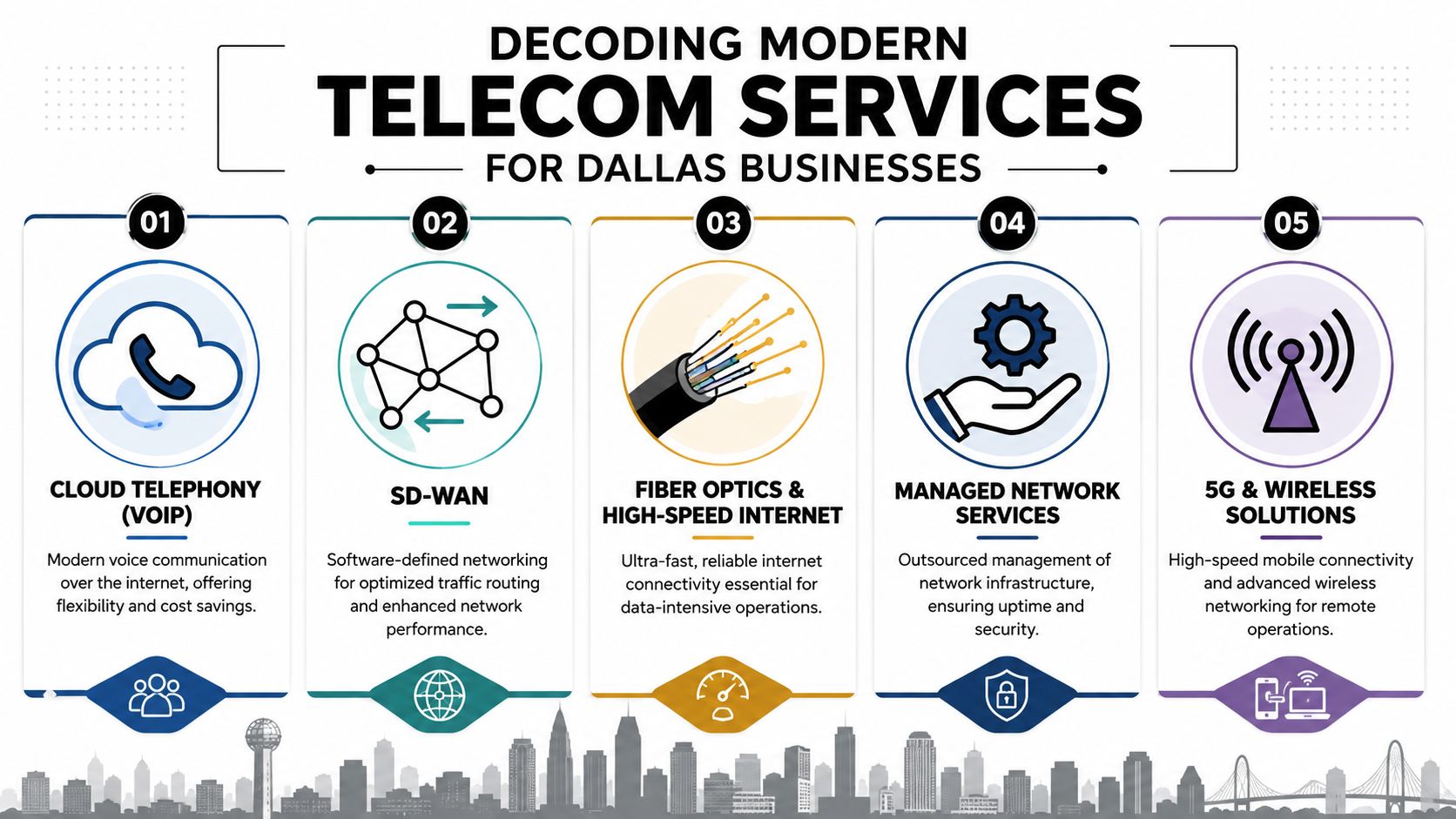
Dedicated internet versus shared broadband
Dedicated Internet Access (DIA) is the private lane. You buy committed capacity, tighter performance expectations, and cleaner support escalation. It fits headquarters, voice-heavy offices, production environments, and sites that host VPN concentration or critical cloud traffic.
Business broadband is the shared lane. It can work well for smaller branches, secondary sites, and noncritical failover paths. It usually costs less, but the trade-off is variability. That's acceptable for some use cases and dangerous for others.
A practical way to split the decision:
| Service | Best fit | Watch for |
|---|---|---|
| DIA | Core offices, latency-sensitive traffic, primary WAN | Contract rigidity, install lead time |
| Broadband | Small branches, backup links, low-criticality sites | Contention, inconsistent support |
Voice is now a software and network question
UCaaS and VoIP replaced the old assumption that voice is a separate telecom domain. Today, your calling platform rides on the same underlying network quality decisions as everything else. If you underbuild QoS, edge design, or failover, users blame “the phone system” even when the root issue sits in the WAN.
That's why many IT teams pair cloud voice with segmented traffic policies, clean switch configurations, and circuit diversity. The telecom service isn't just dial tone. It's the whole delivery path.
SD-WAN and managed overlays
SD-WAN earns its place when you have multiple sites, mixed carriers, cloud applications, or uneven local access options. It lets teams steer traffic by policy instead of pushing everything through one blunt routing design.
That's especially useful in a Dallas footprint that stretches from dense commercial areas to suburban facilities. Some organizations combine fiber, broadband, and wireless under one policy framework, then monitor application experience rather than just interface status. If you're comparing service mixes, a useful starting point is this overview of telecom services near you.
A modern telecom stack should match application behavior, not just circuit availability.
Dallas Telecom Infrastructure a Deep Dive
Dallas network planning starts with physical reality. Carriers can promise speed, but your uptime and latency still depend on route design, building access, carrier presence, handoff quality, and what happens when a conduit, splice, or inside-plant component fails.
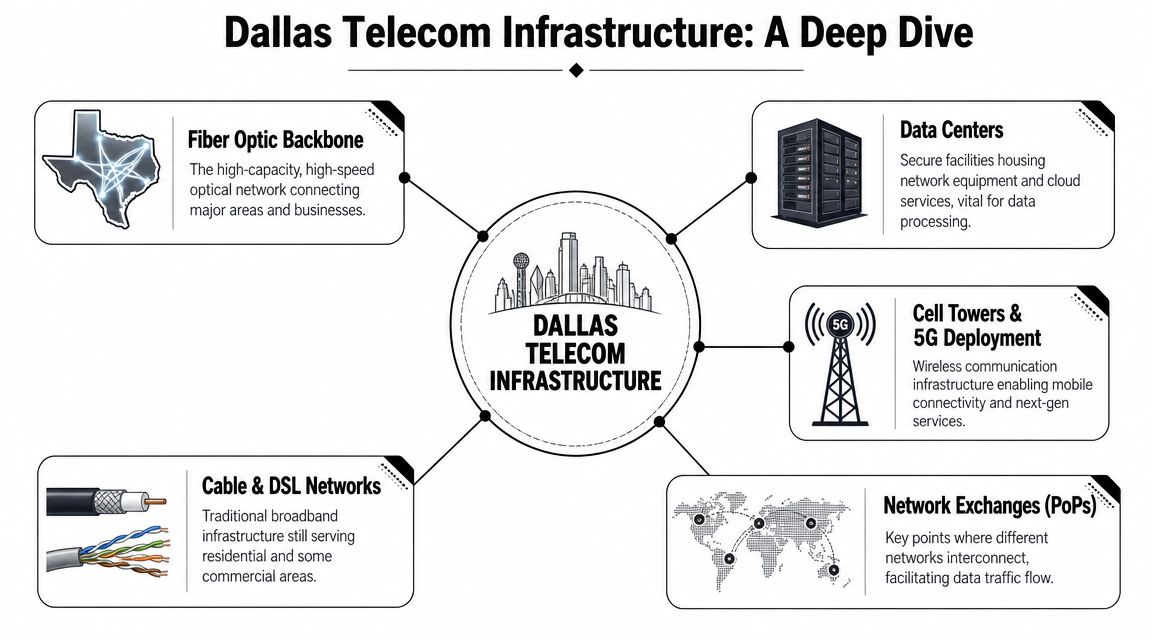
Fiber is the default for serious enterprise work
In Dallas, enterprise deployments are increasingly built on high-density fiber because it supports symmetrical bandwidth, low latency, 5G backhaul, and data-center interconnects. The Dallas telecom infrastructure overview from Wilkins frames fiber as the future-proof choice over legacy copper-based systems in a major enterprise market.
That matters for more than internet access. Fiber gives IT teams room to scale from office connectivity to private transport, cloud on-ramps, and multi-site architectures without redesigning the physical foundation every time demand changes.
Don't confuse building serviceability with resilience
A building may be “on net” and still be fragile. I've seen sites with excellent headline connectivity but only one practical entrance path, one riser dependency, or one sloppy patching environment between the carrier demarc and the core switch stack. The service looked strong on paper. The actual design had obvious single points of failure.
Use this checklist before trusting provider claims:
- Ask for route diversity details: Separate entrances and physically distinct paths matter more than marketing language.
- Inspect inside-plant quality: Poor terminations and undocumented cross-connects create avoidable trouble tickets.
- Confirm data-center adjacency logic: If your workloads live offsite, transport design matters as much as local loop quality.
- Check suburban reality: Metro strength doesn't guarantee the same options at every warehouse, clinic, or satellite office.
Evaluating Providers and Crafting Bulletproof SLAs
Provider selection goes wrong when the buying team compares only price per megabit. That's a procurement shortcut, not an infrastructure strategy.
Dallas telecom operations are shaped by mission-critical and data-center availability demands. The Dallas telecom technician and infrastructure job market evidence on Indeed points to an environment focused on installation, troubleshooting, monitoring, documentation, and compliance across routers, switches, servers, cabling, and network tools. The bigger lesson is simple: real-world uptime depends more on failover, route diversity, and disciplined operations than on nominal port speed alone.
What to press in an SLA review
An SLA should tell you what happens when things break, not just what the service is called.
Ask direct questions around:
- Failure handling: How is failover triggered, tested, and documented?
- Escalation clarity: Who owns troubleshooting across carrier, managed router, and inside wiring boundaries?
- Maintenance windows: How are planned changes communicated, and what approval process exists for critical sites?
- Service definitions: Does “managed” include proactive monitoring, configuration backup, and replacement coordination, or just break-fix dispatch?
Resilience beats headline speed
A 1 Gbps circuit with poor failover planning can be a worse business choice than a smaller primary link paired with a well-designed secondary path. That's especially true for voice, order processing, and hybrid cloud environments where brownouts are as disruptive as full outages.
If a provider can't explain route diversity and failover behavior clearly, keep them out of your final round.
A side-by-side review of telecom providers near you can help organize the shortlist, but the winning provider should be the one that can prove operational discipline, not just quote a lower monthly rate.
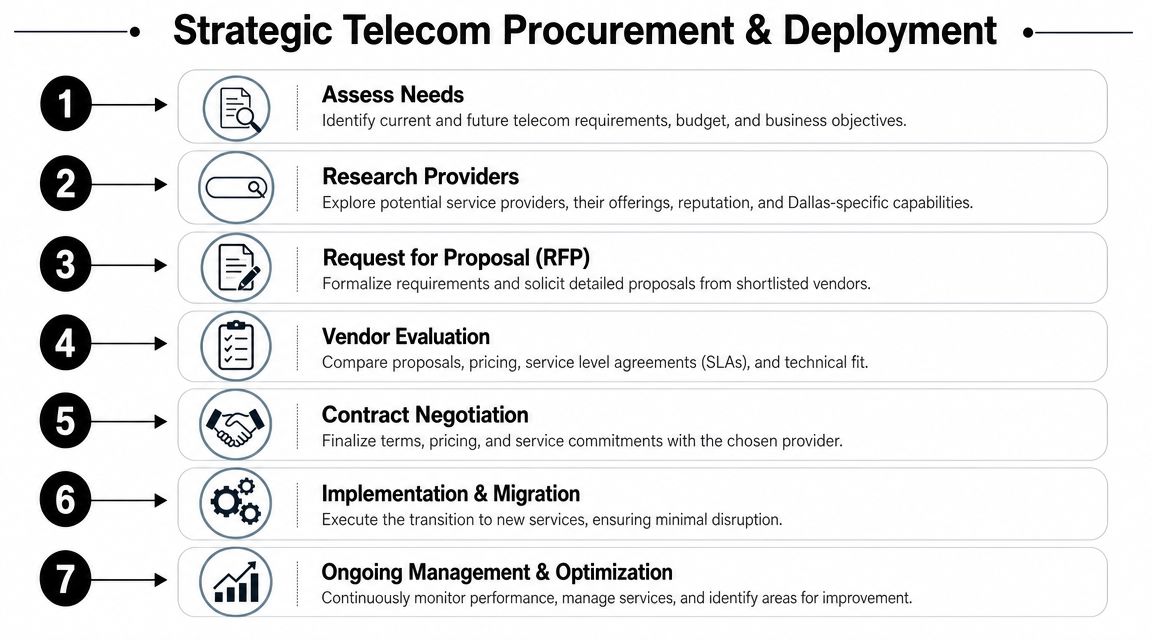
A Strategic Guide to Telecom Procurement and Deployment
Buying telecom in Dallas works better when you force the process to reveal weak assumptions early. That means validating addresses, cabling conditions, handoff requirements, and migration dependencies before anyone debates logos or discounts.
Texas still has meaningful broadband unevenness beyond dense cores. The state has 777,115 unserved and 364,991 underserved broadband serviceable locations, according to Texas broadband availability reporting summarized by Benton. For Dallas-area companies with suburban or exurban operations, that makes last-mile verification a procurement step, not an afterthought.
A practical buying sequence
- Map business-critical workflows first. Tie circuits and voice design to ERP, cloud apps, call handling, warehouse operations, and remote access.
- Run a real site survey. Don't rely on a serviceability database alone. Verify demarc location, conduit condition, power, rack space, and existing cabling.
- Issue an RFP that exposes assumptions. Require providers to state access method, inside wiring responsibility, failover approach, and install dependencies.
- Stage a vendor bake-off where possible. Compare responsiveness, design clarity, and implementation detail, not only recurring cost.
- Build migration around operational windows. Cutovers fail when nobody owns rollback, testing order, or stakeholder communication.
Deployment is where hidden risk appears
A clean deployment plan includes voice porting, WAN failover testing, firewall policy review, wireless overlap, and a retirement path for displaced equipment. Teams planning a major refresh or facility move should also review broader data center migration best practices so telecom changes don't create downstream infrastructure drift.
Managing Costs and Navigating Telecom Contracts
The monthly recurring charge is only one part of telecom cost. Dallas companies often overspend because they ignore install conditions, managed equipment terms, cross-connect dependencies, and renewal language until the renewal notice arrives or a change request lands.
Read the contract like an operator
A good telecom contract tells you what you can change, what you can cancel, and what the provider can increase. If those points are fuzzy, the contract is tilted against you.
Watch the common traps:
- Auto-renewal language: If notice windows are narrow, your ability to negotiate effectively disappears before renegotiation starts.
- Undefined service boundaries: “Managed router” can mean anything from full lifecycle support to basic hardware replacement.
- Escalators and pass-through charges: If the contract leaves price movement open-ended, budget predictability suffers.
- Disconnected order forms: Technical assumptions buried outside the master agreement often create disputes later.
Total cost of ownership includes retirement value
When companies refresh telecom gear, they often focus on acquisition and ignore the disposition side. That's a mistake. Old handsets, network modules, PBX components, and edge equipment may still have reuse or recovery value, and they certainly carry handling obligations. Programs for corporate telecom asset recovery can help organizations evaluate whether equipment should be resold, recycled, or destroyed under documented chain of custody.
Cheap telecom gets expensive when contract language is vague and retired assets pile up unmanaged.
Securely Decommissioning Your Retired Telecom Equipment
Most telecom projects end too early. The circuit is live, users are migrated, and the old gear gets stacked in a closet, cage, or warehouse corner. That's not decommissioning. It's deferred risk.
Retired telecom hardware can hold configuration data, call records, credentials, internal network details, storage media, and asset tags that expose your environment. Routers, firewalls, switches, voice gateways, IP phones, wireless controllers, and server-adjacent appliances all need a controlled exit process.

What proper telecom decommissioning looks like
Use a repeatable chain:
- Inventory first: Match physical devices to records, site locations, and responsible owners.
- Sanitize data-bearing components: Don't assume “network gear” is data-free.
- Separate reuse from destruction: Some equipment has remarketing value. Some should be physically destroyed.
- Document custody and outcome: Certificates, serialized records, and pickup logs matter for audits and internal controls.
Disposal is part of the telecom strategy
For Dallas firms with branch consolidations, PBX retirement, or data-center refreshes, the end-of-life phase belongs inside the project plan from day one. Beyond Surplus is one option for organizations that need telecom equipment disposal, recycling, and documented downstream handling as part of a broader data center decommissioning process.
The point isn't branding. It's governance. If your deployment plan doesn't include secure removal and disposition, the project is incomplete.
Your Action Plan for Mastering Dallas Telecom
A strong Dallas telecom strategy starts with the right service mix, but it doesn't stop there. You need fiber and access decisions that reflect physical realities, provider reviews that prioritize resilience, contracts that control lifecycle cost, and a retirement plan for displaced hardware.
The next step is to treat telecom as a full-stack operational discipline. Verify last-mile conditions. Demand route clarity. Design failover before launch day. Keep decommissioning inside scope. And plan for future redundancy choices as carrier architectures evolve. Major carriers including AT&T, T-Mobile, and Verizon are moving toward satellite-based approaches to address coverage gaps, according to Dallas Innovates reporting on the carrier joint venture. That shift makes hybrid terrestrial-satellite planning worth evaluating for continuity-sensitive operations.
If your Dallas organization is upgrading circuits, retiring telecom hardware, closing sites, or decommissioning network equipment, contact Beyond Surplus for secure IT asset disposal, certified data destruction, electronics recycling, and telecom equipment recovery support.


