

You search for managed telecom services near me when telecom stops feeling like a utility and starts draining staff time. One site has a voice outage. Another has a circuit nobody can explain. Finance is paying invoices from multiple carriers, IT is chasing trouble tickets, and nobody owns the full picture.
That usually means the business doesn't have a phone problem. It has a control problem. The fix isn't another carrier pitch. It's a provider that can audit what you already have, clean up the inventory, manage vendors, and give you one operating model for voice, data, internet, and support.
Why Your Business Needs More Than a Phone Company

A traditional carrier sells connectivity. A managed telecom provider should manage the mess around it. That includes inventory, billing disputes, outage escalation, contract sprawl, and service changes across locations. If you run more than one office, warehouse, clinic, campus, or retail site, that distinction matters fast.
The businesses that struggle most usually have the same pattern. They've added services over time without removing old ones. A site move leaves a circuit behind. A phone system migration doesn't fully disconnect legacy lines. Internet, voice, conferencing, and failover all sit with different vendors. Each decision made sense on its own. The stack as a whole doesn't.
Reactive support costs more than it looks
When teams buy telecom one request at a time, they end up managing exceptions all year. Someone has to compare invoices, open support cases, track renewals, and confirm what's live. That work rarely sits with one owner. It gets split between IT, accounting, operations, and office managers.
Practical rule: If nobody can produce a clean inventory of every circuit, phone line, and carrier by location, telecom is already under-managed.
That's why managed telecom has become standard operating practice, not a niche add-on. The global telecom managed services market was estimated at USD 20.67 billion in 2022 and is projected to reach USD 55.29 billion by 2030, growing at a 13.4% CAGR, according to Grand View Research's telecom managed services market report.
What changes when telecom is managed properly
A good provider gives you structure:
- One accountable team for carrier coordination, escalations, and service oversight
- A maintained inventory so active services match what the business is paying for
- Planned change management for openings, closures, moves, and migrations
- Operational visibility into recurring problems instead of one-off firefighting
That's the primary reason to search for managed telecom services near me. You're not just looking for local support. You're looking for a partner that can turn telecom from scattered vendor management into a controlled business function.
Decoding Managed Telecom What Services to Expect
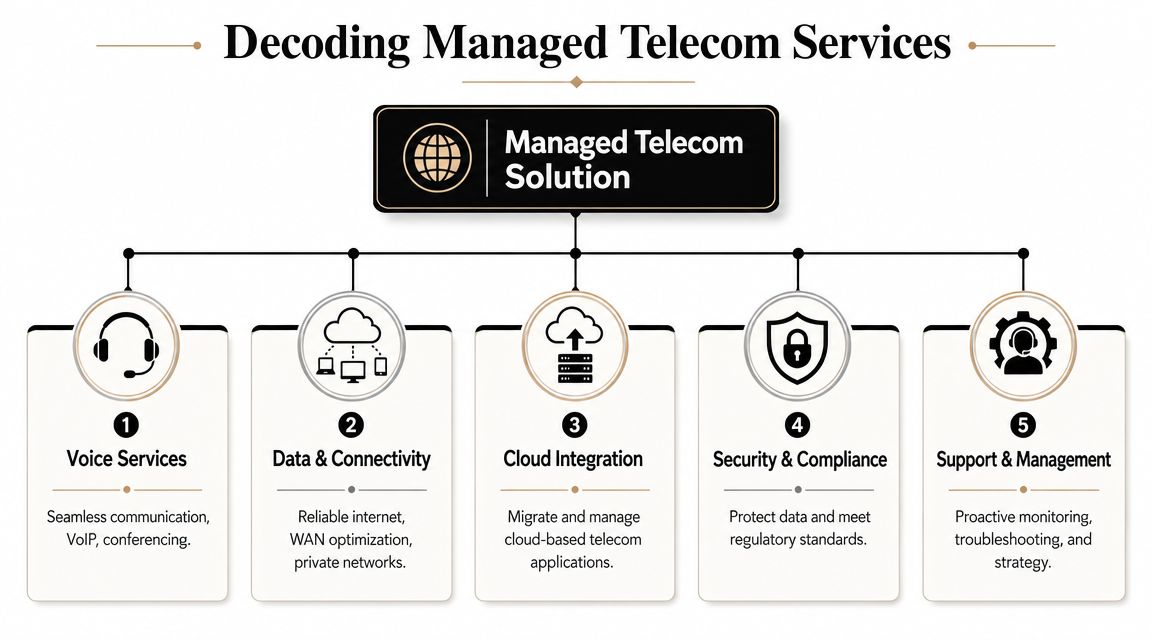
Not every managed telecom package is the same. Some providers are really resellers with a help desk. Others can handle audits, migrations, policy, and lifecycle management. The difference shows up during onboarding, not in the sales deck.
Unified communications and call handling
Most buyers start with phones, softphones, conferencing, voicemail, call routing, and mobile access. That matters, but it's only one layer. The right question is whether the provider can fit communications into your actual workflows.
For some teams, that also means pairing core telecom with specialized phone answering solutions when live call coverage, overflow handling, or after-hours responsiveness matters. That's especially useful for legal, healthcare, service dispatch, and appointment-driven businesses that can't afford missed calls.
Expense management and circuit cleanup
Telecom expense management sounds administrative. In practice, it's one of the fastest ways to expose waste. You want a provider that can tie invoices to actual services, location by location, and challenge anything that doesn't belong.
A key but often overlooked part of managed telecom is vendor-agnostic migration and circuit rationalization. The stronger providers don't just pitch replacements. They audit old voice and data circuits, consolidate overlapping services, and manage migrations across multiple carriers and sites, as described by AscendIT Group's overview of managed telecommunication services.
Providers that skip the cleanup phase often leave the old environment half alive. That's where duplicate spend hides.
Network management and vendor oversight
A managed provider earns its fee by handling complexities beyond basic uptime monitoring. Managing all the carrier relationships, service records, order fallout, and post-install disputes is harder. If your business has branch offices or field locations, this piece determines whether the service feels organized or chaotic.
A practical scope usually includes:
- Connectivity management for internet circuits, WAN links, failover paths, and service changes
- Carrier coordination for installs, disconnects, credits, renewals, and escalation
- Inventory ownership so records stay current after every move, add, or change
- Migration planning for replacing legacy voice or consolidating across providers
If you're comparing vendors, review whether they can support both active service management and end-of-life hardware handling. For example, enterprise telecom solutions in Atlanta may involve equipment retirement, asset recovery, and decommissioning alongside carrier transitions.
What a complete solution feels like
A mature managed telecom program should reduce confusion. Your team should know who owns support, how inventory is tracked, what happens during a site change, and how billing issues are resolved. If a provider can't explain that in plain language, the service is probably thinner than it looks.
Your Vetting Checklist Key Questions for Potential Providers
Most bad telecom decisions happen because buyers ask what a provider sells instead of how the provider operates. Features are easy to list. Process is harder to fake. That's where you should spend your time.
A best-practice workflow begins with a full carrier-contract and inventory audit. The goal is to consolidate services and remove redundant or ghost circuits. The main gains are lower spend, fewer invoices, and reduced administrative overhead, achieved by continuously matching inventory to live usage, according to Telco Solutions' managed telecom services guidance.
Start with operational discipline
Ask every shortlisted provider to describe onboarding in detail. Not “we'll assess your environment.” Ask what documents they request, how they build inventory, how they reconcile invoices, and who validates disconnects. Strong providers answer with steps. Weak ones answer with slogans.
Use this list during vendor calls, and keep each answer in writing.
| Category | Question to Ask |
|---|---|
| Technical process | How do you perform a full carrier contract and telecom inventory audit? |
| Technical process | How do you identify redundant, inactive, or ghost services? |
| Technical process | How do you keep inventory matched to live usage after onboarding? |
| Migration planning | How do you handle multi-site cutovers without leaving old circuits active? |
| Migration planning | Will you manage vendor-agnostic migrations, or only move us to your preferred stack? |
| Support model | Who owns escalations, and will we have a named point of contact? |
| Support model | What does your ticket workflow look like for outages, billing disputes, and service changes? |
| Reporting | What recurring reports do you provide for inventory, incidents, invoices, and service trends? |
| Governance | How do you document service ownership by location, business unit, and carrier? |
| Contracting | How do you handle renewal dates, disconnect confirmations, and dispute credits? |
Watch for three weak answers
Some responses sound polished but should stop the process.
- “We optimize after migration.” If they won't clean up current-state inventory first, expect leftovers and billing leakage.
- “Our portal handles that.” Portals are useful. They don't replace human ownership of disputes, exceptions, and install fallout.
- “We standardize everyone on one carrier.” Standardization can help, but forced standardization can also ignore local service realities.
Ask for the provider's sequence of work. Audit first, then rationalize, then migrate, then govern.
Compare providers on control, not charm
The best discovery calls feel a little operational. You should hear about service records, circuit IDs, invoice matching, disconnect verification, and change control. If the conversation stays at the level of “better service” and “custom solutions,” keep digging.
For a broader shortlist, it helps to compare regional options, national firms, and telecom specialists through a practical search for telecom services near me. Then narrow the field based on process maturity, not brand recognition.
Questions that reveal long-term fit
I'd also ask these before final pricing:
- How do you prevent inventory drift after site openings, closures, and relocations?
- What happens when finance disputes an invoice but the carrier disagrees?
- How do you prove a disconnect was completed?
- Which systems of record will we rely on after handoff?
- How do you separate urgent outage response from slower contract cleanup work?
Those answers tell you whether the provider can run telecom as an ongoing control process. That's what you're buying.
Understanding SLAs and Compliance in the Fine Print
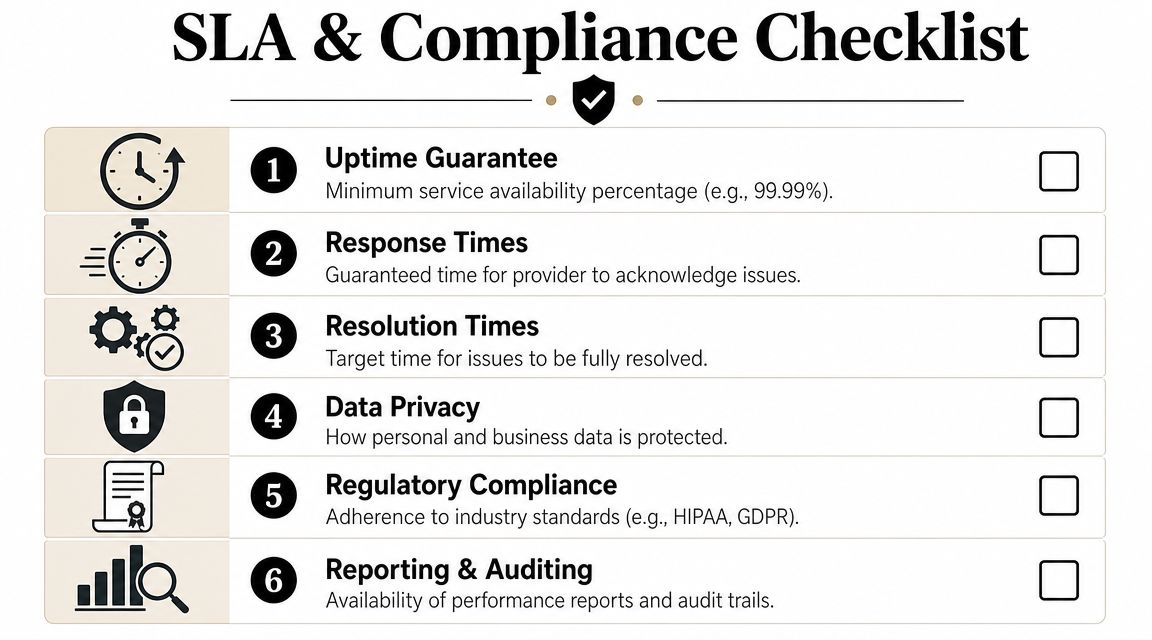
A provider can sound excellent in meetings and still hand you an SLA that leaves too much room for failure. Read the service terms like an operator, not a purchaser. You need to know what triggers support, what gets measured, and what evidence exists when performance slips.
What to read in the SLA
Uptime is only one line item. For voice and collaboration tools, you also need clarity on response times, resolution targets, escalation paths, maintenance windows, and service credits. For data connectivity, ask how the provider treats packet loss, jitter, and latency in practice. If those terms are undefined or buried in carrier pass-through language, support can become an argument.
A useful SLA review should cover:
- Incident acknowledgement so urgent tickets don't sit unowned
- Resolution commitments separated by severity, not one generic standard
- Escalation rules that identify who gets involved and when
- Performance reporting that shows trends, not just isolated tickets
- Service credit language that is claimable
The best SLA is the one your operations team can use during a bad week without calling legal first.
Compliance questions matter more now
Managed telecom is increasingly shaped by AI-driven operations and compliance pressure. Buyers in regulated industries should ask how AI-based monitoring affects incident response, what compliance evidence is produced, and how service expectations change when telecom sits inside a broader governance program, as noted by Innovile's telecom managed services insights.
That means asking for proof, not promises. If you're in healthcare, finance, education, or government, request sample reports, audit trails, access controls, incident documentation, and retention practices. If a provider says monitoring is automated, ask what gets logged, who reviews exceptions, and how findings are handed off.
Fine print that often gets missed
Three issues show up repeatedly:
- Shared responsibility gaps where the provider monitors but doesn't own remediation
- Undefined evidence when compliance support is mentioned but documentation isn't specified
- Carrier carve-outs that let the managed provider step back when the underlying network fails
If you're comparing options, review how different firms frame these obligations through local searches such as telecom providers near me. Then match the contract language to your own risk model. A retail chain, clinic network, and law firm won't need the same evidence package.
Pricing Models and How to Find Local Providers

Managed telecom pricing gets confusing because buyers often compare unlike services. A low quote may only include reactive support. A higher quote may include inventory governance, audit work, proactive monitoring, and carrier management.
According to BCM One's discussion of telecom managed services and operational efficiency, the market reached $28.76 billion in 2025, grew at 11.19% annually, and cloud-based managed services held 55% market share. That helps explain why some pricing reflects proactive, AI-powered monitoring rather than basic break-fix support.
Common pricing approaches
Here's how I usually frame it for clients:
- Per-user pricing works well when the service is centered on seats, calling features, and collaboration tools. It's simple, but it can hide network and carrier management gaps.
- Tiered packages make comparison easier. The risk is that critical tasks like invoice reconciliation or migration support sit in a higher tier than you expected.
- Custom quotes are often right for multi-site businesses with mixed carriers, old contracts, and site-specific connectivity. They take longer to compare, but they expose scope.
How to search locally without wasting time
The phrase managed telecom services near me is a starting point, not a vetting method. Build a shortlist from several angles:
- Check regional IT and telecom firms that support businesses with a similar footprint to yours.
- Ask peer companies which provider handled their last migration well, not just who sold them service.
- Review LinkedIn and local business networks for firms active in your industry and geography.
- Screen for lifecycle capability if you'll retire old PBX hardware, phones, switches, or related telecom assets during the transition.
For organizations that need both telecom change management and equipment retirement planning, a search around telecom solutions near me can help surface providers and adjacent service partners involved in deployment, decommissioning, and asset handling.
Engaging a Provider and Planning Your Next Steps
Once you've narrowed the field, stop treating the process like shopping and start treating it like implementation planning. The businesses that transition cleanly usually force structure into the final stage.
A practical sequence that works
First, send a written requirements document to your top candidates. Include your locations, current carriers, known pain points, support expectations, compliance needs, and the operational questions from your checklist. Ask each provider to respond in the same format. That makes comparisons possible.
Second, hold a working session, not a sales demo. Review how each provider would audit your inventory, handle migrations, manage open disputes, and document ownership after go-live. You want the operating model, not the slideshow.
If a provider can't explain day-one onboarding and day-ninety governance, they probably can't manage the middle either.
Third, negotiate the contract around what matters most to your business. That may be escalation speed, invoice control, migration sequencing, or compliance evidence. Don't let the discussion collapse into monthly price alone.
Finally, plan for the old environment. Telecom projects often leave behind handsets, modules, network gear, and retired communications hardware that need secure chain-of-custody and documented disposition. If that's part of your project, include telecom decommissioning services in the handoff plan so nothing lingers untracked after cutover.
If your business is replacing telecom equipment, decommissioning legacy voice hardware, or needs documented downstream handling as part of a broader telecom transition, Beyond Surplus provides IT asset disposition, secure data destruction, telecom equipment recycling, and logistics support for organizations managing end-of-life technology responsibly.