

Atlanta's clean technology economy is no longer a side story. The City of Atlanta says metropolitan Atlanta is home to 541 clean tech company facilities supporting 30,605 jobs, and that since 2010 the region has recruited 34 clean tech companies that created more than 2,200 jobs.The City of Atlanta's clean tech update For IT leaders, that shift changes the job from simple procurement to full lifecycle control. The hardware that powers green software, smart buildings, and data-heavy services also has to be retired, wiped, tracked, and recycled without exposing data or creating e-waste.
Table of Contents
- Atlanta's Emergence as a Sustainable Tech Hub
- The Driving Forces Behind Atlanta's Green Tech Boom
- Key Infrastructure and Industry Hotspots
- Atlanta's Sustainable Tech Ecosystem and Key Players
- The Overlooked Side of Sustainability IT Hardware Lifecycle Management
- Practical Steps for Atlanta IT Leaders to Embrace Sustainability
- The Future of Sustainable IT in Atlanta
Atlanta's Emergence as a Sustainable Tech Hub

Atlanta's sustainability story is now measurable in employers, facilities, and jobs, not just branding. The city's clean tech cluster gives business leaders a clear signal that the market has moved beyond pilot projects and into operational scale. That matters for IT teams because every new facility, expansion, and digital service eventually adds more endpoints, servers, batteries, networking gear, and retired hardware that needs a disposal plan.
Georgia Tech's regional research also shows that since 2018, companies have invested over $11.5 billion in electric vehicles, next-generation batteries, sustainable fuels, and advanced solar technologies across Georgia, with the greater Atlanta region at the center of the activity.Georgia Tech on Atlanta's clean-tech surge That kind of capital flow usually changes vendor ecosystems fast. It brings new procurement standards, more equipment turnover, and more pressure on leaders to prove that the back end of the lifecycle is handled correctly.
A useful way to read The Rise of Sustainable Technology in Atlanta is as a business operations story. The city is becoming a place where green technology is deployed at scale, which means sustainability can't stop at energy-efficient design or low-carbon promises. The test is whether organizations can recover value from retired assets, protect sensitive information, and keep obsolete devices out of the wrong waste stream.
Practical rule: If a sustainability plan doesn't include end-of-life logistics, it's only half a plan.
For companies evaluating Atlanta's tech growth, a good starting point is local market context. This overview of how Atlanta became a top destination for tech startups helps show why the city keeps attracting firms that depend on constant hardware refresh cycles and secure decommissioning.
The Driving Forces Behind Atlanta's Green Tech Boom
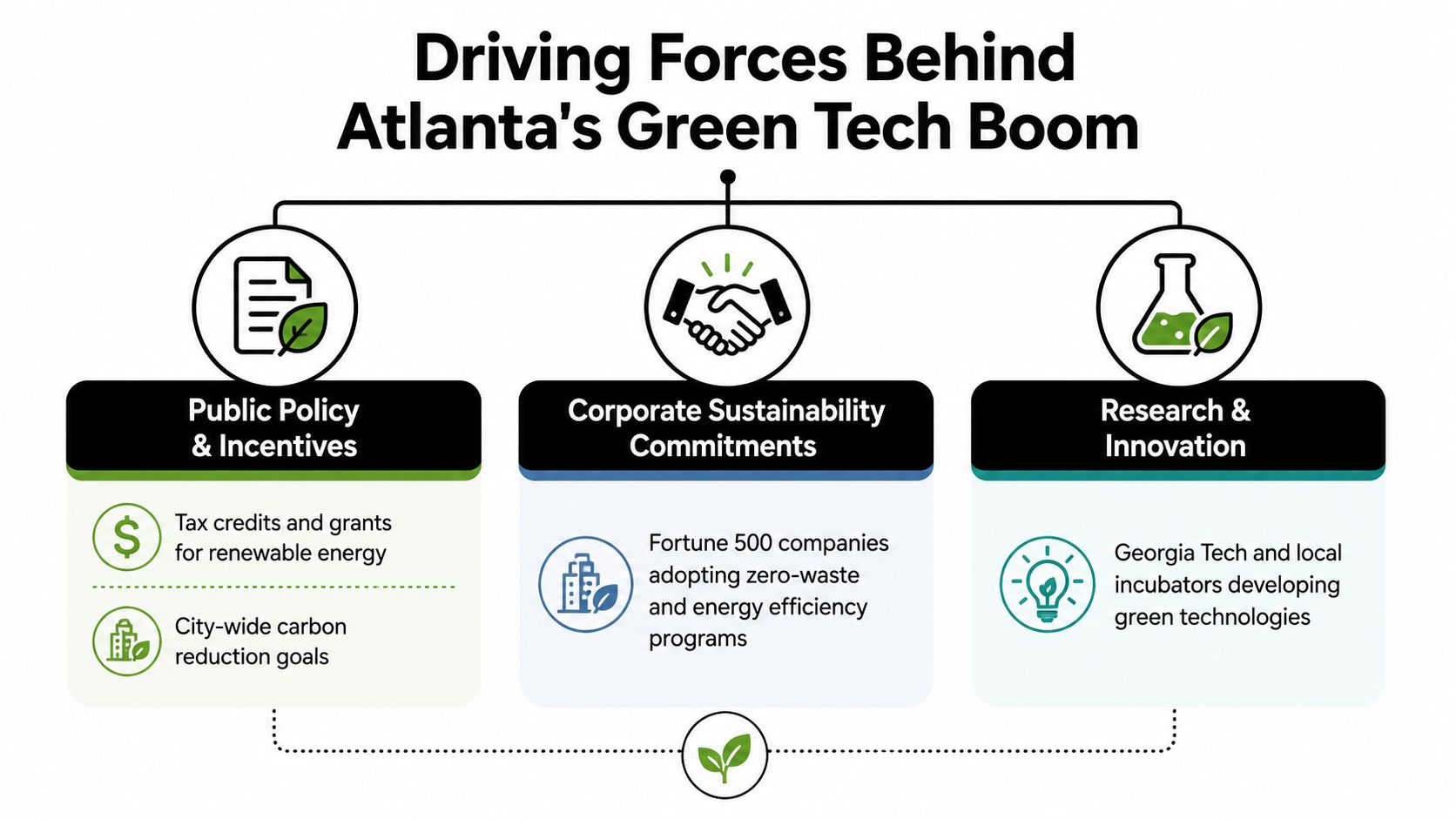
Atlanta's green-tech growth is being pushed by three forces, public policy, corporate sustainability goals, and research capacity. Each one changes what IT leaders have to plan for. Policy sets the compliance bar and affects procurement timing. Corporate commitments shape vendor requirements. Research and startup activity bring new tools into the market, and those tools eventually land in enterprise environments that have to support them, secure them, and retire them correctly.
Policy and public targets
The City Council's Clean Energy Atlanta Plan set a goal for the city to reach 100% clean energy by 2035, with interim targets of 50% by 2030.City of Atlanta ESG and clean energy goals That is more than a public statement. It gives agencies, vendors, and local businesses a long-term signal about how facilities, fleets, and technology decisions will be judged.
For IT groups, policy matters because procurement decisions often follow the same logic as city goals. If the direction of travel is cleaner energy and lower emissions, suppliers are more likely to be evaluated on efficiency, repairability, and responsible disposal practices. Organizations that miss that shift can end up with contract terms that do not support their reporting needs, or with audit questions they are not ready to answer.
Atlanta's broader smart-city work points in the same direction, because connected infrastructure creates both sustainability pressure and lifecycle complexity. Atlanta smart city initiatives and IT growth shows how that growth ties into technology planning, but it also means more devices, more endpoints, and more equipment that eventually has to be decommissioned. Smart systems improve visibility, yet they also increase the volume of hardware that must be tracked from purchase through final disposition.
A second signal comes from the mobility and urban-services side of the market. Teams planning for city workflows can also look at electric bikes and scooters for city life as a clear example of how demand for low-emission transport keeps widening the sustainability conversation beyond power use alone. The same logic applies to enterprise IT. The most sustainable choice is often the one that lasts longer, is easier to maintain, and can be retired responsibly.
Mobility, demand, and adoption
Atlanta's green-tech boom is also being pulled forward by organizations that want lower operating risk, clearer reporting, and faster innovation cycles. Georgia Tech's entrepreneurship pipeline reinforces that dynamic through sustainability-focused commercialization work, giving startups a path from idea to deployment. That matters because green technology only becomes real when it survives the move from prototype to production.
For IT buyers, that usually means new hardware standards, more specialized equipment, and a higher chance that legacy devices will be displaced before they have reached the end of their useful life. The stronger the policy environment becomes, the more important disposal discipline becomes. Hardware refreshes, redeployments, and retirements need a clear chain of custody, or the organization inherits avoidable risk in the form of data exposure, asset loss, and untracked waste.
The end-of-life side is where many sustainability plans fall short. Leaders can buy efficient systems and still miss the bigger operational issue if retired laptops, networking gear, batteries, and peripheral devices are not handled through a controlled ITAD process. That is where the hardware lifecycle becomes a sustainability issue, not just a facilities issue.
Local demand will keep expanding the number of devices in circulation, and that makes end-of-life planning a practical requirement rather than a side task. If the city keeps adding connected services and digitally enabled operations, IT teams need to treat asset disposition as part of the original sustainability plan, not as cleanup after the fact.
Key Infrastructure and Industry Hotspots
Metro Atlanta's data center market shows how sustainability and infrastructure now collide. The region recorded 705.8 MW of net absorption in 2024, the highest in the U.S., and construction activity rose 76% from the year before.Metro Atlanta data center market data Estimates also place Atlanta at 150 to 220 operational data centers, with 32 under construction and at least 50 planned. That scale changes the operational conversation immediately.
A data center is not just a building full of servers. It is a power and cooling problem, a security problem, and eventually a retirement problem. Every expansion adds racks, storage systems, UPS equipment, networking gear, cables, and battery systems that need to be removed in a controlled way when the environment is refreshed or reconfigured.
The practical issue for IT leaders is that growth compounds. More facilities mean more vendor coordination, more decommissioning events, and more chances for mistakes during asset removal. Atlanta's position as a digital hub also raises the stakes for end-of-life planning, because a larger installed base creates more retired inventory that has to be tracked, wiped, transported, and processed without exposing data or losing asset value.
Data center sustainability is never just about power draw. It also depends on what happens when the equipment is no longer needed.
For operators looking at the local market, why Atlanta is a prime data center hub helps explain the business logic behind the region's growth. The takeaway for sustainability planning is straightforward. A hot market for digital infrastructure creates an equally active market for responsible ITAD, because every new deployment eventually becomes retired inventory.
That is where the hardware lifecycle becomes central. If an organization refreshes too aggressively, it increases waste. If it keeps obsolete gear too long, it raises maintenance costs and security exposure. The best operators build a schedule that balances uptime, efficiency, and disposal readiness from the start.
Atlanta's Sustainable Tech Ecosystem and Key Players

Atlanta's ecosystem works because research, startups, industrial recruiters, and service providers sit in the same regional economy. Georgia Tech produces technical talent and applied research. ATDC helps startups move from concept to commercial execution. Large employers create demand, and service firms handle the operational reality of what gets installed, maintained, and eventually removed.
That mix matters for IT leaders because sustainable technology is not only a product story, it is a deployment story. A tool can look promising in a lab and still fail in production if the hardware path, support model, or retirement process is weak. Atlanta's advantage is that it gives founders and operators a place to test those handoffs early, before they become expensive mistakes.
Georgia Tech's ATDC Sustainability Technology Program fits that commercial pathway well. The value is not just startup formation, it is the discipline that comes from helping hardware-heavy ideas prove themselves in the market. That matters in a city where sustainability work often touches servers, batteries, networking gear, and other assets that have to be deployed, serviced, and retired without creating security or waste problems.
For IT leaders, the lesson is straightforward. Innovation does not stop when a device ships. It continues through maintenance, replacement, resale, de-installation, and certified recycling. The companies that manage those steps well reduce risk and recover value. The companies that do not usually discover the problem only after a disposal mistake, a data exposure, or a warehouse full of idle gear.
ESG trends in Atlanta and sustainable IT practices fits naturally into that broader picture because ESG expectations are increasingly tied to real operational controls, not just policies on paper. The organizations that do best tend to separate three functions clearly.
- Innovation: universities, incubators, and startup programs that create new tools.
- Deployment: the teams that buy, install, and operate the technology.
- Disposition: the firms that wipe, dismantle, recover, and recycle the retired assets.
When those functions are disconnected, sustainability programs stall. When they are coordinated, asset turnover becomes easier to measure and much less risky to execute. That coordination also matters outside traditional IT. Even in adjacent infrastructure work, such as retrofitting legacy gate operators, teams see the same pattern. Equipment choices made upstream shape maintenance, energy use, and the eventual disposition burden downstream.
The commercial side of Atlanta's ecosystem also includes circular-economy activity such as e-waste recycling and materials recovery, which keeps the market grounded in real work rather than branding.Georgia sustainability hub activity That matters for enterprises because a sustainability strategy is only credible if there is a practical path for the equipment coming out of service.
The Overlooked Side of Sustainability IT Hardware Lifecycle Management
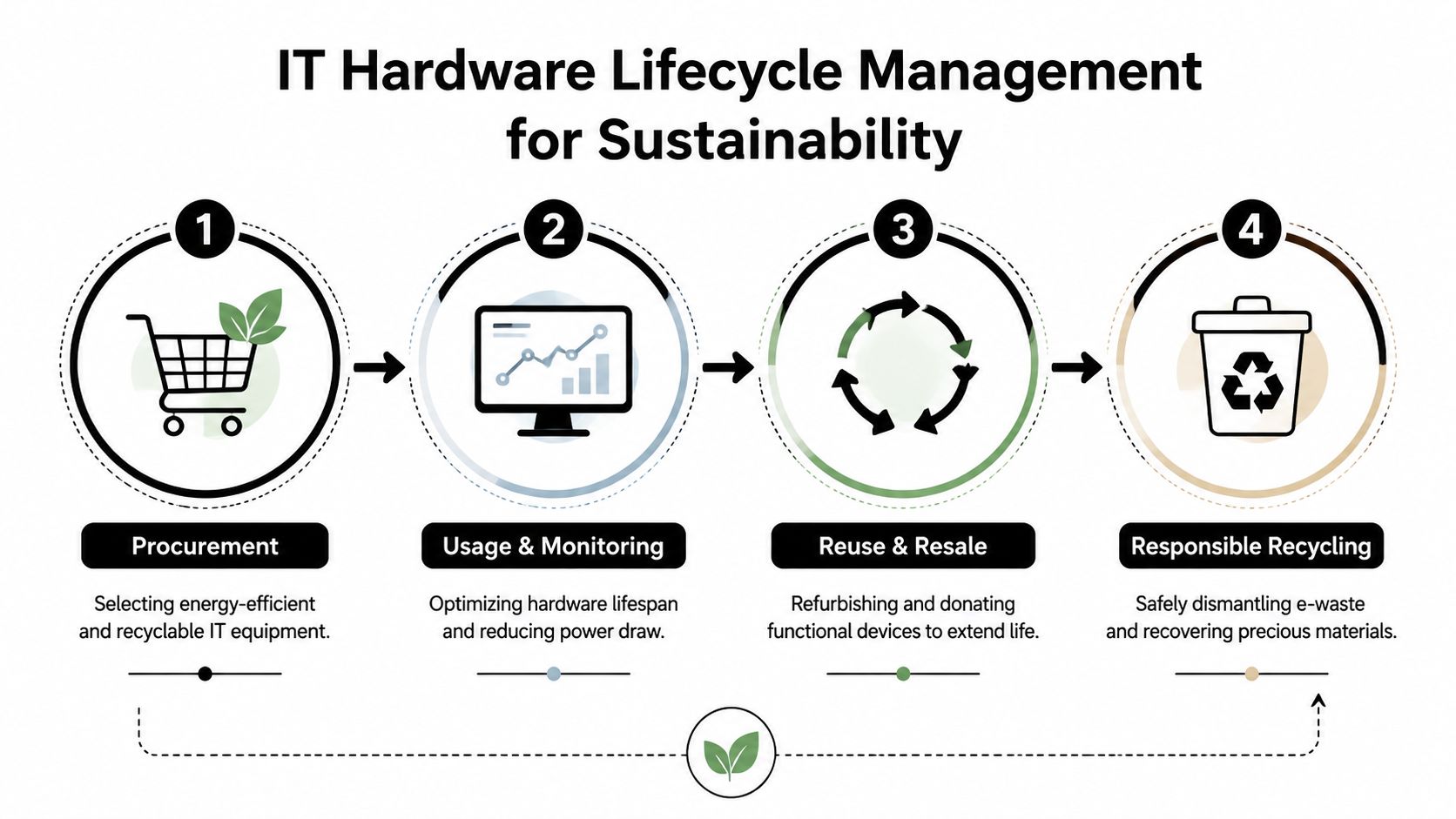
Most sustainability coverage stops at energy use. That misses the messiest part of the problem, the physical lifecycle of the hardware itself. Georgia Tech-linked guidance on underserved communities makes the point clearly, rapid tech growth creates a parallel challenge in managing devices, batteries, and data center equipment, and true sustainability requires secure, compliant pathways for retiring hardware to prevent e-waste and data breaches.Georgia Tech on underserved communities and hardware lifecycle
That framing matters for Atlanta because the city's growth is asset-intensive. Servers, laptops, phones, switches, storage arrays, batteries, and peripherals all move through the same lifecycle. If any one of those streams is handled badly, the organization carries environmental, security, and compliance risk at the same time.
Where IT teams usually go wrong
The common mistake is treating disposal as an afterthought. A purchase order gets approved. The deployment succeeds. Then the old gear sits in a closet or storage cage until someone needs space. By then, chain-of-custody records are incomplete, batteries may be degraded, and no one can say with confidence where sensitive media ended up.
That's why ITAD is not just a recycling task. It's a logistics and compliance function. Secure wiping, hard drive shredding, asset tracking, and documented handoff are part of operational control, not extra services. In a market like Atlanta, where hardware churn is likely to stay high, those controls protect both data and reputation.
What a serious end-of-life program includes
A strong program starts before equipment is retired.
- Procurement discipline: buy gear that is easier to support, maintain, and later recover.
- Usage tracking: monitor where assets sit, who owns them, and when they're due for refresh.
- Reuse or resale review: determine what can be redeployed instead of discarded.
- Certified disposition: send the remainder through a documented recycling and destruction process.
For organizations comparing service models, sustainable IT asset disposal solutions for Atlanta companies is relevant because it shows how the disposal side connects to compliance, resale, and recycling in one workflow. That's the right mindset for a tech hub. Sustainability is not only about buying greener equipment. It's about retiring it safely.
If the device held data, the disposal plan has to be as controlled as the deployment plan.
The same logic applies to adjacent infrastructure. Teams looking at retrofitting legacy gate operators can see how sustainability often means extending the life of existing systems instead of replacing them too early. That principle maps directly to enterprise IT. The longer a usable asset stays in service, the lower the waste burden, as long as performance, security, and compliance stay intact.
Practical Steps for Atlanta IT Leaders to Embrace Sustainability
A workable sustainability program starts with policies that buyers, technicians, and facility managers can follow. If the rules only live in an ESG deck, they won't change how assets move through the company. The goal is to make sustainability part of standard IT operations.
Sustainable procurement
Buy equipment with the next lifecycle in mind. Ask vendors about repairability, parts availability, and data sanitization support. Favor hardware that can be refurbished or resold cleanly when the time comes. If the supplier can't explain how an asset is eventually recovered or recycled, the supply chain is incomplete.
Operational efficiency
Look first at the systems already in service. Virtualization, power management settings, and careful capacity planning can reduce waste without forcing premature replacements. In data-heavy environments, cooling design and workload placement matter just as much as the hardware spec sheet. The best sustainability gains often come from using equipment longer and more intelligently, not from swapping it out early.
Responsible end-of-life management
Risk rises fastest. A certified ITAD partner should be able to document chain of custody, provide data destruction records, and explain how devices are sorted for reuse, resale, or recycling. That's especially important for laptops, storage devices, network gear, and battery-backed systems.
Before choosing a vendor, verify a few basics:
- Security controls: confirm data wiping or physical destruction methods for media.
- Documentation: require certificates of recycling and destruction.
- Handling scope: make sure the vendor can manage mixed assets, not just desktop computers.
- Transparency: ask where equipment goes after pickup and how exceptions are handled.
AI driven transport analytics explained is a useful reminder that logistics is becoming more data-driven across industries, and the same expectation now applies to IT asset movement. Businesses want proof, routing visibility, and auditable handoffs.
The Future of Sustainable IT in Atlanta
Atlanta's sustainable tech future will be defined by two pressures at once. One is growth. The other is accountability. The city's clean-energy goals, data center expansion, and startup activity all point to more technology in more places, which means more equipment moving through more hands.
That creates a simple rule for businesses: if you're modernizing faster, you need a stronger end-of-life process. The winners won't just buy efficient equipment. They'll also manage retirement, resale, and recycling with the same discipline they apply to deployment and security.
For practical decision-making, the takeaway is clear. Sustainable IT in Atlanta is no longer a concept. It's an operating model.
Beyond Surplus helps businesses manage electronics recycling, IT equipment disposal, secure data destruction, and certified IT asset disposition for retired technology. If your Atlanta organization is refreshing hardware, decommissioning a data center, or looking for a compliant end-of-life plan, Beyond Surplus can help you close the loop with documented, secure handling from pickup through final processing.


