

Atlanta, Georgia isn't just talking about digital transformation. It tied its smart-city plans to a $250 million Renew Atlanta infrastructure bond program, linking civic modernization to transportation, analytics, and connected public services in a way that changes how local organizations should think about IT planning, procurement, and retirement of equipment, according to the U.S. Department of Transportation's Atlanta Smart City Challenge materials in Atlanta's proposal summary.
For CIOs, IT managers, and operations leaders, that matters because smart-city infrastructure doesn't stay inside government. It raises expectations for connectivity, resilience, and data handling across the wider business community. It also speeds up one problem many teams under-plan for. Asset turnover.
As Atlanta adds more digital backbone, more organizations feel pressure to modernize networks, endpoints, server environments, and edge-adjacent systems. That creates opportunity, but it also creates a larger stream of retired laptops, networking gear, storage devices, and decommissioned hardware that must be tracked, sanitized, and disposed of correctly. Companies already evaluating Atlanta's data and connectivity ecosystem can see part of that backdrop in this look at why Atlanta is a prime data center hub.
Introduction The New Pace of Tech in Atlanta
Atlanta's public infrastructure story is easy to misread. Many business leaders hear “smart city” and think kiosks, sensors, or a one-off innovation program. That's not the right frame.
The more useful frame is this. Atlanta has been building a technology-backed operating environment for the city itself. When a city invests in digital coordination, analytics, communications backbone, and connected transportation, private organizations operating in that market usually have to adapt to the new pace.
Why IT teams should care
A smarter city changes routine business assumptions:
- Connectivity expectations rise. Offices, warehouses, clinics, campuses, and distributed teams start relying on stronger network performance.
- Data volume expands. More services become digital, more workflows become monitored, and more systems need integration.
- Hardware ages faster. Older equipment may still function, but it no longer fits security, compatibility, or performance expectations.
Smart-city momentum often looks like a public policy story. For IT leaders, it's really a lifecycle management story.
That's where confusion usually starts. Teams focus on acquisition and deployment, but they don't update retirement processes with the same urgency. If Atlanta's business environment is moving toward denser connectivity and more analytics-driven operations, your asset inventory, data destruction process, and vendor controls need to keep up.
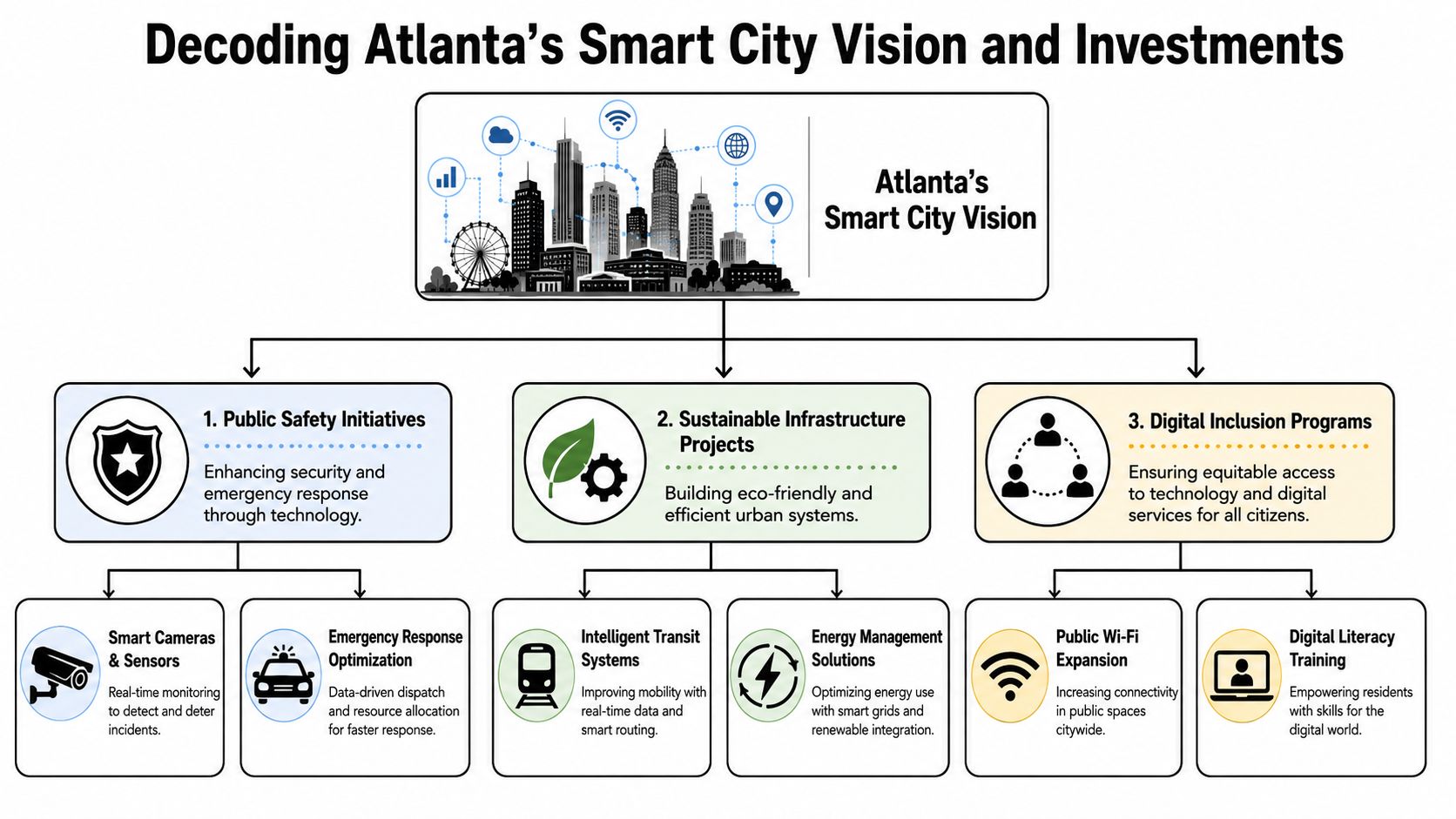
Decoding Atlanta's Smart City Vision and Investments
Atlanta's current smart-city direction is grounded in named programs and physical infrastructure, not just broad ambition. The city formalized this work through the Atlanta Smart City Strategic Infrastructure Initiative, which public descriptions say was driven by the city's $250 million infrastructure bond and included foundational projects such as fiber deployment and master neutral-host carrier deployment, as reported in Smart Cities Dive's coverage of the initiative.
That detail matters. Fiber and carrier-neutral infrastructure are not decorative upgrades. They are the backbone that supports broadband capacity, connected devices, and future digital services.
What Atlanta is actually building
A practical way to read Atlanta's smart-city strategy is to separate it into infrastructure layers.
| Layer | What it means for the city | Why businesses should notice |
|---|---|---|
| Connectivity backbone | Fiber and carrier-neutral communications support | Better conditions for high-bandwidth enterprise operations |
| Operational coordination | Centralized visibility and analytics capabilities | Greater emphasis on integrated data and uptime |
| Future service delivery | A platform for additional digital services | More pressure on private systems to interoperate and modernize |
This is one reason Atlanta's smart-city work deserves more attention from B2B technology buyers. The city isn't only rolling out visible public technology. It's building the conditions that support broader digital operations across the market.
The business interpretation
When readers hear “neutral host” or “fiber deployment,” they sometimes assume those are telecom issues, not enterprise issues. In practice, they affect how firms plan offices, field sites, remote operations, and disaster recovery assumptions.
A stronger civic digital backbone can influence:
- Site selection for technology-heavy operations
- Network architecture decisions for multi-location businesses
- Procurement timing for outdated switches, wireless gear, and endpoint fleets
- Support models for organizations with always-on service expectations
Atlanta's innovation ecosystem also keeps this conversation active beyond city hall. Organizations tracking the local technology environment may also find context in Tech Village Atlanta and the city's broader startup infrastructure.
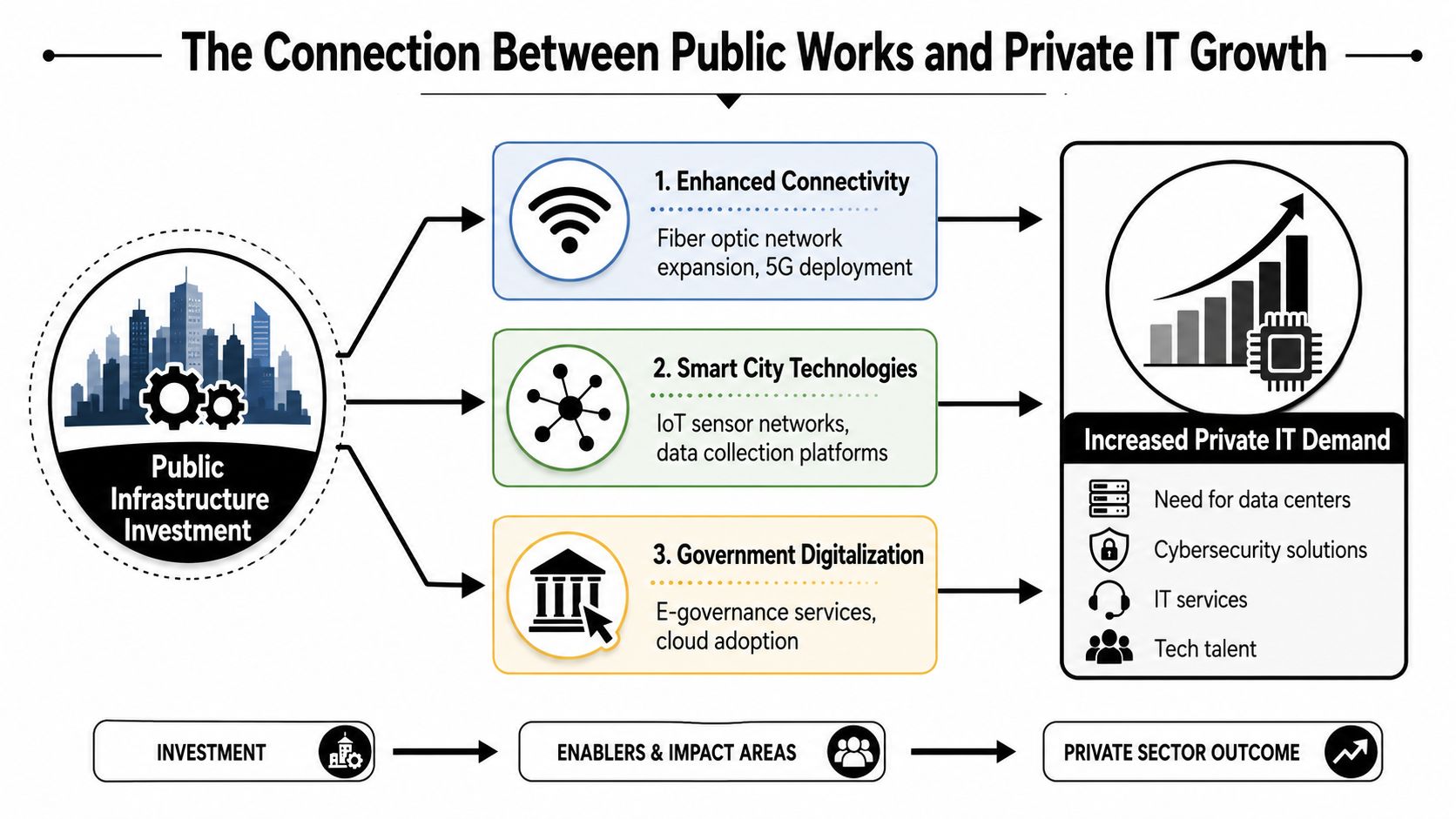
The Connection Between Public Works and Private IT Growth
Public infrastructure spending has a habit of changing private IT priorities faster than many firms expect. Once a city builds more connected transportation, sensor networks, and shared data systems, local businesses start operating in a market where faster response times, better visibility, and more reliable digital services become the baseline.
Atlanta's smart city efforts matter for that reason. The public project is not only a civic upgrade. It also resets what customers, employees, partners, and regulators view as normal digital performance.
How the spillover works
A smart city works like a rising operating standard for the region. As public systems become more data-driven, private organizations feel pressure to keep pace with the same rhythm.
That pressure usually shows up in three places first:
- Infrastructure refresh decisions. Teams revisit aging switches, wireless access points, firewalls, endpoints, and edge devices that were acceptable in a slower operating environment.
- Application and workflow expectations. Business units ask for stronger mobile access, faster reporting, tighter integrations, and better support for field operations.
- Lifecycle management discipline. More frequent upgrades create a larger stream of retired laptops, phones, drives, and network hardware that must be tracked and handled correctly.
The third point gets missed.
City modernization often gets framed as a growth story for software, telecom, or startups. For private sector IT leaders, it is also a lifecycle story. If your organization refreshes equipment more often to support new connectivity, analytics, and security requirements, you also inherit more end-of-life assets and more compliance exposure. That is one reason many firms review their retirement process alongside their deployment plan, especially when checking Atlanta e-waste laws and business compliance requirements.
Where the business impact becomes visible
Consider how this plays out across industries.
A logistics company may replace handhelds and vehicle-connected equipment sooner because real-time tracking becomes part of customer expectations. A healthcare provider may shorten endpoint refresh timing to support stronger security controls and more reliable mobile access. A manufacturer may upgrade plant-floor networking gear to reduce latency and improve monitoring. A professional services firm may standardize newer laptops and collaboration hardware because clients now expect digital interactions to work without friction.
Different sectors feel the pressure in different ways. The pattern is the same.
Public digital investment raises the cost of standing still. It pushes private organizations toward shorter asset refresh cycles, tighter inventory control, and closer coordination between procurement, security, infrastructure, and disposition. For IT managers, that means growth planning is no longer only about what to buy next. It also includes what will leave service next, how quickly it will accumulate, and whether the organization can retire it without creating risk.
Navigating Increased Operational and Compliance Demands
Growth creates work, but not all of that work is visible on an upgrade roadmap. The hidden load usually lands on inventory control, security review, legal coordination, and end-of-life handling.
That's especially true when organizations refresh equipment faster to keep pace with a more connected operating environment. More change means more retired assets. More retired assets mean more opportunities for mistakes.

The operational problems that expand first
Many teams see the front end of modernization. Fewer teams model the back end with the same discipline.
Common pressure points include:
- Device tracking gaps when laptops, phones, drives, and network equipment leave service faster than records are updated
- Data-bearing media risk when retired SSDs, hard drives, and backup devices sit in storage waiting for disposition
- Cross-site inconsistency when branch offices and departments follow different retirement processes
- Audit friction when chain-of-custody records are incomplete or scattered
A smart-city environment doesn't directly create these failures. It exposes them faster because the organization is changing more often.
Compliance is a process problem
Many companies still treat disposal as a facilities issue. For data-bearing devices, that view is too limited. Once an organization handles customer, employee, financial, healthcare, or operational data, end-of-life procedures become a governance issue.
If your retirement process depends on a pile of old equipment sitting in a locked room, you don't have a lifecycle program. You have delayed risk.
IT leaders in Georgia that need a more detailed compliance lens can review this guide to Atlanta e-waste laws and business compliance requirements.
The main takeaway is simple. More modernization usually means more disposal events, more coordination, and more documentation demands. If policy, vendor oversight, and data destruction standards stay static while refresh activity increases, risk increases gradually.
Why Secure IT Asset Disposition Becomes Mission Critical
At this point, the question isn't whether retired hardware needs to leave the building. The question is whether your organization can prove it handled that hardware securely and responsibly.
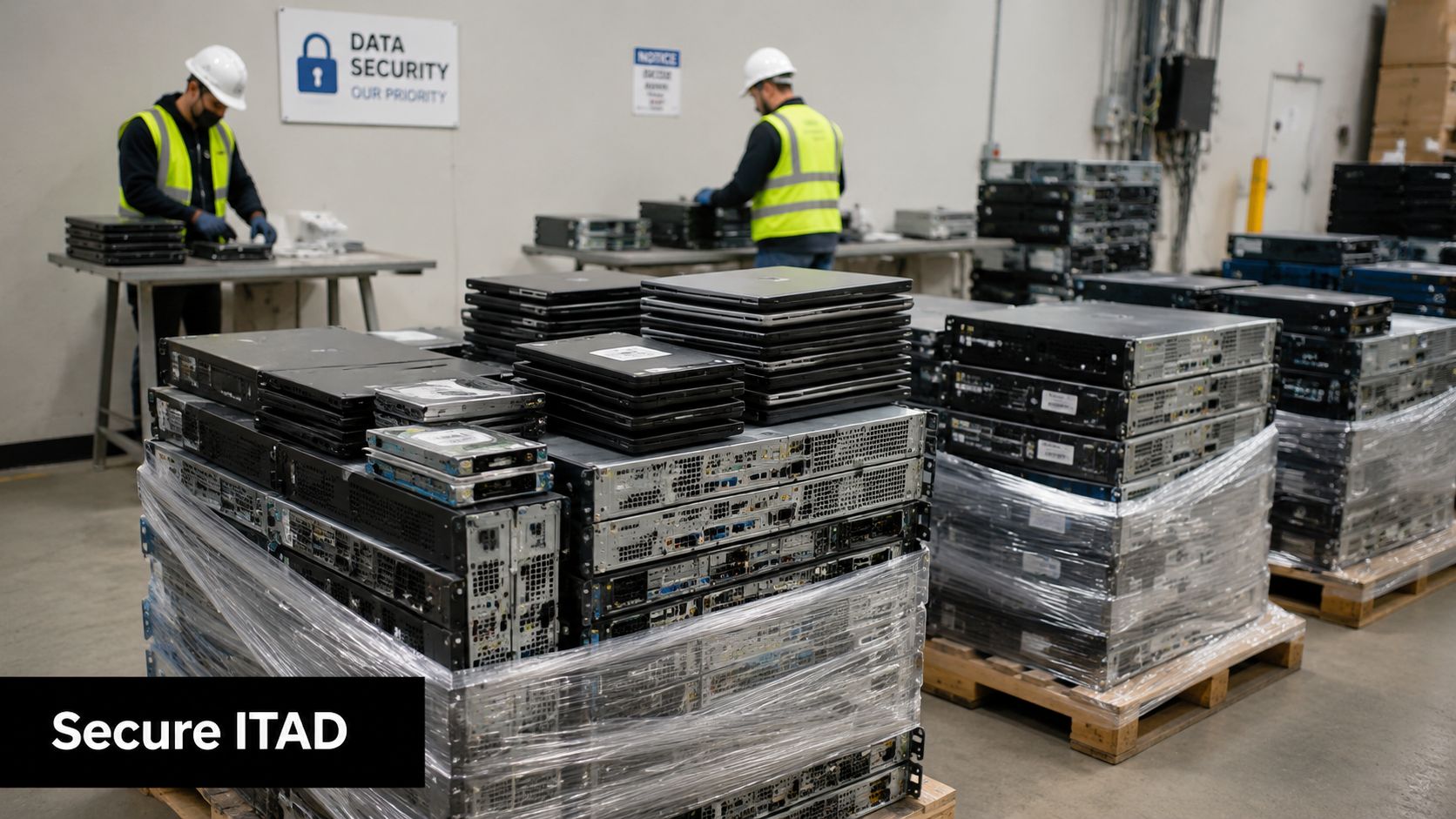
That's the difference between basic recycling and IT asset disposition, or ITAD. Recycling focuses on material handling. ITAD includes security controls, documented custody, data destruction, and reporting that supports internal governance.
What a serious ITAD process includes
A mature program usually covers several checkpoints:
- Asset identification: Systems are logged by type, status, and data-bearing profile before removal.
- Secure chain of custody: Devices are tracked from pickup through processing.
- Data destruction: Drives are wiped or physically destroyed according to policy and device condition.
- Disposition reporting: Certificates and serialized records support audits and internal reviews.
- Value recovery: Reusable assets may be remarketed when appropriate.
That structure matters most when the organization is decommissioning at volume, handling regulated data, or retiring mixed asset classes from multiple sites.
Why this becomes strategic
ITAD is often treated as the last administrative step in a project. In reality, it's a control point that affects legal exposure, cyber risk, procurement planning, and sustainability reporting.
If your team is reviewing providers, chain-of-custody documentation should be part of the first conversation, not the last. This overview of why ITAD chain of custody matters in Georgia is a useful starting point. One Atlanta-based option businesses use for secure data destruction, electronics recycling, and IT equipment disposal is Beyond Surplus, which also issues documentation to support compliance workflows.
An IT Leader's Checklist for Smart City Alignment
A smart response to Atlanta's digital trajectory doesn't require guessing what the city will do next. It requires stronger control over your own environment.
Start with the hardware you already own
Use this checklist to tighten readiness:
- Map asset classes clearly. Separate endpoints, networking gear, servers, storage media, AV systems, and specialty devices. Don't rely on one broad “IT equipment” category.
- Tag data-bearing devices first. Laptops, desktops, servers, backup units, and removable media need stricter retirement controls than non-data peripherals.
- Review aging infrastructure by location. Headquarters may be current while branch offices lag behind.
- Align procurement and retirement calendars. If one team buys and another team disposes, build a shared process.
Build vendor discipline before volume rises
Vendor review is where many organizations can improve quickly. Use a documented set of questions around pickup controls, downstream processing, destruction methods, and reporting. This vendor due diligence checklist can help structure that review.
A few practical questions to ask:
- What happens at pickup? Who signs, labels, and reconciles assets?
- How is data destruction documented?
- Can the provider support multi-site or phased decommissioning?
- What reports will procurement, security, and compliance each receive?
Practical rule: If legal, security, and facilities would answer those questions differently, your process isn't mature enough yet.
Match staffing to the complexity of modernization
Hardware lifecycle planning also depends on talent. If Atlanta's infrastructure momentum is increasing demand for automation, systems integration, and applied AI skills inside enterprise environments, hiring strategy becomes part of the roadmap. Companies expanding those capabilities may benefit from specialized resources such as AI engineer placement when internal recruiting can't move fast enough.
The key is alignment. Modernization, staffing, and disposition should be planned together, not in separate workstreams.
Secure Your Growth with Beyond Surplus
Atlanta's smart-city momentum creates a clear message for business technology leaders. Connectivity is becoming more foundational, data handling is becoming more operational, and retired hardware is becoming more sensitive.
That combination pushes IT asset disposition out of the back office and into core risk management. The organizations that handle it well usually do three things consistently. They keep accurate inventories, they standardize secure retirement procedures, and they choose vendors that can document every handoff.
For Atlanta companies managing office refreshes, data center cleanouts, laptop replacement projects, storage media destruction, or broader electronics recycling programs, the goal isn't just to remove obsolete equipment. The goal is to protect data, support compliance, and keep modernization from creating avoidable exposure.
A disciplined ITAD program also helps finance and operations teams. It reduces storage clutter, supports audit readiness, and creates a cleaner path for value recovery when reusable assets still have market life.
Contact Beyond Surplus for certified electronics recycling, secure IT asset disposal, data destruction, and business-focused ITAD support in Atlanta, Georgia and across the United States.


