

Remote offboarding breaks down fast when the asset never comes back. Only about 30% of company devices are returned on time from remote and hybrid workers, and organizations recover only 70 to 85% overall without a structured process, which means up to 30% of laptops can go missing according to Beyond Surplus on unreturned employee laptop costs. For an IT director, that isn't a shipping problem. It's a security gap, an inventory control failure, and a compliance issue that tends to surface during an audit, an incident review, or a messy termination.
That is why IT managers are outsourcing remote employee laptop recovery. The decision isn't just about mailing a return box. It's about moving a fragile, people-dependent process into a documented workflow with chain of custody, asset reconciliation, data sanitization, and final disposition records. Teams that already invest in effective remote employee management usually discover the same thing at offboarding time. Managing people well doesn't automatically recover hardware well.
The Growing Challenge of Remote Device Retrieval
Remote and hybrid work changed the location of risk. Devices now sit in homes, coworking spaces, cars, and spare bedrooms instead of inside a controlled corporate environment. When an employee leaves, IT has a short window to secure the endpoint, recover the asset, and close the record.
That window gets missed more often than many leaders expect. Internal teams are usually juggling account deprovisioning, identity controls, access reviews, replacement provisioning, and support tickets at the same time. Laptop retrieval becomes one more manual task in a crowded queue.
Why the process breaks in practice
A typical failure pattern looks like this:
- HR triggers offboarding late: IT learns about the departure after the employee has already disengaged.
- Instructions are vague: The employee doesn't know what to return, how to pack it, or where to send it.
- No one owns follow-up: Shipping labels go unused and reminders stop after one email.
- The asset record stays open: Finance, compliance, and security each have a different version of the truth.
Practical rule: If recovery depends on one help desk technician remembering to chase a former employee, it isn't a process. It's an exception waiting to become a loss.
Outsourcing entered this space because the old in-house model doesn't scale cleanly across dispersed workforces. What used to be a local handoff is now a nationwide retrieval problem with legal, security, and financial implications attached.
Key Drivers for Outsourcing Laptop Recovery
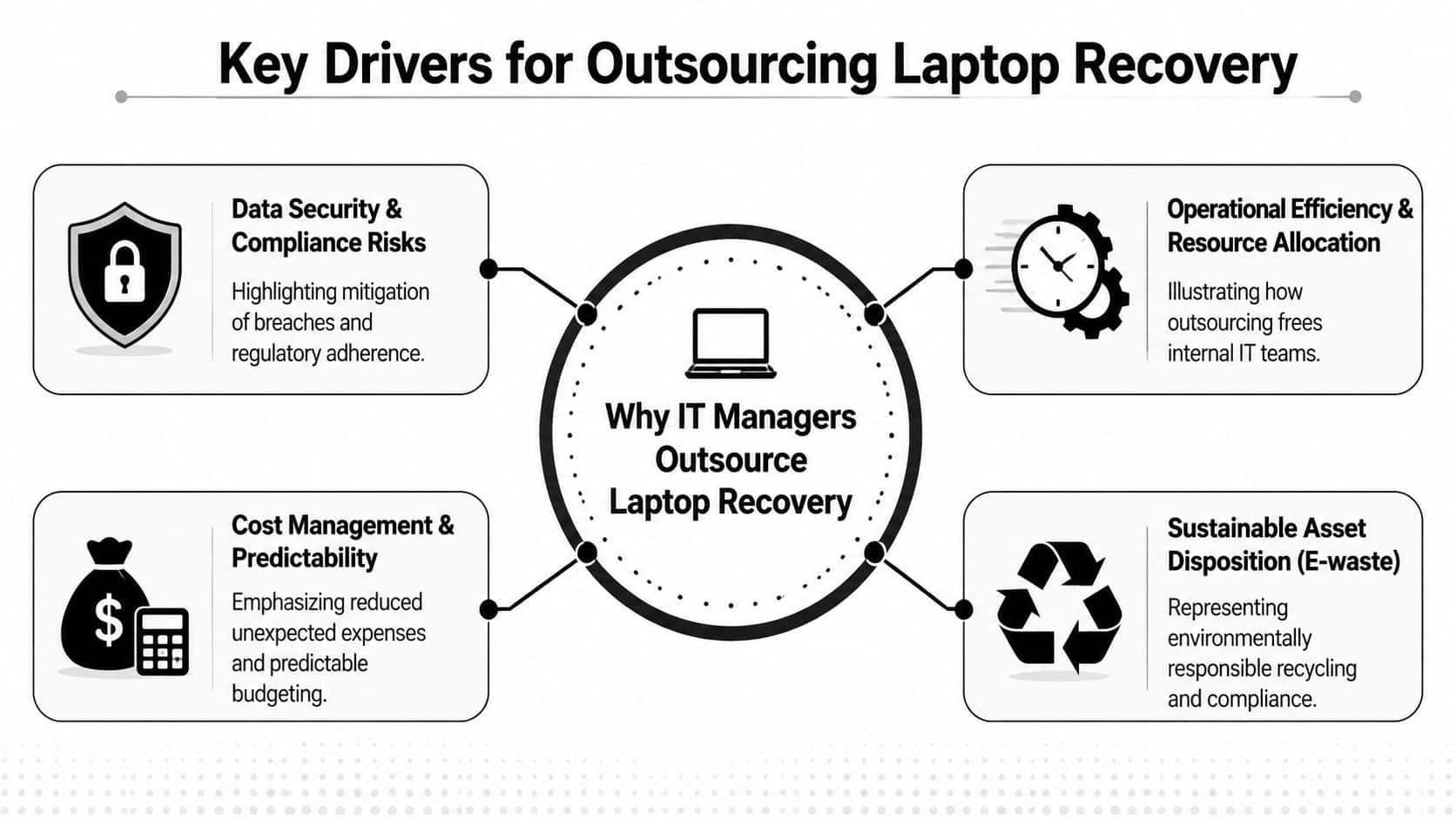
The strongest outsourcing decisions usually come from four pressures at once. Security drives urgency. Compliance drives documentation. Logistics drives process design. Cost drives executive approval.
Security risk pushes the decision first
An unrecovered laptop is a live endpoint until IT can prove otherwise. Even if access is disabled, locally stored files, browser data, cached credentials, and unmanaged peripherals can still create exposure. Offboarding isn't complete when the account is closed. It's complete when the device is either back under control or formally dispositioned.
This is why mature programs tie recovery directly to security operations. The device status belongs in the same conversation as identity revocation, MFA reset, and access removal.
Compliance requires records, not assumptions
Over 80% of unused corporate devices never follow a compliant ITAD path, which leaves organizations exposed on data handling and chain of custody, as Evercycle notes in its guidance on collecting company equipment from remote employees. A certified vendor changes the output of the process. Instead of an email trail and a tracking number, IT gets intake records, disposition decisions, and certificates of recycling or data destruction that support compliance and transfer liability under rules such as the FTC Disposal Rule.
For regulated organizations, that paperwork isn't administrative overhead. It's evidence.
Logistics is where internal teams get stretched
Internal IT can recover a few laptops manually. It struggles when departures happen across states, time zones, and employment types. Packaging, labels, reminders, inspections, serial number checks, and transit exceptions consume time that senior technical staff shouldn't spend.
Outsourcing improves return rates by 30% through simplified processes like pre-paid shipping and clear employee communication, turning a messy retrieval effort into a scalable operation, as outlined in the business benefits of professional laptop recovery services.
Cost becomes easier to defend
The comparison isn't vendor fee versus postage. It's vendor fee versus internal labor, inconsistent follow-up, lost asset value, compliance gaps, and security escalation. Specialized vendors also handle downstream decisions such as refurbishment, redeployment, recycling, or destruction, which keeps devices from sitting in a storage cage waiting for someone to decide what to do next.
A good recovery partner doesn't just get the laptop back. They close the entire lifecycle record.
The Outsourced Recovery Process Explained
Most IT leaders hesitate until they can see the workflow clearly. A qualified outsourced process should feel controlled, auditable, and boring in the best possible way.
What happens after the offboarding ticket opens
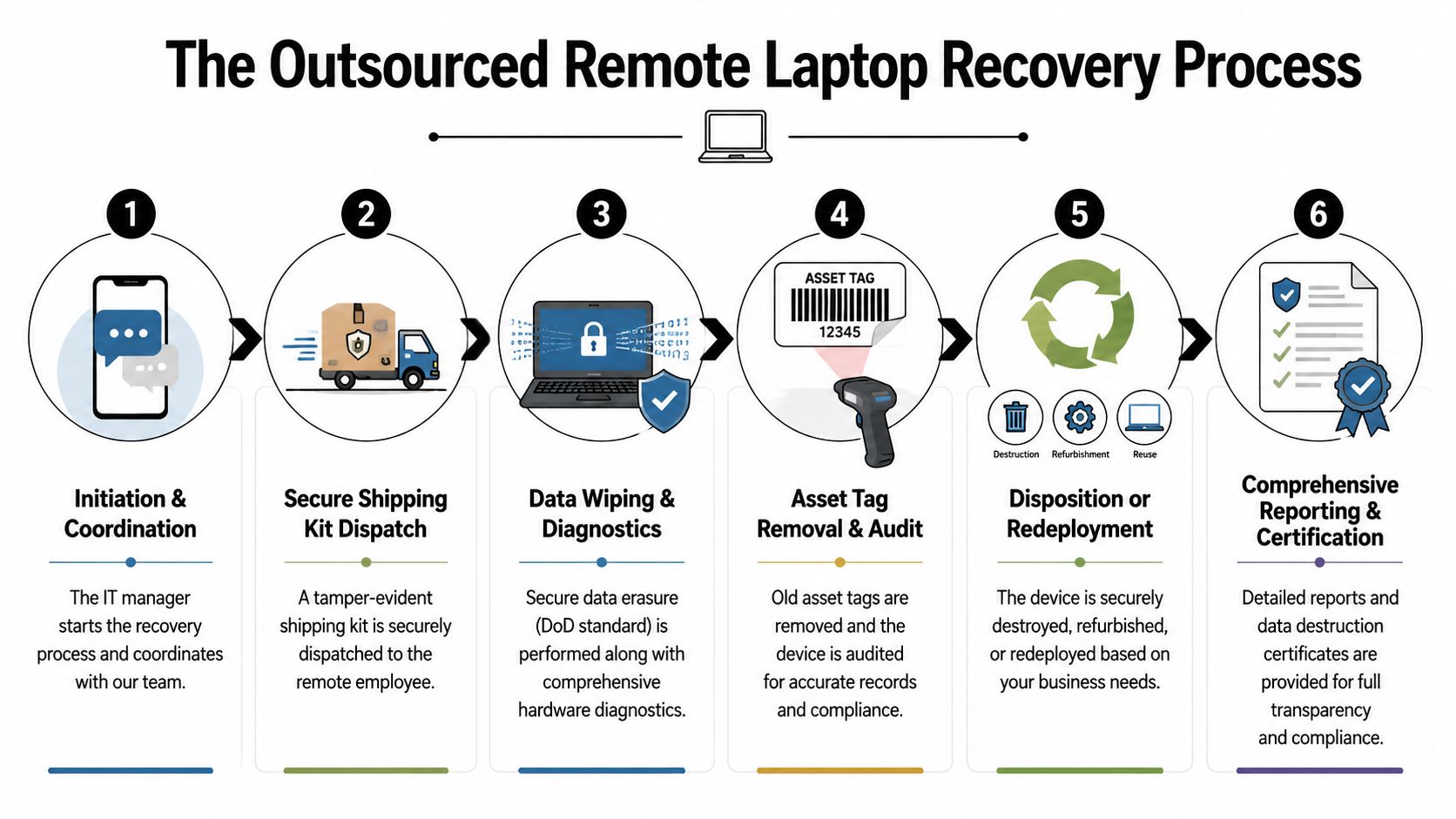
The process usually starts when HR or IT submits a departure notice with the employee name, shipping address, asset details, and return deadline. From there, the vendor takes over communications and logistics. The former employee receives instructions, a pre-paid kit or label, and a clear list of what must be returned.
Tracking starts immediately. That matters because IT needs visibility before the device arrives, not after it disappears into a carrier network.
A practical reference point for this model is how automated logistics improve remote employee laptop returns, where automation removes much of the manual follow-up that slows internal teams down.
Where data protection actually happens
A best-practice workflow uses a dual-layer data sanitization protocol, with a remote wipe upon termination when possible and a second factory reset or certified wipe after physical receipt. That sequence reduces risk during transit and closes the gap left by incomplete remote resets.
That second step is the one many internal processes miss. Teams assume the remote command solved the problem. In practice, the physical device still needs to be verified, wiped correctly, and documented.
If the wipe can't be evidenced and the asset can't be reconciled, legal and compliance teams will treat the device as unresolved.
What the vendor does after intake
Once the laptop reaches the facility, the operational work becomes straightforward but important:
- Inspect the device: Confirm serial number, condition, and accessories against the asset record.
- Reconcile the inventory: Match the return to the original assignment and note any exceptions.
- Sanitize the data: Apply the approved wipe or destruction workflow.
- Route the asset: Decide whether it should be redeployed, refurbished, recycled, or destroyed.
- Issue final records: Provide asset-level reporting and any required certificates.
One example in this category is Beyond Surplus, which offers nationwide laptop recovery with prepaid kit dispatch, tracked transit, intake reconciliation, and secure data sanitization or destruction. That kind of end-to-end scope is what separates an ITAD recovery partner from a basic shipping service.
How to Select the Right ITAD Recovery Partner
Choosing a vendor for remote recovery isn't the same as choosing a parcel carrier or a generic reverse logistics firm. You need a partner that can defend your process to security, legal, finance, and audit teams.
What to evaluate before signing
Use this checklist to screen vendors:
| Criterion | Why It Matters | Look For |
|---|---|---|
| Certifications | Certifications indicate the vendor follows recognized ITAD and data destruction controls. | R2v3, e-Stewards, NAID AAA, or equivalent documented standards |
| Chain of custody | You need defensible records from request through final disposition. | Asset-level tracking, serialized intake, documented custody transitions |
| Data sanitization workflow | Remote wipe alone isn't enough for many environments. | Verified post-receipt wipe or destruction process, with reporting |
| Nationwide logistics | Remote teams create a distributed recovery problem. | Prepaid kits, carrier coordination, return tracking, exception handling |
| Reporting quality | Audit readiness depends on clear records. | Real-time dashboards, inventory reconciliation, exportable reports |
| Value recovery capability | Recovery should include resale or redeployment where appropriate. | Testing, refurbishment, buyback, redeployment support |
| Legal awareness | Device policies can create liability if applied uniformly across states. | Escalation process, documented policy guidance, coordination with legal and HR |
A more detailed due diligence framework is available in this vendor due diligence checklist.
What separates a strategic partner from a shipping coordinator
Ask how the vendor handles exceptions. The answer usually tells you everything. If an employee ignores the first return request, if a device arrives damaged, or if the serial number doesn't match the assigned asset, the vendor should have a documented escalation path.
Also ask for sample reports. Many providers say they offer reporting, but what IT receives is a spreadsheet export with inconsistent notes. That won't satisfy an auditor or a procurement review.
The right partner reduces ambiguity. The wrong one adds another dashboard and leaves your team to interpret it.
Calculating the ROI of Outsourced Recovery
The mistake many organizations make is treating laptop recovery as a pure expense line. That view ignores labor displacement, risk reduction, and recovered asset value.
The cost side is simpler than it looks
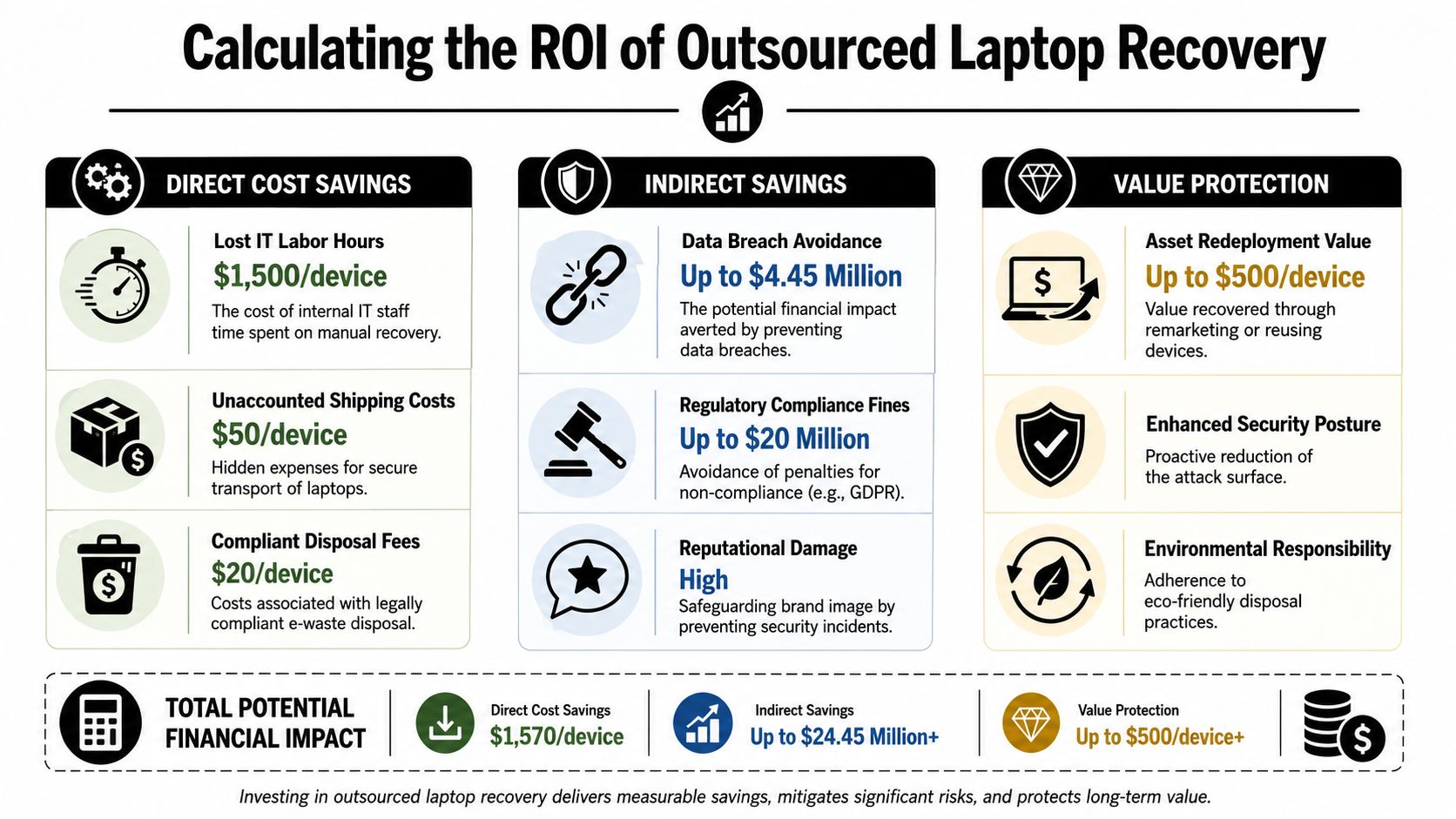
Typical outsourcing costs range from $80 to $200 per device for U.S. shipments. On its own, that can look like one more offboarding cost. In practice, it often replaces several hidden internal costs at once: technician time, coordination with HR, shipping administration, inspection labor, and ad hoc disposition work.
The cleaner way to evaluate the fee is to ask what work disappears from your internal queue and what unresolved risk disappears with it.
The overlooked return comes from asset value
The economics of laptop recovery change. The $80 to $200 per-device outsourcing cost is often recouped or exceeded, because 42% of returned laptops retain 70% or more of their original value. Vendors with refurbishment capabilities can turn a $150 recovery cost into a $200 net gain per device, according to Unduit's remote employee laptop return service guide.
That doesn't happen with every asset. It does happen often enough that recovery should be discussed with procurement and finance as a value-preservation function, not just a security expense.
A practical way to frame ROI internally
Use three buckets when presenting the business case:
- Direct operational return: Internal staff spend less time on logistics, chasing shipments, and reconciling assets.
- Risk avoidance: Legal, security, and compliance teams get a stronger record if a device is disputed, lost, or audited.
- Residual value capture: Returned assets can be redeployed, refurbished, or remarketed instead of written off.
The strongest programs don't treat offboarding as the end of the asset lifecycle. They treat it as the point where value is either recovered or lost.
Navigating Legal Risks and Compliance Mandates
Many teams assume the legal question is simple. The laptop belongs to the company, so IT can wipe it remotely, recover it later, and close the file. That assumption can create avoidable exposure.
Why standard wipe policies can create nonstandard liability
A remote wipe may be operationally sensible, but policy has to match jurisdiction and employment context. The legal risk is highest when organizations apply one national rule to devices used across multiple states, especially when employment agreements, deductions, or conditional use terms vary.
That is one reason specialized partners matter. They don't replace legal counsel, but they usually force the right questions early. Who owns the device. What does the employee agreement say. What records prove authorization. When should legal approve a hold, a wipe, or an escalation.
For complex departures, especially where misconduct, withholding, or disputed property is involved, organizations sometimes also coordinate with teams that understand evidence preservation and fact development, such as corporate private investigations, before making aggressive recovery moves.
Documentation is the compliance product
Over 80% of unused corporate devices never follow a compliant ITAD path, which is exactly why certified recovery matters. When a vendor issues official certificates of recycling and data destruction, the organization gains a cleaner liability transfer and a defensible closeout record under frameworks such as the FTC Disposal Rule, as described in Evercycle's guidance cited earlier and in this review of why unreturned company laptops create compliance risks.
For healthcare, finance, government, and education, this has a practical effect. Audit teams want evidence, not intent. They want to see where the device went, how the data was handled, and who signed off at each handoff.
Compliance isn't the policy PDF in your handbook. It's the record you can produce when someone asks what happened to a specific serial number.
Take Control of Your Offboarding Asset Lifecycle
Remote laptop recovery used to be a minor operational task. It isn't anymore. It now sits at the intersection of endpoint security, legal exposure, asset accounting, and ITAD governance.
That explains why IT managers are outsourcing remote employee laptop recovery. The decision gives IT a repeatable retrieval process, gives compliance a chain of custody, gives finance a path to value recovery, and gives leadership a more defensible offboarding program.
The best outcome isn't just getting more devices back. It's gaining control over what happens from termination notice through final disposition, with fewer unresolved assets and fewer policy gaps left for internal teams to clean up later.
If your team needs a documented process for remote laptop retrieval, secure data destruction, and final ITAD reporting, contact Beyond Surplus for certified electronics recycling and secure IT asset disposal.


