

You're probably looking at a floor full of gear that still has value, a lease clock that doesn't care, and an auditor who wants proof before anyone signs off. That's the shape of a Data Center Equipment Buyback Guide in practice. The mistake is treating buyback like a quick quote exercise, because the risk sits in scope control, data handling, and the paper trail that follows every rack that leaves the room.
A disciplined buyback program starts with one blunt question, what are you selling, and under what controls. If you answer that badly, you'll lose money on idle assets, create chain-of-custody gaps, and invite settlement deductions later. If you answer it cleanly, you can turn retirement into a controlled recovery process instead of a rushed liquidation.
Table of Contents
- Mapping the Decision Before You Start a Buyback
- What Actually Drives Buyback Value in 2026
- Auditing and Triaging Your Data Center Inventory
- Securing Data Destruction and Chain of Custody
- Packaging, Deinstallation, and Logistics Planning
- Negotiating Buyback Contracts and Payment Terms
- Tracking Reports, Compliance, and Long-Term Outcomes
Mapping the Decision Before You Start a Buyback
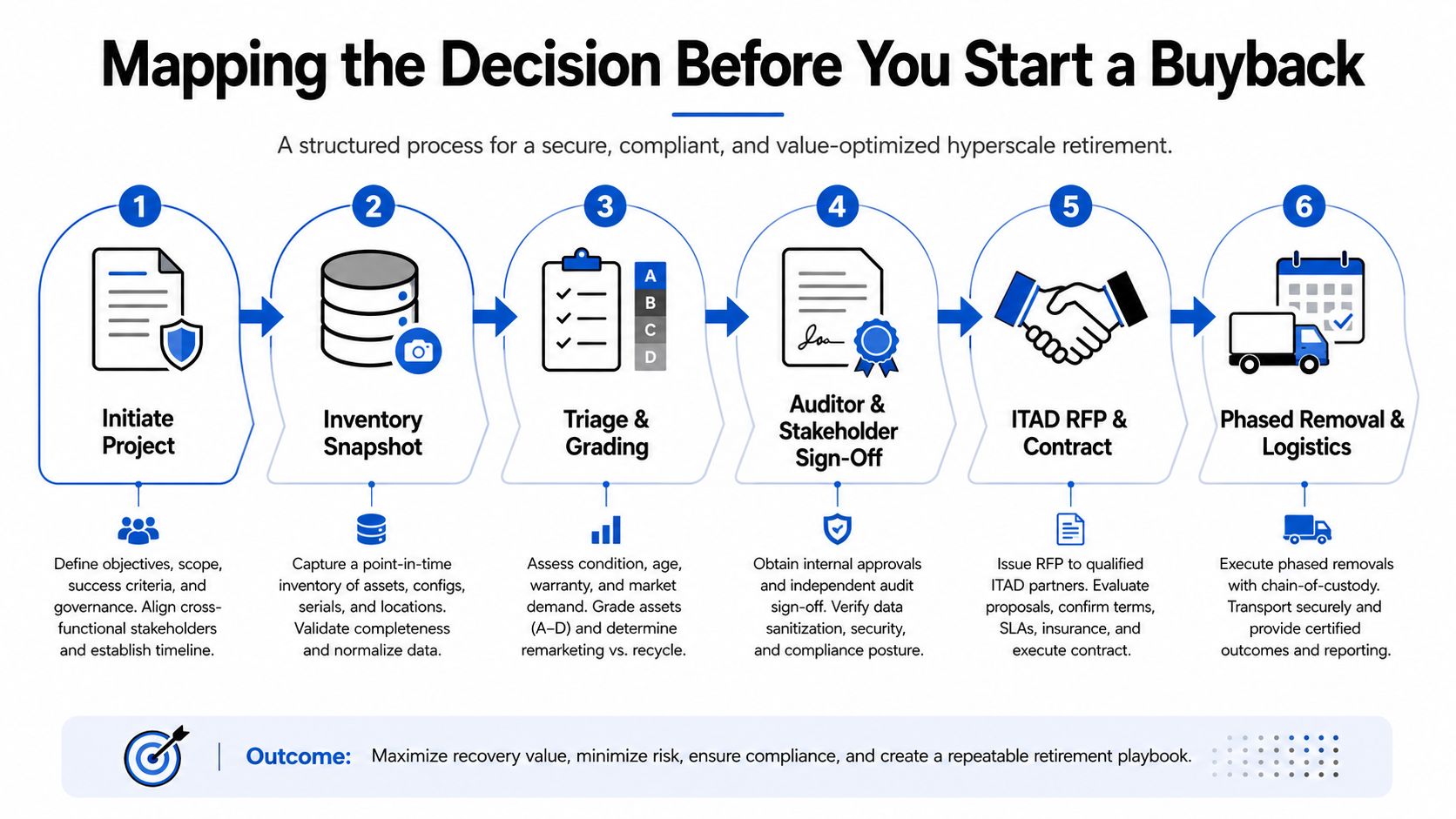
A hyperscale team retiring thousands of servers across two quarters doesn't have a “sell old hardware” task. It has a controlled end-of-life project with auditors, facilities, finance, and security all pulling on the same timeline. The first mistake is letting quotes arrive before the scope is locked, because once assets start sitting idle, value slips and the room keeps costing money.
Lock the scope before the first bid
Start by deciding whether the project covers a full rack, a partial row, or a single vendor family. That choice changes the pricing conversation immediately, because a mixed lot of current-gen compute, legacy storage, and oddball networking gear is not one market. It's three markets with different buyers, different timing, and different tolerance for missing parts.
Then tie the timing to the blockers, lease end dates, power cutovers, and audit deadlines. If auditors want destruction certificates before the lease closes, that requirement belongs in the project charter on day one. The same goes for internal stakeholders, security owns sanitization, finance owns recovery targets, and sustainability owns downstream disposition language.
Practical rule: if the scope is still fuzzy, don't ask for a final buyback number. Ask for a scoped assessment first.
The project charter should also define whether you'll run a single ITAD or a competitive bid. A competitive bid can sharpen pricing, but only if every bidder receives the same inventory, the same grading logic, and the same removal window. For a helpful primer on how ITAD is typically structured, see Beyond Surplus's IT asset disposition overview.
One more thing matters here, and it gets ignored too often. Buyback planning should be part of the same documentation workflow you use for change management and evidence retention. If you need a clean way to compare a working data room with a simple PDF handoff, this guide on data room versus PDF link use is worth your time.
What Actually Drives Buyback Value in 2026
The price you get is usually not about how old the rack looks. It's about how fast the market still wants that exact configuration. Generation, SKU specificity, memory type, and timing matter far more than the generic label on the front bezel.
Four levers that set the number
Refresh-cycle timing is the first one. Enterprises refresh on predictable waves, and that predictability is why assets move through resale or decommissioning pipelines in waves rather than randomly, as the Uptime Institute notes in its refresh-cycle discussion. The same source says many businesses refresh servers every 3 to 5 years, and the historical survey shift from a 3-year cycle to a 5-year cycle means the resale window is no longer uniform. That's why sitting on a lot after decommissioning is expensive, even before the buyer starts negotiating.
The second lever is exact configuration. A buyer does not pay for “a Dell server,” it pays for CPU generation, RAM size, drive type, warranty status, and whether the unit is complete. A server with current memory and storage configuration can clear a very different market than one with the same chassis and a stripped interior.
Third, storage and networking often behave differently from compute. Buyers can absorb some compute at scale, but storage arrays and network switches depend heavily on model-specific demand, port density, and support life. That's why a tidy asset list beats a broad description every time.
Fourth, AI-era scarcity and hyperscale refresh cycles distort pricing. The market can swing hard enough that two units with the same age and family name do not settle anywhere near the same value. If one carries the configuration buyers are chasing and the other doesn't, the spread can be dramatic.
| Recovery Value Drivers by Asset Category | Highest-Impact Driver | Secondary Driver | Typical Value Swing |
|---|---|---|---|
| Server compute | CPU generation and RAM | Completeness and support status | High |
| Storage arrays | Model specificity | Firmware and drive population | High |
| Network gear | Port mix and generation | OEM support window | High |
| GPU or memory-heavy nodes | Configuration demand | Current secondary-market scarcity | Very high |
A simple example: two identical-looking PowerEdge units can price very differently if one carries the exact memory and storage mix buyers want while the other is just a standard config. The lesson is direct, don't price from appearance. Price from the actual line-item spec and current market appetite.
For a broader condition review before you quote, Beyond Surplus's equipment condition assessment fits naturally into this stage. One more reason to stay disciplined, the ITAD market itself has matured into a large global industry, with estimates placing it at USD 25.31 billion in 2024 and projecting growth to USD 54.54 billion by 2030 under one methodology, according to Grand View Research. That growth only reinforces the same point, this is a market with real pricing discipline, not a scrap yard.
Auditing and Triaging Your Data Center Inventory
If your inventory is sloppy, every later step gets more expensive. Pricing, destruction, and logistics all depend on the same source of truth, and that truth has to be built before anyone touches a pallet jack. A strong triage process starts with the rack, not the buyer.
Build the list from the physical environment
Pull one inventory from DCIM or CMDB, then verify it with a rack walk. Capture SKU, serial number, RAM, CPU generation, drive count, rail kit presence, and firmware notes where they matter. Photograph every serial before movement, and keep those photos matched to the asset list so there's no dispute about what was on site.
Then grade the equipment. I use four bands because they force decisions instead of wishful thinking, A-grade for working current-generation gear, B-grade for prior-generation working gear, C-grade for parts-only or incomplete units, and D-grade for scrap. A fully populated NetApp shelf with current firmware belongs in a very different bucket from a half-populated Cisco MDS switch missing SFPs.
A defensible list is worth more than a fast pickup.
Document loose rails, cable kits, and accessories separately. If a server is complete, say so. If the rails are in a bin three aisles away, record that too. The buyer will price completeness, and the auditor will care about traceability.
Make triage visible to every stakeholder
A practical triage flow looks like this:
- Consolidate inventory from software and manual verification.
- Tag condition at the rack, with photos and serial capture.
- Decide routing into buyback, parts harvest, or disposal.
That process keeps the IT director, the finance lead, and the destruction vendor looking at the same record. If you want a second perspective on structured systems review, the auditing IT systems guide from IT Cloud Global, LLC is useful because it keeps the emphasis on evidence, not guesswork.
For planning inside your own environment, Beyond Surplus's inventory optimization page fits this same logic. The point is simple, no ITAD should be guessing what you own after the first truck arrives.
Securing Data Destruction and Chain of Custody
Sanitization is not one action, it's two deliverables. One is a drive that can be reused or resold after verified wiping. The other is media that must be Purged or Destroyed under NIST Special Publication 800-88 depending on sensitivity and the end-of-life path. That distinction belongs in the contract, not in a hallway conversation with a pickup crew.
Require serial-level proof, not generic certificates
The certificate has to match the audited inventory. If a drive serial number appears on the wipe report, it should be traceable back to the asset list, and if the media was destroyed, the certificate should say how and at what outcome level. NIST 800-88 recognizes Clear, Purge, and Destroy, and the method should match the intended reuse or disposal path.
Chain of custody should read like a signed handoff log, not a marketing brochure. Cage to truck, truck to receiving dock, receiving to processing bay, processing to disposition, every step needs timestamps and dual signatures. If the ITAD can't show that sequence, it's relying on trust where you need evidence.
Practical rule: if a vendor co-mingles equipment before sanitization, you've lost the evidentiary trail.
Demand segregated handling for regulated data sets. Drives carrying HIPAA, PCI, or GDPR-sensitive content should not share ambiguous workflows with general inventory. Also require the ITAD to show current R2v3 or NAID AAA credentials with audit dates that are still valid, not expired badges from a website footer.
For deeper buyer-side recovery context, MDrepairs' hard drive and data recovery services are a reminder of why destruction discipline matters. Once a drive leaves your control, you do not get to assume it's unrecoverable unless the certificate proves it.
| Sanitization Outcomes and Certificate Requirements by Media Type | Sanitization Outcome | Destruction Method | Certificate Field |
|---|---|---|---|
| Hard drives for reuse | Clear or Purge | Certified wiping with verification sampling | Serial number and wipe result |
| End-of-life magnetic media | Destroy | Physical shredding | Serial number and destruction method |
| Solid-state media | Purge or Destroy | Sanitize or shred per policy | Outcome and final disposition |
| Regulated sensitive media | Purge or Destroy | Segregated certified processing | Chain-of-custody reference |
For your own internal controls, Beyond Surplus's chain-of-custody page aligns with the same expectation, trace every handoff and keep the paper trail tight.
Packaging, Deinstallation, and Logistics Planning
Deinstallation should follow the audit, not the buyer's calendar. If the pull sequence drifts away from the inventory, reconciliation gets messy and settlement disputes become easier for the buyer to raise later. That's how value disappears after pickup, one gap in the record at a time.
Pull in the right order
Start with current-generation compute, then move to legacy networking and bulk storage. That order protects the highest-value assets from sitting around while lower-value gear slows the schedule. Never let bare drives leave the cage unless they've been logged for wipe or placed in a locked carrier with the chain-of-custody record updated.
Require a site walk before the first truck rolls. The ITAD should know aisle access, elevator limits, dock timing, and whether a floor-loaded truck or dedicated crate is needed. If the vendor shows up without a plan for the physical environment, it isn't ready for a real decommission.
Lock down transport details
Tamper-evident seals should be applied at the dock and photographed into the record. The truck should be insured, the driver should be named where the contract allows, and the loading window should fit your change window so a delayed truck doesn't block cutover. That sounds basic, but it's where many clean projects get strained.
A few controls are essential:
- Serial reconciliation: check every pallet against the audit before release.
- Condition photos: photograph the load before it leaves and keep the images with the settlement file.
- Weight tickets: verify pallet weights against the manifest so “received damaged” claims have something to measure against.
- Dedicated handling: separate data-bearing media from general scrap in transit.
If you need help coordinating the removal side of a move, Beyond Surplus's data center logistics page fits this operational lane. Logistics is not just transport, it's evidence management with wheels.
One clean pickup with the right paperwork is worth more than three rushed pickups with vague notes. That's the part teams learn the hard way.
Negotiating Buyback Contracts and Payment Terms
Stop treating a one-page quote like a real agreement. A buyback deal needs a master buyback agreement that names the ITAD, defines the asset classes, and ties pricing to a clear grading rubric. If the grading language is loose, the settlement will be loose too, and the buyer will control the interpretation.
Put the pricing logic in writing
State whether pricing is per unit, tied to a percentage of fair-market value, or built on a hybrid model. Put the grading rubric in an exhibit so Grade B means the same thing to your team, the buyer, and the resale channel. That closes the door on the common bait-and-switch, where a quoted lot gets downgraded after pickup.
Set payment within ten business days of acceptance, not pickup. Acceptance should mean the inventory reconciles, the certificates line up, and the serialized destruction records match the audit. A holdback can work, but only if it is tied to missing evidence and releases automatically once the records clear.
If the contract lets the buyer settle before the certificates arrive, you are financing the vendor's paperwork delay.
Protective language matters as much as price. Liability should transfer at the dock, but indemnification has to cover data breaches traced to mishandled assets. Add a cure period for missing or substituted items, refuse right-of-return language without a clear condition threshold, and reject any clause that nets recycling credits against your payment.
If you expect volume over time, ask for most-favored pricing. If the buyer gives a better offer next quarter for the same class of hardware, that better pricing should apply to you, not just their pipeline. The buyback market moves enough that loose language leaves money on the table.
If you are comparing proposal language to a broader ITAD workflow, Beyond Surplus's IT equipment disposal page shows the operational side that has to line up with the legal side. For contract negotiation, the better fit is Beyond Surplus's chain-of-custody page. The deal should reward clean scope, clean documentation, and clean settlement, not optimism.

Tracking Reports, Compliance, and Long-Term Outcomes
The project is not done when the trucks leave. It's done when every line item in the inventory has a matching certificate, every payment line reconciles, and the finance team can use the results in the next refresh decision without re-litigating the last one. That's the difference between a one-off disposal and a repeatable buyback program.
Demand a closed-loop report set
Every ITAD should return an itemized asset list with serial numbers, sanitization certificates linked to the original inventory, destruction certificates for media that wasn't sanitized, weight tickets for recycling streams, and a final settlement matched to PO line items. If any of those pieces are missing, the record is incomplete. A clean report set protects both compliance and revenue recognition.
The reporting also has to feed the rest of the business. Finance needs it for asset tracking, security needs it for audit trails, and sustainability needs it for downstream disposition records and vendor destinations. That's especially important when the e-waste story becomes part of ESG disclosure.
Turn one project into a better forecast
Treat the ITAD's reporting cadence as a contract term, not a courtesy. Then run a post-decommission review that compares quoted recovery against actual recovery, by model, lot size, and logistics lane. The point is not blame, it's building a better baseline for the next refresh wave.
Global e-waste reached 62 million tonnes in 2022 and is projected to rise to 82 million tonnes by 2030, according to the Global E-waste Monitor 2024 resource. That scale matters because only about 1% of rare earth element demand is currently met by e-waste recycling, which means good disposition processes still leave enormous value on the table if they're poorly executed.
| Standard ITAD Buyback Reporting Deliverables | Compliance or Business Use | Acceptable Format |
|---|---|---|
| Itemized asset list | Audit reconciliation and asset tracking | Spreadsheet or signed report |
| Sanitization certificates | Data security and compliance proof | Serialized certificate set |
| Destruction certificates | End-of-life media verification | Serialized destruction record |
| Weight tickets | Recycling and settlement support | Scanned transport record |
| Final settlement report | Finance closeout and PO matching | Signed statement with line items |
A 30-day review should end with one decision, whether the next refresh cycle should be sold earlier, segregated more tightly, or contracted with different pricing logic. That's how a buyback process becomes an operating discipline instead of a scramble.
Beyond Surplus handles data center decommissioning, secure IT asset disposal, and buyback for businesses that need the paperwork right as much as the payout. If you're planning a server refresh, a rack liquidation, or a full decommission, visit Beyond Surplus and ask for a structured quote built around inventory, chain of custody, and serialized reporting.


