

At 2 a.m., the rack is already half emptied, the carrier window is closing, and someone has a clipboard open beside a row of Catalyst switches that all look “too good to scrap.” That's the moment Cisco equipment recycling stops being a housekeeping task and becomes an operational decision with compliance, value recovery, and chain-of-custody all on the line. If the gear powers on, it may still belong in a reuse-first path. If it doesn't, or if the data story is messy, it needs a documented route to destruction or recycling that won't blow up the audit trail.
Table of Contents
- Why Cisco Equipment Recycling Is an Enterprise Decision, Not Just an IT One
- Sorting the Fleet Before Anything Leaves the Rack
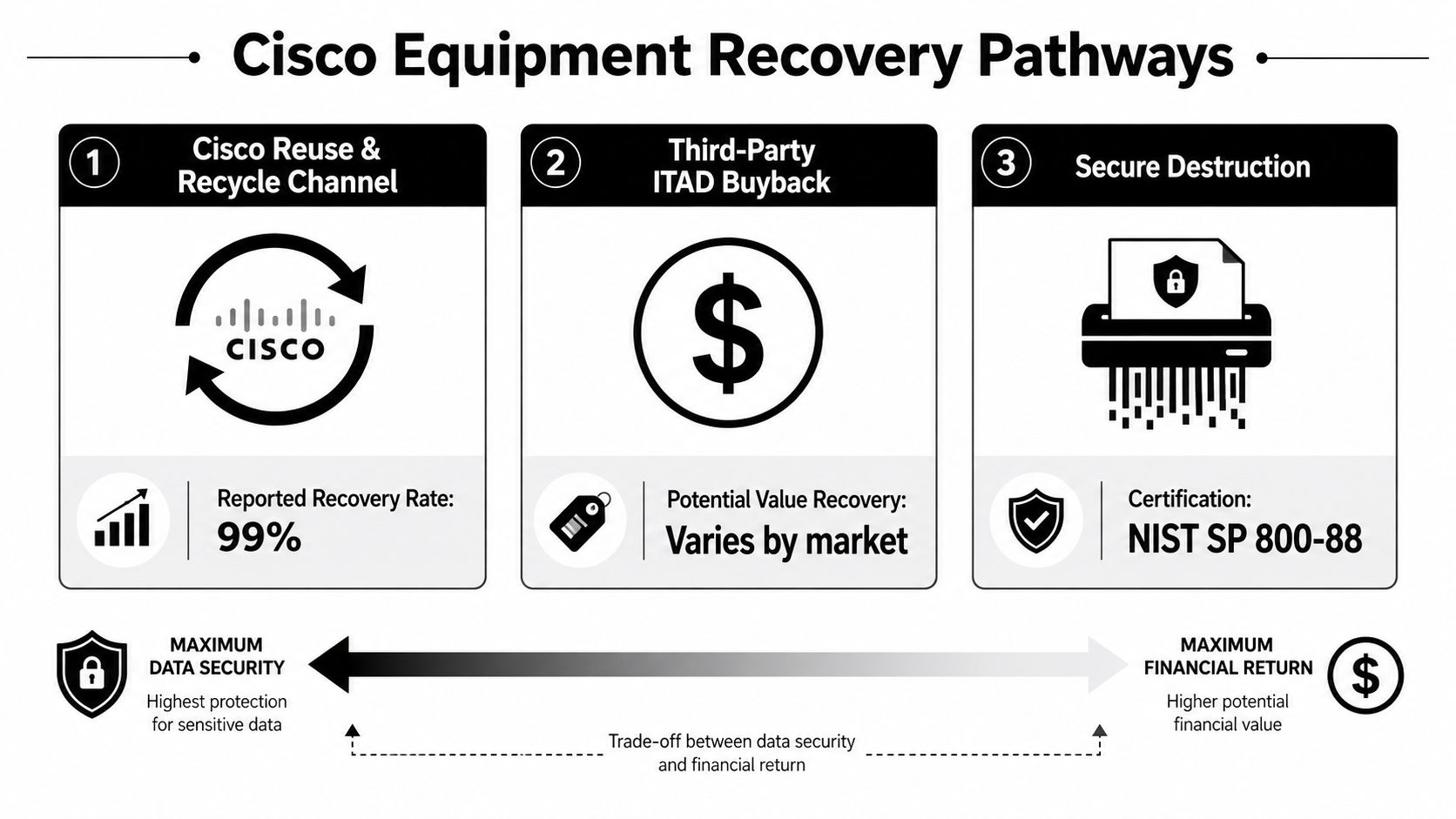
- Choosing Between Cisco's Reuse Path, ITAD Buyback, and Secure Destruction
- Sanitizing Data So Auditors Stay Quiet
- Mapping the Work to FTC, HIPAA, PCI, and FFIEC Expectations
- Packing, Pickup, and Chain of Custody From Site to Processor
- Your Cisco Equipment Recycling Readiness Checklist
Why Cisco Equipment Recycling Is an Enterprise Decision, Not Just an IT One
Cisco refreshes usually touch more than one team. IT sees the racks, procurement sees the return terms, security sees the sanitization risk, and finance sees residual value that can disappear if equipment sits too long or gets misrouted. Cisco's own takeback program is built to handle that complexity, with no-cost customer returns, global coverage for powered-on devices in 100+ territories and countries, and a product recycle pickup form available everywhere for equipment that can't power on Cisco Takeback and Reuse.
The stakes aren't abstract. Cisco says its reverse supply chain was designed to recover and reuse or recycle more than 99% of returned electronic equipment in major markets, and its FY09 disclosure said 0.44% of materials went to landfill, mainly packing waste such as broken pallets, wet cardboard, and shrink wrap Cisco Takeback and Reuse. That doesn't mean every enterprise should default to the Cisco channel, but it does show what a mature, documented recovery flow looks like.
Practical rule: if the gear still has resale value, the decommissioning plan should treat it as an asset first and a waste stream second.
The reason this becomes a cross-functional project is simple. A missed sanitization step can create a bigger liability than any buyback check, while a missed pickup date can strand gear that still had value. Cisco's long-running program, plus its reporting that it reuses or recycles nearly all returned equipment, makes it a strong benchmark for how disciplined end-of-life handling should look in an enterprise setting Cisco product lifecycle management. For an IT director, the job is to coordinate all of that before the rack leaves the building.
Sorting the Fleet Before Anything Leaves the Rack
The cleanest projects start with inventory, not with lifting hardware. Pull the CMDB, reconcile serial numbers against the original purchase or lease paperwork, and walk the rack with a flashlight before anyone disconnects power. If the paperwork says one thing and the chassis tag says another, fix that mismatch first, because it usually turns into a chain-of-custody problem later.
Triage by device, not by assumption
Cisco gear doesn't all carry the same risk profile. An ISR router with stored credentials is not the same as a spare switch that only held configuration fragments, and a UCS blade with embedded media is not the same as a chassis with no persistent storage. Meraki gear adds another layer, because cloud decommissioning has to happen in the dashboard before the hardware is just another box on a pallet.
The practical split is straightforward, even if the hardware mix isn't:
| Cisco Fleet Triage Matrix | Typical Data Stores | Powered-On Triage Feasible? | Recommended Return Path |
|---|---|---|---|
| Catalyst switches | Configs, credentials, MAC tables, PSK secrets | Often, if the device still boots | Reuse or wipe, then recycle or resell |
| ISR and ASR routers | Routing tables, credentials, VPN material | Often, if the platform is healthy | Wipe or destroy depending on policy |
| UCS blades and servers | Boot media, cached system data | Sometimes, if management access exists | Sanitize first, then reuse or recycle |
| Meraki-managed gear | Dashboard-linked credentials and tenant records | Yes, if decommissioned in the portal | Revoke access, then route to return or recycle |
| Damaged or non-booting units | Unknown, potentially residual data | No | Secure destruction or recycle pickup |
Use that matrix to decide what stays in the reuse lane and what gets pushed straight to destruction. Then document the result against the asset tag and serial before the first chassis moves.
The reason this front-end triage matters is timing. Cisco's own condition-based process distinguishes equipment that can still power on from equipment that cannot, and the workflow diverges from there. If you skip the assessment step, you lose the chance to preserve value on working gear and you also raise the odds of sending something sensitive into the wrong stream. For a quick condition review, Beyond Surplus publishes an equipment condition assessment guide that fits neatly into a decommissioning sprint.
Choosing Between Cisco's Reuse Path, ITAD Buyback, and Secure Destruction
Cisco's channel is built around reuse first. Cisco says returned products are evaluated for reuse, functioning items may be remanufactured, refurbished, repaired, and resold, and the remainder are de-configured, recycled, and recovered to minimize landfill disposal Cisco product lifecycle management. That model is ideal when the gear is healthy, the data story is clean, and the organization wants a predictable manufacturer-controlled path.
A third-party ITAD buyback can make more sense when finance wants faster settlement or when the fleet contains mixed vendor equipment that Cisco won't optimize as well as a broad-market processor. A processor that handles used Cisco telecom equipment can also add logistics support and value recovery on working hardware, which is useful when the refresh window is tight Beyond Surplus used Cisco telecom equipment buyers. The trade-off is obvious, third-party value recovery is market-driven, not manufacturer-directed, so the payout structure can differ from one lot to the next.
What actually decides the lane
Working Catalyst and ISR gear with no sensitive remnants often belongs in a reuse or buyback quote comparison. Devices with embedded boot media, questionable firmware states, or higher regulatory exposure should lean toward destruction, even if they still have residual market value. Cisco's own FAQ says returned equipment is stored securely before drives are cleared, and if a wipe fails, the device is repaired and reprocessed or securely destroyed Cisco takeback FAQ.
If the data risk is high enough to keep legal awake, the “best price” question comes second.
That's the core decision logic. Low-risk fleet refreshes can run parallel quotes. Regulated or uncertain assets should default to the path that gives you the strongest documentation and the least chance of a data exception. Cisco's own reporting shows the program is mature, but the right route still depends on your device class, your data sensitivity, and how much speed your decommissioning window really has.
Sanitizing Data So Auditors Stay Quiet
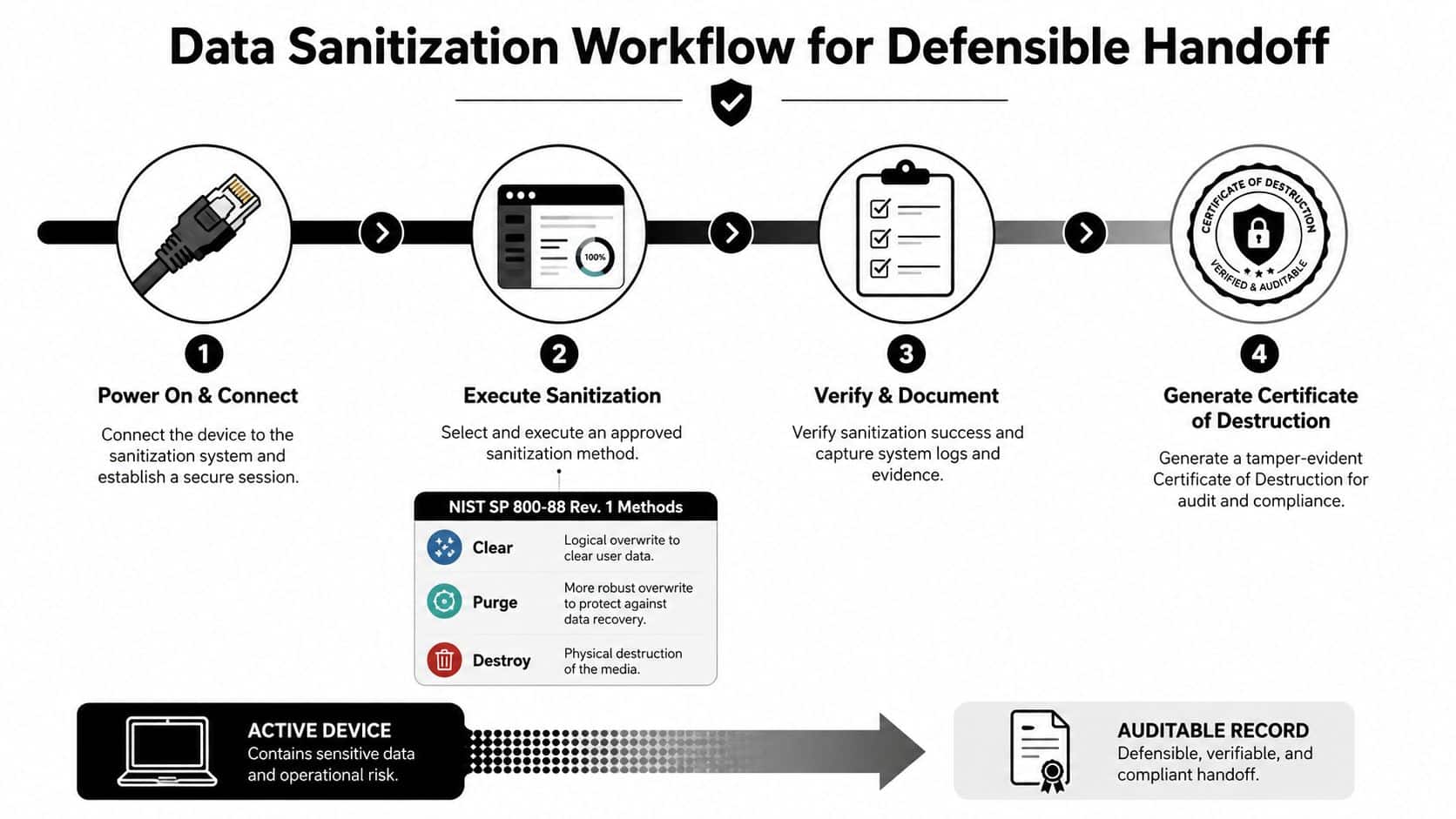
Cisco's own return workflow makes one point clear. A recycling request is not a data-sanitization strategy. Cisco says customers remain responsible for removing data before return, while it clears certain storage classes on its own terms, and its wipe software is certified to meet NIST SP 800-88 Rev. 1 media sanitization guidance Cisco takeback FAQ.
Build the wipe around proof, not intent
The basic flow should be boring, repeatable, and logged against each serial number. Boot the device, execute the approved wipe or crypto-erase method where the platform supports it, verify that it comes back clean, and capture the result before it leaves the rack. If the wipe fails, don't improvise. Send the unit to repair-and-reprocess or destruction, because a half-sanitized device creates more risk than value.
Cisco's operational split between reusable equipment and secure destruction on failed sanitization is the right pattern to copy Cisco takeback FAQ. That separation matters because it keeps the “can this be reused?” question from contaminating the “can this be trusted?” question.
For a defensible packet, the certificate set should include:
- Method used, clear, purge, or destroy
- Tool and version
- Operator ID
- Timestamp
- Pre- and post-verification results
If you want a framework that aligns with that discipline, Beyond Surplus also publishes a NIST SP 800-88 guide that fits the same operational logic.
On-site shredding buys you tighter control over exposure, but it slows the project and adds coordination. Off-site shredding is faster for the move-out crew, but it only works if your chain of custody is disciplined from the first pallet to the final certificate. In practice, the right answer is the one that leaves the auditors with evidence, not explanations.
Mapping the Work to FTC, HIPAA, PCI, and FFIEC Expectations
The compliance file gets cleaner when each rule maps to a specific artifact an auditor will request. For the FTC Disposal Rule, the question is whether reasonable measures were used to protect consumer information on retired equipment. For HIPAA, the focus is on device and media controls, especially when PHI may have touched a router, voicemail gateway, or attached storage. For PCI DSS, the issue is whether cardholder data was made unreadable before hardware left your control. For FFIEC, examiners look for due diligence, contract terms, and ongoing oversight of the processor, which is why many teams also review government electronics recycling requirements alongside internal policy.
Match the rule to the proof
Cisco gear often holds more than the obvious config. Catalyst supervisor engines, ASA platforms, and related network devices can store credentials or VPN material, so the evidence file should show what was checked and what was sanitized. If a device could not be sanitized in place, that fact should appear in the certificate packet, not in an internal note.
| Compliance Mapping for Cisco Equipment Disposal | Relevant Clause | Cisco Equipment Evidence Required |
|---|---|---|
| FTC Disposal Rule | Reasonable measures for disposal | Wipe or destroy record tied to serial number |
| HIPAA | Device and media controls | Sanitization log and custody trail |
| PCI DSS | Make cardholder data unreadable | Verified purge or physical destruction record |
| FFIEC | Due diligence and monitoring | Vendor contract, receipt confirmation, certificate packet |
Processor qualification matters too. EPA guidance recommends independent third-party certification for electronics recyclers, and that gives enterprises a concrete way to separate audited operations from vendors that only promise proper handling. Keep the paperwork tied to the shipment, the serials, and the final disposition record. The EPA electronics stewardship guidance supports that standard, especially for teams that need a defensible audit trail.
The goal is a packet that reads mechanically, not creatively. If the rule asks for reasonable disposal, the file should show the method used, the time stamp, the custodian, and the disposition result.
Packing, Pickup, and Chain of Custody From Site to Processor
The project gets real when the rack starts disappearing. Before anything moves, label each chassis in place, photograph it, bag loose modules separately, and capture the serial number against the asset tag while the unit is still installed. That sequence matters because once gear is on a pallet, small identification errors become big reconciliation problems.
Pack for carrier review, not for optimism
Use original Cisco boxes when they're available. If they're not, double-walled corrugated cartons with foam separation are the safer fallback, especially for line cards, transceivers, and other loose components that can rattle during transit. Pallets should be wrapped, sealed, and staged so the carrier can count units and spot tampering without opening every carton.
The handoff is where control either holds or fails. A signed manifest at pickup, tamper-evident seals in transport, and weight plus serial verification on receipt should all happen before anyone closes the loop. If the counts don't match, stop and reconcile before certificates are issued.
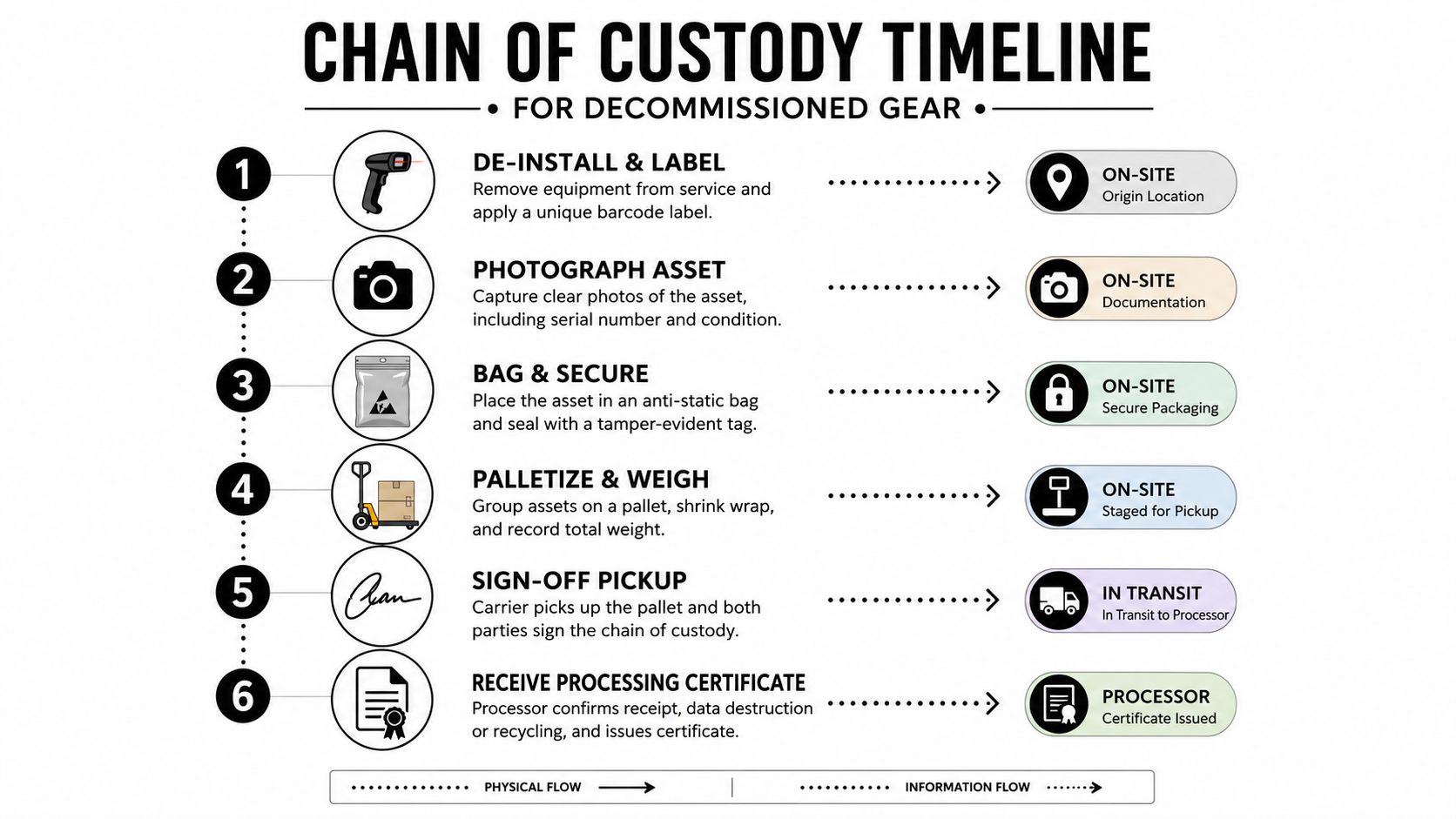
For national fleets, scheduled pickup with a vetted carrier gives you a clean bill of lading and a single handoff record. Atlanta-area teams with tight local timelines sometimes prefer drop-off because it keeps the equipment moving in company vehicles and shortens the chain. Either way, the certificate of recycling or data destruction should release only after the processor confirms what arrived and what was done to it.
If you want a tighter chain-of-custody template, Beyond Surplus publishes a chain of custody guide for IT asset disposal. The underlying rule stays the same, what you can't prove in transit will get questioned later in audit.
Your Cisco Equipment Recycling Readiness Checklist
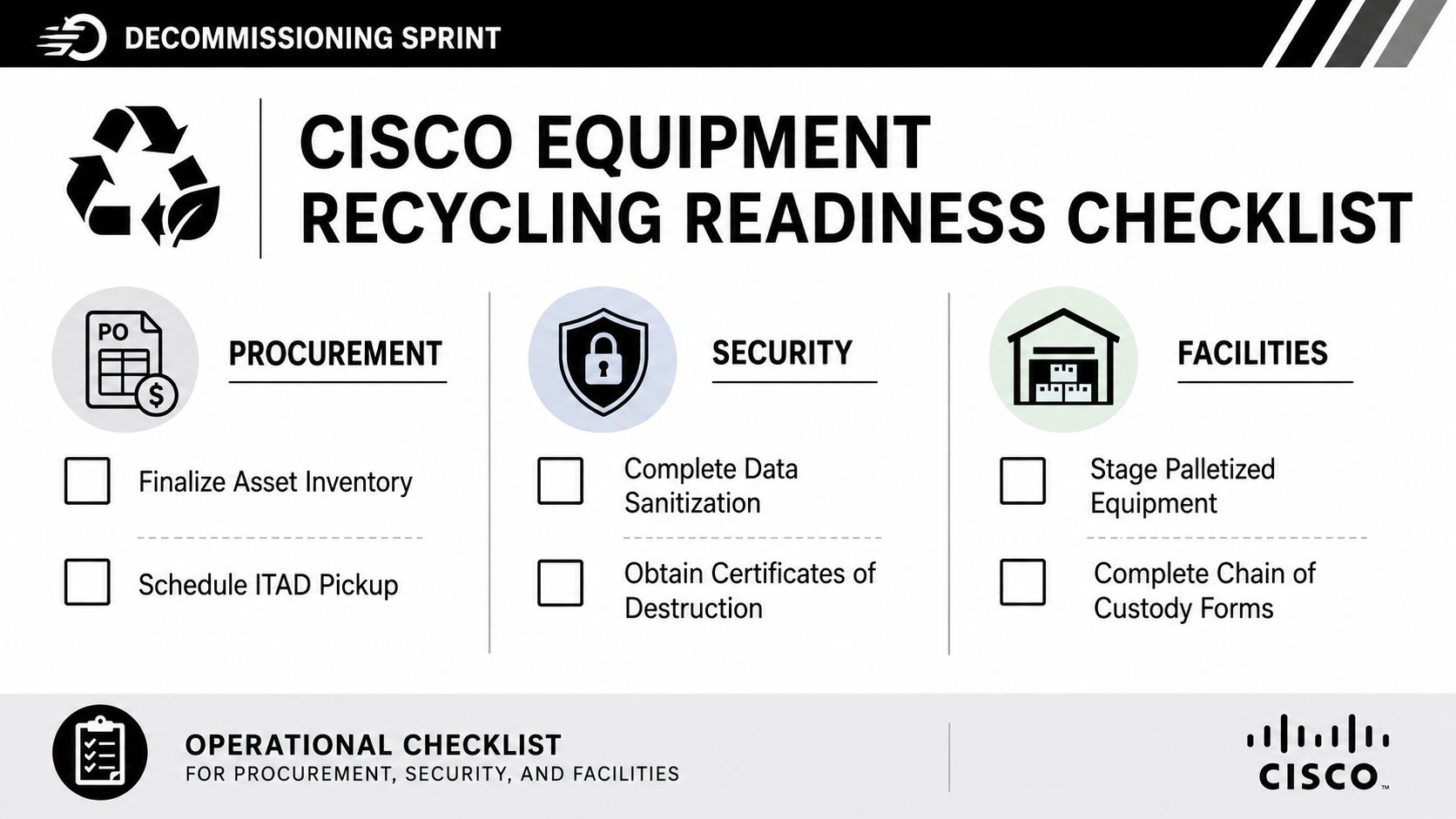
The best decommissioning teams use one checklist that procurement, security, and facilities can all sign without rewriting it for every refresh. Pre-decommission, capture the inventory hash, reconcile serials, classify media, and lock the lease-return or pickup deadline. Active decommission means you follow the power-down order, sanitize or shred by policy, photograph rack ports, and seal the lot in tamper-evident bags.
Post-decommission is where projects either close cleanly or turn into cleanup work. Reconcile the certificate packet, match asset value against the buyback or destruction settlement, and archive the audit log where legal and security can retrieve it later. If any serial is missing from the packet, treat it as an open issue, not a clerical note.
What each owner signs
- Procurement: finalize the asset inventory and settle the buyback or destruction terms
- Security: complete the NIST 800-88 purge attestation and hold the destruction proof
- Facilities: stage palletized equipment and complete the chain-of-custody forms
That same checklist can double as evidence prep for the FTC Disposal Rule, HIPAA, PCI DSS, and FFIEC because it tracks who handled the asset, how it was sanitized, and where the final disposition landed. Use it once, then tighten it after every refresh cycle. A living checklist catches the same mistakes before they become expensive ones.
Beyond Surplus handles Cisco equipment recycling, IT asset disposition, secure data destruction, and documented chain of custody for business environments that can't afford loose ends. If you're planning a Cisco refresh, compare your inventory, sanitize the data path, and move the gear through a process that leaves the audit trail intact. Visit Beyond Surplus to arrange certified electronics recycling and secure IT asset disposal for your next decommissioning project.


