

When your business needs to dispose of obsolete IT equipment, a quick search for electronics drop off locations might seem like the simplest solution. However, this consumer-oriented approach is a significant pitfall for any commercial enterprise, creating substantial security vulnerabilities and compliance gaps. For businesses, professional IT asset disposal is not about conveniently dropping off a box; it's a secure, documented, and compliant process designed to protect sensitive corporate data and mitigate liability.
Why 'Drop Off Locations' Are Unsuitable for Business E-Waste
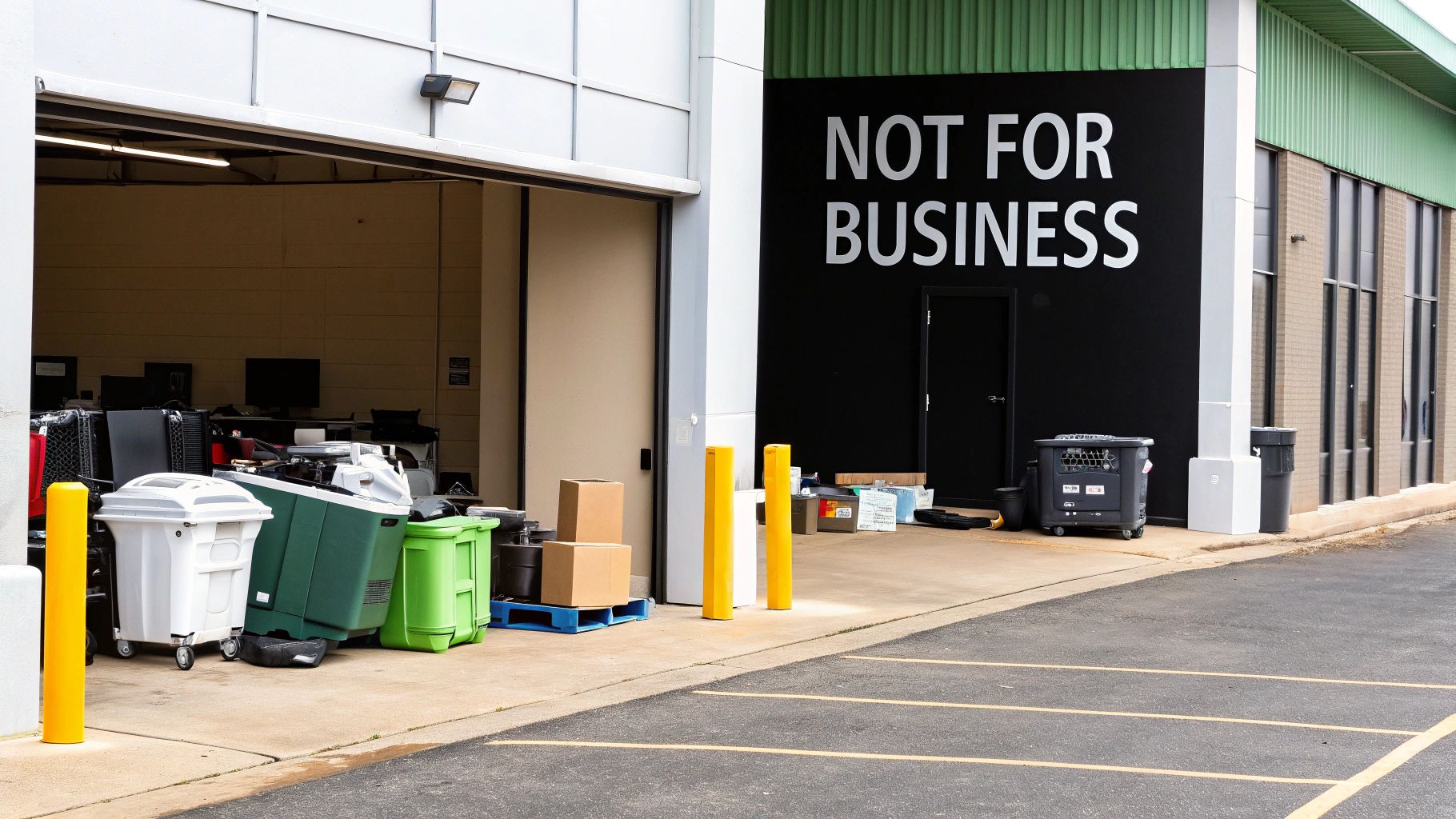
For any IT manager, facility manager, or business owner, the term "drop off" should be an immediate red flag. These collection points, typically found at retail stores or municipal waste sites, are designed exclusively for residential e-waste—a single old laptop, a consumer-grade printer, or a broken television. They are fundamentally ill-equipped to handle the volume, complexity, and stringent data security requirements of corporate IT assets, including computer recycling, IT equipment disposal, and data center decommissioning.
The global electronics recycling market is expanding rapidly, driven by increased collection points and stricter data privacy regulations. While beneficial for consumers, this growth highlights the critical divide between residential convenience and the absolute necessity for secure, commercial-grade disposal services.
The Critical Differences for Businesses
The primary issue is that business IT assets are repositories of sensitive information: customer data, financial records, employee files, and proprietary trade secrets. A simple drop-off provides zero guarantees regarding the secure handling and destruction of this data once it leaves your custody.
Key distinctions that make drop-off locations inadequate for businesses include:
- Data Security: Public drop-off points offer no certified data destruction services. Hard drives and SSDs containing confidential information are often left intact, creating a severe vulnerability for data breaches.
- Chain of Custody: There is no formal documentation tracking your assets from your facility to their final disposition. This lack of a paper trail leaves your company exposed to significant liability.
- Regulatory Compliance: Mandates such as the FTC Disposal Rule, HIPAA, and SOX require businesses to prove they have securely destroyed sensitive data. A simple drop-off receipt fails to meet this legal standard.
- Volume and Logistics: Businesses frequently retire dozens or hundreds of devices at once, including servers, networking gear, laboratory equipment, and medical equipment that drop-off locations are not designed to manage.
The most significant failure of the drop-off model for businesses is the complete absence of a secure, auditable trail. Without a Certificate of Destruction, a company cannot prove it acted responsibly, opening the door to regulatory fines, legal action, and severe brand damage.
The table below starkly contrasts the differing needs of business and residential disposal.
Business vs. Residential Electronics Disposal Needs
For businesses, the stakes are exponentially higher. While a residential drop-off prioritizes convenience, a commercial ITAD service must prioritize security, compliance, and accountability. This comparison clearly illustrates why a one-size-fits-all approach is insufficient for corporate needs.
| Consideration | Residential Drop-Off | Business IT Asset Disposal |
|---|---|---|
| Primary Goal | Conveniently discard 1-2 items | Securely manage and dispose of dozens or hundreds of assets |
| Data Security | No guarantee of data wiping; relies on the consumer | Certified data destruction (wiping, degaussing, shredding) |
| Documentation | Basic receipt, if any | Detailed inventory reports and a Certificate of Destruction |
| Chain of Custody | Non-existent; no tracking | Secure, documented transport from pickup to final disposition |
| Compliance | Not designed to meet any business regulations | Adheres to FTC, HIPAA, SOX, and other data privacy laws |
| Volume Handled | Low (a few personal devices) | High (pallets of servers, desktops, networking gear, etc.) |
| Value Recovery | None; items are simply recycled or trashed | IT asset recovery and revenue sharing opportunities are common |
As demonstrated, what is adequate for a household is completely inappropriate for protecting a business's interests.
A Professional Service Is a Necessity, Not a Luxury
Instead of asking, "Where are the nearest electronics drop off locations?" the correct question for any business is, "Who provides secure, on-site pickup and certified IT equipment disposal?" This shift in perspective is critical for effective risk management. Professional IT Asset Disposition (ITAD) services are engineered to address every business-specific need, from secure logistics and on-site data destruction to detailed reporting and compliance certification.
Partnering with a professional turns a disposal project from a logistical burden into a secure, compliant, and often profitable process. Understanding what to expect from a professional service versus a local recycling center is the first step toward developing a responsible IT asset management policy. A dedicated B2B service that comes to your facility is not merely convenient—it is an essential component of modern corporate governance and data security.
The Hidden Risks of Using Public Drop Off Points
Utilizing a generic electronics drop off location may seem like a quick and cost-effective solution, but for any business, it is a decision fraught with hidden dangers. The apparent convenience conceals a complete lack of security and accountability, placing your company’s most sensitive data at direct risk.
Consider this common scenario: an IT manager, tasked with clearing a storage room, loads a dozen old office PCs and a box of hard drives. He finds a retail collection bin, drops everything off, and considers the job done. Weeks later, the company's confidential client list and financial plans are discovered for sale on the dark web. The source? A "recycled" hard drive that was never properly wiped or destroyed.
The Data Security Nightmare
Public drop-off points are not designed for business-grade data security. They lack certified technicians to perform data erasure, degaussing, or physical shredding. Instead, your retired devices are often bundled and shipped to third-party facilities with minimal oversight, creating a significant security gap where data-bearing assets can be lost, stolen, or mishandled.
Studies have shown that a shocking percentage of used hard drives purchased online still contain recoverable personal and corporate data. For a business, this is not a minor oversight; it is a potential catastrophe. Every device, from a data center server to an old office phone, can hold fragments of critical information:
- Employee Records: Social Security numbers, home addresses, and performance reviews.
- Customer Data: Credit card numbers, contact information, and purchase histories.
- Financial Information: Bank statements, confidential invoices, and proprietary accounting data.
- Intellectual Property: Trade secrets, product designs, and strategic business plans.
Leaving the destruction of this data to chance is a gamble no business can afford. The fallout from improper equipment disposal can be devastating, leading to massive financial losses and reputational damage.
Legal Liability and Compliance Failures
Data privacy regulations are strict and unforgiving. Federal laws like the FTC Disposal Rule mandate that businesses take reasonable measures to protect consumer information during equipment disposal. A simple drop-off provides zero proof that you have met this legal standard.
When a data breach is traced back to improperly discarded IT assets, regulators do not see an honest mistake. They see negligence, and the penalties can be severe—often reaching tens of thousands of dollars per violation.
Without certified documentation, your company has no defense in an audit or investigation. This is where a documented chain of custody becomes non-negotiable.
The Missing Chain of Custody
A chain of custody is the official documentation that tracks every step of your assets' journey, from the moment they leave your facility to their final destruction, providing an unbroken line of accountability. Public drop-off locations offer nothing of the sort.
This comparison highlights what your business is missing:
| Feature | Public Drop Off | Professional ITAD Service |
|---|---|---|
| Pickup | Self-service; no verification | Secure, documented on-site pickup by vetted technicians |
| Transport | Unsecured, often by third-party logistics | GPS-tracked, secure transport in company-owned vehicles |
| Processing | Unknown methods and timelines | Performed in a secure, access-controlled facility |
| Documentation | A simple receipt, if you're lucky | Serialized inventory list and a Certificate of Destruction |
The single most important document is the Certificate of Destruction. This legally binding paper certifies that your data has been permanently destroyed according to NIST 800-88 standards. It serves as your official proof of compliance and legally transfers liability from your company to the disposal vendor. Without it, your organization remains liable for whatever happens to that data.
The Secure Alternative: On-Site IT Asset Pickup
Searching for "electronics drop off locations" places the entire burden of logistics and security on your business. The professional alternative reverses this model. Instead of you transporting sensitive assets to an unsecure location, the compliant solution comes directly to your facility. This is the foundation of a professional IT Asset Disposition (ITAD) pickup service, a process designed to eliminate the risks associated with self-service drop-offs.
An on-site pickup transforms a logistical challenge into a streamlined, secure operation, freeing your staff to focus on their core responsibilities while trained professionals manage the entire end-of-life process. This is about more than convenience; it’s about maintaining control, ensuring security, and creating an unbroken chain of custody.
This diagram illustrates the direct risks businesses face when choosing a drop-off model over a secure pickup service.

The path from a drop-off point can easily lead to data breaches and regulatory fines—risks that are systematically eliminated when you engage a professional ITAD partner.
Deconstructing the Professional Pickup Process
A professional on-site pickup is meticulously planned for maximum security and efficiency. The process begins with a detailed consultation to understand the full scope of your project—the types of assets, their location, and your specific data security requirements.
A custom plan is then developed, including scheduling a pickup time that minimizes disruption to your operations and assigning the appropriate equipment and personnel. Whether you have a few dozen laptops or several pallets of data center hardware, the service is scaled to meet your precise needs.
On-Site Execution by Trained Technicians
On the scheduled day, a team of vetted, uniformed technicians arrives. These are not standard movers; they are professionals trained in handling sensitive IT equipment. Their first step is to conduct an on-site inventory, scanning the serial number of every asset designated for disposal. This creates an immediate, documented record that initiates the chain of custody before anything leaves your premises.
The team then securely packs and palletizes all equipment using specialized materials to prevent damage during transit, which is crucial for preserving potential resale value. For businesses with heightened security requirements, additional options are available:
- On-site hard drive shredding: A mobile shredding truck can physically destroy data-bearing devices at your location before transport.
- Locked and sealed security cages: Assets can be placed in tamper-evident cages for the entire journey.
This level of on-site care and detailed documentation is fundamentally different from leaving your equipment in an unsupervised collection bin.
A professional pickup service is about transferring risk. From the moment the first serial number is scanned, the ITAD vendor assumes full liability for your assets, providing documented proof of responsible handling.
GPS-Tracked Secure Transport
Once packed and inventoried, your assets are loaded onto a secure, company-owned vehicle. These trucks are typically equipped with GPS tracking, providing a real-time audit trail of your equipment's journey to the certified processing facility. You will know the exact location of your assets at all times, completely closing the security gaps inherent in the drop-off model.
This seamless, transparent process ensures your business remains compliant and your data stays secure. It is a proactive strategy for managing IT assets at the end of their life, rendering the search for public drop-off points both unnecessary and obsolete. To see how this secure process can be tailored to your organization, explore our nationwide white glove asset recovery services.
Nailing Data Security and Compliance
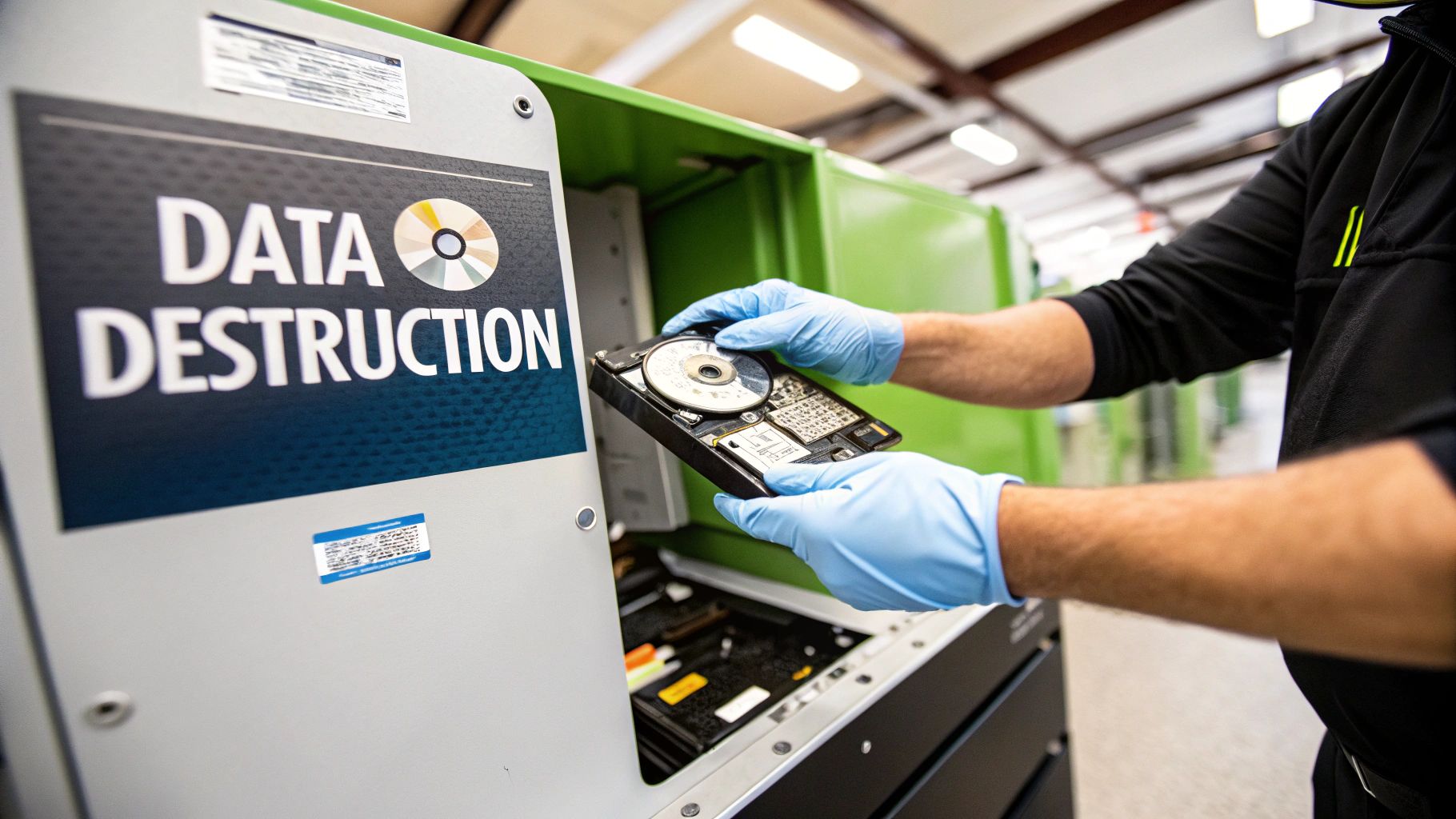
When disposing of retired IT assets, protecting corporate data is not just a best practice—it is an absolute imperative. A single mishandled hard drive can lead to a major data breach, eroding customer trust and resulting in severe financial penalties. A comprehensive ITAD strategy prioritizes verified data destruction far beyond simple recycling.
The core of this strategy is selecting the appropriate method to ensure data is permanently irrecoverable. The two primary methods are physical destruction and software-based wiping, each with specific applications depending on the device type and security requirements.
Physical Destruction for Maximum Security
For traditional magnetic hard disk drives (HDDs) or any scenario requiring 100% certainty, physical destruction is the definitive solution. This is not a rudimentary process but a precise, industrial one.
Hard Drive Shredding is the industry standard. Drives are fed into powerful shredders that tear them into small, mangled fragments of metal and plastic, completely obliterating the data-storing platters and making recovery physically impossible. It is the final word in secure data sanitization for highly sensitive information.
Certified Wiping for Reusable Assets
For newer solid-state drives (SSDs) or assets with resale potential, certified software wiping is the preferred method. SSDs store data on memory chips, and physical damage may not destroy all data.
Software Wiping uses specialized programs to overwrite every sector of the drive with random data, effectively erasing the original information. This process must adhere to strict standards, with the NIST 800-88 guidelines serving as the industry benchmark. Following these protocols ensures data is forensically unrecoverable, allowing devices to be safely reused or resold.
A common misconception is that formatting a drive or deleting files is sufficient. These actions only remove pointers to the data; the underlying files remain and can be easily recovered with basic software.
Why Industry Certifications Matter
How can you verify a vendor is destroying data correctly? The proof is in their certifications. These are not merely logos; they are your guarantee that a disposal partner meets the highest industry standards for security and responsible handling.
Key certifications to look for in an ITAD partner include:
- R2v3 (Responsible Recycling): This comprehensive standard covers data security, environmental impact, and worker safety. An R2v3-certified facility is audited to ensure it prioritizes reuse and recovery.
- e-Stewards: Often considered the strictest standard, e-Stewards has a zero-tolerance policy for exporting hazardous e-waste to developing countries and imposes stringent data security requirements.
- NAID AAA: This certification focuses exclusively on data destruction. A NAID AAA-certified vendor undergoes surprise audits to verify their processes for wiping, shredding, and employee screening, guaranteeing a secure chain of custody.
These certifications serve as your insurance policy for a compliant, defensible disposal process.
Staying on the Right Side of the Law
Choosing a certified partner is your most effective strategy for meeting legal obligations under data privacy laws. Different industries have strict regulations governing the handling of sensitive information on retired devices.
Key regulations include:
- HIPAA: Governs protected health information and mandates certified data destruction for healthcare organizations.
- SOX (Sarbanes-Oxley Act): Requires public companies to maintain secure financial records, including those on retired IT assets.
- GLBA (Gramm-Leach-Bliley Act): Obligates financial institutions to protect consumers’ private financial data through secure disposal.
A certified ITAD partner will provide the necessary documentation, including a Certificate of Destruction, to prove you have met your compliance obligations. This document is your legal proof of due diligence and effectively transfers liability. This is how you protect your business.
Turning Retired IT Equipment into Revenue
Responsible disposal is not just a compliance requirement; it is a significant, often-overlooked opportunity to recover value from your retired IT inventory. While local electronics drop off locations view old equipment as waste, a professional IT Asset Disposition (ITAD) partner sees it as a potential asset. This shift in perspective can transform a disposal expense into a new revenue stream.
Many organizations unknowingly allow thousands of dollars in value to depreciate in storage closets or surrender it for free. Modern servers, laptops, networking gear, and enterprise components often retain significant market value long after their primary operational life. A strategic ITAD program is designed to capture this residual value through a secure and transparent process.
The Value Recovery Process
How does a retired server generate a financial return? The process begins with a meticulous evaluation. When a professional ITAD partner collects your equipment, every item is tested, graded, and audited to determine its functional status and cosmetic condition. This is a comprehensive assessment to identify all components viable for the secondary market.
Assets suitable for remarketing typically undergo a refurbishment process that includes:
- Certified Data Erasure: All data is forensically wiped using NIST 800-88 standards, securing your information while preserving the hardware for its next use.
- Component Testing: Key components like RAM, CPUs, and power supplies are individually tested to ensure they meet performance benchmarks.
- Cosmetic Refurbishment: Devices are thoroughly cleaned, and minor cosmetic issues are addressed to maximize their appeal to buyers.
This careful preparation is what distinguishes true value recovery from basic recycling, positioning your retired assets to achieve the best possible price on the global secondary IT market.
Transparent Revenue Sharing Models
A key benefit of working with a professional ITAD vendor is a clear, transparent revenue-sharing model. After your assets are refurbished and sold, you receive a detailed settlement report that itemizes each sale, showing the gross revenue, processing fees, and your net share of the proceeds.
This model creates a powerful financial incentive. Instead of paying for a disposal service, the service can often pay for itself—and may even generate a positive return. Investigating an IT equipment buy back program can provide the data needed to justify a more strategic approach to asset retirement to your finance or procurement teams.
The core principle is simple: treat your retired IT equipment as part of the company's asset portfolio until final disposition. By managing it strategically, you can liquidate it for a return, just like any other business asset.
The Financial Argument for Professional ITAD
The global e-waste challenge is immense. In 2022, the world generated a record 62 million tonnes of e-waste, yet only 22.3% was properly collected and recycled. This represents a significant missed opportunity, not only environmentally but also for economic recovery. The United Nations Global E-waste Monitor 2024 highlights the scale of this growing issue.
Viewing this through a broader asset management lens is helpful. For example, learning how to liquidate assets for maximum return offers principles directly applicable here. The concepts of remarketing and identifying the right sales channels are precisely what a reputable ITAD partner does for your old technology. By partnering with an expert who has established remarketing channels, you ensure you do not leave money on the table. This financial return makes professional ITAD a fiscally sound decision, not just a security measure.
Your Corporate E-Waste Questions Answered
When managing corporate electronics disposal, numerous questions arise. IT managers and business owners must navigate complex requirements, and this section provides direct answers to the most common questions we encounter, helping your team make secure and informed decisions.
What Is The Difference Between A Recycler And An ITAD Vendor?
This distinction is critical for any business. A standard recycler's primary function is de-manufacturing equipment to recover raw materials like plastic, aluminum, and copper for the commodity market. While important for environmental sustainability, this process often overlooks the significant data security risks associated with business devices.
An IT Asset Disposition (ITAD) vendor, in contrast, offers a comprehensive, security-first service for the entire end-of-life cycle of your company's technology.
- ITAD is a full suite of services: This includes secure on-site logistics, certified data destruction, detailed asset tracking, and remarketing of usable equipment to recover value.
- The real difference is strategy: An ITAD partner provides a strategic risk management solution, while a recycler simply provides material breakdown.
Choosing an ITAD vendor is an investment in protecting your company's reputation and bottom line, not just a disposal service.
Can You Handle Specialized Equipment From Labs Or Medical Facilities?
Yes, a certified and experienced ITAD provider is equipped to manage the disposal of specialized commercial equipment from various sectors. We regularly handle sensitive hardware from data centers, R&D labs, and medical facilities, where the data is often far more valuable than the hardware itself.
We understand that this equipment can contain confidential patient data under HIPAA or proprietary research. Our processes are designed to meet these stringent compliance standards, with strict protocols to ensure all data is verifiably destroyed before a device is recycled or resold. This is how we ensure your organization remains protected and compliant.
For any organization in a regulated industry, partnering with an ITAD vendor who understands your specific compliance needs is non-negotiable. It is the only way to ensure sensitive data from specialized equipment is handled with the required security and documentation.
How Do I Get A Certificate Of Destruction And Why Is It Important?
A Certificate of Destruction is issued once your assets have been completely processed by a certified ITAD vendor. This is not a simple receipt but an official, legally binding document. It serves as definitive proof that all data on the listed devices was permanently destroyed according to industry standards like NIST 800-88.
This certificate is arguably the single most important document in the ITAD process.
- It’s your proof of due diligence: The certificate demonstrates that you took responsible steps to protect sensitive information, a core requirement of the FTC Disposal Rule, HIPAA, and SOX.
- It transfers the liability: Legally, this document transfers liability for the data from your company to the ITAD vendor. It is your primary evidence in the event of an audit or data breach investigation.
- It completes your audit trail: The certificate provides a clear, auditable record that closes the loop on an asset's lifecycle, confirming its secure and final disposition.
Without a Certificate of Destruction, your business has no verifiable proof of responsible action, leaving you exposed to significant legal and financial risks.
Is It Possible To Get Paid For Our Old Office Computers And Laptops?
Yes, this is a major financial benefit of using a professional ITAD service over a basic drop-off recycler. If your company’s retired laptops, desktops, or servers still have functional value, they can be converted into a revenue stream instead of a disposal cost.
Typically, equipment that is less than four or five years old and in good functional and cosmetic condition is a strong candidate for remarketing. The process is transparent: an ITAD partner will test, refurbish, and resell these assets through established secondary markets. Your company then receives a share of the sales proceeds based on a clear revenue-sharing agreement. It is an effective way to turn a liability into a valuable asset.
Contact Beyond Surplus for a secure, compliant, and potentially profitable solution to your company's IT asset disposal needs. We provide certified electronics recycling, computer recycling, and secure data destruction services for businesses across the United States. Schedule your nationwide pickup today.


