
Most Atlanta businesses get this wrong. They think the compliance job starts when the truck arrives, but the primary risk starts much earlier, when nobody can prove what happened to each device after it left the office. If an auditor, client, or plaintiff asks six months later how a laptop, SSD, or monitor was handled, a recycling receipt by itself won't carry the load. The question isn't just where to recycle. It's how you prove you managed it correctly.
That's the standard I use with enterprise clients in Atlanta. Build the paperwork first, then move the assets. If you do that, the disposal vendor becomes part of a defensible process instead of a blind spot.
Why Most Atlanta E-Waste Programs Fail Before Pickup Ever Happens
Atlanta programs usually fail before the truck arrives because the team treats disposal like a hauling task instead of a proof task. The test is whether you can show, later, exactly what happened to every device after it left your control. Georgia's e-waste rules are narrow, so the bigger burden usually comes from internal controls and federal disposal duties, not from a single state rule that covers everything. Georgia's covered product set centers on computers, monitors, and televisions with screens 7 inches or larger, while items such as printers, scanners, and mobile phones are not currently covered under the state e-waste recycling law. That is why asset-level tracking matters more than a generic pickup schedule, and why businesses that want a practical starting point should review Beyond Surplus's Atlanta electronics recycling guide.
The compliance failure is usually paper, not pickup
A vendor can remove hardware and still leave your organization exposed. If your team cannot connect each serial number to a device class, data-bearing status, and final disposition, you are operating on memory instead of evidence. That is a weak position for any Atlanta business that may face a record request, a contract audit, or a legal dispute.
Practical rule: log each unit before it moves. If it is not on the intake sheet, it does not count for compliance purposes.
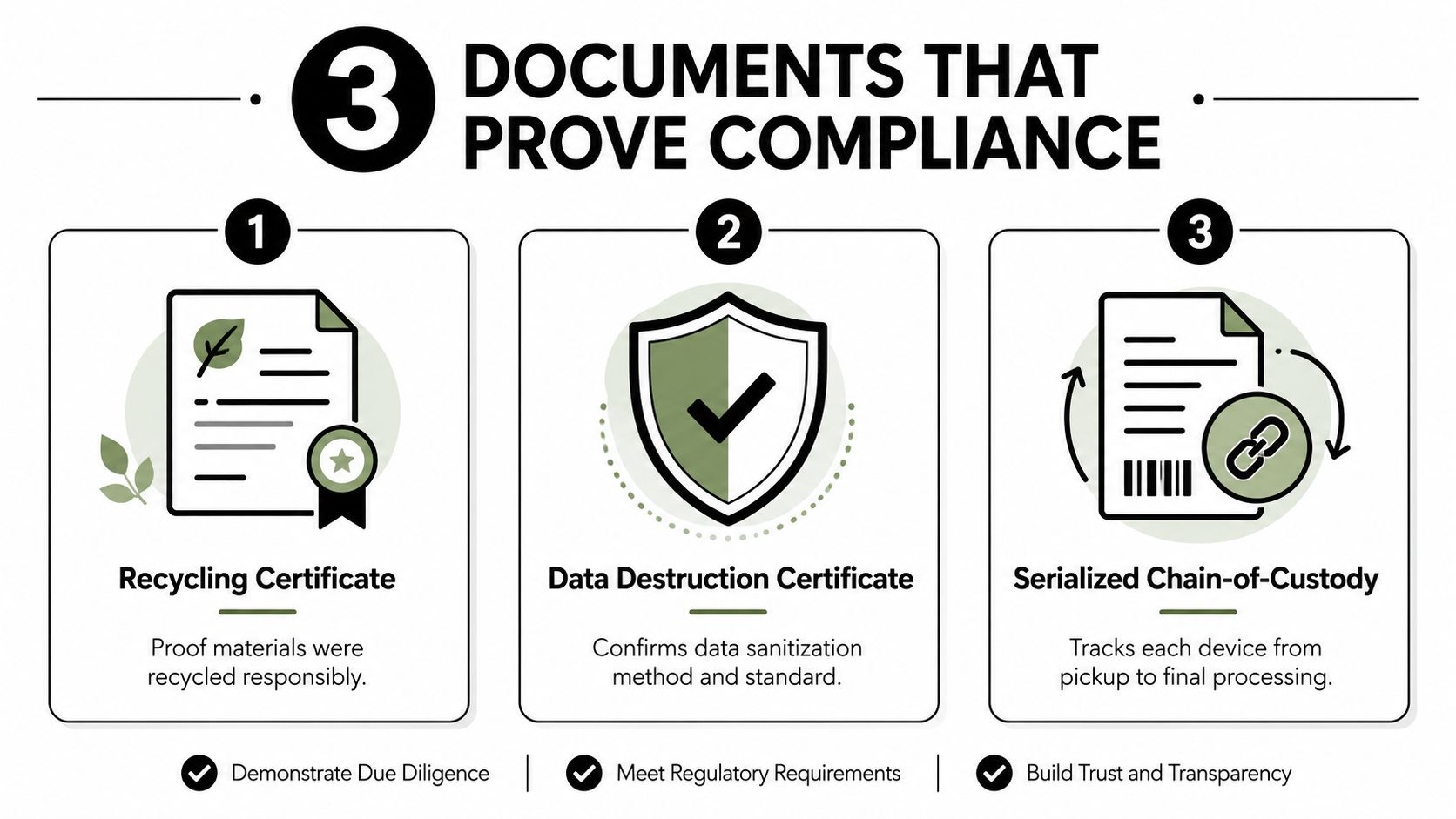
The minimum documentation stack is straightforward. Keep a recycling certificate for the downstream recovery path, a data destruction certificate when media is sanitized or destroyed, and a serialized chain-of-custody record that shows each device from pickup to final processing. Georgia does not give you a single statewide paper trail that solves every issue, so the business has to build its own proof.
The primary question for Atlanta IT teams, healthcare groups, finance departments, and government offices is straightforward. How do you prove you managed it correctly if audited later? That is the standard that holds up.
The Federal, State, and Local Rules That Actually Apply
Federal disposal duties still drive the process. The FTC Disposal Rule matters because it expects businesses to take reasonable steps to protect customer information when they dispose of consumer report information. For hardware handling, federal hazardous-waste and data-protection obligations sit above convenience. Georgia's state framework does not replace that. It sits underneath it.
What Georgia covers and what it does not
Georgia's electronics-recycling statute is narrow. The covered category centers on computers, monitors, and televisions with screens 7 inches or larger, while printers, scanners, and mobile phones are not currently covered under the state e-waste recycling law. That means a business can't assume every device falls under the same state-level recycling rule. You still need to classify the asset, then decide whether it goes to recycling, sanitization, reuse, or destruction.
The practical takeaway is straightforward. If you manage an enterprise inventory, don't build your process around a single “recycle everything” label. Build it around device class and data risk, then route the asset accordingly. The state statute doesn't remove your obligation to manage the rest of the fleet carefully.
Atlanta landfill disposal is the line you do not cross
Local guidance says it is illegal in Atlanta to dispose of electronic equipment in the landfill, and Georgia guidance tied to Rule 391-3-4-04(6)(b) says these electronic-waste components are federally prohibited from municipal landfills. That changes operations immediately. Retired computers, displays, and similar devices should never be staged for ordinary trash removal.
Any process that lets electronics drift into municipal solid waste is a process failure, not a paperwork issue.
That is why the disposal path has to be documented before the pickup happens. For Atlanta businesses, the point is not just compliance with a recycling preference. It's keeping covered devices and data-bearing assets out of the wrong stream entirely. Beyond Surplus's Georgia ITAD compliance guide is a useful internal reference point for teams that need a business-oriented view of the state's narrow coverage and the need for serialized records.
The Three Documents That Prove You Did It Right
A real compliance program does not live on a recycling receipt. It lives on three separate records that do different jobs. Mix them up, and your file stops being audit-ready.
What each document proves
A recycling certificate shows the downstream material went into a responsible recovery stream. It does not prove the data on the device was sanitized.
A data destruction certificate proves the sanitization method and standard used on the storage media. For regulated environments, this is the record that matters when someone asks whether the drive was wiped, shredded, or otherwise rendered inaccessible.
A serialized chain-of-custody record tracks each unit from pickup to final processing. This is the one that prevents the “we handed it off, so it must be fine” defense from collapsing under scrutiny.
The strongest programs keep these records tied to serial numbers and retain them for at least six years in enterprise compliance workflows. That retention window is common in mature programs because it supports future audit defense and internal review. It also lines up with the fact that liability questions don't show up on your schedule.
Why a single receipt is weak evidence
A recycling receipt says material was received. That's all. It doesn't tell you which serial number was processed, whether the SSD was destroyed, or whether the laptop was sanitized before it left custody. For regulated industries, that gap is the whole problem.
If your team handles healthcare records, financial data, student information, or public-sector assets, require the vendor to issue all three records. If they can't, they're selling convenience, not defensible compliance.
Beyond Surplus's chain-of-custody documentation page is the kind of internal reference compliance teams should expect from a vendor that understands serialized accountability.
When to Wipe, When to Shred, and When to Resell
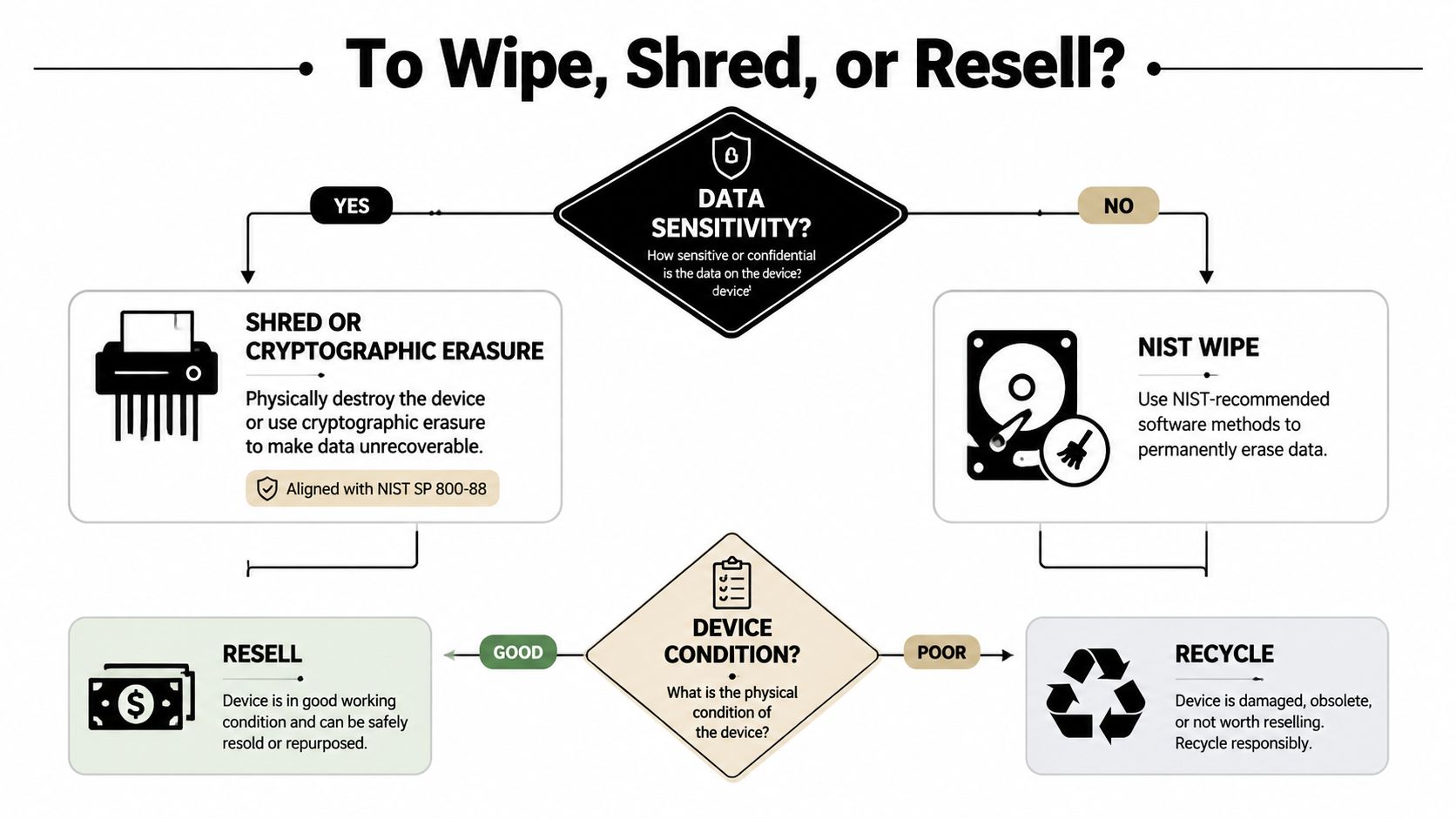
NIST SP 800-88 is the technical benchmark, not generic “recycling.” That matters because the right disposal method depends on the device, the storage type, and the end use. For SSDs, best-practice guidance for Georgia and Atlanta points to physical shredding or cryptographic erasure. Degaussing can work for many magnetic hard drives, but it is not the answer for solid-state storage. If you confuse those methods, you create a false sense of security.
Match the method to the media
Use wiping when a device is being redeployed or resold and the media is suitable for a verified sanitization process. Use shredding when the drive is broken, high-risk, or not worth the uncertainty. Use cryptographic erasure when the platform and controls support it and the process can be audited.
That is the clean rule. Resale and redeployment are for assets with enough condition and control to justify reuse. Destruction is for the rest.
The operational cause and effect are direct. If a drive leaves custody without verified sanitization, the organization keeps breach exposure. If it is shredded or wiped to an auditable standard, the recycler can issue serial-numbered certificates of data destruction and chain-of-custody records that support FTC Disposal Rule compliance and later audit defense.
Sort the whole load before pickup
Do not let mixed inventory go out unsorted. Separate data-bearing devices from non-data-bearing equipment, then classify by condition and risk. Broken devices, older media, encrypted laptops with unclear state, and unknown storage types should move to destruction. Stable laptops and servers headed for redeployment can often be sanitized first, then resold or recycled through a controlled process.
Bottom line: if you cannot explain why a device was wiped instead of destroyed, you do not have a decision standard yet.
That is the part many Atlanta guides skip. They talk about recycling as if every device belongs in the same stream. It doesn't. A full asset inventory and risk classification need to happen before the truck arrives, not after.
Beyond Surplus's hard drive wiping guide is relevant for teams that want a practical reference on sanitization decisions before assets leave the floor.
Sector-Specific Requirements for IT, Healthcare, Finance, Schools, and Residents
Different teams need different proof. The legal driver changes by sector, but the core discipline stays the same, serialized inventory, controlled sanitization, and final documentation.
| Audience | Primary Compliance Driver | Required Documentation | Preferred Sanitization Method |
|---|---|---|---|
| IT directors | Internal controls and data security | Recycling certificate, data destruction certificate, chain-of-custody | NIST SP 800-88-aligned wiping or shredding |
| Data centers | Decommissioning discipline and asset traceability | Serialized inventory, de-installation record, downstream certificates | Wipe, cryptographic erasure, or shredding by asset type |
| Healthcare | HIPAA-aligned data handling | Data destruction certificate, custody records, downstream proof | Shredding or verified wiping on approved media |
| Finance | GLBA and SOX evidence | Serialized records, destruction certificate, custody trail | Verified wiping or shredding |
| Schools and universities | FERPA-sensitive asset handling | Inventory log, destruction proof, recycling certificate | Wipe first, destroy higher-risk media |
| Residents | Safe disposal and data protection | Drop-off or mail-in receipt, optional data wipe proof | Wiping for reusable devices, recycling for the rest |
What each group should demand
IT directors should insist on serialized intake and final certificates for every batch. A data center decommissioning team needs de-installation coordination and proof that storage media was handled separately from general hardware. Healthcare, finance, and government teams should require written evidence that the sanitization method aligns with the risk level of the asset, not just a vague statement that the drives were “processed.”
Schools and universities should treat student-facing devices as data-bearing by default. Their vendors need to show where the devices went, what happened to the media, and how the institution can prove it later.
Residents are a different case. If you're handling a personal device, use the same logic, but the documentation burden is lighter. The business standard is higher because the liability is higher.
Montclair Crew's Georgia responsible recycling guide is useful for the proof gap, while Atlanta businesses should stay focused on whether the vendor can separate recycling proof from data-destruction proof without blurring the two.
How to Vet an Atlanta E-Waste and ITAD Vendor
Start with proof, not promises. A vendor can talk about responsible recycling all day, but if they cannot document custody, sanitization, and downstream handling, they will fail an audit when it matters. Ask for the records before pickup, not after the fact.
Begin with certifications and operating controls. R2v3, e-Steward, and ISO 14001 show the vendor is working inside a recognized environmental and management framework. Then press for specifics on downstream auditing, processor verification, and whether they can handle on-site or off-site destruction based on the asset class.
Questions that should get straight answers
Can they tie every certificate to the original inventory?
Can they provide serial-number-level records?
Do they support NIST SP 800-88-aligned sanitization?
Do they issue both a data destruction certificate and a recycling certificate?
Can they explain what happens to failed or unknown devices?
Ask for sample documents, not summaries. If the vendor cannot show a chain from intake to final disposition, the controls are weak. If they cannot separate sanitization records from recycling records, the paperwork will not hold up when someone reviews it later.
Use the vendor due diligence checklist before you sign anything. It forces the same questions Atlanta enterprises should already be asking, and it keeps the review focused on evidence instead of sales talk.
One practical option for Atlanta businesses is Beyond Surplus, which provides ITAD, secure data destruction, and recycling services with certificate-based documentation. That only matters if the paperwork matches the asset trail, so ask for samples before you sign anything.
Red flags that should end the conversation
- Vague sanitization claims: “We handle everything securely” is not a control.
- No data destruction certificate: If media is involved, that is a miss.
- No chain-of-custody: If they cannot trace the asset, you cannot defend the disposition.
- Refusal to align with NIST SP 800-88: That tells you enough.
A vendor that will not give you serial-number-level proof is not built for regulated work.
Your Atlanta E-Waste Compliance Checklist
Start with the audit file, not the pickup. Capture each asset's serial number, device class, and whether it stores data. Separate covered electronics from everything else, then sort each item for wipe, shred, reuse, or recycle before it leaves your site. That is the record an auditor will ask for later, so build it first.
At handoff, collect three documents and do not accept substitutes. You need the recycling certificate, the data destruction certificate, and the serialized chain-of-custody record. Keep them together with the intake log so the file shows one clean path from collection to final disposition.
Beyond Surplus helps Atlanta businesses close the loop on electronics recycling, IT asset disposal, and secure data destruction with serialized documentation that supports compliance. If you need a vendor that can handle pickup, certificates, and auditable chain-of-custody records, use a provider that can show the full paper trail before the next review starts.