

The first hard part of an IT refresh usually is not buying new equipment. It is deciding how your organization will retire the old assets without creating a data exposure, a documentation gap, or a dispute later about who had custody and when.
You see the pattern quickly. Laptops pile up in a locked room. Retired servers sit on a dock waiting for pickup. Finance wants the space back. Security wants proof that every drive was sanitized or destroyed. Operations wants the project closed without extra delays.
That is why this section starts with liability transfer. Corporate IT recycling in Georgia is a records-and-controls problem before it is a hauling problem. If you cannot show what happened to each asset, who handled it, which destruction method was approved, and when custody changed hands, your organization still owns the risk even after the equipment leaves the building.
For a Georgia-specific baseline, this secure IT disposal guide for Georgia businesses outlines the controls that matter most during retirement and pickup.
The companies that handle disposal well treat it as an ITAD decision framework. They separate reusable equipment from scrap, define approved data-destruction paths, and require documents that hold up under audit. That approach protects your organization long after the pallets are gone.
Your Georgia Business Guide to Secure IT Disposal
Your first major refresh usually exposes weak spots fast. Teams know how to buy and deploy hardware. Fewer teams have a clean process for retiring it. That's where devices go missing from spreadsheets, hard drives sit too long in unsecured closets, and “we'll deal with it later” becomes a compliance problem.
In Georgia, that risk sits with your organization. There isn't a state-specific e-waste mandate that tells you exactly how to run the process, so your controls have to do the work. A practical playbook starts with inventory, moves through secure handling and data destruction, and ends with documentation that proves liability transfer. If you need a Georgia-specific baseline, this secure IT disposal guide for Georgia businesses is a useful starting point.
What safe disposal actually means
A safe process does four things at once:
- Protects data so no device leaves your control without an approved sanitization or destruction path
- Protects operations by removing clutter and avoiding ad hoc pickups
- Protects compliance with records that stand up to internal review
- Protects value by separating reusable assets from scrap before everything gets treated as waste
Practical rule: If your team can't match each retired asset to a serial, a disposition method, and a final document, you don't have a completed project. You have missing evidence.
The companies that get this right build the process backward from the final audit trail. That changes the vendor conversation too. You're not hiring someone to haul equipment away. You're hiring a processor to help close risk.
Start with an Inventory and Risk Assessment
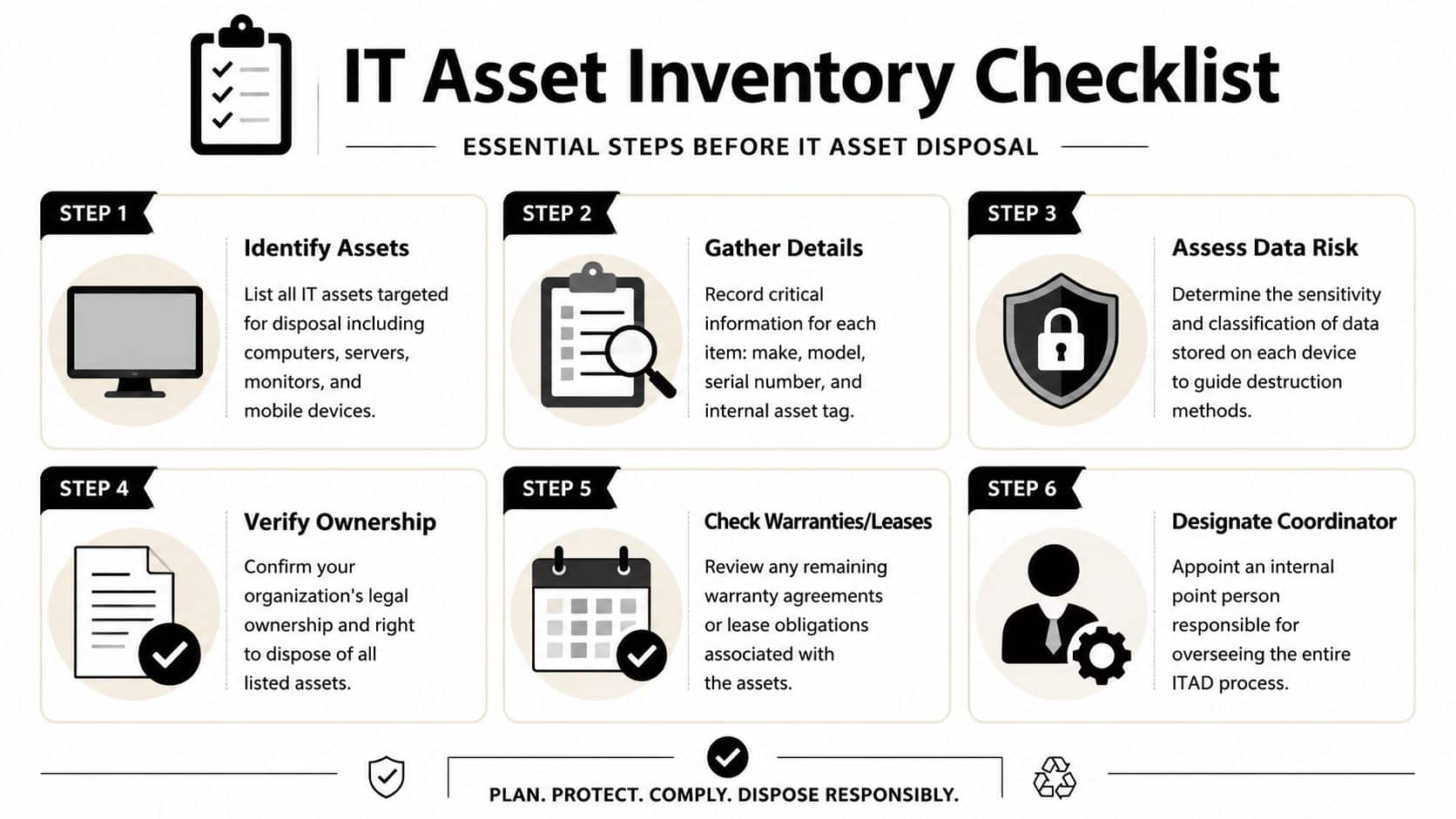
Before pickup is scheduled, lock down the asset list. A defensible workflow in Georgia begins with a serialized inventory, then chain-of-custody logging, secure transport, and either certified wiping or physical destruction before downstream recycling, as outlined in Beyond Surplus's Georgia secure electronics disposal guidance.
Build an asset list that can survive scrutiny
A count of “35 laptops and 12 servers” isn't enough. Your list should track each item at the unit level, including serial number, internal asset tag, device type, assigned location, and whether it contains data-bearing media.
That list should also answer ownership questions before disposal starts. Leased assets, devices under return obligations, and equipment tied to another business unit can derail a pickup after the truck arrives.
A practical way to structure the file is simple:
| Field | Why it matters |
|---|---|
| Serial number | Connects the physical asset to the destruction or recycling record |
| Asset tag | Reconciles your internal records |
| Device type | Helps route wiping, shredding, resale, or recycling |
| Business owner | Prevents orphaned assets |
| Data sensitivity tier | Decides the sanitization method |
| Final disposition | Confirms what happened in the end |
If your current records are inconsistent, it can help to review top free inventory software options before the project starts. Even a basic, disciplined system is better than scattered spreadsheets owned by different departments.
Classify risk before you move anything
Not every retired device should follow the same path. A monitor without storage isn't the same as a laptop from HR, and neither should be treated like a server that handled regulated or confidential information.
Use a simple internal triage:
High-risk assets
Servers, storage arrays, executive laptops, devices from finance, healthcare, legal, or government-facing workflows. These usually move toward physical destruction unless reuse has been formally approved.Moderate-risk assets
Standard employee laptops and desktops with known custody and manageable data profiles. These often qualify for certified wiping if the hardware still has value.Low-risk assets
Non-data peripherals such as monitors, docks, keyboards, and cabling. These still need tracking, but not the same destruction protocol.
The inventory is your control point. If an asset never enters the list, it can't enter the chain of custody.
Assign one internal coordinator to own reconciliation from first count to final report. For broader planning around refresh cycles and retirement workflows, Georgia IT lifecycle management guidance can help you map disposal into the larger hardware program instead of treating it as a one-off event.
Select the Right Data Destruction Method
Once the asset list is clean, the next decision is harder. Do you wipe the media and preserve value, or destroy it and remove the risk completely?
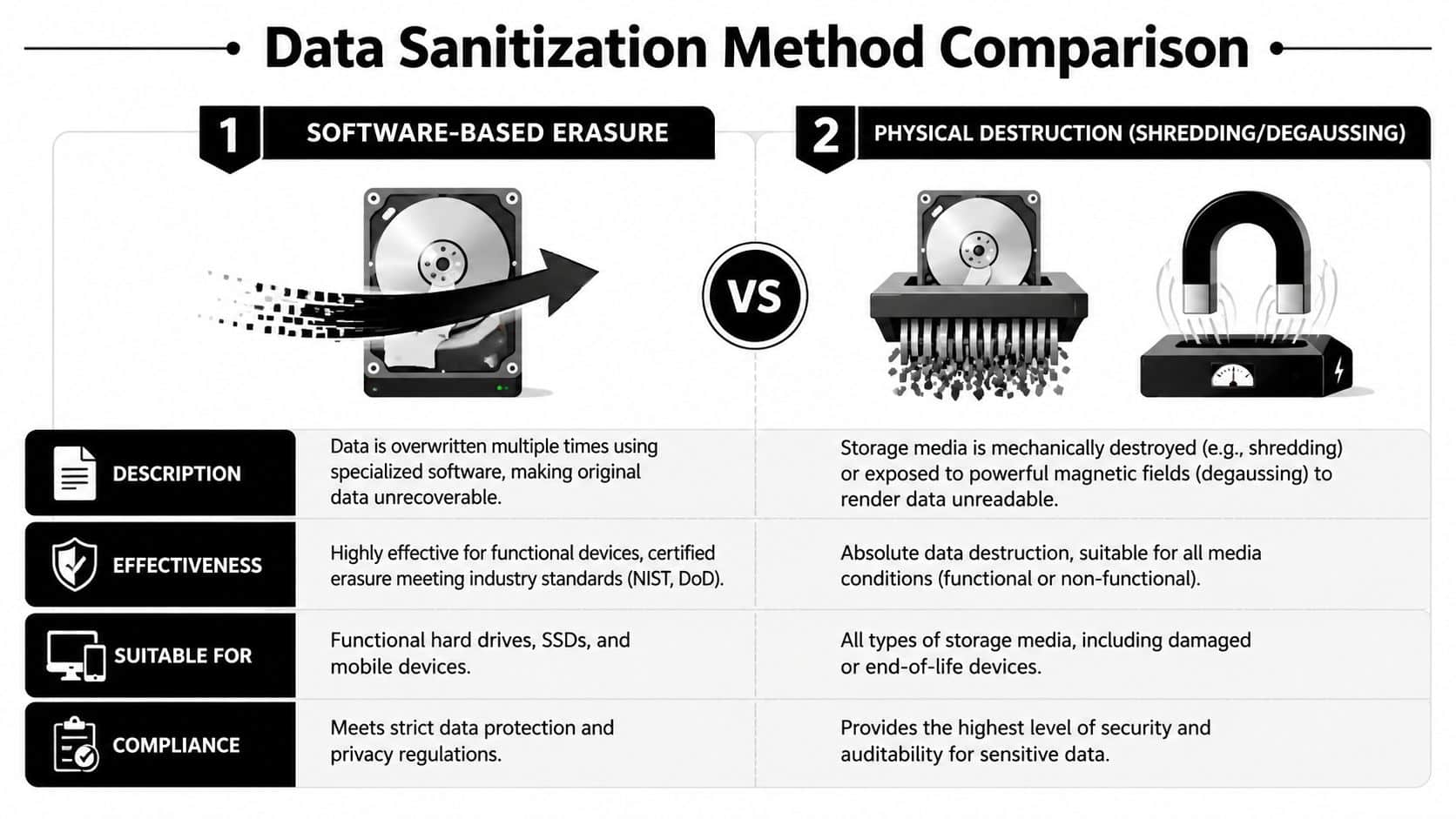
For Georgia businesses, the most practical benchmark is risk tier. Atlanta-area industry guidance notes that physical hard-drive shredding is used for the most sensitive media because recovery becomes unrecoverable, while secure multi-pass wiping is used when reuse or remarketing is possible. The same guidance also emphasizes upfront inventory, designated collection points, employee training, and scheduled pickups to reduce loss and compliance failures during retirement cycles, as described in Montclair Crew's Georgia recycling overview.
When wiping makes sense
Software-based erasure works when the device is functional, the media can be processed reliably, and your organization wants the asset preserved for reuse, redeployment, or resale. That usually applies to newer laptops, desktops, tablets, and some server drives.
Wiping is the better business choice when:
- The hardware still has market value
- The chain of custody is intact
- The device can complete a verifiable sanitization process
- Your internal policy allows remarketing after sanitization
A standards-based process is essential when your security team needs a baseline for sanitization decisions. NIST SP 800-88 media sanitization guidance serves as the framework widely adopted to align business, security, and disposition choices.
When shredding is the right answer
Physical destruction is the cleaner answer when risk outweighs recovery. If a drive is damaged, encrypted status is uncertain, custody is broken, or the data category is highly sensitive, shredding removes too many questions to ignore.
Choose physical destruction when:
- The device held regulated or highly confidential data
- The media is failed, locked, or can't be wiped reliably
- You don't want any downstream reuse of the storage media
- The hardware has little economic value left
If your team spends more time debating whether a drive is safe to remarket than the drive is worth, destroy it.
On-site versus off-site processing
This decision is less about abstract security and more about your operating environment.
On-site destruction works well when witnesses are required, internal policy demands immediate destruction before the assets leave, or the project includes especially sensitive media.
Off-site processing usually works for larger volumes, mixed asset streams, and refreshes where serialized intake, secure transport, and controlled downstream processing are already established.
What doesn't work is mixing methods without rules. Decide in advance which categories are wipe-eligible, which are shred-only, and who has authority to approve exceptions.
Manage Logistics and Chain of Custody
Your team approves the refresh, the old equipment is boxed, and pickup day looks straightforward. Then one pallet leaves without a final count, three loose drives turn up in a desk drawer, and nobody can say with confidence which employee released the load. That is how disposal projects become liability problems.
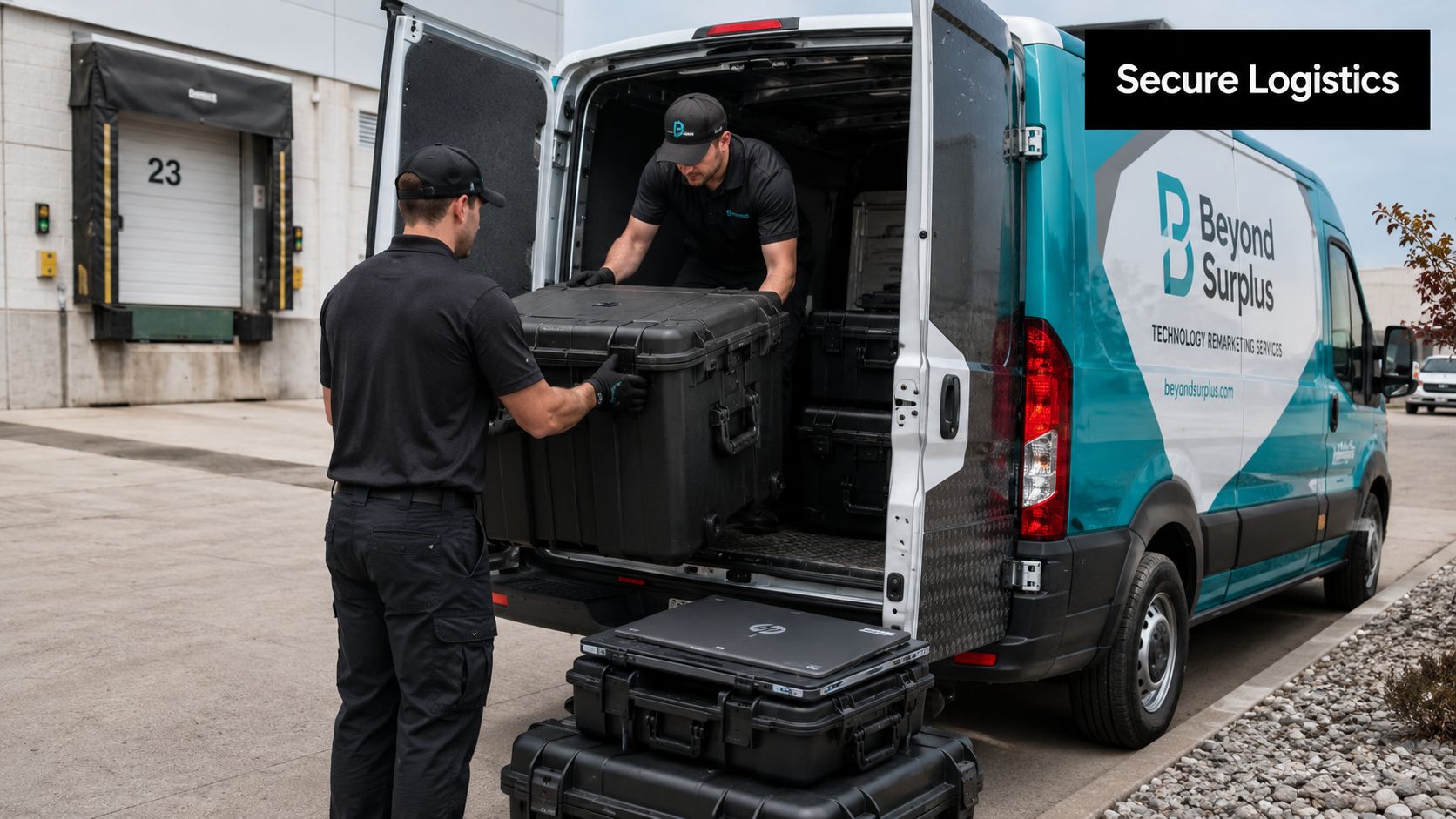
Logistics is where your organization either keeps control of the project or gives it away. Once assets leave your facility, your protection depends on whether the handoff was documented, witnessed, and tied back to the inventory you approved. If that record is weak, you can still end up answering for missing equipment long after the recycler has processed it.
Control the release, not just the pickup
Start with a release standard your team can follow under time pressure. The loading dock should not become the place where asset decisions get made.
Use a handoff process that includes:
- A staged holding area with restricted access before pickup
- Container controls such as locked bins or sealed gaylords for data-bearing devices
- Manifest reconciliation at the dock so pallet counts and serialized items match before anything is loaded
- Named signoff points so one person from your team and one from the transporter accept custody at each transfer
The practical trade-off is speed versus certainty. Fast, informal pickups feel efficient, but they create gaps you cannot fix later. A 20-minute delay to verify serials is cheaper than an internal investigation after a laptop or drive goes missing.
Build chain of custody around exceptions
Most loads are straightforward. The risk sits in the exceptions.
Loose drives, devices pulled from remote offices, equipment discovered after the inventory freeze, and mixed pallets with both wipe-eligible and shred-only assets need separate handling rules. If your vendor accepts everything under one generic signature, your organization loses visibility at the point where mistakes are most likely.
A usable chain-of-custody record shows who had possession, when custody changed, where the assets were transferred, and what sealed containers or asset groups were included. For multi-site refreshes, it also helps to set one logistics owner inside your organization who can approve changes, track late additions, and stop a pickup when the paperwork does not match the load.
For organizations planning a multi-location refresh, Georgia IT equipment pickup coordination should be set before the first truck is scheduled. Good routing matters, but clear release authority matters more.
If an item cannot be tied to the manifest, it should not leave with the load.
Keep transport predictable. Use scheduled pickup windows, designated release contacts, and pre-labeled containers. Boring logistics are usually the safest logistics because every unusual item was identified before the vehicle arrived, not explained afterward.
Ensure Compliance and Document Everything
The end of the project isn't when the equipment leaves. It's when your records prove, at the asset level, what happened and when your organization's liability was transferred in a defensible way.
The core federal backdrop is the FTC Disposal Rule, which requires companies to take reasonable measures to protect consumer information when disposing of records and devices containing that information. In practice, that's why certified wiping and hard-drive shredding became standard in enterprise ITAD workflows. Georgia guidance and industry practice have also pushed organizations toward formal recycling rather than ad hoc disposal, as noted in this Georgia ITAD compliance summary.
What your paperwork needs to show
A generic certificate with a date and a vendor logo isn't enough. Auditors and legal teams usually need a record set that reconciles back to the original inventory.
A strong documentation package includes:
- Serialized asset-level tracking
- The destruction or sanitization method for each applicable item
- Date and location of processing
- Chain-of-custody references
- A statement covering transfer of responsibility or indemnification where applicable
- Inventory reconciliation showing no unexplained gaps
Neutral Georgia-facing guidance on responsible e-waste recycling has highlighted this exact problem. Many buyers receive a certificate, but not the supporting manifest and reconciliation needed to close the loop. That becomes painful during internal audit reviews, especially in healthcare, finance, education, and government settings.
Liability transfer is the point
The discussion moves from disposal to legal defensibility. Your organization needs proof that each asset followed an approved path. Without that, the risk stays with you long after the project is “done.”
That same documentation also supports value recovery. If a device can be wiped, tested, and documented properly, it may move into reuse or resale rather than scrap. Beyond Surplus, for example, offers certified data destruction, recycling records, and IT buyback pathways for Georgia organizations through its certified data destruction and ITAD checklist. The important point isn't the vendor name. It's the model: secure process first, recover value second.
“Certificate received” is not the same as “audit ready.” Keep the manifest, the serial-level report, and the custody record together.
Your Georgia IT Recycling Questions Answered
How do I choose an ITAD vendor in Georgia for a first major refresh
Start with process questions, not marketing claims. Ask how assets are inventoried at pickup, how chain of custody is documented, what the final reporting package contains, and how wipe-versus-shred decisions are made.
You should also ask for sample documentation. A vendor that can't show you what a destruction record, reconciliation report, and custody trail look like will be hard to defend internally. For specialized media or regulated assets, ask who authorizes exceptions and what happens when serials don't match the manifest.
When should we choose resale and when should we choose destruction
Use three filters: data sensitivity, hardware condition, and economic usefulness.
Recent neutral guidance frames data wiping as the path that preserves hardware for reuse or resale, while physical shredding is the stronger option when data sensitivity is highest or the assets are no longer economically useful. That decision matters more because global e-waste remains structurally large at 62 million tonnes in 2022, only about 22.3% was formally collected and recycled, and UN tracking projects 82 million tonnes by 2030, according to ReWorx Recycling's discussion of on-site hard drive destruction and e-waste trends.
Use resale when the device is functional, the media can be sanitized reliably, and your internal risk owner is comfortable with reuse.
Choose destruction when the data category is highly sensitive, the media is compromised, or the equipment has little value beyond scrap.
What should we do with servers from a data center room
Treat them as a structured decommissioning project, not a recycling pickup. Servers often carry higher data risk, denser media counts, and more complex removal logistics than office endpoints.
Separate the work into three tracks:
- Rack de-install and staging
- Media handling and destruction decisions
- Residual hardware processing and recycling
Don't let infrastructure equipment leave without serial reconciliation. Data center projects create too many chances for trays, loose drives, and accessories to get detached from the main asset record.
Are certificates of destruction enough on their own
Usually not. A certificate matters, but it should be supported by the underlying manifest and inventory match. If your internal list shows one serial and the vendor report shows another, the certificate won't solve that discrepancy.
Keep the original inventory, pickup manifest, chain-of-custody record, and final destruction or recycling report in the same retention file. That package is what turns disposal into liability transfer.
How should we handle medical, lab, or proprietary equipment
Don't force specialized assets into a standard office refresh workflow. Medical and lab devices may contain storage, embedded systems, licensed components, or regulated attachments that need additional review. Proprietary manufacturing or R&D equipment can create intellectual property concerns even when the hardware itself looks obsolete.
The safest approach is to identify these categories during inventory and route them through a separate approval path. That may mean a different destruction method, added documentation, or product destruction rather than conventional recycling.
What's the biggest mistake first-time teams make
They focus on removal speed instead of record quality. Fast pickups feel productive, but speed without serialized control creates cleanup work later. The better standard is simple: every asset accounted for, every data-bearing device assigned a sanitization path, every transfer documented, every final record retained.
If your organization is planning a refresh, consolidation, relocation, or decommissioning project, Beyond Surplus can help you build a documented ITAD process for secure electronics recycling, data destruction, and asset disposition in Georgia. Contact Beyond Surplus for certified electronics recycling and secure IT asset disposal.


