An Atlanta office can finish an equipment refresh while retired laptops and servers sit in a locked room, waiting for pickup. The files may be gone from the desktop, but the hard drives still contain data unless someone has completed and documented a real sanitization process. For IT managers, facilities teams, and procurement leaders, hard drive destruction in Atlanta is therefore a risk-transfer decision, not a routine disposal task.
The right outcome depends on the drive's condition, the sensitivity of its data, and whether the organization wants reuse or permanent destruction. A verified wipe can preserve a functional drive, while physical shredding removes the media's ability to store data. In both cases, the handoff should be traceable from collection through final disposition.
Table of Contents
- Why Secure Hard Drive Destruction Matters for Atlanta Businesses
- Understanding How Hard Drive Destruction Actually Works
- Comparing Your Service Options in Atlanta
- Compliance Documentation and Liability Transfer Explained
- Chain of Custody Security and Responsible Environmental Handling
- Pricing Logistics and How to Vet a Provider in Atlanta
- Planning Your Next Step With Beyond Surplus in Atlanta
Why Secure Hard Drive Destruction Matters for Atlanta Businesses
An Atlanta company may retire storage media during an office relocation, a server-room upgrade, a cloud migration, or a data center decommissioning. A facilities manager sees metal devices leaving a room. An IT manager sees a record of customer information, employee files, credentials, or proprietary work that might remain recoverable. Those are the same objects, but they represent very different risks.
Dragging files to a recycle bin only removes the operating system's reference to them. It doesn't reliably remove the underlying information. A device that leaves company control without verified wiping or physical destruction can create a gap between the organization's disposal policy and what happened to its data.
The business risk extends beyond privacy
Secure destruction protects more than confidential records. It supports customer trust, internal security, audit readiness, and the organization's ability to show reasonable care after equipment leaves service. The FTC Disposal Rule took effect in 2005 and requires covered organizations to use reasonable and appropriate disposal practices so consumer-report information can't be read or reconstructed. The FTC disposal requirements and hard drive destruction guidance also recognize destruction contractors as an option after the organization performs due diligence.
The wider e-waste context makes the operational issue harder to ignore. Worldwide, 62 million metric tons of e-waste were generated in 2022, while only 22.3% was formally collected and recycled, according to global e-waste reporting summarized by Gitnux. The same source reports annual generation rising by about 2.6 million tons per year and projects 82 million tons by 2030, a 33% increase from the 2022 level.
What a defensible result looks like
A defensible destruction outcome has three parts:
- The method matches the risk: The organization chooses verified sanitization or physical destruction based on data sensitivity and asset disposition.
- The movement is documented: Each device is identified and tracked through the handoff.
- The result is provable: The provider supplies destruction or recycling documentation that names the processed assets and method.
That combination gives Atlanta businesses a clear answer when an auditor, security officer, or customer asks what happened to retired drives.
Understanding How Hard Drive Destruction Actually Works
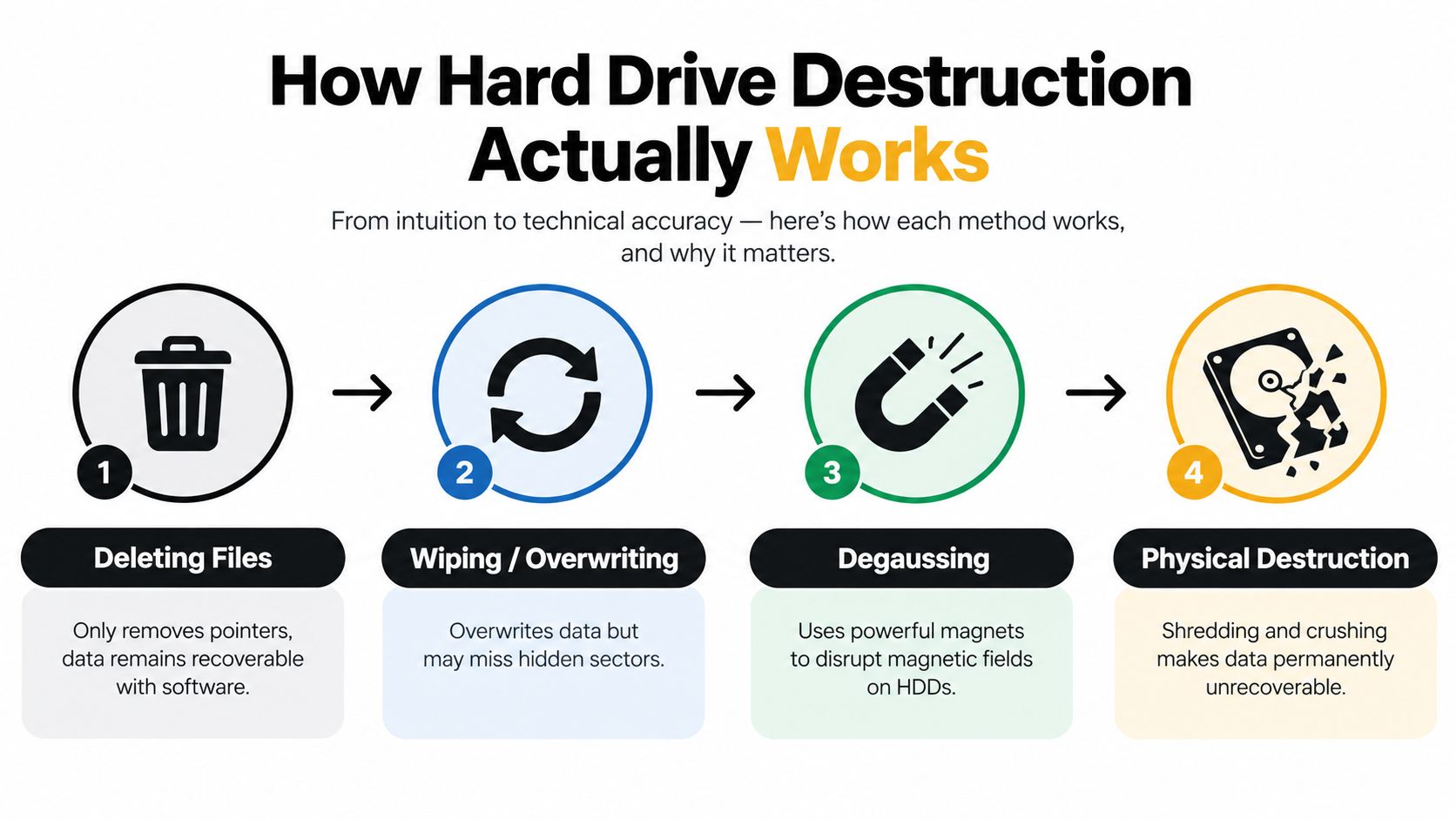
Think of a hard drive as a filing cabinet. Deleting a file removes the label from the drawer, but it doesn't necessarily remove the papers. Wiping replaces the papers with controlled overwrite activity. Shredding breaks the cabinet and its contents into pieces that can't function as a storage device.
The technical choice matters because sanitization and destruction are different end states. A verified wipe aims to remove the data while keeping the drive usable. A Destroy method makes recovery infeasible and leaves the media unable to store data afterward, as defined by NIST Special Publication 800-88 Revision 2.
Four outcomes, not four interchangeable steps
File deletion is the weakest outcome. It changes the file system's references, but recovery software may still find data in the remaining storage areas.
Overwriting and verified wiping use specialized processes to replace stored information. The result can support redeployment or resale when the process is properly verified. A wipe should be checked at the block level, not assumed complete because a program displayed a success message. Verified hard-drive wiping guidance distinguishes Clear, Purge, and Destroy outcomes and explains why the method must match the intended end state.
ATA Secure Erase or cryptographic erase can satisfy a Purge outcome for suitable media. This can be useful when a business wants to preserve hardware value, but the procedure and verification must fit the drive technology and the organization's security policy.
Physical destruction includes shredding, disintegration, pulverizing, melting, or incineration. NIST defines Destroy as making recovery infeasible with state-of-the-art laboratory techniques and making the media unable to store data afterward.
For a practical look at the physical process, review what happens during hard drive shredding. The important question isn't whether a drive looks empty. It's whether the selected process produces evidence that the data and the media reached the required security outcome.
Comparing Your Service Options in Atlanta
Atlanta buyers generally choose among on-site shredding, off-site shredding, and certified data wiping. The decision should begin with the asset's intended future. If the drive will be reused, destruction defeats the recovery objective. If the media is damaged, leaving custody, or subject to a policy requiring Destroy, wiping may be the wrong endpoint.
On-site shredding brings destruction equipment to the business. It gives authorized staff the opportunity to witness the process and can reduce uncertainty during sensitive projects. Off-site shredding moves drives in controlled containers to a secure processing location, which may suit larger projects or organizations that don't need a physical witness at the loading dock.
Certified wiping preserves reuse, but it requires stronger process discipline than a basic format. The provider should identify the media, apply an appropriate sanitization method, verify the outcome, and issue records tied to the specific assets.
A practical comparison
| Service Option | Best For | Security Level | Reuse Preserved | Documentation Provided |
|---|---|---|---|---|
| On-site shredding | Highly sensitive media and witnessed projects | Destroy | No | Chain-of-custody records and certificate of destruction |
| Off-site shredding | Volume projects and controlled facility processing | Destroy | No | Pickup records, processing records, and certificate of destruction |
| Certified data wiping | Functional drives planned for redeployment or resale | Verified Clear or Purge, depending on method | Yes | Wipe verification and asset-level disposition records |
Practical rule: Choose the end state before choosing the truck. A secure process that destroys reusable equipment may protect data but waste recoverable value, while an unverified wipe may preserve hardware without producing defensible security evidence.
Physical destruction is particularly appropriate when a drive cannot be reliably sanitized, has failed, is damaged, or contains information under a higher-security classification. NIST-aligned summaries also note that degaussing is no longer accepted as a Destroy method under Revision 2, so buyers should ask exactly which standard and method a provider is using rather than treating every erasure technique as equivalent.
Compliance Documentation and Liability Transfer Explained
A certificate doesn't make an insecure process compliant by itself. It becomes useful when it reflects a documented workflow that identifies the devices, records the handoff, and states how the data-bearing media was processed.
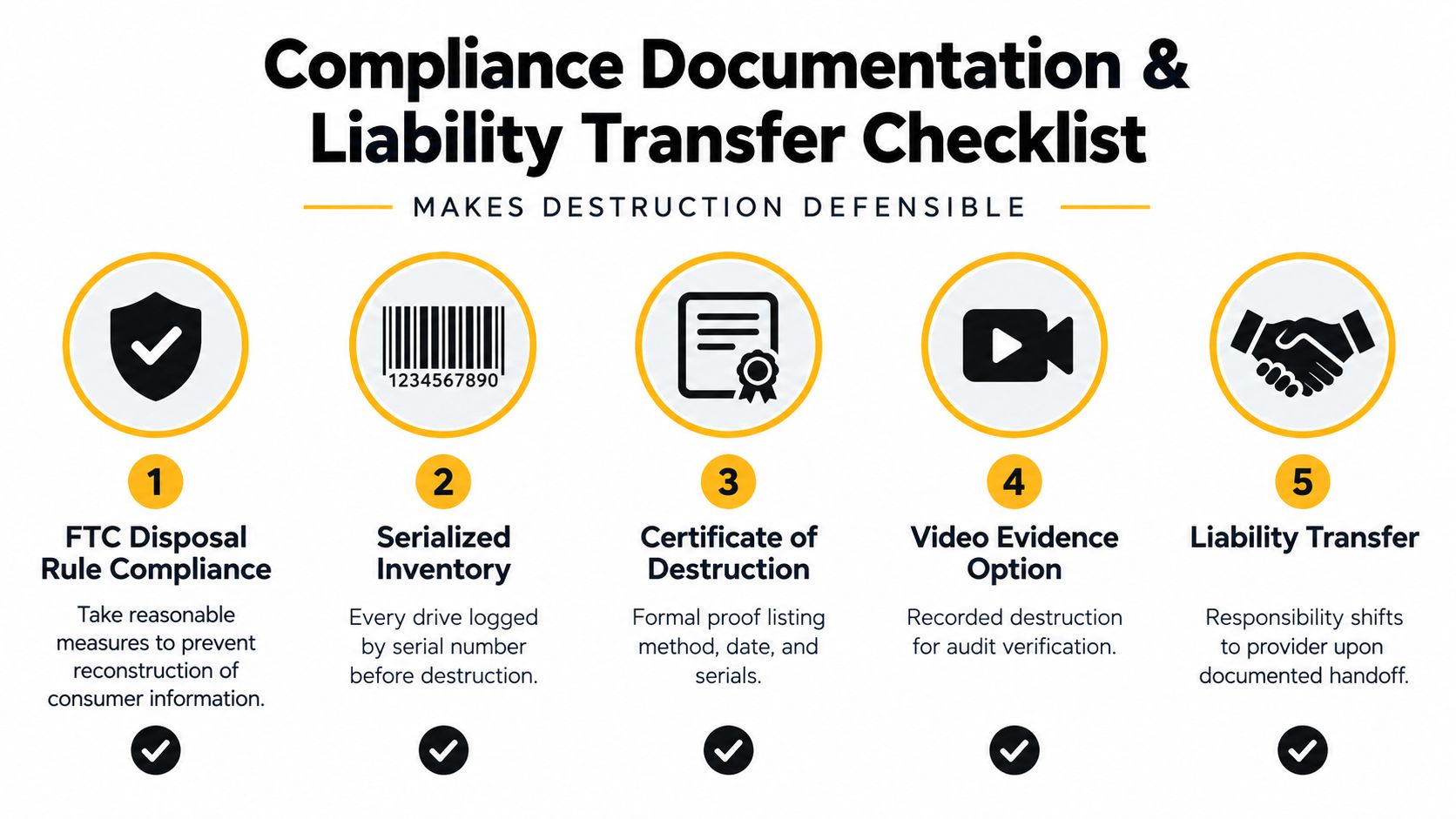
The FTC Disposal Rule requires covered businesses handling consumer information to take reasonable measures so that information can't be read or reconstructed. The FTC specifically includes electronic media and allows a business to hire a destruction contractor after due diligence. That means outsourcing can support compliance, but the customer still needs to select and oversee a provider responsibly.
The records an auditor can follow
A useful destruction file should connect the original asset list to the final outcome. It may include:
- Serialized inventory: Record the make, model, and serial number before the drive leaves the customer's control.
- Transfer record: Document who released the assets, who accepted them, and when the handoff occurred.
- Processing method: State whether the provider wiped, purged, shredded, or otherwise destroyed the media.
- Certificate of destruction: List the relevant devices, date, location, and method in a formal completion record.
- Recycling record: Show that destroyed material entered an appropriate downstream recycling process.
A certificate of data destruction explained for business teams can help procurement and compliance staff distinguish a meaningful certificate from a generic service receipt. The certificate should close the loop on specific assets, not state that “equipment” was processed.
Liability transfer needs a clear boundary
Liability transfer is practical, not magical. The organization remains responsible for its vendor-selection decision and internal controls, while the provider assumes responsibility for the assets after the documented handoff under the agreed service terms. A complete chain of custody and asset-level certificate make that boundary visible.
NIST SP 800-88 serves as the technical benchmark many organizations use to align sanitization decisions with media type, confidentiality, and intended disposition. The strongest records let a reviewer move from policy to inventory, from inventory to transfer, and from transfer to verified final disposition without relying on assumptions.
Chain of Custody Security and Responsible Environmental Handling
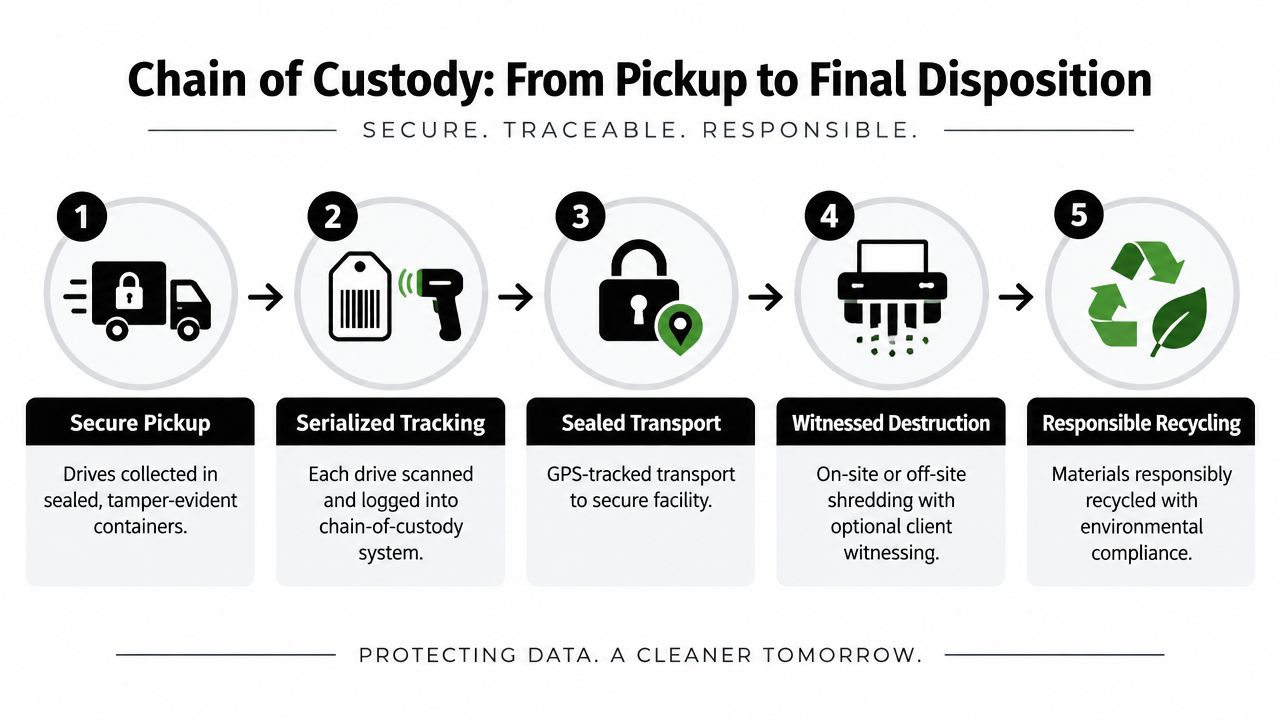
Chain of custody is the travel log for every data-bearing device. It should answer four basic questions: what was collected, who controlled it, where it went, and what happened at the end.
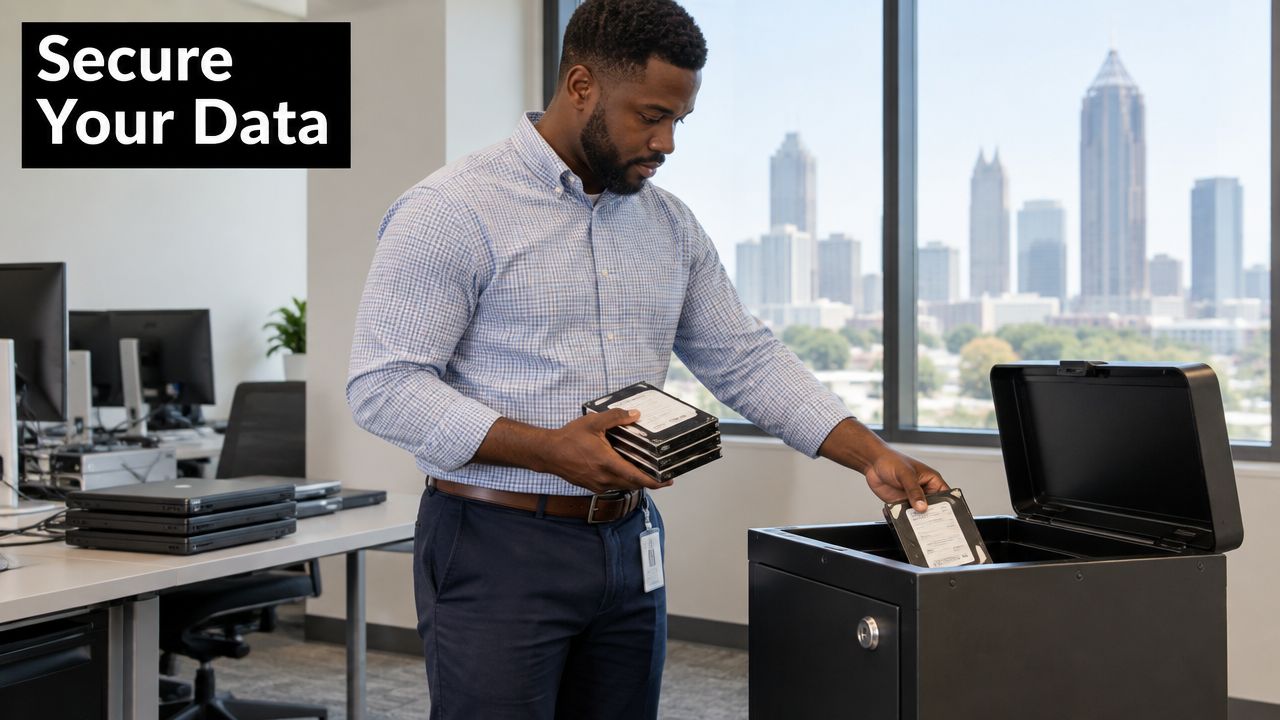
The process begins before pickup. Staff should separate data-bearing drives, confirm the inventory, and place the media into sealed or tamper-evident containers. The provider then scans or records the assets, transports them under controlled conditions, and completes the selected destruction or sanitization method.
Following the physical workflow
- Secure pickup: The team collects drives in controlled containers rather than leaving loose media in a loading area.
- Serialized tracking: Each unit is matched to the inventory so missing or unprocessed devices can be identified.
- Sealed transport: The load remains protected during movement to the processing location.
- Witnessed destruction: Authorized personnel may observe on-site or off-site processing when the service supports that option.
- Responsible recycling: Shredded material moves into electronics recycling streams that recover usable commodities and reduce environmental leakage.
For projects involving litigation, security investigations, or internal incidents, teams should preserve relevant records before equipment moves. A resource on practical evidence preservation steps can help staff think through documentation, access controls, and retention before the destruction workflow begins.
Security and sustainability can share one workflow
Physical destruction addresses data recovery, but it doesn't eliminate the need for responsible material handling. Hard drives contain recoverable metals and electronic components that shouldn't be treated as ordinary waste. After shredding, the material should move through controlled downstream processing rather than an informal disposal route.
The strongest Atlanta electronics recycling programs connect the security record to the environmental record. The certificate shows what happened to the data-bearing media. Recycling documentation shows what happened to the resulting material. Together, they give the business a more complete view of the asset's final disposition. For more detail on chain of custody for IT asset disposal, procurement teams can evaluate how each stage is documented.
Pricing Logistics and How to Vet a Provider in Atlanta
Hard drive destruction pricing depends on the project rather than a universal per-drive promise. Volume, media type, access conditions, pickup distance, on-site versus off-site processing, witnessing, sorting, inventory work, and documentation can all affect the quote.
A small office with mixed laptops may need identification and separation before processing. A data center project may involve racks of servers, many drive formats, scheduled loading, and coordination with a decommissioning crew. Ask providers to quote the actual workflow, not just the destruction machine time.
Questions that protect the buying decision
Use a written checklist before approving a vendor:
- Method: Will the provider perform verified wiping, Purge, physical shredding, or another process?
- Media compatibility: Does the method work for both traditional hard disk drives and solid-state media in the project?
- Witnessing: Can authorized staff observe destruction, and is video evidence available if required?
- Tracking: Are drives recorded by serial number before pickup and reconciled after processing?
- Certificates: Does the final certificate list the method, date, and processed assets?
- Transport: Who controls the load between the Atlanta site and the processing facility?
- Environmental handling: Where do shredded materials go after destruction?
- Fleet coordination: Can the provider schedule equipment pickup around a refresh, move, or decommissioning window?
Beyond Surplus describes questions to ask before hiring an ITAD company that can help teams compare vendors on process quality, documentation, and downstream accountability.
Planning Atlanta and national logistics
Business customers can schedule pickups across the contiguous United States, while Atlanta-area operations can coordinate with the Smyrna facility when drop-off is appropriate. A provider may use its own fleet, transportation partners, or both, so the service agreement should state who accepts custody and how the handoff is recorded.
For procurement, the clearest comparison includes the complete scope: pickup, containers, inventory, processing, witnessing, certificates, recycling, and reporting. That prevents a low initial quote from becoming an incomplete compliance solution.
Planning Your Next Step With Beyond Surplus in Atlanta
Atlanta organizations don't all need the same endpoint. A healthcare provider may require physical destruction for selected media, a financial services team may separate high-risk drives from reusable equipment, and an enterprise IT group may combine certified wiping with data center decommissioning. The useful plan is the one that maps each asset category to a documented outcome.
Beyond Surplus provides commercial and enterprise ITAD services that include on-site or off-site hard drive shredding, certified data wiping, certificates of recycling and data destruction, IT equipment disposal, product destruction, and logistics coordination. Its service model supports nationwide business pickup across the contiguous United States and Atlanta-area processing through its Smyrna facility.
A clear decision path
- Inventory the media: Identify drives, devices, locations, and ownership.
- Classify the data: Separate ordinary business information from regulated or highly confidential records.
- Choose the end state: Preserve reuse with verified sanitization, or select Destroy when the media must not store data again.
- Set documentation requirements: Define serial tracking, witnessing, certificates, and recycling records before pickup.
- Schedule the project: Align collection with the refresh, relocation, or decommissioning timeline.
Healthcare, finance, education, government, and enterprise IT teams can review Atlanta IT asset disposition services when planning a secure local project. The key is to make the risk decision before the drives are loaded, then preserve evidence that the selected process was completed.
Beyond Surplus offers Atlanta businesses secure hard drive shredding, certified data wiping, electronics recycling, and documented IT asset disposition for refreshes and decommissioning projects. Visit Beyond Surplus to discuss your inventory, choose the appropriate destruction or reuse path, and schedule secure pickup with the records your organization needs.