

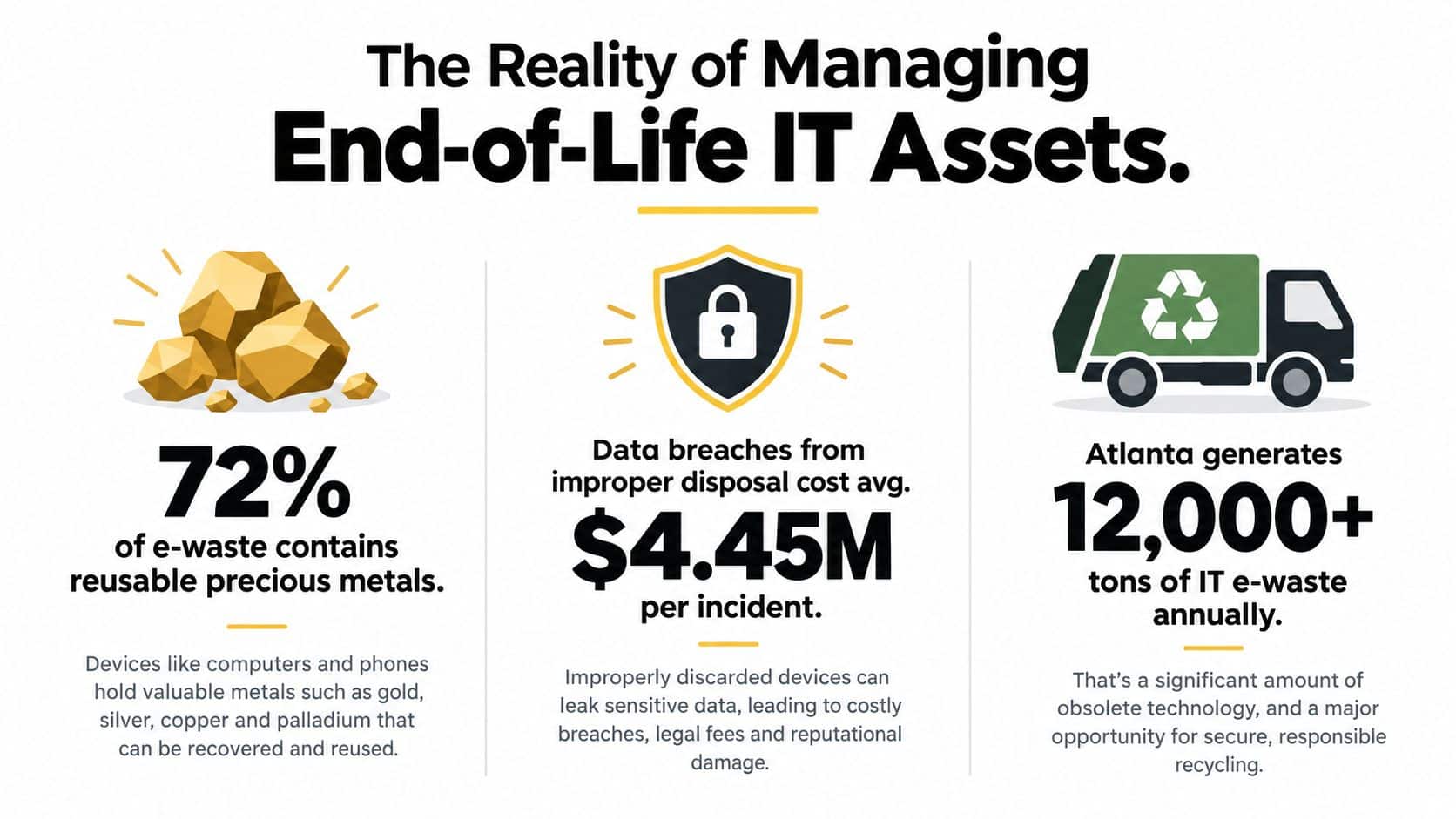
The secure answer is to document every asset and verify data destruction before recycling. In 2022, the world generated 62 billion kilograms of e-waste, but only 22.3% was formally collected and recycled in an environmentally sound manner.
The IT manager is standing in a data center with a retirement schedule, a contractor waiting for access, and thousands of laptops, servers, drives, and network devices marked for removal. Procurement sees equipment that has reached the end of its useful life. Facilities sees a clearance problem. Compliance sees a collection of unresolved questions.
The most important asset leaving the building isn't the equipment. It's the paperwork proving what happened to each device.
That distinction defines business e-waste recycling in Atlanta. A truck and a weight ticket may clear floor space, but they don't prove that a hard drive was sanitized, that an asset reached an approved processor, or that a missing serial number wasn't diverted. Secure electronics disposal requires inventory control, media-specific destruction, documented handoffs, and final disposition records.
Table of Contents
- The Reality of Managing End-of-Life IT Assets
- Preparation and Inventory Tracking
- Data Destruction Methods for Different Media Types
- Compliance and Regulatory Requirements
- Chain of Custody and Documentation
- Value Recovery and Vendor Selection
- Next Steps for Your Business
The Reality of Managing End-of-Life IT Assets
A large decommissioning project rarely fails because nobody knows how to move a server rack. It fails in the gaps between departments. A facilities team disconnects equipment, an IT team exports an asset list, a logistics crew loads pallets, and a recycling vendor later reports that a shipment was processed. If those records don't match, the company has a problem that no amount of sustainability language will solve.
Atlanta organizations face this issue across data centers, corporate offices, schools, healthcare sites, and financial operations. A retired laptop may still contain browser credentials, cached files, or regulated information. A server may have storage that wasn't included in the original inventory. A rack of drives may be separated from the chassis during transport. Each device creates a control point.
The wider resource problem is substantial. The 2024 Global E-waste Monitor summary from the International Telecommunication Union estimates that discarded electronics contained 31 billion kilograms of valuable metals worth about USD 91 billion, including USD 19 billion in copper, USD 15 billion in gold, and USD 16 billion in iron. Formal recycling in 2022 also avoided the extraction of 900 million tonnes of primary ore and prevented 93 million tonnes of CO2-equivalent emissions.
When equipment changes category
During its working life, a laptop is an assigned asset. At retirement, it becomes a data-bearing object that needs controlled disposition. That change should trigger a formal workflow, not a casual instruction to “send it to recycling.”
A practical plan separates:
- Data-bearing equipment, including laptops, desktops, servers, storage arrays, and removable media.
- Non-data electronics, such as cables, keyboards, monitors, and some peripherals.
- Reuse candidates, which may qualify for testing, remarketing, or donation.
- Damaged or regulated items, which require special handling and downstream review.
A company may also need advice outside ITAD for individual hardware problems. For example, teams that maintain high-performance workstations can use computer repair for gamers as a relevant repair resource before deciding whether a specialized machine is ready for retirement. That decision belongs before the disposal manifest is finalized.
The operational answer is to treat removal as a controlled project. Beyond Surplus's end-of-life IT asset management guidance for Georgia provides a useful reference point for organizations planning that transition.
Preparation and Inventory Tracking
The first truck shouldn't arrive until the asset list is credible. An inventory spreadsheet assembled from memory won't withstand an audit, especially when a data center includes equipment owned by multiple departments, leased devices, spares, and hardware stored outside the main room.
Start with a serial-level reconciliation. Capture the manufacturer, model, serial number, asset tag, location, owner, condition, and intended disposition. Record storage media separately from the host equipment. A server chassis and its drives should not disappear into one generic line item.
Build the manifest before moving equipment
A reliable preparation sequence looks like this:
Freeze the retirement population. Identify the devices approved for removal and record who authorized the decision. Keep excluded equipment physically separate so it isn't loaded by mistake.
Scan and reconcile. Compare barcode or serial scans with the asset register. Investigate missing, duplicate, or unexpected records before pickup day. Incoming hardware should later be checked against the same list.
Tag the data-bearing media. Mark HDDs, SSDs, NVMe devices, tapes, and removable media by type. Don't let a mixed box of drives become an anonymous processing batch.
Separate disposition paths. Place reuse, destruction, recycling, and hold-for-review assets in distinct staging areas. A device awaiting legal approval shouldn't sit on a pallet labeled for immediate destruction.
Create a pickup manifest. List quantities, serial ranges, pallet or container identifiers, originating location, and authorized release contact. Both the releasing employee and receiving handler should have a copy.
The business technology disposal planning guide from Beyond Surplus is relevant when an organization needs to turn those activities into a repeatable project plan.
Why segregation matters
Media type affects both the destruction method and the evidence required afterward. A wiped laptop, a physically shredded SSD, and an obsolete monitor shouldn't share the same status code. If the vendor issues one certificate for a mixed load without asset-level detail, the certificate may be difficult to connect to the original inventory.
Assign one internal owner to approve exceptions, review missing serials, and receive final reports. That person doesn't need to supervise every pallet, but someone must own the question, “What happened to this asset?” Without that assignment, responsibility spreads across IT, facilities, procurement, and the vendor until nobody can answer.
Data Destruction Methods for Different Media Types
A single wipe button isn't a secure media strategy. Hard disk drives, solid-state drives, hybrid drives, and NVMe devices store and manage data differently. The destruction method must match the technology and the required disposition.
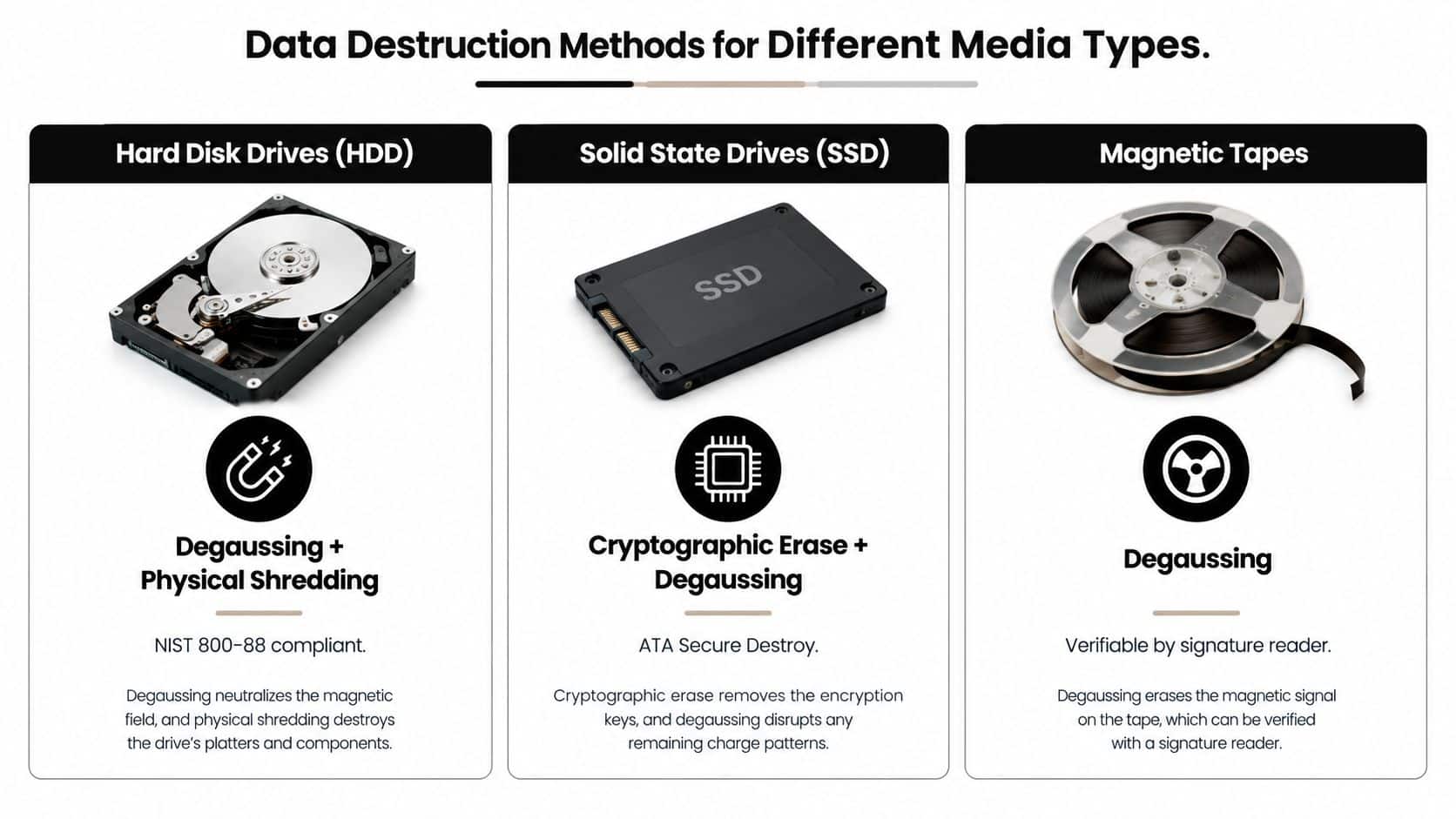
For HDDs, multi-pass overwrite or degaussing is commonly used. Mechanical drives write data to magnetic platters, so a verified overwrite can be appropriate when the drive remains intact for reuse. Degaussing disrupts magnetic storage, but it can also make the drive unusable for remarketing. Physical shredding is the clearest route when reuse isn't required.
SSDs create a different problem. Wear leveling moves data across flash cells, which means overwrite-only methods can leave inaccessible remnants. Firmware secure erase or cryptographic erase is generally more appropriate, provided the device supports the method and the encryption state can be verified. A failed or unknown controller is a poor candidate for software-only treatment.
Match the method to the media
| Media type | Practical treatment | Main decision |
|---|---|---|
| HDD | Verified overwrite, degaussing, or physical destruction | Is reuse worth preserving, or is destruction required? |
| SSD | Firmware secure erase or cryptographic erase, with verification | Can the controller execute and report a reliable purge? |
| NVMe | Device sanitize operation or physical destruction | Does the device support a verifiable sanitize command? |
| Magnetic tape | Degaussing or physical destruction | Can the result be documented for the tape format? |
The operational time can vary by media and method. Independent guidance reports completion windows of roughly 8 to 24 hours for HDDs, 2 to 4 hours for SSDs, and 1 to 3 hours for NVMe sanitize operations in the relevant workflows. Those figures are not a promise for every fleet. They illustrate why a data center schedule should account for testing, exceptions, failed devices, and reprocessing. The NIST 800-88 data destruction standards guide offers useful context for selecting and documenting sanitization methods.
Verification is the control
A wipe log generated by the software isn't the same as proof that the data is gone. The processor should rescan the media after sanitization, record failures, and route unsuccessful units to another method. Independent guidance reports that verified post-wipe testing can reduce failed sanitization rates from 23% to under 2%, and says that more than 2% of verified drives still showing recoverable data should be treated as a systemic control failure. Those figures come from independent guidance on NIST-aligned hard-drive wiping.
Practical rule: A certificate should identify the asset, the method, the result, and the exception path. “Wiped” without those details is a status label, not an audit record.
Compliance and Regulatory Requirements
A recycler's reputation does not protect your company during an audit. The defensible question is whether the disposal process blocked unauthorized access and produced records showing who controlled each asset.
The FTC Disposal Rule requires businesses to use disposal practices that are “reasonable and appropriate” for preventing unauthorized access to consumer-report information. Electronic files and media may be destroyed or erased when the information cannot be read or reconstructed. The FTC guidance on disposing of consumer report information explains that contractors may perform the work, but the hiring business remains responsible for due diligence and for confirming that the contractor follows the rule.
That distinction matters when selecting a vendor. A hauler can remove equipment from a loading dock. An ITAD provider should identify the media, record the relevant actions, apply a suitable destruction method, and issue certificates connected to the assets. Those certificates are not administrative footnotes. They are the evidence that turns a completed service into a defensible control.
Match obligations to the records
Different organizations may face overlapping requirements, so the disposal file should match the company's activities and control environment:
- Finance teams should address consumer-report information and records covered by financial controls. GLBA and SOX may belong in the internal review, depending on the organization's operations.
- Healthcare organizations should connect device retirement with HIPAA security and privacy procedures. Disposal records should align with existing access-control and incident-response documentation.
- Schools and public agencies may need to account for procurement rules, retention schedules, public-records obligations, and contract terms before equipment is destroyed.
- All covered businesses should retain vendor due-diligence records, approved methods, exceptions, certificates, and final disposition details.
Georgia does not require businesses to use one specific statewide electronics recycling program, but that flexibility does not remove the need for controlled documentation. This Georgia ITAD compliance and electronics recycling requirements guide provides Georgia-specific context, while the Georgia electronics recycling compliance overview notes that electronics may be landfilled under the current framework. Federal and hazardous-waste rules can still apply to particular materials.
Local permission does not equal corporate approval. A company can follow Georgia's disposal framework and still fail an internal review if its certificates cannot show where a storage device went, what happened to it, and which vendor handled the work.
Chain of Custody and Documentation
Chain of custody is the physical story of an asset, written down as it moves through the process. It begins when an employee releases a laptop or a technician removes a drive. It ends only when the asset is destroyed, recycled, or remarketed and the final report is issued.
A complete record should show the transfer between authorized handlers, the location, the date, the asset identifier, and the action taken. Typical ITAD workflows can involve five to eight custodial handoffs, according to IT asset disposition guidance from Iron Mountain. More handoffs mean more opportunities for an item to become separated from its paperwork.
The evidence trail
For a commercial pickup, request records that connect the loading dock to final disposition:
- Pickup manifest: The itemized list released by the business, including serial numbers where available.
- Transport record: The vehicle, authorized carrier, origin, destination, and transfer confirmation.
- Facility intake record: The processor's reconciliation showing what arrived and what exceptions were found.
- Sanitization or destruction report: The method, result, operator, date, and failed-media treatment.
- Certificate of data destruction: Evidence that the data-bearing asset was sanitized or physically destroyed.
- Certificate of recycling or disposition: The final route for recycled, reused, resold, or destroyed equipment.
The chain-of-custody explanation for IT assets describes the control as a tracked transfer from collection through final processing. That is the point often missed in vendor proposals. Liability doesn't magically transfer when a pallet crosses the threshold. It transfers operationally when the company can show an authorized handoff and substantiate the final outcome.
Georgia makes weak records more obvious
Because Georgia doesn't impose a single statewide business e-waste program, a local mandate won't create the paper trail for you. The company has to set its own standard and require the vendor to meet it.
Assign one accountable owner for final disposition. Keep the signed manifest, reconciliation report, certificates, approvals, and exception notes together. When an auditor asks about a missing laptop months later, the answer should come from a record, not a recollection.
Value Recovery and Vendor Selection
Secure disposal and value recovery aren't opposites. A retired laptop, server, or networking device may have a remaining market value, but the organization should never sacrifice data control to chase a resale return.
The sensible sequence is secure first, recover second. Identify equipment eligible for reuse, sanitize it using a verified method, test its condition, and then document the resale or remarketing route. Devices that fail testing or can't support a trustworthy purge should move to physical destruction or responsible recycling.
The global recovery opportunity reinforces the point. The ITU reports valuable metals worth about USD 91 billion inside the world's 2022 e-waste stream, including copper, gold, and iron. That doesn't mean an individual company will receive a predictable payment for every retired device. It means disposal decisions should distinguish recoverable value from material that has become a liability.
Questions for a serious ITAD partner
Ask prospective vendors:
- Do you operate your own vehicles, or do you subcontract every pickup?
- Who accepts the equipment at the loading dock?
- Can you reconcile the vendor intake report against the client's serial-level manifest?
- Which method do you use for HDDs, SSDs, NVMe devices, and tapes?
- How do you verify a completed wipe?
- What happens to a failed or unreadable drive?
- Are downstream processors identified and controlled?
- Do certificates list individual assets or only a total weight?
- Is pricing based on processing, logistics, destruction, recovery, or a combination?
- How are resale proceeds calculated and reported?
Certifications such as R2v3, documented downstream management, and disciplined audit practices can help buyers compare vendors. The 2026 corporate ESG recycling discussion notes that NAID AAA audits include scheduled and surprise inspections, which is a useful reminder that security depends on routine process discipline, not a polished sales presentation.
Choose a partner whose logistics, reporting, and destruction process fit the risk. The lowest quote is often cheap because it excludes the controls your audit will later require.
Next Steps for Your Business
Start with a retirement inventory, separate data-bearing media, and assign one owner for final disposition. Before selecting an Atlanta-area recycler, ask:
- Will every asset be reconciled by serial number?
- Which destruction method fits each media type?
- Will failed sanitization be physically destroyed?
- Who controls transport and downstream processing?
- Which certificates and final reports will you receive?
A defensible program protects data, supports the FTC Disposal Rule, and gives procurement a record of what the company bought and how it retired it.
Beyond Surplus offers business electronics recycling, secure data wiping, hard-drive shredding, IT equipment disposal, data center de-installation, value recovery, and certificates of recycling and data destruction. Visit Beyond Surplus to plan a documented Atlanta electronics recycling project and request secure IT asset disposal support.


