

Navigating the disposal of outdated servers, laptops, and networking gear is a significant challenge for any modern business. This isn't just about clearing out storage space; it's a critical process involving potential security risks, complex compliance regulations, and untapped revenue. For businesses across the state, a professional end-of-life IT asset management Georgia program is more than just disposal—it's an essential business function. Properly managing this process helps sidestep data breach risks, adhere to a maze of compliance laws, and recover value from retired equipment, protecting your company's future and bottom line.
Why Smart IT Asset Management Matters in Georgia
For businesses all over Georgia, from Atlanta's bustling tech corridors to the state's expanding data center hubs, dealing with retired IT equipment has become a key strategic priority. The outdated method of stockpiling obsolete hardware in a closet or using a generic junk hauler is no longer viable for commercial enterprises. Today, every discarded hard drive, server, or company laptop represents a potential liability and a missed opportunity. A well-executed IT Asset Disposition (ITAD) program is a core business function that directly impacts your organization's security, compliance, and financial health.
The High Stakes of Improper Disposal
The consequences of improper IT equipment disposal are severe. A single un-wiped hard drive falling into the wrong hands can expose sensitive customer data, proprietary company secrets, or employee records, leading to devastating reputational damage and steep legal penalties. Federal and state regulations are strict, and claiming ignorance is not a valid defense.
This reality is fueling significant market growth. The North American ITAD market is projected to reach USD 4.85 billion in 2025 and climb to USD 6.59 billion by 2030. A major driver of this growth is small and medium-sized businesses (SMEs), which constitute 63.90% of the market. This surge indicates a widespread awakening among businesses to the massive risks associated with mishandling their old IT gear. Improper disposal has led to fines under the FTC Disposal Rule exceeding $100,000 per incident in cases across the country.
Core Components of a Modern Georgia ITAD Strategy
An effective ITAD strategy is built on several key pillars, each designed to address specific business needs. This structured approach transforms a logistical headache into a secure, compliant, and even profitable process. To fully understand this, it is beneficial to review foundational IT asset management best practices.
Below is a breakdown of what a modern, comprehensive ITAD plan looks like for any Georgia organization.
Core Components of a Modern Georgia ITAD Strategy
| ITAD Component | Primary Goal | Business Impact in Georgia |
|---|---|---|
| Secure Data Destruction | Permanently erase all sensitive data from storage media. | Protects against data breaches and ensures compliance with FTC, HIPAA, and other regulations. |
| Regulatory Compliance | Adhere to all federal, state, and local disposal laws. | Avoids costly fines, legal action, and damage to your brand's reputation. |
| Value Recovery & Remarketing | Recoup financial value from retired but still functional assets. | Generates revenue that can offset disposal costs and boost the IT budget. |
| Responsible Recycling | Ensure hazardous e-waste is processed in an environmentally safe manner. | Fulfills corporate social responsibility goals and prevents illegal dumping. |
| Chain-of-Custody Reporting | Provide a documented audit trail for every asset from pickup to final disposition. | Transfers liability and provides auditable proof of secure and compliant disposal. |
By ensuring each of these areas is covered, Georgia companies can confidently manage their technology lifecycle, turning a potential risk into a strategic advantage.
Securing Your Data at Equipment End-of-Life
Hitting "delete" on a file or reformatting a hard drive offers a false sense of security. For anyone with basic data recovery tools, that supposedly "erased" information—client lists, financial records, employee PII—is often just a few clicks away from being restored. For any Georgia business, an old, discarded hard drive is a ticking time bomb.
This is why professional end-of-life IT asset management in Georgia is a critical security measure. It goes far beyond a simple delete command, using methods that guarantee your confidential data is permanently destroyed. This isn't just about cleaning house; it's about protecting your organization from massive liability and reputational damage.
Data Sanitization Versus Simple Deletion
Think of your hard drive like a library book. Deleting a file is like tearing out the index card that points to the book's location on the shelf. The book itself is still there, just waiting to be overwritten by a new one. Data sanitization, on the other hand, is the process of deliberately and permanently destroying the data itself.
It’s the difference between hiding the book and completely incinerating it. That distinction is everything when it comes to compliance and security.
Methods of Secure Data Destruction
To ensure your data is truly gone forever, Georgia businesses need to rely on industry-standard techniques that are both verifiable and legally defensible. The two main approaches are data wiping and physical destruction, each playing a specific role in an asset's final chapter.
NIST 800-88 Compliant Data Wiping: This is the gold standard for digitally sanitizing a drive. Following strict guidelines from the National Institute of Standards and Technology (NIST), this process overwrites every single sector of a hard drive with random data, often in multiple passes. This is the perfect method for newer, working drives that can be refurbished and resold, allowing you to recover some of their value.
Physical Shredding and Destruction: When a drive is old, broken, or contained extremely sensitive data, physical destruction is the only answer. We use industrial-grade shredders that grind hard drives, SSDs, and other media into tiny, mangled fragments. This method provides absolute certainty that the data can never be accessed again.
The process below shows how a proper ITAD strategy delivers a trifecta of benefits, all starting with rock-solid security.
As you can see, securing your data isn't just one step—it's the foundational step that makes compliance and value recovery possible.
The Power of a Certificate of Data Destruction
How can you prove your data was destroyed correctly? That's where the Certificate of Data Destruction comes in. This legally binding document is your official record and legal shield.
A Certificate of Data Destruction serves as a formal, auditable document that transfers liability from your organization to the ITAD vendor. It confirms that your data has been destroyed in accordance with federal and state regulations.
This certificate is your proof and should always include:
- A unique serial number for tracking the job.
- The exact method of destruction used (e.g., NIST 800-88 wipe, physical shred).
- A serialized list of every single device that was destroyed.
- The date and location where the destruction took place.
- A statement of indemnification, where the vendor takes on the liability.
For any Georgia business navigating HIPAA, FACTA, or the FTC Disposal Rule, this certificate is non-negotiable. It’s the final step in preventing devastating business data breaches.
To get a better feel for how these processes work, you can explore the different types of secure data destruction services available that meet today's rigorous standards. Ultimately, this documentation closes the loop on your IT asset's lifecycle, giving you peace of mind and a rock-solid defense in any audit.
Staying on the Right Side of the Law in Georgia
For any business in Georgia, compliance is a critical, day-to-day part of doing business. How you handle the disposal of old IT equipment is a massive piece of that puzzle. One wrong move can lead to painful fines, messy legal fights, and a tarnished reputation that could take years to fix.
The regulatory landscape is a complex map with federal, state, and industry-specific rules all overlapping. Every one of these laws is designed to keep sensitive information safe, and authorities are getting much stricter about negligence. That’s why having a solid plan for end-of-life IT asset management in Georgia isn't just good practice—it's your best defense.
The Rules of the Road: Key Regulations and Standards
The first step in building a bulletproof disposal process is knowing which rules apply to you. While Georgia has its own data privacy laws, many federal standards have become the unofficial law of the land for everyone.
You absolutely have to consider these big ones:
- The FTC Disposal Rule: This federal rule requires businesses to take proper steps to get rid of sensitive info from consumer reports. Simply tossing an old hard drive in the dumpster is a clear violation.
- HIPAA (Health Insurance Portability and Accountability Act): For businesses in healthcare or working with healthcare providers in Georgia, HIPAA demands incredibly strict procedures for protecting patient health information (PHI). That means any data on retired medical devices, servers, or office computers must be completely and permanently destroyed.
- NIST SP 800-88: The National Institute of Standards and Technology (NIST) provides the gold standard guidelines for properly sanitizing digital media. It is referenced consistently in legal cases and compliance audits.
These regulations set a clear expectation: businesses are responsible guardians of the data they handle.
To help you see how these pieces fit together, here's a quick breakdown of the major regulations that impact Georgia businesses when it comes to data.
Data Security Regulations Affecting Georgia Businesses
| Regulation/Standard | Key Requirement | Who It Applies To in Georgia |
|---|---|---|
| FTC Disposal Rule | Requires proper disposal of sensitive data from consumer reports. | Virtually any business that uses credit reports, background checks, or similar consumer data (e.g., auto dealers, landlords, employers). |
| HIPAA | Mandates secure destruction of Protected Health Information (PHI) on any electronic media. | Hospitals, clinics, insurance companies, and any business associates (like IT providers or billing services) that handle patient data. |
| NIST SP 800-88 | Provides detailed technical guidelines for data sanitization (Clear, Purge, Destroy). | While not a law itself, it's the recognized best practice standard for all industries, especially government contractors, finance, and tech. |
This table isn't exhaustive, but it hits the main players. The key takeaway is that if you handle sensitive data of any kind, you have a legal and ethical duty to destroy it securely.
How Certifications Prove You're Doing It Right
How do you know if your ITAD partner is actually following all these high-level standards? That’s where third-party certifications come in. They are hard-earned proof that a vendor follows a strict, audited process for both security and environmental safety.
Look for these two big certifications:
- R2v3 (Responsible Recycling): The R2 Standard covers the entire journey of an electronic device, ensuring materials are handled in an environmentally responsible way and data security is locked down at every step.
- e-Stewards: This certification is known for being incredibly strict, especially with its ban on exporting hazardous e-waste to developing nations. It also has very strong requirements for data security and worker safety.
Choosing a vendor with these credentials gives you peace of mind. You know they're being held accountable by global experts. You can dive deeper into what this means by checking out our guide on what R2 certification is and why it's a must-have for any enterprise. The stakes are only getting higher. A slip-up in ITAD can easily lead to breach notifications and fines.
Managing IT Assets in Georgia’s Data Center Boom
Georgia is rapidly becoming a global powerhouse for data centers. This explosive growth is incredible for our state's economy, but it creates a massive challenge: a constant tsunami of retiring IT hardware. The sheer scale of these operations means end-of-life IT asset management in Georgia must be a core part of the operational plan.
For data center operators, IT asset disposition (ITAD) is a critical process that directly impacts security, regulatory compliance, and the bottom line. Tech refresh cycles are lightning-fast, meaning thousands of servers, storage arrays, and network switches become obsolete almost overnight. Every single one is packed with sensitive client data tied to strict service-level agreements (SLAs). Secure data destruction isn't just a good idea—it's a requirement.
The Unique ITAD Needs of Data Centers
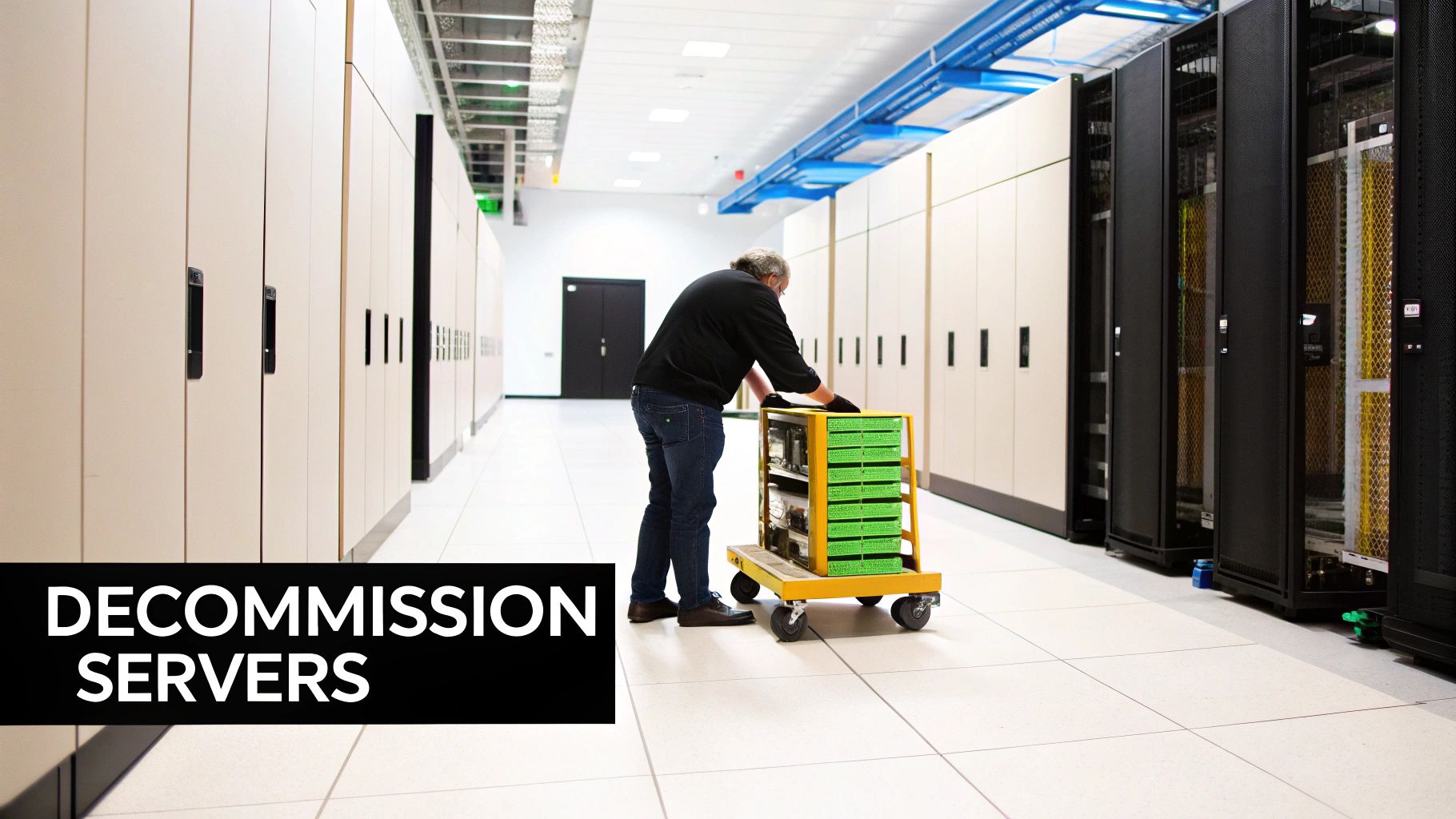
Decommissioning a data center is a project of immense scale. It requires a rock-solid plan for tracking every asset, destroying data on-site, and physically hauling thousands of heavy pieces of equipment out of a highly secure facility. The logistics alone can be a nightmare.
Furthermore, the hardware inside data centers often retains significant value. Enterprise-grade servers, high-capacity storage area networks (SANs), and sophisticated networking gear can fetch a good price on the secondary market. A smart ITAD partner doesn't just make the problem go away; they tap into that hidden value through certified refurbishment and resale, turning a major operational headache into a welcome check.
For data center operators in Georgia, a robust ITAD strategy isn't just good housekeeping. It's a fundamental pillar of risk management and operational efficiency. Getting this wrong can lead to catastrophic data breaches and costly violations of client SLAs.
Navigating Georgia’s E-Waste Tsunami
The amount of investment pouring into Georgia's data center infrastructure is staggering, and it's directly creating a tidal wave of e-waste that must be managed responsibly. Major investments, such as those from leading cloud providers, are making Georgia one of the largest hubs for data center investment in the country. This growth accelerates hardware refresh cycles, creating piles of retired servers that are each a potential data security risk. For IT managers and cloud teams in the Atlanta area, this means sustainable disposal is a smart, and often profitable, business decision. You can find more insights into Georgia's booming data center industry and its implications.
This is why having a proactive asset management plan is no longer a "nice-to-have." It's essential.
Key Considerations for Data Center ITAD in Georgia
When selecting an ITAD partner for a data center, there are several non-negotiable factors to consider to ensure a smooth and secure process.
- On-Site Services: The vendor must be able to perform data destruction—whether shredding or wiping—and de-installation of equipment right there, inside your secure facility.
- Logistical Capability: They need the right crew, equipment, and secure transport to move thousands of assets without disrupting your operations.
- Compliance and Certification: Do not consider a vendor who isn't R2v3 certified. This is the gold standard, proving they follow the strictest rules for data security and responsible environmental practices.
- Value Recovery Expertise: Your partner should have a deep understanding of the secondary market for enterprise gear to get you the best possible financial return.
Managing the lifecycle of this powerful hardware is a complex job. Bringing in a specialist in data center decommissioning provides the expertise to handle these massive projects safely and profitably, turning a huge challenge into a strategic advantage.
Turning Old Tech into New Revenue
That storage closet full of old laptops, servers, and networking gear? It's not just taking up space—it's a hidden source of cash. Too many Georgia businesses see IT disposal as just another expense. With the right strategy, you can flip that script. End-of-life IT asset management in Georgia isn't a cost center; it's a genuine revenue opportunity.
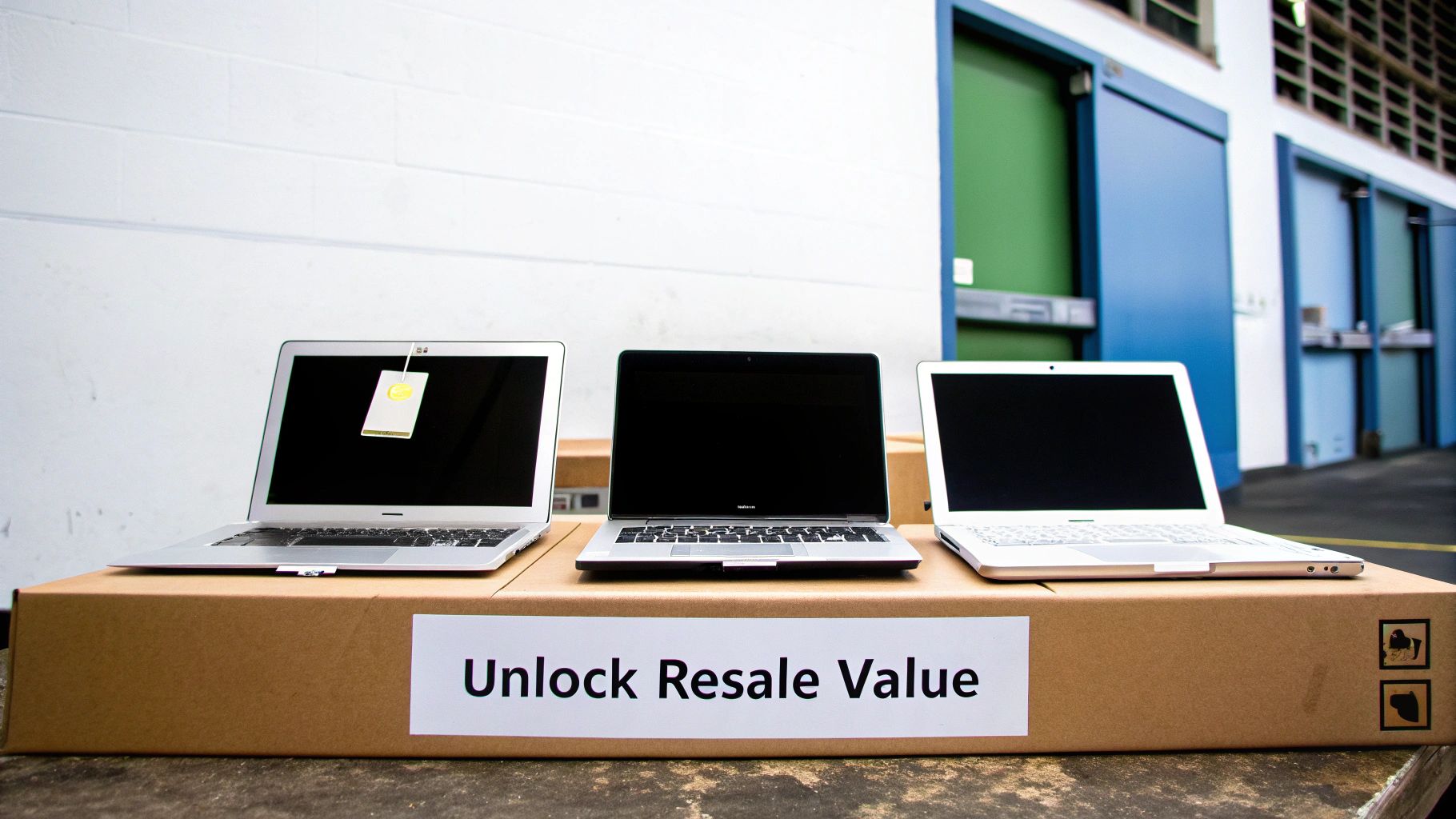
The secret is a process called IT Asset Value Recovery (ITAVR), or an IT buyback program. Instead of paying someone to haul away your old equipment, you work with a certified specialist who tests, refurbishes, and sells your functional hardware for you. The money you get back can dramatically lower—or even eliminate—the costs of data destruction and recycling. In many cases, you’ll end up with a net positive return, turning old tech into fresh cash for your IT budget.
Unlocking the Value in Your Retired Assets
Not every piece of old tech is a goldmine. The key to a successful buyback program is knowing which assets still have value on the secondary market. A professional ITAD partner will handle the full inventory and appraisal, but here's a look at the assets with the highest potential value:
- Recent-Model Laptops and Desktops: Enterprise-grade devices from major brands that are only three to five years old are always in demand.
- Enterprise Servers and Storage: Even after you've upgraded, old servers, SANs, and NAS units are packed with valuable, reusable components.
- Networking Equipment: High-end switches, routers, and firewalls from names like Cisco and Juniper hold their value well.
- Specialized Medical and Lab Equipment: Well-maintained diagnostic, imaging, and testing gear often has a long and valuable second life.
The goal of value recovery is simple: to maximize the financial return on your retired assets while maintaining the highest standards of data security and environmental responsibility throughout the process.
The Value Recovery Process Explained
Turning old hardware into cash is a carefully managed process built to protect your data and maximize your return. While every partner has their own workflow, the core steps are designed to be transparent.
- Inventory and Assessment: An ITAD specialist creates a serialized list of every asset, noting its make, model, specs, and condition.
- Secure Logistics: Your equipment is securely transported from your Georgia facility to a certified processing center with strict chain-of-custody protocols.
- Data Destruction: Every data-bearing device is wiped using NIST 800-88 compliant data wiping or physically shredded. You receive a Certificate of Data Destruction for your records.
- Testing and Refurbishment: Technicians test, clean, and repair working items for resale on the secondary IT market.
- Remarketing and Sales: The refurbished assets are sold through established global remarketing channels to fetch the best possible price.
- Revenue Sharing: Once the sales are complete, you receive a transparent report breaking down the sale price for each item, and the net proceeds are shared with your organization.
This structured approach transforms a logistical headache into a secure, documented, and profitable process. To see how this could look for your organization, check out our IT asset recovery and profit-sharing program in Atlanta and discover the value hiding in your storage closet.
How to Choose the Right ITAD Partner in Georgia
Picking the right partner for your end-of-life IT asset management in Georgia is one of the most important vendor decisions you'll make. This isn't just about hauling away old gear; it's a choice that directly impacts your data security, legal compliance, and bottom line. A mistake can lead to devastating data breaches, stiff compliance fines, and environmental headaches.
The Non-Negotiable Checklist for Vetting a Partner
To make sure you’re making the right call, use this checklist to guide your conversations. You'll want to ask direct questions and expect clear, documented answers.
1. Verify Industry Certifications
This is the absolute starting point. Certifications are hard-earned proof that a company has passed rigorous, third-party audits for security and environmental safety.
- Ask: "Are you R2v3 or e-Stewards certified?"
- Why it matters: These are the gold standards in our industry. An R2v3 certification confirms the vendor meets the highest requirements for sanitizing data, maintaining a secure chain of custody, and responsibly managing materials. A vendor without one simply can't guarantee a compliant process. It's a deal-breaker.
2. Scrutinize Their Data Destruction Process
You need more than a verbal promise that your data is gone. You need undeniable proof.
- Ask: "Can you show me a sample Certificate of Data Destruction? What are my options for on-site versus off-site destruction?"
- Why it matters: A legitimate certificate is your legal proof. It should include serial numbers for each asset, the exact destruction method used (like a NIST 800-88 wipe or physical shredding), and a clear transfer of liability statement. The option for on-site services offers an extra layer of security.
Digging Deeper into Logistics and Value
Once you've covered the critical security and compliance bases, it's time to look at how the partnership will work operationally and financially.
3. Evaluate Logistics and Chain of Custody
The journey your assets take from your office to their facility is a crucial link in the security chain.
- Ask: "What does your chain-of-custody protocol look like from the moment you pick up to the final disposition?"
- Why it matters: A professional ITAD partner uses secure, GPS-tracked vehicles, employs background-checked personnel, and maintains a documented audit trail for every single asset. This meticulous process ensures nothing gets lost or compromised in transit.
4. Demand Transparency in Value Recovery
If a vendor offers to buy back your used equipment, the entire process needs to be an open book.
- Ask: "How do you calculate the value of our assets? Can you walk me through a report showing the remarketing process and how our revenue share is determined?"
- Why it matters: You should expect to receive a clear, itemized report showing the value of each piece of equipment, any fees for processing, and a final settlement statement. This transparency builds trust and ensures you’re getting a fair return on your assets.
Common Questions About IT Asset Management
We get a lot of questions from Georgia businesses trying to figure out how to handle their old IT assets. Let's clear up some of the most common ones.
What Happens If My Business Lacks a Formal ITAD Policy?
Operating without a formal policy for end-of-life IT asset management in Georgia is a significant gamble. The biggest risk is a data breach from an improperly wiped hard drive, which can lead to serious financial penalties under federal laws like the FTC Disposal Rule and cause lasting damage to your reputation. Furthermore, you are likely leaving money on the table by not reselling valuable used equipment. A professional ITAD partner helps you build a process that's compliant, secure, and financially smart.
Can You Handle Both Old and New Equipment?
Absolutely. A good ITAD provider manages your entire range of end-of-life assets, making sure every device is handled correctly.
- Newer Equipment: Assets with market value are tested, refurbished, and resold through a buyback program, returning money to your budget.
- Older Equipment: Obsolete or broken items are securely processed for data destruction and then responsibly recycled according to top-tier standards like R2v3 or e-Stewards.
How Does the Chain of Custody Work?
The chain of custody is a documented paper trail that follows your IT assets from the moment they leave your facility until their final disposition. It starts with a serialized asset list, includes secure transportation logs, and ends with confirmation of arrival at a secure facility.
Once the data is destroyed and the equipment is recycled, you get official paperwork back, like a Certificate of Data Destruction and a Certificate of Recycling. This unbroken, documented chain is your proof of compliance and the key to transferring liability.
This gives you a defensible, auditable record that protects your Georgia business and proves you securely managed every last asset.
Contact Beyond Surplus for certified electronics recycling and secure IT asset disposal. We provide a complete, secure, and compliant solution to protect your data and maximize your returns. Learn more at https://www.beyondsurplus.com.


