

If you're reviewing telecom services in Atlanta, you're probably already dealing with the usual warning signs. Contracts are up for renewal. A second location needs cleaner connectivity. Voice quality is inconsistent. Nobody is fully sure which carrier owns what, what fails over, or what old gear is still sitting in a closet with live configs on it.
That mix is common in Atlanta because the market gives businesses real choice, but choice creates decision overhead. The right move isn't just buying a faster circuit or shifting phones to a hosted platform. It's designing the whole lifecycle correctly, from provider selection to migration to secure retirement of the equipment you replace.
Navigating Atlanta's Crowded Telecom Market
Atlanta doesn't behave like a thin telecom market where one incumbent sets the tone. Its downtown core functions as a regional interconnection point for long-haul fiber routes. A city connectivity report says routes from "all points of the compass" converge through downtown interconnection facilities, making Atlanta "the Southeast's nexus point for internet, voice and data traffic," with over a dozen telecommunications companies operating their own fiber networks in the Central Business District and 14 metro service providers identified there in that district-level review (Atlanta connectivity report).

That density is why Atlanta businesses often have access to national carriers, regional network operators, resellers, colocation-driven providers, and dark-fiber options in the same procurement cycle. It can enhance competitive advantage. It can also waste weeks if you compare vendors that aren't selling the same thing.
Why local density helps and complicates buying
A building might be "serviceable" by multiple providers, but the operational reality can still vary a lot. One carrier may control more of the path. Another may rely on leased last-mile access. A third may bundle support well but give you less route visibility.
Practical rule: In Atlanta, don't compare logos. Compare access method, demarc responsibility, support ownership, and physical path diversity.
The downtown concentration also influences nearby data center and enterprise decisions. Businesses with interoffice traffic, cloud workload movement, or disaster recovery dependencies usually benefit when they treat Atlanta as an interconnection ecosystem instead of just a place to buy internet. That matters for firms operating near carrier-dense areas such as Tech Village Atlanta telecom infrastructure, where proximity can affect design options and turn-up flexibility.
The provider landscape isn't just national carriers
The market includes recognizable names such as Zayo, AT&T, Comcast, and Level 3 among dense fiber operators in the area, but Atlanta also has a long-standing regional infrastructure base. Southern Telecom says it was founded in 1997, is headquartered in Atlanta, and provides wholesale dark fiber, including long-haul and metropolitan routes linking Atlanta with smaller Southeast cities (Southern Telecom company history).
That kind of provider matters when your requirement isn't generic business internet. Healthcare, finance, manufacturing, and multi-site enterprises often need route control, custom handoffs, or transport that aligns with a larger regional footprint.
Short version. Atlanta offers strong telecom options, but the market rewards buyers who know exactly what they're trying to buy.
Decoding Telecom Service Types for Business Needs
Most telecom buying mistakes happen before pricing even starts. A business asks for "internet and phones," then receives proposals for very different service classes. The U.S. Bureau of Labor Statistics separates telecommunications into wired, wireless, satellite, cable distribution, and related categories. That's useful because it reminds buyers that similar product labels can sit on very different operational foundations (BLS telecom industry definitions).

Match the service to the business function
A design firm pushing large files, a medical group with multiple clinics, and a warehouse with a small office won't need the same telecom stack.
| Telecom Service Comparison for Atlanta Businesses | Best For | Key Feature |
|---|---|---|
| Dedicated internet access | Sites that need predictable performance | Symmetrical business-grade connectivity |
| Business broadband | Offices with lighter critical workload demands | Lower-cost managed access |
| VoIP and unified communications | Teams replacing legacy PBX or fragmented calling | Centralized voice, messaging, and mobility |
| SD-WAN | Multi-site businesses | Application-aware routing across locations |
| Dark fiber | Organizations that want network control | Customer-managed transport and optics |
| Managed network services | Lean IT teams | Outsourced monitoring and support |
What works well in practice
Dedicated internet access fits headquarters, call-heavy teams, and sites where uptime and consistent throughput matter more than the cheapest monthly rate.
Business broadband can work fine for low-complexity offices, especially if the site has few latency-sensitive workloads and a clean backup plan.
VoIP and unified communications are strong choices when your issue is workflow fragmentation. If users bounce between desk phones, mobile phones, and separate messaging apps, a unified platform usually solves more operational friction than a bandwidth upgrade alone.
SD-WAN becomes useful when one policy has to manage multiple branches, cloud applications, and failover logic. It isn't automatically necessary for every company with two offices.
The dark fiber question
Atlanta has an unusually large dark-fiber ecosystem. One industry directory estimates 54 dark-fiber providers in the city, and local availability includes metro and long-haul dark fiber options connecting Atlanta to other Southeast cities (Atlanta dark fiber market overview).
That doesn't mean dark fiber is the right answer for most businesses.
Dark fiber gives you control. It also gives you responsibility for optics, lighting, maintenance coordination, and lifecycle management.
Choose it when your organization has a clear reason to own that burden, such as compliance design, route control, or long-term transport strategy. If not, managed Ethernet, waves, or DIA usually create fewer moving parts. For broader planning around business telecom solutions near Atlanta, that distinction matters more than the product label in a sales sheet.
Building Your Provider Selection Framework
A strong provider selection process should survive first contact with sales pressure. If your team only compares monthly recurring cost, you'll miss the issues that create tickets, outages, and regret after go-live.
Start with a weighted scorecard
Use a scorecard that reflects business risk, not just procurement convenience. I usually push teams to rank providers against operational categories before they look at final commercial terms.
Include items such as:
- Serviceability proof that identifies exactly what the provider can deliver at each location
- Escalation ownership so you know who handles outages, MACDs, and chronic performance issues
- SLA language that defines response expectations in plain terms
- Path diversity for critical sites where backup service must be physically meaningful
- Support model including after-hours coverage and named contacts for implementation
Look beyond "internet"
A common problem in telecom services in Atlanta is buying a product bundle without validating the underlying service class. A quote may look equivalent on the surface, while one provider is selling direct wired access and another is layering service through a reseller structure.
Ask each vendor to answer the same operational questions:
- What access method are you delivering at this address?
- Who owns the last mile?
- What proof of serviceability can you provide before contract signature?
- What happens when the local loop fails?
- Who owns the trouble ticket from open to close?
If a vendor can't explain fault ownership in plain English, expect confusion during the first serious outage.
Price the full operating model
Cheap monthly service can become expensive if your team has to do all the coordination. That includes vendor chasing, after-hours incident calls, handoff confusion, and support escalation through multiple parties.
A practical framework for reviewing local telecom company due diligence should score contract flexibility, implementation discipline, and support accountability alongside bandwidth and cost. Teams that formalize those categories usually make calmer decisions, especially when multiple carriers can technically serve the same Atlanta site.
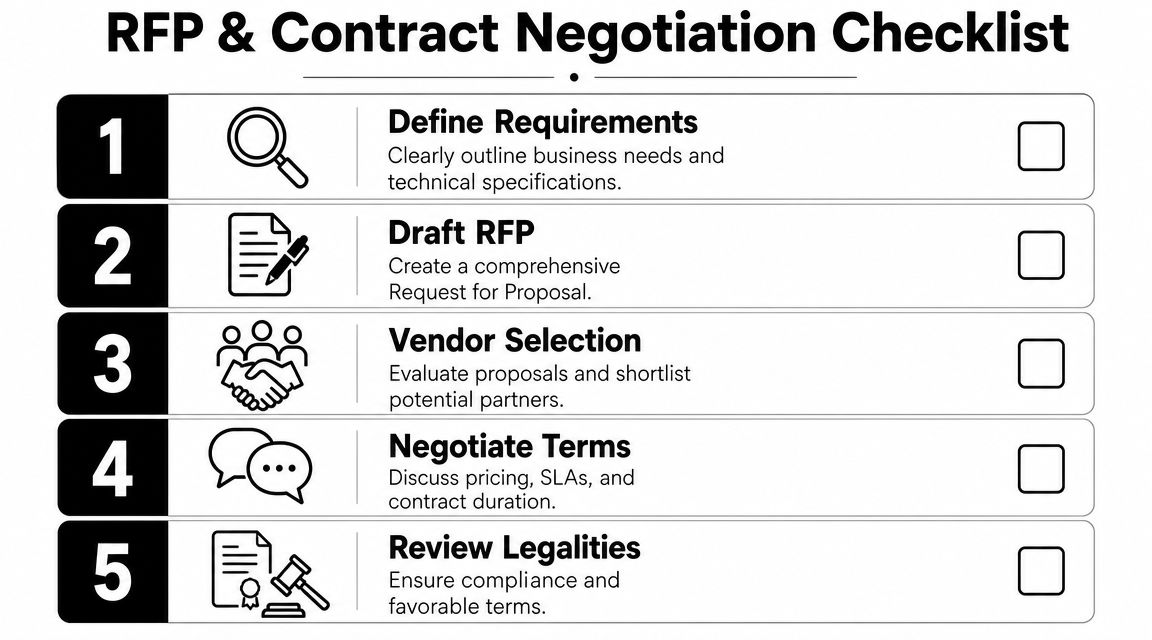
Your RFP and Contract Negotiation Checklist
Procurement gets risky when the RFP is vague and the contract is dense. Telecom vendors are good at filling in blanks in ways that favor their own operating model. Your job is to remove the blanks.
What the RFP should force vendors to answer
An effective RFP doesn't ask for a brochure. It asks for site-specific commitments.
Include these items:
- Location detail with every address, suite, and current carrier setup
- Performance requirements covering throughput, latency sensitivity, failover expectations, and voice dependence
- Implementation scope including construction assumptions, demarc details, equipment responsibilities, and testing steps
- Support expectations with escalation paths, maintenance windows, and outage communications
- Growth assumptions for branch additions, office moves, or cloud migration plans
Contract terms that deserve extra scrutiny
Telecom contracts often hide risk in ordinary-looking language. Push hard on renewal terms, early termination language, install contingencies, and service credits. If a provider says a clause is "standard," that's a reason to read it more carefully, not less.
Use a review pass that separates business points from legal enforceability. For a plain-language outside reference on contract basics, this overview of business contract advice is useful because it reinforces the importance of clear obligations, accurate parties, and unambiguous terms.
Negotiation note: If the SLA and the order form conflict, assume the provider will rely on the wording that limits its obligation.
Non-negotiables before signature
Some items should be resolved before your legal team approves the paper:
| RFP and contract checkpoint | Why it matters |
|---|---|
| Defined install scope | Prevents surprise construction disputes |
| Written escalation path | Reduces support ambiguity |
| Renewal language | Avoids unwanted term extensions |
| Exit terms | Protects leverage if service disappoints |
| Equipment ownership | Clarifies what must be returned or retired |
For teams building a repeatable procurement process, a vendor due diligence checklist for telecom projects helps standardize review across legal, IT, and finance.
Planning a Seamless Service Migration
Most telecom migrations don't fail because the new circuit never turns up. They fail because the business cut over before it tested the pieces around it. Phones ring to the wrong queue. A firewall policy wasn't updated. The backup path exists on paper but not in operation.
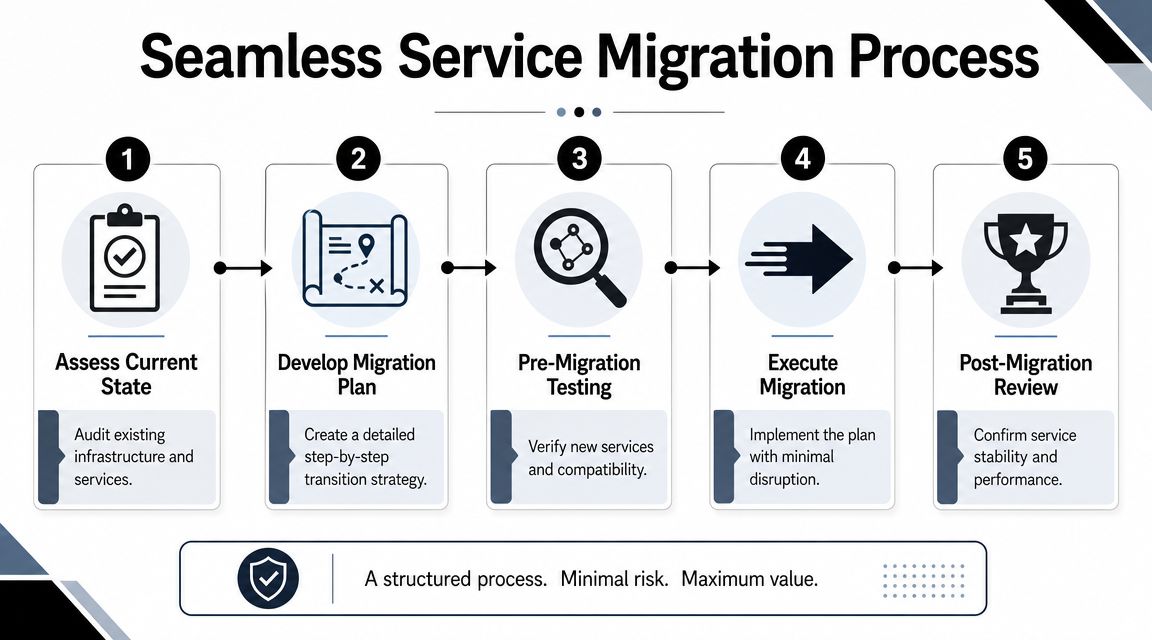
A clean migration usually follows this pattern
First, audit the current state. Inventory circuits, voice services, on-prem PBX components, analog dependencies, and every device tied to the existing environment. Old fax lines, alarm paths, paging adapters, and conference room phones are where surprises tend to hide.
Next, stand up the replacement service before anyone talks about disconnecting the old one. Test throughput, failover, voice routing, handset behavior, and remote-user access under normal conditions.
Use overlap on purpose
A short overlap between old and new service isn't wasteful. It's operational insurance. During that window, you validate call flows, verify critical routing, and give department owners time to confirm that real workflows still work.
A practical migration runbook should assign named owners for:
- Carrier coordination for turn-up and number moves
- Network changes on firewalls, switching, and QoS policy
- User communications so staff know what changes and when
- Fallback decisions in case a cutover step fails
- Post-cut validation for reception, customer-facing teams, and leadership
Test the business workflow, not just the circuit
I've seen teams declare success because a speed test looked fine, then spend days fixing reception logic and voicemail routing. Test by business function. Can the front desk transfer properly? Does the after-hours routing work? Do remote users present the right caller identity? Do mobile users know what to do if the office loses connectivity?
The migration isn't finished when the provider says the service is up. It's finished when your users can do their jobs without improvising.
After go-live, keep the old environment in documented standby until the business confirms stability. That approach feels slower, but it usually prevents the frantic cleanup that follows an overconfident cutover.
Securely Decommissioning Your Old Telecom Hardware
A telecom upgrade isn't complete when the new service works. It's complete when the old hardware is removed, documented, and processed securely.
That matters because retired routers, switches, firewalls, PBX appliances, VoIP phones, and edge devices often retain configurations, credentials, call records, and network metadata. Leaving them on a shelf creates avoidable risk. Throwing them into a generic recycling stream creates a different problem. You lose chain of custody and can't prove what happened to the data.
Why disposal belongs in the project plan
Decommissioning should be scheduled during the migration project, not weeks later when equipment starts piling up in storage rooms. The business needs a clear record of what was removed, what data-bearing components were sanitized or destroyed, and what assets were recycled downstream.
For regulated organizations, that documentation supports internal policy and external audit readiness. It also helps facilities, procurement, and IT close the loop without arguing over ownership of legacy gear.
What a proper retirement process includes
A sound process usually covers:
- Asset inventory tied to the migration scope
- Segregation of data-bearing hardware from commodity peripherals
- Documented data destruction for drives and storage components
- Certificates of recycling and destruction for compliance records
- Environmentally responsible downstream processing instead of informal disposal
One option for projects involving carrier gear, network equipment, or retired phone systems is telecom decommissioning services in Atlanta. Beyond Surplus handles secure IT asset disposition, data destruction documentation, and recycling workflows for end-of-life telecom equipment.
This is not optional housekeeping. It's part of risk management. The same discipline you apply to selecting and migrating telecom services in Atlanta should apply to the equipment leaving your network.
Frequently Asked Questions About Atlanta Telecom Services
| Common Questions | Answer |
|---|---|
| Should every Atlanta business buy dark fiber? | No. Dark fiber fits organizations that need control and can manage the operational burden. |
| Is the cheapest internet quote usually the best business option? | Not if support ownership, SLA detail, and failover design are weak. |
| When should old telecom hardware be removed? | During the migration closeout process, after service validation and data handling are documented. |
| What's the biggest procurement mistake? | Treating unlike service types as if they were directly comparable. |
If your Atlanta organization is replacing circuits, retiring PBX equipment, closing a telecom room, or cleaning up gear after a migration, contact Beyond Surplus for certified electronics recycling and secure IT asset disposal.


