

Atlanta businesses don't need more ESG language. They need better operational evidence. This is the defining shift behind ESG trends in Atlanta: sustainable IT practices. The companies getting ahead aren't the ones writing broader sustainability statements. They're the ones proving what happened to retired laptops, servers, storage arrays, and networking gear, with records that finance, compliance, and security teams can all use.
That matters locally because Atlanta's business environment already points in one direction. The city's sustainability agenda isn't abstract policy. It creates practical pressure on how offices, data centers, and enterprise IT fleets consume energy, extend equipment life, and handle end-of-life assets.
The New Business Imperative for Sustainable IT in Atlanta
Atlanta's ESG strategy is tied to Clean Energy Atlanta, which targets 100% clean energy by 2035, with interim milestones of 10% by 2020, 30% by 2025, and 50% by 2030, alongside a goal to cut greenhouse-gas emissions 40% by 2030 according to the City of Atlanta ESG program. For enterprise IT, that changes the conversation. Sustainable IT is no longer a side initiative run by facilities or procurement.
IT leaders in Atlanta now operate inside a citywide framework that favors efficiency, electrification, and lower-carbon operations. That affects refresh cycles, endpoint management, decommissioning plans, and vendor selection. If your team still treats asset disposition as a cleanup task after a migration or hardware refresh, your process is already behind the market.
A lot of business leaders still talk about ESG as branding. In practice, it's much closer to operational discipline. Broader discussions around corporate sustainability advocacy are useful because they frame sustainability as a business issue, not a public-relations exercise. In IT, that shows up in very concrete decisions: whether devices are redeployed, whether data destruction is documented, and whether recycling records are auditable.
What this means for Atlanta IT operations
Circular IT is now easier to defend internally because it aligns with the city's direction. Refurbishment, reuse, and value recovery support waste minimization. Better power management supports energy efficiency. Formal chain-of-custody records support governance.
For Atlanta teams building policy, this is the practical starting point: connect your refresh and retirement workflows to the local sustainability agenda, then document the outcomes. That's the same logic behind sustainable IT disposal in Georgia ESG ITAD explained.
Practical rule: If a device leaves inventory and you can't prove how it was wiped, reused, remarketed, or recycled, it doesn't belong in a credible ESG program.
Why ESG Now Matters for Atlanta IT Leaders
The pressure isn't coming from one place. It's coming from customers, investors, procurement teams, auditors, and peers that increasingly expect sustainability reporting to be normal business practice. One industry benchmark says 86% of large companies globally disclose some sustainability information, while only 22% of all companies do. The same source reports ESG adoption at 79% in North America compared with 93% in Europe, according to Vena's ESG statistics summary. That gap tells Atlanta IT leaders two things. Large organizations already treat ESG reporting as standard, and mid-market companies are under pressure to catch up.
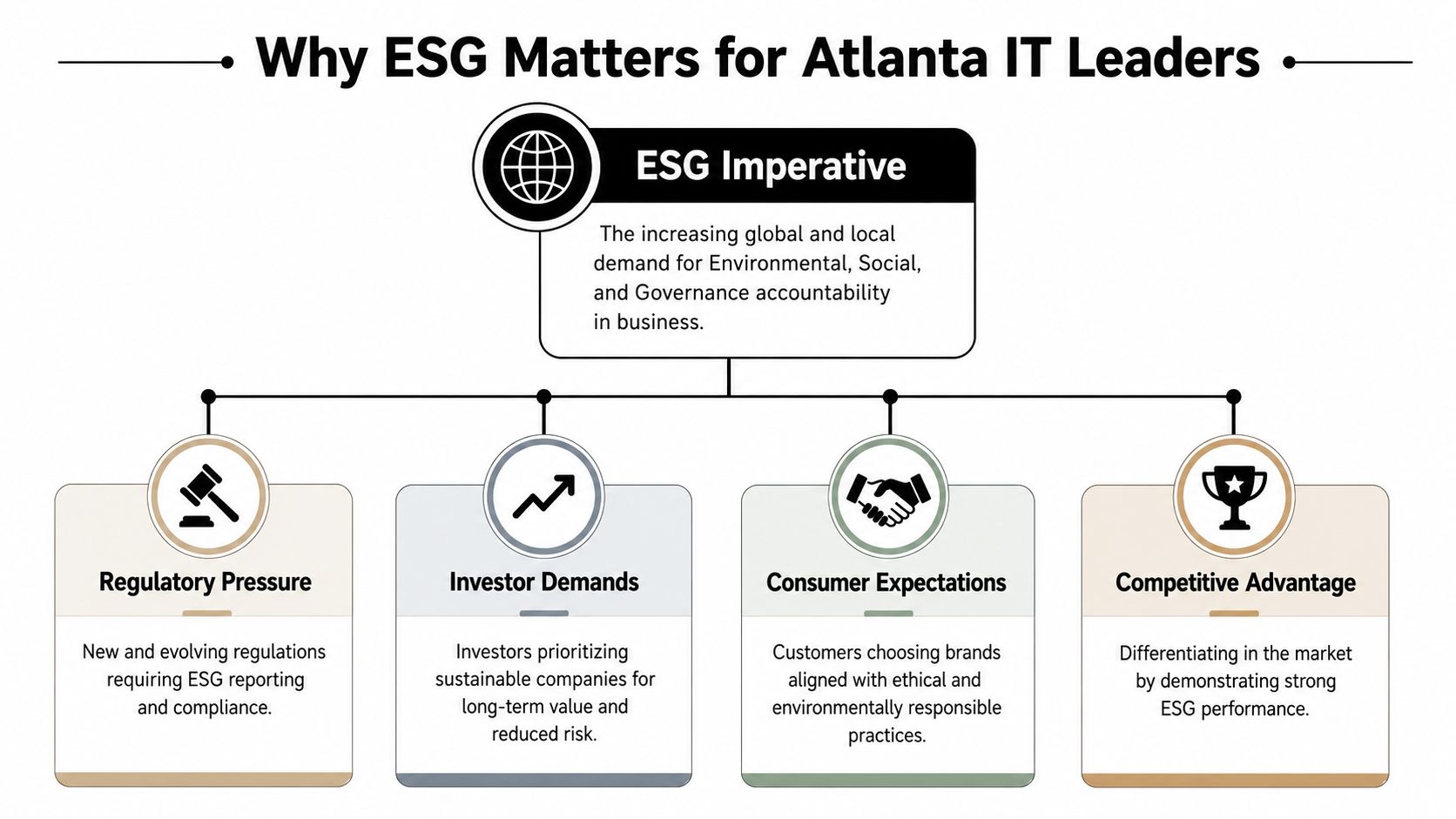
Peer expectations are becoming procurement expectations
An Atlanta healthcare network, bank, university, or manufacturer may not get asked first about recycling certificates. They will get asked about governance, vendor controls, risk handling, and reporting discipline. Sustainable IT sits inside all of that.
When procurement asks for environmental documentation, they're rarely looking for slogans. They want process. When an internal ESG team asks for support, they don't need a paragraph about responsible disposal. They need records that connect asset retirement to business controls.
Why IT is now in the reporting path
IT used to hand retired equipment to operations or facilities and move on. That model doesn't work well anymore because end-of-life hardware creates overlapping obligations:
- Security obligations tied to data destruction
- Governance obligations tied to chain of custody
- Environmental obligations tied to reuse and recycling documentation
- Financial obligations tied to value recovery and inventory reconciliation
That's why ESG electronics recycling in Georgia is no longer a narrow disposal topic. It's part of enterprise reporting hygiene.
The strongest IT departments don't treat retired hardware as scrap. They treat it as a controlled workflow with reporting outputs.
Navigating Atlanta's ESG Regulatory Landscape
The compliance side is getting sharper, not looser. The current trend is a move from voluntary ESG disclosure toward regulated, data-intensive reporting. Clark Hill notes that California's climate-disclosure regime includes a first-year deadline of August 10, 2026 for Scope 1 and Scope 2 emissions reporting under SB 253, as outlined in its analysis of ESG and sustainability trends in 2026. Even if your headquarters is in Atlanta, that matters if your company operates across state lines, serves regulated customers, or reports at a parent-company level.
The lesson for IT directors is simple. You can't support modern disclosure obligations with vague disposal practices. You need auditable infrastructure data, and that includes what happens when hardware leaves service.
What regulated reporting changes in practice
Older ESG programs could get by with annual narratives and rough estimates. That approach breaks down when reporting becomes more specific and reviewable. IT teams need records that show:
- When assets were retired
- How data was destroyed
- Whether equipment was reused, remarketed, or recycled
- Which vendor handled each step
- What documentation exists for audit review
Those records matter beyond environmental reporting. They also support internal control frameworks, legal defensibility, and vendor oversight.
Governance starts at asset retirement
Strong disposal processes serve two functions at once. They reduce environmental leakage, and they create proof that the company handled retired technology responsibly. That's why governance discussions often belong next to sustainability discussions. Teams that need a broader framing often benefit from reviewing established corporate governance principles and then translating them into operational controls for IT.
A common mistake is separating security records from ESG records. In a mature program, those datasets connect. The certificate of destruction, the pickup manifest, the serialized inventory list, and the final recycling documentation should support the same control environment.
Quantifying the Impact of Your IT Lifecycle
Sustainable IT doesn't create value because it sounds responsible. It creates value when your team stops destroying residual asset value, reduces control failures, and produces usable documentation. That's the business case Atlanta IT leaders need to make internally.
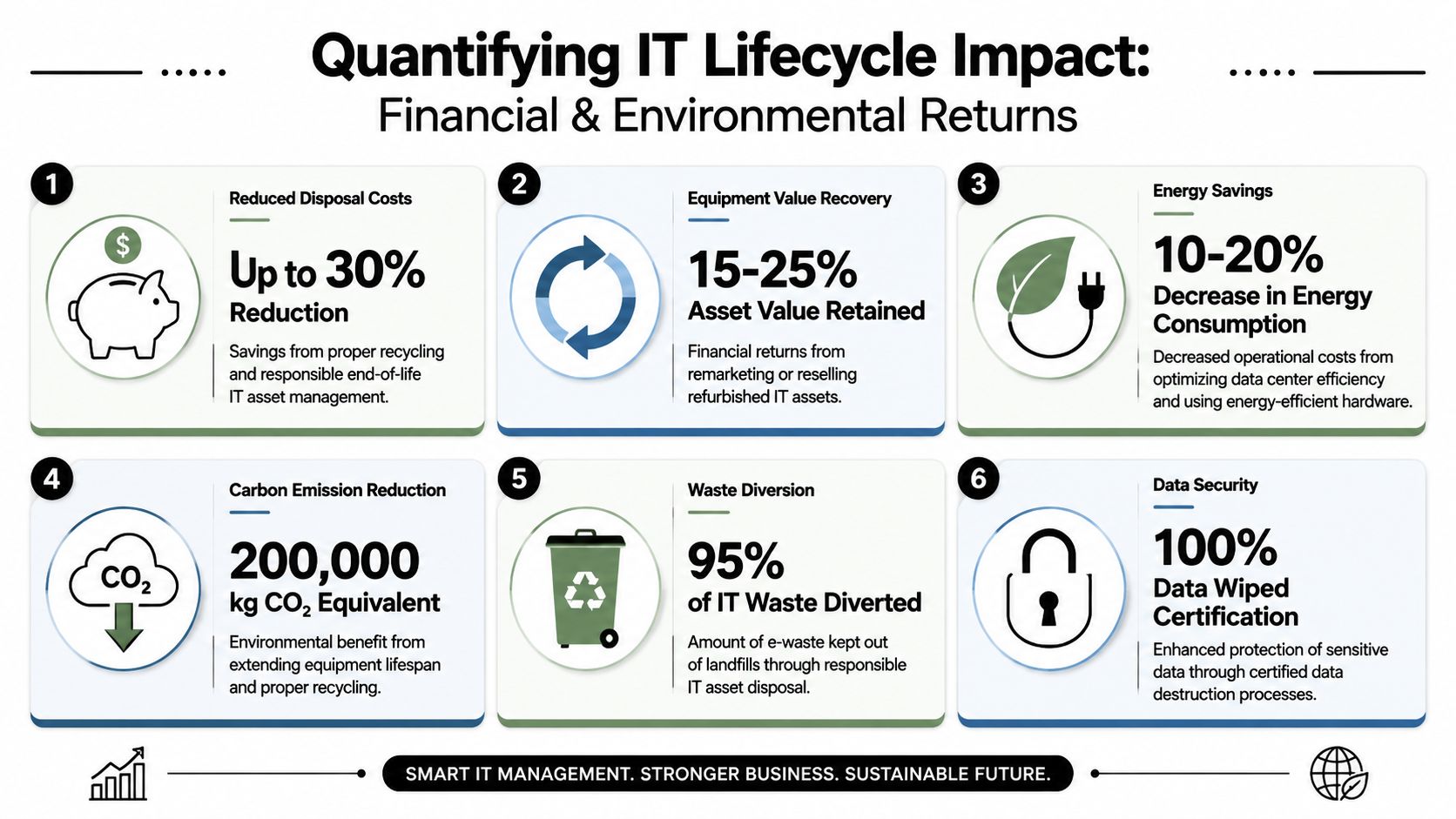
The infographic above shows common value themes, but the critical point is this: use your own operational records, not generic market claims, when you present results to finance or leadership. Unsupported numbers weaken the case. Auditable internal data strengthens it.
Where the return actually comes from
A disciplined IT lifecycle program usually creates benefit in four places:
| Impact area | What to measure internally |
|---|---|
| Asset recovery | Resale eligibility, redeployment volume, parts harvesting outcomes |
| Risk reduction | Data destruction completion, chain-of-custody completeness, exception handling |
| Environmental reporting | Reuse rate, recycling yield, documented downstream processing |
| Inventory control | Serialized reconciliation, retired-versus-active asset cleanup |
The biggest mistake is tracking only weight. Weight can help environmental reporting, but it doesn't tell leadership whether your process preserved value, closed security risk, or produced governance evidence.
Better metrics beat broader claims
For CFO conversations, talk about retained value and avoided process waste. For compliance conversations, talk about evidence quality. For ESG conversations, talk about traceable end-of-life outcomes.
A more mature lifecycle program asks different questions:
- Which assets were fit for reuse instead of scrap?
- Which items required certified destruction?
- Which devices generated documentation strong enough for audit review?
- Which refresh decisions shortened useful life without a clear business need?
That's where IT lifecycle management in Georgia becomes relevant as an operating model rather than a disposal event.
If you can't separate reused assets from recycled assets in your reporting, your ESG data is too blunt to guide decisions.
Implementing Actionable Sustainable IT Practices
Most ESG reporting around IT still stays too high-level. The operational fix is to treat sustainability data as part of normal asset management. The G20 Sustainable Finance Working Group notes that ESG digitization is being driven by cloud-based platforms that aggregate asset-level information from sensors, IoT devices, satellites, and other monitoring tools, and the same guidance emphasizes centralization, lineage, auditability, and automated validation in tech-driven ESG practices guidance. For IT teams, that means end-of-life data should live inside systems and workflows, not in a year-end spreadsheet.
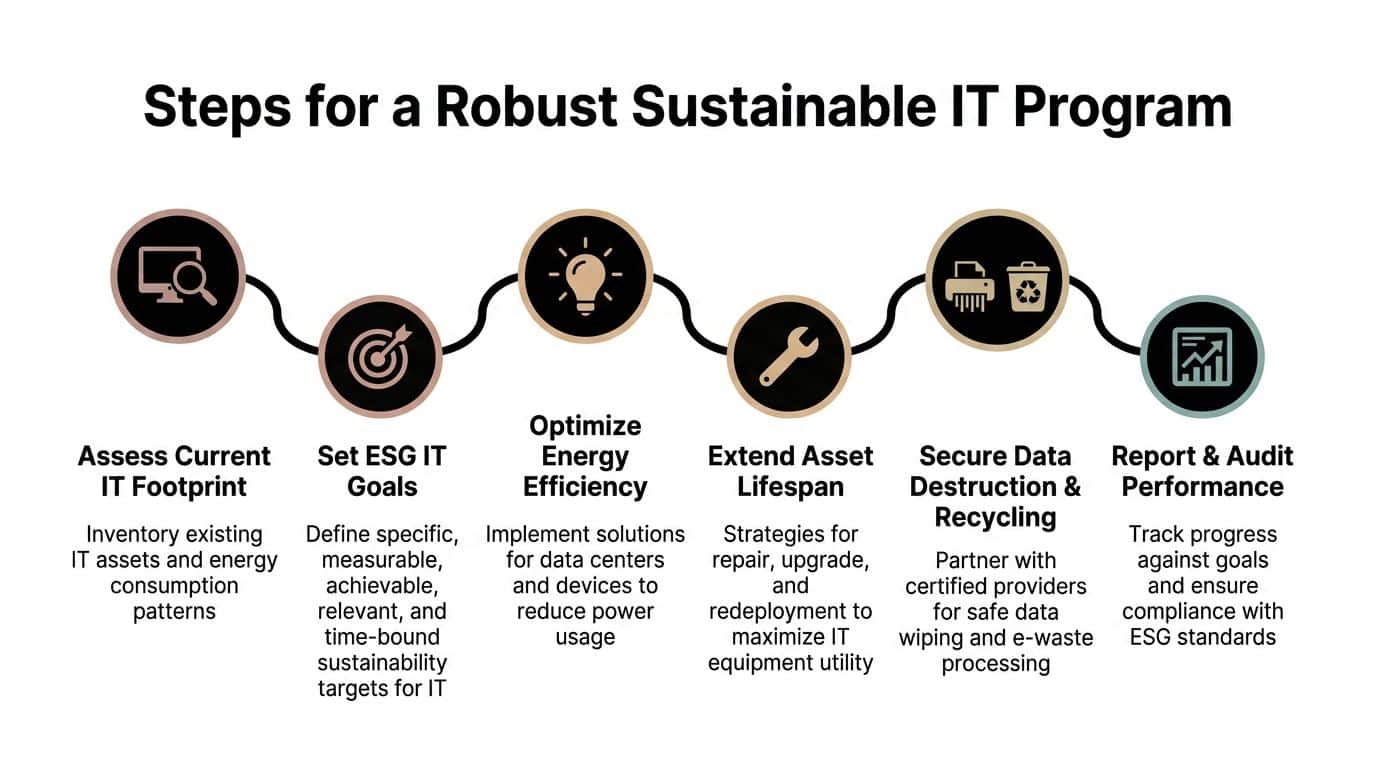
The metrics that belong in your ITAD workflow
If you're building an auditable program, track end-of-life data at the asset or batch level. The most useful metrics are specific enough to support review and comparison across sites and vendors.
- Reuse rate. Measure how many retired assets were redeployed, refurbished, or remarketed instead of recycled.
- Certified destruction rate. Track which data-bearing devices received documented sanitization or shredding.
- Recycling yield. Separate material recycling from reuse so your reporting doesn't blur two different outcomes.
- Chain-of-custody completion. Confirm whether every transfer point has supporting records.
- Exception count. Log missing drives, damaged labels, unmatched serials, and undocumented pickups.
- Avoided emissions methodology. If you report this, define the method clearly and apply it consistently across vendors and facilities.
What works and what fails
Here's where programs usually break.
What works
- Tie ESG records to asset records. If the serial number, model, user group, and disposition result sit in one reconciled dataset, reporting gets easier.
- Standardize vendor evidence. Require the same output every time: inventory list, destruction confirmation, recycling documentation, and final summary.
- Review by site and business unit. That helps identify whether one location recycles everything while another redeploys aggressively.
What fails
- Annual spreadsheet exercises. They're slow, hard to audit, and full of gaps.
- Mixed disposal language. Teams say “recycled” when they mean anything from resale to shred.
- Security-only workflows. They wipe the drives but lose the environmental reporting value.
A practical operating model
A workable program usually follows this sequence:
- Inventory retired assets before pickup.
- Classify by reuse, resale, destruction, or recycling path.
- Capture custody transfer at every handoff.
- Reconcile final outcomes against the original inventory.
- Store records where ESG, finance, security, and audit teams can all access the same truth.
For organizations that need a vendor aligned to that model, an ESG recycling partner in Georgia can support the operational side, provided the documentation standards are clear from the start.
Good ESG reporting from IT doesn't begin with the annual report. It begins when the first retired asset is tagged, counted, and routed.
How Beyond Surplus Supports Atlanta ESG Goals
The hardest part of sustainable IT isn't deciding that responsible disposal matters. It's proving, months later, what happened to every retired device. That's the gap most organizations discover after a refresh project, an office move, a data center shutdown, or a fleet replacement.
A strong ITAD partner closes that gap by turning disposal into documented process. Current ESG commentary often misses this practical question: what end-of-life IT metrics belong in an ESG report, and how should they be documented for auditability? That gap is identified in Carbon Trail's discussion of ESG reporting trends and the missing ITAD measurement layer.
What a documented partner relationship looks like
Take a typical Atlanta organization with multiple offices and a mixed fleet of laptops, monitors, servers, and storage. The internal team needs speed, but also needs evidence. The right process usually includes:
- Serialized intake records so inventory and retirement data can be reconciled
- Certified data destruction outputs for drives and other data-bearing devices
- Recycling documentation for assets that can't be reused
- Value recovery reporting where remarketing is appropriate
- Clear liability transfer records for governance and audit support
That's where Beyond Surplus in Georgia fits as a local service option. The company provides secure data destruction, recycling documentation, and chain-of-custody reporting that businesses can use for compliance and internal ESG controls.
Why this matters more in regulated sectors
Hospitals, financial institutions, schools, and government contractors don't just need hardware removed. They need records that stand up to scrutiny. If a sustainability team asks for reuse and recycling data, and an auditor asks for proof of destruction, the same workflow should answer both questions.
That's the practical value of sustainable ITAD. It connects environmental outcomes with governance evidence instead of forcing your team to build two separate processes.
Your Next Step Toward Auditable Sustainability in Atlanta
Atlanta IT leaders don't need to guess where ESG is going. The direction is clear. Reporting is becoming more operational, more reviewable, and more dependent on underlying data. That puts retired IT hardware directly inside the ESG discussion.
The companies that adapt fastest will treat end-of-life technology as a governed business process. They'll know which assets were reused, which were destroyed, which were recycled, and which records support those outcomes. They won't rely on broad sustainability language after the fact.
If your current process ends when equipment leaves the building, you have a visibility problem. If your documentation can't connect inventory, destruction, recycling, and value recovery, you have a control problem. Both are fixable, but only with tighter workflows and better evidence.
Atlanta's sustainability direction makes this more urgent. Enterprise reporting pressure makes it more visible. And nationwide compliance trends make it harder to postpone.
Contact Beyond Surplus for certified electronics recycling and secure IT asset disposal that supports auditable ESG reporting, documented chain of custody, and sustainable IT practices for Atlanta business operations.


