

A recalled e-bike in a fleet cage or a service bay is a fire problem before it is a recycling job. The battery's condition sets the only destination that should receive it, and that site has to confirm acceptance before anyone books a truck. Recalled e-bike disposal services make that confirmation, the handoff, and the final certificate routine for businesses that can't treat a suspect pack like ordinary IT hardware.
Table of Contents
- Triage Recalled E-Bikes by Battery Condition
- How to Intake and Isolate a Recalled Unit
- Federal Hazardous Waste Rules for Lithium-Ion Batteries
- Transport and Acceptance Rules for Recalled Batteries
- What a Recalled E-Bike Disposal Service Includes
- Vetting a Certified Recycler for Recalled E-Bikes
- Chain of Custody, Data Security and Final Certificates
- Schedule a Compliant Recalled E-Bike Pickup
Triage Recalled E-Bikes by Battery Condition
The decision that runs the whole project is which route this battery can take. The U.S. Consumer Product Safety Commission identified 310 deaths associated with micromobility products from 2017 through 2024, and 19 of those deaths were linked to 13 incidents involving lithium-ion battery fires. That record is why a recalled unit is identified, isolated, and moved only after a facility equipped for recalled lithium batteries confirms it will take the pack. The same guidance says recalled or damaged lithium-ion batteries should not go into household trash, curbside recycling, or common used-battery collection boxes, because they can ignite during handling, transport, or processing.
Sort every pack into one row before anyone discusses a pickup window.
| Condition | Visible signs | Immediate action | Acceptable destination |
|---|---|---|---|
| Recalled, intact | Model matches recall notice, no visible damage | Disconnect from bike and charger, store dry and separated from other stock | Facility that has confirmed it accepts recalled lithium-ion batteries |
| Damaged or defective | Cracks, dents, deformed casing | Stop charging, isolate from combustibles, handle as little as possible | Permitted hazardous-waste facility or qualified battery recycler after pre-acceptance confirmation |
| Swollen or leaking | Bulging case, odor, residue or wet casing | Quarantine in a ventilated area, use protective equipment, escalate to emergency procedures | Specialist facility with a documented emergency handling plan |
| Hot, smoking or hissing | Heat, smoke, hissing or rapid temperature rise | Follow emergency procedures first and keep people clear | Only after emergency response clears the unit, to a specialist facility with a documented emergency handling plan |
Practical rule: The first call goes to the receiving facility, not to a second reading of the recall notice. Acceptance isn't universal.
An intact recalled pack comes off the bike and the charger, stays dry, and stays off the shelf with sound stock. A cracked or dented pack stops being charged and moves only after a permitted hazardous-waste facility or qualified battery recycler has said yes. Swelling, odor, residue, or a wet case means a ventilated quarantine, protective equipment, and a specialist site with a written emergency plan. Heat, smoke, hissing, or a fast rise in temperature is an emergency first. People clear the area, and the pack moves only after responders clear it.
A worn pack that lost range can follow ordinary replacing and recycling e-bike batteries advice. A recalled pack can't. Chargers and power banks that arrive with the fleet don't belong in the same container. Send those accessories through recalled charger and power bank disposal so a cord doesn't get buried in the battery load.
Match each unit to a row, write the classification on the tag, and leave the unit in place until the destination in that row is confirmed.
How to Intake and Isolate a Recalled Unit
Intake is what makes a recall defensible later. A quarantine path beats normal electronics sorting, because a suspect pack isn't tested, mixed with good inventory, or closed out on a pickup receipt.
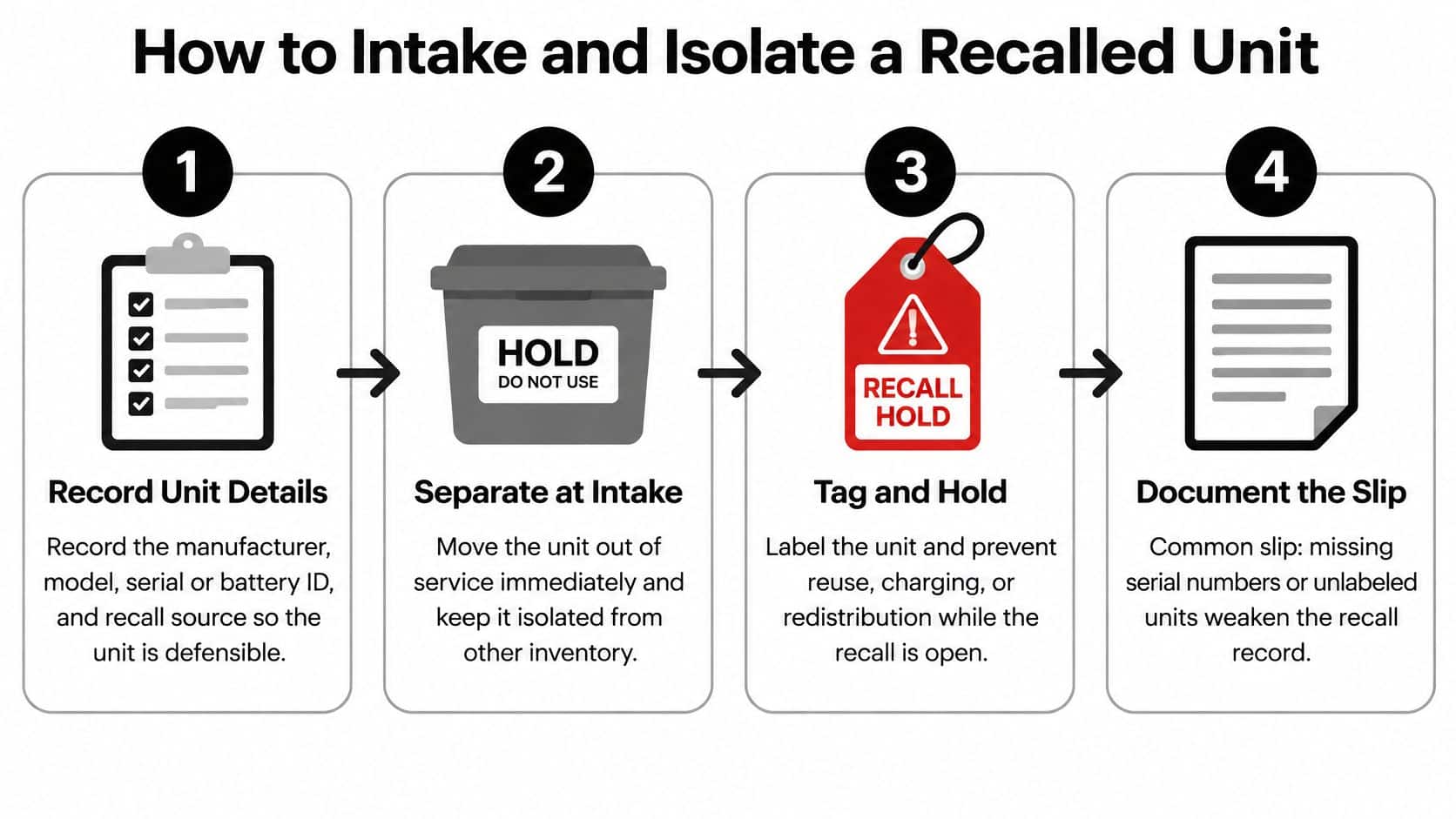
The hold, in order
- Record the unit before it moves. Write the manufacturer, model, serial or battery ID, recall notice, owner, and visible condition. The common slip is logging the bike model and skipping the battery ID, which is the identifier the destination will ask for.
- Stop use and charging. Disconnect the battery from the bike and the charger, following the manufacturer or municipal procedure. Leaving a pack on a charger is how a quiet hold becomes a hot one.
- Tag the battery, not the bicycle. Use the condition categories, recalled, damaged, swollen, leaking, hot, or otherwise abnormal. A tag on the frame and a loose pack in a tote is an unlabeled battery.
- Isolate it from combustibles and from sound stock. A controlled area, away from cardboard, chargers, and good packs. Consolidating recalled packs with undamaged inventory is the failure that spreads one bad unit across a rack.
- Look only. Don't power the pack, don't run an electrical test, and don't plug a charger back in to see if it still works. A visual check is the inspection.
- Escalate abnormal signs. Heat, odor, hissing, deformation, leakage, smoke, or a rapid temperature rise goes to emergency procedures, and people move clear.
- Photograph the unit and the battery label before further handling. That picture is the recall evidence. It shouldn't require opening the case.
The U.S. Environmental Protection Agency recommends separate collection for lithium-ion batteries and careful handling of damaged batteries with appropriate personal protective equipment. The destination is a permitted hazardous-waste facility or a qualified battery recycler. Universal-waste shipments generally don't require a hazardous-waste manifest, but the material still has to reach an appropriately permitted recycler or disposal facility, and recalled batteries should never be routed by air.
Treat these as internal controls, not as an industry recycling rate. 100% pre-acceptance confirmation, 100% documented chain of custody, 0 batteries placed in general recycling, 0 air shipments, and 100% certificate closure. The pitfall that breaks the file is accepting a walk-in pack when no facility has confirmed it will take that condition.
Federal Hazardous Waste Rules for Lithium-Ion Batteries
Two federal waste codes decide most of this routing: D001 for ignitability and D003 for reactivity. The Environmental Protection Agency lists both, and many discarded lithium-ion batteries can meet one or both because a damaged pack may burn or react. Classification sets which destination can legally accept the pack before any move is booked. No classification exercise matters if no permitted destination has agreed to take the condition.
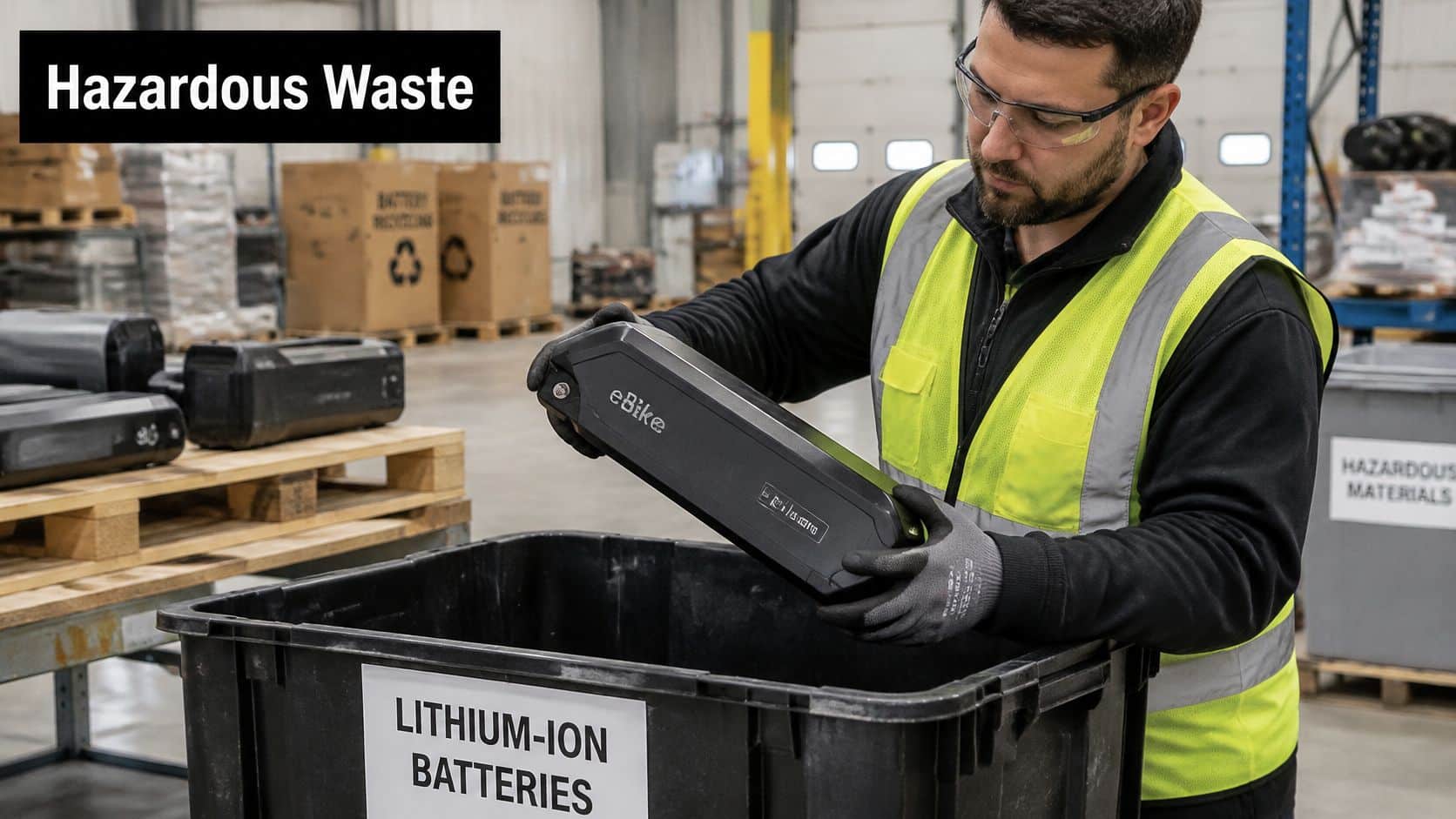
A commercial recall program checks condition against those codes and against state rules, then isolates damaged or suspect units. A standard electronics recycling stream does not automatically comply. Lithium batteries may qualify for recycling exclusions under 40 CFR 261.4(a)(24) or 261.4(a)(25), but only when the generating state and the recycling state have both adopted the exclusion and every condition is met. If either state has not adopted it, the exclusion is unavailable, no matter what a national summary says. The habit that keeps a battery file defensible is the same one used in assessing risks from hazardous substances: name the hazard, then decide the control. Assuming a green bin covers it is how a compliant load turns into a rejected one.
For a recalled e-bike, the battery often arrives removed from the bike, which means the pack has no product housing to protect it. A swollen pack and an intact pack can leave the same dock on different paperwork. The practical test is not whether a recycler advertises battery recycling. The test is whether the specific destination will accept the specific condition, under the specific state rule, in writing.
What the status still requires
Universal-waste handling, where it applies, still means preventing releases, labeling containers correctly, and sending batteries to a permitted hazardous-waste facility or recycler. The classification sets the route. The state check sets whether an exclusion can be used. The handling rules set the label and the storage. Miss one and the paperwork describes a shipment the rules do not allow.
- Confirm the hazard classification for each condition on the triage table.
- Check whether the generating state and the recycling state have adopted the exclusion.
- Apply universal-waste handling and label each container.
- Keep shipment records with the unit file.
- Confirm a permitted destination before any shipment leaves.
Store damaged packs away from flammables while they wait, and keep the label legible so the next handler can read the route without opening the case. Beyond Surplus processes electronics through environmentally compliant recycling channels in accordance with EPA guidelines. That does not replace the state check on a recalled pack. More detail on how these rules sit next to other batteries is on our universal waste regulations page.
Transport and Acceptance Rules for Recalled Batteries
A county household-hazardous-waste site can refuse a recalled lithium-ion pack even when the recall notice sends consumers there. The notice names a type of place. It does not guarantee your county's dock will take a damaged, swollen, or recalled e-bike battery today. Acceptance is the first decision in the job, not a step after the van is loaded. Ask for it in writing, with the battery chemistry, condition category, and quantity named on the confirmation.
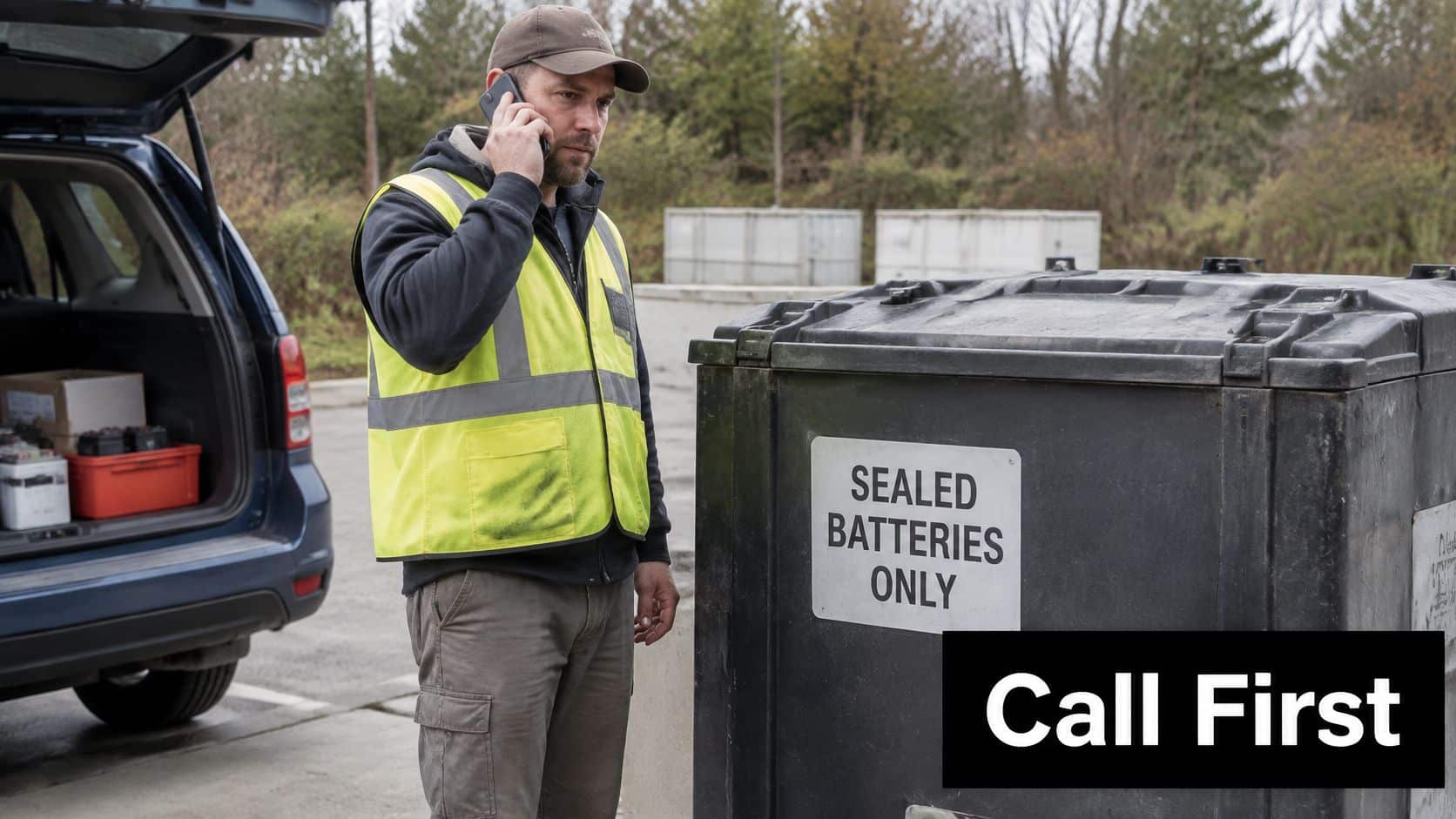
Follow this order, and do not load the van between steps. Call the prospective destination and ask whether it takes recalled or damaged packs; quote the recall reference and model. If the answer is no, ask for the next permitted hazardous-waste facility or specialist battery recycler. Do not move the unit until that destination confirms acceptance in writing or on a confirmed booking. A phone representative's willingness to "take a look" is not acceptance. A booking without a named receiving facility and acceptance reference is not acceptance either. Keep the written confirmation, booking reference, and carrier authorization with the unit file, because that file is how you prove the pack reached a permitted destination.
The Environmental Protection Agency's lithium-ion battery recycling FAQ recommends that businesses consider managing all used lithium batteries, rechargeable lithium-ion and single-use lithium primary, under the federal universal-waste rules in 40 CFR Part 273. Those rules govern generator management and labeling. They do not create a guaranteed acceptance slot at a receiving facility. Recalled packs carry a higher fire risk, so they stay out of ordinary trash and mixed recycling.
Damaged, defective, or recalled batteries cannot travel by air, and packaging must meet Department of Transportation requirements. The carrier must be authorized to transport dangerous goods. A useful primer on what that licence covers is TP Training's dangerous goods licence guide.
- Pack each battery on its own. One pack per outer package, so cases do not strike each other.
- Protect terminals only as the carrier's dangerous-goods instructions require. Do not invent a tape job for a swollen or hot pack.
- Do not charge, dismantle, or drop a recalled pack in a retail collection box. Those boxes are not built for this size or this risk.
- Keep recalled batteries on the ground. No air leg, including a connecting flight.
Can the whole bike ride in a company vehicle? Where the recall instructions say to disconnect the battery, remove it first and move the battery as its own load. The frame can follow as ordinary equipment. When a manufacturer wants proof of disposal and the pack is too hazardous for ordinary transport, document the refusal and each escalation, then ask the manufacturer for written direction. Do not handle the pack to speed a refund. When you compare recalled battery device disposal services, require the same written acceptance before any pickup is booked.
What a Recalled E-Bike Disposal Service Includes
Compare quotes on the same scope, in the order the job runs. A price that skips a line isn't cheaper. It's unfinished.
- Intake and triage at your site, using the condition categories, so an intact recalled pack isn't booked like a hissing one.
- Isolation and quarantine containers for damaged, swollen, or leaking packs, separate from sound inventory.
- Pickup or drop-off logistics, including packing and dangerous-goods transport by a capable carrier.
- Pre-acceptance confirmation that the destination takes recalled lithium-ion batteries of that condition.
- Disposal at a permitted hazardous-waste facility or a qualified battery recycler.
- Chain-of-custody records and a certificate of recycling for each load, not a single pickup slip for the fleet.
- Destruction or erasure certificates for any data-bearing hardware on the same job.
Cost moves with battery condition, because damaged and swollen packs change packaging and the carrier. It also moves with unit count, distance to a permitted facility, whether storage media need destruction, and whether intake happens on site. Ask for a written quote that itemizes each of those seven lines. Scope sets the cost, so a bare number without those lines isn't comparable.
Vetting a Certified Recycler for Recalled E-Bikes
Most providers will quote a price and a pickup date. Fewer will show how a recalled lithium-ion pack is handled once it leaves your dock. Use the table as a filter. Any red flag ends the conversation before a load is offered.
| Criterion | What to require | Red flag |
|---|---|---|
| Battery handling | Written handling procedure for recalled lithium-ion packs | Accepts packs without a condition check |
| Documentation | A certificate for every load and a chain-of-custody record | Pickup receipt only |
| Data destruction | Certificate of destruction and a stated destruction method | Data wiped with no proof |
| Liability | Written transfer of liability to the provider | No written terms |
| Compliance | Statement of local and federal compliance and EPA-guideline processing | Vague claims of green processing |
| Transport | Dangerous-goods capable carrier and no air freight | Offers air shipment for batteries |
Questions that filter the shortlist
- Ask for a sample certificate and a sample chain-of-custody record. A complete answer names the certificate issued for each load.
- Ask who physically handles the battery and whether that person is trained for lithium-ion hazards.
- Confirm the carrier is dangerous-goods capable and that no air shipment is used.
- Ask whether recalled lithium-ion batteries are accepted specifically, and get that answer in writing.
- Request written terms, including liability transfer, before any load is accepted.
Every load we pick up receives a Certificate of Recycling and Data Destruction, and all liability transfers to Beyond Surplus. Corporate computer disposal services are compliant with local and federal laws governing the disposal of computers. Verify current credentials yourself rather than relying on a marketing line, including how an R2 certified electronics recycler is checked. A complete answer names the handling procedure, the certificate, and the written terms. Anything shorter isn't a shortlist candidate.
Chain of Custody, Data Security and Final Certificates
A pickup receipt shows that someone took the bike. It doesn't show where the battery went. Keep one evidence file per unit, and close the job only when final disposition is in that file.

| Record | Evidence it provides |
|---|---|
| Intake record | Recall reference, model, serial or battery ID and condition at receipt |
| Photographs | Unit and battery label as they were before handling |
| Handoff receipts | Each transfer between custodians |
| Transport documentation | Carrier, packaging and dangerous-goods handling |
| Final recycling or disposal certificate | Final disposition of the battery |
| Certificate of destruction | Erasure or destruction of data-bearing media |
Work down that list in order. Intake and photos come before the first handoff. Transport papers name the carrier, the packaging, and the dangerous-goods handling. The recycling or disposal certificate is the line that closes the battery. Certificates of recycling and data destruction are available for each load of equipment picked up, and they're the written guarantee that the equipment was handled responsibly. A recall remedy that asks for proof of disposal is answered with this file, not by opening, taping, or shipping a pack that isn't safe to move.
Data-bearing hardware is a separate check
Diagnostic tools, fleet-management units, point-of-sale systems, and attached storage can hold customer, employee, financing, or operational records. The Federal Trade Commission's Disposal Rule applies to any business or individual that uses consumer reports for a business purpose. It requires reasonable measures to prevent unauthorized access during disposal, recognizes destruction or erasure so information can't be read or reconstructed, and allows a destruction contractor after due diligence.
Pull data-bearing components off the battery path. Ask for the destruction method in writing. For large pickups of servers, computers, and laptops, free shredding of storage media is provided, and a Certificate of Destruction is included at no cost. Our methods render all media "unusable and/or inaccessible." File that certificate with the battery's disposition record, and see how a certificate of destruction for recalls is scoped when the hardware and the pack travel together.
Schedule a Compliant Recalled E-Bike Pickup
Booking starts with the inventory, not with a truck. A move that gets scheduled before acceptance is confirmed is the move you'll have to turn around.
- Assemble the inventory. Model, serial or battery ID, recall reference, and condition for each unit, matched to the triage rows.
- Confirm acceptance first. The receiving facility or the disposal provider has to accept recalled lithium-ion batteries of that condition before any move is booked.
- Request the service by phone, by email, or by filling out the online form.
- Set the handoff in writing. For businesses with qualifying equipment, pickup is free, and we remove, pack, and transport the equipment. If the site uses drop-off instead, accepted equipment can go to the Atlanta warehouse during business hours on a no-contact basis. Confirm that the specific site accepts the recalled batteries before any unit travels.
- Hold the certificates. Keep the certificate of recycling and, where data-bearing hardware is included, the certificate of destruction, and file both with the intake record.
Bring the recall references and the unit count to that first conversation so the quote and the pickup get scoped together. Contact Beyond Surplus for certified electronics recycling and secure IT asset disposal.
Beyond Surplus coordinates commercial pickup, documented chain of custody, and certificates of recycling and data destruction for recalled e-bike batteries and the IT hardware that travels with them. If you're holding recalled packs, start with the condition list and a confirmed destination rather than a curbside plan. Visit Beyond Surplus to scope a compliant pickup.


