

The most popular advice on recalled lighting product disposal is also the most dangerous for a business. It tells you to recycle fast, toss the fixture in an e-waste bin, or drop lamps at the nearest collection point. Do that before you've confirmed the recall remedy, and you can forfeit a refund, destroy proof the manufacturer required, or ship a mercury lamp or damaged lithium battery through the wrong stream.
For commercial inventories, disposal isn't the first step. It's the last step after identification, quarantine, hazard sorting, and a written acceptance check from the receiving facility. That order protects your reimbursement, your workers, and your audit file.
Table of Contents
- Confirm the Recall Remedy Before Disposal
- How to Quarantine and Inventory Recalled Units
- Sort Recalled Lighting by Hazard Before Transport
- Mercury Lamp Rules and Packing for Shipment
- Choose an Authorized Receiving Facility
- Records That Prove Compliant Recall Disposal
- Book Certified Recall Disposal for Your Lighting Inventory
Confirm the Recall Remedy Before Disposal
| Recall remedy | First action | Disposal allowed? |
|---|---|---|
| Dispose or destroy | Get written destruction instructions | Yes, after verified destruction |
| Refund or replacement | Contact the manufacturer first and keep units intact | Not until the remedy closes |
| Repair | Hold units for the repair process | Only unrepairable parts |
| Manufacturer unreachable | Confirm return is not required | Only after disabling the unit |
The recall notice decides what happens next, not the lamp in your hand. Match every unit's model number, lot or date code, and serial range to that notice, and file the recall number before anyone moves product.
Match the Unit to the Notice First
The U.S. Consumer Product Safety Commission recall listings show that recall guidance is remedy-specific, because some notices instruct disposal while others require contacting the manufacturer for a replacement or repair first. Recalled high-bay LED fixtures, for example, have been handled through free repair or replacement rather than automatic disposal. If your team shreds those fixtures on day one, you've eliminated the manufacturer's remedy and possibly your reimbursement.
Photograph each rating label before removal, and record quantities by serial number, not by pallet estimate. Capture visible damage, scorching, cracked housings, or swollen battery packs without opening the unit. That record proves which units you held, what condition they were in, and why you chose the route you did.
When Intact Quarantine Beats Immediate Recycling
I would not dismantle a fixture that can't safely remain energized until you have written transport instructions. Isolate power at the breaker, restrict access to the area, and ask the manufacturer how the unit should travel. Cutting into a driver, capacitor, or sealed battery compartment can create the exposure you're trying to prevent.
Quarantining an intact product for a few days is often safer than recycling it immediately into the wrong stream.
Close this stage with three decisions in writing. First, the confirmed remedy. Second, the reconciled count. Third, whether any unit must stay intact for return, inspection, or photographic proof before destruction.
How to Quarantine and Inventory Recalled Units
Recycling does not prove recall compliance. The quarantine and the confirmed remedy decide if disposal is allowed at all, and the CPSC Recall Handbook covers corrective action plans and how remedies are administered once a recall is agreed. Hold the product intact until that remedy is clear.
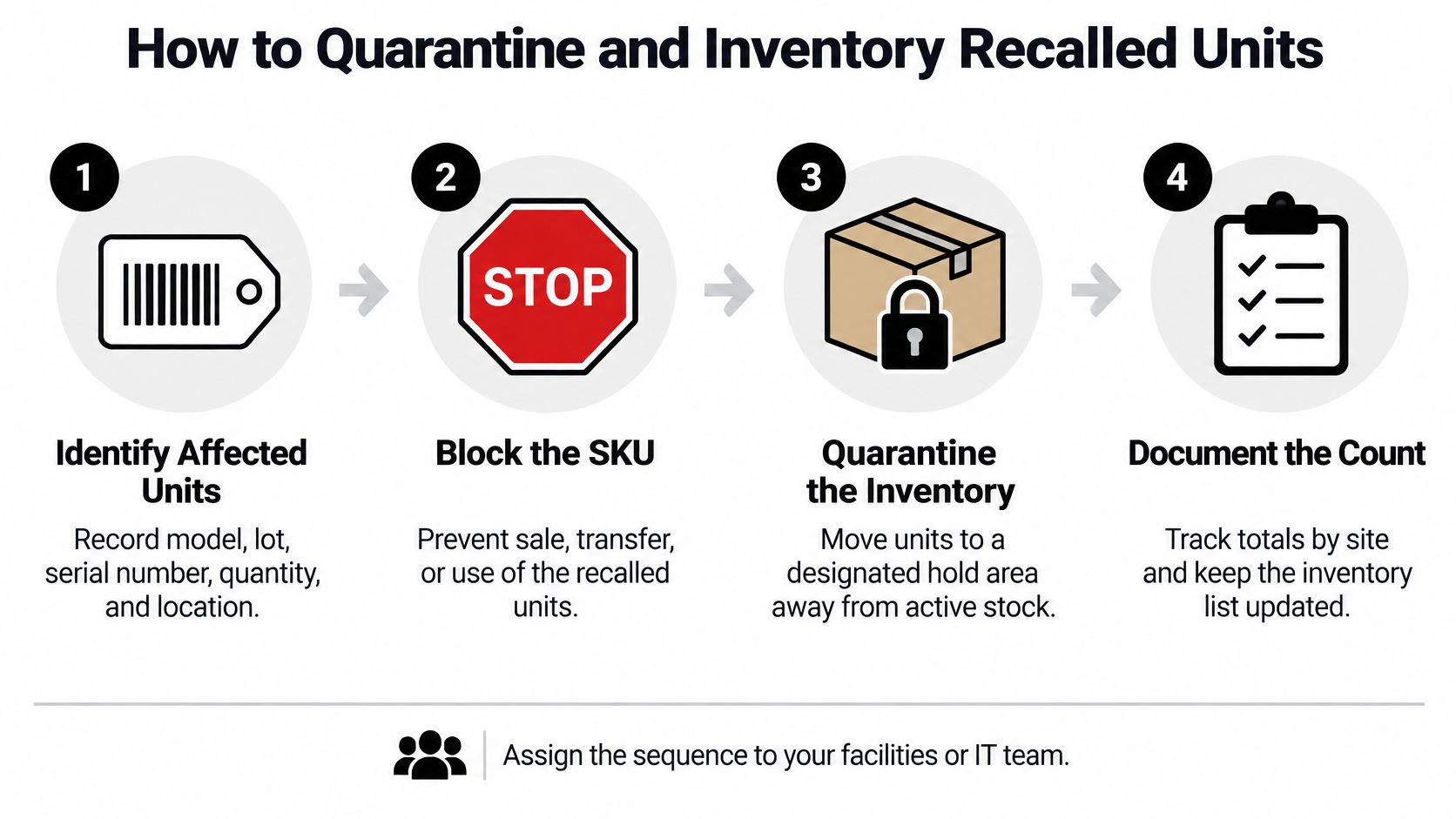
Assign These Seven Steps to Named Owners
- Identify every affected unit. Record model, lot, serial number, quantity, and installed or stored location. Counting by box is the common slip, because mixed lots hide unaffected and affected units together.
- Block the SKU in your system. Prevent sale, transfer, donation, or redeployment before you move anything. A warehouse corner is not a control if purchasing or maintenance can still pull the asset.
- Move units to a controlled area. Keep them separate from active stock, and isolate damaged or energized units within that area. Restrict keys and badge access to named handlers.
- Photograph labels and damage. Include the serial plate in the frame, then have two people sign the count. Independent verification catches transposed digits while correction is still easy.
- Log every transfer. Record date, handler, quantity, and destination each time custody changes. A gap here becomes an unaccounted unit later.
- Get written instructions before altering units. Do not dismantle, cut, probe, or test high-risk products. Preserve shipping records and destruction certificates with the same file.
- Reconcile before closing quarantine. Compare the final count against the original inventory and keep the hold active until the remedy is confirmed.
I recommend treating alteration as prohibited until the recalling company authorizes it in writing. That protects the return requirement and avoids opening a driver, capacitor, or sealed battery compartment.
Facilities that manage this as a formal hold benefit from the controls described for recalled product disposal for warehouses, especially where multiple sites feed one inventory. A clean file is simple to describe. Every unit is listed, every transfer is logged, and no quantity is explained by memory.
If a manager cannot produce that reconciliation, the quarantine has not finished, even if the product has left the building.
Sort Recalled Lighting by Hazard Before Transport
Recalled lighting fails in transport when teams sort by fixture shape instead of chemistry. The recall notice decides if you can dispose at all. The hidden component decides where each unit can go.
| Lighting type | Hidden hazard | Interim handling | Receiving route |
|---|---|---|---|
| Fluorescent tubes and CFLs | Mercury, breaks easily | Intact, sealed, labeled packaging; no crushing | Universal waste lamp recycler |
| HID, metal-halide, high-pressure-sodium, neon and mercury-vapor lamps | Mercury, breakage during handling | Lamp packaging; keep broken lamps separate | Universal waste lamp recycler |
| Mains-powered LED fixtures with drivers | Electrical; capacitors in drivers | Power isolated; no dismantling unless the manufacturer instructs | Facility confirmed to accept recalled electronics |
| Battery-powered and solar fixtures | Lithium-ion fire risk, overheating packs | Nonconductive packaging; no terminal contact; separated from stock | Household hazardous-waste or battery-specific recycler confirmed in advance |
| Older light switches | Possible mercury content | Isolated and labeled; do not crush | Hazardous-waste handler confirmed in advance |
A single e-waste gaylord cannot hold this mix. The CPSC recalls guidance states that recalled lithium-ion batteries and devices should not enter household trash, curbside recycling, or ordinary retail battery boxes because of increased fire risk, and it recommends confirming in advance that the receiving facility accepts recalled batteries. Hold removed legacy fixtures and switches in a separate hold until their hazards are identified. Replacement work in finished spaces adds pressure to clear the area fast, even on jobs where designers plan to find LED mirrors for new bathrooms after demolition, and that pressure is where mixed streams get created.
Where Sorting Usually Breaks Down
Teams pull the visible lamp and leave the battery pack inside a solar or portable housing. That pack creates the transport risk, not the lamp. Isolate damaged, overheated, or swollen components. Prevent terminal contact with nonconductive packaging. Keep visibly damaged batteries apart from intact stock.
Mains LED fixtures create a different trap. A driver or capacitor does not justify field dismantling when the manufacturer expects an intact return or a specific disabling method. Older switches can contain mercury, so label them as a distinct stream and confirm acceptance before transport. For the regulatory basis behind that separation, review the handling categories for universal waste under EPA rules and apply them stream by stream.
Use this short check before loading:
- Classify each unit: Mains LED, fluorescent or CFL, HID, halogen, solar, or battery-powered.
- Isolate exceptions: Broken, hot, swollen, leaking, or fire-damaged units travel apart from intact stock.
- Label by chemistry and condition: The carrier and receiver should see contents, hazards, and count on the container.
- Confirm the receiver in writing: Acceptance for ordinary lamps does not prove acceptance for recalled or damaged articles.
Mercury Lamp Rules and Packing for Shipment
Mercury changes a routine lighting removal into regulated waste handling. Under the federal Universal Waste Rule in 40 CFR Part 273, businesses must package spent lamps to minimize breakage, keep containers closed, label them as universal waste or waste lamps, and separately contain broken lamps, and they may generally accumulate lamps for up to one year before sending them to an approved handler, according to EPA hazardous waste guidance on lamps. A lamp that hasn't been tested and proven nonhazardous must be presumed hazardous, and the Toxicity Characteristic Leaching Procedure determines whether mercury leaches at a hazardous level.
What Compliant Packaging Actually Means
The EPA frequent questions on universal waste require containers that are structurally sound, compatible with the lamp contents, and adequate to prevent breakage, with no leakage, spillage, or damage that could cause a release. That rules out loose tubes in a dumpster, open drums in a loading dock, and mixed lamps rattling inside a general trash compactor.

Use the original lamp cartons when they're intact, or use purpose-built tube boxes with dividers. Pack HID lamps with cushioning so glass doesn't contact glass, close every container, and mark the accumulation start date where handlers can see it. Put broken lamps in a separate sealed container, not back into the intact box, and stop work if a container shows damage that could release contents during normal handling.
Say a school district is holding a recalled fluorescent lot across three campuses. Each site needs labeled boxes, a recorded start date, a count per container, and one authorized destination on file before the lot moves. Centralizing the paperwork is fine, but don't consolidate containers in a way that erases which site generated them. Your label format should match the requirements for universal waste labeling before the first pickup is scheduled.
Crushing, State Rules, and the Handoff
Practical rule: Crushing is not recycling.
Crushing alone doesn't recover mercury. Actual recycling requires further treatment, such as retorting, so don't let a vendor describe volume reduction as final treatment. Ask what happens after crushing, where the mercury-bearing material goes, and what certificate you'll receive.
State rules can be stricter than the federal baseline. Check requirements for the state where the lot is stored, the states it crosses, and the state where it's processed. Small-quantity and large-quantity handlers also have different obligations, so confirm which category your operation falls under instead of copying another facility's procedure.
Pack and document each shipment in this order:
- Seal intact lamps in compatible containers. Keep tubes straight, supported, and closed, and cushion HID and other fragile lamps against impact.
- Separate broken lamps immediately. Use a closed, labeled container and record the count separately from intact units.
- Protect battery-containing fixtures separately. Use nonconductive packaging and keep visibly damaged packs apart from the lamp load.
- Record the container contents. Note count, label, weight, origin, destination, date, and carrier.
- Test traceability before release. Pick a serial number or container number at random and confirm your team can locate it through quarantine, staging, carrier handoff, and receipt.
That load test exposes weak custody before an auditor does. If staff can't trace a container without calling three people, fix the log before the truck leaves. A one-year accumulation clock doesn't excuse poor staging, unlabeled boxes, or an unverified destination.
Choose an Authorized Receiving Facility
Vet the receiver before any lot moves, not while the truck is being loaded. A facility that accepts ordinary spent lamps may reject recalled fixtures, fire-damaged units, or damaged lithium packs. Get the answers in writing and file them with the recall number.
Five Checks Before the First Pickup
- Ask for authorization proof. Confirm the facility can handle mercury-containing lamps and, where relevant, lithium-ion batteries in the state where processing occurs.
- Confirm recalled articles are accepted. State the recall, condition, and quantity plainly, and get a written yes for that exact stream.
- Ask how mercury is recovered. Request retorting or another treatment that recovers mercury, not crushing presented as recycling.
- Check your dates. Compare accumulation and transfer dates against your universal waste deadline before scheduling.
- Define the closing document. Request a destruction or recycling certificate whose quantities can be matched to your serialized inventory.
Also ask for a written list of streams the facility won't accept. That negative list prevents a rejected load and lets you route damaged battery packs elsewhere in advance.
I would disqualify a vendor that can't answer these questions in writing. When you compare a universal waste disposal company, the deciding factor isn't a low pickup price. It's whether the receiver's authorization, acceptance, treatment method, and certificate all line up with your inventory.
Records That Prove Compliant Recall Disposal
| Record | Key fields | What it proves |
|---|---|---|
| Recall notice and remedy letter | Recall number, model, remedy, date | Which instruction was followed |
| Serialized inventory log | Model, lot, serial number, quantity, location | Every unit is accounted for |
| Transfer and shipping log | Carrier, date, quantities, destination | Custody at each handoff |
| Photos of units and disabled parts | Date stamp, serial number visible | Condition and disabling method |
| Destruction or recycling certificate | Facility, method, quantity, date | Final proof of disposal |
After a recall closes, the file is the evidence. Auditors, insurers, and manufacturers won't accept a verbal assurance that product was handled correctly. They'll reconcile quantities in against quantities out and look for a named custodian at every handoff.
Build One File an Auditor Can Follow
Index everything by recall number and lot, so one search returns the notice, remedy letter, inventory, photos, shipping record, and final certificate. Store readable copies outside a single employee's inbox. If the certificate reports fewer units than your inventory, treat that as an open exception, not a clerical detail.
Say a hospital reconciles a recalled fixture batch and finds two boxes missing from the transfer log. Serial-level records let the team determine whether the boxes stayed in quarantine, moved under another shipment, or never left the loading dock. Without serials, that same discrepancy becomes an untracked transfer.
Your one-page control sheet should carry the recall number, remedy, quantities received into quarantine, quantities shipped, custody handoffs, and final proof. The closing document should match the format and evidentiary purpose of a certificate of destruction for recalls, with no quantity left to inference.
Book Certified Recall Disposal for Your Lighting Inventory
Book the pickup only after the remedy, quarantine, and hazard routes are set. Scheduling first creates pressure to load units that haven't been reconciled or accepted by the receiver.
Run the Three-Item Pre-Pickup Check
- Confirm the remedy in writing. File the signed remedy letter or manufacturer disposal instruction with the recall number.
- Finalize the serialized inventory. Reconcile model, lot, serial range, and count for each stream against the quarantine log.
- Classify every stream by hazard. Separate mercury lamps, lithium-ion battery units, mains LED fixtures with drivers, and older mercury switches, then confirm each route in writing.
Once those items are ready, request the pickup and specify the certificate you need. Certificates of recycling and data destruction are available for each load of equipment picked up. Every load receives a Certificate of Recycling and Data Destruction, and all liability transfers to Beyond Surplus. Customers can request a recycling pickup or drop-off by phone, by email, or by filling out the online form.
Contact Beyond Surplus for certified electronics recycling and secure IT asset disposal. Bring the remedy letter, reconciled inventory, and hazard classification to that first conversation, and the pickup becomes an execution step rather than another compliance risk.
If your team is holding recalled lighting across warehouses, schools, healthcare sites, or data centers, Beyond Surplus can coordinate certified product destruction, documented chain of custody, and compliant recycling for the electronic components in that inventory. Send us your recall number, remedy letter, and serialized count, and we'll help you confirm the route before the first load moves.


