
When your business searches for a “hard drive shredding service near me,” you are taking a crucial step to protect its most valuable asset: data. Physical destruction isn’t just about disposal; it’s the only guaranteed method to permanently eliminate sensitive information from retired IT assets, shielding your company from devastating breaches and regulatory penalties. For any business, improper disposal of IT equipment is a risk that is simply not worth taking.
Why Secure Hard Drive Shredding is Non-Negotiable for Businesses
Every retired hard drive in your storage closet is a potential liability. These devices are often packed with a treasure trove of confidential corporate data—customer financial records, employee PII, proprietary research, and strategic business plans.
Simply deleting files or reformatting a drive is insufficient for commercial IT asset disposal. These actions only remove the pointers to the data, leaving the underlying information easily recoverable with basic software. This lingering data is a goldmine for malicious actors targeting businesses.
A single discarded drive falling into the wrong hands can trigger a catastrophic data breach. The severe consequences of data breaches like leaked credit card data from infostealer malware are a clear warning. Such incidents lead to millions in fines, legal fees, and remediation costs, not to mention irreparable harm to your brand’s reputation.
The Financial and Reputational Costs of Corporate Negligence
Failing to properly destroy data isn’t just a security blind spot; it’s a massive financial gamble. Regulatory bodies are hitting companies with increasingly steep penalties for neglecting their data protection duties.
For example, one healthcare system faced a staggering $4.9 million fine for HIPAA violations and multiple class-action lawsuits after improperly disposing of patient records. The incident shattered patient trust that took years to rebuild.
These risks are driving a major trend in corporate responsibility. The global hard drive destruction service market, valued at approximately USD 1.65 billion in 2024, is projected to soar to USD 5.05 billion by 2035, growing at a rate of 10.7% annually. This growth sends a clear message: professional data destruction is a necessary investment for any business, not an optional expense.
Moving Beyond Software Wipes for Enterprise Assets
While software-based data wiping has its place, it is not a foolproof solution for enterprise-grade devices at their end-of-life. Wiping processes can fail, especially on drives with bad sectors or physical damage. They also demand significant time and internal IT resources to manage and verify, opening the door for human error.
Physical destruction through shredding provides a definitive, auditable solution for businesses. It renders data completely irrecoverable by turning hard drive platters into tiny, unrecognizable fragments. This method offers the ultimate peace of mind and a clear, defensible record of compliance.
Choosing a professional shredding service transfers the liability and ensures the job is done right, every time. You can explore our in-depth analysis of the crucial reasons you need data destruction services today to see the full scope of benefits for your organization.
Ultimately, secure shredding is a fundamental part of any robust IT asset disposal (ITAD) program. It’s the final, non-negotiable step in protecting your company’s legacy.
Choosing Between On-Site and Off-Site Shredding for Your Business
When you’re ready to engage a professional hard drive shredding service, one of the first decisions is where the shredding will occur. The choice between on-site and off-site shredding has significant implications for your company’s security, budget, and logistics.
Each approach offers distinct advantages, and the optimal solution depends on your organization’s risk tolerance and compliance requirements. For instance, a healthcare provider governed by strict HIPAA rules might consider on-site, witnessed destruction a non-negotiable part of their process. Conversely, a large corporation retiring an entire data center might find off-site services to be the only practical and cost-effective method for handling the sheer volume of assets.
The On-Site Shredding Workflow
On-site shredding, also known as mobile shredding, brings the entire destruction operation to your business location. It is designed for maximum transparency, allowing your team to witness the process firsthand.
Here’s the typical procedure for a commercial client:
- A specialized shredding truck arrives at your facility.
- Technicians scan and verify every hard drive against your inventory list, establishing a clear chain of custody from the start.
- Your designated staff can physically watch as the drives are fed into an industrial shredder mounted inside the truck. There is no guesswork; the destruction is confirmed visually.
- Upon completion, you are immediately provided with a Certificate of Destruction for your audit trail.
This hands-on method eliminates any risks associated with transporting data-bearing media. For organizations handling highly sensitive information or facing stringent regulatory scrutiny, it is often considered the gold standard. You can learn more about how this works by exploring our professional on-site shredding services.
This visual helps frame the decision: you either choose a path that leads to a potential data breach or one that guarantees security through certified shredding.
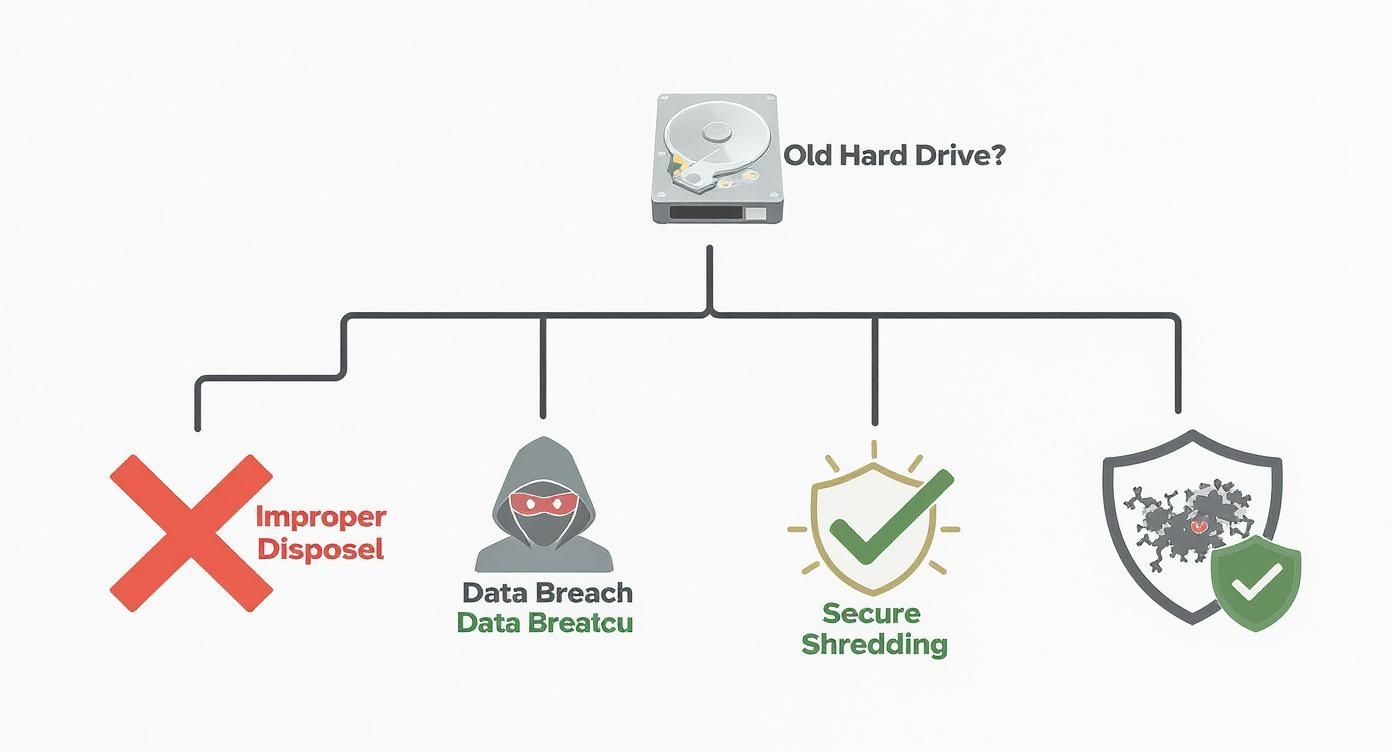
As you can see, the only surefire way to protect your data is to physically destroy the media it lives on.
The Off-Site Shredding Workflow
Off-site shredding, or plant-based shredding, offers a secure and efficient alternative that is often more budget-friendly, especially for large-volume projects. The process is governed by equally stringent security protocols to ensure data integrity.
Here’s the typical workflow for a business:
- Vetted, uniformed technicians arrive at your office to collect the hard drives, which are placed into sealed, often GPS-tracked containers before leaving your premises.
- The assets are transported in a locked vehicle to a secure, access-controlled destruction facility, with every step logged to maintain the chain of custody.
- At the plant, your drives are shredded under 24/7 video surveillance.
- Once finished, you receive a Certificate of Destruction, often including a serialized list of the destroyed drives and sometimes a link to the video recording of the shredding session.
This approach is ideal for large-scale IT asset retirement projects, such as data center decommissioning or company-wide hardware refreshes, where logistics and cost are major factors.
Making the Right Choice for Your Business
Choosing the right shredding service is more important than ever. The demand for secure data destruction is surging, with the global market projected to grow from USD 0.72 billion in 2024 to USD 1.2 billion by 2033. This growth is being fueled by everything from the rise of remote work to widespread digital transformation initiatives. You can dig into more of the data behind this trend on Business Research Insights.
To help you decide, let’s break down the key differences. This table weighs the core factors of security, cost, and logistics for both mobile (on-site) and plant-based (off-site) shredding.
| Feature | On-Site Shredding | Off-Site Shredding |
|---|---|---|
| Security | Highest level; you witness the destruction firsthand. Eliminates transport risk. | Very high; managed through locked transport, GPS tracking, and facility surveillance. |
| Cost | Typically higher due to the convenience and dedicated mobile equipment. | More cost-effective, especially for larger volumes. |
| Logistics | Simple for you—the service comes to your location. Requires scheduling and space for the truck. | Involves secure pickup and transport. Can be more efficient for large, multi-location projects. |
| Compliance | The best option for meeting the strictest compliance and audit requirements. | Fully compliant with major regulations, with a documented and auditable trail. |
| Best For | Highly sensitive data, strict regulatory needs (HIPAA, FTC), or organizations wanting absolute peace of mind. | Large-scale asset retirement, budget-conscious projects, and companies comfortable with a documented, secure process. |
Ultimately, the best choice depends entirely on what your organization values most.
Key Takeaway: If absolute, witnessed certainty for compliance is your top priority, on-site shredding is the clear winner. If you’re managing a high-volume project and trust a documented, audited process, off-site shredding provides a secure, efficient, and cost-effective solution.
Your Checklist For Vetting A Shredding Vendor
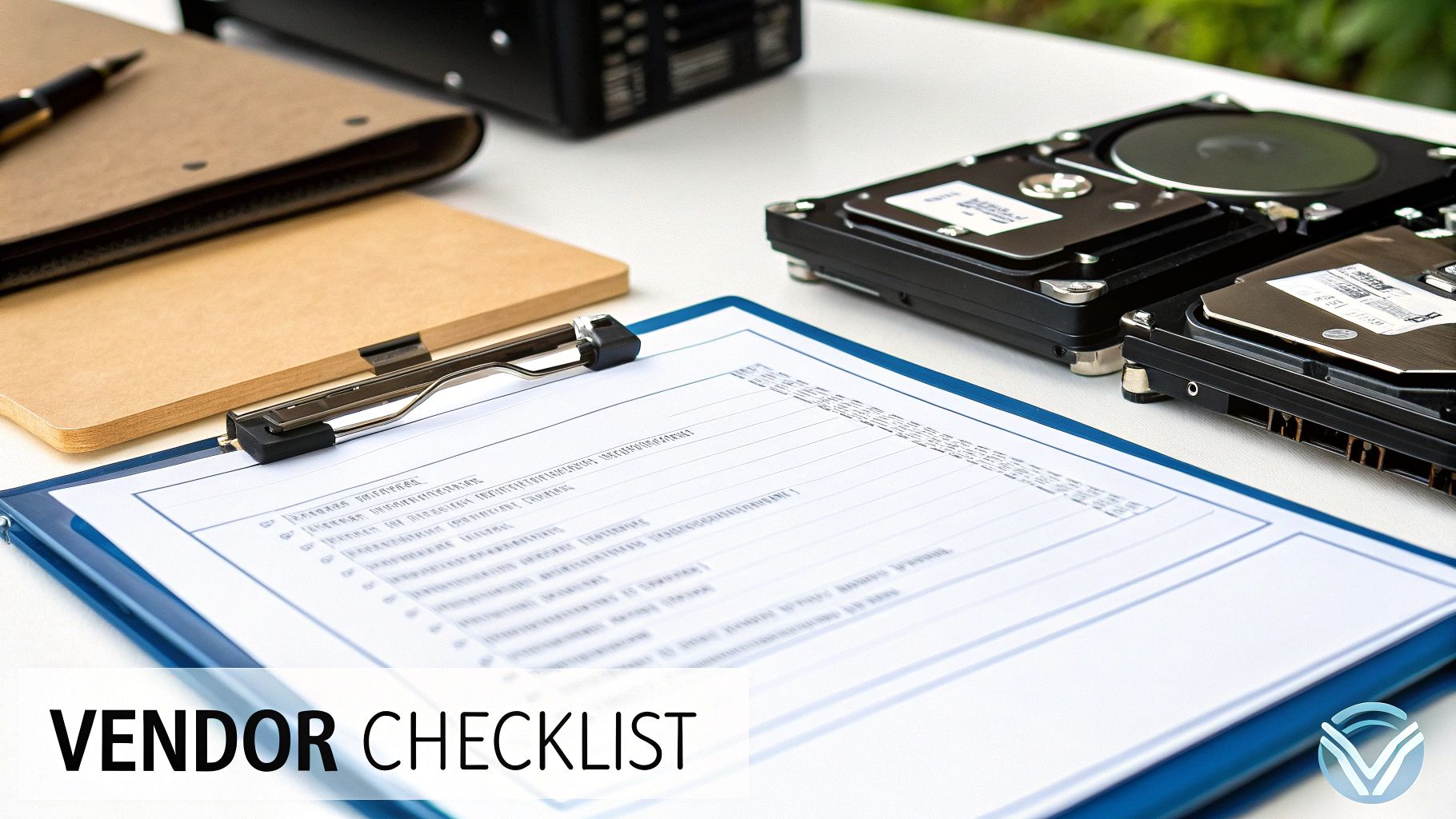
Choosing a partner to destroy your old hard drives is a decision that goes way beyond just comparing quotes. The vendor you hire becomes a crucial part of your data security protocol, and a weak link can expose your entire organization to massive risk. A little due diligence upfront is what separates a truly secure, compliant partner from a basic disposal company that might just create more problems than they solve.
This checklist is designed to give IT managers and procurement teams a solid framework for evaluating potential vendors. Let’s focus on the absolute non-negotiables: the credentials, documentation, and processes that define a top-tier service.
Certifications Are Your First Filter
Before discussing pricing, inquire about certifications. These are not merely logos for a website; they are hard-earned proof that an independent auditor has verified the vendor’s security controls, employee screening, and operational processes.
Two certifications are paramount in the IT asset disposal industry:
- NAID AAA Certification: This is the gold standard for data destruction. A vendor with NAID AAA certification is subject to unannounced audits covering everything from employee background checks and facility access control to video surveillance and the destruction process itself. It is your best guarantee of a consistently high level of security.
- R2 (Responsible Recycling) Certification: While NAID focuses on data security, R2 addresses environmental stewardship and worker safety. An R2 certified recycler ensures that all shredded materials are managed ethically and safely, preventing hazardous e-waste from entering landfills.
A vendor holding both certifications demonstrates a serious commitment to protecting both your data and the environment. This is the quickest way to filter out unqualified providers.
Scrutinize The Chain of Custody
From the moment your hard drives leave your facility, you require a documented, unbroken trail of their journey. This is the chain of custody, and it is a critical process to scrutinize. Any gap in this chain represents a significant security vulnerability.
Ask potential vendors to detail their entire process:
- How are assets scanned and inventoried on-site at pickup?
- Are they transported in locked, secure vehicles?
- Is GPS tracking used for the transport vehicle?
- What security protocols, such as access controls and surveillance, are in place at the facility?
Every touchpoint must be logged. A professional service will have a robust, transparent system and will readily demonstrate how it works.
A secure chain of custody isn’t just a promise; it’s a documented process. Ask to see sample documentation to understand exactly how they track assets from your door to final destruction. This meticulous tracking is your assurance against loss or theft during transit.
Demand A Legitimate Certificate of Destruction
The final, and arguably most important, document you will receive is the Certificate of Destruction. This is more than a receipt—it is your legal proof of due diligence. In the event of an audit, this document demonstrates compliance.
A legitimate certificate includes specific, verifiable details:
- Unique Serial Number: For tracking the certificate itself.
- Client Information: Your company’s name and address.
- Vendor Information: The destruction company’s details.
- Date and Location of Destruction: Pinpoints exactly when and where the shredding took place.
- Method of Destruction: Clearly states the process used (e.g., “physical shredding to 2mm particles”).
- List of Destroyed Assets: A serialized inventory of every single hard drive.
- Authorized Signatures: From the vendor and a witness, confirming the act.
This document formally transfers liability from your organization to the shredding vendor. You can dive deeper into what makes a proper Certificate of Destruction so important, but the bottom line is this: without this detailed record, you have no evidence of compliant disposal, leaving your business exposed.
Meeting Compliance Demands With Physical Destruction
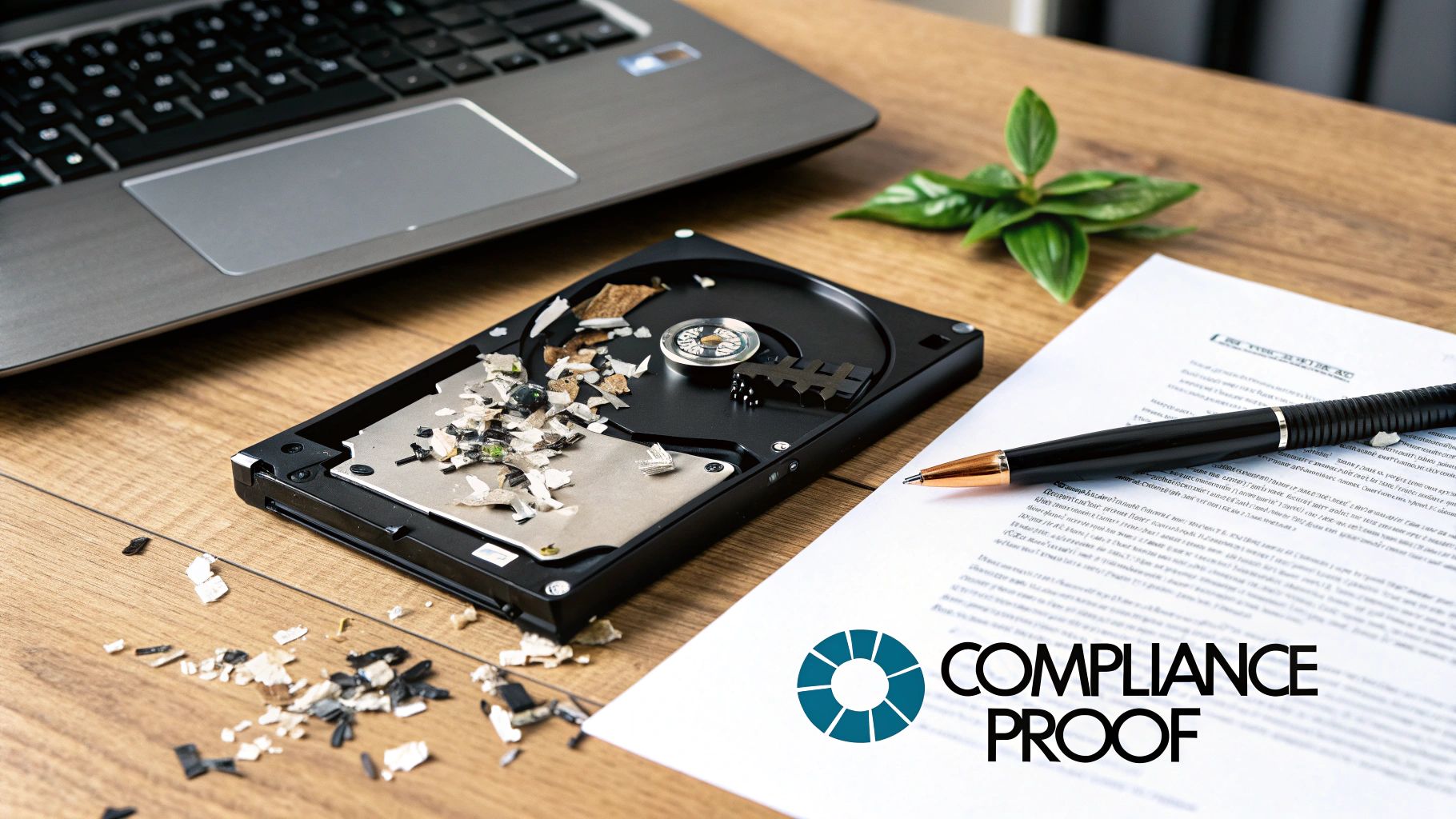
Navigating the complex web of data privacy laws is a significant challenge for any business. Regulations like HIPAA, FACTA, and GLBA are not mere suggestions—they are strict legal mandates that dictate how you must protect sensitive information from creation through to final destruction.
Physical hard drive shredding simplifies this complexity. It provides a clear, definitive, and auditable method for managing your end-of-life data obligations, eliminating gray areas and ensuring legal compliance.
Why Software Wipes Can Fall Short for Compliance
Many organizations assume that software wiping or degaussing old drives is “good enough” for compliance. However, these methods often fail to meet the “reasonable measures” standard required by many data protection laws.
Software can fail to erase data on damaged sectors of a drive. Degaussing, which uses a powerful magnet, may not be effective on newer solid-state drives (SSDs). Crucially, both methods leave the physical drive intact, meaning a determined expert could potentially recover the data.
For regulators, this ambiguity is a significant concern. Physical destruction, in contrast, is absolute. It pulverizes the data-bearing platters, making recovery impossible and providing undeniable proof of your commitment to data security.
Translating Regulations Into Action
Let’s move beyond legal jargon to what these rules mean for your IT asset disposal program.
- HIPAA (Health Insurance Portability and Accountability Act): Healthcare organizations are responsible for protecting patient health information (PHI). Improper disposal of old devices can lead to millions in fines. Shredding is the only method recommended by NIST that guarantees PHI on old drives is permanently destroyed.
- FACTA (Fair and Accurate Credit Transactions Act): The Disposal Rule under FACTA requires businesses to take “reasonable measures” to destroy consumer report information. Physical destruction is explicitly named as a compliant method.
- GLBA (Gramm-Leach-Bliley Act): Financial institutions must protect consumers’ private financial data. The Safeguards Rule requires a comprehensive security plan that includes the secure disposal of customer information. Hard drive shredding provides a defensible, well-documented process that withstands scrutiny.
Given the increasing stringency of global data protection rules, staying informed is vital. For a deeper look into international standards, you can review this guide on your GDPR compliance obligations.
The Power of Auditable Proof
In compliance, if it isn’t documented, it didn’t happen. This is why a certified shredding service is so critical. After every job, you should receive a Certificate of Destruction.
This document is far more than just a receipt—it’s your official legal record for any compliance audit. It details exactly what was destroyed, when, where, and how, effectively transferring liability and proving your due diligence to regulators.
This intense focus on secure, verifiable disposal is driving major investment. The market for hard disk destruction equipment was pegged at USD 2.69 billion in 2024 and is expected to blow past USD 4.23 billion by 2032. This isn’t just a trend; it’s a direct response to the growing need for businesses to protect themselves from data theft with verifiable destruction.
If you’re looking to align your internal processes with federal guidelines, our guide on NIST SP 800-88 standards for media sanitization is a great resource that reinforces why physical destruction is so effective. At the end of the day, partnering with a certified shredding service turns your data destruction process from a potential risk into a symbol of trustworthiness.
What To Expect With Pricing And Scheduling
Arranging professional hard drive shredding is straightforward once you understand the common practices. When businesses search for a “hard drive shredding service near me,” they will find that most vendors offer a few standard pricing models tailored to different project scales.
Understanding these models and the factors influencing the final quote is key to accurate budgeting and seamless scheduling.
Decoding Common Pricing Models
Your quote will almost certainly fall into one of three categories, depending on the quantity of drives and the required service frequency.
Here’s what you’ll typically run into:
- Per-Drive Pricing: This is the most direct model. You pay a set fee for each hard drive, SSD, or magnetic tape destroyed. It is ideal for smaller jobs or when you have an exact inventory count.
- Per-Pound Pricing: For larger projects like data center decommissioning or a company-wide tech refresh, paying by weight is often more cost-effective. The vendor weighs the containers of media and charges based on the total weight.
- Flat-Rate or Project-Based Fee: Some projects, particularly on-site shredding events or those with complex logistics, may receive a flat-fee quote. This price typically includes all labor, transport, and documentation, providing a clear, fixed cost upfront.
Insider Tip: Always ask about minimum charges, especially for on-site service. A mobile shredding truck is a significant piece of equipment, and vendors almost always have a minimum fee to cover the operational cost of dispatching it to your location.
Factors That Influence Your Final Cost
Beyond the basic pricing structure, several factors can adjust your quote. Awareness of these can help you manage your budget effectively.
The most significant factor is service type. On-site shredding is typically more expensive than off-site services due to the operational costs of mobile equipment. Volume is another major consideration—as with most services, a higher quantity of drives usually results in a lower per-unit cost.
A few other things to keep in mind:
- Asset Location: If drives are scattered across different locations, the additional labor for consolidation can increase costs.
- Drive Removal: If a technician must physically remove drives from laptops, servers, or desktops, expect an additional labor fee for this service.
- Reporting Requirements: A standard, serialized Certificate of Destruction is typically included. Custom audit reports or other specialized documentation may incur an extra charge.
Preparing for a Seamless Service Engagement
Proper preparation ensures the shredding process is fast, smooth, and secure. Before the service team arrives, there are several steps your business can take.
First, prepare an inventory. Create a detailed list of serial numbers for every drive designated for destruction. This is crucial for your records and for verifying against the vendor’s Certificate of Destruction.
Next, consolidate the assets. Gather all drives in one secure, accessible location. This reduces the time technicians spend on-site and minimizes disruption to your operations. If drives are still in machines, decide beforehand whether your staff or the vendor’s team will handle their removal.
Finally, designate a point of contact. Have a team member ready to meet the technicians, direct them, and witness the shredding for on-site services. Clear communication prevents delays and ensures all security protocols are followed.
Your Hard Drive Shredding Questions Answered
Even with a well-defined IT asset disposal plan, questions inevitably arise. IT managers and business leaders require clear, direct answers to be confident in their data security decisions.
Let’s address the most common questions about professional data destruction for commercial clients.
Is Wiping Or Degaussing Hard Drives Enough?
While software wiping and degaussing are suitable for sanitizing devices intended for internal reuse, they are not foolproof for equipment leaving your company’s control. A software wipe can fail on drives with bad sectors, leaving recoverable data behind. Degaussing may not be effective on all modern media, especially solid-state drives (SSDs).
Most importantly, both methods leave the physical drive completely intact.
Physical shredding is the only method that guarantees 100% data irrecoverability. It works by completely destroying the data-bearing platters. For businesses with high-security needs or those subject to strict compliance standards like HIPAA or the FTC Disposal Rule, physical destruction is the required final step. There are many misconceptions, so it’s worth taking a moment to debunk the most common hard drive destruction myths.
What Happens To The Shredded Material After Destruction?
The shredded material is not sent to a landfill. A certified vendor like Beyond Surplus operates on a strict zero-landfill policy, ensuring all material enters a secure and environmentally sound recycling stream.
The process involves:
- Secure Transport: The shredded fragments are securely transported to a certified downstream recycling partner.
- Material Separation: Using advanced sorting technology, the mixed metals—primarily aluminum, steel, and precious metals from circuit boards—are separated.
- Responsible Refining: These separated commodities are sent to certified refiners for processing.
This responsible approach prevents hazardous e-waste from entering the environment and allows valuable raw materials to be recovered for manufacturing, supporting a circular economy.
By partnering with a certified e-waste recycler for shredding, you ensure that your data security goals are met without compromising your company’s environmental commitments. It’s a dual-win for compliance and corporate social responsibility.
How Can I Be Sure All My Drives Were Actually Destroyed?
Verification is fundamental to a professional shredding service. A reputable, certified provider uses a multi-layered process to provide total confidence and a solid, auditable record.
With on-site shredding, you get the ultimate proof by witnessing the destruction yourself. For both on-site and off-site services, a strict chain-of-custody is maintained from collection to destruction, typically including scanning and tracking the serial number of every drive.
Upon completion, you will receive a formal Certificate of Destruction. This is your official, legally binding record for any compliance audit. It details the method, date, and time of destruction and includes a serialized list of every destroyed asset. This document formally transfers liability and confirms your due diligence.
Can You Shred Solid-State Drives (SSDs)?
Yes, and it is absolutely critical. SSDs use flash memory chips, not the magnetic platters found in traditional hard drives (HDDs). Standard wiping or degaussing methods are often ineffective on SSDs due to features like wear-leveling, which distributes data across memory chips in complex patterns.
Professional shredders designed for electronic media can pulverize SSDs into tiny pieces, physically obliterating the memory chips and rendering the data unrecoverable. As SSDs are now standard in business environments, ensuring your vendor can properly destroy them is a vital part of your vetting process.
For businesses seeking a certified, secure, and environmentally responsible partner for IT asset disposal, Beyond Surplus provides comprehensive solutions. We offer both on-site and off-site hard drive shredding services nationwide, complete with serialized reporting and a Certificate of Destruction to guarantee your compliance.