

Discarding old hard drives is more than a simple cleanup task for your business—it's a critical moment for risk management. If handled improperly, it’s a moment that can expose your entire organization. Proper, secure hard drive disposal is the only way to guarantee that sensitive company, customer, or employee data is permanently destroyed, preventing costly breaches and ensuring compliance with industry and federal regulations.
Why Secure Disposal Is a Critical Business Strategy
An old hard drive in a storage closet might seem harmless, but it's a significant liability. Each device can contain a wealth of sensitive information: financial records, proprietary research, customer lists, and employee PII (Personally Identifiable Information). If those assets fall into the wrong hands, the consequences for your business can be catastrophic, leading to severe financial penalties, brand damage, and a complete loss of customer trust.
For example, a healthcare provider discarding old computer towers into a dumpster could expose thousands of patient records from a single recovered drive, triggering a massive HIPAA violation with fines that can run into the millions. Similarly, a financial firm that fails to shred retired server drives could inadvertently leak client investment data, leading to lawsuits and irreparable harm to its reputation. These are not hypothetical scenarios; they are real-world risks for commercial and enterprise entities.
The Growing Demand for Ironclad Data Destruction
It’s no surprise that organizations are rethinking how they handle IT asset disposal. What was once a minor operational chore is now correctly understood as an essential investment in security and resilience. This shift is driven by two powerful forces impacting the business landscape:
- Skyrocketing Data Breaches: Cybercriminals and data thieves actively target discarded business electronics, knowing they are often the weakest link in a company's security chain.
- Strict Regulatory Oversight: Government bodies enforce stringent data protection laws with serious penalties. Regulations like the FTC Disposal Rule, HIPAA for healthcare, and Sarbanes-Oxley for public companies all mandate that businesses prove they’ve taken reasonable measures to destroy consumer and proprietary information permanently.
The hard truth is that simply deleting files or formatting a drive offers a false sense of security. Forensic software can easily recover "erased" data, leaving your organization completely exposed. Physical destruction is the only foolproof method to ensure that data is gone forever.
This growing sense of urgency is reflected in the market. The global hard drive destruction service market was valued at USD 1.65 billion in 2024 and is projected to surge to USD 5.05 billion by 2035, growing at a robust CAGR of 10.7%. This growth is fueled by businesses scrambling to comply with regulations and avoid the nightmare of a data breach.
More and more enterprises are abandoning software-based wiping altogether. Why? Studies have shown over 70% of 'wiped' drives can still leak recoverable data under forensic examination, making physical shredding the new gold standard for business security.
Comparing Data Disposal Risks and Security Solutions
Choosing the right disposal method is not just about convenience; it's a critical security decision for your business. The table below illustrates the stark contrast between common shortcuts and professional, secure solutions designed for commercial needs.
| Disposal Method | Associated Risk | Secure Alternative | Business Benefit |
|---|---|---|---|
| Deleting Files/Formatting Drive | Data is easily recoverable with basic software. High risk of data breach. | Professional Data Wiping (to NIST 800-88 standards) or Physical Destruction. | Verifiable data erasure that meets compliance standards. |
| Throwing in a Dumpster | High risk of theft, environmental fines, and guaranteed non-compliance. | Certified ITAD Vendor with secure chain-of-custody. | Liability transfer, environmental compliance, and secure logistics. |
| In-house Smashing (Hammer) | Ineffective and unsafe. Platters often remain intact and recoverable. | On-site or Off-site Shredding. | Guaranteed destruction of data platters, making recovery impossible. |
| Donating without Wiping | Accidental release of sensitive company or customer information. | Professional data wiping service before donation. | Supports community initiatives without compromising data security. |
As you can see, the perceived ease of insecure methods carries a heavy price in potential liability and reputational damage for any business.
From Liability to Strategic Advantage
Ultimately, a proactive approach to secure disposal is the hallmark of a well-run organization. A crucial part of this is thorough business planning for digital security and resilience, which ensures all data is protected throughout its lifecycle—right up to its end.
By partnering with a certified IT asset disposition (ITAD) provider, you transfer that liability and gain auditable proof of compliance. This documentation, like a Certificate of Destruction, serves as your legal safeguard during an audit or in the event of a security inquiry.
You can discover more about the crucial reasons you need data destruction services today in our detailed guide. This process transforms a potential vulnerability into a documented strength, protecting your brand, your customers, and your bottom line.
Comparing Data Destruction Methods
Deciding how to destroy your data isn't just a technical choice—it's a critical business decision that affects your security, budget, and compliance. This isn't a one-size-fits-all situation for enterprises. The best approach depends on the asset type, data sensitivity, and whether you want to recover value from the old hardware.
Let's cut through the jargon and look at the three main options from a practical, B2B standpoint: wiping, degaussing, and shredding.
This decision tree breaks down the simple but crucial choice your business faces when dealing with old hard drives.
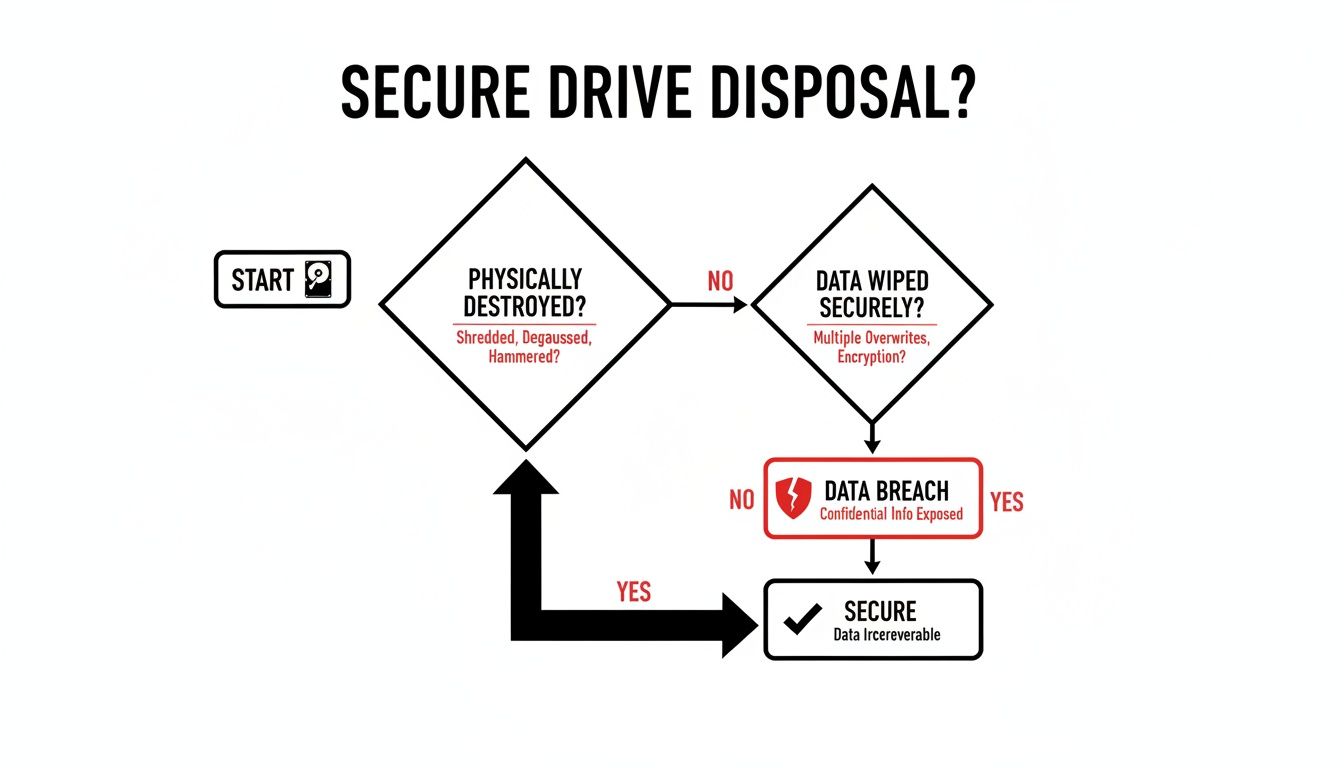
As the flowchart makes clear, any path that doesn't end with verified, secure destruction is a direct route to a potential data breach for your business.
Software Wiping (Data Overwriting)
Software-based data wiping, or data erasure, uses specialized programs to write random characters over every sector of a hard drive, making the original data impossible to recover through normal means. This is often done in multiple passes for thoroughness.
The main draw for businesses is that the physical drive remains intact and functional. This makes it a great option for assets you plan to reuse internally, return to a lessor, or resell to recover cost.
But its effectiveness has limits. We've seen companies use certified wiping to meet lease-return requirements on a fleet of laptops—a perfect use case. However, for drives holding sensitive PII, proprietary financial data, or your core intellectual property, wiping can be a risky gamble. Sophisticated forensic tools can sometimes recover data fragments, and the process often fails on drives with bad sectors, leaving that data exposed.
Degaussing (Magnetic Media Erasure)
Degaussing is a totally different beast. It uses an incredibly powerful magnetic field to scramble the magnetic domains on storage media where data resides. It's a fast, permanent, and extremely effective method for traditional magnetic hard disk drives (HDDs) and magnetic tapes.
The end result? A drive that is completely blank and rendered useless. You cannot reuse a degaussed hard drive; it is a pure destruction method.
But here’s the critical catch for modern IT infrastructure: degaussing is completely useless on Solid-State Drives (SSDs). SSDs use flash memory chips, not magnetic platters, to store data. With more and more businesses switching to SSDs, relying only on degaussing leaves a massive security hole in your disposal strategy.
A common mistake we see is companies assuming one destruction method fits all media. Your data disposal policy must account for the specific technology of each asset, especially the crucial difference between HDDs and SSDs.
Physical Shredding: The Gold Standard
For absolute, guaranteed data destruction, nothing beats physical shredding. We're talking about industrial-grade shredders with powerful steel teeth that grind hard drives, SSDs, and other media into tiny, unrecognizable pieces of metal and plastic.
Once a drive goes through a shredder, that data is gone. Forever. There is a zero percent chance of recovery.
This is exactly why it’s the non-negotiable standard for any business that cannot afford to take chances, including:
- Healthcare Providers: To stay compliant with HIPAA, they must physically destroy drives containing Protected Health Information (PHI).
- Financial Institutions: They have to protect customer financial data and meet tough regulations like Sarbanes-Oxley (SOX).
- Government Agencies: Securing classified information according to strict federal mandates demands physical destruction.
The corporate world’s reliance on physical destruction is clear in market trends. Commercial users account for over $450 million of the hard disk destruction equipment market, dwarfing other sectors. Why the boom? Because wiping a 10TB drive with a DoD 3-pass overwrite can take over eight hours, while shredding provides instant, verifiable proof of destruction. That speed and certainty are everything when you're dealing with massive amounts of data and tight compliance deadlines.
For any business handling sensitive information, the choice becomes clear. While wiping has a place for asset reuse, only physical destruction gives you the absolute peace of mind needed for true risk management. To make sure your company is fully buttoned-up, learn more about our certified security and data destruction services.
On-Site vs. Off-Site Destruction: Where Should It Happen?
Once you’ve decided physical destruction is the way to go for your business, the next big question is where it all happens. Choosing between on-site and off-site shredding isn’t just about convenience; it’s a critical decision that directly impacts your security, compliance paper trail, and bottom line. Each path has its own set of perks, and the right one for your organization depends on its risk tolerance and operational needs.
Ultimately, this comes down to a classic trade-off: do you prioritize absolute, witnessable security, or do you need the cost-efficiency and scale that an off-site partner can provide? For some, an unbroken chain of custody is non-negotiable. For others, tackling a massive volume of drives makes an off-site solution the only practical choice.
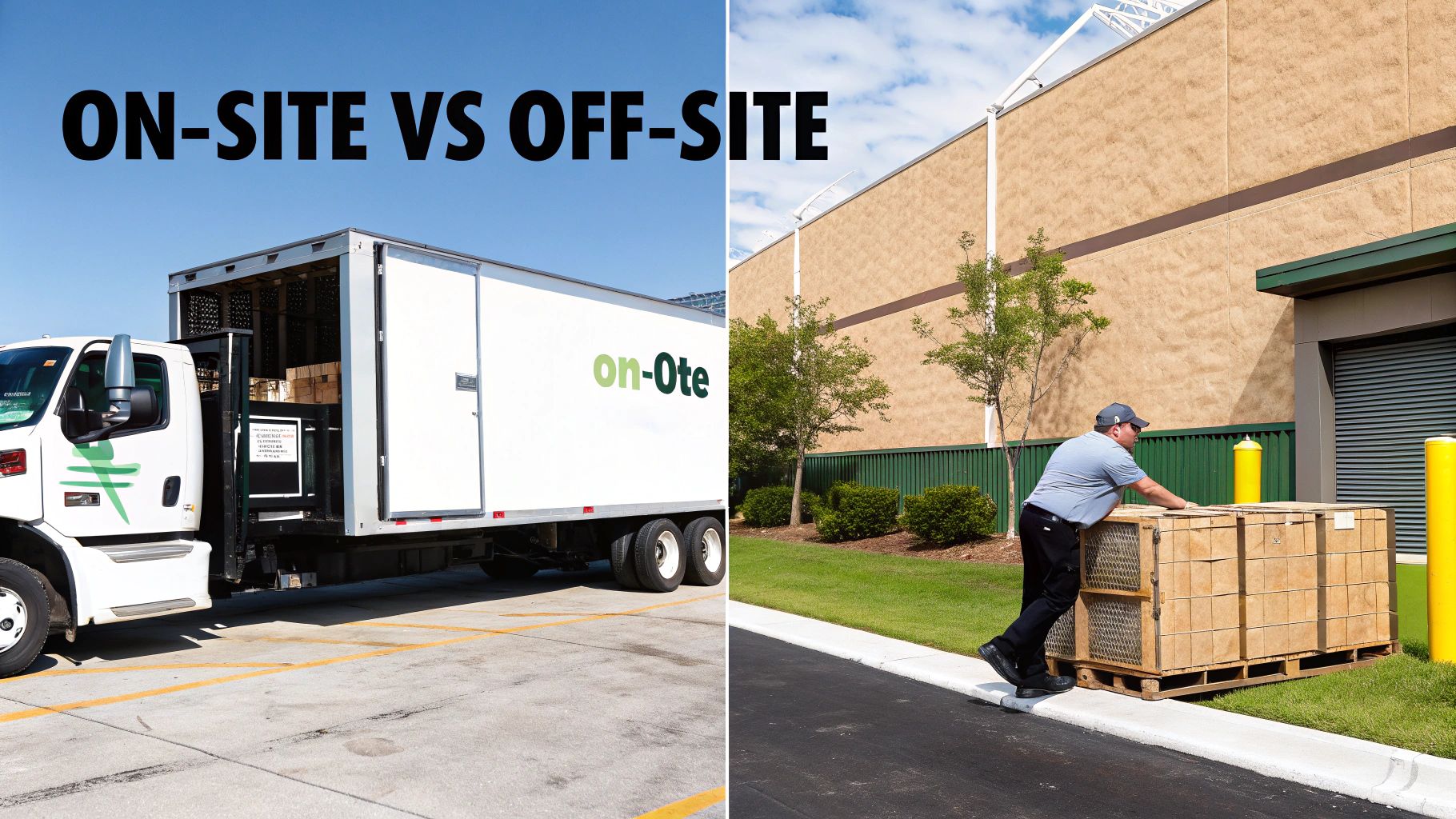
The Case for On-Site Shredding
On-site, or mobile, shredding is exactly what it sounds like. A specialized truck pulls up to your facility, armed with an industrial-grade shredder, and your hard drives are turned into tiny fragments right there at your business location. It’s the gold standard for security and transparency.
The biggest win here is the unbroken chain of custody. Your hard drives never leave your sight until they’re destroyed. That visual confirmation is powerful, and for many organizations in highly regulated industries, it’s a must-have.
Here are a few scenarios where on-site shredding is clearly the best option for a business:
- Government Agencies: When dealing with classified data or CUI (Controlled Unclassified Information), witnessed destruction is often baked into federal security protocols.
- Financial Institutions: Banks, credit unions, and investment firms can’t afford any chance of data interception in transit. On-site shredding helps them lock down compliance with rules like GLBA and SOX.
- Healthcare Providers: To prove HIPAA compliance, having a staff member physically watch the destruction of drives containing patient PHI provides an undeniable layer of verification.
With on-site shredding, your team can stand there with a serialized inventory list and check off each asset as it's destroyed. That immediate confirmation closes the security loop instantly. There's zero room for error or doubt.
For any risk-averse IT manager, the peace of mind that comes from witnessing the process is invaluable.
When Off-Site Shredding Makes Sense
Off-site shredding is when a certified ITAD partner securely collects your hard drives, transports them in locked containers, and destroys them back at their specialized facility. While it does involve a transport step, this approach brings serious advantages in cost and scale for businesses.
This method is dramatically more cost-effective and efficient for large-scale projects. Think about a data center decommissioning involving thousands of drives. Shredding that kind of volume on-site would take forever and cause major disruptions. Off-site processing allows for bulk destruction in a controlled environment, and those efficiencies mean lower costs for you. For more on handling large volumes, our guide to California hard drive shredding services dives deep into enterprise-level logistics.
Off-site destruction is a perfect fit for:
- Large Enterprise IT Refreshes: When a company retires hundreds or even thousands of laptops at once, off-site shredding simplifies the entire process.
- Data Center Decommissioning: The sheer quantity of drives makes on-site shredding completely impractical.
- Businesses with Limited Space: If your facility simply can't accommodate a massive shredding truck, a secure pickup is the only logical choice.
The secret to making off-site destruction work is choosing the right vendor. You need to verify they use GPS-tracked vehicles, locked and sealed containers, and have iron-clad security at their facility, like 24/7 surveillance and strict access controls. A certified partner will provide the same detailed chain-of-custody documentation you'd get on-site, just with the addition of a secured transit log.
The Power of Certification and Chain of Custody
Simply turning a hard drive into a pile of metal shavings isn't where secure disposal ends for your business. From a risk and compliance standpoint, the most critical part is the paperwork that proves the destruction happened. Without it, you have no legal leg to stand on in an audit or a data breach investigation.
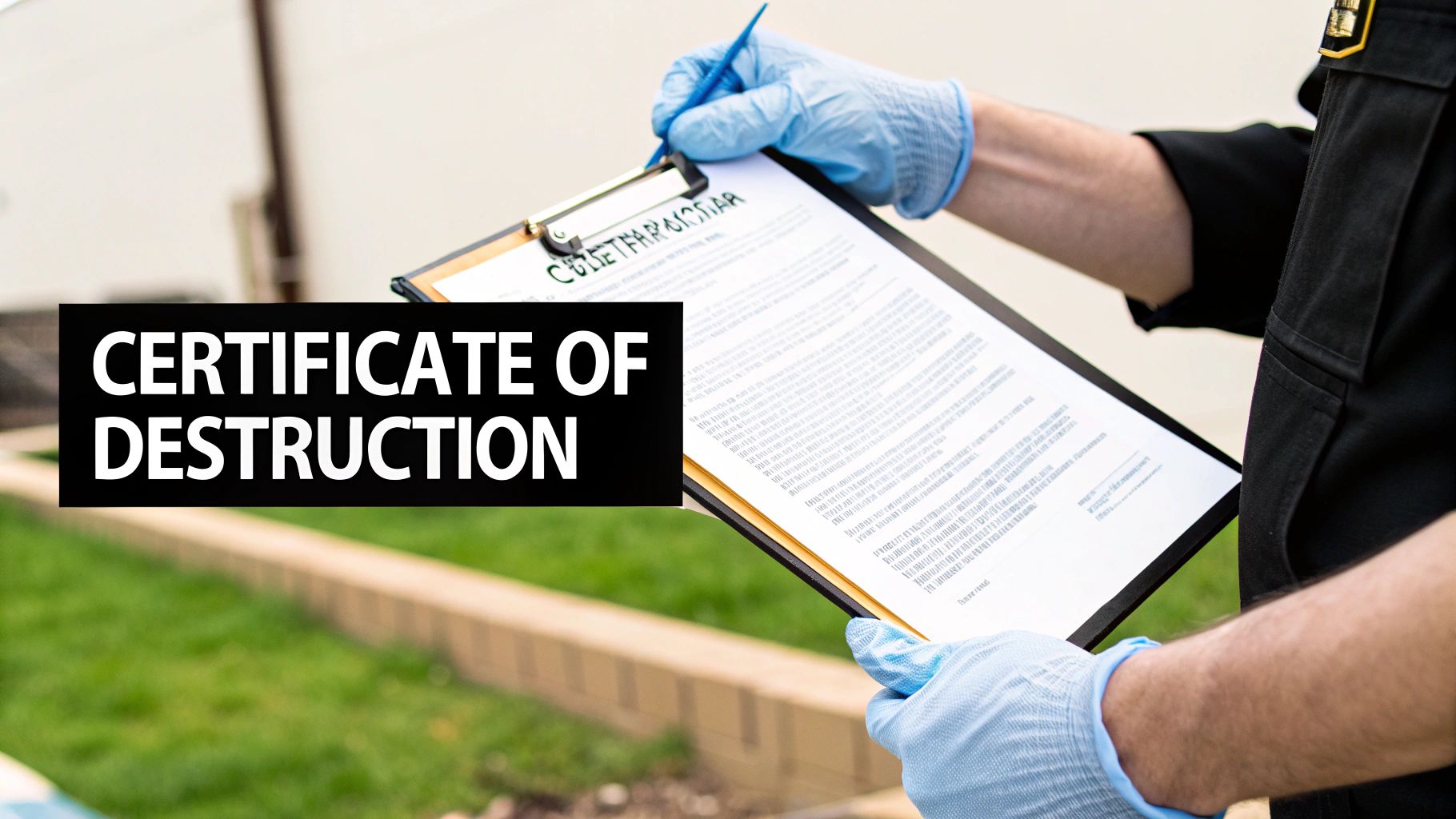
This is where a Certificate of Destruction and a detailed chain of custody come in. These documents are your legal safeguard, transforming a simple service into a defensible liability shield. They are much more than receipts; they are legally binding records that officially transfer liability from your organization to your certified ITAD partner. Think of them as your proof of due diligence, showing you took verifiable steps to protect sensitive information.
Anatomy of an Auditable Certificate of Destruction
A legitimate Certificate of Destruction isn't a generic template. It must contain specific, detailed information to hold up under scrutiny. When you get this document, you need to check for a few key elements that create an unbroken, auditable trail from your asset closet to oblivion.
Your certificate absolutely must include:
- A Unique Serialized Number: For easy tracking and referencing in your own business records.
- Transfer of Custody Details: It has to state exactly when and where the assets were handed over.
- Accurate Asset Counts: The total number of hard drives, SSDs, tapes, or other media destroyed.
- Method of Destruction: The document must specify how it was done, like "on-site shredding to 10mm particle size."
- Witness Signature Line: A spot for one of your authorized employees who watched the destruction to sign off.
But here’s the most important part: it needs a serialized list of every single asset destroyed. This one-to-one mapping of device serial numbers to the certificate is the bedrock of a defensible disposal process. You can learn more about what makes this document so vital by exploring our guide on the Certificate of Destruction.
Why Industry Certifications Like NAID AAA Matter
Not all data destruction vendors operate by the same rules. This is exactly why third-party certifications are so important—they provide an independent stamp of approval on a vendor's processes, people, and facilities. The most recognized and respected certification in this industry is NAID AAA Certification.
Choosing a NAID AAA Certified partner means you are working with a company that has passed rigorous, unannounced audits covering over 20 areas of operational and security standards. This includes everything from employee background checks and facility surveillance to the integrity of their destruction equipment.
This certification isn't just a logo for their website; it's a guarantee of a secure process. It confirms the vendor sticks to the highest industry standards, ensuring your data is protected from the moment it leaves your sight until it's completely destroyed. For any business in healthcare, finance, or government, this level of verification isn't just nice to have—it's non-negotiable.
The demand for this kind of verified service is exploding. Projections show the hard drive shredding market hitting USD 631.8 million globally in 2025, a trend driven by the massive financial risks of not complying with rules like GDPR. With studies showing that a shocking 42% of supposedly "erased" drives still contain recoverable data, physical shredding by a certified partner has become the gold standard for businesses.
You can dig into the full research on hard drive shredding services on archivemarketresearch.com to see the market dynamics for yourself. The takeaway is clear: the paper trail is just as important as the shredder itself.
Staying Compliant with Data Disposal Laws
Navigating the web of data privacy laws can feel like a minefield for any business. One wrong move in your hard drive disposal process can lead to staggering fines and damage to your reputation that’s hard to shake. It’s not just about getting rid of old data; you have to do it in a way that satisfies a growing list of federal and state regulations.
These laws aren't just gentle suggestions—they're mandates with serious consequences. For any organization, understanding these rules is the first step toward building a data destruction policy that will actually hold up under scrutiny.
Key Federal Regulations to Know
Several federal laws establish the baseline for data security, and they all share a core principle: your business is legally on the hook for protecting sensitive information from creation to destruction.
- The FTC Disposal Rule: This one is broad. It requires businesses to take "reasonable measures" to protect consumer information during disposal. That applies to almost any business handling consumer reports or similar data.
- HIPAA: If your business is in the healthcare world, you know this one. The Health Insurance Portability and Accountability Act demands that Protected Health Information (PHI) is rendered completely unreadable and unusable before any IT asset is retired.
- Sarbanes-Oxley Act (SOX): Publicly traded companies live by SOX, which has strict rules for record-keeping and data integrity. Securely destroying financial data on old hardware isn't just a good idea; it's a critical piece of SOX compliance.
Don't underestimate the penalties. HIPAA violations, for instance, can climb as high as $1.5 million per year for each type of violation. Suddenly, investing in professional, documented data destruction looks like a smart risk management strategy.
A common mistake is thinking these regulations only apply to massive corporations. The FTC Disposal Rule, for instance, covers everyone from a local accounting firm to a national retailer. If you handle consumer data, you're responsible for its secure disposal. Period.
The Growing Influence of State-Level Laws
Compliance doesn't stop at the federal border. A patchwork of state-specific privacy laws is making things even more complicated, especially for businesses operating in multiple locations. These state laws often place stricter rules on companies.
California’s CCPA (California Consumer Privacy Act) and its successor, the CPRA (California Privacy Rights Act), are perfect examples. They grant consumers the "right to be forgotten," meaning they can request that their personal data be deleted. This directly impacts your disposal policies—you must be able to prove you permanently destroyed a specific person's data when they ask.
Trying to manage different requirements across states can quickly turn into a logistical nightmare for a business. This is where a certified ITAD partner with a national presence becomes a huge asset. They can help you standardize your disposal process to meet the toughest applicable laws, ensuring you're covered no matter where your offices are. Managing different data disposal laws is a challenge, and solid regulatory compliance risk management is an essential part of the solution.
Turning Compliance into a Streamlined Process
Meeting all these legal demands requires a clear, auditable process. You don't want to be reinventing the wheel. Your approach should be built on established frameworks that are recognized as the industry gold standard for sanitizing data.
For any business looking for a definitive playbook, the guidelines in NIST SP 800-88 provide a clear roadmap for media sanitization. When you align your internal policies with standards like these and work with a certified expert, you can turn a complex compliance burden into a smooth, secure, and defensible part of your operations.
Answering Your Top Hard Drive Disposal Questions
Even with the best-laid plans, questions always pop up when it's time for a business to get rid of old hard drives. Let's walk through some of the most common ones we hear from IT managers and business owners, so you can move forward with confidence.
Is Wiping a Hard Drive Good Enough for Compliance?
For most businesses handling any kind of sensitive information, the short answer is no. Software wiping might be fine for a low-risk office computer you plan to reuse internally, but it's far from a foolproof method for final disposal.
The reality is, skilled forensic specialists can often pull data fragments from drives that have been wiped, even multiple times. When regulations like HIPAA, GLBA, or the FTC Disposal Rule are involved, the standard is clear: data must be 100% unrecoverable. Physical destruction through shredding is the only way to meet that tough standard and give your business a rock-solid defense if an auditor ever comes knocking.
What Actually Happens to the Shredded Metal?
Once your drives are turned into a pile of coin-sized metal fragments, the job still isn't done. That shredded material—a jumble of aluminum, steel, plastics, and circuit board components—is securely transported to a certified downstream recycling facility.
These specialized plants take over from there, separating and refining the raw materials. This final step is what ensures those valuable commodities get back into the manufacturing supply chain instead of sitting in a landfill. It's a critical part of a responsible process, hitting both environmental and corporate sustainability goals for your business.
The whole point of a certified ITAD process is to achieve two things at once: absolute data security and complete environmental compliance. A professional partner makes sure your business gets both, with the paperwork to prove it.
Do I Really Need to Track Serial Numbers?
Yes, absolutely. This is non-negotiable and the foundation of a legally defensible data destruction program for your business. Just getting a certificate that says "we destroyed 100 hard drives" won't cut it and leaves you exposed.
A certified ITAD partner is required to give you a detailed, serialized inventory of every single drive they handle. Each unique serial number must be listed on your final Certificate of Destruction. This creates a clean, auditable paper trail that proves which specific assets were properly destroyed, closing the loop on your records for good.
How Does This Work for Solid-State Drives (SSDs)?
This is a great question and a detail many businesses miss. SSDs are built completely differently than traditional spinning hard drives. They use flash memory chips, not magnetic platters, which means old-school methods like degaussing are totally useless against them.
While some specialized software can sanitize an SSD, it's a tricky process that isn't always reliable. Again, physical destruction is the safest bet for business assets.
But here’s the key: you can't just shred an SSD the same way you shred a regular hard drive. To be truly secure, SSDs have to be pulverized into a much smaller particle size—typically 2mm or less. This is the only way to guarantee that every tiny memory chip on the circuit board is shattered beyond any hope of recovery. Always ask your vendor if their shredders are rated for this higher standard for SSDs.
For a partner that provides transparent, certified, and compliant solutions for all your IT assets—including secure hard drive disposal for both HDDs and SSDs—trust Beyond Surplus. Schedule a pickup or learn more about our services.


