
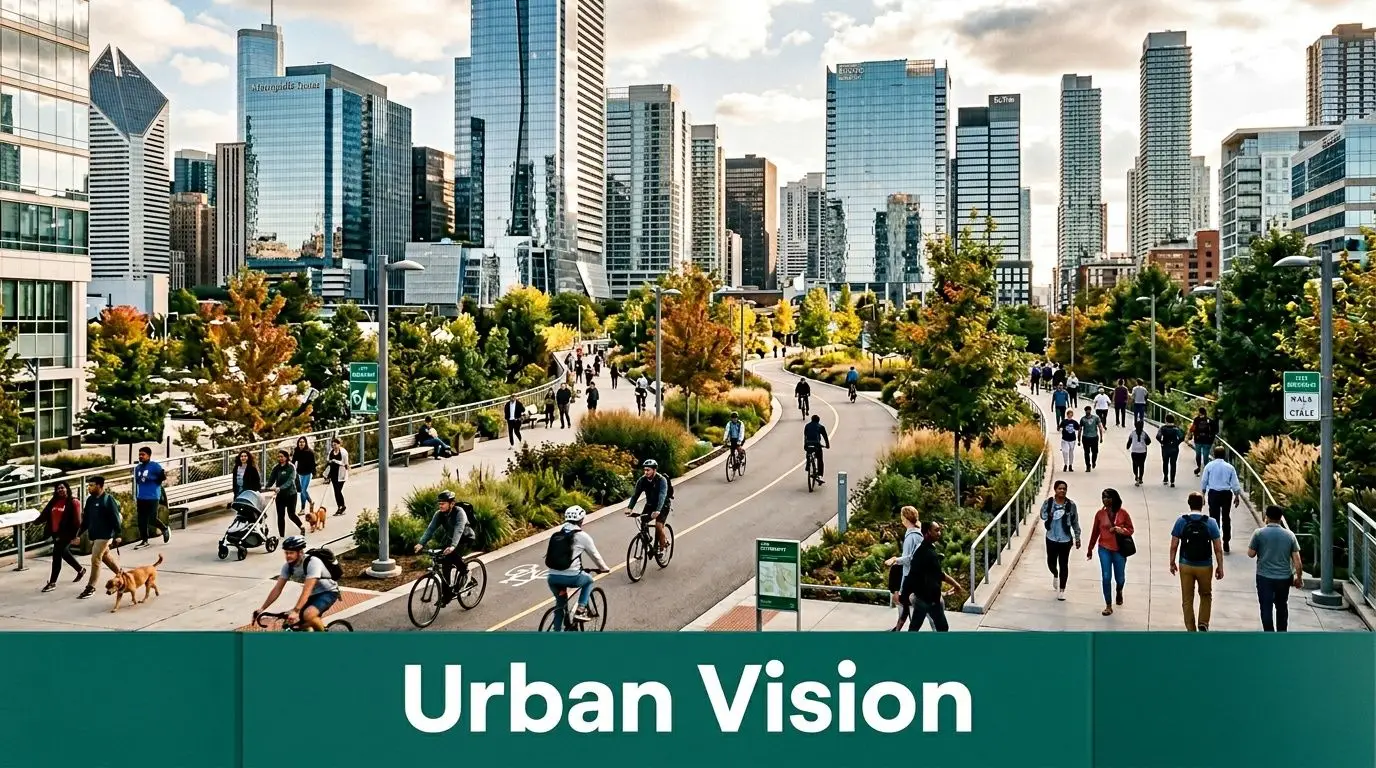
A friend from out of town once asked me why Atlantans talk about the BeltLine like it’s a neighborhood, a park, and a transportation project all at once. We were standing near the trail watching runners, parents with strollers, and cyclists all move through the same former rail corridor, and the easiest answer was this. The beltline of atlanta changes how the city feels when you’re in it.
Introducing the Atlanta BeltLine Vision
A lot of Atlanta projects promise to fix traffic, add green space, or make neighborhoods feel more connected. The BeltLine is unusual because it tries to do all three in one physical loop.
The idea took shape in December 1999, when Georgia Tech graduate student Ryan Gravel proposed reusing old rail corridors to tie together neighborhoods, parks, trails, and future transit. What makes that proposal memorable is not just that it was ambitious. It gave Atlanta a map for repairing parts of the city that had long felt cut off from each other.
Why people care so much about it
If you are visiting for the first time, it helps to treat the BeltLine like a piece of city infrastructure that happens to be fun. You can walk it like a park trail, stop for coffee, watch street art change block by block, and still be standing inside a long-term urban planning project.
That dual identity explains the strong local attachment. The BeltLine gives people a place to exercise and socialize today, but it also changes how Atlanta grows. New parks, safer routes for walking and biking, and stronger links between neighborhoods all affect daily life far beyond the trail itself.
It also shapes conversations about what kind of city Atlanta wants to become. A more connected one. A less car-dependent one. A greener one.
Big idea: The BeltLine works like a circulatory system for the city. It moves people, investment, and public life through areas that were once harder to reach and easier to overlook.
What the project is in plain language
In plain terms, the Atlanta BeltLine is a 22-mile multi-use trail system built along a historic rail corridor around the city’s core. The larger vision also includes parks, transit, and redevelopment that support denser, more walkable neighborhoods.
If the word “BeltLine” feels slippery at first, that is normal. Atlantans use it in three common ways:
- The trails you can walk, run, or bike right now
- The full city-building project, including parks and planned transit
- The surrounding areas whose businesses, housing, and street life have changed around the corridor
That overlap can confuse newcomers, but it tells you something important. The BeltLine is not only a route on a map. It is a public space, a planning framework, and a visible force in how Atlanta is remaking itself.
The long-range buildout is still in progress, with Atlanta BeltLine identifying 2030 as the target year for full completion in its official project timeline. So when you visit now, you are seeing both a finished destination and a work in progress.
That mix matters. It means your day on the trail connects to bigger questions about housing, transportation, tree canopy, and sustainability. Even practical choices around the corridor, from supporting local businesses to learning about reuse and materials such as building a retaining wall with railroad ties in Atlanta, fit into the broader story of how Atlanta adapts old infrastructure for new community use.
From Rails to Trails The BeltLine's Origin Story
On a quiet stretch of the trail, it is still possible to notice what this place used to be. The curve feels too purposeful to be a park path drawn from scratch. The grade stays gentle for long runs. Old bridges, retaining edges, and the corridor’s width all hint at an earlier job. Before the BeltLine became one of Atlanta’s favorite public spaces, it was a working ring of rail infrastructure that helped freight move around the city’s core.
That history matters because the BeltLine was never just a beautification project. It grew from a practical urban planning insight. Atlanta already had a continuous corridor in many places. Instead of letting that leftover infrastructure sit idle, planners and advocates saw a chance to reuse it for trails, parks, transit, and neighborhood connections.
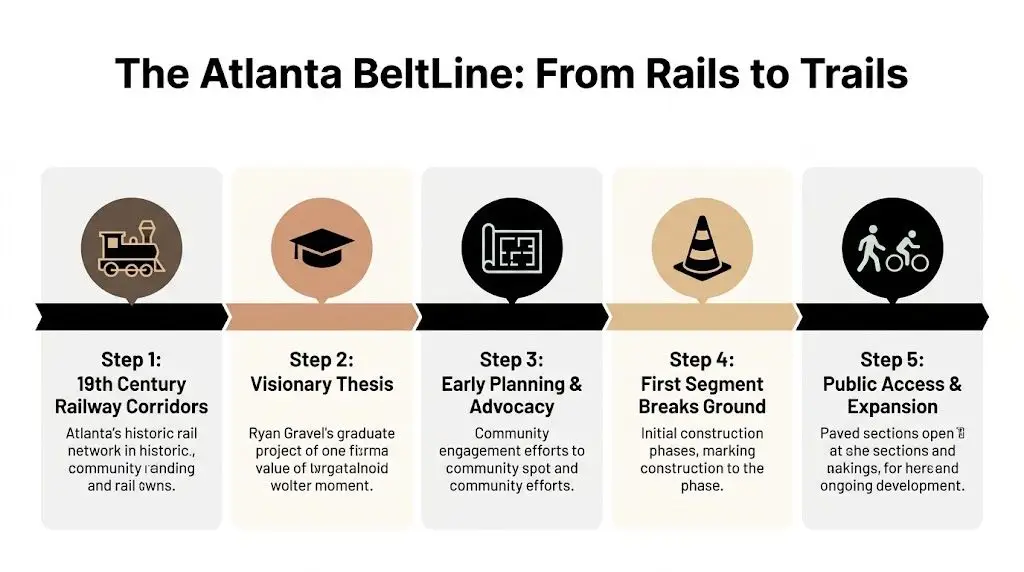
Ryan Gravel’s 1999 Georgia Tech master’s thesis gave that idea its modern shape. Georgia Tech’s College of Design describes the thesis as a proposal to convert underused rail corridors into a network that could link intown neighborhoods, add transit and green space, and reshape growth patterns in a more connected way (Georgia Tech on the BeltLine thesis origins).
How the old corridor became available
The rail lines themselves were much older than the plan. Segments of the corridor were assembled over decades by different railroad companies, then used heavily during Atlanta’s industrial growth. The Atlanta Regional Commission explains that as freight patterns changed and trucking took over more of that work, many portions of the line became inactive or underused, leaving behind a rare kind of urban asset: a long, continuous right of way inside a growing city (Atlanta Regional Commission overview of the BeltLine concept).
For urban planners, that kind of corridor is like finding the frame of a house still standing. You do not have to invent the structure from nothing. You can adapt it for new uses.
The timeline that changed Atlanta
A few public milestones help explain how the idea became a place people could visit. Atlanta BeltLine, Inc. traces the formal project launch to the mid-2000s, when the redevelopment framework and funding tools were approved and implementation shifted from student thesis to city-scale program (official BeltLine project timeline).
Land deals mattered too. The City of Atlanta’s acquisition of Bellwood Quarry created the foundation for what is now Westside Park, showing that the BeltLine vision was about much more than a trail. It tied recreation, water infrastructure, and land reuse into one long-term civic project (City of Atlanta on Bellwood Quarry and Westside Park).
Then came the pieces visitors know on the ground. Atlanta BeltLine, Inc. documents early trail openings on the south, north, and east portions of the corridor, each arriving in phases rather than all at once (Atlanta BeltLine trail history and segments). That staggered buildout explains a common newcomer question: why does one segment feel polished and commercial while another feels quieter, more residential, or still in transition? They opened in different eras, under different neighborhood conditions, and with different surrounding investments.
You can see the same pattern across Atlanta more broadly. Old industrial land does not disappear. It gets reused, revalued, and folded into new civic life. In some parts of the city that story shows up in adaptive reuse and redevelopment around major destinations, including the area discussed in this look at Atlanta Braves development and surrounding change.
Why the rail history still matters
The BeltLine works so well for walking and biking partly because railroads prefer gradual slopes and efficient alignments. What once helped trains move freight now helps people move comfortably. That is one reason the corridor often feels easier to cover than regular city streets with stop-and-go crossings and sharper hills.
The older materials still shape the atmosphere too. Timber, steel, masonry, ballast, and industrial edges give parts of the route a texture that brand-new greenways often lack. If you are curious how rail-era materials still show up in Atlanta outdoor design, this practical guide to building a retaining wall with railroad ties in Atlanta gives helpful context on the visual language many people associate with older rail corridors.
There is a sustainability lesson here as well. The BeltLine shows what a city can gain when it reuses land and infrastructure instead of abandoning them. That same mindset applies at smaller scales, from preserving materials to disposing of old electronics responsibly so redevelopment does not create a new waste problem somewhere else.
Navigating the Loop A Guide to the Main Segments
A first BeltLine visit can surprise people. You hear the word “loop” and expect one continuous, same-feeling path. What you get is more like a city told in chapters. Each segment has its own pace, neighbors, sounds, and reasons to visit, and that variety is part of the project’s larger value to Atlanta.
Eastside Trail
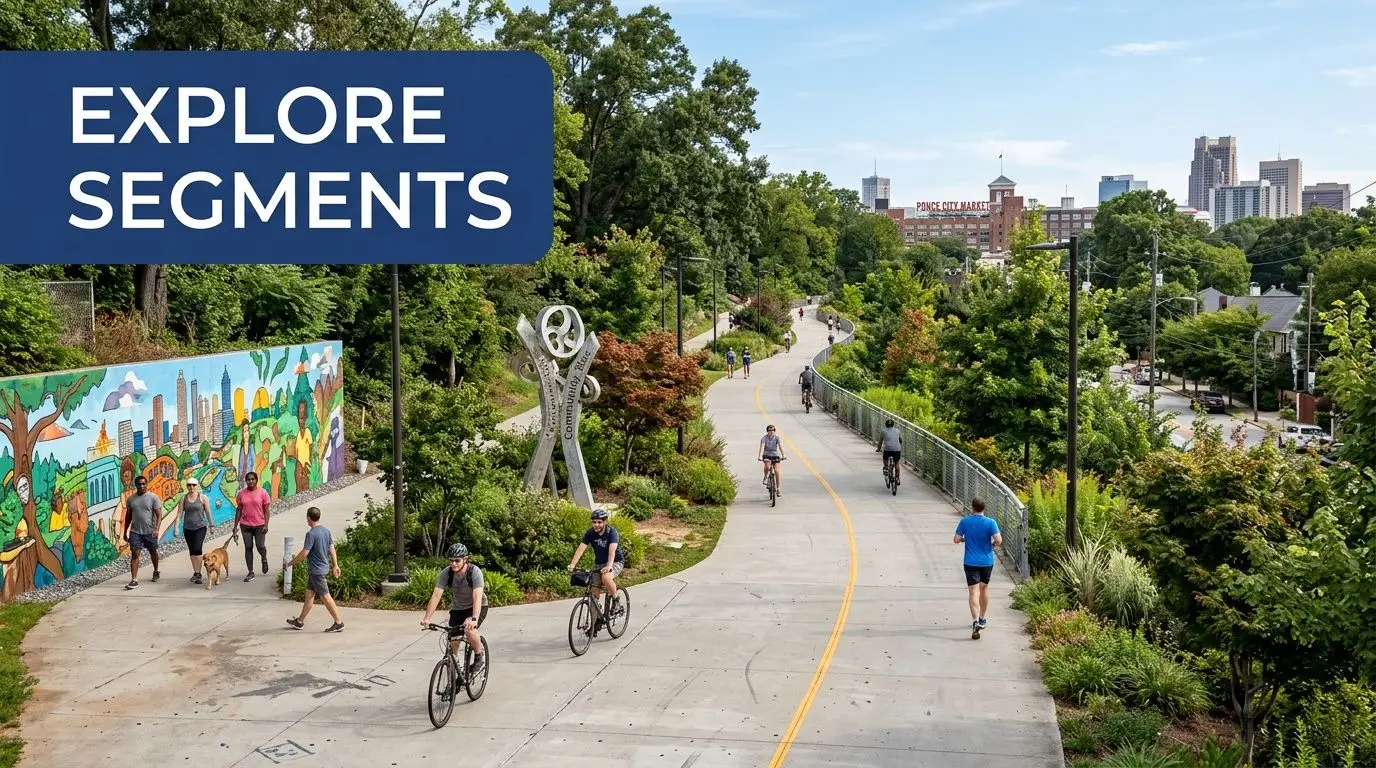
Eastside is the BeltLine section many visitors meet first, and for good reason. It is busy, visible, and full of the features people associate with the project: patios, murals, fitness stops, and a steady stream of walkers, runners, cyclists, and people out to see Atlanta in motion.
It helps to treat Eastside like a city promenade rather than a quiet greenway. If you arrive expecting solitude, the crowds can feel like a mismatch. If you arrive wanting energy, snacks, people-watching, and easy access to nearby destinations, it usually delivers.
This stretch also makes the BeltLine’s bigger idea easy to understand. You can see how a former rail corridor now works as public space, transportation route, and economic engine all at once.
Westside and West End areas
The western segments feel different in a way that matters. The mood is more neighborhood-centered and less curated for first-time visitors. You notice front porches, local institutions, everyday errands, and the practical side of what trail investment can do for parts of the city that are often discussed less than the Eastside.
For anyone interested in Atlanta beyond the postcard version, this is a rewarding place to walk. It shows the BeltLine as urban infrastructure, not just as a leisure amenity. The connection to the city’s wider redevelopment story also comes into focus here, especially if you are comparing how major destinations shape surrounding investment patterns in metro Atlanta, including business growth around the Braves stadium district.
Northside Trail
Northside is calmer and more tucked into the surrounding greenery. It works well for a shorter outing, a stroller walk, or a run that feels less crowded than the best-known BeltLine stretches.
A newcomer sometimes asks whether Northside “counts” as the BeltLine, as it feels quieter. It does. In fact, that quieter character helps explain the project better. The BeltLine is not one single atmosphere repeated over and over. It is a network that meets different needs in different places.
Southside and the developing sections
The southern and still-developing areas show the BeltLine as an unfinished civic project, which is useful context for any visitor. You are not just visiting a completed attraction. You are watching Atlanta reshape itself in phases, with construction, design work, and future openings all affecting what the experience looks like on the ground.
Atlanta BeltLine’s April 2025 design and construction update states that Northeast Trail Segment 3 is targeting a public opening before the June 2026 FIFA World Cup, and that Southwest Trail Segments 1 and 2 construction is expected to continue through mid-2028. Those details matter because they help set expectations. A route that looks close on a map may still be in progress, temporarily rerouted, or missing the amenities found on older sections.
That ongoing buildout also connects back to the BeltLine’s larger goals. Every new segment changes how residents move between neighborhoods, parks, transit, jobs, and daily services. For visitors, that means each return trip can reveal a different stage of Atlanta’s long-term urban experiment.
Quick comparison
| Segment | Best for | General feel |
|---|---|---|
| Eastside | First-time visitors, food stops, people-watching | Busy and social |
| Westside or West End | Neighborhood exploration, local context | Grounded and community-focused |
| Northside | Short walks, easier pace, lower crowd levels | Quieter and relaxed |
| Southside or developing areas | Repeat visitors curious about future growth | Transitional and changing |
Practical rule: Choose the segment that matches your goal for the day. Eastside suits a social outing. Northside fits a calmer walk. Westside and West End reward curiosity about how the BeltLine connects to the everyday life of Atlanta.
Planning Your Perfect BeltLine Visit
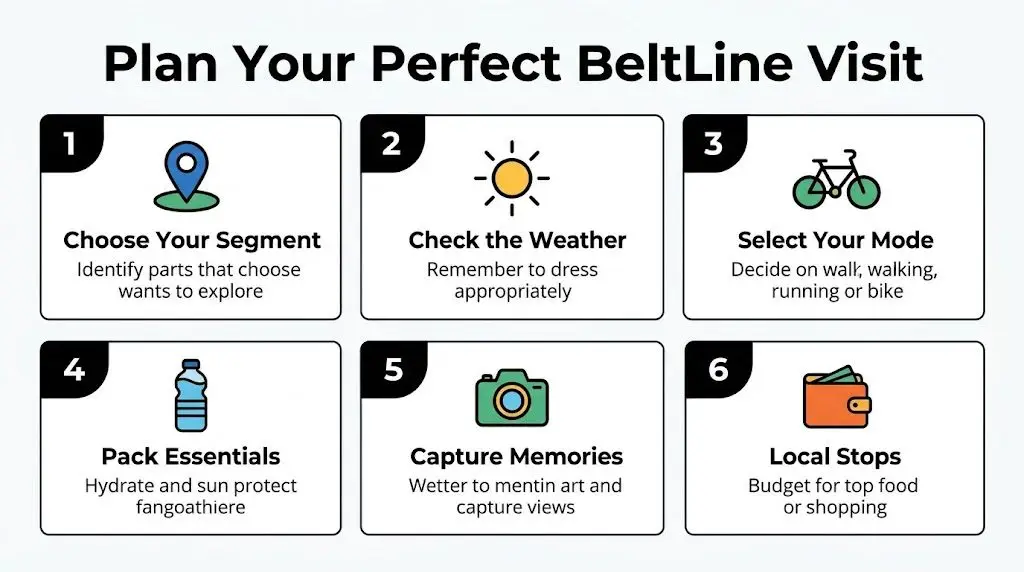
A good BeltLine day starts with one simple decision. Choose the segment first, then build the outing around that choice. People often do the reverse, and that’s when the day feels scattered.
The easiest way to plan
Use this checklist before you head out:
- Choose your vibe: Decide whether you want food and crowds, a workout, family time, or a quieter walk.
- Dress for exposure: Large parts of the trail are open, so sun and heat matter.
- Pick your mode: Walking works everywhere. Bikes and scooters are better when you want to cover more ground.
- Pack lightly: Water, phone, and comfortable shoes usually beat overpacking.
- Leave room for stops: The best BeltLine visits include time to pause, not just push through mileage.
Parking transit and access
Atlanta visitors often ask whether driving or transit is better. The honest answer is that both can work, depending on your starting point and patience level. If you’re targeting a busy section, parking can shape your mood before the walk even starts, so arriving with a backup plan helps.
If your trip starts near the airport or you’re coordinating a broader Atlanta work visit, it’s useful to understand the city’s logistics through a business mobility lens. This overview tied to Hartsfield-Jackson Atlanta International Airport operations and local access can help frame how people move into the city before they reach destinations like the BeltLine.
Common mistakes first-timers make
A few things trip people up:
- Starting too ambitious: The full system is large. Don’t try to “do the whole BeltLine” in one casual outing.
- Ignoring crowd patterns: A social trail at the wrong time can feel more stressful than fun.
- Wearing the wrong shoes: This sounds basic, but long paved walks punish bad footwear.
- Treating it like a single attraction: The BeltLine works better when you pair it with a meal, an art stop, or a neighborhood stroll.
Go with one anchor plan and one optional detour. That’s usually the sweet spot.
Curated Itineraries for Every Visitor
The best BeltLine day depends on why you came. Here are a few tried-and-true ways to experience it without overthinking every turn.
The first-timer food walk
Start on the Eastside Trail and keep the pace easy. Don’t treat it like a workout. Treat it like a long urban stroll with snacks, people-watching, and a couple of sit-down pauses.
Pause when something catches your eye. That matters here. The BeltLine rewards curiosity more than speed.
If you’re visiting Atlanta partly to understand its startup and innovation culture, you can also connect the outing to nearby business ecosystems such as Atlanta Tech Village in Atlanta GA, which helps place the BeltLine within the city’s broader growth story.
The family-friendly outing
Families usually do better on a shorter stretch with room for flexibility. Pick a segment where stopping often won’t feel inconvenient. Plan around snacks, bathrooms, and the simple fact that kids rarely care about your perfect route.
A good family BeltLine day has a rhythm:
- Start with movement.
- Add a play break.
- Stop for food before anyone gets tired and dramatic.
- Leave while everyone still thinks the day was fun.
The art-focused walk
The BeltLine is one of the easiest places in Atlanta to enjoy public art without making a whole production out of it. You can walk, notice, stop, and move on. That’s part of the pleasure.
Look for murals, sculptural pieces, and small visual surprises along the way. Don’t rush from one “must-see” point to the next. The art works best when it feels woven into the city rather than isolated from it.
Some of the best BeltLine moments aren’t landmarks. They’re combinations. A mural, a curve in the trail, a passing cyclist, and skyline light all at once.
The fitness outing
If your goal is exercise, go early or choose a less crowded segment. The most popular stretches can be frustrating if you’re trying to hold a steady pace. Pick a route that matches your training day, not your social media feed.
For runners, the paved surface is consistent and easy to traverse. For cyclists, trail etiquette matters more than speed. For walkers, the key is simple. Don’t overload the day. A focused, enjoyable outing beats a heroic but annoying one.
More Than a Path The BeltLine's Community Impact
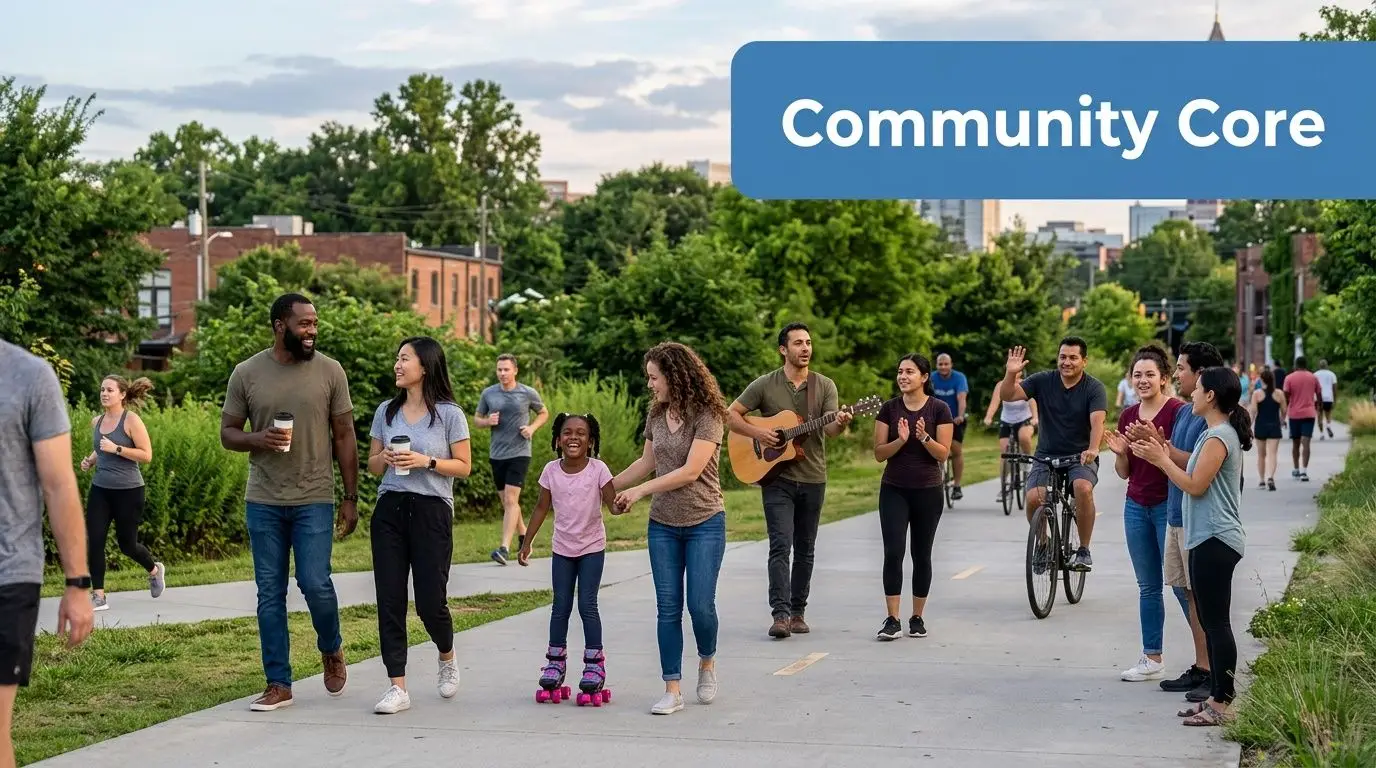
On a busy evening, the BeltLine can feel like a small model of Atlanta in motion. A couple is walking a dog. Kids roll past on scooters. Friends stop at a mural, then keep going toward dinner. What looks like a pleasant trail at first is also a public works project, an economic force, and a long-running argument about who gets to shape the city.
What the project has made possible
The easiest way to understand the BeltLine’s impact is to compare it to an old rail corridor turned into civic infrastructure. It gives people a place to move through the city, but it also pulls investment, events, housing debates, small business growth, and public art into the same corridor. That is why people talk about it with so much intensity. The BeltLine affects daily life, not just weekend recreation.
Its reach shows up in several ways. The project connects dozens of neighborhoods. It has attracted major private investment around the corridor, as noted earlier in this guide. Cultural events have also grown alongside it, turning the trail into a shared public stage rather than a simple route from one place to another.
You can see that change without needing a spreadsheet. Restaurants and shops gather near popular access points. Underused industrial areas become places people visit on purpose. Public art gives the corridor a local identity, so a walk feels tied to Atlanta’s character instead of generic city redevelopment.
The harder side of the story
Big public improvements rarely spread benefits evenly, and the BeltLine is a clear example. The Urban Institute at Georgia State analysis of BeltLine-driven green gentrification found rising property values and demographic change around parts of the corridor, especially in fast-changing Southside and Westside areas.
For a newcomer, this can be confusing. How can a trail be both beloved and controversial? The answer is simple. Better parks, trails, and transit access often make nearby areas more desirable. Desirability raises rents and property values. If a city does not protect affordability and support longtime residents, improvement for the area can become pressure on the people already there.
That pressure reaches beyond housing. Small businesses forced to move often have to sort through furniture, fixtures, payment systems, office equipment, and outdated electronics at the same time. Responsible disposal matters here too. For readers who want a practical local example, this guide to social impact recycling in Georgia shows how reuse and recycling can support broader community goals.
The BeltLine works like a citywide circulatory system. It brings energy, money, and activity into new places, but a healthy system also needs safeguards so the benefits do not flow only to the people best positioned to capture them.
That tension is part of the BeltLine story, not a side note. Loving the project means paying attention to both sides of it.
Safety Accessibility and Visitor Etiquette
The BeltLine works best when people treat it as shared space, not their personal lane. That sounds obvious, but it’s the difference between a smooth visit and a frustrating one.
Trail habits that help everyone
Keep right unless you’re passing. If you stop, move out of the main flow first. If you’re riding, slow down around crowded stretches and blind spots. If you’re walking in a group, don’t spread across the full width of the path.
These aren’t complicated rules. They’re just the basic habits that make a multi-use trail function.
Accessibility and comfort
The paved trail sections are generally the easiest choice for wheelchairs, strollers, and anyone who wants a smoother surface. For many visitors, the challenge isn’t the trail itself. It’s selecting an access point, parking area, or route length that matches their comfort level.
If you’re visiting with kids, older relatives, or someone using a mobility device, shorter out-and-back plans usually work better than ambitious point-to-point adventures.
Personal safety
Go where the activity level fits your comfort. Busier sections often feel easiest for first-time visitors. If you’re heading out early or later in the day, keep the usual city awareness you’d use anywhere else. Stay alert, keep valuables managed, and avoid creating conflict over trail space.
The BeltLine is one of Atlanta’s most enjoyable public places. A little awareness keeps it that way.
Atlanta Resources for a Sustainable City
A good BeltLine visit can end with coffee, public art, and a sunset walk. The bigger lesson starts after you leave. This project teaches Atlanta how to reuse what a city already has, how to maintain it over time, and how to think about waste before it piles up out of sight.
That lesson reaches beyond trails and parks.
Sustainability also includes technology
The BeltLine’s history is rooted in second chances. Old rail corridors became public space. Former industrial edges became places people use every day. The same civic mindset applies to the less visible systems that keep a city running, including the computers, monitors, servers, and networking gear that offices and organizations replace over time.
Urban improvement creates physical debris, but it also creates digital leftovers. A business relocates near the trail. A nonprofit upgrades its office. A facility closes or consolidates. Suddenly there is a stack of retired devices that still contains materials to recover and data to protect.
You can see the value of long-term planning in the BeltLine itself. The Eastside Trail used standardized materials and construction details, including 14-foot-wide concrete paths, stone cladding, and stainless steel cable mesh systems, to support durability and easier maintenance across later phases, as noted in the Landscape Performance case study on the Eastside Trail. That kind of thinking matters because a well-built public project is easier to care for year after year.
The same logic applies to technology. Buy it carefully. Use it well. Retire it responsibly.
What responsible participation looks like
For Atlanta organizations, supporting a more sustainable city can include handling outdated equipment with the same care the BeltLine applies to long-term stewardship. The goal is not just clearing storage rooms. The goal is protecting data, recovering usable materials, and keeping hazardous waste out of the wrong places.
A practical local option is Atlanta electronics recycling services for organizations, which explains pickup, secure data destruction, and compliant processing for retired business equipment.
That may sound far removed from a trail walk in Inman Park or West End, but the connection is real. Cities become more sustainable when residents enjoy public spaces and when businesses handle the hidden byproducts of growth responsibly. The BeltLine shows the visible side of renewal. Electronics recycling handles one of the quieter parts.
Atlanta keeps reinventing itself. The BeltLine is one of the clearest examples. It reminds us to pay attention not only to what gets built, but also to what gets reused, recycled, and documented along the way.