
For businesses in Georgia, managing end-of-life IT equipment is no longer an afterthought—it's a critical component of risk management and operational security. Corporate computer recycling Georgia services provide a formal process for handling outdated assets, ensuring secure data destruction and environmentally responsible disposal. Executing this incorrectly exposes your organization to data breaches and regulatory penalties, making a certified IT Asset Disposition (ITAD) partner an essential part of your business strategy.
Why Georgia Businesses Are Prioritizing IT Asset Disposal
For companies across Georgia, from Atlanta's tech hubs to Savannah's logistics centers, managing obsolete technology has become a strategic priority. This shift is driven by rapid technology upgrade cycles and an increasingly complex landscape of data privacy regulations, such as the FTC Disposal Rule.
Forward-thinking organizations understand that professional IT asset disposal is not a cost center but a crucial protective measure. Attempting to manage retired computers, servers, and network equipment in-house introduces significant risk. A single misstep can lead to a damaging data breach or a financially crippling non-compliance penalty.
The Growing Need for Certified Partners
This is where a certified ITAD partner becomes your best defense. These specialists handle the entire complex process of e-waste management from start to finish. They do a lot more than just haul away your old junk; their services are built to protect your business at every step.
The market tells the story. The IT asset disposition (ITAD) market, the engine behind corporate recycling, hit USD 70.1 billion in 2024 and is expected to explode to USD 251.9 billion by 2034. That's a staggering 259% growth, powered by massive data center decommissioning projects and tougher compliance demands. Here in Georgia, that trend is especially strong as Atlanta cements its role as a national tech and recycling hub, drawing investment to manage the flood of e-waste from enterprise upgrades.
A professional ITAD strategy does more than just dispose of old hardware; it formally transfers the liability for data security and environmental compliance from your company to a certified expert. This transfer is documented through certificates of destruction and recycling, providing a clear and auditable trail.
To understand why this is so important for Georgia businesses, let's break down the main drivers and their impact.
Key Drivers for Corporate E-Waste Management in Georgia
| Driving Factor | Business Impact | Relevant Regulations |
|---|---|---|
| Data Security & Privacy | Prevents data breaches, protects customer trust, and avoids reputational damage from leaked sensitive information. | FTC Disposal Rule, HIPAA (Healthcare), GLBA (Financial), FACTA |
| Regulatory Compliance | Avoids steep fines and legal action for improper disposal of data-bearing devices or hazardous materials. | RCRA (Resource Conservation and Recovery Act), Sarbanes-Oxley (SOX) |
| Environmental Responsibility | Enhances brand image, meets corporate social responsibility (CSR) goals, and prevents toxic e-waste from polluting landfills. | Georgia E-Waste Management Act (targets consumers but influences corporate standards) |
| Value Recovery & ROI | Recovers residual value from retired assets through secure remarketing, turning a cost center into a potential revenue stream. | N/A |
These factors together create a compelling case for a formal ITAD program, moving it from a "nice-to-have" to a "must-do" for any forward-thinking Georgia company.
Core Benefits of a Formal ITAD Program
Working with a certified partner brings several key advantages that directly affect your bottom line and your company's good name.
- Risk Mitigation: Securely destroying data on old hard drives is the only way to prevent breaches and protect your intellectual property. It’s your first line of defense.
- Regulatory Compliance: Good partners live and breathe regulations like HIPAA, FACTA, and Sarbanes-Oxley. They ensure your disposal methods are 100% compliant, so you don't have to worry about fines.
- Sustainability and Corporate Responsibility: Proper recycling keeps lead, mercury, and other hazardous materials out of our landfills. It’s a powerful way to show your commitment to the environment and boost your brand image.
- Operational Efficiency: Outsourcing this work frees your IT team from the logistical headache of managing old equipment. Let them focus on what they do best—driving your business forward.
By prioritizing professional IT asset disposal, Georgia businesses can manage their technology's end-of-life with confidence. Partnering with an expert ensures you are protected, compliant, and responsible. Explore our certified Georgia electronics recycling services to see how we implement these principles for businesses like yours.
How to Prepare Your IT Assets for Secure Disposal
Before a single piece of equipment leaves your facility, there’s some essential prep work to do. Getting this foundational step right is about more than just a smooth pickup; it’s the bedrock for your compliance, data security, and any potential value you hope to get back. Think of it as turning a chaotic pile of old hardware into an organized, trackable inventory that's ready for its next chapter.
If you just pile devices onto pallets without any real documentation, you're opening the door to risk. It becomes nearly impossible to prove what you handed over, track which devices held sensitive data, or even make sense of the final report from your ITAD partner. The effort you put in now will pay you back tenfold in security and peace of mind down the road.
Creating a Detailed Asset Inventory
First things first: you need a comprehensive inventory list. This document is the cornerstone of the entire project, serving as the master record for both your team and your recycling partner. A simple note saying "50 computers" just won't cut it. For a secure chain of custody, you need details.
At a bare minimum, your inventory should capture this information for each asset:
- Asset Tag Number: Your company's internal ID for the device.
- Serial Number: The manufacturer's unique number, which is critical for verification.
- Device Type: Be specific—is it a desktop, laptop, server, switch, or monitor?
- Brand and Model: For instance, "Dell Latitude 7420" or "HP ProLiant DL380 Gen10."
- Basic Specifications: Jot down key specs like CPU, RAM, and storage size. This directly impacts any potential resale value.
This level of detail is non-negotiable for anything that holds data or might be resold. For low-value items like keyboards, mice, and cables, a simple bulk count or an estimated weight is usually fine. For a deeper dive, check out our guide on how to prepare your computers, tablets, and phones for recycling in Atlanta.
Sorting Equipment for Reuse Versus Recycling
Not every retired piece of IT equipment is headed for the shredder. A crucial part of the prep is sorting your assets based on their age, condition, and whether they still work. This simple act of sorting has a huge impact on your potential for value recovery and helps your ITAD partner process everything much more efficiently.
Create two main groups:
- Assets for Potential Remarketing: This is where you'll put newer equipment (usually less than five years old) that is fully functional and still has some market demand. Laptops, servers, networking gear, and enterprise-grade desktops are common candidates.
- Assets for Recycling: This pile is for the older, broken, or completely obsolete gear with no resale value. These items will be broken down for their raw materials after any data has been destroyed.
Segregating your assets upfront is a strategic move. It allows you to clearly identify the equipment you expect to receive a buyback offer for, making the financial reconciliation process much more transparent and predictable.
This sorting process helps set clear expectations and gives your ITAD partner a much better idea of what they're picking up, which often leads to a more accurate initial quote.
Consolidating Hardware for Pickup
Once everything is inventoried and sorted, the final step is to get it all consolidated for a seamless pickup. If your business is spread across multiple floors or buildings in Georgia, find a single, secure spot to stage everything. A loading dock, an empty office, or a conference room with ground-floor access works perfectly.
Here are a few best practices for getting everything ready:
- Palletize Securely: Stack heavier items like servers and desktops on the bottom of the pallets and lighter items on top. Then, use shrink wrap to secure the whole stack.
- Label Clearly: Tape a copy of your inventory list to each pallet or give them simple labels (e.g., "Pallet 1 of 4") so they can be identified at a glance.
- Isolate Data-Bearing Devices: If you can, keep hard drives and other sensitive media separate. Putting them on their own pallet ensures they are flagged for secure processing the moment they arrive at the facility.
Properly consolidating your gear minimizes how much time the logistics team spends on-site. This means less disruption for your business and a clean, accountable handoff of all your assets.
Choosing the Right Data Destruction Method
When it comes to corporate computer recycling, protecting your company's sensitive information is priority number one. For any Georgia business, a data breach from an improperly retired asset isn't just an IT headache—it's a potential catastrophe. The method you choose to destroy that data has to square with your industry's compliance rules and your own tolerance for risk.
Let's be clear: simply deleting files or formatting a hard drive is nowhere near enough. Readily available recovery tools can pull that data back from the brink, leaving your company’s confidential information wide open. That's why certified data destruction isn't just a best practice; it's a non-negotiable step to protect your business, your customers, and your reputation.
Understanding Data Sanitization Standards
You'll hear a few key standards mentioned in the data destruction world. These aren't just suggestions; they're proven, repeatable processes for making data completely unrecoverable. For businesses in Georgia, two names come up most often:
- NIST 800-88: This is the current gold standard, developed by the National Institute of Standards and Technology. It outlines three approaches: Clear, Purge, and Destroy. For most corporate gear that still has life in it, the "Purge" method—which involves overwriting the drive's data multiple times—is more than sufficient.
- DoD 5220.22-M: An older Department of Defense standard that uses a specific three-pass overwrite process. While largely replaced by the more modern NIST 800-88, it's still a well-respected and effective method for securely wiping a drive.
Working with a vendor who can perform and certify their work to these standards is absolutely critical. It’s the difference between hoping your data is gone and having the paperwork to prove it.
This quick flowchart helps visualize that first critical decision for every piece of equipment before you even think about data destruction.
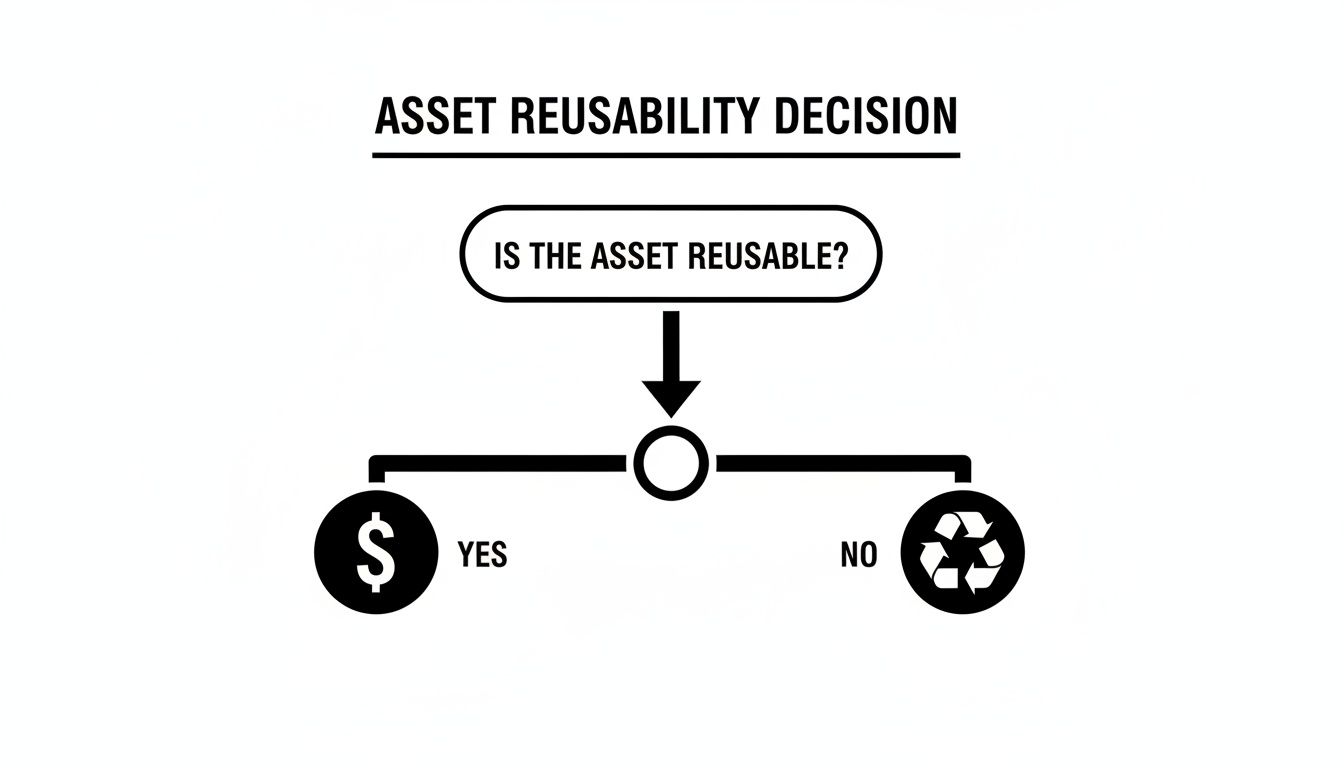
As you can see, if an asset can be reused, it can generate financial value. If not, it heads straight for responsible recycling after its data has been securely destroyed.
Physical Destruction Versus Digital Wiping
Your main choice boils down to either physically demolishing the storage media or digitally sanitizing it. Each has its time and place, and the right call depends on the situation.
- Physical Hard Drive Shredding: This is the brute-force, foolproof method. An industrial shredder grinds hard drives, SSDs, backup tapes, and other media into tiny, mangled pieces of metal and plastic. It’s the go-to for devices that are broken, ancient, or held the company's most guarded secrets.
- On-Site vs. Off-Site Shredding: You can have a mobile shredding truck come to your facility in Georgia (on-site) and watch the destruction happen. For larger quantities, off-site shredding at the vendor’s secure facility is usually more budget-friendly.
- Data Wiping (Sanitization): This is a software-based approach that overwrites every single sector of a hard drive with random data, effectively erasing the original information. The huge advantage here is that the drive remains intact, allowing the computer or server to be refurbished and resold. This is how you maximize your value recovery.
Picture this: A healthcare provider in Augusta, dealing with strict HIPAA rules, is retiring servers full of patient records. They'd almost certainly choose on-site physical shredding. This gives them an unbroken chain of custody and visual confirmation, leaving zero chance of a data breach.
Now, consider a law firm in Atlanta upgrading a batch of three-year-old laptops. For them, NIST 800-88 compliant data wiping makes more sense. It completely secures their client data while keeping the functional laptops intact, allowing them to be resold to help pay for the new equipment.
The need for proper disposal is a massive global issue. Back in 2016, the world generated a staggering 44.7 million tons of e-waste, but only 20% of it was properly recycled. The rest? Much of it sits in landfills, where hazardous materials can cause serious environmental problems—a challenge that's especially relevant in tech-heavy states like Georgia.
Comparing Data Destruction Methods for Corporate IT Assets
To help you decide, here’s a straightforward comparison of the common methods available to Georgia businesses. This table breaks down each option based on security, ideal use case, and how it aligns with compliance demands.
| Destruction Method | Security Level | Best For | Compliance Alignment |
|---|---|---|---|
| Data Wiping (NIST 800-88 Purge) | Very High | Functional devices intended for resale or reuse (laptops, servers, desktops). | Meets or exceeds requirements for HIPAA, SOX, GLBA, and FTC Disposal Rule. |
| On-Site Physical Shredding | Absolute | End-of-life devices, damaged media, or assets with extremely sensitive data. | The ultimate proof of destruction for all major regulations, providing an unbroken chain of custody. |
| Off-Site Physical Shredding | Absolute | Large volumes of non-functional IT assets where cost-effectiveness is a key factor. | Provides certified proof of destruction for HIPAA, SOX, and other regulations. |
| Degaussing | Very High | Magnetic media like traditional hard drives and backup tapes. (Note: Ineffective on SSDs). | Excellent for older media types covered by DoD and NIST standards. |
Choosing the right method is about balancing the value of the asset, the sensitivity of its data, and your compliance obligations. The good news is, you don't have to choose just one—a comprehensive ITAD plan often uses a mix of these techniques.
The Critical Role of Documentation
No data destruction project is finished until the paperwork is done. A Certificate of Data Destruction is your official, legally defensible proof that your company’s data was handled correctly.
This document is your shield. It should clearly state:
- The exact method used (e.g., NIST 800-88 Purge, physical shredding).
- A serialized inventory of the hard drives that were processed.
- The date and location where the destruction took place.
- The signature of an authorized representative from the certified vendor.
This certificate formally transfers liability from you to your ITAD partner and serves as your primary defense in an audit or legal challenge. Understanding the power of modern Georgia data recovery services really drives home why this certified proof of destruction is so essential. To dive deeper into our certified processes, check out our detailed guide on security and data destruction.
Getting Your Gear Picked Up and Paid For
Once you have a handle on your inventory and a solid data destruction plan, the next question is always: "How do we get all this stuff out of here?" This is where the rubber meets the road, and it’s a part of the process that trips up a lot of companies.
But it doesn't have to be a headache. With an experienced partner, moving hundreds—or even thousands—of devices from your Georgia facility is a carefully managed process. This is also the point where you can unlock the cash hiding in your old equipment.
Making the Pickup and Transport Painless
A smooth pickup doesn't just happen; it's coordinated. It starts with a simple conversation between your team and your ITAD partner. The whole point is to minimize the time crews are on-site and to make sure every single asset is tracked the moment it leaves your building.
Here’s what you should expect from a professional logistics service:
- Scheduling That Works for You: Pickups should be scheduled around your business hours. Need it done after 5 PM or on a Saturday to avoid disrupting your team? A good partner makes that happen.
- Secure, Tracked Trucks: Your equipment should be moved in secure, GPS-tracked vehicles. This maintains a documented chain of custody from your loading dock right to the processing facility.
- A Professional On-Site Crew: The team that shows up should know how to handle sensitive IT gear. They should be quick, efficient, and careful not to damage the equipment (or your office).
This kind of coordinated effort takes the logistical burden completely off your plate. What seems like a massive project becomes just another scheduled event on the calendar, letting your people stay focused on their real jobs.
Turning Old Tech into New Revenue
Here’s a fact that surprises many Georgia businesses: your old IT equipment can actually make you money. Corporate computer recycling in Georgia isn't just about paying for a disposal service; it’s about recovering value. A good IT asset buyback program means you can sell your functional, more recent equipment, turning a pile of depreciating assets into a check for your company.
This is a huge part of a smart ITAD strategy. The money you get back from selling your old laptops, servers, and networking gear can seriously reduce—or even completely cover—the costs of recycling lower-value items and paying for certified data destruction.
We see this all the time. A local Atlanta firm recently upgraded all 200 of their sales team's laptops. The devices were three-year-old Dell Latitudes. After we securely wiped them, they still had plenty of life and value on the secondary market. The buyback offer we provided turned what they thought would be a disposal expense into a nice, unexpected deposit.
How We Figure Out What Your Assets Are Worth
The value of your used IT equipment isn't just a number pulled out of thin air. It’s calculated based on real-world factors that dictate what it can sell for on the secondary market. Knowing what drives value helps you set realistic expectations for your return.
Here are the key things we look at:
- Age and Model: Technology moves fast. Equipment that’s less than five years old, especially enterprise-grade gear, holds the most value.
- Cosmetic Shape: A clean device with minimal scratches or dents will always fetch a better price.
- Functionality: Does it power on and work correctly? A fully functional unit is worth far more than a non-working one that’s only good for parts.
- Specs and Configuration: Just like when it was new, higher specs matter. More RAM, faster processors, and bigger hard drives mean a higher buyback offer.
- Completeness: It might seem small, but having the original accessories, like AC adapters for laptops, adds to the total value.
When you work with a transparent partner, you should get a detailed report breaking down the value of each asset. You'll see exactly how the offer was calculated. This approach shifts IT retirement from being a line-item expense to a smart financial move.
How to Select a Certified ITAD Partner in Georgia

Your choice of vendor is easily the most critical decision you'll make in this entire process. Picking the right partner for corporate computer recycling in Georgia is what separates a smooth, secure project from a potential liability nightmare. It’s about more than just hauling away old gear; it’s about finding a provider who acts as a true extension of your team, dedicated to protecting your business.
A great partner doesn't just pick up your equipment. They take on the full weight of responsibility for your data security and environmental compliance. That requires a level of trust that can only be earned through proven credentials and completely transparent practices.
Look for Non-Negotiable Certifications
Certifications aren't just fancy logos for a website. They are hard-earned proof that a vendor follows rigorous, third-party audited standards for security and environmental responsibility. For any Georgia business, these are the credentials that matter most:
- R2 (Responsible Recycling): This is the leading global standard for electronics recycling, period. An R2-certified facility is audited for everything from environmental protection and worker safety to data security and a documented chain of custody. You can learn more about why this is so critical by reading our guide explaining what R2 certification is.
- e-Stewards: Another highly respected standard, e-Stewards has a sharp focus on preventing the illegal export of hazardous e-waste to developing countries and strictly prohibits the use of prison labor.
- NAID AAA: This certification is laser-focused on one thing: data destruction. A NAID AAA-certified vendor has gone through exhaustive audits of their hiring practices, operational security, and destruction methods to guarantee your data is 100% irrecoverable.
Asking a potential partner if they hold these certifications should be your first question. If the answer is "no," the conversation should probably end right there.
Verify Their Insurance Coverage
Proper insurance is your financial safety net. A reputable ITAD partner will carry specific policies designed to shield you from the unique risks of this industry. Don't be shy about asking to see their Certificate of Insurance.
You need to see proof of:
- General Liability: This covers basic business operations and any potential accidents.
- Pollution Liability: This one is crucial. It protects your company in the rare event of an environmental mishap resulting from improper disposal.
- Cyber/Data Breach Insurance: This policy covers the staggering costs associated with a data breach that happens while your assets are in their possession.
Without this coverage, your business could be left holding the bag for cleanup costs or breach notification expenses that can easily run into the millions.
A key takeaway for any Georgia IT manager is this: certifications and insurance are not optional add-ons. They are the fundamental pillars of risk management in IT asset disposition. They are what allow you to confidently transfer liability to your chosen vendor.
Demand a Clear Chain of Custody
From the moment your equipment leaves your Georgia facility, you need an unbroken, documented trail of where it goes and who handles it. A transparent chain of custody is your proof of due diligence. Your partner must provide serialized reporting that tracks each individual asset from pickup to its final destination, whether that's resale, recycling, or shredding.
This isn't just for your own records; it's your primary defense in an audit. It proves you took every reasonable step to manage your assets responsibly. When you've found a certified provider, formalizing these expectations is the next step—consider drafting a robust contract for your ITAD supplier to lock in the terms.
The global scale of e-waste really drives home why these strict controls are so vital. E-waste is the fastest-growing solid waste stream on the planet, with 50-60 million tons generated every year. Here in the U.S., the recycling industry processes 130 million metric tons of materials, including electronics. When you consider that making just one desktop computer requires about 530 pounds of fossil fuels and over a ton of water, responsible recycling becomes critical for both security and sustainability.
Ultimately, choosing the right ITAD partner in Georgia comes down to vetting their credentials, verifying their protections, and confirming their processes. This diligence ensures your corporate computer recycling project is handled with the professionalism and security your business deserves.
Got Questions About Computer Recycling? We Have Answers.
Even with a solid plan, specific questions always pop up when it's time to handle corporate computer recycling. For businesses across Georgia, getting straight answers is key to making the right call on IT asset disposition. Here are some of the most common questions we hear from IT managers and business owners from Atlanta to Savannah.
What Types of Corporate Equipment Do You Recycle in Georgia?
We handle the full spectrum of business-grade IT and electronic assets. Our entire process is built from the ground up to manage the kind of equipment you'd find in a professional environment, not a home.
You can count on us for:
- Core IT Hardware: Desktops, laptops, servers, and workstations.
- Networking Gear: Switches, routers, firewalls, and access points.
- Data Center Equipment: Server racks, storage arrays (SAN/NAS), and UPS systems.
- Peripherals: LCD monitors, keyboards, mice, docking stations, and all the associated cables.
- Specialized Electronics: We also manage the disposal of sensitive laboratory and medical devices, ensuring every step complies with strict, industry-specific regulations.
Just to be clear, we focus exclusively on commercial equipment. Our systems aren't set up for residential appliances like televisions or microwaves.
What Are the Costs for Business Computer Recycling?
This is a big one, and the answer is: it depends entirely on your specific inventory. There's no one-size-fits-all price tag for corporate computer recycling in Georgia.
It really comes down to two main scenarios:
- Projects That Generate Revenue: If your inventory is packed with newer, functional equipment—think less than five years old—you might be looking at our IT asset buyback program. In this situation, the service could be free, or we might even write your company a check. The value we recover from remarketing the gear covers all the costs for logistics, data destruction, and processing.
- Projects With an Associated Cost: For older, non-functional, or mixed-value assets, there's typically a fee involved. This covers the real-world costs of secure transportation, certified data destruction, labor, and the environmentally sound dismantling and recycling of the materials.
We always provide a transparent, itemized quote right at the start, after reviewing your asset list. You’ll see everything laid out, so there are no surprises and you can budget with confidence.
A lot of people assume recycling always comes with a cost. The reality is, for many businesses doing a tech refresh, a smart ITAD program can actually become a revenue stream, turning old hardware into a positive line item on the balance sheet.
What Documentation Will My Company Receive?
Proper documentation isn't just paperwork; it's the foundation of a compliant ITAD program. It’s your official record and proof that you did everything by the book. Once we've processed your equipment, we'll send a complete documentation package for your audit and compliance files.
This package always includes two key documents:
- A Certificate of Recycling: This officially records the transfer of ownership and liability. It details exactly what equipment was processed and confirms it was handled in line with all environmental regulations.
- A Certificate of Data Destruction: This is your legal proof that every single data-bearing device was sanitized or destroyed according to NIST 800-88 standards. It lists the serial numbers of every hard drive, giving you a clear and defensible audit trail.
These certificates are absolutely critical for proving compliance with data privacy laws like HIPAA, FACTA, the FTC Disposal Rule, and Sarbanes-Oxley (SOX).
Do You Offer Pickups Outside the Atlanta Metro Area?
Absolutely. Our main facility is in the Smyrna/Atlanta area, but our reach extends across the entire state of Georgia. And for our larger corporate clients, we operate nationwide. We know that business doesn't stop at the perimeter.
Our logistics network is fully equipped to handle secure pickups for businesses anywhere in Georgia, whether you're in major hubs like Augusta, Columbus, Macon, and Savannah, or in a more remote location. If you're an enterprise with offices sprinkled across the country, we can coordinate a single, unified project to securely transport all assets to our certified processing facility. This centralized approach guarantees consistent security, reporting, and quality, no matter where your equipment is coming from.
Contact Beyond Surplus for certified electronics recycling and secure IT asset disposal for your Georgia-based business.