

Decommissioning a data center in Denver is a massive undertaking. It's not just unplugging servers; it's a strategic project that involves methodically shutting down and removing every piece of IT infrastructure. A successful project for any Denver, Colorado business hinges on a meticulous blueprint that covers everything from project scope and inventory management to secure data destruction and compliant asset disposal. Without this, you're looking at major security risks and costly overruns.
Think of it this way: a solid plan transforms a logistical nightmare into a secure, value-driven process.
Building Your Decommissioning Blueprint
Jumping into a data center decommissioning without a plan is a recipe for disaster. It’s a high-stakes initiative where a single misstep can lead to data breaches, compliance fines, and budgets spiraling out of control. The very first phase is all about building that foundational blueprint to guide every single action that follows. This initial planning prevents the chaos that can derail even the most technically skilled teams.
It all starts with defining the scope of the project. Are you shutting the whole place down for good? Moving some gear to a colocation facility? Or is this just a hardware refresh within your current space? Each of these scenarios brings its own unique operational, financial, and logistical headaches that need to be ironed out upfront. A full shutdown, for instance, means coordinating with the facilities team on power, cooling, and physical security, while a migration demands flawless timing to keep service disruptions to an absolute minimum.
Assembling Your Cross-Functional Team
Here’s a hard truth: no single department can pull off a decommissioning project alone. Your success depends on putting together a cross-functional team with people from all the key business units. This collaborative approach makes sure every angle is considered and potential roadblocks are spotted early on.
Your core team should have stakeholders from:
- IT Operations: These are your boots on the ground, managing the technical shutdown of servers, networks, and storage arrays.
- Facilities Management: They handle the physical site—power, cooling, fire suppression, and security.
- Finance and Procurement: This team oversees the budget, tracks every cost, and manages vendor contracts and asset valuation.
- Legal and Compliance: They’re essential for making sure you stick to data privacy laws like HIPAA or the FTC Disposal Rule and all environmental regulations.
This infographic gives a great overview of these foundational steps, from the initial scope to the final inventory.

The flow here really shows how a successful project is built step-by-step, with each phase providing the critical information needed for the next one.
Creating a Detailed Asset Inventory
Now for the most critical, non-negotiable part of the plan: creating a detailed and accurate asset inventory. You simply cannot securely dispose of what you can't track. This inventory becomes the single source of truth for the entire project, from the moment a server leaves the rack to its final disposition.
An incomplete inventory is one of the most common points of failure in data center decommissioning. It introduces chain-of-custody gaps, making it impossible to guarantee that every data-bearing device has been securely sanitized.
Your inventory needs to capture specific data for every single asset—servers, storage devices, switches, PDUs, you name it. Essential details include the serial number, asset tag, make, model, and physical location (down to the rack and U-position). This meticulous tracking is the foundation of the entire IT asset disposition process. Knowing exactly what you have is the only way to ensure every piece of equipment is accounted for, all data is destroyed, and any potential value is recovered.
Executing Flawless Data Destruction
Once your blueprint is set and the inventory is locked down, we get to what is arguably the most critical phase of any decommissioning project: data destruction. Your data is an incredibly valuable asset while in use, but it flips into a massive liability the second it’s marked for disposal.
A single slip-up here can lead to staggering financial penalties, brand damage that’s hard to repair, and serious legal trouble. This is the part of the process where meticulous execution isn’t just a nice-to-have—it’s an absolute requirement. Getting this right means creating a secure, auditable, and irreversible process to ensure every last byte of sensitive information is completely unrecoverable.
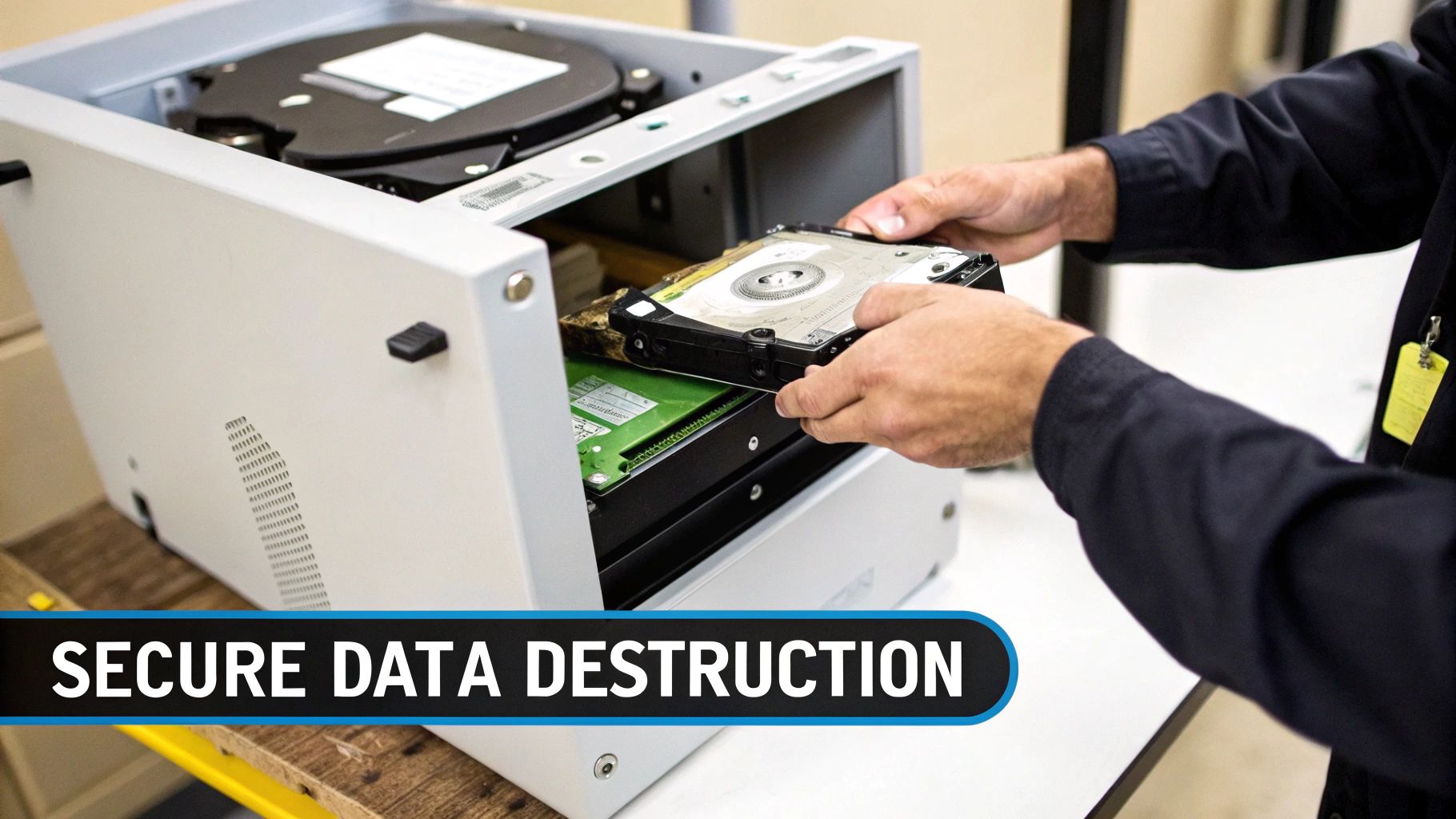
On-Site vs. Off-Site Destruction
One of your first big calls will be deciding where the data destruction happens. Each path offers a different mix of security, cost, and logistical effort.
-
On-Site Destruction: This is your maximum-security option. The destruction equipment—shredders, degaussers, wiping stations—comes directly to your facility in Denver. It completely eliminates chain-of-custody risks during transport because no data-bearing device ever leaves your secure perimeter until it's been sanitized or turned into tiny fragments. This is the go-to for organizations with the strictest compliance needs, like those in finance, healthcare, or government.
-
Off-Site Destruction: Here, your assets are securely transported from your Colorado location to a specialized ITAD facility for destruction. While it can be more cost-effective and logistically simpler, it puts a huge emphasis on your vendor's security protocols. You'll need to see proof of locked, GPS-tracked vehicles and a bulletproof chain-of-custody process.
Ultimately, the choice comes down to your organization's risk tolerance. If a data breach would be catastrophic, the extra cost for on-site services is a smart investment. The main driver here is the non-negotiable need for preventing a breach of privacy and keeping proprietary information locked down.
Software Sanitization Standards
For any assets you plan to remarket or reuse internally, software-based data wiping is the way to go. This process overwrites every sector of a drive with random characters, making the original data impossible to get back. Two main standards govern how thoroughly this is done:
- DoD 5220.22-M: This is an older, three-pass overwrite standard. It was the benchmark for years, but it’s now considered less effective for modern, high-capacity drives.
- NIST 800-88: This is the current gold standard. It’s a more modern and flexible framework that outlines three levels of sanitization—Clear, Purge, and Destroy—based on data sensitivity. The Purge method is what you’re looking for, as it’s designed to withstand advanced, laboratory-level data recovery attempts.
Sticking to a recognized standard like NIST 800-88 is non-negotiable for compliance. At Beyond Surplus, our services are built around these rigorous guidelines. You can dive deeper into the specifics in our guide on NIST 800-88 compliance.
Physical Destruction Methods
When drives are at the end of their life, have failed, or held top-secret data, physical destruction is the only way to be 100% certain the data is gone forever. This isn't about taking a hammer to a drive in the parking lot; it involves industrial-grade processes that make data physically impossible to retrieve.
Physical destruction is the final word in data security. It provides an unambiguous, verifiable endpoint for sensitive data, leaving no room for doubt or potential recovery.
The leading methods are pretty straightforward:
- Shredding: Exactly what it sounds like. Drives are fed into a massive shredder that grinds them into small, twisted metal fragments. The final particle size can even be specified to meet certain security mandates.
- Degaussing: This technique uses an extremely powerful magnetic field to instantly and permanently erase the magnetic data on traditional spinning hard drives (HDDs) and tapes. Just remember, degaussing is completely ineffective on Solid-State Drives (SSDs), since they don't store data magnetically.
Deciding between these methods often comes down to the type of media and your internal security policies. The table below breaks it down to help you choose the right approach for your assets.
Choosing Your Data Destruction Method
This table breaks down the primary data destruction methods, highlighting their effectiveness, ideal scenarios, and key security and compliance considerations.
| Method | How It Works | Best For | Key Advantage | Important Consideration |
|---|---|---|---|---|
| Software Wiping | Overwrites all data on a drive with random characters, following standards like NIST 800-88. | Functional drives intended for reuse, resale, or donation. | Allows for asset value recovery. | Verification and certification are critical to prove sanitization was successful. |
| Degaussing | Exposes magnetic media (HDDs, tapes) to a powerful magnetic field, scrambling the stored data. | End-of-life or failed HDDs and magnetic tapes. | Extremely fast and effective for supported media types. | Does not work on SSDs or other flash-based storage. |
| Shredding | Physically grinds drives and other media into small, irrecoverable metal and plastic fragments. | All media types, especially failed drives, SSDs, and high-security assets. | The ultimate "proof of destruction" that is media-agnostic. | Destroys all asset value; ensures complete data elimination. |
Making the right choice here isn't just a technical decision—it's a core part of your risk management strategy. For most decommissioning projects, you'll likely use a combination of these methods depending on the asset's condition and destination.
Making the Most of Your Old Hardware with Smart ITAD
Once every last byte is securely wiped, you're left staring at the next big challenge: a mountain of physical hardware. This is where a smart IT Asset Disposition (ITAD) plan comes in. Without one, all that gear is just a logistical headache and a potential environmental liability.
But with a well-thought-out ITAD strategy, this problem flips into a real financial opportunity. It’s all about methodically sorting, evaluating, and sending each piece of equipment to its most valuable destination. Getting this step right not only keeps you compliant but can also bring in serious cash to offset the project's bottom line.
Sorting Assets for Their Next Life
Let's be real: not all retired equipment is created equal. The first thing to do is sort your assets based on their age, condition, and what they might be worth to someone else. This initial triage decides if a piece of gear can be sold, needs to be recycled, or should be physically destroyed.
This means getting granular and looking at each component:
- High-Value Assets: Newer servers, networking gear, and storage arrays that are still in demand can be refurbished and sold on the secondary market. These are your money-makers.
- Reusable Components: Even older servers have parts with value. Things like CPUs, RAM, and NICs can often be harvested and sold individually.
- Obsolete Hardware: For equipment that has no resale value, the only responsible option is recycling. This reclaims raw materials like copper, aluminum, and even precious metals.
- Proprietary Equipment: Any custom-built or branded hardware that can’t be resold should be physically destroyed. You don't want your intellectual property walking out the door.
Turning Decommissioned Hardware into Revenue
The financial side of ITAD is where you can really see a decommissioning project’s ROI jump. By finding and remarketing the valuable equipment, you turn depreciated assets into a real revenue stream. This process, often called IT asset recovery or buyback, involves a certified partner checking out your hardware and making you a fair market offer.
Think about it this way: a rack of servers that are only a few years old might still be worth 30-40% of what you originally paid. Multiply that across an entire data center, and you're talking about a serious reduction in the net cost of the project. To see how this works in practice, you can learn more about professional IT equipment buy-back services that specialize in turning old hardware into working capital.
The trick is finding an ITAD vendor with a solid global network for reselling enterprise-grade equipment. That’s how you know you’re getting the best possible return.
The Critical Role of Certified E-Waste Recycling
For any gear that can't be resold, your focus shifts from making money to protecting the environment. Dumping electronics improperly can lead to huge fines and do lasting damage to your company's reputation. This is why partnering with a certified e-waste recycler is absolutely non-negotiable.
Choosing a certified recycler isn't just about being green; it's a critical risk management decision. It transfers liability and gives you a documented, auditable trail proving your organization followed every legal and environmental rule.
Keep an eye out for vendors holding certifications like R2 (Responsible Recycling) and e-Stewards. These standards are your guarantee that e-waste will be handled in an environmentally sound way, that workers are protected, and that hazardous materials won’t be illegally shipped overseas.
These certifications are your peace of mind, ensuring your end-of-life assets won't end up in a landfill, protecting both the planet and your business. And just as you're maximizing value from physical assets, remember to apply the same mindset to your virtual ones by integrating cloud cost optimization best practices into your broader IT strategy.
Mastering Logistics and Regulatory Hurdles
Once the data is wiped and the assets are sorted, the real heavy lifting begins. We're talking about the physical act of moving thousands of pieces of equipment out the door. This part of the project is far more than just boxing up servers; it's a high-stakes operation where one slip-up can lead to damaged assets, stolen gear, or a broken chain of custody.
Honestly, a secure logistics strategy is just as critical as the data destruction itself.
The process kicks off with the painstaking work of de-racking servers, switches, and storage arrays. It demands serious coordination to sidestep damage to sensitive components while untangling the messy web of power and network cables. After that, each asset needs to be professionally packed with anti-static materials and, for the bigger items, custom-fit crating to survive the journey.

Maintaining an Unbroken Chain of Custody
The absolute cornerstone of secure logistics is an unbroken chain of custody. Think of it as the documented, auditable paper trail that follows every single asset from the moment it leaves your data center floor to its final destination. It’s your proof that nothing was lost, stolen, or mishandled along the way.
A solid chain of custody isn't just a single document; it’s a system built on several key practices:
- Serialized Tracking: Every asset's journey is logged against its unique serial number and asset tag—the same ones you captured back in the inventory phase.
- Secure Transport: This is non-negotiable. Assets have to move in locked, GPS-tracked vehicles operated by vetted, background-checked personnel.
- Sealed Pallets and Crates: Equipment should be palletized and shrink-wrapped with tamper-evident seals. This makes it immediately obvious if someone tried to access the gear in transit.
- Documented Handoffs: Every time the assets change hands—from your team to the logistics crew, from the truck to the ITAD facility—it must be signed for and documented. No exceptions.
A gap in the chain of custody is more than a logistical error; it's a security failure. It creates an opportunity for data-bearing devices to disappear, leaving your organization exposed to significant risk.
This whole process is a fundamental part of professional ITAD. If you want to see how these complex movements are managed from start to finish, our nationwide reverse logistics services are designed specifically to maintain that critical security from pickup to final reporting.
Navigating the Regulatory Minefield
Beyond the physical move, you have to navigate a complex web of federal and state regulations covering data disposal and e-waste. Non-compliance simply isn't an option. It can lead to steep fines and do lasting damage to your company's reputation. Knowing these rules is your best defense.
A few key regulations almost always come into play during a data center decommissioning:
- The FTC Disposal Rule: This rule demands that businesses take "reasonable measures" to guard against unauthorized access to consumer information when it's being disposed of. It directly applies to any customer data that was on your servers.
- HIPAA (Health Insurance Portability and Accountability Act): If you handle protected health information (PHI), HIPAA’s privacy and security rules have strict protocols for data destruction and asset disposal. The penalties for getting this wrong are severe.
- State-Specific E-Waste Laws: Many states have their own laws dictating how electronic waste must be recycled. These rules often flat-out prohibit landfilling IT equipment and require you to use certified recyclers.
The global data center decommissioning service market is expected to hit $153.34 billion by 2032, growing at a 6.9% CAGR. This boom is largely driven by companies migrating to the cloud and having to retire legacy infrastructure—which forces them to comply with this growing list of regulations.
Documenting your compliance isn't just about collecting certificates. It’s about building a complete audit trail that proves you took every required step to protect sensitive data and handle e-waste responsibly. That documentation will protect your organization long after the last server is gone.
Final Documentation: Your Proof of Compliance
The physical work of decommissioning your data center might be finished, but you're not across the finish line until the paperwork is signed, sealed, and delivered. This final paper trail is your official, auditable record proving the entire project was secure and compliant. It’s what protects your company from future liability and is the final, critical step that closes the loop on every single asset.
Without this proof, you leave your organization exposed. Imagine trying to convince an auditor, months or even years from now, that a specific server's data was properly wiped. Verbal assurances mean nothing in that scenario. Only certified, detailed documentation provides a defensible position and connects every action you took back to your initial asset inventory.
The Power of a Certificate of Data Destruction
If there's one document you absolutely cannot skip, it's the Certificate of Data Destruction (CoD). This isn't just a receipt—it's a legally binding document that formally transfers liability for the data from your organization to your ITAD vendor. It serves as undeniable proof that your data-bearing assets were sanitized or physically destroyed according to specific, recognized standards.
When you get a CoD, comb through it to make sure it contains these critical details:
- A unique serial number for the certificate itself
- The exact date the destruction process was completed
- The specific method used (e.g., NIST 800-88 Purge, physical shredding)
- A serialized list of the destroyed assets that matches your inventory
This document is your ultimate safeguard. To get a better sense of its full weight and what to look for, you can learn more about the role of a Certificate of Destruction in your compliance strategy.
Essential Supporting Documents for Your Audit Trail
While the CoD is the star of the show, it's part of a larger collection of documents that create a complete project file. Each report has a specific job, tracking assets through every stage of disposition and verifying that you've met all regulatory requirements. Your final documentation package needs to be robust and well-organized, ready for any level of scrutiny.
Other key documents to collect include:
- Serialized Asset Disposition Reports: This report details the final outcome for every single item from your inventory, whether it was resold, recycled, or destroyed. It should clearly list the make, model, and serial number of each asset, giving you a final status update that closes out your tracking.
- Certificates of Recycling: For any non-resaleable equipment, this certificate confirms the assets were processed in an environmentally responsible manner according to standards like R2 or e-Stewards. This is your proof of environmental compliance, protecting you from illegal dumping liabilities down the road.
- Chain of Custody Forms: These logs provide a detailed, chronological record of every person who handled your assets from the moment they left your facility. Signed and dated handoffs are essential for proving an unbroken, secure chain of custody.
Your Essential Decommissioning Document Checklist
Keeping track of all the necessary paperwork can feel overwhelming, but it's crucial for creating an airtight audit trail. This table summarizes the critical documents you'll need to prove compliance and close out your project with confidence.
| Document | What It Proves | Key Information Included | Provided By |
|---|---|---|---|
| Certificate of Destruction | Data was sanitized/destroyed to specific standards. | Unique certificate ID, destruction method, asset serials. | ITAD Vendor |
| Asset Disposition Report | The final status of every single asset (resold, recycled). | Make, model, serial number, final disposition status. | ITAD Vendor |
| Certificate of Recycling | Equipment was recycled according to environmental regulations. | Compliance with standards (e.g., R2), date, facility info. | ITAD/Recycling Partner |
| Chain of Custody Forms | Secure, unbroken handling of assets from start to finish. | Signatures, dates, times, and location of each handoff. | Logistics/ITAD Vendor |
| Logistics & Transport Records | Assets were securely transported. | Bill of Lading, driver IDs, vehicle numbers, seal numbers. | Logistics Partner |
Having this full suite of documents organized and ready means you're prepared for any internal review or external audit that comes your way.
A complete documentation package is your long-term insurance policy. It demonstrates due diligence and provides a clear, irrefutable record of every decision made and every action taken throughout the decommissioning process.
The demand for these rigorous, documented processes is only getting stronger. The global data center decommissioning market is forecasted to grow at a robust compound annual growth rate (CAGR) of 9.7%, expected to reach $13.2 billion by 2033. This growth highlights just how important secure data disposal and sustainable IT management have become. You can read more about the trends shaping the data center decommissioning market. With this final documentation in hand, you can confidently close out the project, knowing your organization is secure, compliant, and completely protected.
Your Top Decommissioning Questions, Answered
Even with the best playbook, every data center decommissioning project has its own unique wrinkles. IT leaders are always wrestling with a specific set of questions that go far beyond standard project management. Here are the straight-up, honest answers to the most common queries we get from the field.
How Long Does a Data Center Decommissioning Really Take?
This is always the first question, and the only real answer is: it depends entirely on the scale and complexity of your operation. There's no one-size-fits-all timeline.
A small server room with a dozen racks? You could probably knock that out in a week. But a large enterprise or colocation facility with hundreds of racks, tangled dependencies, and legacy systems could easily stretch into a multi-month engagement, from the first planning meeting to the final asset report.
Several factors will heavily influence your timeline:
- Size and Density: The sheer volume of servers, storage arrays, and networking gear is the single biggest driver. More hardware simply means more work.
- Data Destruction Requirements: On-site data wiping and shredding is the gold standard for security, but it can add significant time compared to letting your vendor handle it off-site. You have to factor in the time for them to bring equipment to your facility.
- Logistical Hurdles: Simple things can become major time sinks. Think limited elevator access, strict building security protocols, or the need for specialized moving equipment to get heavy storage arrays out the door.
- Resource Availability: The project moves only as fast as your internal team and your partners can work. If your key people are juggling other projects, expect delays.
As a rule of thumb, I always advise clients to build in a buffer of at least 20-30% on their projected timeline. You will run into surprises, like finding a rack full of uninventoried devices or dealing with last-minute scope changes. Plan for it.
Can We Actually Get Money Back for Old Servers and Networking Gear?
Absolutely. This is probably the most overlooked opportunity in the entire process. Too many organizations just assume old hardware is worthless e-waste, but that's rarely true. Even equipment that’s a few generations old often contains components with real value on the secondary market.
You’d be surprised what you can recover value from:
- CPUs and Memory (RAM): These components hold their value remarkably well. There's always high demand for them for upgrades and repairs.
- Networking Gear: Enterprise-grade switches, routers, and firewalls from brands like Cisco or Arista are often sought after by companies with tighter IT budgets.
- Storage Arrays: Even after the hard drives are properly destroyed, the chassis, controllers, and power supplies can often be refurbished and resold.
The key is to partner with an ITAD vendor that has a strong, transparent remarketing program. They should be able to give you a fair market value assessment of your functional gear and offer a clear revenue-sharing model that helps offset your project costs.
What Certifications Should My ITAD Partner Have?
Choosing your ITAD partner is a massive risk management decision. Don't just take their word that they follow best practices—make them prove it. Their certifications are your guarantee that they adhere to the industry's highest standards for security, environmental compliance, and quality.
At a minimum, you should be looking for a vendor that holds these three key certifications:
- R2v3 (Responsible Recycling): This is the leading global standard for electronics recycling. It’s your assurance that e-waste is managed in a way that protects the environment and worker safety, with a secure, audited downstream chain of custody.
- NAID AAA: This one is non-negotiable for secure data destruction. NAID performs rigorous, unannounced audits to verify that a provider’s security protocols for handling sensitive data are airtight.
- ISO 9001, 14001, and 45001: This suite of certifications shows a deep commitment to quality management (9001), environmental management (14001), and occupational health and safety (45001).
A partner with these credentials has invested heavily in having their processes scrutinized by third parties. It gives you the peace of mind that your assets, your data, and your company's reputation are in safe hands.
Can We Watch the Data Destruction Happen?
Yes, you can, and for many organizations with strict compliance mandates or internal security policies, you should. Any reputable ITAD vendor will offer on-site data destruction services, bringing mobile shredders or data wiping stations right to your facility so your team can observe the entire process firsthand.
Witnessed destruction provides a few critical benefits:
- Eliminates Chain of Custody Risk: Your data-bearing devices never leave your secure perimeter until they are physically destroyed or forensically wiped.
- Provides Ultimate Peace of Mind: There’s zero ambiguity. You see it happen, you know the data is gone for good.
- Satisfies Strict Auditing Requirements: It offers an indisputable layer of verification for internal auditors or external regulators.
If on-site services aren't practical for some reason, ask your vendor about secure, remote viewing options at their processing facility. The ultimate goal is always transparency and verifiability.
Navigating the complexities of decommissioning a data center in Denver, Colorado requires a partner with proven expertise in security, logistics, and value recovery. At Beyond Surplus, we provide certified, audit-proof solutions to protect your data, ensure environmental compliance, and maximize the return on your retired IT assets. Contact us today to schedule a consultation and build a decommissioning plan that meets your organization's unique needs.


