When your team searches for “e waste recycling near me,” you’re not looking for a drop-off bin. You're trying to find a partner to handle a critical business function: secure and compliant IT asset disposition (ITAD). For any business in the United States, this process is about far more than just environmental responsibility—it’s a non-negotiable part of data security and risk management.
Why Businesses Need a Specialized E Waste Partner
Let's be clear: the generic recycling solutions designed for household electronics just don't cut it for the complex needs of a modern business. A commercial operation generates e-waste that contains sensitive company data, customer information, and proprietary secrets. Improper disposal isn’t just an environmental misstep; it's a direct threat to your company’s security and reputation.
The scale of the problem is staggering. Global electronic waste generation hit a record 62 million tonnes in 2022, yet only about 22.3% was properly collected and recycled. This massive gap is where unmanaged business assets can easily fall through the cracks, leading to painful compliance violations and data breaches.
The Limits of Standard Recycling
Standard recycling drop-offs or municipal programs are fundamentally unequipped to handle commercial needs. They just don't have the infrastructure or certifications for the things that matter most to a business.
Things they can't provide include:
- Guaranteed Data Destruction: They simply cannot offer certified proof that your data has been irretrievably destroyed.
- Chain of Custody: There's no documented trail to prove where your assets went or how they were processed.
- Compliance Documentation: They won’t issue the Certificates of Destruction and Recycling you need to satisfy regulations like HIPAA, FACTA, or the FTC Safeguards Rule.
For any business, relying on these services is a gamble. The risk of a data breach from a single discarded hard drive far outweighs any perceived convenience.
For a clearer picture, let's compare the two side-by-side.
Commercial vs Residential E Waste Services
This table breaks down the essential differences between a simple drop-off and a professional service designed for businesses.
| Feature | Residential Drop-Offs | Professional B2B Services |
|---|---|---|
| Data Security | No guaranteed data destruction; high risk of data exposure. | Certified data destruction (wiping, degaussing, shredding) with documented proof. |
| Compliance | No documentation provided for regulatory audits (HIPAA, FTC). | Issues Certificates of Destruction and Recycling to prove compliance. |
| Chain of Custody | None. Assets are untracked once dropped off. | Secure, documented process from pickup to final disposition. |
| Logistics | Self-service drop-off, limited to small quantities. | On-site pickup for bulk equipment, secure transport, and managed logistics. |
| Liability | Liability for data and disposal remains with the individual. | Liability is formally transferred to the vendor upon pickup. |
| Reporting & Value | No asset reporting or potential for value recovery. | Detailed asset reporting, potential for remarketing, and value recovery on viable equipment. |
As you can see, the services aren't just different in scale—they're different in purpose. One is for public convenience, the other is for corporate risk management.
What a Professional ITAD Partner Provides
A professional ITAD partner like Beyond Surplus operates on a completely different level. Instead of just collecting waste, we manage the entire end-of-life process for your IT assets. You can get a much deeper look into this comprehensive approach in our detailed guide on IT asset disposition.
This professional service is built around three core pillars: security, compliance, and value recovery. A certified partner handles bulk equipment pickups, whether it's a few dozen laptops or an entire data center's worth of servers and networking gear. We provide secure, locked transportation and process all assets within a monitored, access-controlled facility.
The crucial difference lies in liability transfer. When you work with a certified e-waste recycler, you receive documentation that legally transfers the responsibility for the equipment and its data from your company to us. This is your proof of due diligence.
Ultimately, searching for "e waste recycling near me" as a business means you’re looking for a risk management solution. You need a partner who understands the intricacies of corporate IT infrastructure, data security protocols, and the complex web of environmental and data privacy regulations. This is the only way to ensure your retired assets are handled securely and responsibly, protecting your business from potential fines, lawsuits, and brand damage.
Making Data Destruction Your Top Priority
Let's get one thing straight: when you're retiring old IT gear, it's a data security task first and a recycling task second. Simply reformatting a hard drive is not enough. That just creates a false sense of security. Data recovery software is surprisingly effective at pulling sensitive files off supposedly "wiped" devices, and that can become a massive liability for your business.
This is exactly why certified data destruction isn't some optional add-on; it's the absolute core of any responsible IT asset disposition (ITAD) strategy. Think about it—a single data breach from one carelessly discarded hard drive can snowball into millions in fines, legal fees, and a damaged reputation that's hard to fix.
This flowchart breaks down the initial decision your business will face, showing the dedicated path required for commercial assets.
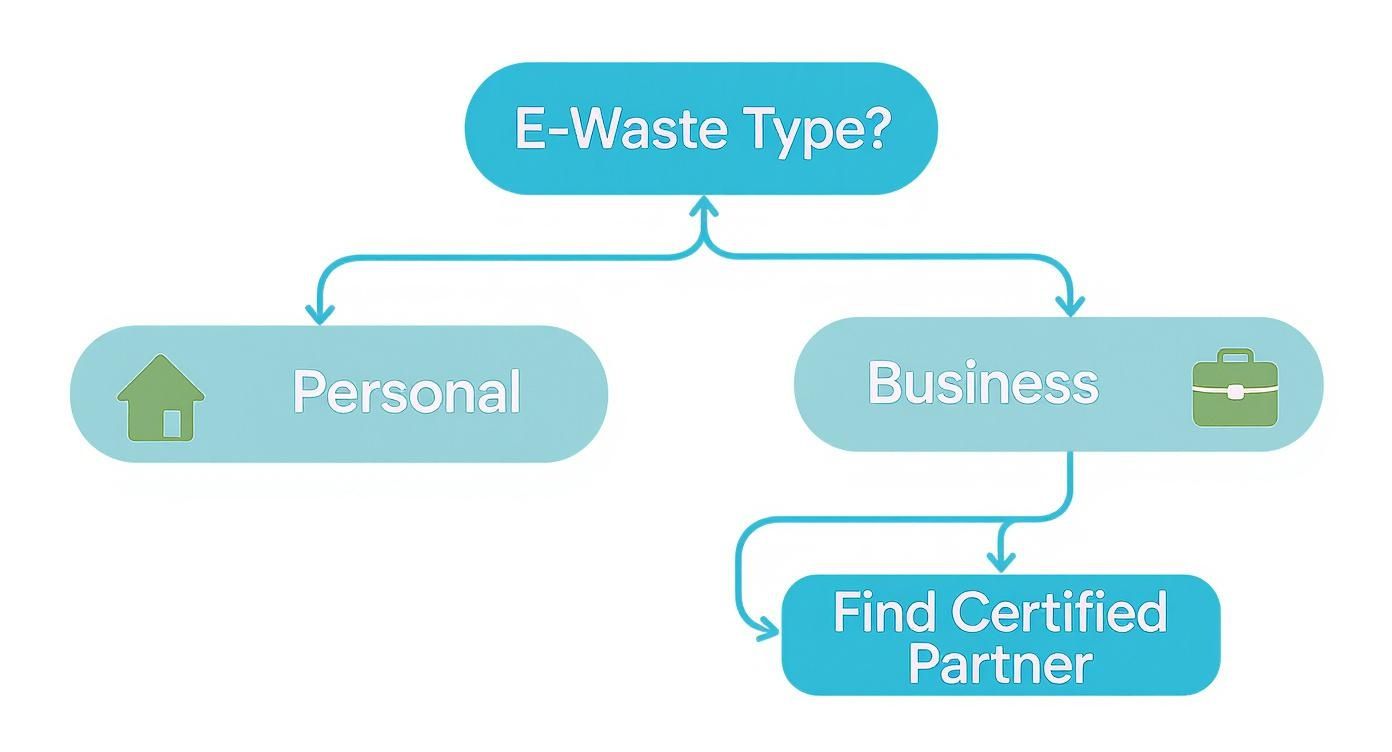
The main takeaway here is that your business electronics need a dedicated, certified process. This ensures everything is secure and compliant, a world away from a residential collection event.
Understanding Secure Destruction Methods
As you look for an "e waste recycling near me" partner, you have to confirm they use auditable, industry-standard destruction methods. To be confident your data is gone for good before any recycling happens, it helps to understand the different common data destruction and disposal methods.
A certified vendor should offer three main techniques:
- Physical Shredding: This is the gold standard for destroying data on traditional magnetic hard drives (HDDs) and other media. The device is literally pulverized into tiny metal fragments, making it physically impossible to recover anything.
- Degaussing: This technique uses a crazy-powerful magnetic field to completely scramble and erase the data on magnetic media like HDDs and tapes. It renders the drive totally unusable and the data unrecoverable.
- Cryptographic Erasure: This is a software-based method used mainly for Solid-State Drives (SSDs). It works by deleting the media encryption key, which essentially locks the data forever and throws away the key.
The right method really depends on the type of device. For instance, degaussing doesn’t work on SSDs, so for those, you’re looking at either physical destruction or cryptographic erasure as the only truly secure options.
The Role of a Certificate of Destruction
In the world of compliance, proof is everything. Once your assets have been processed, a certified ITAD partner must give you a Certificate of Data Destruction (CoD). This isn't just a receipt; it's a legal document that serves as your official record that the data on specific devices was destroyed according to industry standards.
The Certificate of Destruction is not just a piece of paper; it is your shield against liability. It formally transfers the responsibility for the data from your organization to the destruction vendor, providing a critical component of your compliance audit trail.
This piece of paper is crucial for proving you did your due diligence under a host of regulations, including:
- HIPAA: Protecting patient health information.
- FACTA: Safeguarding consumer financial data.
- FTC Safeguards Rule: Requiring financial institutions to secure customer information.
Without a CoD, your business has zero verifiable proof of secure data disposal. That leaves you wide open to huge legal and financial risks. When you’re vetting e-waste services, your first question should always be about their ability to provide this critical document. For a deeper dive, check out our ultimate guide to data destruction and why you need it.
A true ITAD partner gets it: their primary job is to protect your data. Recycling the physical materials is the last step, something that can only happen after the digital risk has been completely and verifiably eliminated. Any vendor who downplays the importance of certified data destruction is not a vendor you can trust with your company's sensitive assets.
Decoding E-Waste Certifications and Compliance
When you start searching for "e-waste recycling near me," it's tempting to think all vendors are basically the same. That’s a critical mistake. The line between a legitimate IT Asset Disposition (ITAD) partner and a run-of-the-mill scrap dealer often boils down to one thing: certifications.
These aren't just fancy badges to put on a website. They are your business's frontline defense against data breaches, steep environmental fines, and the kind of reputational damage that’s hard to shake. Choosing an uncertified vendor is like handing over your company’s most sensitive data without even asking if the door has a lock.
The Most Important E-Waste Certifications
In the world of electronics recycling, three main certifications really matter. Each one means a recycler has passed tough, independent audits that cover everything from their data security protocols to tracking exactly where your old equipment ends up.
R2v3 (Responsible Recycling): This is the leading global standard for the industry. An R2v3 certified facility is audited on its environmental, health, and safety practices. It requires a secure facility, ironclad data destruction methods, and a clear "chain of custody" to track all materials and prevent illegal exporting.
e-Stewards: Developed by the Basel Action Network, the e-Stewards standard is often seen as the most stringent. It has a zero-tolerance policy for shipping hazardous e-waste to developing nations and forbids the use of prison labor. It also demands comprehensive data security and environmental protections.
NAID AAA Certification: This one is all about data destruction. A NAID AAA certified vendor is subject to surprise audits to verify their procedures for shredding, wiping, and degaussing hard drives are completely secure and effective. It's the gold standard for proving your data was truly gone for good.
It's important to know these certifications aren't interchangeable. R2v3 and e-Stewards cover the entire recycling process, while NAID AAA offers specialized proof for the data destruction piece. A top-tier partner will ideally hold multiple certifications, showing a layered commitment to doing things the right way.
Why Certifications Are Non-Negotiable for Businesses
The legal landscape for data and environmental protection is complex and, frankly, unforgiving. Partnering with a certified recycler is the simplest way to ensure your business stays on the right side of the law, especially in the U.S., where regulations can be a patchwork from state to state.
The global numbers tell a stark story. Europe leads with a formal e-waste recycling rate of 42.8%, thanks to unified legislation. The USA, on the other hand, generates a massive 6.92 million tonnes of e-waste but recycles only about 15% of it. This gap puts the responsibility squarely on businesses to voluntarily choose certified recyclers who uphold high standards. You can see more global e-waste statistics on WasteDirect.co.uk.
A certified partner gives you the documentation you need to prove you did your due diligence. This includes official Certificates of Destruction and Recycling, which are essential for meeting your obligations under rules like HIPAA, FACTA, and the FTC Disposal Rule. You can learn more by checking out our guide on navigating electronics recycling regulations.
Think of it this way: a certification is third-party proof that a vendor does what they claim. Without it, you are simply taking their word for it—a risk no business can afford when sensitive data and legal compliance are at stake.
The consequences of getting this wrong can be severe. Imagine your company's old hard drives, full of customer data, showing up in a landfill or on an overseas market. The resulting data breach could trigger crippling fines, lawsuits, and a permanent loss of customer trust.
Likewise, if your e-waste is dumped illegally, your company could be held liable for the cleanup costs and face a public relations nightmare. These aren't just hypotheticals; they're real-world risks that certifications are designed to prevent. When you vet a potential partner, asking to see their current certification documents should be the very first thing you do.
Choosing Between Pickup and Drop-Off Services
You’ve done the hard part and found a certified partner for your e-waste. Now for the logistics: how do you get all that old equipment from your building to theirs? This might seem like a simple final step, but the choice between pickup and drop-off can have a real impact on your security, efficiency, and how you use your internal resources.
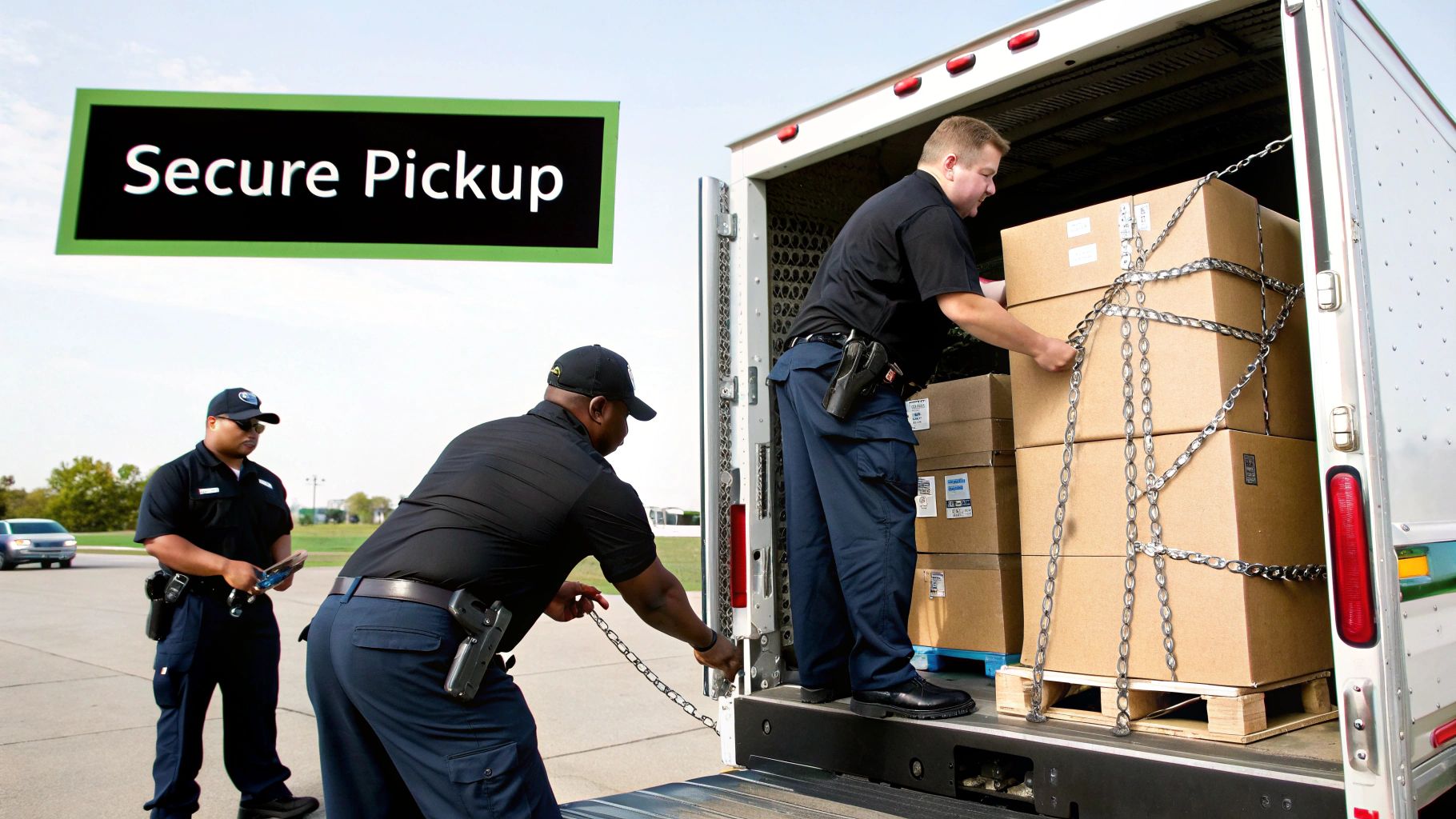
It’s not just about what’s convenient. For most businesses, the sheer volume, weight, and sensitive data on their equipment make a professional pickup the only realistic and secure path forward.
The Case for Scheduled Pickup Services
When you're dealing with a significant amount of IT gear, a scheduled pickup service is the industry standard. It's an absolute must for big projects like an office move, a company-wide tech refresh, or decommissioning an entire data center. The benefits go way beyond just avoiding the heavy lifting yourself.
A professional pickup establishes a secure and documented chain of custody the second those assets leave your sight.
A secure pickup is the first link in your compliance chain. It's where the liability for your assets and the sensitive data they contain is formally transferred to your certified ITAD vendor. This handoff should be seamless, secure, and fully documented.
Here’s why a scheduled pickup is the smart move:
- Enhanced Security: Your assets travel in locked, GPS-tracked vehicles. This drastically cuts the risk of anything getting lost or stolen en route.
- Proper Handling: Trained technicians know how to safely palletize, wrap, and load heavy or awkward equipment like server racks. This prevents workplace injuries and protects the equipment itself.
- Efficiency and Scale: A pro team can clear out a whole office worth of electronics in hours. That’s a job that could tie up your internal team for days.
- On-Site Services: For maximum peace of mind, some vendors can perform services like hard drive shredding or asset scanning right at your location, before anything is loaded onto the truck.
Ultimately, a pickup service is built for businesses that need to manage risk and keep their operations running smoothly. It lets your IT and facilities teams focus on their real jobs instead of getting sidetracked by a massive logistics project they aren’t equipped for.
When Is Drop-Off a Viable Option
While it’s less common for businesses, dropping off your e-waste can work in a few specific situations. This option is really designed for a small business with just a handful of items—think a few old desktops, monitors, and maybe a printer.
Consider dropping off your equipment if you can say yes to all of these:
- Low Volume: You have fewer than a dozen or so small-to-medium-sized items.
- No Sensitive Data: The equipment is clean of any sensitive or regulated data, or you have a rock-solid, verifiable process for wiping it internally.
- Available Resources: You have the staff and the right vehicle to haul the items safely without pulling people away from their core responsibilities.
For most companies, the time, labor, and security risks of transporting equipment themselves just don't add up. You still have to get a quote and arrange the logistics, and many find that once they calculate the internal costs, a professional pickup is actually more cost-effective. You can start the process for either service and get a clear idea of what works for you when you schedule a pickup or register for drop-off with a certified provider.
Whether you choose pickup or drop-off, a little prep work can make everything go smoother. Try to consolidate all the assets in one accessible spot, like a loading dock or a ground-floor storage room. It’s also a great practice to create a basic inventory list of what’s being removed for your own records. A little planning up front ensures a fast, efficient, and secure handoff.
What Business Equipment You Can Actually Recycle
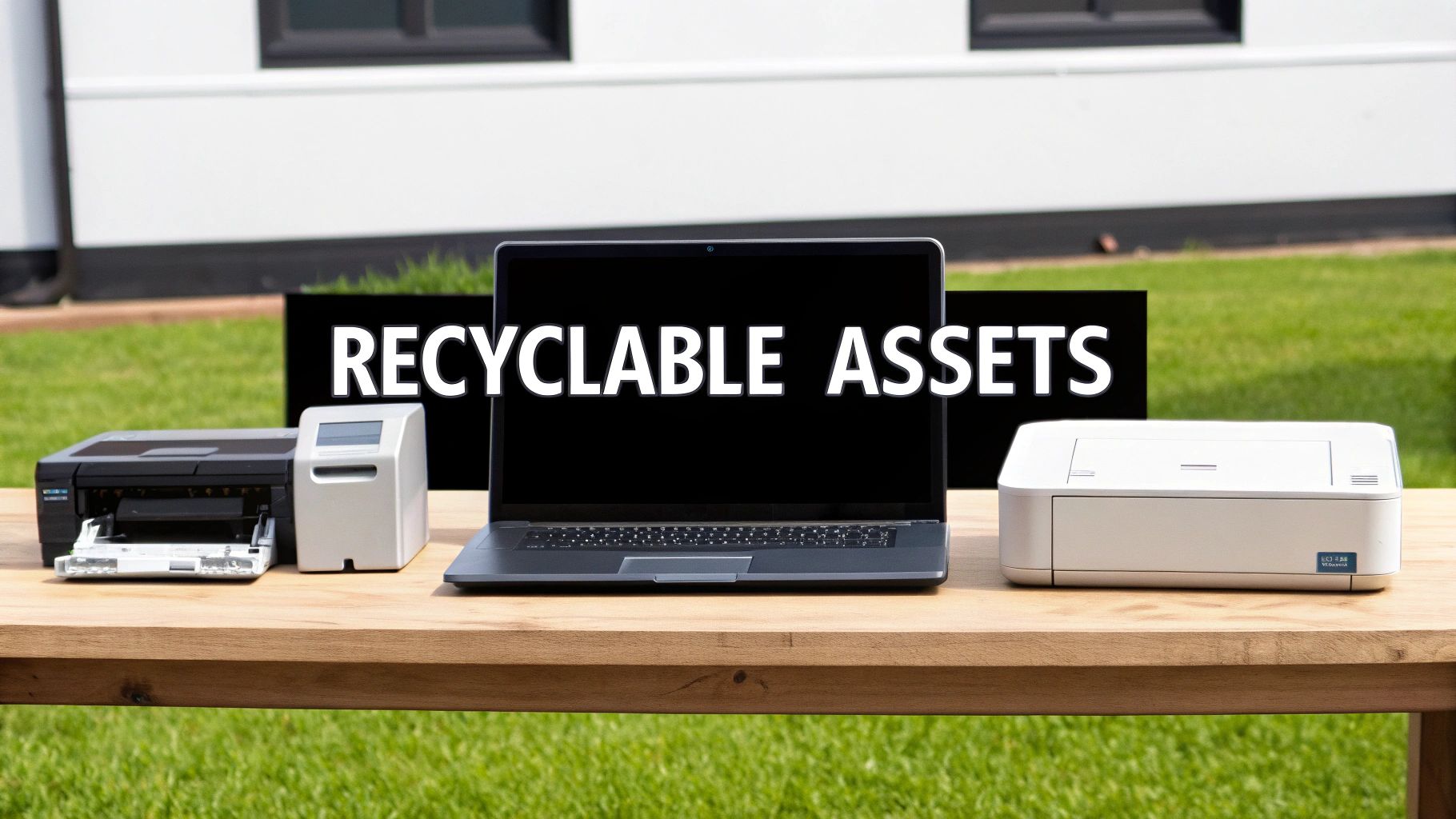
When you’re looking for "e-waste recycling near me," it’s important to remember that a business runs on far more than just laptops and monitors. You need a partner who can handle your entire inventory of electronic assets, not just the obvious stuff. A true IT Asset Disposition (ITAD) partner acts as a single point of contact for everything from the server room to the supply closet, simplifying the entire process.
This approach saves you from the headache of juggling multiple vendors for different types of equipment. More importantly, it ensures a consistent, secure chain of custody and data destruction process across all your retired assets. The goal is to make disposal predictable, secure, and straightforward.
Core IT Infrastructure and Office Electronics
Let's start with the backbone of your operations. An experienced e-waste recycler is set up to handle the full spectrum of IT and office hardware. This category is often the most critical because of the sheer volume of sensitive data these devices hold.
We see this every day. Businesses come to us with:
- Data Center Hardware: Think servers, storage area networks (SANs), blade enclosures, and networking gear like switches, routers, and firewalls.
- Computers and Peripherals: This is your bread and butter—desktops, laptops, monitors (both the old CRT style and flat panels), keyboards, mice, docking stations, and webcams.
- Office Equipment: Beyond computers, we regularly process printers, scanners, copiers, fax machines, and VoIP phone systems.
- Mobile Devices: Company-issued smartphones and tablets all require certified data destruction before their materials can be reclaimed.
The key here isn’t just what is accepted, but how it's processed. For any device that can store data, the recycler’s data destruction methods are what matter most.
Specialized and Industrial Equipment
Many businesses depend on highly specialized equipment that doesn't fit the typical "office tech" mold. A versatile ITAD partner should have the experience to manage these unique assets, making sure they are disposed of in line with both environmental and industry-specific regulations.
This category often includes some interesting and complex items:
- Medical and Healthcare Equipment: Diagnostic machines, patient monitors, and lab analyzers are common. These often contain sensitive patient data and require careful handling.
- Laboratory and Scientific Instruments: We’ve processed everything from spectrometers to electronic testing devices, all of which must be handled securely.
- Telecommunications Gear: Cell site equipment, broadcasting hardware, and other communication infrastructure are also fully recyclable.
The ability to handle specialized assets is a huge differentiator. It shows a recycler knows how to manage complex logistics and compliance requirements that go far beyond standard IT hardware, offering a genuinely complete solution.
To give you a better idea of what a comprehensive ITAD service can handle, here's a quick look at the typical equipment we process for our business clients.
Common Business Equipment for Recycling
| Equipment Category | Examples of Accepted Items | Key Recycling Consideration |
|---|---|---|
| Standard IT & Office | Laptops, desktops, servers, monitors, printers, keyboards, mice, networking gear (routers, switches) | High volume of sensitive data requires certified data destruction. |
| Data Center | Servers (rack, blade), storage arrays (SAN, NAS), tape libraries, UPS battery backups | Heavy equipment may require specialized logistics and on-site services. |
| Telecommunications | VoIP phones, PBX systems, cell site equipment, broadcasting hardware | Must be processed in compliance with industry-specific regulations. |
| Medical & Lab | Patient monitors, diagnostic machines, lab analyzers, scientific instruments | Potential for Protected Health Information (PHI) necessitates strict data security protocols. |
| Mobile Devices | Smartphones, tablets, ruggedized field devices | Certified data wiping is essential before physical recycling or refurbishment. |
This table covers the most common items, but a good ITAD partner can often create custom solutions for unique or oversized equipment. The key is to ask.
Items That Need Special Handling (Or Aren't Accepted)
While a certified recycler can take most electronics, some items fall outside the usual e-waste stream or need a different disposal process. Knowing these exceptions helps your asset management team plan ahead and avoid surprises.
For instance, large appliances like refrigerators or air conditioners contain refrigerants that must be removed by a certified technician before the metal can be recycled. Likewise, anything contaminated with biological or chemical hazards can't be processed in a standard electronics recycling facility. For a full breakdown, you can always check a detailed list of items accepted for recycling and disposal to confirm what a provider handles.
It's also worth thinking beyond just recycling. Instead of tossing extra office supplies, you can explore options like selling unused toner cartridges. This not only keeps them out of a landfill but can also recover some value for your business—a smart, sustainable practice that perfectly complements your ITAD strategy.
Common Questions About Commercial E-Waste Recycling
When you're responsible for your company's IT assets, navigating the disposal process can bring up a lot of practical questions. As an IT manager or business owner, you need clear, direct answers to make sure everything is handled smoothly and by the book. Here are some of the most common inquiries we get from businesses looking for "e waste recycling near me."
Are There Fees for Business E-Waste Recycling Services?
Yes, professional ITAD (IT Asset Disposition) services almost always involve fees. While some very new, high-value IT equipment might have enough resale potential to offset or even cover the costs, the reality is that most recycling projects have a service fee.
You're paying for a lot more than just making your old equipment disappear. These costs cover critical, specialized services:
- Secure Logistics: This isn't just a guy in a truck. It's insured transportation in locked vehicles, professional labor to handle and load heavy or bulky equipment, and the fuel and time for on-site pickups.
- Certified Data Destruction: This is non-negotiable. You're paying for the guaranteed, documented, and legally defensible destruction of all data on your devices.
- Compliant Processing: The fees also cover the complex labor and machinery required to safely dismantle equipment, responsibly separate materials, and ensure every component is handled according to strict environmental regulations.
Always ask for a detailed, itemized quote before you commit. A reputable partner will have no problem clearly explaining their pricing structure, ensuring you know exactly what you're paying for and avoiding any surprise charges down the line.
What Paperwork Should I Get from My Recycler?
Documentation is the absolute cornerstone of a compliant IT disposal program. It's your official record of due diligence and the legal instrument that transfers liability from your organization to the vendor. Without it, you have zero proof that your assets were handled correctly.
The paperwork you receive isn't just for your files—it's your legal shield. A Certificate of Data Destruction and a Certificate of Recycling are your primary evidence that you've met your obligations under rules like the FTC Disposal Rule, HIPAA, or FACTA.
When the project is done, you should expect to receive a complete documentation package. This includes:
- Certificate of Data Destruction: This document legally certifies that all data on your specified assets has been destroyed using industry-standard methods. It should list the serial numbers of the sanitized devices for a clear audit trail.
- Certificate of Recycling: This confirms that all non-reusable materials were processed in an environmentally responsible manner, in line with all local, state, and federal regulations.
- Serialized Asset Report: For the most detailed tracking, a full report listing every single asset processed by its serial number provides a complete chain-of-custody record for your internal asset management and accounting teams.
How Should We Prepare Our IT Assets for Pickup?
A little preparation on your end can make the pickup process go much faster and more efficiently for everyone. While you are not expected to wipe the drives yourself—that's the critical service your certified partner performs—a few simple steps can make a huge difference.
First, try to consolidate all the equipment into one single, secure, and easily accessible spot. A ground-floor storage room, warehouse space, or an area near a loading dock is perfect. This prevents the recycling technicians from having to disrupt your daily operations by weaving through offices to collect items.
Next, it's a good idea to create a basic internal list of the equipment you're handing over. It doesn’t need to be hyper-detailed, but it's helpful for your own records and makes it easier to cross-reference with the vendor's final report.
Finally, just communicate. Let your partner know about any logistical details in advance. Do you have a loading dock? Is there a freight elevator they need to use? Are there specific security protocols for getting into your building? A quick heads-up prevents delays on pickup day.
What Does It Mean If a Recycler Is R2 Certified?
Seeing that a recycler is R2 Certified (the current standard is R2v3) is a huge green flag. It tells you that you’re dealing with a top-tier, professional organization that takes security and compliance seriously.
R2 is a voluntary, market-based standard, but it's incredibly rigorous. To get certified, a company must pass intensive third-party audits to prove they meet the highest industry benchmarks for data security, environmental protection, and worker safety.
An R2 Certified recycler has proven they:
- Maintain a secure, access-controlled facility to protect your assets from theft.
- Follow a strict and verifiable data destruction process.
- Track all hazardous materials through their downstream partners, guaranteeing nothing is illegally exported or dumped in a landfill.
- Protect the health and safety of their employees.
Choosing a non-certified recycler gives you none of these assurances. You're opening your business up to massive risks, from data breaches and environmental fines to serious damage to your brand's reputation. Certification is your peace of mind.
Contact Beyond Surplus for certified electronics recycling and secure IT asset disposal. We provide the documentation, security, and expertise you need to manage your end-of-life IT assets with total confidence. Contact us today to schedule your pickup and ensure your company remains compliant and protected.