

For businesses in Atlanta, GA, knowing how to dispose of old computers safely and legally starts with a documented, strategic plan. This process isn't an afterthought—it begins long before a single cable is unplugged. The initial phase is dedicated to creating a detailed asset inventory to establish a clear chain of custody, properly decommissioning devices from your network to eliminate security vulnerabilities, and engaging a certified IT Asset Disposition (ITAD) partner.
Executing these first steps correctly is critical for preventing data breaches and ensuring compliance with state and federal regulations for your Atlanta enterprise.
Your First Steps for Safe Computer Disposal in Atlanta
Disposing of outdated IT equipment is far more than a simple cleanup project for any Atlanta business. It’s a critical business function laden with security, legal, and environmental risks. For any organization, the process of how to dispose of old computers safely must begin with a structured, methodical approach.
Simply unplugging machines and storing them in a closet is a recipe for disaster, creating significant security vulnerabilities. A successful disposal project is built on two key pillars: a comprehensive inventory and a secure network decommissioning process. These are not merely administrative tasks; they are your primary defense against data exposure and costly regulatory fines. They establish the foundation for a secure and compliant process, ensuring every device is accounted for and neutralized before it leaves your facility.
Here is a foundational checklist to initiate your internal process. Consider this the minimum requirement before any equipment is physically moved.
Initial IT Asset Disposal Checklist for Businesses
| Action Item | Primary Objective | Why It's Essential for Atlanta Businesses |
|---|---|---|
| Create an Asset Inventory | Establish a clear chain of custody. | Provides an auditable trail, confirms every device is accounted for, and is required by certified ITAD vendors like Beyond Surplus. |
| Securely Decommission | Eliminate network vulnerabilities. | Prevents "ghost" devices from remaining on the network, which could be exploited if compromised, posing a threat to your business. |
| Verify Data-Bearing Status | Identify all devices with storage media. | Ensures no device containing sensitive corporate or customer data is overlooked during the data destruction phase. |
| Revoke Access & Licenses | Terminate all digital connections. | Closes security backdoors and assists with software license compliance and potential cost recovery. |
This table summarizes the foundational steps. Without these, you are operating without a clear plan and exposing your organization to unnecessary risk.
Creating a Detailed IT Asset Inventory
The first hands-on step is to create a meticulous inventory of every single asset designated for disposal. This is not a quick headcount; it must be a detailed log that serves as the foundation for your entire chain of custody, tracking each device from its current location to its final destruction.
Your inventory list must include:
- Asset Tag Number: Your company's internal ID.
- Serial Number: The manufacturer's unique identifier.
- Device Type: Be specific—desktop, laptop, server, switch, etc.
- Make and Model: For instance, "Dell Latitude 7420" or "HPE ProLiant DL380."
- Physical Location: Note the office, server room, or specific desk where it is currently located.
- Data-Bearing Status: A simple "Yes" or "No" to indicate if it contains a hard drive or other storage media.
This detailed record is non-negotiable. It provides a clear, auditable trail and is the first document a certified ITAD partner like Beyond Surplus will require to schedule a pickup in Atlanta. Without it, you cannot prove what was disposed of, when, or by whom. For more details, review our guide on how to get rid of old computers for business.
Decommissioning Devices from Your Network
Once an asset is inventoried, it must be formally decommissioned from your live network environment. This is a crucial security step that ensures no digital backdoors or access points remain open after a device is physically removed. Neglecting this is equivalent to leaving a secure facility's door wide open after vacating.
A common error we observe is businesses merely unplugging servers or workstations without revoking their credentials and network access. This leaves a "ghost in the machine"—an orphaned digital identity that can be exploited if the device is compromised before data destruction.
Secure decommissioning involves several deliberate actions:
- Revoke All User and System Access: Remove the device from Active Directory and any other identity and access management systems.
- Disable Network Ports: Shut down the corresponding switch ports to prevent unauthorized reconnection.
- Remove from Management Software: Delete the asset from your remote monitoring (RMM) or mobile device management (MDM) platforms.
- Terminate Software Licenses: Unregister any software licenses tied to the specific hardware to maintain compliance and potentially recover costs.
As businesses plan their disposal strategy, a frequent question is whether you can electrical items go in a skip. For any commercial entity, the answer is a definitive no. Business computers contain hazardous materials and, more importantly, sensitive corporate data, which mandates a professional, secure disposal process.
Ensuring Complete Data Destruction
Once you’ve inventoried and disconnected your old IT equipment, the most critical step follows: ensuring every byte of sensitive data is permanently destroyed. This means more than just using the "delete" function or reformatting a drive. For a business, such actions are grossly inadequate, as they only hide data, they don't destroy it. Data recovery software can easily restore it.
This is not a minor technical detail—it's a significant security risk. Consider the data on retired machines: customer lists, financial records, employee PII, and proprietary trade secrets. To a malicious actor, this is a treasure trove. If you fail to properly sanitize these devices before they leave your control, you are effectively inviting a data breach, which can lead to regulatory fines, reputational damage, and severe financial consequences. Properly handling this step is also a key component of how you prevent identity theft online on a corporate scale.
Software Data Wiping for Asset Reuse
The first professional method for data destruction is software-based data wiping. This is not a standard reformat. We utilize specialized software to systematically overwrite every sector of the hard drive with random data—typically a series of zeros and ones—in multiple passes. The process doesn’t just erase the data; it completely obliterates it, rendering the original information forensically unrecoverable.
The industry gold standard for this procedure is the NIST 800-88 "Guidelines for Media Sanitization." Any reputable data destruction service must adhere to this standard. For businesses looking to resell or redeploy newer equipment, NIST-compliant wiping is the required method. It guarantees the drive is forensically clean while preserving the hardware's functionality and value.
This decision tree illustrates the initial steps your business must take before considering data destruction methods.
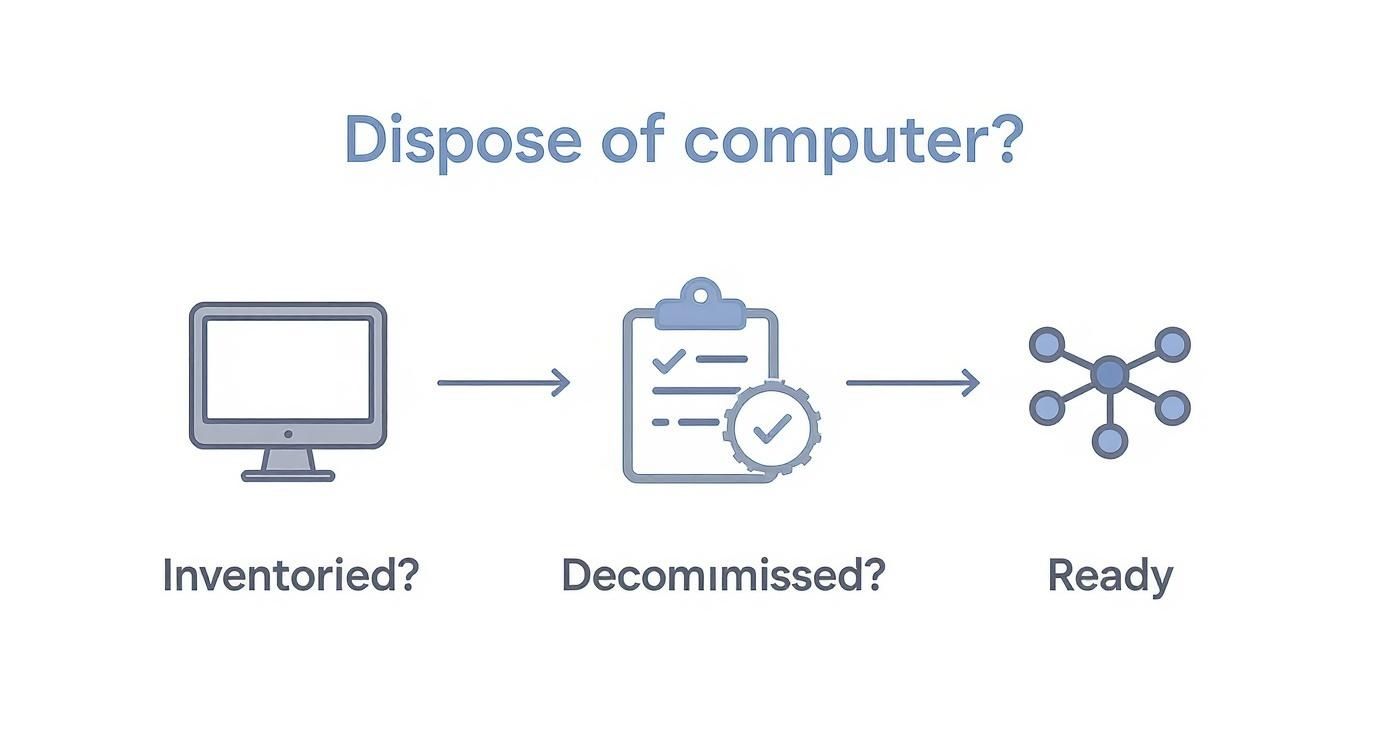
As shown, a solid inventory and decommissioning plan must be established first. It is the foundation of a secure disposal process.
Degaussing for Magnetic Media
For legacy technology like magnetic tape backups or traditional hard disk drives (HDDs), degaussing is another highly effective data destruction option. A degausser is a machine that subjects the drive to a powerful magnetic field, which instantly and permanently scrambles the magnetic coating on the drive's platters where data is stored.
The data is rendered unreadable in seconds. However, degaussing also destroys the drive's firmware, rendering it permanently inoperable. As it relies on magnetism, it is completely ineffective on modern solid-state drives (SSDs), which store data electronically without magnetic media.
We often use degaussing for clients with large quantities of old backup tapes or obsolete HDDs that have no resale value. It's a rapid and highly secure method for data destruction before the hardware is sent for materials recycling.
Physical Shredding for Ultimate Security
When data sensitivity is paramount or regulatory compliance demands absolute certainty, nothing surpasses physical shredding. This is the terminal stage of data destruction, from which there is no recovery.
We employ industrial-grade shredders with hardened steel teeth that tear through hard drives, SSDs, smartphones, and servers, grinding them into small, confetti-like fragments. For certain industries, this is not just a best practice; it is a legal requirement.
- Healthcare (HIPAA): Protecting patient health information (PHI) is non-negotiable, and physical destruction is often the mandated standard.
- Finance (GLBA): Banks and financial institutions must ensure customer financial data is completely unrecoverable.
- Government & Defense: For any device that has stored classified or sensitive state information, physical destruction is the only acceptable option.
Your business can choose between on-site and off-site shredding, depending on your security protocols. On-site shredding, where a specialized shredding truck comes directly to your Atlanta facility, allows you to witness the destruction process in real-time, providing maximum peace of mind and an unbroken chain of custody.
The choice between wiping, degaussing, or shredding depends on the asset's potential for reuse, the data's sensitivity, and your industry's specific regulatory requirements.
How to Choose a Certified Disposal Partner in Atlanta
Selecting an IT Asset Disposition (ITAD) partner is the most critical decision in the entire disposal process. Entrusting your company's retired technology to an uncertified vendor is a significant and unnecessary risk, akin to gambling with your corporate data and brand reputation. A certified partner, in contrast, provides a verified safeguard against data breaches, environmental fines, and negative publicity.
This decision is not about finding the lowest price; it is about comprehensive risk management. A professional ITAD firm delivers an auditable, secure, and compliant service that protects your organization long after the equipment has left your premises. By choosing the right partner in Atlanta, you can dispose of old computers with confidence, knowing every legal and ethical requirement has been met.

Decoding Key E-Waste Certifications
When vetting potential partners, certifications are non-negotiable. They are third-party proof that a vendor adheres to the highest industry standards for data security and environmental responsibility. In the United States, two certifications are paramount.
-
R2v3 (Responsible Recycling): This is the leading global standard for the electronics recycling industry. It provides a comprehensive framework covering environmental protection, worker health and safety, data security, and the entire downstream recycling chain. An R2v3 certified facility has proven its processes are safe, secure, and transparent.
-
e-Stewards: Developed by the Basel Action Network, the e-Stewards standard is intensely focused on preventing the illegal export of hazardous e-waste to developing nations. It is known for having some of the most stringent and globally responsible requirements.
A vendor holding one or both of these certifications has undergone exhaustive third-party audits. It confirms they have implemented and maintain robust systems for secure and sustainable electronics disposal.
What to Look for Beyond a Certificate
While certifications are the entry ticket, they are just the starting point. A truly reliable partner demonstrates their competence through their operational processes and the quality of their documentation.
You must ask direct questions and demand clear, verifiable answers. Vague responses regarding their methods or downstream partners are a major red flag.
Here’s what you should require:
- A Detailed Chain-of-Custody Process: How do they track your assets from your loading dock to their final disposition? They must provide serialized reporting for every item.
- Proof of Data Destruction: Request a sample Certificate of Data Destruction. This legal document should detail the serial numbers of the destroyed drives and specify the method used, such as wiping to NIST 800-88 standards or physical shredding.
- Downstream Vendor Transparency: Where does the shredded material go? A certified vendor is required to vet, audit, and be accountable for their downstream recycling partners.
- Secure Logistics: Do they use their own trucks and background-checked drivers? Are the vehicles locked and GPS-tracked?
The illegal dumping and trafficking of e-waste is a massive global issue. A certified partner is your guarantee that your company's assets will not contribute to this problem.
Spotting Red Flags in Potential Vendors
Recognizing warning signs is as crucial as identifying positive attributes. Be extremely cautious of any vendor who:
- Cannot Produce Current Certifications: If they cannot immediately provide a valid R2 or e-Stewards certificate, disengage.
- Offers Vague or Incomplete Reporting: A lack of detailed, serialized reporting indicates a lack of an auditable trail, leaving your business exposed.
- Has a Poorly Secured Facility: If a site visit reveals a disorganized facility with inadequate access controls, assume your sensitive equipment will be handled with the same lack of care.
- Charges Unusually Low Fees (or Offers "Free" Services): Proper recycling and secure data destruction have associated costs. An unusually low price often indicates that profits are being made through improper or illegal means, such as exporting hazardous waste.
Your due diligence is critical. For a deeper analysis, review our guide on the complete criteria for selecting a recycling center to ensure you find a partner that meets your security and compliance needs.
Mastering the Chain of Custody Process
A secure disposal strategy extends beyond your facility's exit doors. You must account for the entire journey, from your server room to the final recycling facility. This end-to-end oversight is managed through a rigorous chain of custody.
This is the legal and logistical documentation trail that records every touchpoint, transfer, and action performed on your retired IT assets.
Without a robust chain of custody, you have a critical blind spot. Once assets leave your building, you have no way to prove they were not lost, stolen, or improperly handled. A documented chain of custody is your primary defense in an audit and your proof of due diligence.
What Is Chain of Custody Documentation?
Chain of custody is a collection of records that creates an unbroken, auditable history for each asset. It is the formal process that transfers liability from your organization to your certified ITAD partner.
At a minimum, this documentation must include:
- Serialized Asset List: A master inventory that matches the one you created, detailing every device by make, model, and serial number.
- Secure Transfer Logs: Signed and dated records from both your team and the vendor's, confirming the pickup and receipt of assets.
- Transportation Details: Information about the secure vehicle used, including seal numbers for locked trucks if applicable.
- Final Disposition Report: A comprehensive summary confirming the final outcome for each asset—whether recycled, remarketed, or destroyed.
This entire process ensures accountability at every stage, transforming a vague promise of security into a legally defensible record.
The final documentation provided by your vendor is a critical component. It serves as legal proof that your organization fulfilled all its data security and environmental obligations.
Securing Assets During Transit
The physical journey from your Atlanta facility to the disposal site is one of the most vulnerable points in the process. A professional ITAD partner mitigates this risk with strict logistics protocols designed to prevent theft or loss.
For high-security projects, these measures often include:
- Sealed and Tamper-Proof Pallets: Assets are securely shrink-wrapped and sealed onto pallets before being loaded.
- GPS-Tracked Transport: Vehicles are tracked in real-time from departure to arrival, providing a constant location log.
- Background-Checked Personnel: Only vetted, uniformed employees should ever handle your equipment.
- Locked and Secured Vehicles: All trucks must be fully enclosed and locked, with some scenarios requiring security seals on the doors.
These measures ensure that what leaves your loading dock is exactly what arrives at the processing facility.
This meticulous tracking culminates in a Certificate of Destruction. This is the ultimate legal document that finalizes the chain of custody for any data-bearing devices that were physically destroyed. You can learn more about this critical document in our detailed explanation of the Certificate of Destruction. It officially closes the loop on your data liability for those assets.
Finding Value in Your Retired IT Assets
While data security and environmental compliance are the top priorities, many retired IT assets still hold residual value. Overlooking this is a missed financial opportunity.
A strategic approach called IT Asset Value Recovery (ITAVR) focuses on identifying, assessing, and remarketing used equipment to recover a portion of its original cost. A skilled ITAD partner can transform a costly disposal project into a revenue stream or a significant cost offset.
Assessing Equipment for Remarketing
Not all hardware is destined for recycling. A professional ITAD partner will conduct a thorough assessment of your inventory to separate equipment with resale potential from that which is truly end-of-life.
Key factors determining resale value include:
- Age and Generation: Equipment less than three to four years old, such as recent-generation servers, laptops, and networking gear, often has a strong secondary market.
- Cosmetic Condition: Devices that are physically clean and undamaged are more appealing to buyers.
- Technical Specifications: Higher-end CPUs, ample RAM, and large solid-state drives (SSDs) significantly boost an asset’s value.
- Brand and Model: Certain enterprise-grade brands and models are known for reliability and hold their value better.
- Completeness: Including original accessories, like power adapters, makes a notable difference.
This triage allows a vendor to create a clear plan: high-value items are slated for secure data wiping and refurbishment, while older or non-functional equipment is routed for responsible recycling.
The Financial Logic of Resale vs. Recycling
The decision between reselling and recycling is a financial calculation. For newer equipment, the return from selling a batch of three-year-old enterprise laptops will almost always exceed the cost of securely processing them.
Conversely, for a pallet of seven-year-old desktops, the labor cost to test, wipe, and prepare them for sale would likely negate any potential return. In this case, recycling is the most financially sound move. The "value" is in avoiding the cost of storing obsolete hardware.
A professional ITAD partner provides the expertise to make this determination accurately. They have real-time market data and established sales channels to maximize returns on valuable assets while ensuring lower-value items are processed efficiently.
Turning Liabilities into a Revenue Stream
The global electronic waste recycling market, valued at $24.7 billion in 2024 in the United States alone, is projected to reach $45 billion by 2032. These figures underscore the immense value locked within retired electronics—a value your business can access. You can explore detailed industry analysis on backthruthefuture.com to learn more about this expanding market.
By working with a vendor that offers robust IT equipment buy-back services, you can directly benefit. Beyond Surplus can assess your retired assets and provide a fair market value offer, converting your end-of-life hardware into a positive entry on your balance sheet. This process ensures your data is securely destroyed while maximizing the financial return on your initial technology investment.
Why Your Brand is On the Line with E-Waste Disposal
How your company gets rid of old computers is a public statement about your corporate values. It speaks volumes about your commitment to Corporate Social Responsibility (CSR) and directly shapes how customers, partners, and employees perceive your brand.
Improper disposal carries a dual risk: a potential data breach and a severe environmental impact. Electronics are laden with hazardous materials like lead, mercury, and cadmium. If these devices end up in a landfill, these toxins can contaminate soil and groundwater, causing long-term ecological damage. A single incident of illegal dumping traced back to your company can ignite a PR crisis.
Meeting the Expectations of Modern Stakeholders
Stakeholders, from investors to customers, now expect businesses to demonstrate a tangible commitment to environmental stewardship. A documented, certified electronics recycling program is not optional—it is proof of responsible corporate citizenship.
Working with a certified partner ensures that hazardous materials are managed safely. This builds trust and solidifies your brand's reputation as a responsible, forward-thinking organization. It signals that you are considering your broader impact beyond quarterly profits.
A robust CSR policy that includes certified e-waste recycling is a competitive advantage. It helps attract top talent, builds customer loyalty, and can improve your standing with environmentally-focused investors.
Fueling the Circular Economy
Proper disposal is a cornerstone of the circular economy. Your old computers are not waste; they are a rich source of valuable materials waiting to be recovered.
Certified recycling focuses on extracting these resources, such as:
- Gold and Silver: Used in circuit boards and connectors.
- Copper: Found in wiring and heat sinks.
- Aluminum: Used for device casings and frames.
- Plastics: Which can be reprocessed for new products.
Reintroducing these materials into the manufacturing supply chain reduces our reliance on destructive and energy-intensive mining operations. It is an environmentally and economically sound strategy that helps build a more sustainable global supply chain.
The Global E-Waste Tsunami
The urgency of this issue cannot be overstated. The world generated a staggering 62 million metric tons of electronic waste in 2022—an 82% increase from 2010. This figure is projected to reach 82 million metric tons by 2030.
Despite this, global recycling efforts are critically insufficient. Only 22.3% of the e-waste generated in 2022 was properly collected and recycled. This means an estimated $62 billion worth of recoverable natural resources were lost. You can discover more insights about the rising e-waste crisis on ewastemonitor.info.
By choosing a certified ITAD provider, your business becomes part of the solution to this global challenge, positioning your brand as a leader in corporate sustainability.
Your company's retired IT assets present significant responsibilities, but with the right partner, they also offer opportunities. Beyond Surplus provides certified electronics recycling and secure IT asset disposal services for businesses in Atlanta and across the state of Georgia, designed to protect your data, enhance your brand's reputation, and ensure full environmental compliance. Contact Beyond Surplus today to schedule a secure, responsible, and fully documented pickup for your business.


