

Your retired equipment usually starts as a storage problem. A few decommissioned laptops sit on a shelf. Then a switch stack gets pulled during a network refresh. Then old servers from a virtualization project end up in a locked room nobody wants to touch because they still contain drives, labels, and unknown data.
For an IT Director in Alpharetta, that pile is not scrap. It's a security exposure, a compliance issue, and in some cases a source of recoverable value. Good IT asset disposition treats retired hardware the same way you'd treat any other controlled business asset. You inventory it, secure it, document every handoff, and decide whether it should be redeployed, resold, dismantled, or destroyed.
Navigating IT Asset Disposition in Alpharetta
Alpharetta companies tend to have the same pressure points. Faster refresh cycles. Mixed inventories from mergers, office moves, or cloud transitions. Internal audit teams asking for proof, not verbal assurances. Legal and finance teams wanting to know who holds liability once assets leave the building.
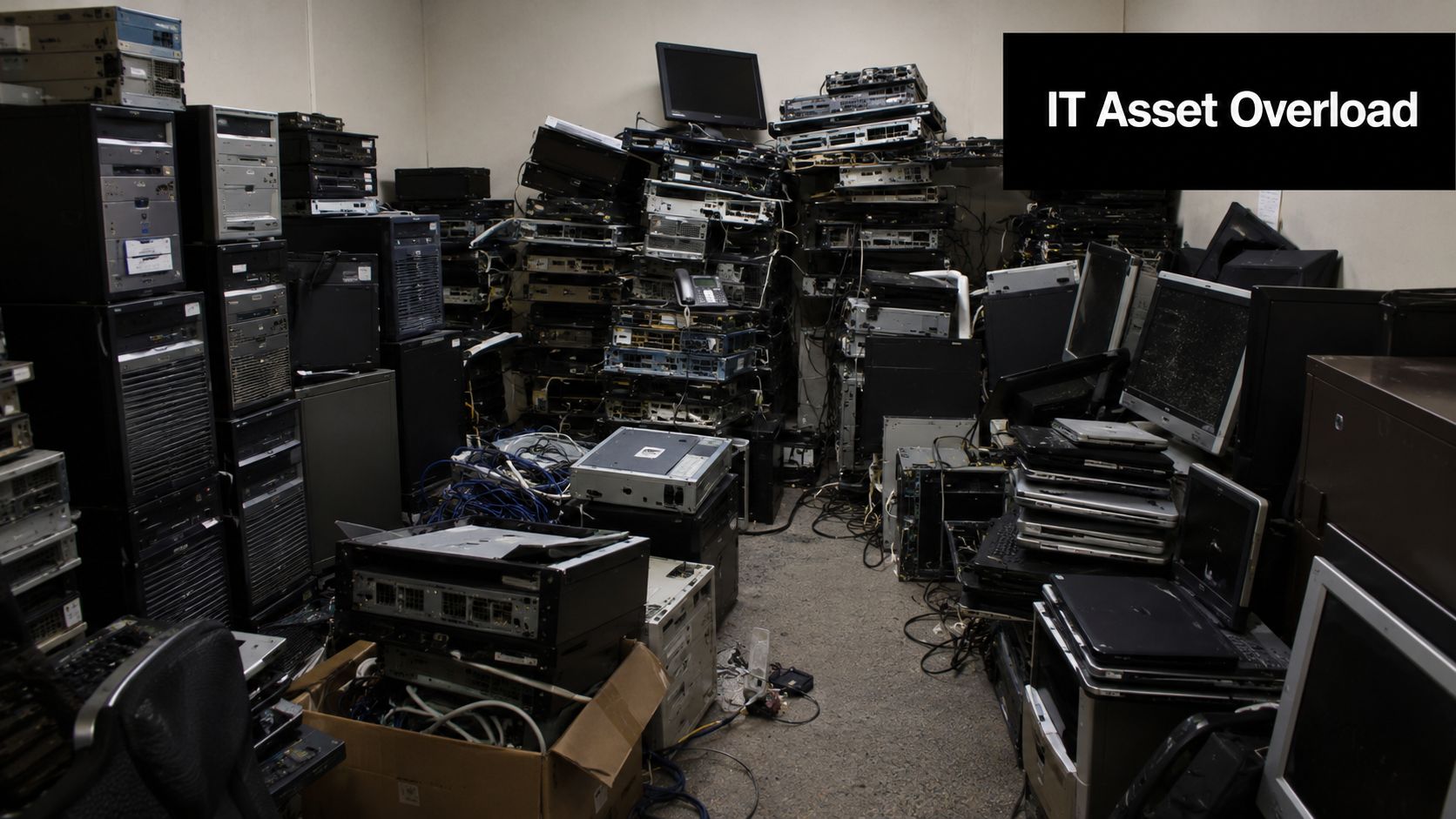
That's why ITAD is a business process, not a junk haul. The national market reflects that shift. The U.S. IT asset disposition market was valued at $2.66 billion in 2022 and is projected to reach $4.90 billion by 2032, with a 6.2% CAGR from 2023 to 2032, according to Custom Market Insights on the U.S. ITAD market. For Alpharetta organizations, that means secure data destruction, certified recycling, and IT buyback now sit inside a mature operating category, not a niche service.
What usually goes wrong first
The first mistake is treating disposition as something to handle after a project closes.
The second is separating logistics from security. If your team schedules a pickup before it has a clean asset list, approved destruction methods, and documentation requirements, you've already made the project harder to defend later.
A workable local process usually starts with three decisions:
- Define the asset population: Know which laptops, servers, storage devices, phones, and network gear are leaving service.
- Set the data handling rule: Decide what must be wiped, what must be shredded, and what can't leave the site intact.
- Set the proof standard: Determine what records your auditors, insurer, privacy team, and finance group will expect after completion.
Why Alpharetta teams need a stricter standard
A lot of metro Atlanta businesses operate in environments where a generic recycling receipt isn't enough. Healthcare, finance, software, and data center environments need evidence tied to serial numbers and chain of custody.
Practical rule: If a record can't be matched back to a specific device or storage component, it usually won't help much in an audit.
For companies sorting through old hardware now, a structured Alpharetta secure IT disposal process is the difference between clean closure and a future documentation scramble.
Understanding Core ITAD Principles for Businesses
A lot of people confuse ITAD with electronics recycling. Recycling is one possible outcome. IT asset disposition is broader. It covers decision-making, custody, data security, value recovery, and final reporting.
If you decommission a fleet vehicle, you don't just abandon it in a yard. You remove identifying information, transfer ownership, close out liability, and settle remaining value. IT equipment needs the same discipline.
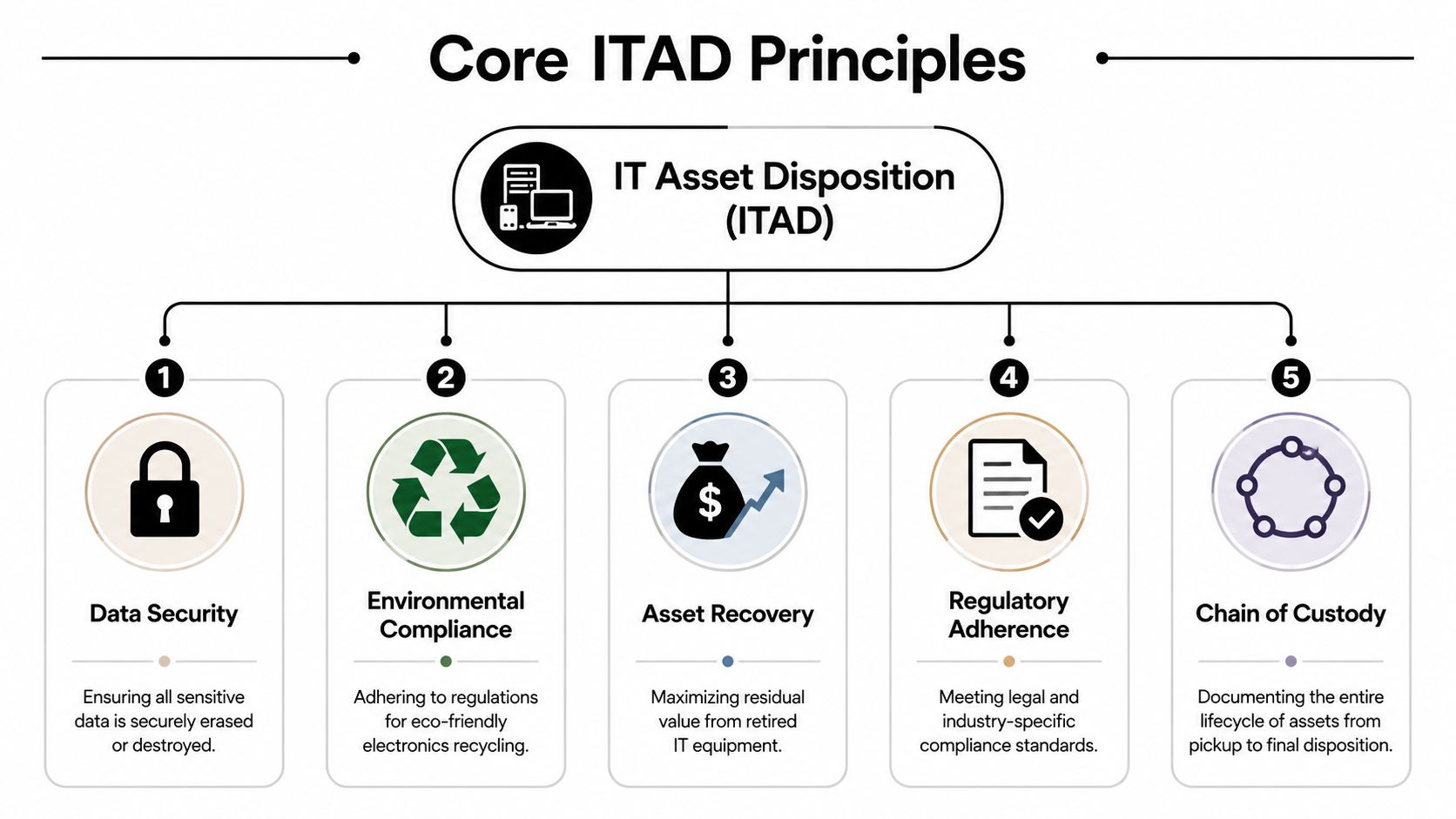
The five pillars that matter in practice
- Data security comes first. If storage media isn't sanitized correctly, nothing else in the process matters much.
- Asset recovery matters because some retired equipment still has market value if it's tested, complete, and properly documented.
- Regulatory adherence matters because disposed devices often contain regulated data or business records.
- Environmental compliance matters because downstream handling creates its own risk if the material flow isn't controlled.
- Chain of custody matters because every other promise depends on proving who had the assets, when, and what happened next.
The broader market shows why this has become standard enterprise work. Globally, the ITAD market was valued at about $14.2 billion in 2021, rose to an estimated $15.8 billion in 2022, and is forecast to reach $28.56 billion by 2030 at a 7.6% CAGR, according to ASCDI's global ITAD market summary. That growth tracks with what regulated organizations already know. Hardware retirement is now part of operational risk management.
What ITAD is not
It is not a loading dock cleanup.
It is not “take everything and send a certificate later.”
It is not a uniform process for every asset class. A batch of encrypted laptops, a SAN shelf full of drives, and old VoIP handsets should not all follow the same disposition path.
Good ITAD treats retired hardware as controlled inventory until final disposition is documented.
If you need a clean baseline definition, this overview of what IT asset disposition means for businesses is a useful starting point before you compare vendors or write internal requirements.
Navigating Compliance for Regulated Industries
In Alpharetta, compliance is often the primary reason an ITAD project gets funded. The operational pain may be storage space or decommissioning backlog, but legal exposure gets executive attention faster.
Healthcare organizations have to think about protected health information embedded in laptops, workstations, printers, and backup media. Financial firms have to think about customer records, account documents, and retention controls. Public sector and government-adjacent contractors often face stricter internal handling rules even when the equipment itself looks ordinary.
The risk isn't only the data on the device
The risk also sits in the failure to prove what happened to it.
An old firewall with no visible customer data may still contain configurations, credentials, logs, and network intelligence. A copier may hold cached documents. A failed SSD may still require controlled destruction even if it no longer mounts. Compliance failures rarely come from the equipment category. They come from assumptions.
What regulated teams should require
A compliant ITAD workflow usually includes these control points:
- Asset-to-record matching: Every device and loose media item should map back to your internal inventory or retirement list.
- Approved sanitization method: The destruction method should match your policy and the device type.
- Transfer documentation: Pickup records, load manifests, and intake reporting should align.
- Final proof package: You need documentation suitable for audit, legal review, and insurance questions.
What doesn't work is relying on generic language like “materials recycled responsibly” when your issue is data-bearing equipment. That phrase may be fine for commodity scrap. It won't answer an internal auditor asking which serial-numbered drive from a terminated employee laptop was sanitized, how it was processed, and where that record is stored.
Compliance review should start before pickup
Bring legal, compliance, privacy, and finance into the process early if your environment is regulated. They'll often care less about the truck date and more about record retention, claims defensibility, and whether the documentation supports internal controls.
If your vendor packet looks stronger than your internal retirement records, fix your internal records first.
That single step prevents a lot of cleanup later.
Secure Data Destruction Methods and Verification
The highest-risk failure point in most enterprise ITAD programs is media sanitization. Device42 notes that disposition has to remove data in a way that meets information security requirements and preserve records for audit and compliance, while also recommending planning, risk assessment, and keeping the asset register as the source of truth. The same emphasis on step-by-step documentation appears in Device42's guidance on IT asset disposition best practices.
Choosing the right method
There isn't one universal destruction method. You need a toolkit.
| Method | Best For | Security Level | Allows Reuse | Verification |
|---|---|---|---|---|
| Wiping | Reusable laptops, desktops, servers, and some storage media | High when the method matches the device and policy | Yes | Serialized wipe report and audit log |
| Degaussing | Magnetic media where reuse is not the priority | High for applicable magnetic media | Usually no | Process record and destruction log |
| Shredding | Failed drives, SSDs, high-security media, and non-redeployable storage | Very high | No | Serialized destruction record and certificate |
What works and what fails
Software wiping works when the media is healthy, addressable, and intended for reuse or resale. It preserves asset value. It also requires good process control. A wipe job that isn't tied to a specific serial number creates evidence gaps.
Degaussing has a narrower use case. It applies to magnetic media, not every modern storage type. Teams sometimes overestimate it because it sounds decisive. It's only appropriate when the media type supports it and your policy allows it.
Physical shredding is the cleanest answer for failed drives, high-risk environments, and media that should never return to market. It ends reuse value, but it also eliminates arguments about whether a damaged device was fully sanitized.
Verification is where many programs break
The method matters. The proof matters just as much.
A good record set should show the asset identifier, the media identifier if separate, the sanitization outcome, exceptions, and final disposition path. If the drive failed wiping and was then shredded, that exception path needs to be documented, not handled verbally.
For organizations with stricter data handling rules, a documented secure hard drive destruction workflow helps align technical destruction with legal proof.
Sanitization is only complete when your records show who approved it, how it was done, and how the result maps back to the asset register.
Maximizing Value Recovery and Calculating ITAD ROI
A lot of IT teams still budget ITAD as a disposal cost. That's incomplete. The better model is to treat it as a controlled recovery program with security and compliance constraints.
Recent ITAD frameworks use a value-first hierarchy. Redeploy first. Resell next. Harvest components if complete resale doesn't make sense. Recycle what has no practical residual value. That same hierarchy, along with the point that value depends heavily on exact model, configuration, and market demand, is reflected in current Georgia IT equipment disposal guidance.
What actually drives resale value
Three things influence recovery more than businesses typically anticipate:
- Configuration detail: Exact CPU, RAM, storage, GPU, and network card details matter.
- Completeness: Missing caddies, rails, power supplies, or adapters reduce resale options.
- Disposition choice: Shredding a reusable drive may satisfy policy, but it can also lower the value of the rest of the system.
Current hardware conditions also complicate estimates. AI-related demand and data center refresh activity have changed which server and component classes move quickly and which sit. That means blanket assumptions like “used servers always have value” or “old networking gear is just scrap” don't hold up well.
How to think about ROI without bad math
You don't need a complicated spreadsheet to evaluate an ITAD project. Start with four buckets:
- Service costs for pickup, handling, wiping, shredding, and reporting.
- Recovered value from resale or component harvesting.
- Avoided internal labor from having your team process and document everything manually.
- Risk reduction, especially where weak proof could turn a routine retirement into a legal or audit problem.
That last category is hard to price precisely, so treat it qualitatively unless you have internal figures. The point is simple. Cheap isn't the same as efficient if the documentation can't support later review.
A useful way to frame this internally is alongside broader corporate digital resilience strategies. Retirement controls are part of the same resilience conversation as access control, incident response, and records governance.
For organizations disposing of mixed inventories, an asset recovery service in Georgia can help separate equipment that should be remarketed from equipment that should go straight to destruction.
The Critical Role of Chain of Custody and Certification
The most overlooked part of IT Asset Disposition in Alpharetta isn't pickup. It's post-disposition proof.
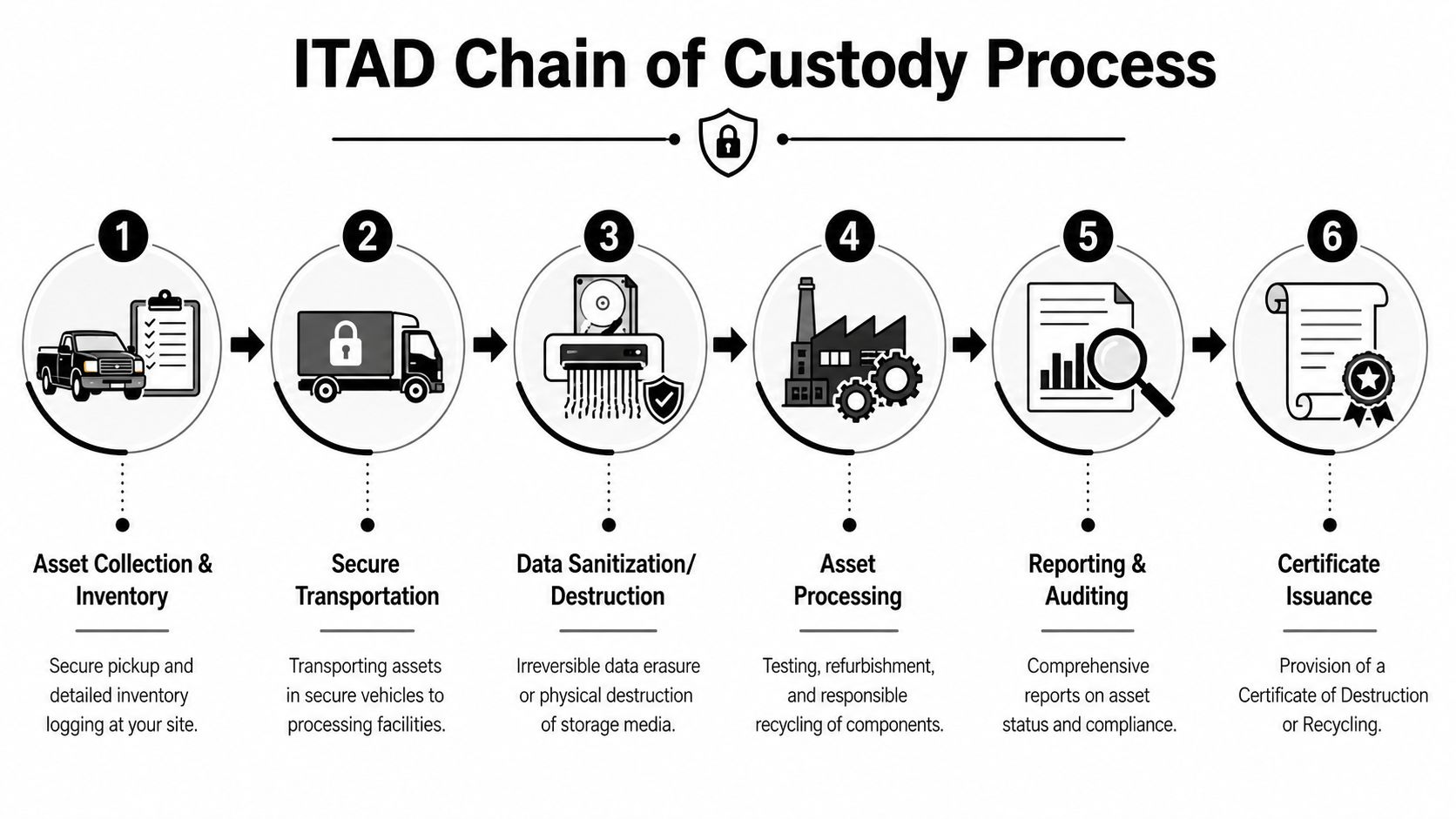
Most vendor conversations focus on collection, wiping, and recycling. Those steps matter, but they don't close your exposure by themselves. What closes exposure is a documented chain showing where the assets were, who controlled them, how data-bearing media was processed, and what records you retained at the end.
The certificate is the end of the story, not the whole story
A certificate of destruction has value, but only as the final layer. On its own, it may not answer the questions that matter in an audit or insurance review.
You should expect supporting records such as:
- Serialized intake reporting that matches what left your site
- Wipe or destruction reports tied to specific assets or media
- Load receipts and transport records that show transfer
- Downstream recycling confirmations where relevant to final disposition
- Internal retention procedures so the records stay accessible
This gap is often missed in local content. HOBI's guidance highlights that post-disposition proof for audits and insurance is underserved, and that incomplete documentation can make the cheapest pickup the most expensive disposition because the cost of proving defensible disposal may exceed the hardware's resale value. That point appears clearly in HOBI's step-by-step ITAD guide.
What to ask before you approve a vendor
Ask for a sample final report package. Not marketing material. Actual reporting format.
Then ask how each document maps to your internal controls. If finance needs proof of retirement, privacy needs proof of sanitization, and insurance may ask for claim support, one generic certificate probably won't satisfy all three groups.
The chain of custody is what transfers liability in practice. The certificate just summarizes it.
If you need to standardize internal review, this destruction certificate template can help your team understand what should appear in a usable proof package.
Your ITAD Project Checklist for Alpharetta and Atlanta
A common failure point looks like this. The truck is scheduled, assets are piled in a staging room, and procurement assumes IT already approved the scope. Then legal asks whether backup tapes are included, finance asks how retirements will be documented, and no one can say what final proof package will be retained if an auditor or insurer asks questions six months later.
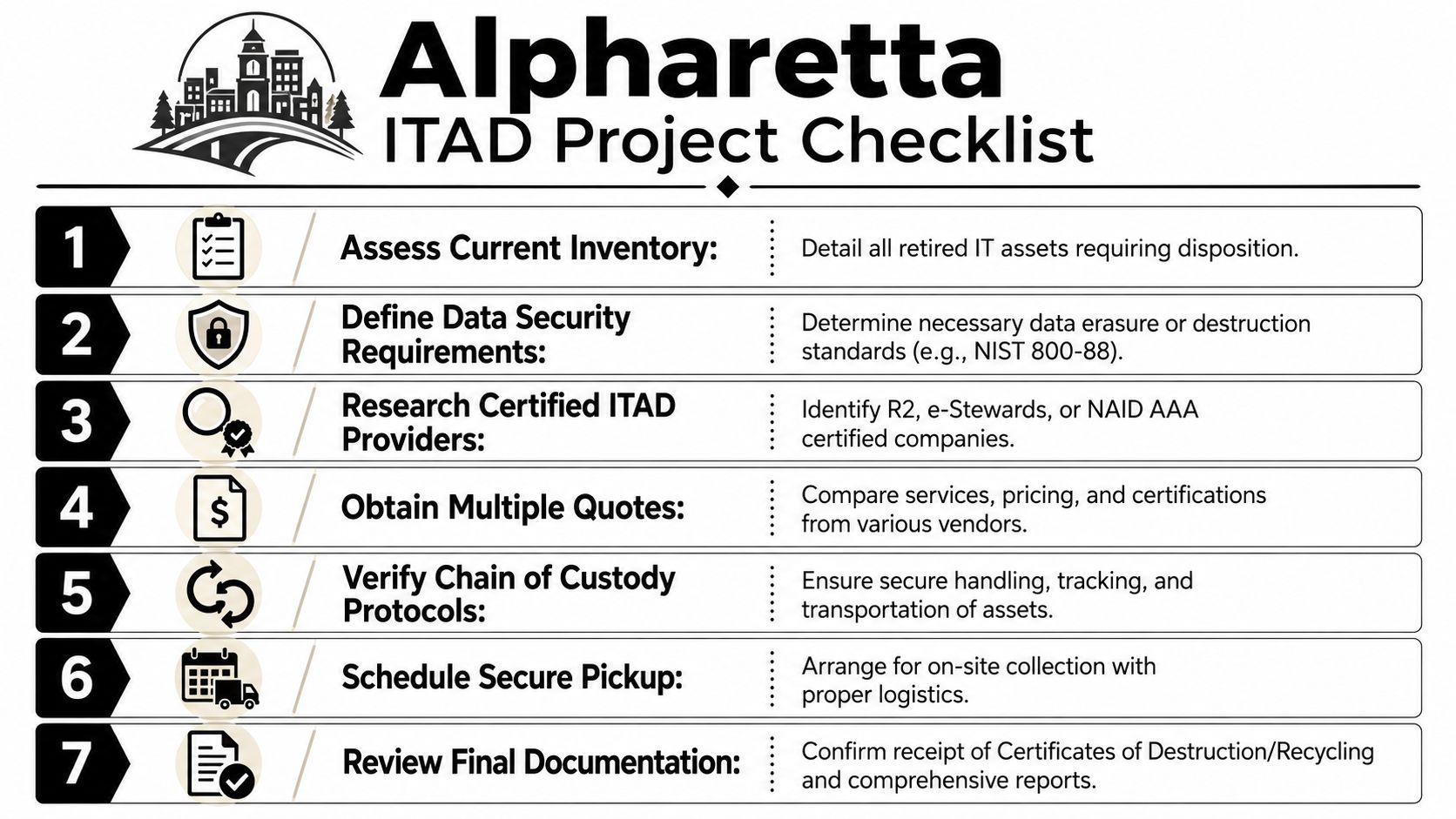
That is why a checklist matters. It keeps the project from drifting into a pickup event with weak documentation.
Pre-project actions
- Assign one internal owner: Pick the person who will approve scope, resolve exceptions, and confirm the final closeout file is complete.
- Build the actual retirement list: Start with the asset register, then add loose drives, failed equipment, spare devices, lab gear, and anything stored outside normal inventory.
- Define the disposition path upfront: Separate assets for resale, redeployment, recycling, and physical destruction before the vendor arrives.
- Set reporting requirements before pickup: Decide what finance, privacy, legal, and insurance need to see after the project is complete.
- Confirm retention responsibility: Name the team that will store the final records in a system the company can still access after staff changes.
Vendor review questions
A quote should answer operational and compliance questions, not just pricing.
- Ask for the final report package format: Review the actual deliverables your team will receive at closeout.
- Test exception handling: Ask what happens when serial numbers do not match, labels are missing, or media cannot be sanitized successfully.
- Review insurance documentation: If procurement needs a quick reference for certificates of insurance, The Ephraim Group's COI guide is useful.
- Confirm downstream accountability: Ask who provides final confirmation when assets move beyond the primary processor.
- Check timing: Find out how long it takes to receive the full documentation set, not just the pickup receipt.
Day-of-project and closeout
- Stage assets by category. Keep high-risk media and resale candidates separate so handling rules stay clear.
- Match the outbound manifest before release. The list leaving your site should match what your team approved for disposition.
- Document exceptions the same day. Missing assets, swapped serials, and failed media should be logged while people still remember what happened.
- Review the closeout package for audit defense. Make sure the records support retirement, sanitization, transfer, and final disposition in a way an auditor, insurer, or outside counsel can follow.
- Store records in a controlled location. If the proof only lives in one employee's mailbox, it will be hard to produce when a claim or audit arrives.
Cheap pickups create expensive problems when the proof package falls apart under review. In Alpharetta and Atlanta, the better standard is simple. No asset leaves the project until ownership, exception handling, and post-disposition documentation are clear.
Frequently Asked Questions about ITAD Services
What equipment can a business include in an ITAD project
Most commercial projects include laptops, desktops, servers, storage arrays, loose hard drives, SSDs, networking gear, phones, tablets, racks, and related peripherals. Many companies also include printers, copiers, point-of-sale devices, and specialty equipment if those assets contain storage or business data.
What's the difference between ITAD and standard electronics recycling
ITAD includes asset tracking, data destruction, chain of custody, value recovery review, and audit-grade reporting. Standard recycling may handle material responsibly, but it often won't provide the level of serialized proof a business needs.
Should data destruction happen on-site or off-site
That depends on your policy, asset type, and risk tolerance. On-site destruction makes sense for high-security media or environments that can't allow intact drives to leave. Off-site processing can work well if custody controls and reporting are strong.
How long should we keep ITAD records
Keep them according to your legal, privacy, finance, and insurance requirements. In practice, many companies keep them with other controlled compliance records so they can retrieve them during audits, investigations, or claim reviews. The mistake is storing them only in an email folder owned by one employee.
Can ITAD support office closures and relocations
Yes. Many projects happen during consolidations, remodels, or moves because that's when dormant assets finally surface. If your team is coordinating a broader relocation, TLC Moving & Storage has a useful overview of office IT move planning considerations that pairs well with ITAD planning.
What should we ask for at the end of the project
Ask for the full proof package, not just a certificate. That usually means intake records, serialized wipe or destruction reports, final disposition reporting, and any downstream confirmations relevant to your internal controls.
If you're planning a refresh, decommissioning old servers, or cleaning out a backlog of retired devices, contact Beyond Surplus for certified electronics recycling and secure IT asset disposal.


