

Atlanta added 31% more new listings in Q1 2026 than in Q1 2025, and that shift sits at the center of any serious Atlanta Real Estate Market Forecast for 2026. At the same time, Metro Atlanta is projected to post a 9% to 10% increase in residential resale unit sales, helped by mortgage rates easing into the 6.0% to 6.5% range and averaging 6.3% for the year, according to this Metro Atlanta market outlook.
That combination reframes the market. Atlanta isn’t heading into a broad boom or a broad bust. It’s moving into a more balanced phase where buyers have more options, sellers face more competition, and neighborhood-level differences matter more than metro averages.
For business planners, that matters beyond housing. Companies making location, hiring, leasing, or relocation decisions need to read Atlanta through a wider lens of labor mobility, local affordability, and uneven submarket performance. That context is part of why Atlanta’s economic base keeps drawing attention, as explored in this look at how Atlanta’s economy is driving growth across Georgia.
The Atlanta Real Estate Story for 2026
Balanced conditions are real
The broad metro picture points to normalization, not disorder. The same Metro Atlanta market outlook projects resale unit sales growth of 9% to 10%, with January inventory up 9.4% year over year and Atlanta price growth expected in a modest 0.5% to 2.0% range for 2026. That’s a sharp contrast with the city’s historical 8.69% decade-average appreciation.
The message is clear. Atlanta is no longer being defined by scarcity alone. Supply is improving, financing costs are softening somewhat, and more paused buyers are likely to reenter.
The more important story is bifurcation
Metro stability hides two splits.
One is geographic. Some areas remain durable because demand drivers are stronger, while other pockets face much heavier pricing pressure. The other is sectoral. The resale market is cooling into moderation even as the rental market is set up for firmer upward pressure.
Atlanta’s 2026 market is best understood as balanced in aggregate and uneven in practice.
That distinction changes how people should act. A buyer looking in an Intown neighborhood, a landlord evaluating rental yield, and a business planning a facility move aren’t operating in the same market, even if all three are in Metro Atlanta.
Key Projections At a Glance
The top-line forecast for 2026 is relatively disciplined. Mortgage costs are expected to settle rather than swing, and that steadier financing backdrop is one reason transaction activity is projected to improve.
What the headline numbers say
According to this Atlanta real estate market forecast, mortgage rates are projected to stabilize between 6.0% and 6.5% through 2026, with the 30-year fixed rate averaging 6.3%. That same forecast ties lower borrowing costs to a 9% to 10% increase in residential resale unit sales across Metro Atlanta. Inventory is expected to range between 3 and 6 months, and average days on market reached 105 days in early 2026.
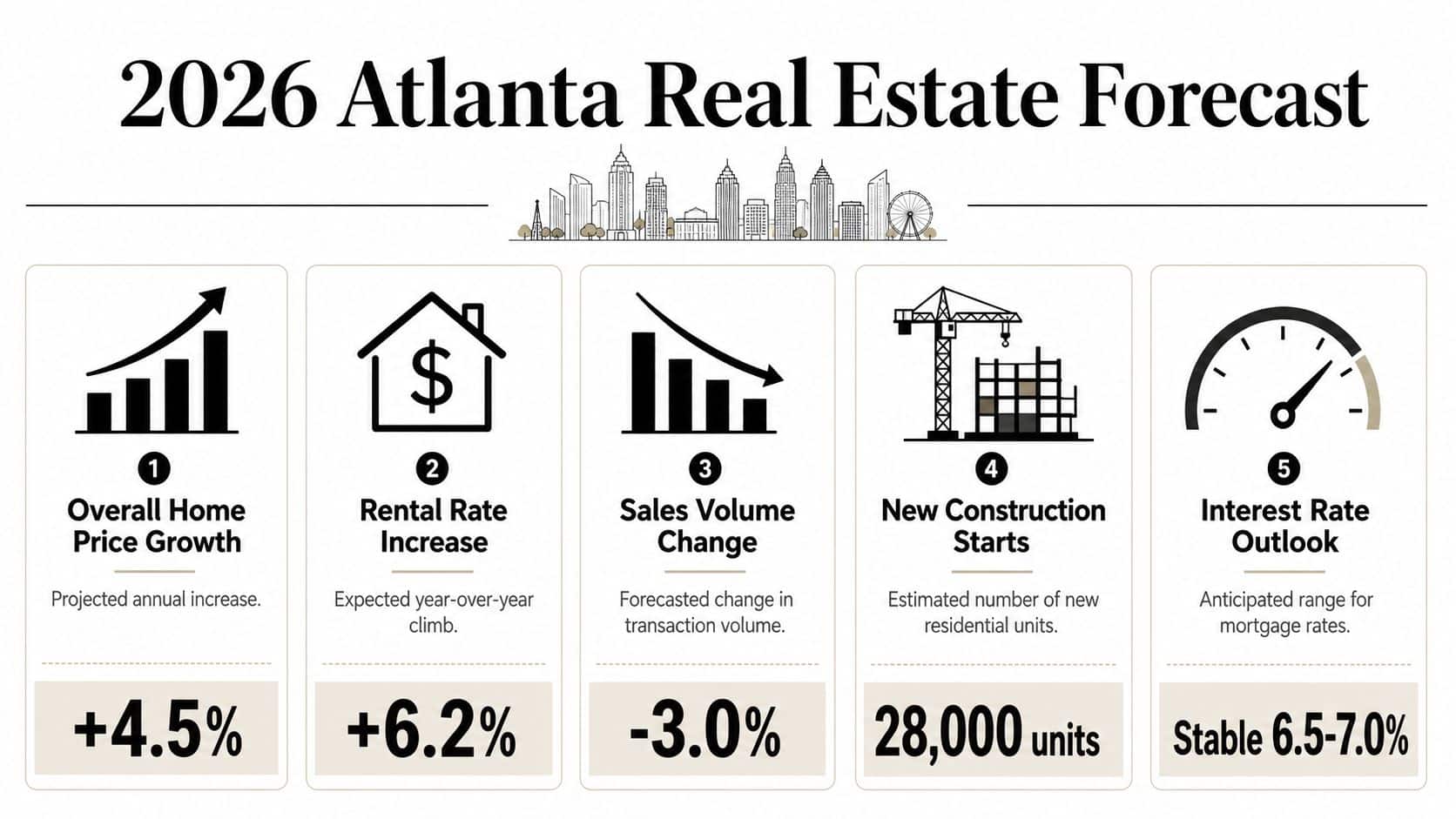
Those figures point to a market with more negotiation, more time for diligence, and fewer conditions that force rushed decisions.
Why stability doesn’t mean simplicity
Some forecasts lean softer on pricing. One Atlanta analysis notes Zillow projects home values may decline another 1.3% through mid-2026, while other outlooks anticipate modest local appreciation. That divergence matters less as a debate over who’s right and more as proof that average forecasts can obscure local variance.
A useful framework for interpreting conflicting market signals is this comprehensive guide for real estate brokers, which breaks down how professionals weigh inventory, pricing, and transaction data together instead of relying on one metric.
For business readers, the implication is practical. If you’re evaluating employee relocation, branch expansion, or leased-space commitments, you should treat Atlanta as a market with improving flexibility, not uniform direction. Local business sentiment and growth patterns will shape that as much as housing will, which is why this broader piece on Atlanta business trends that will shape the next decade is worth pairing with the housing data.
Practical rule: In a balanced market, financing terms and submarket selection often matter more than broad metro averages.
Residential Deep Dive Price and Rental Dynamics
Atlanta’s residential story in 2026 is split between a sales market that looks steady on paper and a rental market that may tighten faster than many buyers expect.
Home prices are flat and rising at the same time
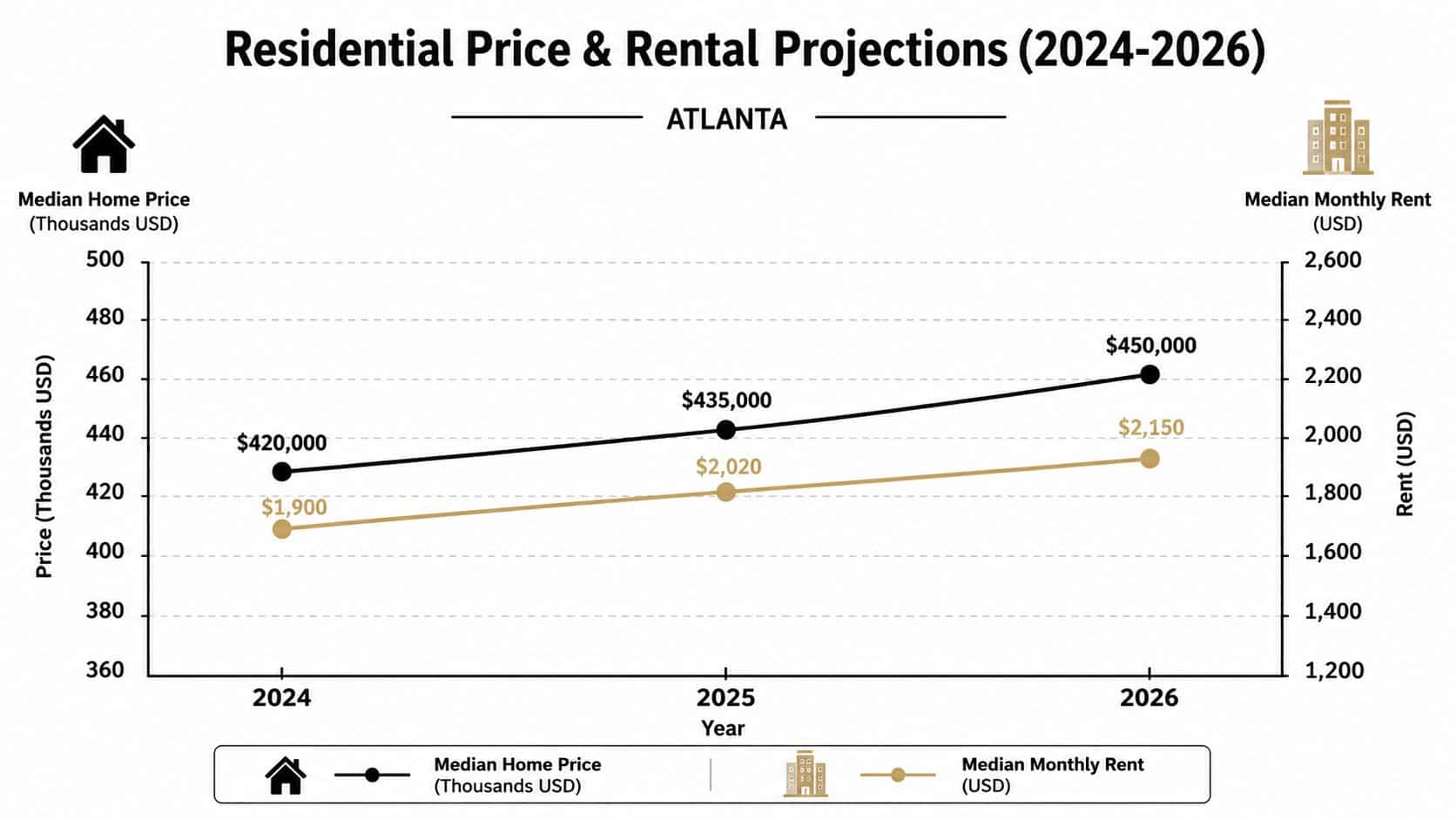
That sounds contradictory until you separate monthly readings from year-to-date trends. The March 2026 Atlanta housing update shows the median sold price for Atlanta homes at $550,000 in March 2026, remaining flat at -0.09% compared with March 2025. Yet the year-to-date median reached $500,000, up 5.26% from the same period in 2025, and the projected full-year 2026 median is $510,000.
That tells you the market isn’t moving in a straight line. It’s absorbing earlier softness while still holding a longer-run upward bias.
Rentals may strengthen while resale softens
A separate Atlanta analysis says the rental market faces upward pressure because the new apartment construction pipeline is contracting in 2026, while population growth remains positive and vacancy stays contained. The same outlook says resale values may soften even as rental yields strengthen in the metro area, as detailed in this Atlanta housing market sellers guide.
That divergence creates a different calculus for each group:
- Buyers may find more negotiating room on resale homes than headlines suggest.
- Landlords may see firmer rent support than home-price appreciation alone would imply.
- Corporate relocation teams should assume housing costs won’t move uniformly across ownership and rental options.
If you want another data source to compare pricing direction, this overview of Zillow housing market data is useful for tracking broader home value trends alongside local brokerage reporting.
For households deciding whether to rent or buy inside the city, this broader question of timing remains highly relevant in is now a good time to buy a home in Atlanta.
The Neighborhood Divide Mapping Atlanta’s Micro-Markets
The most underappreciated part of the Atlanta Real Estate Market Forecast for 2026 is that the metro average may be the least actionable number in the entire discussion.
Some neighborhoods are holding, others are slipping
One analysis argues that generic 2026 forecasts fail to capture severe geographic bifurcation. It notes that some Atlanta pockets are already seeing double-digit year-over-year declines, with a potential -9.2% downward forecast for specific zones, while resilient Intown pockets continue to hold up better, according to this Atlanta neighborhood bifurcation analysis.

Another Atlanta market view points to Buckhead, Sandy Springs, and Brookhaven as core areas maintaining price stability or slight gains due to enduring demand drivers, while some suburban zones face more pressure.
A useful way to think about risk
Instead of asking whether Atlanta will rise or fall, ask which local demand engine is supporting the area you care about.
A simple decision lens looks like this:
| Area profile | Likely 2026 read |
|---|---|
| Established Intown demand | More resilient pricing |
| Core job-linked suburban nodes | Mixed but steadier |
| Outlying or more rate-sensitive pockets | Greater downside risk |
That framework won’t replace block-by-block research, but it is more useful than treating Metro Atlanta as one market.
Buyers and investors should build a neighborhood risk map first, then a budget. Doing it in the reverse order can push them into the weakest submarkets.
For readers focused on Atlanta’s high-demand urban corridors, this guide to the ultimate Atlanta BeltLine guide for visitors and locals also helps explain why certain Intown areas continue to command attention.
Commercial Real Estate and Business Implications
Business leaders should read Atlanta’s housing data as an input into operating strategy, not just a consumer-market story.
What housing conditions mean for employers
When resale inventory expands and price growth moderates, employers gain a more flexible environment for recruiting and relocation. Candidates have more time to evaluate neighborhoods, and companies can structure moves without the urgency that dominated tighter years.
Rising rental pressure complicates that picture. Firms that rely on younger mobile talent, contract staffing, or short-term transfers may find that leasing costs stay stubborn even if for-sale home values cool. That split matters for HR budgets, housing stipends, and office-location planning.
How to translate the forecast into decisions
A few business implications stand out:
- Office users: Prioritize employee commute patterns and neighborhood affordability over metro-wide assumptions.
- Industrial and logistics operators: Watch where labor remains accessible, not just where land is available.
- Healthcare and education systems: Treat local housing stability as part of workforce retention.
- Data center and infrastructure teams: Evaluate submarkets through both real estate cost and community demand durability.
Atlanta’s long-term business case still benefits from scale, connectivity, and sector diversity. But the 2026 market suggests that location analysis needs to be more granular. A broad metro thesis is no longer enough for facility planning or lease negotiation.
That’s also why commercial readers should pair residential signals with broader sector-specific thinking found in the future of commercial real estate in Atlanta insights.
Actionable Strategies for Every Stakeholder
The best 2026 strategies come from accepting the split market for what it is. Broad optimism or broad caution won’t be precise enough.
For buyers and sellers
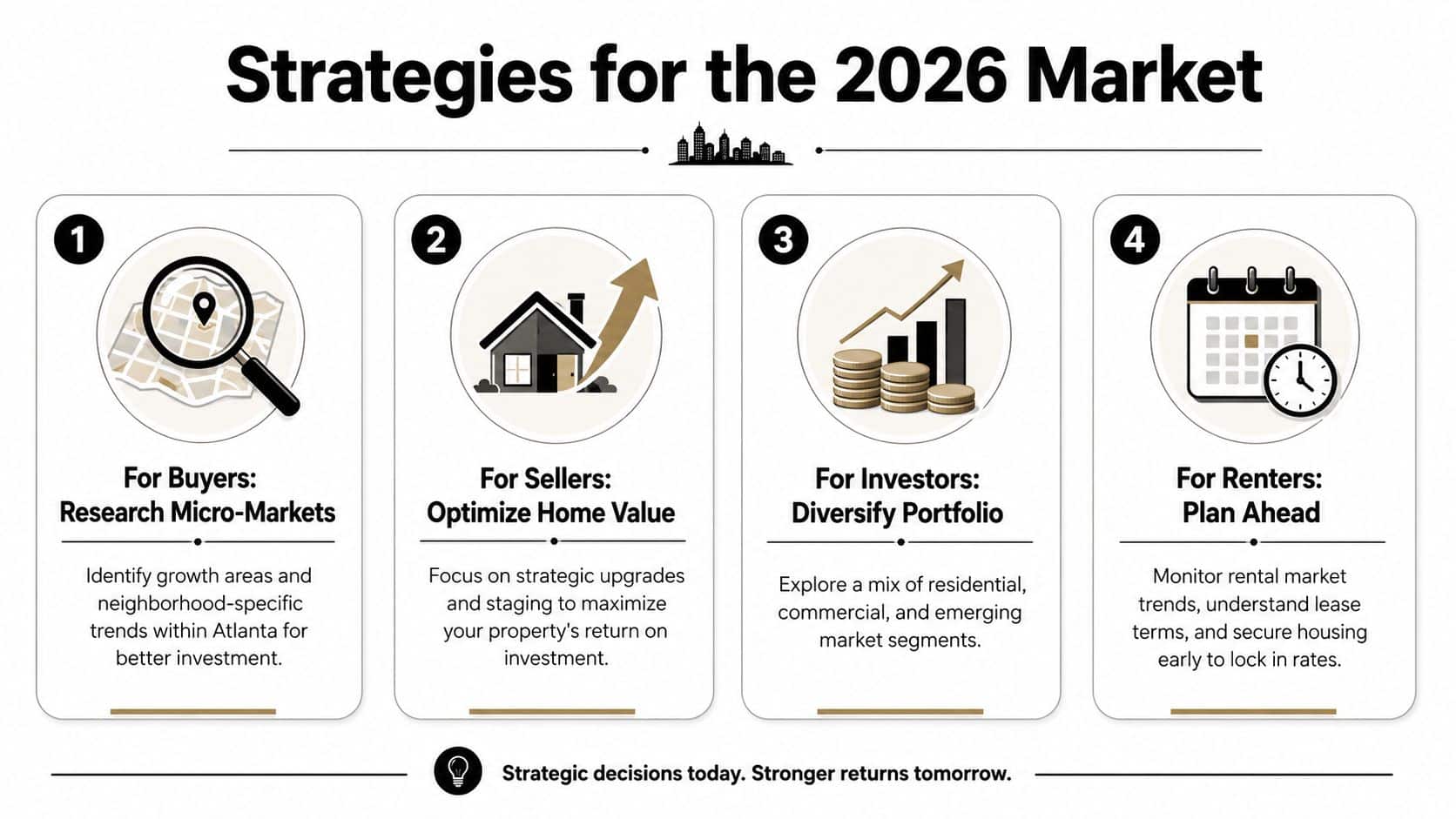
- If you’re a buyer, research micro-markets first. The citywide average won’t tell you whether the neighborhood you want is resilient or weakening.
- If you’re a seller, price to current competition. In a market with more listings and longer marketing times, stale pricing is costly.
- If you’re moving within Atlanta, compare owning and renting side by side. The rent trajectory may be firmer than the resale trajectory.
For investors and businesses
The rental side deserves close attention. The earlier Atlanta analysis on apartment supply says rent pressure is likely to persist as the new construction pipeline contracts, while positive population growth and contained vacancy support stronger rental performance.
That creates a clear distinction:
Resale softness doesn’t automatically mean weak housing economics. In some Atlanta submarkets, softer purchase pricing and firmer rents can improve the investment case.
For investors working through acquisition or wholesale strategies, this essential guide for Georgia real estate investors provides a useful operating primer.
For businesses, the right move is usually one of these:
- Delay a purchase until neighborhood pricing becomes clearer.
- Lock in a lease where workforce access matters more than appreciation.
- Use 2026 as a scouting year for future expansion while the market offers more negotiating room.
Your 2026 Atlanta Market Outlook
The Atlanta Real Estate Market Forecast for 2026 isn’t a story of sharp acceleration. It’s a story of moderation, better choice, and uneven local performance.
The broad setup is constructive. Mortgage rates are projected to stabilize, inventory looks balanced, and transaction activity is expected to recover from a restrained base. Those are healthy signals. They point to a market that can function more normally than it did under the pressure of extreme scarcity.
But broad stability is only the first layer. The more valuable insight is that Atlanta is splitting by neighborhood and by housing type. Some areas are positioned to remain firm. Others may face meaningful pricing pressure. At the same time, the rental market may strengthen even where resale appreciation cools.
That’s why the smartest reading of 2026 is this: Atlanta is investable, livable, and strategically important, but only for people willing to get specific. Metro averages can orient you. They can’t make the decision for you.
Readers who treat Atlanta as a collection of micro-markets, rather than one headline number, will make better choices in 2026.
Businesses that need secure technology disposition during office moves, facility upgrades, data center changes, or equipment refresh cycles can contact Beyond Surplus for certified electronics recycling and secure IT asset disposal.


