

You're probably here because you've heard the Atlanta BeltLine is one of the best ways to experience the city, but the practical part still feels fuzzy. Where do you start, which stretch is worth your time, and how do you avoid turning a fun day into a parking or transit headache?
That's exactly where the challenge lies. The BeltLine sounds simple when someone says, “Just walk the trail,” but Atlanta locals know it works better when you choose the right segment, the right entry point, and the right pace for your day.
This guide is built for both first-timers and regulars who want a smarter plan. If you like exploring cities on foot and want extra perspective for independent travelers seeking authenticity, that mindset fits the BeltLine perfectly. And if you're building a bigger Atlanta weekend, the local roundup at things to do in Atlanta this weekend pairs well with a BeltLine day.
Welcome to the Atlanta BeltLine
The easiest mistake is treating the BeltLine like one continuous, identical path. It isn't. Some stretches feel social and high-energy, others feel residential and relaxed, and some are better for bikes than brunch.
That matters because your best BeltLine day depends on what kind of outing you want. A visitor trying to see iconic Atlanta spots should plan differently from a local who wants a quieter walk or a family looking for open space.
Start with the kind of day you want
Ask yourself three quick questions before you go:
- Walking or biking: Some segments reward a slow stroll with food, art, and people-watching. Others feel better with wheels.
- Social or quiet: If you want patios and crowds, pick a busier section. If you want space to move, choose a calmer corridor.
- One stop or several: Some visits work best as a short out-and-back. Others make sense as a longer trail-hopping afternoon.
What usually confuses first-time visitors
Most confusion comes from logistics, not from the trail itself. People hear “loop” and assume uninterrupted access, easy rail connections, and one obvious starting point. In practice, the better approach is choosing a home base first, then building the day around that.
Practical rule: Pick one segment, one main access point, and one food stop before you leave home. That single decision removes most of the stress.
A good BeltLine trip feels spontaneous once the basics are set. You know where you'll start, what kind of route you want, and how you'll get back. That gives you room to enjoy the city instead of constantly checking your phone.
The Story of the Atlanta BeltLine
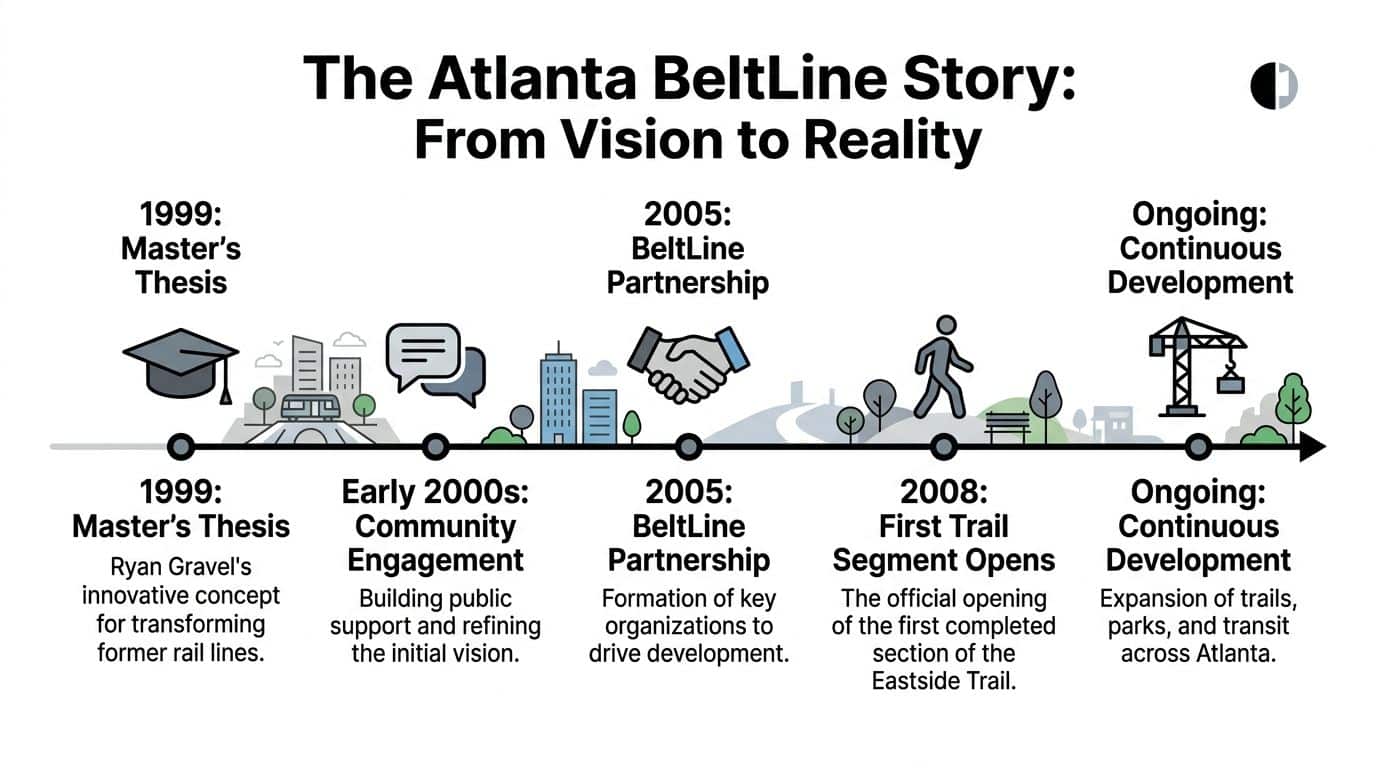
The BeltLine started as a student vision in 1999, when a Georgia Tech student proposed turning former rail corridors into a connected public asset for Atlanta. What makes that idea so durable is that it wasn't just about recreation. It tied together movement, parks, neighborhoods, redevelopment, and civic identity.
Why the project matters
The Atlanta BeltLine is a 22-mile (35 km) multi-use trail on a former railway corridor designed to reconnect 45 neighborhoods and create 1,300 acres (530 ha) of green space by 2030. It generates approximately $23 billion in annual economic output for Atlanta, and the Eastside Trail alone draws 2 million visitors annually, according to the Atlanta BeltLine overview.
That scale explains why people talk about it as more than a trail. It functions as public space, transportation corridor, redevelopment framework, and neighborhood connector all at once.
From concept to city-shaping project
The long-term vision includes trails, parks, cultural programming, and future transit elements. The idea was to stitch together areas that had been separated by older infrastructure and to give Atlantans a shared place to move through the city without always relying on a car.
A big part of the BeltLine's appeal is that you can feel that mission while using it. On one outing, you might pass apartment buildings, murals, breweries, playgrounds, and tree-lined stretches that feel almost hidden. That variety is part of the design, not an accident.
The BeltLine works best when you see it as a city framework, not just a fitness path.
Why locals keep returning
Even if you already know one stretch well, the project keeps rewarding repeat visits. Different segments attract different crowds, businesses, and rhythms. Morning runs feel unlike evening patio walks. Weekday rides feel unlike weekend strolls.
The BeltLine also gives Atlanta something many car-oriented cities struggle to create. It offers a shared route where neighborhoods feel connected by experience, not just by roads on a map.
A Segment by Segment Guide to the Trail
If you've only heard people talk about “the BeltLine,” it helps to translate that into actual segments. The full system includes Northside, Northeast, Eastside, Southeast, Southside, Southwest, and Westside Trails, plus connector trails. It also carries the Art on the BeltLine program, described in this Atlanta BeltLine guide as the largest outdoor public art exhibition in the South.
Atlanta BeltLine Segments at a Glance
| Trail Segment | Vibe | Best For | Key Attractions |
|---|---|---|---|
| Eastside | Busy, social, polished | First visits, food walks, people-watching | Ponce City Market, Krog Street Market, murals |
| Westside | Open, evolving, neighborhood-focused | Cyclists, repeat visitors, longer rides | Historic neighborhoods, breweries, skyline views |
| Southside | Quieter, local, less crowded | Walkers who want breathing room | Industrial-meets-residential scenery, slower pace |
| Northside | Developing, mixed-use, practical | Curious locals, shorter explorations | Access to newer areas and future growth zones |
| Northeast | Emerging and useful | Exploration beyond the usual hotspots | Connections to nearby dining and retail areas |
| Southeast | Varied and transitional | Walkers who like discovery | Local restaurants and changing streetscapes |
| Southwest | Community-centered | Riders and neighborhood explorers | Lee + White area and local businesses |
Eastside Trail
This is the stretch most visitors picture first. It's the easiest place to understand the BeltLine quickly because the energy is obvious. You'll find busy trail traffic, patios, public art, market stops, and a lot of people treating the route like Atlanta's outdoor living room.
Choose Eastside if you want:
- A classic first visit: It delivers the most immediate “I get it now” experience.
- Food built into the route: Ponce City Market and Krog Street Market make natural anchors.
- A social atmosphere: Great for out-of-town guests and group outings.
Westside Trail
Westside feels different in the best way. It's less about being seen and more about moving through neighborhoods with a steadier rhythm. Cyclists often prefer it because there's more room to settle into a ride and less stop-and-go energy.
The Westside is a strong pick if you want a route with character but less crowd pressure. It also rewards people who've already done Eastside and want to see another side of Atlanta.
Local perspective: If Eastside feels like Atlanta on display, Westside feels like Atlanta in motion.
Southside and Southwest Trails
These stretches appeal to people who don't need a packed social scene to have a good trail day. You'll notice more space, fewer bottlenecks, and a mood that leans neighborhood-first.
That makes them useful for:
- Focused walks: Good when you want to keep moving.
- Casual bike rides: Fewer distractions than the busiest segments.
- Exploration days: Better for locals who enjoy finding corners they haven't seen before.
Northside, Northeast, and Southeast Trails
These segments matter because they show the BeltLine as an evolving system, not a finished postcard. Some stretches feel newer, more transitional, or more practical than iconic. That doesn't make them less worthwhile. It just means they serve a different kind of visitor.
If you like watching how cities change, these areas are fascinating. You can see how the BeltLine influences development patterns, access points, and everyday neighborhood life.
Curated Itineraries for Every Visitor
Sometimes the best plan is having a ready-made one. These three routes work because they reflect people's real usage of the BeltLine, not how brochures describe it.
Foodie and art walk
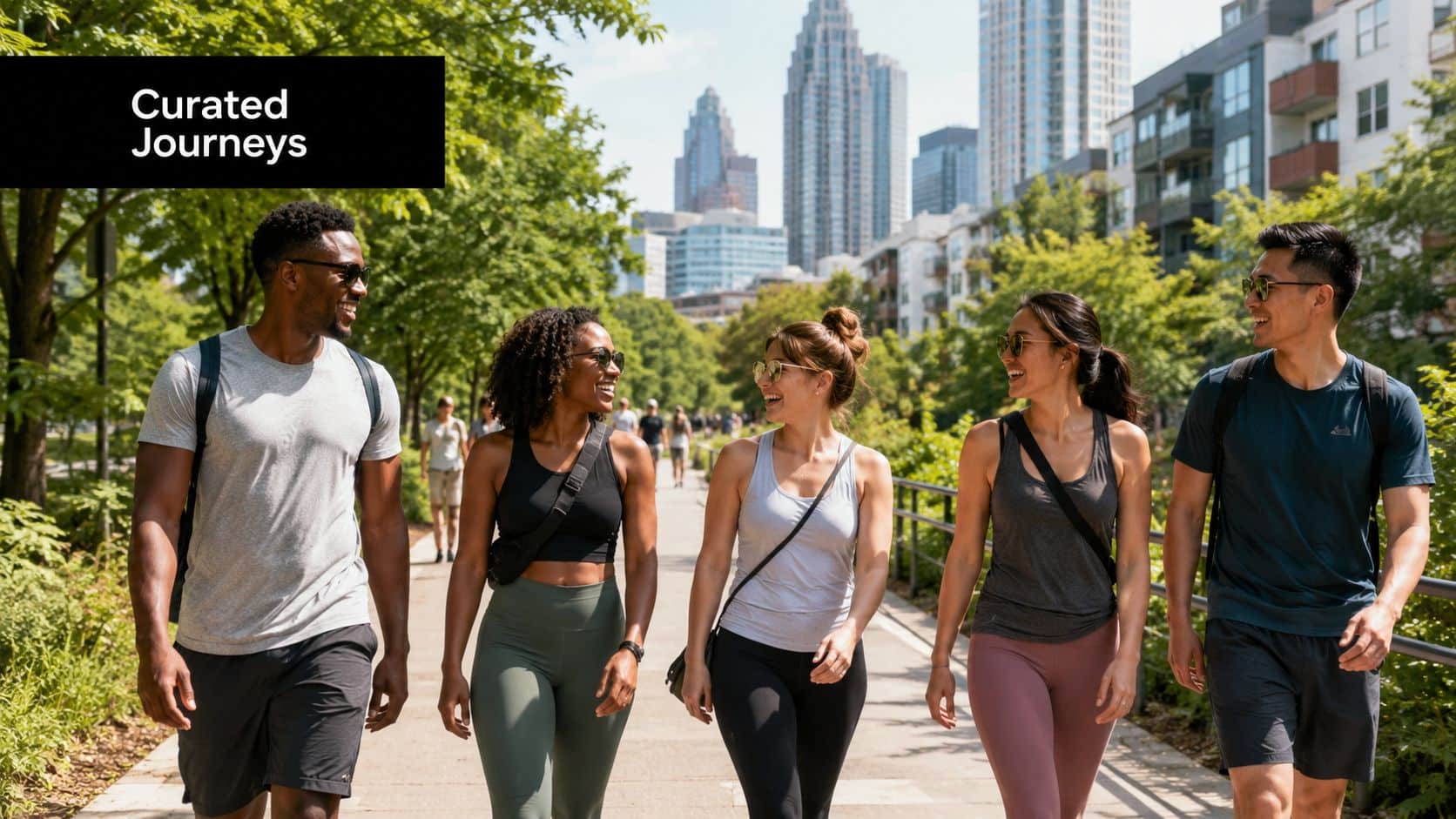
Start near Ponce City Market. Give yourself an easy walking pace and let the day unfold southward. This route works well when you want a few hours of Atlanta flavor without overplanning every stop.
A simple flow looks like this:
- Begin with coffee or a light bite near Ponce City Market.
- Walk the Eastside Trail slowly and pay attention to murals, installations, and side-path views.
- Pause where the trail feels lively, not just where a map tells you to stop.
- Finish near Krog Street Market and settle in for a meal or drink.
If you want to pair the outing with another Atlanta sports-and-city stop later in the day, the local guide to Atlanta Braves activities and nearby ideas can help round it out.
Cyclist's Westside exploration
This is the route for people who'd rather cover ground than linger at every patio. Start from the West End area, get your bike set, and head into a section of the BeltLine that feels more spacious.
Ride with a loose structure:
- Warm up on the flatter early stretch
- Keep your stops intentional, maybe for a brewery or skyline photo
- Turn back before fatigue makes traffic feel annoying
The Westside ride suits solo riders, couples, and locals showing friends a less obvious part of town.
Family-friendly park day
Families usually do best when the BeltLine is part of the day, not the whole day. Start near Piedmont Park or the Historic Fourth Ward area, where you can mix trail time with room for kids to be kids.
A low-stress version works like this. Walk a manageable portion of the trail, stop for a snack before anyone gets cranky, and build in unstructured park time. Children remember the skatepark energy, open lawns, and surprise discoveries more than mileage.
Go shorter than you think you need. A family BeltLine day succeeds when everyone still has energy for the last hour.
Top Attractions Food and Public Art
The BeltLine can overwhelm people because there's so much within reach. The fix is simple. Group your stops by what kind of experience you want.
Food halls and easy win dining
For a first visit, two places do a lot of work. Ponce City Market gives you a strong starting point with lots of options and a built-in sense of occasion. Krog Street Market works especially well as a finish line because you can arrive hungry and let everyone choose their own meal.
Those two anchors are useful because they remove indecision. You don't need one perfect reservation. You need flexible, reliable places that fit a trail day.
If you're building a fuller Atlanta itinerary around food, sports, and neighborhood stops, the city guide tied to Atlanta Falcons outings and local planning ideas can add a few nearby options.
Public art worth slowing down for
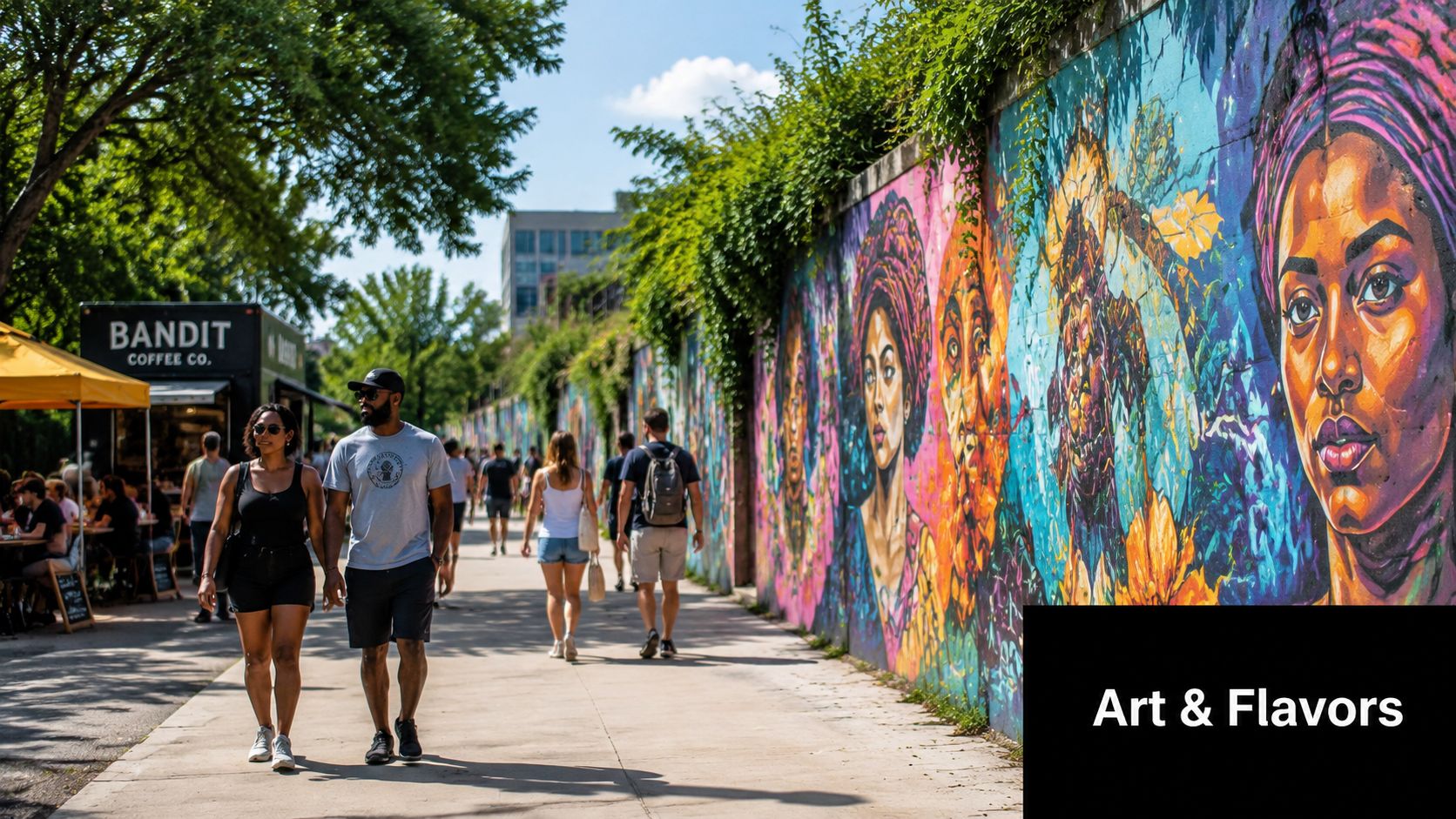
The smart way to enjoy BeltLine art is not to hunt every piece. Walk with your head up and expect art to appear as part of the route. Murals, sculptures, and temporary installations often matter most when they catch you by surprise.
Good art stops usually have one of these qualities:
- A natural pause point: somewhere people already slow down
- A strong neighborhood backdrop: art that feels tied to the place around it
- Room to linger safely: enough space to step aside without blocking the trail
Parks and green space
The BeltLine isn't only about food and murals. It also gives you places to reset. Piedmont Park remains the obvious classic when you want broad lawns and room to relax. The Historic Fourth Ward area offers a different kind of energy, with activity, movement, and easy access to the trail.
For a calmer experience, look for stretches where the landscaping and tree cover make the path feel less urban for a moment. Those quieter pockets often end up being the part of the day locals remember most.
The best BeltLine attraction isn't always a destination. Sometimes it's the stretch between destinations where Atlanta feels most open.
How to Access the BeltLine Parking and Transit
Most guides make access sound easier than it is. Parking can be manageable if you start early or choose a less crowded segment, but transit takes more thought than many first-timers expect.
Parking strategy that actually helps
If you're driving, the simplest move is choosing your segment first and parking near your intended experience. Eastside access works best if you're arriving early and planning a food-focused walk. Westside is often less stressful for people who want a ride or a lower-pressure start.
Use this mindset:
- Pick your finish as carefully as your start: Ending near food or a comfortable return point makes the day easier.
- Expect popular zones to fill: Busier trailheads can change the mood fast if you arrive late.
- Don't chase the “perfect” spot: A short walk from parking is often better than circling endlessly.
MARTA and the missing-link reality
Transit sounds ideal on paper, but the on-the-ground experience can be fragmented. As noted in Ryan Gravel's discussion of BeltLine access gaps, visitors often run into “missing link” segments between MARTA stations and the trail, and only about 12 of the 22 miles are continuously completed.
That's the part many guides skip. You may find yourself leaving the station and then dealing with awkward roadway connections instead of a smooth pedestrian handoff.
A realistic approach is to use MARTA for part of the trip, then finish with a short rideshare or carefully planned walk if the station-to-trail segment doesn't feel comfortable. That's especially useful for visitors arriving through the city's main air gateway and orienting themselves with local travel context around Hartsfield-Jackson Atlanta International Airport.
Sustainable Living Near the BeltLine
The BeltLine encourages a certain kind of city living. Walk more. Drive less when you can. Use shared public space well. Think about what kind of neighborhood habits make urban life cleaner and easier for everyone. If you're interested in broader sustainable transport options for city dwellers, that same mindset applies here.
Sustainability goes beyond the trail
People often think of sustainability near the BeltLine in terms of bikes, refill bottles, or skipping short car trips. That matters, but responsible city living also includes what happens when technology reaches the end of its useful life.
Old laptops, retired office monitors, storage devices, networking gear, and outdated workstations don't belong in the trash stream. For companies near the corridor, secure disposal is part of basic operational hygiene.
What businesses should look for
For commercial clients in Atlanta, free e-waste pickup is often available with a minimum of 10–20 major IT items, and credible providers should issue a Certificate of Data Destruction for standards such as NIST 800-88, as outlined in this guidance on Atlanta commercial electronics pickup and data destruction expectations.
That's the baseline. A business should know who handled the equipment, how data was destroyed, and what documentation supports the chain of custody. For organizations that need local support, Georgia electronics recycling guidance is one practical starting point, and Beyond Surplus is one Atlanta-area option for IT asset disposition and secure electronics recycling services.
Plan Your Visit Seasonal Events and Safety Tips
The BeltLine changes with the season, not because the route disappears, but because your best strategy does. Summer heat can turn a long midday walk into a slog. Spring and fall usually reward longer outings, and cooler days make it easier to combine trail time with food stops and parks.
Seasonal planning that keeps the day enjoyable
Use a simple checklist before you leave:
- Check the weather: Atlanta heat and sun can sneak up on you fast.
- Start earlier in warmer months: Shade helps, but timing matters more.
- Build around events if you want energy: Lantern parades, art happenings, and running events can make the BeltLine feel festive.
- Avoid peak congestion if you want calm: A weekday morning often feels completely different from a sunny weekend afternoon.
Trail etiquette and basic safety
The BeltLine works because people share it well. Keep right when you can. If you're biking, announce passes clearly. If you stop to talk, step aside so others can keep moving. Dogs should stay leashed, and families should keep children close on busy stretches.
Stay aware of your surroundings, especially where the trail narrows or crowds gather near food and art stops. The safest BeltLine users aren't the fastest or the most experienced. They're the ones paying attention.
A smooth BeltLine day usually comes down to simple habits. Start with a realistic route, keep your pace flexible, and leave room for small detours.
If your Atlanta organization needs a responsible way to handle retired technology, Beyond Surplus provides secure IT asset disposition, electronics recycling, and documented data destruction services that fit business, healthcare, education, and enterprise compliance needs. Contact Beyond Surplus for certified electronics recycling and secure IT asset disposal.


