

A Sandy Springs office manager usually notices end-of-life IT the same way. First it's a few laptops in a closet. Then it's retired desktops under a conference table, failed hard drives in an admin drawer, and a stack of network gear nobody wants to touch because nobody wants to own the data risk.
That's where many disposal projects go wrong. The equipment looks like a storage problem, but it's a security, compliance, and documentation problem. If your team can't show what was picked up, how it was tracked, which media was wiped, which drives were shredded, and when final disposition occurred, you don't have a defensible ITAD process. You have a cleanup event.
Protecting Your Business with Sandy Springs ITAD Solutions
In Sandy Springs, retired technology moves fast. Offices refresh laptops, healthcare groups replace workstations, finance teams cycle storage devices, and regional facilities shut down server rooms. What used to be called “computer disposal” is now a formal end-of-life discipline. The reason is simple. Businesses need documented data sanitation, value recovery, recycling, and compliance reporting in one workflow.
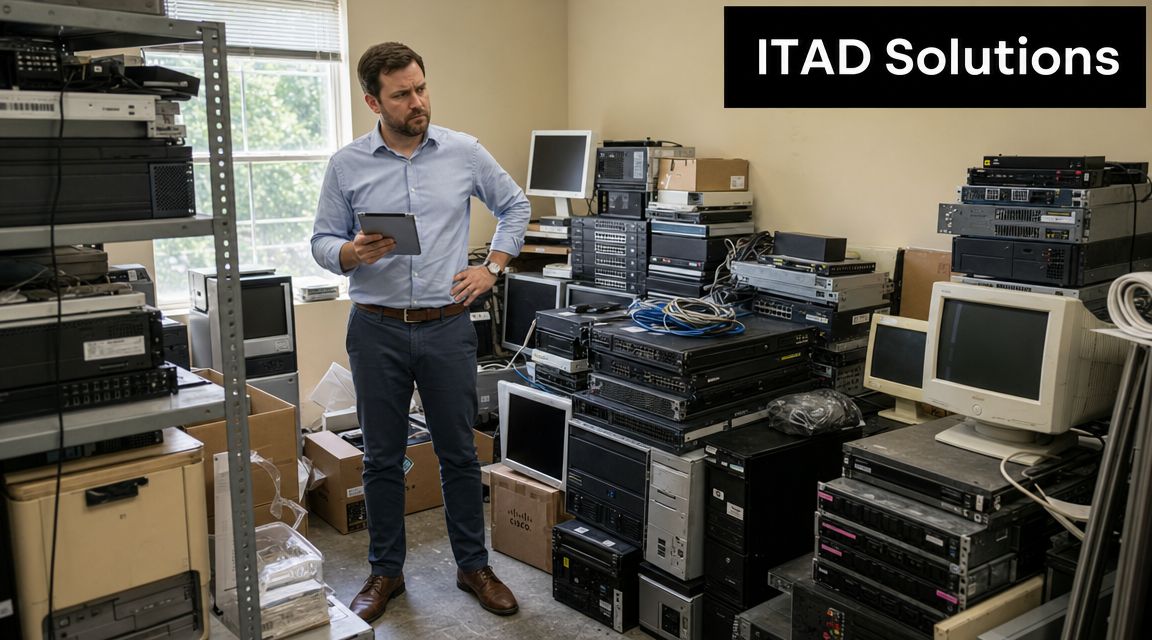
The market reflects that shift. The global data center ITAD market was estimated at US$13.7 billion in 2024 and is projected to reach US$19.1 billion by 2030, a projection tied to rising demand for documented data sanitation, resale recovery, and compliance reporting, according to this data center ITAD market analysis.
What business managers usually underestimate
Most internal teams focus on removal. They ask who can pick everything up this week. That matters, but it's not the hard part.
The hard part is building a process that answers these questions later:
- What left the site and under whose control?
- Which assets contained data and what method was used on each one?
- Which items were reusable and which were nonfunctional?
- What record ties final destruction or recycling back to the original asset list?
Secure ITAD starts with inventory discipline, not with a truck.
A practical ITAD program treats old equipment as a controlled stream of assets, not scrap. That's why businesses looking for Sandy Springs IT equipment recycling services should evaluate process depth as closely as pickup capability. In practice, the strongest programs combine serialized tracking, media-specific destruction decisions, downstream reporting, and clean handoff between operations, security, and compliance teams.
Why Secure Data Destruction Is Non-Negotiable
You can replace hardware. You can't easily repair a data handling failure that exposes customer records, internal files, or regulated information. Once a retired device leaves your building without controls, the risk is no longer theoretical.
Industry guidance published in 2026 makes the standard clear. Secure ITAD is no longer treated as a best practice. It's a documented compliance process that requires service elements such as on-site shredding, secure transport, chain-of-custody documentation, and certificates of destruction to transfer liability, as outlined in this 2026 secure ITAD guidance.
What doesn't work
A surprising number of organizations still rely on weak controls at end of life. These are the patterns that create audit and legal exposure:
- Informal storage: Devices sit for months with no asset list, no owner, and no retirement decision.
- Bulk disposal without media review: Working SSDs, failed drives, laptops, and servers all go into the same outbound stream.
- Receipt-based thinking: A pickup ticket gets treated like proof of compliant destruction.
- Vendor trust without verification: Teams assume the downstream process is sound because the vendor says it is.
None of those steps creates defensible evidence.
What holds up under scrutiny
A compliant approach is more disciplined. It starts before pickup and ends after verification. Security teams want method selection. Procurement wants custody records. Legal wants proof that responsibility transferred under a documented process.
Operational reality: If your destruction paperwork can't be matched back to specific devices, auditors may treat it as incomplete.
That's why secure destruction isn't just about eliminating data. It's about producing records that show your organization controlled the asset from retirement through final disposition. For Sandy Springs companies with healthcare, finance, government, or enterprise obligations, undocumented disposal is a bad bet. The risk isn't only in the drive. It's in the missing paperwork.
Certified Wiping vs Physical Shredding
The most common buying mistake is treating wiping and shredding as interchangeable. They are not. Each has a different purpose, and the right choice depends on media condition, sensitivity, reuse plans, and the level of proof your organization requires.
Certified data wiping, benchmarked by NIST SP 800-88, sanitizes storage media so data is rendered irrecoverable while preserving the asset's resale value. That allows organizations to route reusable assets to verified erasure workflows and reserve shredding for failed or high-risk media, as explained in this hard drive erasure and sanitization overview.
Where wiping makes sense
Wiping is the right fit when the device is functional, the media can be sanitized according to the required standard, and the organization wants to preserve refurbishment or resale value. This is especially useful for laptop refreshes, workstation rotations, and portions of mixed enterprise fleets where the hardware still has downstream use.
Where shredding makes sense
Shredding is the stronger option when media has failed, when reuse is off the table, or when the sensitivity level pushes the organization toward physical destruction. It also simplifies disposition when the cost of testing and erasure outweighs any likely recovery value.
Comparison of Data Destruction Methods
| Attribute | Certified Data Wiping (NIST 800-88) | Physical Shredding |
|---|---|---|
| Primary outcome | Sanitizes media for reuse | Permanently destroys media |
| Asset value | Preserves resale or redeployment potential | Eliminates refurbishment value |
| Best fit | Functional, reusable devices | Failed, high-risk, or non-redeployable media |
| Verification focus | Erasure validation and process records | Witnessed destruction and destruction records |
| Common use case | Laptop and desktop refresh projects | Damaged drives, obsolete storage, sensitive media |
The method should match the media. If you shred every drive by default, you may be destroying recoverable value. If you wipe every drive by default, you may be applying the wrong control to failed or higher-risk media.
A disciplined ITAD program separates assets early. Test the device. Identify the media type. Decide whether reuse is realistic. Then apply the correct destruction path.
On-Site vs Off-Site Shredding Logistics
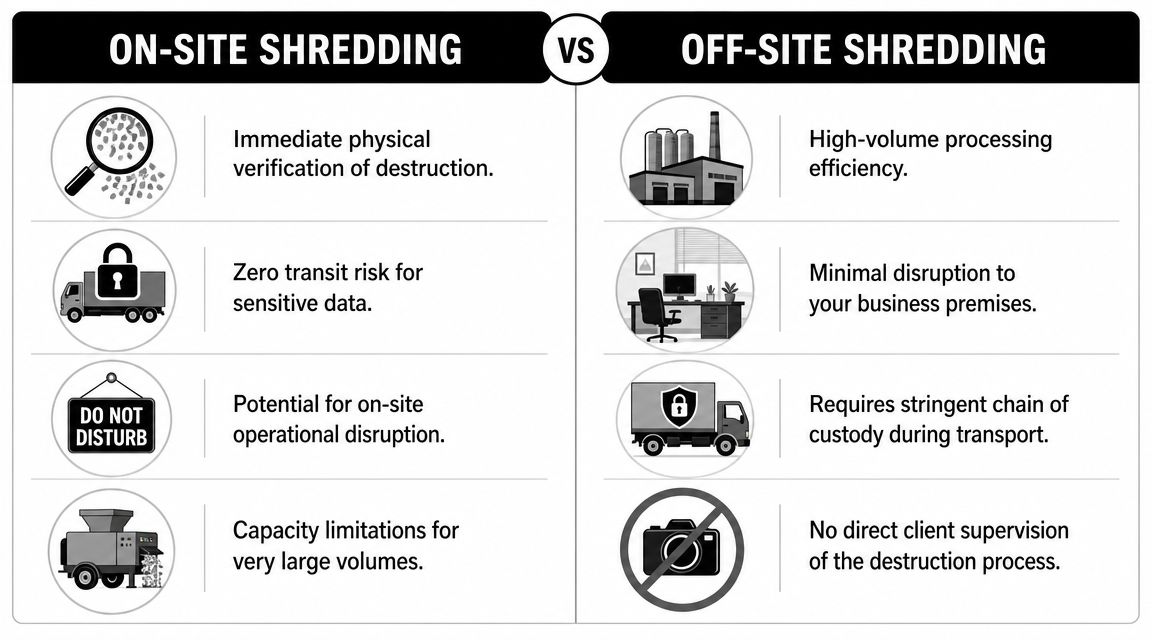
Once your team decides physical destruction is necessary, the next decision is logistical. Should the shredding happen at your Sandy Springs location or after transport to a secure processing facility? There isn't one right answer for every organization.
When on-site shredding is the better call
On-site destruction works well when your security team wants immediate physical verification. It's often preferred for highly sensitive media, executive concern, or situations where an internal policy limits transit of intact drives.
Typical reasons to choose on-site:
- Direct observation: Staff can witness destruction at the facility.
- Reduced transit exposure: Media isn't transported intact to another location.
- Immediate closure: Sensitive drives can be destroyed the same day they're collected.
There are trade-offs. Mobile shredding can affect loading areas, parking access, noise levels, and scheduling. It also may not be the most efficient option for unusually large or complex volumes.
When off-site processing is more practical
Off-site shredding works when the vendor's secure transport controls are strong and the job benefits from facility-scale throughput. For many office relocations, multi-floor pickups, or larger decommissions, this model is easier to execute without disrupting operations.
A sound off-site workflow should include sealed containers, controlled transfer points, and documented intake at the processing facility. If you're comparing options, review how on-site data destruction in Georgia differs operationally from plant-based processing and ask what evidence is generated at each handoff.
Off-site can be secure. The deciding factor isn't distance. It's whether custody is documented from pickup through intake and destruction.
Ensuring an Auditable Chain of Custody
This is the part many vendors describe loosely and many buyers inspect too late. A Certificate of Destruction is useful, but by itself it doesn't prove much. What makes it legally defensible is the trail behind it.
A common gap in ITAD programs is the lack of documented proof across the full chain of custody. A defensible certificate requires serial-level inventory tracking from pickup to final disposition, validating that each device was handled under NIST 800-88 guidelines, according to this analysis of ITAD chain-of-custody gaps.
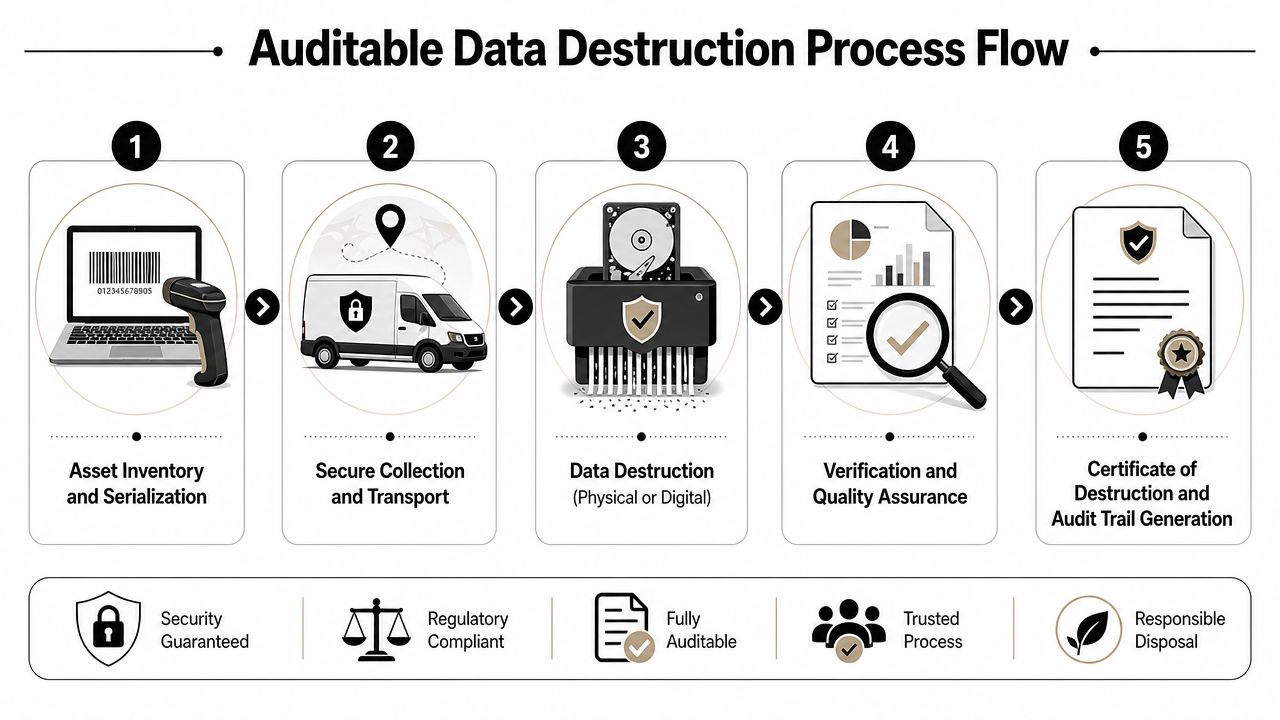
What a defensible process looks like
The strongest custody workflows are simple to describe because every step is controlled.
Asset inventory and serialization
Devices are counted, categorized, and tied to serial numbers or equivalent asset identifiers before they leave your control.Secure collection and transport
Containers are sealed, the pickup is documented, and the transport stage isn't treated as a black box.Media-specific destruction
Drives that qualify for wiping are processed under verified erasure workflows. Failed or high-risk media moves to physical destruction.Verification and quality checks
The vendor confirms the process was completed correctly and resolves exceptions instead of hiding them in a bulk report.Certificate linked to the original asset list
Final reporting ties the disposition record back to the devices originally collected.
Questions worth asking before pickup day
A lot of weak programs sound polished until you ask for examples. Ask to see a sample hard drive certificate of destruction and then ask what source records support it.
Look for these details:
- Serial traceability: Can the vendor show where each drive appears in the intake and final disposition record?
- Exception handling: What happens when a serial number is unreadable or a device arrives damaged?
- Method clarity: Does the documentation distinguish wiped media from shredded media?
- Audit readiness: Can legal or compliance teams follow the record without asking for extra explanation?
If the answer is vague, the process probably is too.
Balancing Security with Asset Value Recovery
A mature ITAD program doesn't force a false choice between protection and financial discipline. You can reduce risk and still recover value, but only if method selection happens early and intentionally.
Recent guidance makes the point well. A one-size-fits-all destruction model is weak. Certified vendors should match the method to the media and the reuse objective, especially when enterprises are balancing compliance, ESG, and asset recovery goals, as discussed in this ITAD guide on matching destruction methods to business objectives.
The practical decision framework
For most business managers, the easiest way to think about this is by asset lane:
- Redeploy lane: Functional systems that can stay in service after verified sanitization.
- Resale lane: Equipment with secondary market value after compliant data wiping.
- Destruction lane: Failed, obsolete, or high-risk media that shouldn't be returned to circulation.
- Recycling lane: Non-recoverable electronics that still require compliant downstream handling.
That's why IT buyback and ITAD should be discussed together. If your team shreds reusable media before valuation, the recovery opportunity is gone. If your team chases recovery without controlling sanitization, you've increased exposure. A balanced program uses Georgia ITAD services that focus on value recovery only after the security decision is made correctly.
Beyond Surplus offers on-site and off-site hard drive shredding, certified data wiping, and certificates of recycling and data destruction for organizations that need both security controls and compliance documentation.
Your Sandy Springs ITAD and Data Security Checklist
If you're evaluating vendors, use a checklist that goes past pickup speed and pricing. The safer choice is usually the provider that can document the process clearly before the first asset leaves your building.
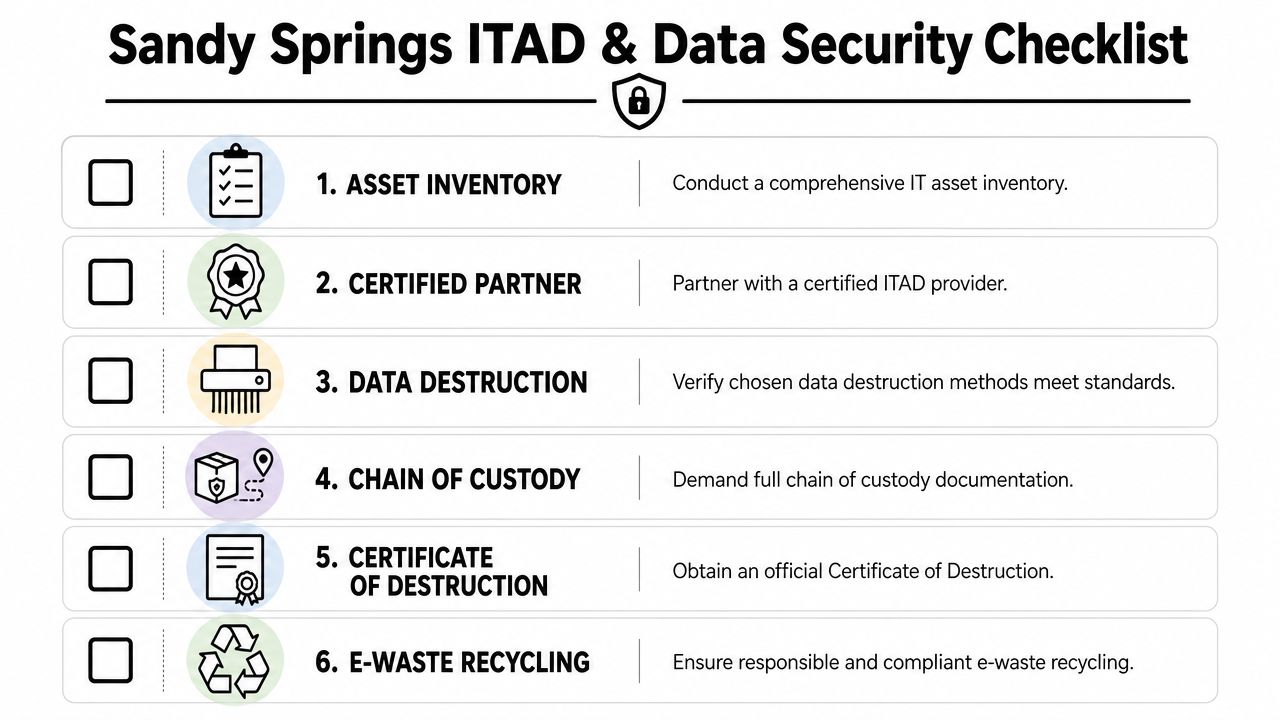
Use this short list with your internal stakeholders:
- Inventory first: Build a clear list of devices, media types, and locations.
- Match method to asset: Don't apply the same destruction path to every device.
- Demand custody records: Ask how pickup, transport, intake, and final disposition are documented.
- Review sample reporting: Look at the certificate and the records behind it.
- Clarify value recovery: Separate reusable assets from destruction-only media before processing.
- Confirm downstream handling: Make sure recycling and destruction outputs are both documented.
If a vendor can't explain the custody trail in plain language, they probably can't defend it in an audit.
If your Sandy Springs team needs a documented process for retired laptops, servers, storage, and mixed IT equipment, contact Beyond Surplus for certified electronics recycling and secure IT asset disposal.


