

Think of a "compliance fast-pass" for recycling some of the most common, yet hazardous, items your business deals with every day. That’s the simplest way to understand universal waste systems. These are streamlined regulations from the U.S. Environmental Protection Agency (EPA) that make managing things like batteries and fluorescent lamps much easier and less costly for commercial enterprises.
Why Universal Waste Systems Are Critical for Your Business
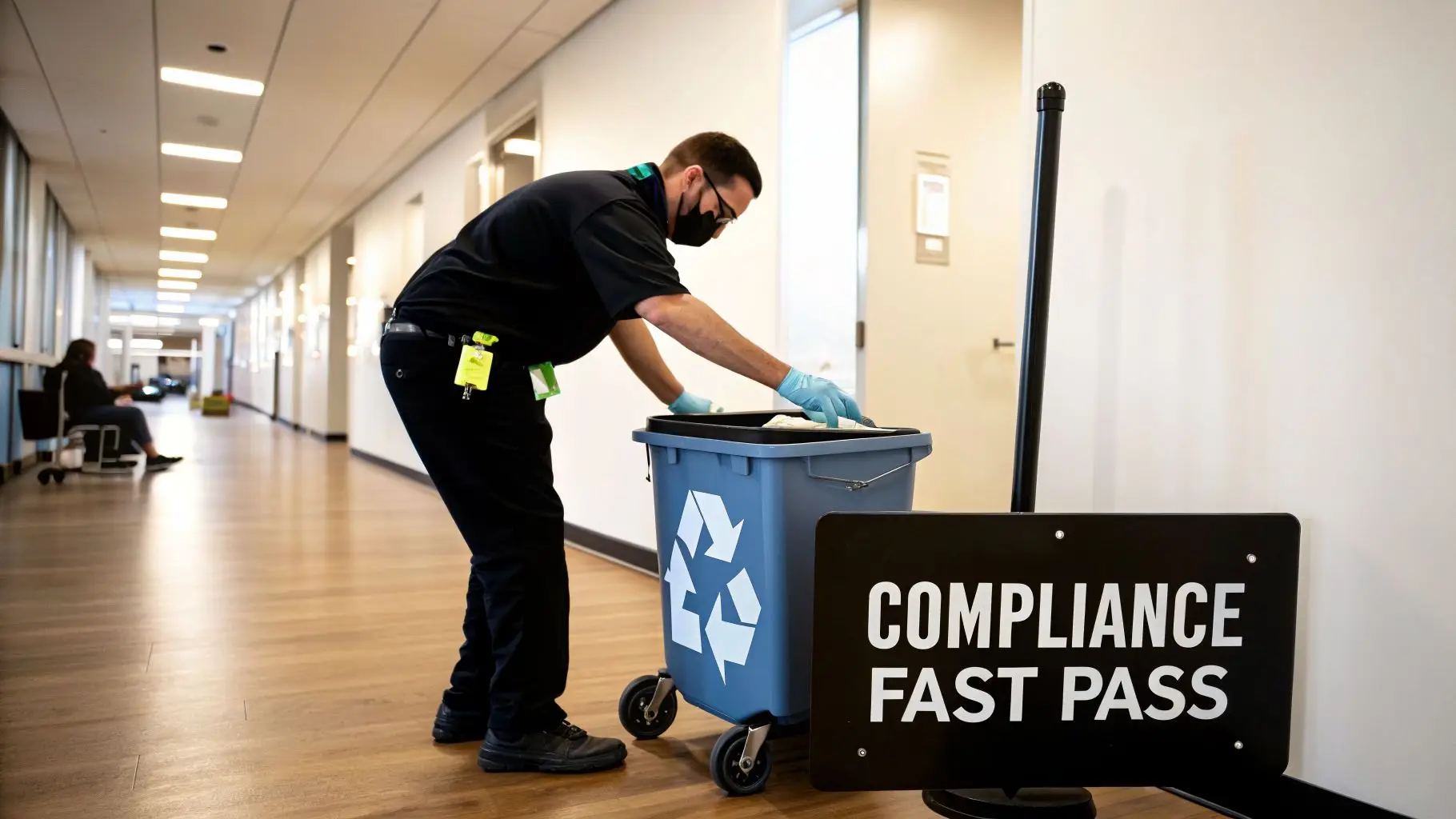
For IT managers, facility managers, and procurement professionals, mastering universal waste is a core component of corporate risk management. Disposing of these items improperly—for example, in standard commercial trash—can lead to significant regulatory fines, environmental liability, and damage to your company's reputation. The universal waste rules provide a practical, compliant alternative to the more stringent regulations governing other types of hazardous waste.
The Business Case for Compliance
Implementing a compliant universal waste system is a strategic business decision. The primary benefit is avoiding steep fines and legal challenges associated with improper hazardous waste disposal. By simplifying the regulations, the EPA encourages businesses to recycle these materials correctly rather than risking non-compliance.
This "compliance fast-pass" saves both time and money. Instead of navigating the complex Resource Conservation and Recovery Act (RCRA) requirements for hazardous waste, your team can follow a more straightforward process for:
- Collection: Designate specific, marked bins or areas for each type of waste.
- Labeling: Mark containers with clear, required text identifying the contents.
- Storage: Accumulate waste on-site for up to one year, providing flexibility for scheduling efficient pickups.
From Office Lighting to Data Center Batteries
These regulations apply to items your business handles frequently, especially those with large facilities or extensive IT infrastructure.
IT managers regularly decommission uninterruptible power supply (UPS) units containing lead-acid batteries. Concurrently, facility managers replace thousands of fluorescent lamps. Both are classic examples of universal waste, and their proper management is a fundamental operational task. For a comprehensive list of items in this category, see our guide on universal waste management.
By integrating universal waste management into your asset lifecycle process, you transform a potential liability into a routine, manageable task. This proactive approach is essential for protecting your organization from compliance issues and demonstrating corporate environmental responsibility.
Ultimately, a well-managed universal waste program is a business necessity. It integrates directly into your IT asset disposition (ITAD) and facility maintenance strategies, ensuring every end-of-life asset is handled in accordance with federal and state law. This structured approach protects your bottom line, safeguards your brand, and promotes a more sustainable operation.
How to Identify Universal Waste in Your IT and Facility Assets
Now that you understand what universal waste is, the next step is identifying it within your facility. For any IT or facilities team, the ability to spot these materials is the first line of defense against costly compliance errors. A single misidentified battery or lamp can disrupt your entire disposal strategy.
The objective is to make recognition of these items second nature for your staff. Universal waste is a specific category with its own rules, not a general term for "old electronics." Think of it like sorting mail: a letter, a package, and an oversized envelope all get delivered, but each requires distinct handling. Your waste streams function similarly.
Common Universal Waste Items in Business Environments
Take a look around your office, data center, or warehouse. Your business is likely generating universal waste right now. Training your team to identify these common items is the first step toward a compliant program.
Batteries: This is a major category, covering everything from the lithium-ion batteries in laptops and mobile devices to the nickel-cadmium (Ni-Cd) batteries in older equipment. It also includes the large sealed lead-acid (SLA) batteries that power your uninterruptible power supply (UPS) systems and emergency lighting.
Lamps: Nearly any light bulb that is not an LED is likely universal waste. This includes the long fluorescent tubes common in office ceilings, compact fluorescent lamps (CFLs), and powerful high-intensity discharge (HID) lamps used in warehouses and manufacturing facilities. All contain small amounts of mercury.
Mercury-Containing Equipment: Beyond lamps, mercury can be found in older LCD monitors and flat-screen TVs that use CCFL backlights. It may also be present in legacy thermostats, switches, and certain types of medical or laboratory equipment.
Distinguishing Between Waste Categories
A common point of confusion for businesses is distinguishing universal waste from other types of commercial e-waste. Commingling these materials is a recipe for regulatory trouble and can introduce safety risks. Proper sorting is critical. You can explore the 2025 Global Waste Index findings on Sensoneo.com for a closer look at global waste generation trends.
This table clarifies the key differences to help your team correctly sort end-of-life business assets.
Universal Waste vs. Standard E-Waste vs. Hazardous Waste
| Waste Type | Common Examples in a Business/Data Center | Primary Regulatory Framework | Key Handling Requirement |
|---|---|---|---|
| Universal Waste | UPS batteries, fluorescent lamps, older LCDs with CCFL backlights, thermostats | Streamlined EPA rules (40 CFR Part 273) | Must be labeled, stored for less than one year, and sent to a certified recycler. Less stringent than full hazardous waste rules. |
| Standard E-Waste | Servers, network switches, laptops, keyboards, newer LED monitors, office phones | State-specific electronics recycling laws and data privacy regulations (e.g., FTC Disposal Rule) | Focus is on secure data destruction and responsible materials recovery. Not federally hazardous but often banned from landfills. |
| Hazardous Waste | Cathode Ray Tube (CRT) monitors, chemical solvents, industrial cleaning agents | Full RCRA Subtitle C regulations | Requires a manifest, licensed transporter, and disposal at a permitted Treatment, Storage, and Disposal Facility (TSDF). Very strict. |
Seeing it laid out like this makes the distinction much clearer. The "universal" label is designed to make your life easier, not harder.
Key Takeaway: The "universal" designation is a benefit, not a burden. It allows your business to manage specific hazardous items with greater flexibility and lower administrative overhead compared to the stringent RCRA hazardous waste rules.
Correctly identifying these materials is the foundation of a sound IT asset disposal program. For more detailed guidance, our guide on professional universal waste disposal services can help. When you equip your team with this knowledge, you ensure every retired asset is managed securely, compliantly, and efficiently.
The Four Pillars of a Compliant Universal Waste Program
Building a compliant universal waste system for your business does not have to be an overwhelming task. The regulations, while specific, are based on four core pillars: collection, labeling, storage, and training.
By mastering these four areas, you can transform complex rules into a straightforward, routine process that protects your business from liability.
This diagram breaks down the main categories of universal waste that you’ll need to identify and manage.
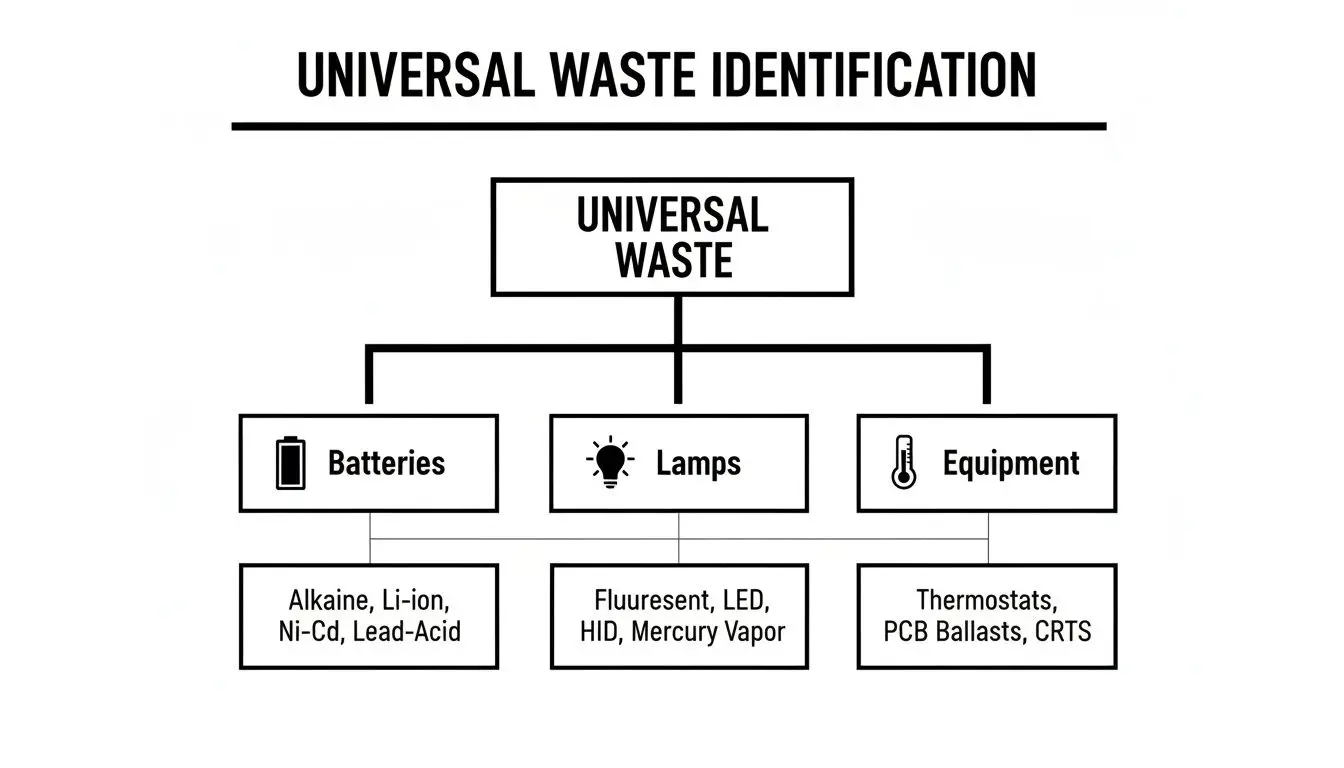
It clearly separates items into distinct groups—batteries, lamps, and mercury-containing equipment—helping your team quickly recognize what requires special handling.
Pillar 1: Proper Collection
The first step is to establish designated collection points for each type of universal waste. This is more than placing a bin in a corner; it requires creating a structured system for separation.
These collection points, often called satellite accumulation areas, should be clearly marked and located where the waste is generated—for instance, in a data center for used UPS batteries or a maintenance closet for spent fluorescent lamps.
Ensure your containers are durable and compatible with the waste they hold to prevent leaks or breakage. For example, fragile lamps should be placed in protective boxes or drums, not flimsy containers where they could easily shatter.
Pillar 2: Accurate Labeling
Once collected, every container of universal waste must be properly labeled. This is a non-negotiable EPA requirement. The label serves two critical functions: it identifies the contents and marks the beginning of your storage timeline.
The EPA requires specific wording. You cannot simply write "Old Batteries." The label must clearly state one of the following:
- "Universal Waste—[Waste Type]" (e.g., "Universal Waste—Batteries")
- "Waste [Waste Type]" (e.g., "Waste Lamps")
- "Used [Waste Type]" (e.g., "Used Mercury-Containing Equipment")
Critical Compliance Point: Along with the waste type, you must mark the date when the first item of waste was placed in the container. This "accumulation start date" initiates the one-year storage clock.
Pillar 3: Compliant Storage
The universal waste rules provide a significant advantage: you can store this waste on-site for up to one year from the accumulation start date. This generous window allows for flexibility in scheduling cost-effective pickups with a certified recycler. However, this flexibility comes with responsibility.
Your primary duty is to store all waste in a manner that prevents its release into the environment.
This means you must:
- Keep containers closed unless actively adding or removing waste.
- Store containers in a secure area to prevent damage or unauthorized access.
- Maintain a system for tracking dates to ensure no container exceeds the one-year limit.
While the complex manifest system required for fully regulated hazardous waste is not necessary, maintaining a simple log of your containers and their start dates is a best practice. This documentation can serve as your proof of compliance during a regulatory inspection. For a deeper look at vetting recycling partners, our vendor due diligence checklist outlines the key questions to ask.
Pillar 4: Essential Employee Training
The final pillar is ensuring your team knows how to handle these materials safely. A program is only as strong as the people who execute it. Any employee who handles or manages universal waste must be fully informed about proper procedures and emergency responses.
This training does not need to be a formal seminar; it can be integrated into regular safety meetings. The key is to ensure every relevant employee understands:
- Identification: How to recognize and correctly sort different types of universal waste.
- Handling: Safe practices for moving and storing materials to prevent breakage or spills.
- Labeling: The importance of dating and correctly labeling every container.
- Emergency Response: What to do in case of a spill or release, such as a broken fluorescent lamp releasing mercury vapor.
By systematically implementing these four pillars, you create a robust and defensible universal waste system that simplifies regulatory burdens and protects your business from liability.
Securely Shipping and Transporting Universal Waste

You have carefully collected, labeled, and stored your universal waste. The final step is getting it off-site and to a certified facility. This is a critical point where your internal compliance program intersects with external logistics, directly impacting your company's liability.
Fortunately, universal waste rules simplify this process compared to fully regulated hazardous waste. A significant advantage is that a hazardous waste manifest is not required for transport, which reduces administrative overhead. However, simplicity should not be mistaken for a lack of responsibility; you must ensure the waste reaches an authorized destination.
Packaging for Safe Transit
Before any universal waste leaves your facility, it must be packaged to prevent breakage or leaks. This is a strict regulatory requirement designed to protect handlers and the environment. A single spill from an improperly packed container could reclassify your shipment as a hazardous material release, triggering the complex regulations you worked to avoid.
Key packaging tips for businesses:
- For Lamps: Use original packaging or specially designed fiberboard drums to prevent fragile fluorescent tubes from shattering. Once palletized, shrink-wrap the entire pallet for stability.
- For Batteries: Protect terminals on lead-acid or lithium-ion batteries to prevent short circuits. Always use sturdy, leak-proof containers, especially for any battery that could leak corrosive fluids.
- For Equipment: Pack devices containing mercury, such as older thermostats or switches, securely to prevent the glass ampules or components from breaking.
Choosing Your Destination and Transporter
While you don't need a licensed hazardous waste hauler, you cannot send your universal waste to just any facility. It must be transported to a destination authorized to receive it. This could be another universal waste handler or, more commonly, a certified destination facility—such as a permitted recycler or treatment center.
As the generator, your liability does not end when the truck leaves your dock. Choosing a non-certified or irresponsible vendor means you retain liability if that waste is mismanaged or illegally dumped, exposing your company to significant financial and reputational damage.
This is precisely why partnering with a qualified IT Asset Disposition (ITAD) provider like Beyond Surplus is a strategic business decision. A professional partner manages the entire process, providing correct packaging, arranging transport, and ensuring final disposition at a vetted, certified facility. This seamless coordination is integral to our nationwide reverse logistics services, designed to protect your business interests from start to finish.
The environmental stakes are too high to ignore. For example, plastic waste is a global crisis, and much of your e-waste is cased in it. In 2025, a shocking 31.9% of all plastic was projected to be mismanaged globally. Since electronics are a mix of plastics and hazardous materials, it underscores why you need certified partners who can responsibly handle every single component.
Ultimately, a documented chain of custody from a trusted vendor is your best defense, connecting your internal compliance program to secure and responsible vendor management.
Mastering Documentation and Choosing the Right Partner
For universal waste management, effective documentation is not merely administrative; it is your primary defense against future liability. This documentation creates an unbroken chain of custody, detailing the complete journey of every asset from the point of disposal to its final, secure processing.
The paper trail begins within your facility with consistent logs. Tracking the accumulation start date for each waste container is crucial for proving compliance with the one-year on-site storage limit. When the waste is ready for transport, the bill of lading serves as the next link, documenting the official transfer to your recycling partner.
The final and most critical document is the Certificate of Recycling and Data Destruction. This formalizes the transfer of liability from your company to your certified vendor, confirming that all materials were managed in accordance with state and federal regulations.
Vetting and Selecting a Certified Partner
Selecting the right partner for your universal waste and IT asset disposal is one of the most critical business decisions you will make. Your vendor's performance directly reflects on your company's compliance and reputation. Choosing an uncertified or unqualified recycler is a direct path to significant risk, as you remain liable for any downstream errors.
When evaluating potential partners, look beyond a simple price quote. Ask targeted, specific questions:
- Certifications: Are you R2v3 or e-Stewards certified? These are the industry's premier standards, demonstrating adherence to the highest environmental and data security benchmarks.
- Regulatory Authority: Are you registered with the EPA and fully authorized to transport and handle universal waste?
- Chain of Custody: Can you provide a complete, serialized chain-of-custody record for all processed assets?
- Documentation: Will you issue a serialized Certificate of Recycling and Data Destruction for every service job?
- Downstream Vetting: What is your process for auditing your own downstream partners to ensure they are also compliant?
A transparent and professional partner will readily provide clear answers to these questions and should be able to walk you through their entire process, from pickup to final disposition.
The Value of an Integrated ITAD Partner
For most businesses, managing universal waste is one part of a larger asset disposition strategy. The scale of this challenge is massive; in 2022, the world generated 2.56 billion tonnes of solid waste, with an annual management cost exceeding US$250 billion. You can read the full World Bank analysis on global waste trends to understand the scope of this global issue.
An integrated IT Asset Disposition (ITAD) partner like Beyond Surplus simplifies this complexity by consolidating all necessary services under a single, accountable provider. Instead of managing separate vendors for universal waste, electronics recycling, and data destruction, you have one expert partner.
Beyond the physical handling of waste, managing a compliant universal waste program involves significant administrative and documentation tasks. Embracing understanding workflow automation can streamline these repetitive processes, freeing up valuable time and resources.
This type of partnership strengthens your operations. A qualified vendor provides all necessary documentation, such as a destruction certificate template, ensuring every step is properly recorded.
By entrusting your universal waste systems to a certified expert, you protect your organization, guarantee full regulatory compliance, and free up your team to focus on core business objectives.
Common Questions About Universal Waste Management
When it comes to universal waste, the rules can seem a little murky, and it’s natural to have questions. While the program is designed to simplify things, real-world situations often bring up the same key concerns for IT managers, business owners, and facilities teams. Let's clear up some of the most common questions to help you manage your program with confidence and avoid easy-to-make mistakes.
What Happens if Universal Waste Is Mixed with Regular Trash?
It’s a scenario that happens all too often: someone accidentally tosses a few old batteries or a handful of fluorescent lamps into the commercial dumpster. It might seem like a small oversight, but the consequences can be surprisingly severe. Once universal waste is mixed with regular solid waste, the entire container is often reclassified as hazardous waste.
This single mistake can trigger a cascade of problems. Suddenly, you're on the hook for the much stricter and more expensive disposal rules under the Resource Conservation and Recovery Act (RCRA). This can lead to steep regulatory fines from environmental agencies and a massive jump in disposal costs. Your company is also liable for that waste from "cradle to grave," meaning if a landfill finds the improperly mixed waste, the legal and financial responsibility traces right back to you.
Think of it like adding a drop of red dye to a gallon of water—the whole batch is changed. The same principle applies here; a small amount of contamination can spoil the whole load.
How Does My Company’s Size Affect the Rules We Follow?
Your company's size absolutely matters when it comes to universal waste. The EPA has two main categories for generators, and it all depends on how much waste you have on-site at any single point in time.
Small Quantity Handler of Universal Waste (SQHUW): Most businesses fall into this category. If you store less than 5,000 kilograms (that's about 11,000 pounds) of total universal waste, you're an SQHUW. The rules are more streamlined, focusing on proper labeling, safe storage in containers, basic employee awareness, and sticking to the one-year storage limit.
Large Quantity Handler of Universal Waste (LQHUW): If your business accumulates 5,000 kg or more of universal waste, you're bumped up to LQHUW status. This brings extra responsibilities, like officially notifying the EPA about your waste activities and keeping more detailed records of all your shipments.
The key is to keep an eye on your accumulation levels. A big data center refresh or an office-wide cleanout could easily push a company from an SQHUW to an LQHUW, even if it's just for a short time.
What Is the Absolute Deadline for Storing Universal Waste On-Site?
The deadline is firm: you can hold onto universal waste for no longer than one year. That one-year clock starts ticking the very second the first piece of waste—whether it’s a single battery or a lamp—goes into a collection bin. This is precisely why labeling each container with its "accumulation start date" isn't just a good idea; it's a core compliance rule.
The one-year limit is a key benefit of the universal waste program, giving you operational flexibility. However, it is not a suggestion. Exceeding this timeframe means the waste is no longer eligible for the simplified universal waste rules and may become subject to full hazardous waste regulations, erasing all the compliance advantages.
A simple tracking log or a quarterly check-in on your storage areas is all it takes to make sure a container never goes past its "best by" date. It’s a small administrative step that prevents a huge regulatory headache.
Who Exactly in My Organization Needs to Be Trained?
The training requirement is much broader than most people think. It’s not just for the EHS manager. The EPA states that any employee who handles universal waste or is responsible for managing it needs to be properly trained on safe handling and what to do in an emergency.
This casts a wide net and includes people like:
- IT Staff: Technicians who swap out laptops, servers, and UPS units containing lithium-ion batteries.
- Facilities and Maintenance Teams: The crew that changes out fluorescent bulbs or old mercury-containing thermostats.
- Warehouse Personnel: Employees who manage the central accumulation areas and prepare waste for shipment.
- Custodial Staff: Workers who might be the first to find a broken lamp or leaking battery and need to know the right way to respond.
The training itself should cover the basics: how to identify the waste, handle it safely, label containers correctly, and what immediate steps to take if a lamp breaks or a battery leaks. This way, everyone on your team becomes a part of your compliance defense.
Do State Rules Differ from Federal EPA Regulations?
Yes, they definitely do. The federal program run by the EPA is just a baseline. Individual states have the authority to create their own, often stricter, universal waste rules. For example, some states add paint, pesticides, or other materials to their programs to simplify disposal for businesses.
On the other hand, some states might not recognize a certain federal universal waste at all, meaning you'd have to manage it as a full-blown hazardous waste inside their borders. For any company with facilities in multiple states, this is a critical detail to track. You can't just assume the rules that apply in one location are valid everywhere else.
This is where having a certified ITAD and recycling partner proves its worth. A knowledgeable expert like Beyond Surplus keeps up with the complex and changing web of federal and state-specific regulations, making sure your business stays compliant no matter where you operate.
Navigating the complexities of universal waste systems is critical for corporate risk management and operational efficiency. For certified electronics recycling, secure IT asset disposal, and expert guidance on your business's compliance program, contact Beyond Surplus for a consultation. Schedule your nationwide pickup here.


