Chicago buyers usually start this search when something is already hurting. A branch office keeps dropping calls. A cloud migration exposed the limits of a cheap broadband circuit. A building manager says the riser is full, the carrier says construction is required, and the business still needs uptime next quarter. That's the context behind telecommunications services Chicago searches.
Chicago remains a serious telecom market because it combines dense carrier presence with a major corporate customer base, including Chicago-based providers such as TDS and Access One, and broad enterprise demand for fiber internet, VoIP, SD-WAN, hosted voice, and managed networking across the metro area (Chicago telecom market context). That density gives enterprise buyers options, but it also makes comparisons messy. The wrong choice often isn't the “bad provider.” It's the wrong access method, wrong SLA, or wrong fit for the building.
The practical question isn't who advertises the fastest speed. It's who can support your sites, your failover design, your voice stack, and your cloud traffic without turning every change request into a project.
1. Comcast Business (Greater Chicago Region)
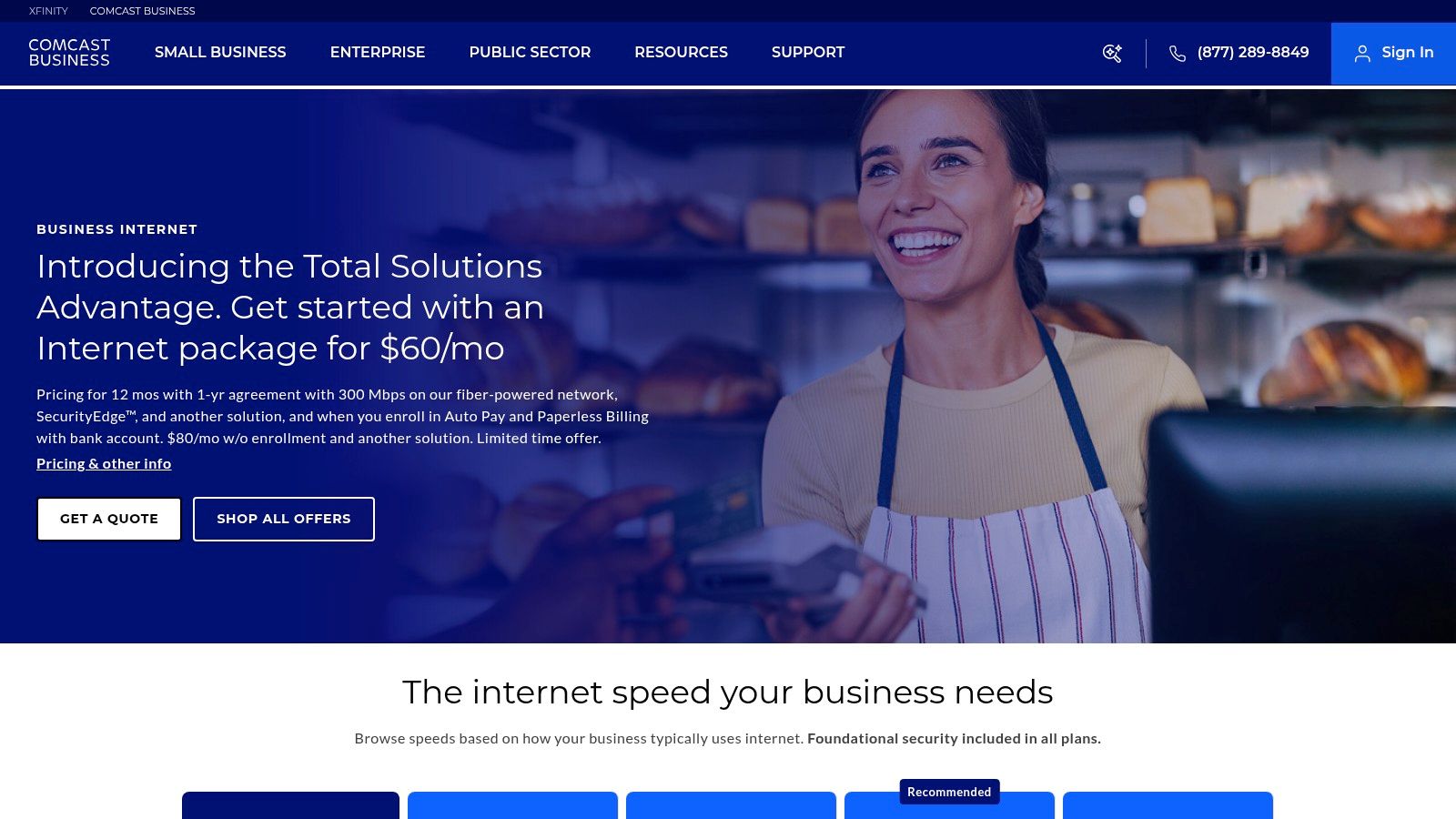
Comcast Business is often the practical first quote in Chicago because it can cover a lot of ground. If you need broadband at one site, Dedicated Internet at another, Metro Ethernet between offices, and managed WiFi in a customer-facing environment, Comcast usually has a product for it.
For single-site offices, it's easy to overbuy or underbuy here. HFC and coax tiers can work for general productivity, guest WiFi, and light cloud usage. They're not what I'd choose for latency-sensitive voice, transaction systems, or a headquarters that can't tolerate noisy shared access behavior. In those cases, Dedicated Internet is the safer purchase.
Where Comcast fits best
Comcast is strong when you need one provider that can serve both ordinary and critical locations without creating a completely fragmented support model.
- Best use case: Primary internet for mainstream offices, or backup circuits for sites that already have a fiber incumbent
- Better product tier: DIA when uptime and performance matter
- Useful add-ons: LTE-based failover, managed WiFi, and security overlays for lean IT teams
Practical rule: In Chicago, don't compare Comcast coax against enterprise fiber as if they solve the same problem. They don't.
Its regional field presence also matters. In a metro this size, local dispatch, building coordination, and account management affect outcomes more than marketing claims. If you're comparing providers for office connectivity and telecom lifecycle planning, this broader view of local telecom companies and support models is worth keeping in mind.
The trade-off is variability. Pricing, install timing, and construction requirements can swing hard by address. If your building already has Comcast on-net, the process is usually straightforward. If it doesn't, the quote can look very different from the first conversation.
2. AT&T Business
AT&T Business makes the most sense when the network design matters as much as the access circuit. Chicago enterprises with multiple sites, compliance requirements, or a mix of wired and wireless resilience often end up shortlisting AT&T because it can bundle fiber, Ethernet, VPN-style WAN options, wireless, and voice under one procurement track.
That doesn't mean every site should go with AT&T. The main issue is address specificity. A great enterprise portfolio is only useful if the building can get the service tier you need without expensive construction or long lead times.
What AT&T does well
AT&T is a strong fit for organizations that want fewer handoffs between network teams and mobility teams.
- Fiber plus wireless design: Useful for primary plus backup architectures
- Enterprise WAN options: Better fit than commodity internet when you need policy control across sites
- Support model: Usually more comfortable for procurement teams that want formal documentation and structured escalation paths
A lot of Chicago companies searching for telecommunications services in Chicago don't need another internet bill. They need a provider that can handle a branch rollout, temporary wireless turn-up, and long-term fiber migration without forcing a new vendor at each step. AT&T can do that better than many providers built only for one access type.
For fast site activation, fixed wireless can keep a project moving. For steady-state critical traffic, wired transport still wins most of the time.
If you're sorting through nearby carrier options and trying to separate business-grade service from generic local listings, this directory of telecom services near me for business use can help frame the comparison.
The downside is that quote-based enterprise pricing takes patience. AT&T is rarely the simplest bid to evaluate, but it can be one of the more complete ones.
3. Verizon Business

Verizon Business internet services stand out in Chicago when speed of deployment matters almost as much as circuit quality. If you need a branch online quickly, want to avoid a messy construction project, or need wireless backup under the same vendor umbrella, Verizon is often a credible option.
Its strongest card is access diversity. You can look at fixed wireless, LTE backup, and Dedicated Internet in the same conversation. That's useful for retail, temporary office space, clinics, and smaller distributed sites where waiting on a fiber build can slow down operations.
The real trade-off
Wireless-first business internet is convenient. It is not equivalent to a fully engineered fiber handoff with an enterprise SLA and predictable behavior under load.
Verizon works best when you're honest about that difference. For interim connectivity, backup design, and sites with moderate demand, it can be a smart operational choice. For heavy voice concentrations, always-on VPN traffic, or large data movement, I'd still push buyers toward dedicated wired access where possible.
Chicago enterprises also have to check footprint carefully. Fios availability is selective, and fixed wireless performance depends on local conditions. The convenience is real, but so is the need for site-level validation.
If your team manages telecom projects across multiple markets, not just Illinois, it can help to compare how firms structure services in other metros, including telecom services in Houston for business environments.
One budget point matters here. The broader telecom services market is projected at USD 2.34 trillion in 2026 and USD 4.35 trillion by 2036, reflecting continued carrier investment and service expansion according to telecom services market projections. For buyers, that means negotiating architecture, SLA terms, and repair commitments matters more than chasing the cheapest monthly rate.
4. Astound Business Solutions
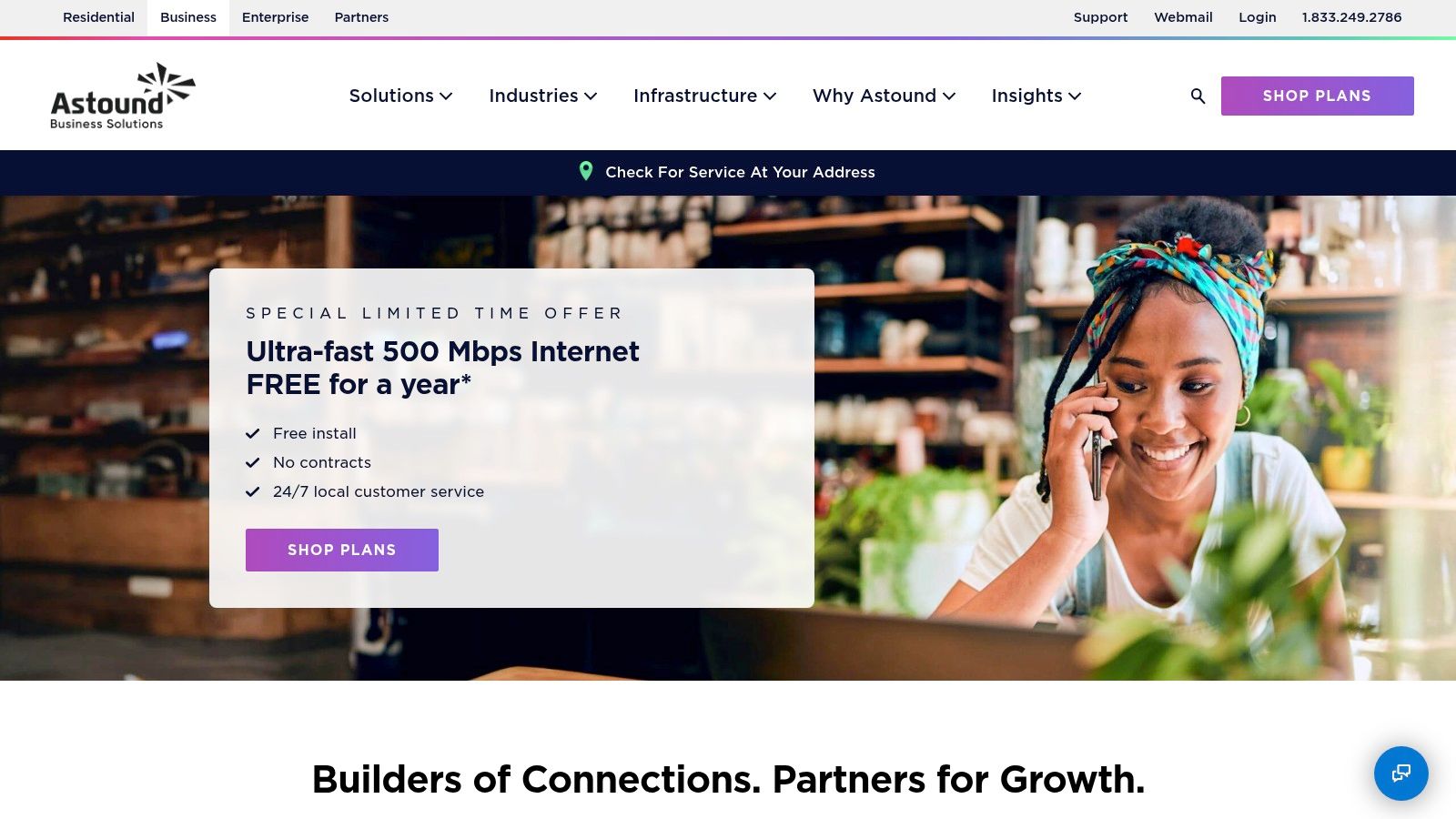
Astound Business Solutions is the provider I'd look at when the brief is simple: get a Chicago office connected at a competitive rate, and don't pay enterprise-carrier premiums unless the site needs them.
Former RCN buyers in Chicago already know the pattern. Astound can be attractive for SMB offices, branch locations, and secondary circuits where cost discipline matters. It's also a practical path-diversity option when your incumbent fiber provider is too expensive or too slow to move.
Where Astound can surprise you
In the right building, Astound can be the quote that keeps a project on budget without forcing a major compromise for ordinary office use. In the wrong building, it can become an off-net construction conversation quickly.
- Good fit: SMB offices, backup circuits, cost-sensitive branches
- Watch for: Footprint limitations and building-specific availability
- Procurement note: Read all recurring fee language before approval
This is also where lifecycle planning gets ignored. Teams add a backup circuit, replace handsets, retire edge switches, and then discover they've accumulated obsolete telecom hardware with no clean disposition path. If that applies to your environment, a dedicated service for telecom equipment disposal should be part of the operating plan, not an afterthought.
Astound usually isn't the answer for a large, latency-sensitive, multi-cloud core. That's fine. It doesn't need to be. It wins when you match it to practical office connectivity rather than trying to force it into a national backbone role.
5. Zayo
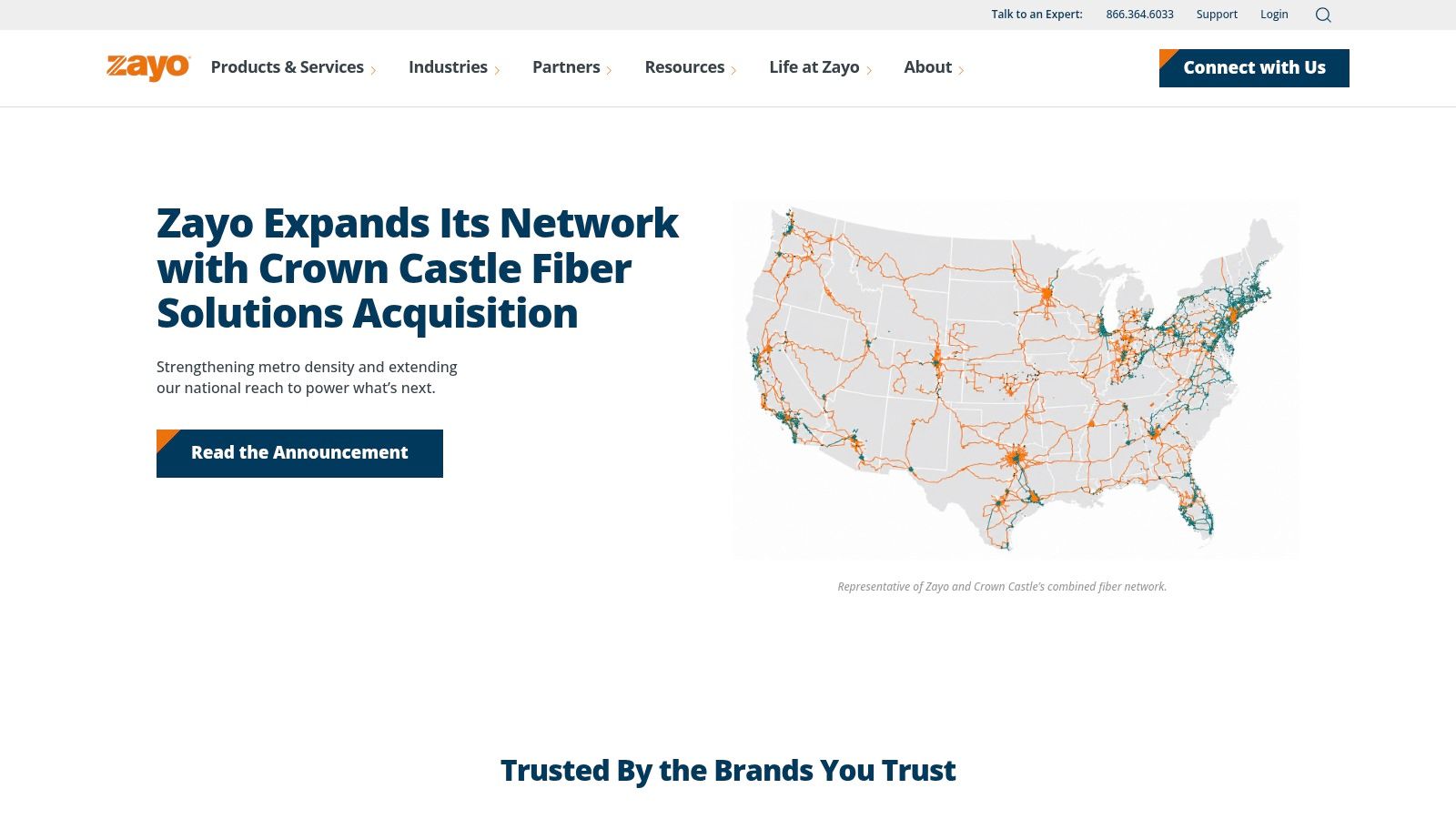
A Chicago CIO usually brings Zayo into the conversation after the easy options stop fitting the requirement. The trigger is rarely basic office internet. It is a data center migration, a low-latency path between trading or media environments, a private transport design, or a bandwidth profile that makes shared broadband feel like the wrong tool.
Zayo is strongest where fiber engineering matters. Dark fiber, wavelength services, high-capacity Ethernet, and custom route design make it a serious candidate for enterprises that care about path diversity, deterministic performance, and direct connectivity between key sites. That is the right lens for evaluating telecommunications services in Chicago at the enterprise tier. SLA-backed transport, private networking options, and clean access to colocation and cloud matter more here than headline download speeds.
Who should shortlist Zayo
Zayo tends to make sense for organizations building around infrastructure rather than branch convenience.
- Data center and colocation users: Strong fit for metro transport, interconnects, and high-capacity backhaul
- Financial, media, and research environments: Good option where latency, route control, and throughput affect the business outcome
- Multi-site enterprises with private network requirements: Worth evaluating when DIA alone does not cover security, performance, or cloud access needs
The trade-off is straightforward. Zayo is often quote-driven, engineering-heavy, and more carrier-like in both process and pricing. If a building is off net, the timeline can shift from a standard turn-up to a construction discussion. That is manageable for a core site with revenue impact. It is usually excessive for a 20-person office that just needs stable internet and a backup path.
I usually recommend Zayo for Chicago networks that have a clear core and edge strategy. Put Zayo in the core, where transport quality, diversity, and inter-site performance justify the spend. Keep simpler access methods at commodity branches unless those locations carry unusual risk.
Network upgrades at this tier also surface a cleanup problem. Teams replace optics, PBX modules, switches, and older voice gear during carrier transitions, then leave the retired equipment sitting in storage. If that inventory is building up, these telecom hardware buyers for switches, PBX, and VoIP equipment can be part of the project plan alongside the circuit order.
6. Lumen Technologies

A Chicago CIO usually starts looking at Lumen after a familiar problem shows up. Internet is no longer the only requirement. The business also needs predictable cloud access, cleaner data center connectivity, and a WAN design that can support more than one critical site without turning every bandwidth change into a contract fight.
Lumen Technologies tends to enter at that point. It competes in enterprise accounts where DIA is only part of the decision, and where managed network options, cloud interconnection, and private transport matter just as much as raw access speed. That makes it a different evaluation from residential-style provider rankings or small-office broadband comparisons.
The practical reason to shortlist Lumen in Chicago is its fit for mission-critical environments. Enterprises with hybrid cloud, colocation footprints in and around the metro, or a mix of MPLS, SD-WAN, and dedicated internet often need a carrier that can support the full design, not just deliver a single circuit. Lumen's Level 3 heritage still carries weight here because backbone quality and long-haul routing still affect application performance, failover behavior, and user experience.
Why Lumen works for some Chicago enterprises
Lumen is strongest when network requirements change faster than carrier contracts usually do. On-demand capacity and broader network services can reduce the operational friction that comes with seasonal traffic swings, cloud migrations, or a phased data center exit.
Buying note: Ask two questions early. How quickly can capacity change in practice, and what commercial approvals are required each time? A flexible platform loses value if the billing model or account process slows every move.
I usually place Lumen on the shortlist for organizations with regional hubs, cloud-heavy application stacks, or uptime requirements that justify SLA-backed DIA and private networking in the same conversation. It is also worth examining if the Chicago site is a core node in a larger Midwest footprint. In that case, the provider matters not only at the local access layer, but across the WAN and into cloud on-ramps.
The trade-off is straightforward. Lumen can be a strong strategic fit for enterprise connectivity, but it is rarely the simplest or cheapest answer for a basic branch office. Buyers should expect a more structured sales process, more design discussion, and closer scrutiny of contract terms, service handoff, and support ownership.
That extra effort is often justified at headquarters, data center-connected sites, and multi-location environments where outages carry real financial or operational cost. It is usually harder to justify for a small office that only needs standard business internet and a backup link.
7. T-Mobile for Business
T-Mobile for Business internet services are easiest to recommend when the question is, “How fast can we get this site online?” That matters more than many telecom buyers admit. New branch openings, temporary project sites, construction trailers, relocations, and merger transitions often need connectivity now, not after a long fiber interval.
That's where T-Mobile works. Portable customer premises equipment, simple deployment, and predictable commercial packaging make it useful for interim service and failover designs. In some smaller offices, it can also serve as the primary connection if the application mix is forgiving.
Where T-Mobile helps most
This is not the platform I'd build around for a trading floor, core call center, or heavily routed enterprise edge. It is the platform I'd use to reduce deployment friction.
- Strong fit: Temporary sites, fast branch launches, backup access
- Acceptable fit: Smaller offices with ordinary SaaS and collaboration traffic
- Weak fit: Advanced routing needs, highly deterministic performance requirements
One under-discussed issue in Chicago is building complexity. Mixed legacy and modern infrastructure, older high-rises, demarc extensions, and the need to coordinate copper, fiber, WiFi, and cellular failover create more operational risk than provider marketing usually admits. That challenge is especially visible in Chicago telecom resiliency and mixed-infrastructure environments.
T-Mobile is valuable in that context because wireless can bypass some of the riser and construction bottlenecks that delay wired installs. Just don't confuse fast deployment with universal suitability. Use it where flexibility matters, and keep DIA or fiber in the design for locations that carry real operational risk.
Chicago Telecommunications: 7-Provider Comparison
| Provider | 🔄 Implementation Complexity | ⚡ Deployment Speed / Efficiency | 💡 Resource Requirements & Tips | ⭐ Expected Outcomes / Quality | 📊 Ideal Use Cases / Impact |
|---|---|---|---|---|---|
| Comcast Business (Greater Chicago Region) | Medium, mix of plug‑and‑play HFC and engineered fiber/Ethernet installs | Moderate, coax quick, fiber/Ethernet may require construction | Local field force reduces delays; install cost varies by address | ⭐⭐⭐⭐, Reliable SLA options (DIA) and scalable capacity where fiber exists | Regional primary or backup circuits, multi‑site Ethernet, managed Wi‑Fi |
| AT&T Business | High, engineered WAN/Ethernet deployments and address‑specific fiber builds | Variable, fiber fast but may have longer lead times; Internet Air enables quick turn‑up | Quote‑based pricing; construction charges possible; strong enterprise support/compliance | ⭐⭐⭐⭐, Enterprise SLAs and solid WAN portfolio | Multi‑site enterprises, mixed fiber+wireless resilience, managed services |
| Verizon Business | Medium, straightforward for FWA; fiber (Fios/DIA) is engineered and address‑limited | Fast for 5G/LTE fixed‑wireless; fiber delivery depends on footprint | Good for rapid rollouts; verify Fios/5G coverage and wireless terms/limits | ⭐⭐⭐⭐, Good for fast rollouts and SLA‑backed DIA where available | Fast site turn‑ups, wireless backup, sites avoiding construction |
| Astound Business Solutions | Low–Medium, HFC plug‑and‑play in‑net; fiber builds are engineered | Quick for on‑net HFC promos; fiber/ off‑net builds add time | Often cost‑competitive for SMBs; check for network access/maintenance fees and on‑net status | ⭐⭐⭐, Competitive SMB performance where on‑net | SMB primary circuits, cost‑sensitive secondary circuits, branch diversity |
| Zayo | High, engineered, quote‑based dark fiber/wavelength and metro builds | High capacity but longer construction intervals for new laterals | Engineered solutions require planning and quoting; suited to large bandwidth budgets | ⭐⭐⭐⭐⭐, Best‑in‑class for low‑latency, high‑bandwidth links | Data centers, carriers, finance/media, cloud interconnects requiring low latency |
| Lumen Technologies | High, enterprise‑oriented NaaS/on‑demand and wavelength deployments | Fast for Internet On‑Demand/NaaS capable sites; engineered for large links | Enterprise pricing and architecture; verify on‑net status per address | ⭐⭐⭐⭐, Strong backbone heritage and multi‑cloud interconnects | Multi‑cloud connectivity, data‑center interconnects, low‑latency enterprise workloads |
| T‑Mobile for Business | Low, largely plug‑and‑play 5G fixed‑wireless installs | Very fast turn‑up; portable CPE enables quick deployment | Predictable/simple pricing; limited static IP/advanced routing compared with DIA | ⭐⭐⭐, Good for fast, simple connectivity and backup use cases | Small sites, pop‑ups, interim primary links, cellular backup for wired DIA |
Your Checklist for Choosing the Right Chicago Telecom Partner
Selecting from this list is only the start. In Chicago, the better buying decision usually comes from building-level diligence, not brand recognition. A provider can look excellent on paper and still be the wrong fit if the address is off-net, the riser is crowded, or the quote assumes a service class that doesn't match the workload.
Start with application truth. Separate traffic into categories such as general productivity, voice and UC, cloud access, large file movement, and business-critical transactions. That prevents the most common mistake I see, which is buying one circuit type for every site because procurement wants a single template.
Then validate the site, not just the carrier. Ask whether the building is on-net, what construction is required, who owns inside wiring responsibility, and whether the provider has handled that property before. In older Chicago buildings, demarc extensions and riser politics can slow a project more than any carrier process.
Your contract language matters just as much as the access method. If a service is meant to support critical applications, request SLA terms for latency, jitter, and mean time to repair, and confirm what remedies apply. If the provider is pitching wireless, decide whether you're buying primary access, backup, or temporary service. That distinction should be explicit before the order is signed.
It also helps to think beyond turn-up. Telecom upgrades usually leave behind handsets, PBX gear, routers, switches, optics, and other retired hardware. For organizations replacing communications infrastructure, Beyond Surplus can be relevant on the back end because it handles IT asset disposition, electronics recycling, product destruction, and telecom equipment recovery as part of broader end-of-life IT programs.
The Chicago market rewards buyers who design for resilience instead of just bandwidth. Use wired circuits for steady-state critical traffic when possible. Use wireless for speed, flexibility, and backup. Push every vendor to explain how they'll handle building access, support escalation, and failover behavior before you commit.
The best telecommunications services Chicago strategy usually isn't one provider everywhere. It's a deliberate mix of access types, service tiers, and accountability that matches the risk at each site.
If your Chicago telecom refresh includes retired phones, PBX gear, network hardware, or broader IT equipment, contact Beyond Surplus for secure electronics recycling, IT asset disposition, and telecom equipment disposal support.