For businesses across the United States, understanding "what is R2 certification" is critical when managing end-of-life IT equipment. In short, R2 certification is the leading global standard for responsible electronics recycling and IT asset disposal. It serves as a verifiable seal of approval, ensuring a vendor handles sensitive corporate IT assets securely, ethically, and in full compliance with environmental regulations. The certification, which stands for Responsible Recycling, provides business owners and IT managers with the confidence that their IT asset disposition (ITAD) strategy mitigates risk.
The Gold Standard for Commercial Electronics Recycling
Think of R2 certification as a CARFAX report for your e-waste vendor. It delivers a transparent, audited history of how your company's old equipment is managed from the moment it leaves your facility. For any business, selecting an R2-certified partner isn't just an environmental choice—it's a fundamental risk management decision that protects your data, brand, and bottom line.
The standard was first developed around 2008 through a multi-stakeholder process convened by the U.S. Environmental Protection Agency (EPA). The objective was to address the growing environmental, data security, and operational challenges within the electronics recycling and refurbishment industry.
Today, this voluntary, market-driven standard is managed by SERI (Sustainable Electronics Recycling International). The R2 framework is built on three core pillars that guarantee a vendor adheres to strict, auditable protocols designed for the commercial sector.
The Three Pillars of R2 Certification
The R2 standard is not a mere certificate; it is a commitment to a comprehensive management system. The table below outlines its three foundational principles and explains why each is crucial for protecting your business from liability.
| Core Pillar | What It Means for the Vendor | Why It Matters to Your Business |
|---|---|---|
| Environmental & Worker Safety | They must implement and maintain a robust Environmental, Health, and Safety Management System (EHSMS) to properly handle hazardous materials and protect their workforce. | This ensures your brand is not associated with environmental damage or unsafe labor practices, safeguarding your corporate reputation and ESG commitments. |
| Data Security | Secure data destruction is mandatory. They must prove their data sanitization processes meet or exceed industry standards like NIST 800-88, ensuring your information is irretrievable. | This is your primary defense against costly data breaches. It provides an auditable trail proving that sensitive company and customer information was completely destroyed. |
| Downstream Accountability | They are responsible for the entire chain of custody. They must rigorously vet, monitor, and document all downstream partners to ensure every component is processed responsibly. | This closes the loop on liability. You have verifiable proof that your IT assets will not be illegally dumped or exported, even after leaving the primary vendor's facility. |
These pillars work in concert to create a system of total accountability. They protect your business from the significant financial, legal, and reputational consequences that arise from improper IT asset disposal.
The R2 standard creates a system of accountability that protects your business from the significant financial, legal, and reputational risks associated with improper IT asset disposal. It transforms a potential liability into a verified, compliant process.
Choosing a partner with R2 certification is the most effective method for ensuring your end-of-life corporate IT assets are managed with the highest level of integrity and security.
The Hidden Dangers of Uncertified E-Waste Disposal
Partnering with an uncertified electronics recycler might seem like a cost-saving measure, but it exposes your business to catastrophic risks that far outweigh any initial savings. These are not abstract threats; they are tangible, expensive, and brand-damaging realities for any commercial enterprise.
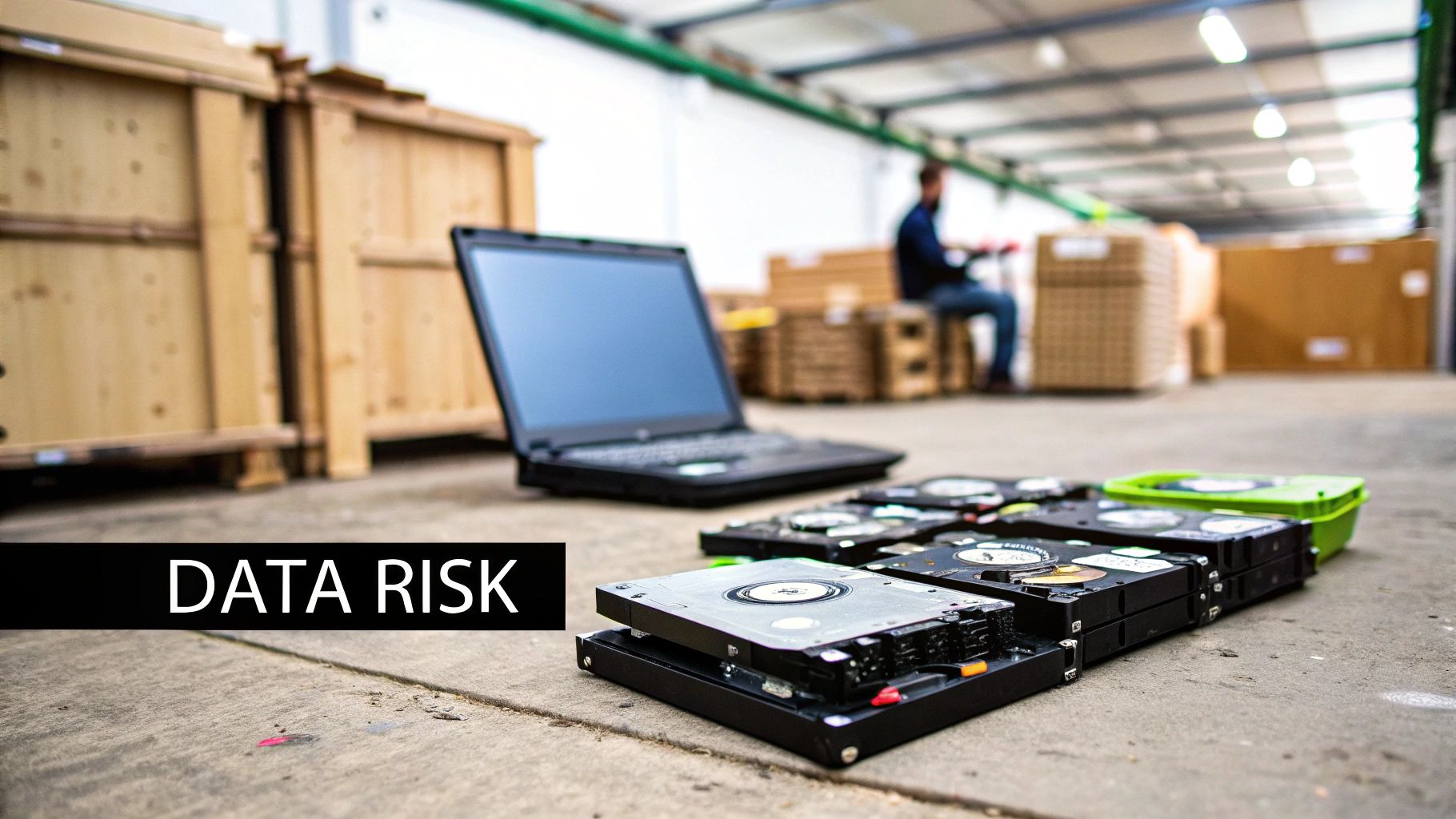
Consider a common scenario: a mid-sized company liquidates its retired IT equipment through a local, uncertified vendor offering a low price. Months later, the IT director receives a call from a journalist who found several of the company's old hard drives for sale online, still containing sensitive customer data and internal financial records.
The fallout is immediate and severe. The company faces six-figure fines for data privacy violations, mounting legal fees, and a shattered reputation. Customer trust, built over years, is destroyed overnight. This is the direct result of a vendor cutting corners on data destruction to offer a rock-bottom price.
Understanding Downstream Liability and Chain of Custody
This nightmare scenario highlights two critical concepts for every business: downstream liability and chain of custody.
- Downstream Liability: Your company’s responsibility for its electronic waste does not end when the truck leaves your loading dock. You remain legally and financially accountable for your assets through their final disposition, even if they pass through multiple subcontractors.
- Chain of Custody: This is the documented, auditable paper trail that tracks your assets from your facility to their final recycling or destruction. Without a verified chain of custody, you have no proof of proper disposal, leaving your company completely exposed.
An uncertified vendor provides no verifiable guarantee for either. They operate without the rigorous oversight, documentation, and audited processes that a certification like R2 demands.
Choosing an uncertified recycler is like handing over your company's most sensitive secrets without a contract, a paper trail, or any guarantee of their destruction. The initial savings are insignificant compared to the potential cost of a single data breach.
The True Cost of Non-Compliance
The financial penalties for improper disposal are severe. Federal regulations like the FTC Disposal Rule and industry-specific laws like HIPAA have strict requirements for protecting consumer and patient information. A single violation can lead to crippling fines.
The brand damage from a public data breach or illegal dumping incident can be even more costly. Corporate responsibility is a market requirement, and customers, partners, and investors demand proof of ethical and secure operations. An environmental or data security scandal can destroy decades of brand equity. To learn more, explore the hidden dangers of improper electronics disposal.
This is why a verifiable standard like R2 certification is non-negotiable for modern businesses. It is an essential investment in risk management, compliance, and brand protection, providing the third-party validation that your assets were handled correctly.
Exploring the Core R2 Standard Requirements
To understand the value of R2 certification, it is essential to look beyond the certificate and examine the operational framework it represents. Earning the R2 seal requires building and maintaining a robust system that undergoes rigorous, independent verification.
This framework is built on core requirements that directly translate into reduced risk and enhanced compliance for your business. Each requirement addresses a specific, high-stakes risk in the IT asset disposition lifecycle, from data security to environmental liability.
Secure Data Sanitization Following NIST Standards
The single greatest risk in disposing of corporate IT equipment is a data breach. The R2 standard confronts this threat head-on, requiring certified vendors to follow strict, globally recognized protocols for data destruction. The benchmark is NIST Special Publication 800-88, a framework developed by the U.S. National Institute of Standards and Technology.
This is a mandatory requirement. An R2-certified vendor must prove their processes for data wiping, degaussing, or physically shredding devices render data completely unrecoverable. This provides your business with an auditable guarantee that sensitive corporate, employee, and customer data has been permanently destroyed. You can learn how vendors implement NIST SP 800-88 guidelines in our detailed guide.
For your business, this means:
- Reduced Liability: You receive auditable proof of data destruction, essential for complying with regulations like HIPAA, FACTA, and the FTC Disposal Rule.
- Peace of Mind: You can be confident that your company's proprietary information will not resurface on a secondary market or fall into the wrong hands.
- Brand Protection: A data breach from a retired asset is a public relations disaster. This requirement helps you avoid it entirely.
Rigorous Downstream Vendor Management
An uncertified vendor may not know or care what happens to your equipment after it leaves their facility, but an R2-certified partner is required to. A core principle of the R2 standard is downstream vendor management, which holds the certified facility accountable for the entire recycling chain.
They must conduct due diligence on all partners who handle specific materials, such as circuit boards or batteries. This includes auditing those partners to ensure they also meet strict environmental, health, and safety standards.
The R2 standard creates a "chain of custody" that extends beyond the primary vendor's facility. It compels your certified partner to act as a gatekeeper, ensuring every link in the recycling chain is secure and responsible.
This requirement closes a dangerous liability loophole for your company, ensuring your assets are not illegally exported or landfilled by a subcontractor, protecting your business from association with environmental negligence.
The Materials Recovery Hierarchy
At its core, the R2 standard is built on a "reuse first" philosophy, formalized as the Materials Recovery Hierarchy. This is a mandatory sequence for managing used electronics that prioritizes keeping valuable equipment in use and minimizing waste.
An R2-certified vendor must follow this hierarchy:
- Reuse: The first priority is to test, repair, and refurbish functional equipment or components to extend their lifecycle.
- Materials Recovery: If reuse is not feasible, the next step is to recover valuable materials like metals, plastics, and glass through recycling.
- Disposal: This is the absolute last resort, reserved only for materials that cannot be recovered. Even then, it must be done through responsible energy recovery or in an approved landfill.
This approach offers a direct business benefit. By focusing on reuse, R2-certified vendors excel at identifying assets with remaining market value. This often translates into revenue for your company through IT asset value recovery (ITAVR) programs, turning a disposal cost into a revenue stream.
How a Vendor Achieves R2 Certification
Obtaining R2 certification is an exhaustive, multi-stage process designed to prove a vendor’s commitment to the highest standards of electronics recycling and data security. This rigorous journey is what gives the R2 seal its authority, ensuring a partner’s promises are backed by verifiable, third-party proof.
The process is intentionally demanding, forcing a vendor to demonstrate that their written policies are implemented in their daily operations. For any business seeking a reliable ITAD partner, understanding this process provides confidence that the vendor has earned their credentials.
The Initial Application and Documentation Review
The path to certification begins with a detailed application and a Stage 1 audit. In this "paperwork" phase, an accredited, independent auditor meticulously reviews every document governing the facility's operations.
The vendor must present a complete management system covering every requirement of the R2 standard, including:
- An Environmental, Health, and Safety Management System (EHSMS): A detailed plan for managing hazardous materials and protecting worker health and safety.
- A Data Security Plan: Documented procedures for data sanitization that meet or exceed standards like NIST 800-88.
- Downstream Vendor Management Policies: A robust system for vetting, monitoring, and holding all downstream partners accountable.
- Legal Compliance Documentation: Proof that the facility adheres to all applicable local, state, and federal regulations.
This first stage builds the foundation. If the documentation is weak or incomplete, the process is halted until the vendor meets the standard's strict requirements.
The Intensive On-Site Inspection
After the documentation is approved, the vendor proceeds to the Stage 2 audit—an intensive, on-site inspection. Here, the auditor verifies that the procedures detailed on paper are being followed in practice. Nothing is taken at face value; every claim is tested.
Auditors physically inspect the entire facility, from the receiving dock to final processing areas. They conduct employee interviews, inspect equipment, and review records to confirm compliance. For example, an auditor might select a pallet of hard drives and demand to see the complete chain-of-custody documents and proof of data destruction for every device.
The infographic below highlights the core operational pillars that receive this intense scrutiny during an audit.
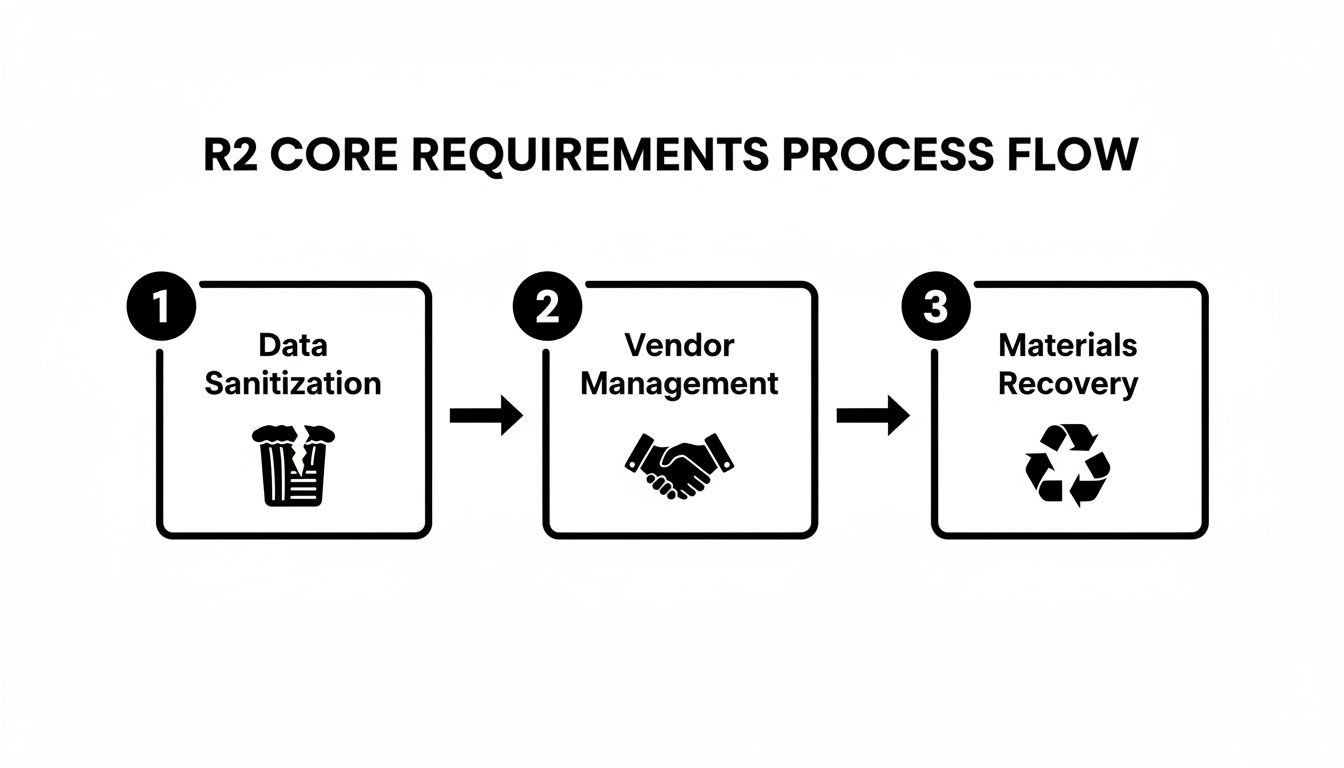
Data sanitization, vendor management, and materials recovery are audited as interconnected processes, ensuring a closed-loop system where nothing is overlooked.
Ongoing Surveillance and Recertification
R2 certification is not a one-time award. To maintain their status, a vendor must undergo annual surveillance audits. These are targeted inspections designed to ensure standards have not declined. Every three years, the facility must undergo a full recertification audit, repeating the entire Stage 1 and Stage 2 process.
This cycle of continuous verification ensures R2-certified facilities maintain high standards. The standard’s growth from 27 facilities in 2010 to 942 certified sites worldwide by November 2020 reflects the increasing demand from businesses for verifiably secure and responsible IT asset disposition (ITAD) services.
By choosing an R2-certified partner, you are selecting a vendor who has voluntarily opened their doors to intense scrutiny. It’s a testament to their confidence in their processes and their commitment to transparency and accountability.
How to Choose and Verify Your R2 Certified Partner
Knowing what R2 certification entails is the first step. The next is applying that knowledge to vet and select the right IT Asset Disposition (ITAD) partner. For IT managers and procurement professionals, this process is about asking the right questions and verifying the answers.
A truly compliant vendor will not only tolerate your due diligence—they will welcome it. This guide will help you partner with a provider who is genuinely transparent and accountable.
Creating Your Vendor Evaluation Checklist
Before signing a contract, use a checklist to evaluate potential R2 partners. Their approach to IT Asset Management (ITAM) reveals how they will handle your equipment.
Here are non-negotiable questions for every potential ITAD vendor:
- Can you show me your active R2 certification? Do not accept a PDF. Ask for a direct link to their listing in the official SERI directory to confirm it is current.
- Does your certification cover all your facilities? A vendor may have a certified headquarters but process assets at an uncertified location. Consistent standards are crucial.
- What does your data destruction documentation include? Request a sample Certificate of Data Destruction. It should be detailed and serialized for every single device.
- Can I review your downstream audit reports? An R2-certified recycler must audit their partners and should be able to demonstrate a transparent downstream chain of custody.
- What type of insurance do you carry? Ask for proof of pollution liability and errors and omissions insurance as a safeguard.
Hesitation or inability to answer these questions is a major red flag. A trustworthy partner will have this information readily available.
Verifying a Vendor's R2 Certification
Never take a vendor's claim of certification at face value. The only way to be 100% certain is to check their status directly with the governing body, Sustainable Electronics Recycling International (SERI).
A logo on a website or a PDF certificate can be easily faked. The SERI directory is the single source of truth for R2 certification and a non-negotiable step in your due diligence.
The verification process is simple and takes less than five minutes:
- Visit the SERI Website: Go to the official R2 Certified Electronics Recyclers directory, which is a public database.
- Search for the Company: Look up the vendor by name, state, or city.
- Check Their Status: The directory will confirm if their certification is "Active," which version of the standard they hold (e.g., R2v3), and the certificate's expiration date.
This quick check is the most effective way to protect your organization from a non-compliant or fraudulent operator. To learn more about identifying reliable partners, see our guide on what makes a recycling center trustworthy.
By asking targeted questions and independently verifying claims, you can proceed with confidence, knowing your chosen partner meets the strict demands of the R2 standard and shares your commitment to security and compliance.
Common Questions About R2 Certification
Even after understanding the fundamentals, most businesses have a few final questions before finalizing their ITAD strategy. Here are answers to the most common inquiries.
Is R2 Certification Required By Law?
No, R2 certification is a voluntary industry standard, not a federal law.
However, it has become the de facto requirement for corporate risk management. Many government agencies and large corporations now mandate R2 certification for their ITAD vendors. This is because partnering with an R2-certified recycler is one of the most effective ways to demonstrate compliance with legally binding data privacy laws like HIPAA, FACTA, and the FTC Disposal Rule. Choosing a non-certified vendor exposes your company to significant legal and financial risks in the event of a data breach or environmental incident.
What Is The Difference Between R2 And e-Stewards?
Both R2 and e-Stewards are credible, top-tier certifications for responsible electronics recycling. The primary differences lie in their origins and philosophy.
- R2 (Responsible Recycling): Developed with input from the U.S. EPA, R2 is known for its flexibility and market-driven approach. It emphasizes a "reuse first, then recover, then recycle" hierarchy, which has led to its broad industry adoption.
- e-Stewards: Originating from the Basel Action Network, an environmental advocacy group, this standard is generally considered more rigid. Its most notable feature is a strict ban on exporting hazardous e-waste to developing nations.
Both certifications guarantee high standards for environmental protection and data security. The "better" choice depends on your company's specific corporate social responsibility policies.
How Does R2 Certification Help With ESG Goals?
Partnering with an R2-certified vendor is a direct and powerful way to advance your company's Environmental, Social, and Governance (ESG) initiatives. It provides credible, third-party-verified data for your sustainability reports.
An R2 partner provides tangible evidence for your ESG reporting. The "E" is covered by verified responsible recycling. The "S" is addressed through ethical labor practices in the downstream chain. And the "G" is demonstrated by secure, compliant data and asset management.
This partnership transforms ESG goals from abstract objectives into concrete, auditable actions, demonstrating strong corporate governance and a genuine commitment to sustainability.
Does R2 Certification Cover Data Destruction?
Yes, absolutely. Secure data sanitization is a non-negotiable cornerstone of the R2 standard, particularly in the latest R2v3 version.
Certified vendors must prove their data destruction processes align with globally recognized standards like NIST SP 800-88. R2 auditors rigorously examine every step, whether it involves cryptographic erasure, physical shredding, or degaussing. This verification ensures your company's sensitive information is permanently destroyed, protecting you from future data breaches.
For a partner that delivers certified, secure, and transparent electronics recycling and IT asset disposal for businesses, contact Beyond Surplus. We provide the documentation and peace of mind your business needs to manage IT assets responsibly. Schedule your pickup today.