

Five wins and nine wins are not two different worlds in the NFL. For the 2026 Falcons, they are the difference between another lost season and a December race that matters.
That is why Atlanta is such a difficult team to forecast. The low-end view sees a roster with too many pressure points: unsettled quarterback play, a defense that still has to prove it can affect games consistently, and a margin for error that disappears fast in close contests. The optimistic view sees a path that is narrower than fans would like, but still real. If the Falcons get competent play at the most important spots and stop wasting possessions, the gap between disappointing and respectable can close quickly.
The tension around this team goes beyond the usual offseason hope. Atlanta has spent years trying to turn potential into structure, and fans have seen how often that promise has broken down by October. That broader uncertainty feels familiar in this city, even as Atlanta continues to project growth and ambition in other arenas, from roster building to the regional momentum reflected in its rise as a destination for tech startups.
So the right way to frame this preview is not as a simple thumbs-up or thumbs-down on the Falcons. It is a question of which version shows up. The one that confirms the grim consensus, or the one that finds enough answers in the margins to push toward the high end of the range.
A Franchise at a Crossroads
Eight straight losing seasons change the standard. In Atlanta, they also explain why a team projected near the bottom by some outlets can still inspire a believable best-case case for relevance deep into December.
That tension is the central story of the 2026 Falcons. The grim view is easy to understand. Atlanta has spent too many years turning close questions at quarterback, pass rush, and late-game execution into recurring losses. The optimistic case exists, too, but it is narrower than fans would like. It depends on the Falcons being merely competent in the spots that have repeatedly sunk them, then cashing in on a schedule that should offer a few swing games.
Why 2026 feels different
The split in expectations suggests Atlanta is no longer being judged as a team with one obvious flaw. It is being judged as a team with several volatile ones. That distinction matters. Teams with one major weakness can often cover for it. Teams with three or four thin areas tend to live week to week, and their record usually follows the quality of their decision-making as much as their talent.
For the Falcons, that means the gap between a five-win season and a nine-win season is not abstract. It shows up in specific places. Can the quarterback keep the offense on schedule against disguised pressure. Can the defense get off the field without needing perfect coverage for four quarters. Can Atlanta split close divisional games instead of turning them into another source of regret.
A respectable season does not require a dramatic transformation. It requires fewer wasted possessions, cleaner answers in obvious passing situations, and a defense that creates even modest disruption. If those areas hold up, the pessimistic projection starts to look too harsh. If they do not, the darker consensus will feel familiar by midseason.
There is also a larger backdrop to all of this. Atlanta is a city that expects growth, reinvention, and smarter long-term bets, the same civic identity reflected in its reputation as a destination for tech startups. The Falcons are under pressure to match that standard. This season is less about preseason hope than organizational proof.
Offseason Moves and Roster Analysis
The hard part of evaluating Atlanta's roster is separating what we know from what people want to believe. The Falcons do have enough structural talent to avoid a total collapse. But they also have enough unresolved questions to justify skepticism.
The roster question starts at quarterback
The central roster issue isn't complicated. If Atlanta gets subpar quarterback play, everything else tightens. The margin for error shrinks for the line, the run game, the receivers, and the defense.
The problem isn't only internal development. It's comparative. In the NFL, you aren't judged in a vacuum. You're judged against the quarterback on the other sideline. If Atlanta regularly enters games at a disadvantage there, then even competent football elsewhere won't always be enough.
Where the supporting cast helps
A fragile quarterback situation doesn't automatically doom a season. Teams can stabilize young or inconsistent passers if they check enough other boxes.
Atlanta's path to that kind of support looks like this:
- Protection matters first. If the offensive line can keep the pocket usable and create clean run lanes, the offense can stay on schedule.
- Skill players must create easier throws. Short-area separation, yards after catch, and reliable timing can lower the burden on the quarterback.
- The defense has to shorten games. More stops on early downs can keep Atlanta in lower-possession contests, which is usually where underdog teams can survive.
What the roster still doesn't answer
The biggest concern is that too many positive outcomes depend on best-case development rather than proven certainty. That's a dangerous place for a team coming off a long losing cycle.
Practical rule: When a roster needs multiple uncertain positions to break right at the same time, analysts usually lean toward the lower end of the projection range.
That doesn't mean the Falcons are talent-poor across the board. It means their strengths may not be strong enough to carry obvious weaknesses. For a team trying to move from chronic disappointment to weekly credibility, that's the difference between hanging around the playoff race and falling out of it early.
Evaluating the Coaching Staff and Schemes
Coaching is where Atlanta could outperform the harshest projection. Scheme won't erase a quarterback gap, but it can reduce how often that gap decides games.
Offensive identity has to be disciplined
The best version of this Falcons offense is controlled, layered, and patient. It should emphasize sequencing over flash. Early-down efficiency, manageable third downs, and a run game that forces defenses to respect play action would give Atlanta its clearest offensive blueprint.
If the staff asks the quarterback to win high-volume dropback games, the offense could get exposed. If it builds answers into the structure, Atlanta can at least stay functional.
A lot of modern business leaders in the city talk about system design over individual heroics, which is why the logic in this discussion of how AI is impacting Atlanta businesses today oddly applies here too. The Falcons need repeatable decision-making more than isolated brilliance.
Defensive flexibility is just as important
Atlanta's defense doesn't need to dominate every week. It needs to stay structurally sound, avoid coverage busts, and create enough disruption to keep games from tilting too quickly.
That puts pressure on the staff in two areas:
| Coaching challenge | Why it matters |
|---|---|
| Coverage discipline | One breakdown can undo an otherwise solid series |
| Pressure design | If the front can't win cleanly, the scheme must manufacture stress |
| Situational calls | Red zone and third down decisions often decide close games |
The coaching question isn't whether Atlanta has intelligent ideas. Most staffs do. The question is whether this staff can tailor those ideas to a roster that still looks uneven. If it can, the Falcons could look stubborn and competitive. If it can't, the season will feel longer than the calendar says.
Falcons Strengths and Glaring Weaknesses
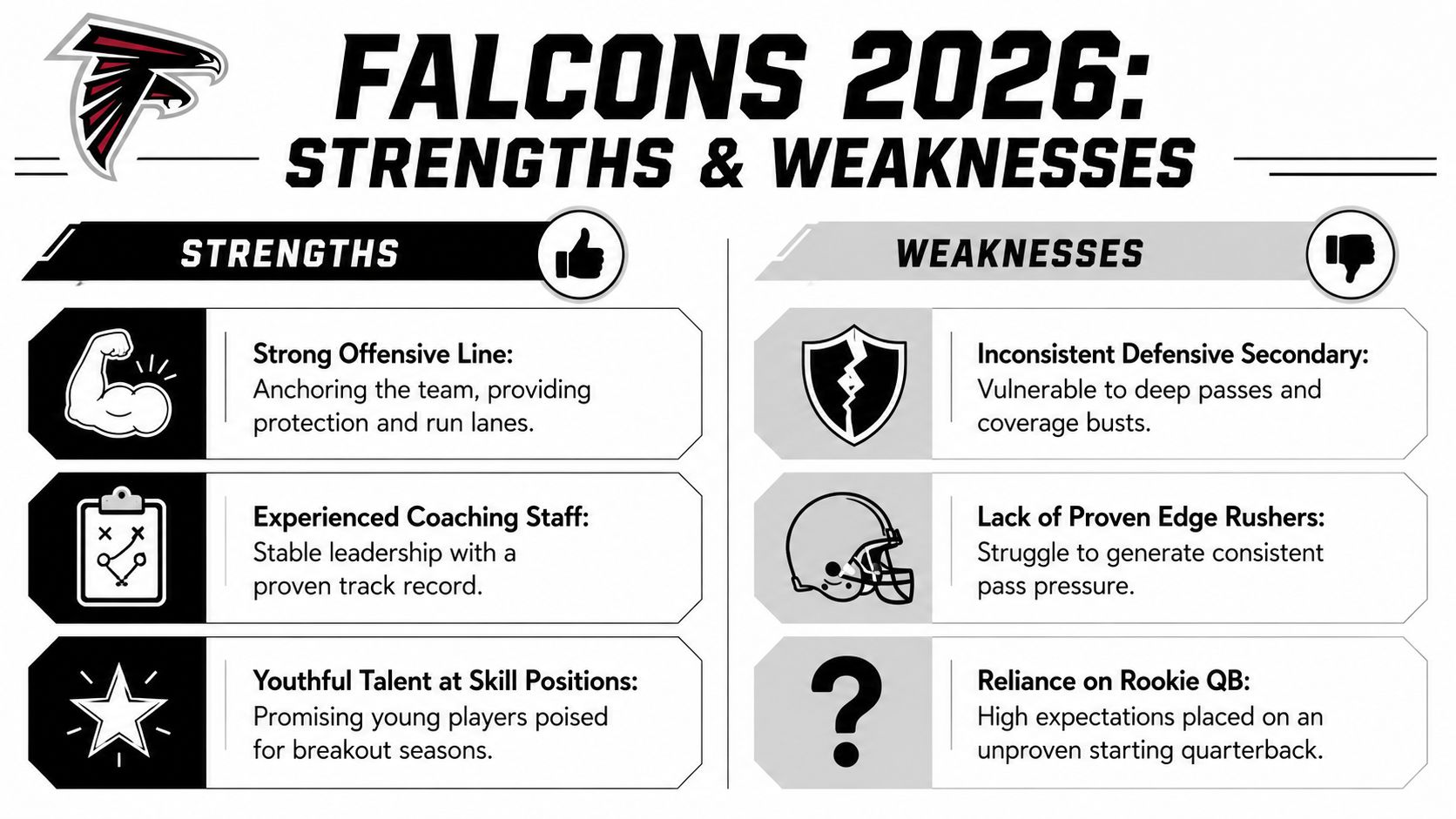
Quarterback uncertainty skews almost every projection around Atlanta. It is the clearest reason national forecasts cluster around the pessimistic end, and the clearest reason the best-case case still feels plausible if the offense can reduce how often the quarterback has to carry the game.
What can keep them afloat
Atlanta's strengths are real, but they are supporting strengths. That distinction matters. Teams beat grim preseason expectations when their stable units keep games close enough for variance, red-zone execution, and a handful of explosive plays to swing the result.
The offensive line gives Atlanta its best chance to stay on script. Clean pockets matter, but the bigger value is down-to-down control. If the line can create manageable second and third downs, the Falcons can stay in the part of the playbook that protects the quarterback instead of exposing him.
The skill group also gives the offense a little margin for error. Young playmakers do not need to post star-level production every week. They need to win a few isolated matchups, force defenses to widen, and turn ordinary drives into scoring chances. For a team trying to live in one-score games, that is enough to change the season's shape.
There is also a path for the defense to be good enough without becoming dominant. If Atlanta avoids coverage busts and tackles consistently on the perimeter, it can force opponents to stack long drives instead of giving away fast points. That formula works for middle-tier teams that want to get from five-win expectations to a legitimate run at .500 or better.
What can break the season
The weakness list hits premium positions, which is why the gap between 5-12 and 9-8 feels smaller than it looks. A team can survive one soft spot. It usually cannot survive weakness at quarterback, edge pressure, and coverage depth in the same season.
Quarterback remains the hinge point. If Atlanta gets merely competent play there, the roster has enough structure to stay competitive most weeks. If the position becomes a weekly problem, every other weakness gets amplified. Protection has to hold up longer, the call sheet shrinks, and the defense gets dragged into too many sudden-change situations.
The pass rush is the second issue because it directly affects the optimistic scenario. Atlanta does not need a top-tier sack total. It needs enough disruption to keep average quarterbacks from getting comfortable on third-and-medium. Without that, the secondary has to cover too long, and otherwise solid defensive snaps start ending in chain-moving completions.
The back end carries similar volatility. Secondary inconsistency rarely shows up as a steady leak. It shows up as two or three coverage mistakes that decide a close game. That is the type of weakness that keeps a flawed team stuck in the consensus projection instead of pushing toward the high end of its range.
One more concern deserves attention. Atlanta is asking for improvement from several unproven spots at once. That can work, but it usually leads to uneven Sundays. The Falcons do not need every young player to break out. They need enough of them to become reliable at the same time.
For fans tracking the broader pulse of the franchise, this Atlanta Falcons coverage hub offers useful context. On the field, the equation is simpler. If Atlanta gets steady quarterback play, a functional rush, and fewer coverage lapses, the 9-8 argument holds up. If two of those three fail, the darker forecasts will look conservative.
Navigating the 2026 Schedule
Schedule analysis matters most for volatile teams. Atlanta doesn't need only a good roster outcome. It needs the season's rhythm to cooperate.
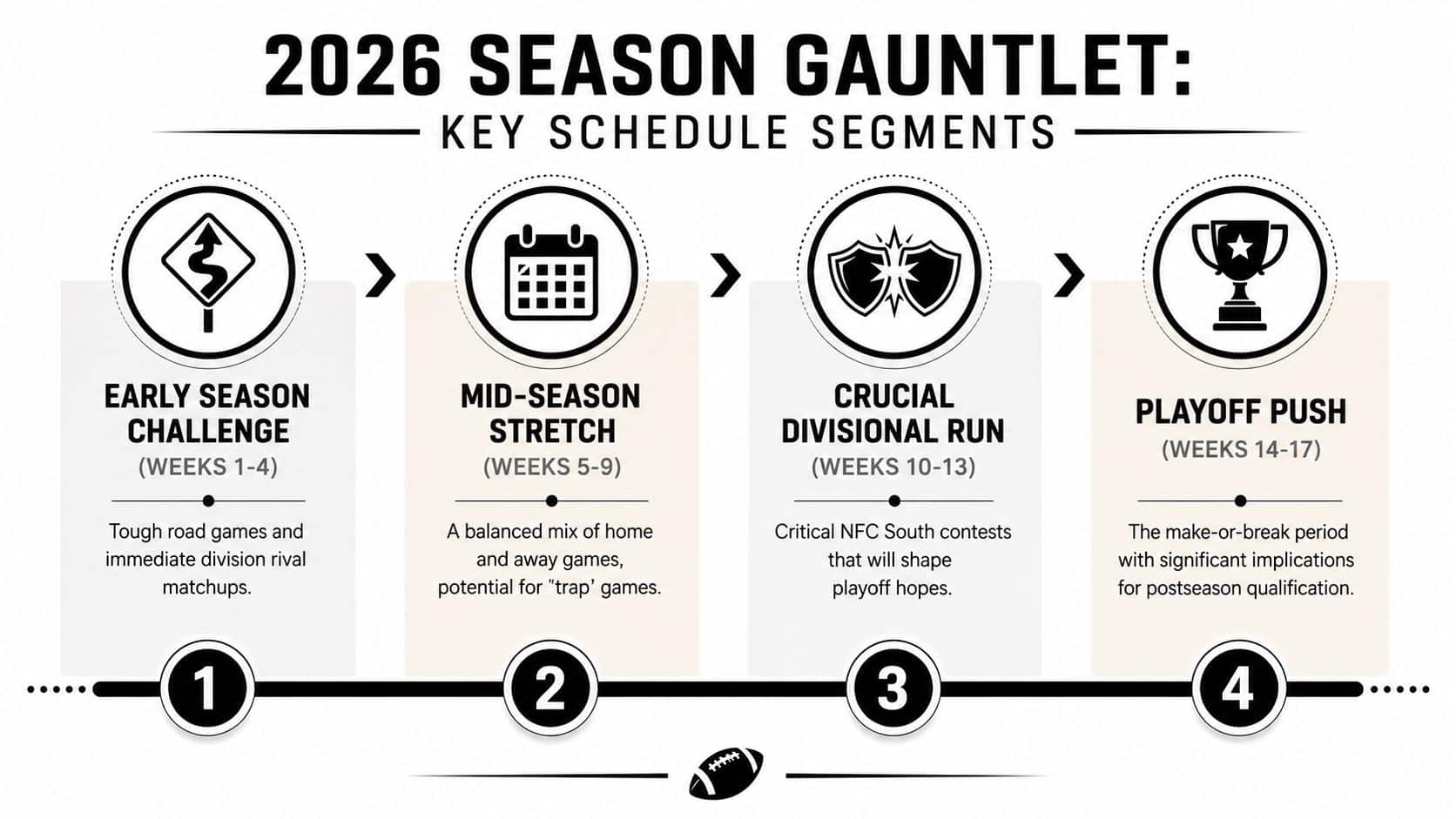
The first half can define everything
For a team already carrying external doubt, a difficult opening stretch can change the entire emotional shape of the season. If Atlanta starts unevenly, the pressure around quarterback decisions and offensive identity will intensify quickly.
That's why the opening months matter beyond the standings. They will tell us whether this team can absorb adversity without fracturing into blame and desperation.
Early-season adversity doesn't ruin every year. It does expose whether a team has a stable internal plan.
Divisional games will decide the ceiling
The optimistic case for Atlanta has never been about dominating the NFC. It's about staying close enough in the division to matter late.
That puts extra weight on NFC South matchups. If the Falcons split the tough non-division games but handle their divisional business, the tone changes. If they stumble inside the division, the best-case scenarios disappear fast.
A practical way to view the schedule is by tiers:
| Stretch | What Atlanta needs |
|---|---|
| Early challenge | Avoid a confidence-draining start |
| Middle of season | Bank winnable games without giving one away |
| Divisional run | Treat every NFC South game like a standings swing |
| Final push | Still have meaningful football left to play |
Fans who track seasonal momentum across Atlanta sports understand this pattern well, and the Atlanta Braves schedule page offers a different version of the same truth. Calendar structure shapes expectations. For the Falcons, the schedule doesn't just present opponents. It tests whether the team can remain coherent long enough for the ceiling to stay visible.
Final Record Prediction and Playoff Odds
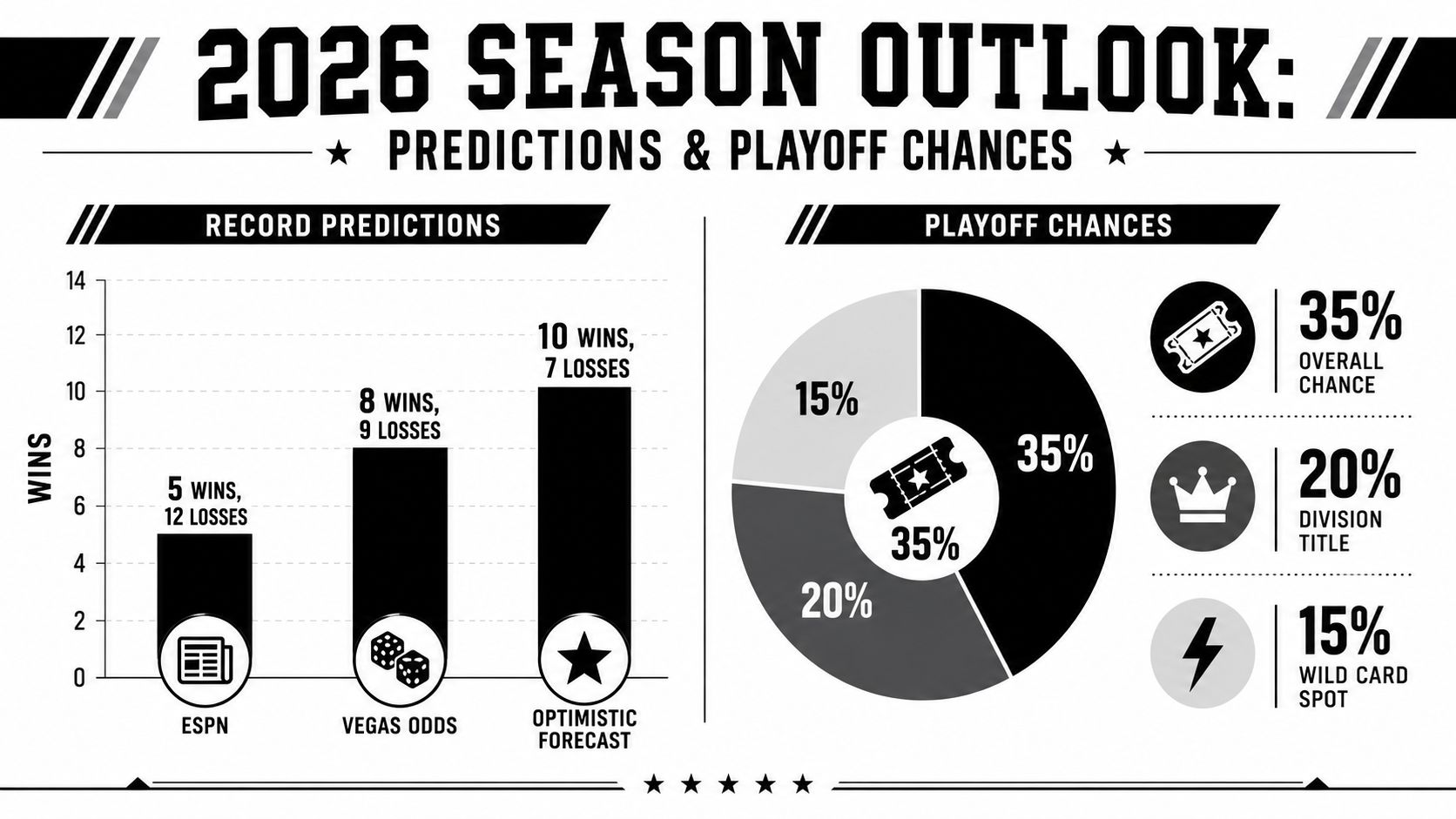
Seven wins sits at the center of Atlanta's 2026 argument. The pessimistic camp sees a roster with too many failure points and lands in the 5 to 6 win range. The optimistic view gets to 9 wins by assuming stable quarterback play, cleaner coverage on the back end, and a split or better in the NFC South.
That gap matters because it is not about luck as much as repeatable football. Atlanta's record will swing on a small set of weekly questions. Can the offense stay on schedule often enough to avoid obvious passing downs? Can the defense get off the field without giving away explosive plays? Can the Falcons win the close divisional games that usually decide whether a middling team becomes relevant in December or disappears by Thanksgiving?
Why the lower-end outcome is easy to see
The case for a losing season does not require much imagination. Atlanta still carries the profile of a team that can lose the hidden-down battle. A sack on second-and-medium, a coverage bust on third-and-long, a red-zone trip that ends in three points instead of seven. Over 17 games, that is how a 7-win idea becomes 5-12.
Quarterback uncertainty remains the biggest reason the consensus stays cold. If that spot produces uneven timing, late reads, or too many turnover-worthy throws, the offense will put stress on every other unit. Atlanta is not built to survive repeated negative game scripts.
Why 9-8 is still on the table
The optimistic case has a real football foundation. It starts with competence, not stardom. If the Falcons get steady quarterback play, improve their third-down execution, and avoid weekly breakdowns in the secondary, they can live in one-score games long enough to flip the math.
That is the path to 9-8. Not dominance. Efficiency.
It also helps that the NFC South rarely requires perfection. If Atlanta handles the division better than the broader schedule and protects the winnable middle tier of the season, the standings can tighten quickly. Fans know that kind of late-year swing from other parts of the city too. A season can feel lost in October and still reopen by December, much like a long afternoon spent walking Atlanta BeltLine trails and neighborhoods can look completely different a few miles later.
My prediction
I land closer to the market middle than the harshest national forecast or the hopeful best-case projection. Atlanta finishes 7-10.
That record fits a team with enough talent to avoid collapse, but not enough proven reliability to expect a winning season. It also matches the specific pressure points already outlined in this preview. The Falcons should be competitive more often than their harshest critics expect. They still have too many spots where one weakness can ruin an otherwise solid Sunday.
The playoff path is narrow. Atlanta's clearest route is the division, not a wild-card push built on conference-wide strength. If they are playing meaningful NFC South games in December, the season will have beaten the bleak consensus. If not, 2026 will be remembered less for contention and more for what it revealed about whether this roster can support a serious run in 2027.
Key X-Factors and Fantasy Football Takeaways
The offensive X-factor is the quarterback, because no other position can swing Atlanta's outcome so violently. If that spot settles into efficient, mistake-controlled play, the Falcons can outperform the harsh consensus. If not, every Sunday becomes a matchup in which Atlanta needs too much from everyone else.
On defense, the X-factor is the secondary's consistency. The Falcons don't need perfect coverage. They need fewer busts, fewer free explosives, and a better ability to survive obvious passing situations.

Fantasy football view
For fantasy managers, the rule is simple. Draft Falcons players selectively, not emotionally.
- Lean toward volume-based options. Players tied to the run game or short passing game usually carry the safest weekly floor in uncertain offenses.
- Be cautious with the quarterback. Until Atlanta shows stable production, this is a matchup play at best.
- Treat explosive skill players as volatile starters. They may produce spike weeks, but consistency could be hard to trust.
- Watch camp and early usage closely. Roles matter more than talent hype in offenses still finding their identity.
Atlanta fans know how quickly local narratives can swing, whether in sports or around the city itself, which makes this Atlanta BeltLine guide for visitors and locals an oddly fitting reminder that the city always moves forward. The Falcons need to do the same. The 2026 season doesn't require perfection. It requires proof that this team is finally heading somewhere other than the middle of the draft board.
If your organization needs secure, compliant IT asset disposition, Beyond Surplus provides certified electronics recycling, data destruction, IT equipment disposal, logistics coordination, and nationwide pickup for businesses. Contact Beyond Surplus for certified electronics recycling and secure IT asset disposal.


