

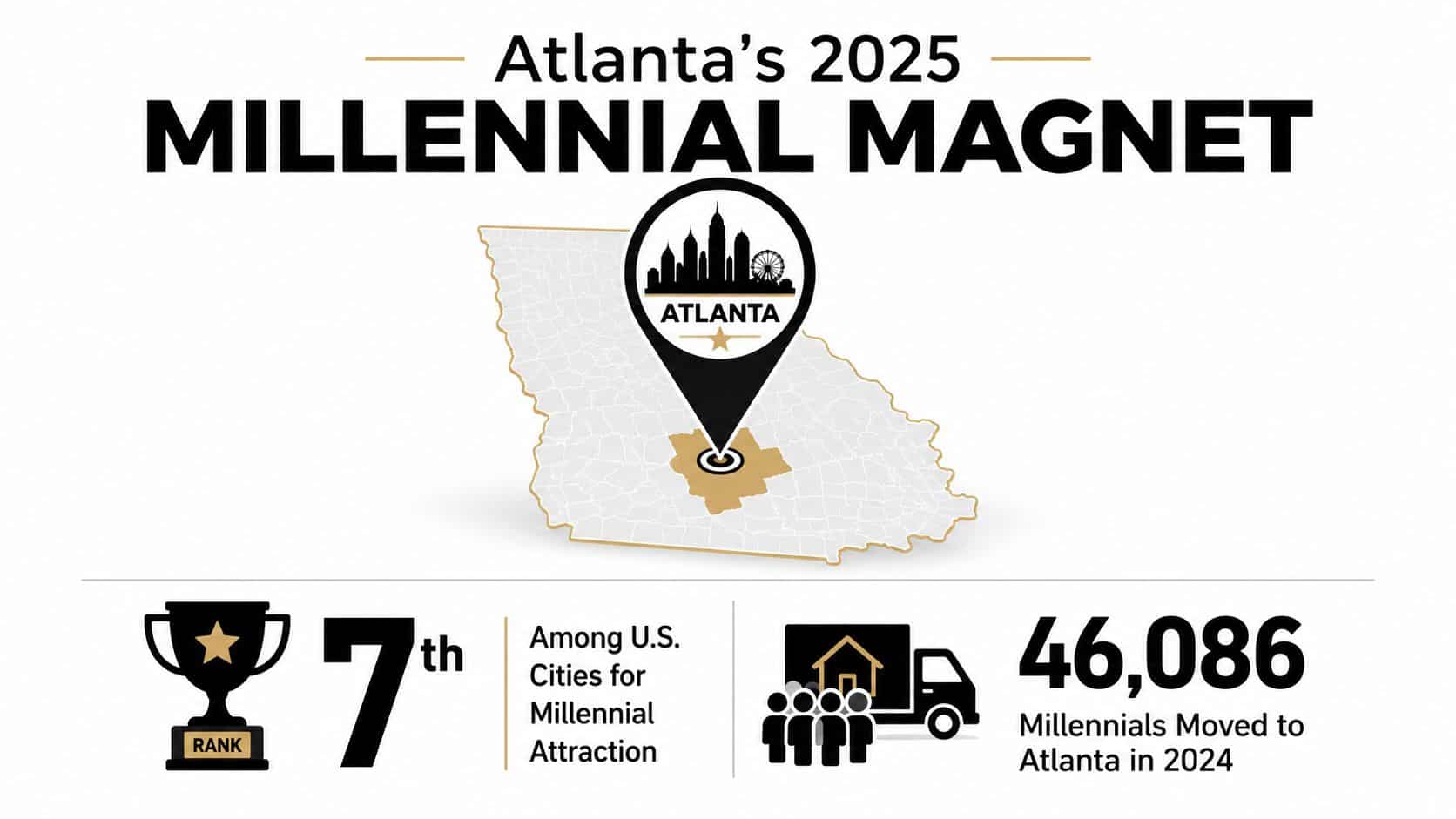
Atlanta's millennial story is bigger than a low-rent headline. SmartAsset's 2025 migration analysis put the city 7th among U.S. cities attracting the most millennials, with 46,086 millennial newcomers in one year, and millennials making up 36.28% of Atlanta's total population (SmartAsset's 2025 millennial migration analysis). That kind of scale changes the way a city competes, because it suggests Atlanta isn't just holding onto young adults, it's pulling them in from multiple directions at once.
The mix matters. Of those newcomers, 9,848 came from other states and 1,779 arrived from abroad (SmartAsset's 2025 millennial migration analysis). Domestic inflow usually signals a city can win against peer markets. International inflow points to something stronger, a place with enough economic gravity to matter beyond its region.
For readers comparing Atlanta with other major metros, a useful cross-check is broader city fundamentals, not just migration lists. A solid comparison should include housing, job depth, and long-run growth. The wider market picture is one reason analysts keep an eye on wealthy US cities to invest in, since migration and investment appetite often move together. If you want a separate lens on where Atlanta may be heading next, the city's own growth outlook is worth reviewing in the Atlanta real estate market forecast for 2026.
The Migration Signal in the 2025 Numbers
Atlanta's 2025 migration profile looks less like a trend and more like a repeatable pattern. SmartAsset ranked the city 7th among U.S. cities attracting the most millennials, and that came with 46,086 millennial newcomers in a single year, equal to 9.12% of the city's population (SmartAsset's 2025 millennial migration analysis). When a city is bringing in that many people relative to its size, the signal is not just “popular,” it's structurally competitive.
Why the source mix matters
The source mix helps separate real demand from simple churn. Some of Atlanta's inflow came from other states, and some came from abroad (SmartAsset's 2025 millennial migration analysis). Those two channels tell different stories, but together they point to a city that can attract both domestic movers and globally mobile workers.
Practical rule: if a metro draws from both interstate and international pools, it usually has more than one reason to win.
That matters because millennials don't relocate on a single variable. They compare job access, living costs, commute time, culture, and how much slack they'll have left after rent. Atlanta's 36.28% millennial share also matters, because it means the city already has a large peer group, not just a few isolated newcomers (SmartAsset's 2025 millennial migration analysis).
For a deeper look at how those demographic signals intersect with local development, the city's broader growth pattern is also visible in the local housing conversation around Atlanta real estate market forecast for 2026.
What the 2025 numbers suggest is simple. Atlanta isn't winning by accident, and it isn't winning only because it's in the South. It's winning because enough millennials see it as a place where moving can change their economic position for the better.
The Value-Density Equation Behind Affordability
Atlanta's affordability story works best when you stop calling it “cheap.” The sharper lens is value density, how much a resident gives up in housing, time, and taxes versus what they get back in jobs, mobility, and lifestyle. That is the logic behind The Langston Co.’s millennial scorecard, which ranked Atlanta No. 2 for best value, No. 3 for overall cost of living, and No. 3 for housing costs (The Langston Co. scorecard covered by Curbed).
Pay versus get changes the relocation math
The scorecard's method is important because it doesn't treat cost as a stand-alone metric. It compares what millennials pay against what they get, including housing, traffic time, taxes, jobs, culture, and access to nature (The Langston Co. scorecard covered by Curbed). That framework is closer to how real movers think.
A millennial choosing between Atlanta and a higher-cost coastal city is rarely asking, “Which place is cheapest?” The core question is, “Where do I keep more of my paycheck after rent, and what kind of life does that leftover budget buy?” In that sense, Atlanta's ranking hints at stronger after-rent flexibility than places where housing eats a larger share of income.
If you're comparing Atlanta with more expensive markets like New York or San Francisco, the decision often comes down to how much stress a city extracts before the month even starts. Atlanta's scorecard suggests the city leaves more room for savings, dining, travel, and mobility because the resident is not overpaying for basic access. That doesn't make Atlanta universally affordable, but it does make it unusually efficient.
You can also see why lifestyle-oriented movers keep circling Atlanta in broader regional comparisons, including affordable Atlanta suburbs with the best quality of life. The point isn't just lower cost, it's a better ratio between cost and daily experience.
Entry-Level Jobs and the Early-Career Pipeline
Affordability alone doesn't pull people across state lines. Atlanta keeps showing up in millennial rankings because the city also gives early-career workers a usable job ladder. The Langston Co. scorecard ranked Atlanta No. 5 for a high number of entry-level gigs, and an AJC-reported expert analysis placed the city among the top ten best U.S. cities for millennials using metrics such as entry-level and graduate-friendly jobs, unemployment rate, educational enrollment, and green commuting options (AJC analysis of Atlanta's millennial ranking).
Why pipeline depth matters more than one headline job number
A healthy early-career market reduces job-search friction. That means a worker in their 20s or early 30s can more often find a match that fits both skill level and growth path, instead of taking the first role available. In practical terms, Atlanta's mix of entry-level and graduate-friendly jobs helps new arrivals land faster and move faster once they're in.
Atlanta's advantage is not just that jobs exist. It's that younger workers can see a path from first role to second role without leaving the metro.
That's why Atlanta keeps ranking well for both millennials and younger adults. The labor market is broad enough to absorb new graduates, but still deep enough to support workers who want to move from junior roles into more specialized tracks. For employers, that creates a more fluid talent pool. For job seekers, it lowers the cost of taking a chance on relocation.
The city's standing in this category also connects to its broader appeal for younger workers, which is why it shows up in discussions of top companies hiring in Atlanta right now. The more predictable the early-career funnel, the easier it is for a move to feel rational instead of risky.
Georgia-Wide Momentum That Compounds the Advantage
Atlanta's pull makes more sense when you zoom out to Georgia as a whole. Migration into the state has been strong enough that the city's millennial gains look less like an isolated spike and more like part of a larger migration corridor. Urbanize Atlanta cited analysis showing Georgia saw 116,000 millennials move in during 2022, creating a net gain of 36,000 people in the 24-to-39 age group (Urbanize Atlanta on Georgia millennial migration).
State momentum makes city momentum stick
A separate statewide migration study found Georgia recorded a net inflow of more than 20,200 millennials in 2023 and over 400,000 net new residents since 2014, while Atlanta-region forecasts project an additional 1.8 million people by 2050 (Urbanize Atlanta on Georgia millennial migration). Those figures matter because they imply persistence, not one-off excitement.
When a city sits inside a fast-growing state, its advantages compound. Employers have more recruiting depth. Housing demand stays active. Infrastructure investment becomes more likely. That is a different proposition from a city that gets a single hot year and then stalls.
For millennials, this matters because relocation is usually a medium-term decision. People want to know whether the city they choose now will still feel viable by the time they've changed jobs once or twice. Georgia's continued inflow suggests Atlanta is benefiting from a wider regional engine, not standing alone.
That is also why Atlanta's growth story keeps showing up in broader economic commentary such as how Atlanta's economy is driving growth across Georgia. The city's appeal is stronger when the surrounding market is moving in the same direction.
Where the Draw Is Heading in 2026
The better question for 2026 is whether Atlanta is still winning for the same reasons. A 2026 market piece reported 4.4% unemployment and said 29%+ of skilled jobs are entry-level or require under four years' experience, while a separate 2024 summary of CommercialCafé research said Atlanta's metro saw a 6.3% increase in its millennial population between 2018 and 2022 and household incomes averaged just over $109,000 (2026 market piece on Atlanta's Gen Z financial freedom appeal, Capital Analytics Associates summary of CommercialCafé research).
Those numbers point to a value-density story, not just a cheap-rent story. Millennials evaluating Atlanta are weighing what they give up and what they get back, and the current mix still looks favorable for people who want a city with jobs, income potential, and room to move without paying top-tier coastal prices.
Millennial preference or Gen Z funnel
That is where the interpretation gets more interesting. If Atlanta continues to attract younger workers because the market is open to early-career applicants and the cost structure still leaves room to build, then the city's advantage may be shifting from a settled millennial lifestyle preference to a broader entry point for younger talent. That does not weaken Atlanta, but it does change the reason it keeps winning.
Atlanta's reputation with younger adults still supports that reading. Niche.com has consistently ranked the city in its top 25 Best Cities for Millennials using factors like millennial residents, job opportunities, bars and restaurants, and affordable housing (KnowAtlanta on Atlanta's millennial appeal). Those same variables also line up with the priorities that matter to many Gen Z movers.
The city's startup economy adds another layer to that pattern. Atlanta's technology and startup base gives early-career workers a place where entry-level roles, growth companies, and professional mobility can coexist, which is one reason the city keeps drawing attention in coverage of its innovation corridor, including Atlanta's technology startup ecosystem.
A practical comparison also shows up in partner industry behavior. Teams that rely on fast hiring cycles, frequent onboarding, and short tenure patterns often start looking at the city differently, which is why related business services keep tracking demand alongside relocation trends, including the delivery partners list by OrderOut.
The edge is drifting from “best millennial city” toward “best first serious city.”
That shift matters because it tells us what to watch next. If Atlanta keeps pairing entry-level access with livability and income growth, the millennial case stays intact. If that mix weakens, the city can still remain attractive, but the argument will rest more on early-career opportunity than on the classic millennial draw.
What This Means for Atlanta's Employers and Service Providers
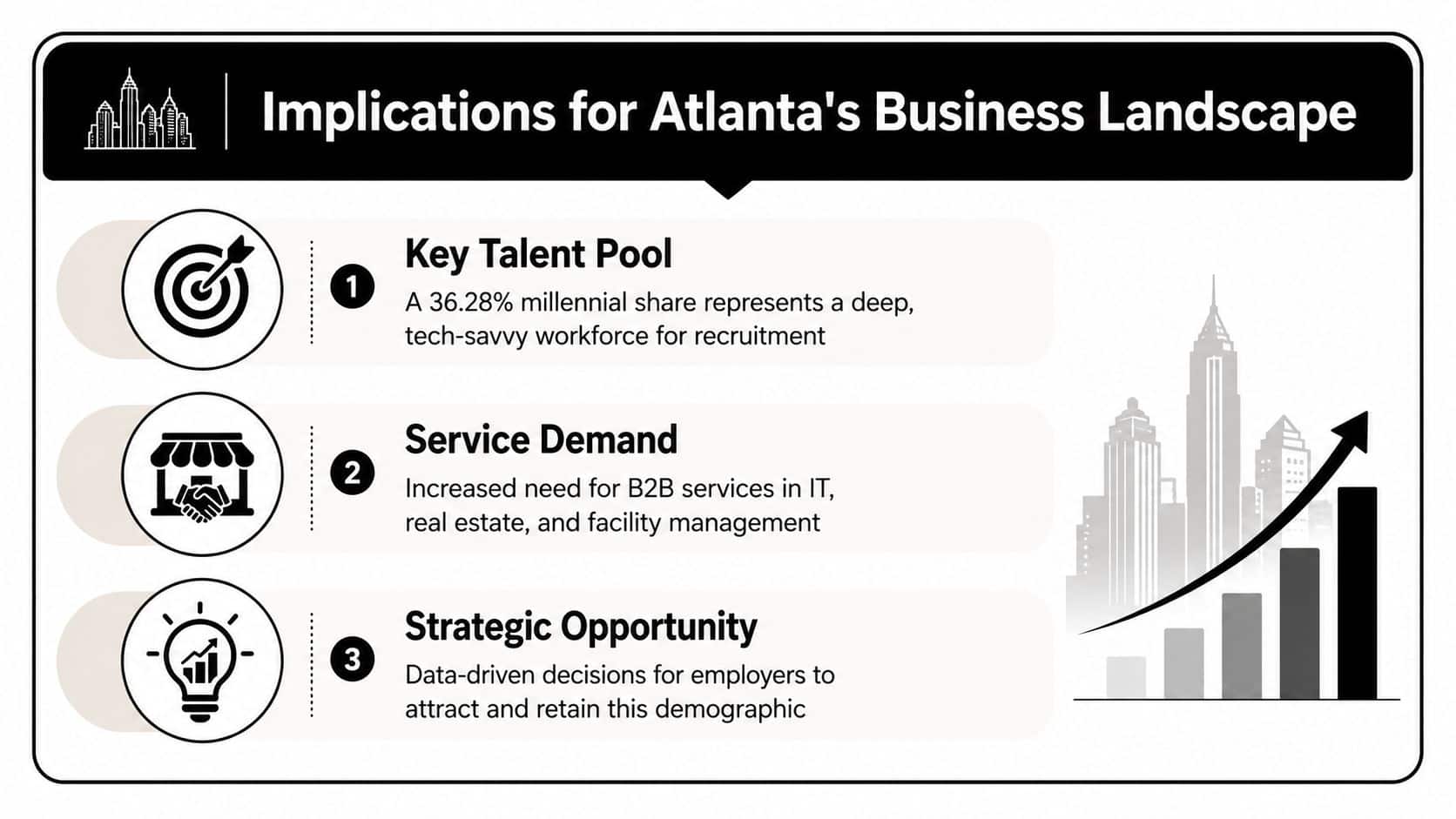
Atlanta's demographic mix has real operational consequences. A city where millennials make up 36.28% of the population and where millennial growth has remained positive creates a workforce that is younger, more mobile, and more likely to rotate through new roles and new employers (SmartAsset's 2025 millennial migration analysis, Capital Analytics Associates summary of CommercialCafé research). That changes how companies hire, equip, and retire technology.
What younger workforces change inside the enterprise
A dense early-career labor pool usually means more frequent onboarding, more laptop turnover, and more device standardization across departments. It also means procurement teams face more pressure to document lifecycle handling clearly, because younger managers often expect visible compliance, traceability, and sustainability in the vendors they approve.
That's especially relevant in Atlanta, where office growth, mixed-use development, and a broad corporate base all interact with a fast-moving talent market. More workers cycling through more jobs means more endpoints entering and leaving the corporate environment. That puts secure IT asset disposal, certified data destruction, and responsible electronics recycling squarely inside standard operations planning.
The broader service ecosystem matters too. Businesses that support workplaces, moves, and tenant turnover have to account for a younger population that expects speed, transparency, and cleaner handoffs. A useful reference point for service operators is how delivery and logistics networks adapt to urban demand, including resources like the delivery partners list by OrderOut, which shows how service coordination becomes part of the competitive stack.
Decision rule: if your workforce is getting younger, your asset-disposal and data-destruction process needs to get tighter, not looser.
A Practical Checklist for Comparing Atlanta to Your Other Options
Atlanta looks strongest when you compare it on the same three dimensions every time, value, labor depth, and momentum. Start with the pay-versus-get question. Does the city leave more after-rent discretionary income than your current option, and does that show up in housing and cost-of-living rankings like Atlanta's No. 2 best value, No. 3 cost of living, and No. 3 housing result (The Langston Co. scorecard covered by Curbed)?
Then check the labor funnel. Does the city have enough entry-level gigs to shorten the job search, and does it show up in outside rankings that weigh entry-level and graduate-friendly jobs, unemployment, educational enrollment, and commuting options (AJC analysis of Atlanta's millennial ranking)? A city can look attractive on paper and still be painful to land in if the early-career market is too thin.
Next, inspect the migration trend. Is the city pulling in millennial newcomers from both domestic and international channels, as Atlanta did in SmartAsset's 2025 analysis, or is its growth more local and fragile (SmartAsset's 2025 millennial migration analysis)? Then widen the frame to the region. Does the state show sustained net inflow and long-range population projections, or is the metro carrying the whole load alone (Urbanize Atlanta on Georgia millennial migration)?
Finally, ask whether the city is still winning for the same reasons next year. If entry-level access, affordability, and job growth stay aligned, Atlanta's case strengthens. If those conditions drift, the lead can narrow faster than the headlines suggest.
If your organization is planning office relocations, IT refreshes, or end-of-life device handling in Atlanta, Beyond Surplus can help you plan secure electronics recycling and compliant IT asset disposal around real business needs. Visit Beyond Surplus to review services, schedule pickup, and make your next technology turnover cleaner and safer.