
In 2022, organizations and individuals generated a record 62 billion kilograms of electronic waste, but only 22.3% was formally collected and recycled through environmentally sound processes, according to the Global E-waste Monitor 2024. For a business retiring laptops, servers, phones, storage media, networking hardware, or medical and laboratory equipment, the risk isn't limited to where the equipment ends up. It also includes what data remains on it, who handles it, and whether the organization can prove every disposition step.
Secure ITAD services turn retirement into a controlled business process. The right program combines asset inventory, risk-based data sanitization, documented custody, compliant recycling, and clear reporting. That approach supports IT security, regulatory response, sustainability programs, and value recovery without treating hardware disposal as an informal pickup.
Table of Contents
- Why Secure ITAD Services Matter for Modern Businesses
- Core Components of Secure IT Asset Disposition
- On-Site vs Off-Site Data Destruction Methods
- Compliance Documentation and Certificates of Destruction
- How to Evaluate and Select a Secure ITAD Provider
- Real-World ITAD Process for a Multi-Site Business
- Business Value of Secure ITAD Services
Why Secure ITAD Services Matter for Modern Businesses
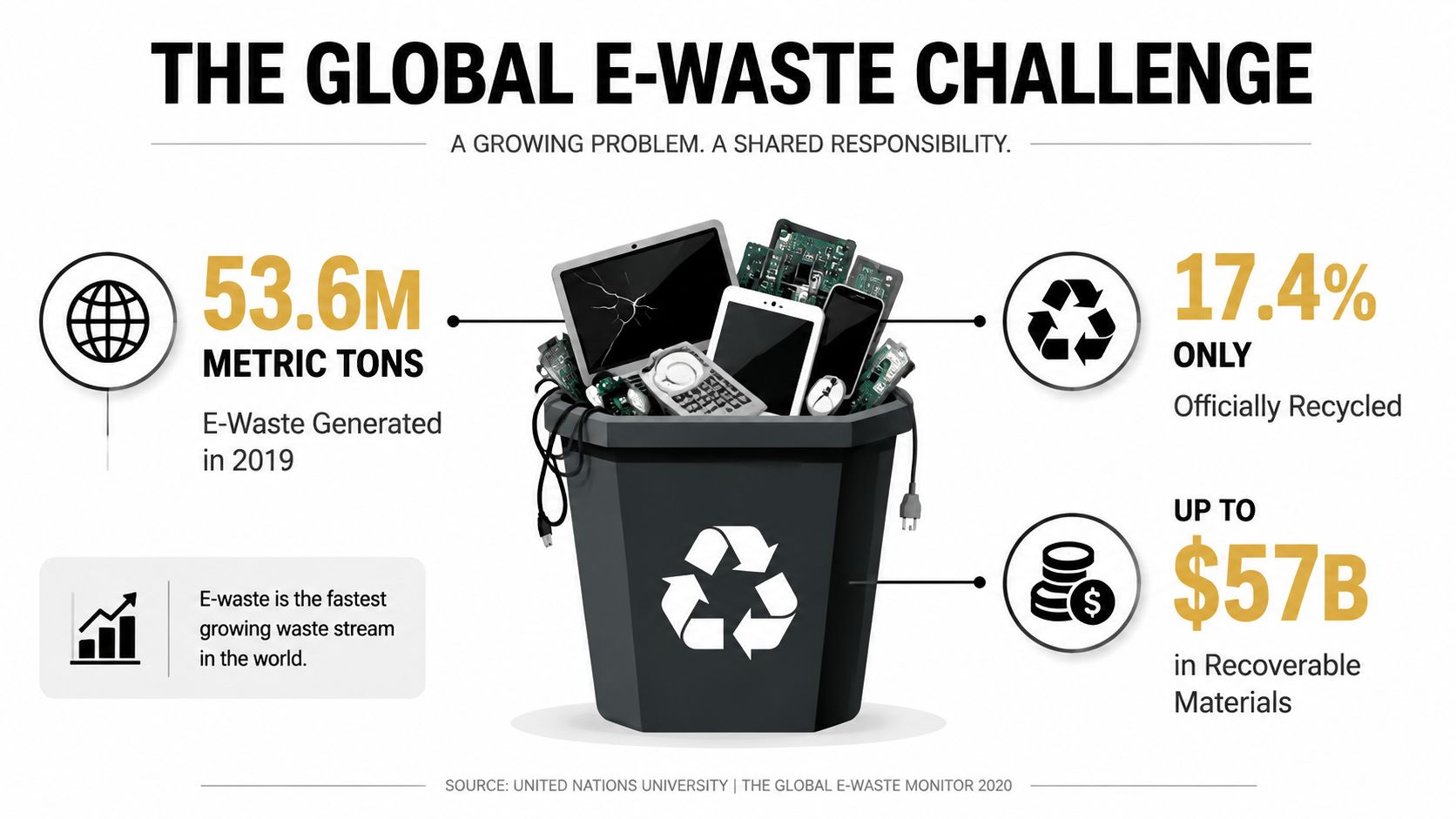
The e-waste stream is growing faster than responsible recovery systems can handle. The UN recorded 53.6 million metric tonnes of e-waste in 2019, with only 17.4% formally collected and recycled, according to the UN Global E-waste Monitor 2020. The later 2024 global monitor reported 62 billion kilograms generated by 2022 and a formally recycled share of 22.3%.
The gap creates a direct business risk. Retired equipment may leave a controlled environment through resale, donation, transport, informal recycling, or storage overflow. Each route raises questions about data exposure, environmental handling, ownership records, and downstream accountability. A truck receipt confirms collection, not secure disposition.
The same ITU report also identified about US$62 billion in recoverable natural resources associated with properly collected and recycled e-waste that remained unaccounted for. Secure ITAD helps separate equipment suitable for reuse or recovery from media and components requiring destruction. It also produces evidence that procurement, sustainability, security, and compliance teams can review. For commercial electronics recycling and secure e-waste management, Beyond Surplus electronics recycling services illustrate a workflow covering equipment handling, data destruction, and downstream processing.
Data exposure is the hidden failure point
A retired endpoint may retain browser data, cached credentials, local files, customer records, encryption keys, or regulated information. Blancco's 2025 State of Data Sanitization Report identifies stolen devices as a bigger cause of data loss than stolen credentials or ransomware.
The control failure often occurs after equipment leaves the employee's desk. Organizations need asset-level records showing what was collected, which sanitization decision was made, who handled the device, and how the final outcome was verified. Without that evidence, a later investigation may establish that hardware disappeared without proving that its data was rendered inaccessible.
Secure ITAD therefore supports risk management, not recycling alone. It gives security and compliance teams a repeatable disposition process, while helping business leaders address environmental obligations, ownership questions, and exposure created by third-party handling.
Core Components of Secure IT Asset Disposition
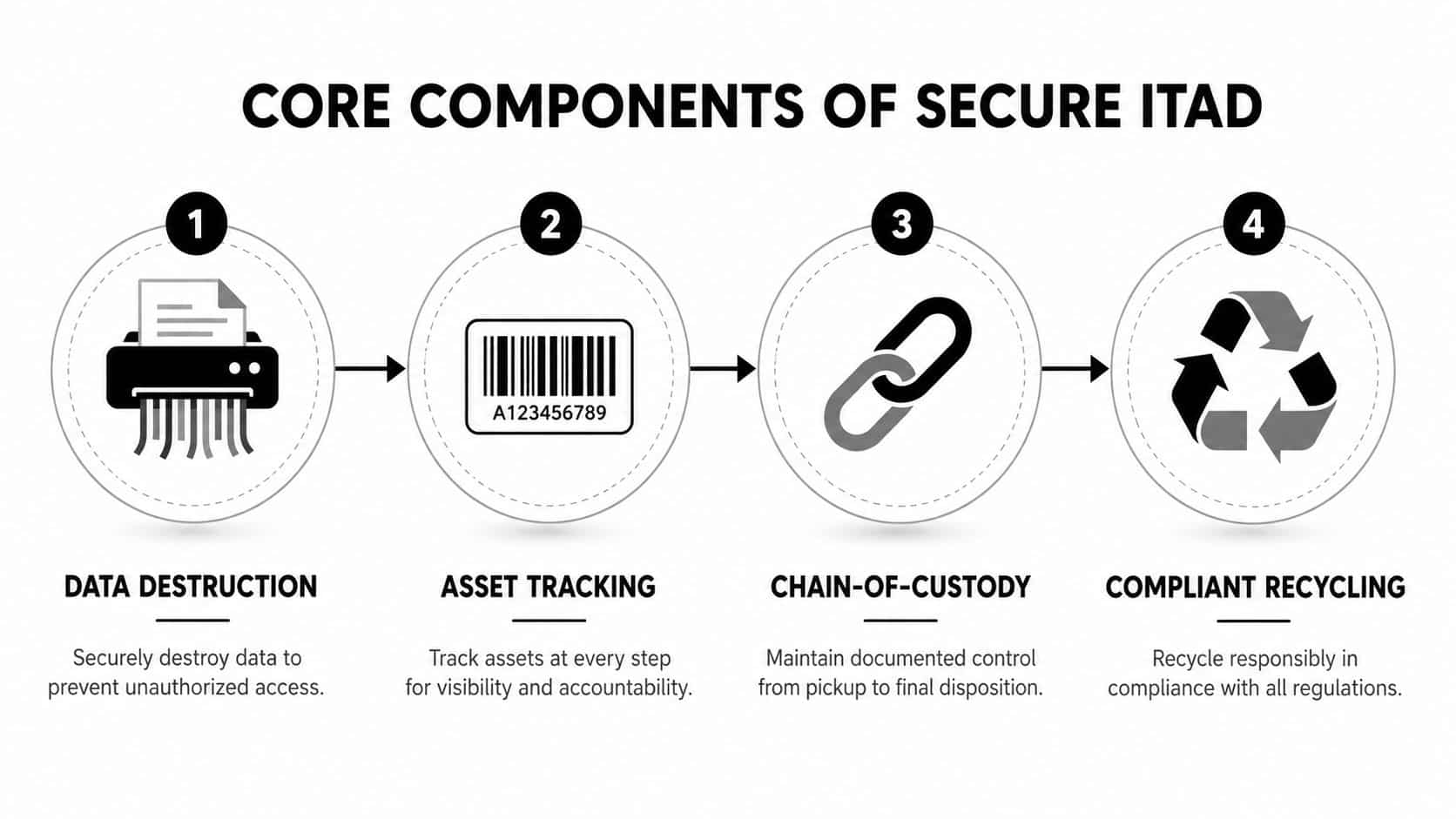
A secure ITAD program works like an audit trail with physical controls. Every asset should be identifiable, every handoff should be explainable, and every data-bearing device should have a recorded disposition decision.
Start with identification and risk classification
Before equipment moves, build an inventory that connects each asset to a serial number, barcode, tag, location, device type, and disposition status. Include laptops, desktops, servers, storage arrays, removable media, network gear, phones, point-of-sale equipment, medical technology, and laboratory hardware when those assets may contain storage or sensitive configuration data.
Then classify the asset according to reuse intent and information sensitivity. A low-risk device planned for internal redeployment may follow a different sanitization path from a server containing customer records or a failed drive that can't be reliably wiped.
Choose the sanitization method deliberately
NIST SP 800-88 Rev. 2 is the current federal benchmark for media sanitization and supersedes Rev. 1. It describes sanitization as a risk-based process that makes access to target data infeasible for a given level of effort. The NIST media sanitization publication recognizes cryptographic erase for encrypted media and techniques aligned with IEEE 2883 or organizational standards.
In practical terms, the decision commonly falls into three categories:
- Clear: Use for lower-risk situations where the media remains in a controlled reuse environment.
- Purge: Use for stronger sanitization when reusable media requires greater protection against recovery.
- Destroy: Use when reuse isn't acceptable or residual recovery risk must be minimized.
Verification matters as much as the selected technique. A wiping job without a reliable result, asset association, operator record, and completion report leaves a gap between the intended process and the evidence.
Control movement and downstream routing
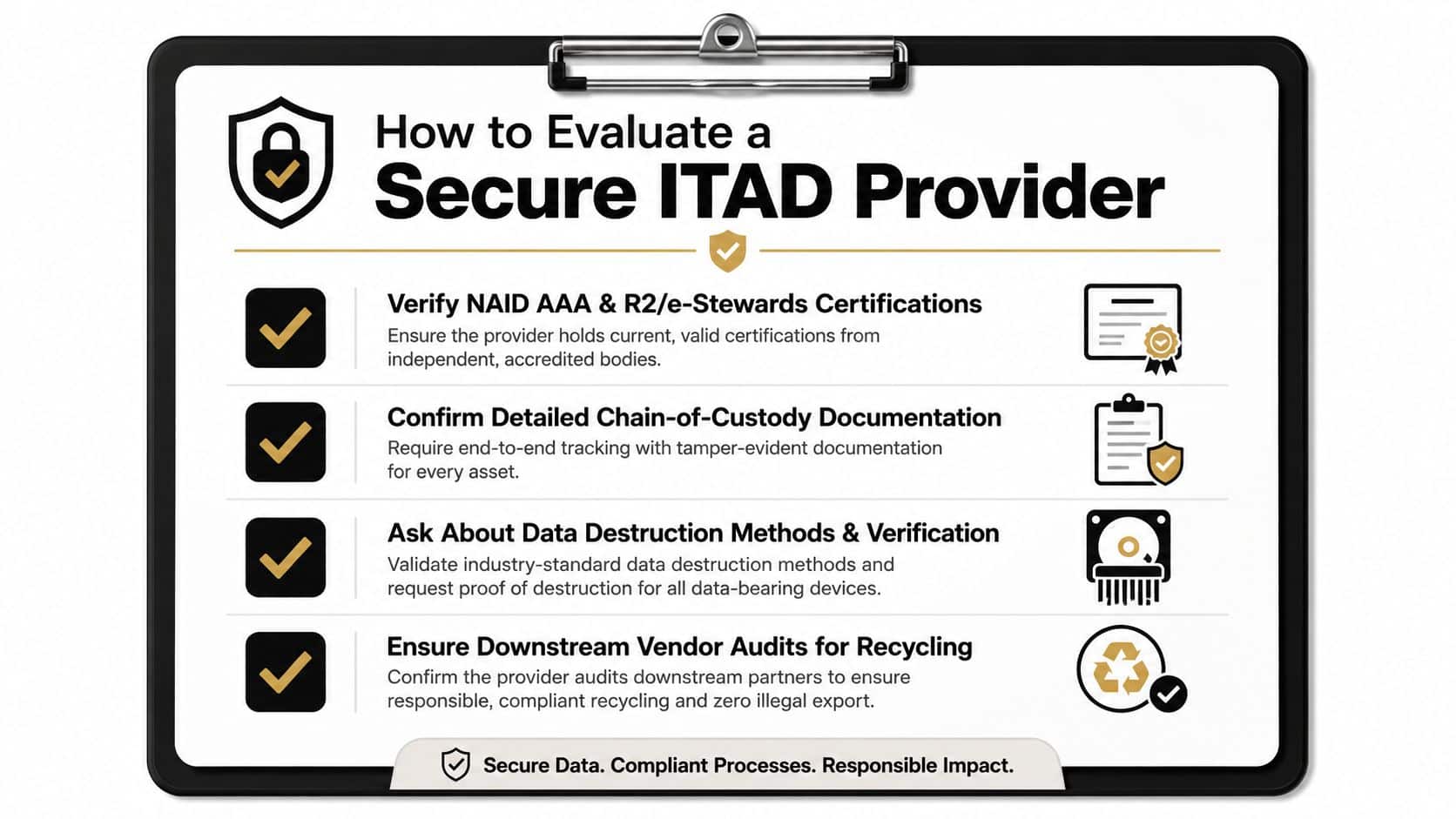
Chain-of-custody begins at removal and continues through packaging, internal transfers, loading, transportation, facility intake, sanitization, destruction, recycling, resale, or final reporting. Guidance for data-center decommissioning chain of custody says each movement should record the date and time, responsible personnel, asset identification, location, and transfer confirmation.
Recycling is the final control, not an afterthought. A provider should explain how non-reusable equipment is processed, how downstream vendors are reviewed, and how certificates connect the physical assets to the completed outcome. Vendor review should cover insurance, certifications, facilities, transportation, data handling, and subcontractors. A practical vendor due diligence checklist can help procurement teams ask consistent questions before award.
Practical rule: If a provider can't connect the pickup record, asset identifier, sanitization result, and final certificate, the process isn't audit-ready.
On-Site vs Off-Site Data Destruction Methods
The choice between on-site and off-site destruction depends on the media, risk tolerance, reuse plans, site conditions, and volume. Neither method is automatically safer. The control comes from matching the method to the asset and documenting the result.
On-site shredding
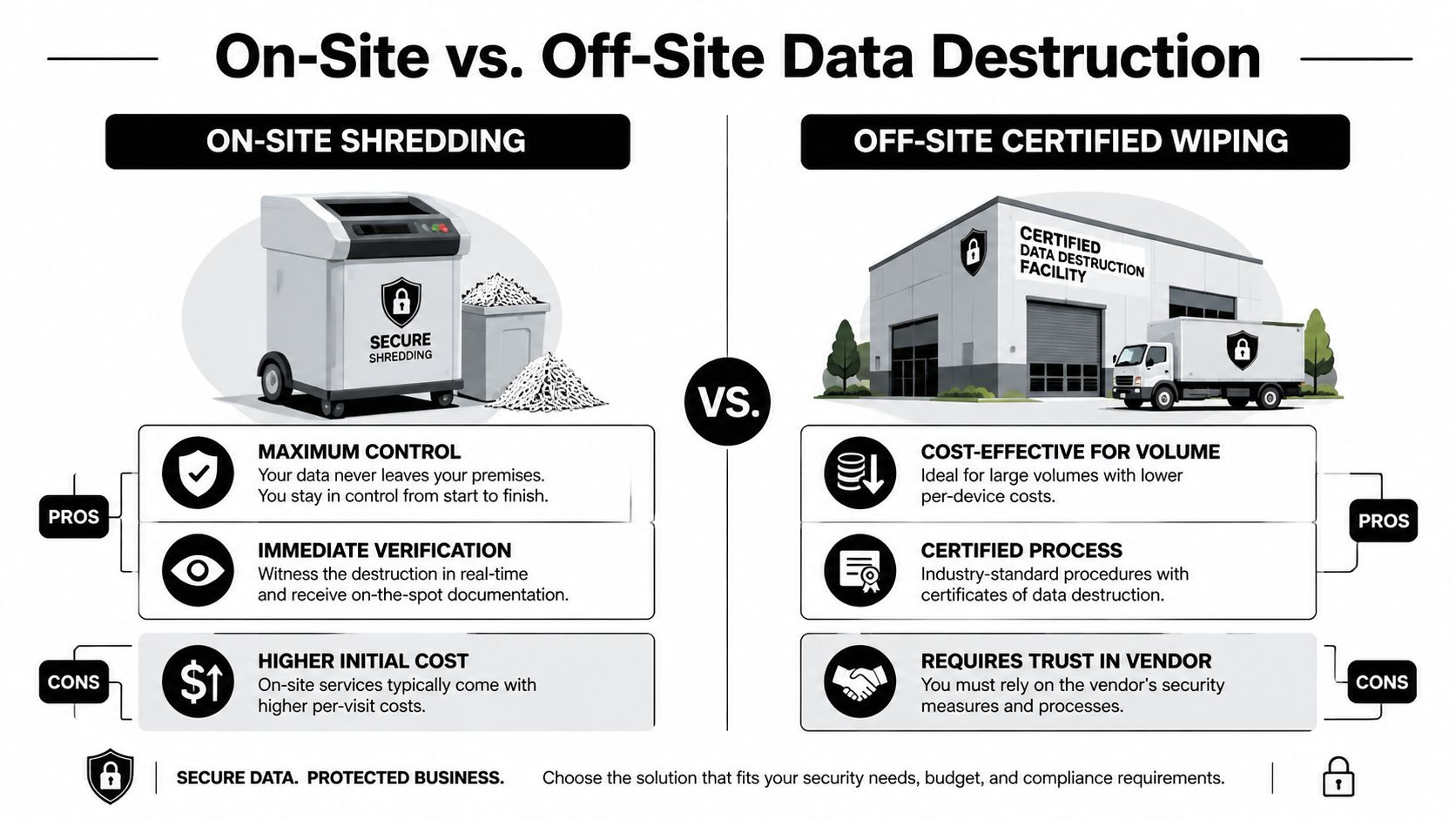
On-site hard drive shredding brings destruction equipment to the business location. It suits organizations that need immediate physical control, have high-sensitivity media, or don't want intact drives transported to another facility. Security teams can witness the process, reconcile the destroyed serial numbers, and receive documentation tied to the work performed.
The trade-off is operational. On-site destruction can require staging space, vehicle access, scheduling coordination, and a higher initial cost. It also eliminates the possibility of remarketing the destroyed media, so it should be reserved for devices where reuse isn't acceptable.
Off-site certified wiping
Off-site wiping moves equipment to a controlled processing facility, where technicians sanitize reusable media using an approved method and record the outcome. This can work well for laptops, desktops, servers, and storage devices that retain resale or redeployment value. It also supports larger batch workflows when the provider has appropriate inventory systems and secure transportation.
The weakness is dependence on vendor controls. The organization must verify packaging, vehicle security, facility access, operator authorization, sanitization software, exception handling, and certificates. A vendor's promise of secure processing isn't a substitute for evidence.
| Decision factor | On-site shredding | Off-site certified wiping |
|---|---|---|
| Primary outcome | Permanent physical destruction | Sanitization with potential reuse |
| Control point | Business location | Provider facility |
| Best fit | High-risk or non-reusable media | Reusable equipment and batch processing |
| Main trade-off | Higher initial cost and lost recovery value | Greater reliance on vendor custody and verification |
Physical security also extends beyond data erasure. Organizations reviewing facility controls can consult this resource on fire and security for waste management for broader considerations around waste-handling environments. For a more detailed operational comparison, see on-site versus off-site ITAD services.
Compliance Documentation and Certificates of Destruction
A certificate is useful only when it reflects a controlled process. A generic statement that equipment was recycled doesn't prove which devices were handled, how data was sanitized, whether exceptions occurred, or where the material went.
The FTC Disposal Rule sets a benchmark for organizations handling consumer report information. Disposal must be reasonable and appropriate to prevent unauthorized access or use, and accepted methods include shredding, burning, pulverizing, erasing, or using a contractor after due diligence such as independent audits and recognized certifications, as explained by the Federal Trade Commission Disposal Rule guidance.
The FTC's proposed rule text also makes clear that disposal includes discarding, abandoning, selling, donating, or transferring any medium, including computer equipment, that stores consumer information. The relevant FTC federal register text is important because it places business IT equipment within the analysis when regulated information remains on the device.
What a defensible record should show
A strong destruction or recycling package normally connects the business request to the individual asset. It should identify the client, pickup or work order, asset identifiers, media type, sanitization or destruction method, completion status, exceptions, processing date, responsible provider, and final disposition.
The record should also preserve the custody sequence. That means the organization can show who removed the equipment, who accepted it, how it was transported, when it arrived, and when the provider completed wiping, shredding, resale, or recycling. A useful primer on Chain of Custody DPP Grid illustrates why documented transitions matter in any controlled material workflow.
Audit question: Could an independent reviewer select one retired laptop from your inventory and trace it from production removal to verified sanitization and final disposition?
Certificates don't erase liability by themselves, but they support a credible due-diligence position. They also help internal audit, incident response, procurement, sustainability reporting, and regulatory inquiries work from the same factual record. For hard-drive-specific documentation, organizations can review this guide to a hard-drive destruction certificate.
How to Evaluate and Select a Secure ITAD Provider
Provider selection should begin with evidence, not a sales presentation. Ask the vendor to show how it handles an asset that is missing, unreadable, damaged, encrypted, rejected by wiping software, or routed to a downstream processor.
Review certifications and scope
Certifications can support due diligence, but only when the certification applies to the relevant facility, service, and processing scope. Ask the provider to verify current NAID AAA and R2 or e-Stewards credentials where applicable, then confirm whether subcontractors and downstream vendors operate under equivalent controls.
Don't assume a recycling certification proves data destruction capability. Data sanitization, physical destruction, resale, transportation, and environmental processing are related but distinct functions.
Test the workflow with specific questions
A procurement review should require direct answers to questions such as:
- Asset visibility: How are serial numbers captured at pickup, arrival, and final processing?
- Sanitization evidence: Which method is selected for each media type, and how is the result verified?
- Exception handling: What happens when a drive fails wiping, a serial number is missing, or an asset count doesn't reconcile?
- Custody control: Which employees and carriers can access equipment, and what records document each transfer?
- Downstream oversight: How often are recycling and resale partners audited, and can the provider identify the final route?
- Reporting: Can the provider deliver asset-level certificates, recycling records, resale statements, and exception reports?
Evaluate practical capacity
A provider may have sound policies but lack the staffing, secure storage, transportation, or processing capacity required for a multi-site rollout. Confirm pickup coverage, project management, loading procedures, facility controls, turnaround expectations, insurance, and escalation contacts before signing.
Beyond Surplus provides commercial IT equipment disposal, secure wiping, on-site and off-site hard-drive shredding, certificates of destruction and recycling, product destruction, data-center de-installation, logistics coordination, and IT asset recovery services. Organizations comparing vendors can use this step-by-step ITAD vendor selection guide to structure the evaluation.
Real-World ITAD Process for a Multi-Site Business
Consider a financial services company replacing equipment across offices, a support center, and a server room. The project includes employee laptops, network appliances, retired servers, backup drives, and several devices held in storage because no team had confirmed their ownership or disposition status.
The provider starts with a site-by-site inventory. Local contacts identify equipment scheduled for retirement, while the IT team confirms which assets contain data and which devices may be redeployed. Each item receives a recorded identifier and disposition route before the first box leaves a facility.
At pickup, technicians separate data-bearing equipment from accessories and packaging materials. They document the removal, secure the load, and provide a transfer record. The company doesn't treat the carrier handoff as the end of its responsibility. It retains the pickup manifest and waits for facility receipt and reconciliation.
Processing decisions happen by asset
The provider routes reusable laptops and network hardware toward verified sanitization and testing. Failed drives and media designated for destruction go through an approved physical process, while equipment without recovery value moves into compliant recycling. A damaged server isn't automatically treated like a reusable laptop, and a device with an uncertain data status isn't released solely because it powers on.
The processing team records results against the original identifiers. If a wipe fails, the asset is placed on an exception report and escalated for destruction or another approved method. If an item is missing from the received inventory, the provider investigates the custody record rather than closing the work order without comment.
The closeout package supports governance
At completion, the company receives asset-level destruction records, recycling documentation, and any value-recovery statement for eligible equipment. Its security team can reconcile every data-bearing device, while facilities and procurement teams can close their inventory and sustainability records.
This approach scales because it standardizes the control points without pretending every site has identical equipment. A distributed business needs one policy, local execution instructions, and a single reporting structure that makes exceptions visible.
Business Value of Secure ITAD Services
Secure ITAD creates value by combining controls that businesses often manage separately. Data sanitization reduces exposure from retired endpoints. Chain-of-custody records give security and compliance teams evidence. Responsible recycling supports sustainability reporting, while testing and remarketing can recover value from equipment that still has a useful secondary life.
The strongest programs also reduce operational friction. Facilities teams don't have to store obsolete hardware indefinitely, IT teams can close decommissioning tasks with traceable records, and procurement can evaluate vendors against consistent requirements. For hospitals, financial institutions, schools, manufacturers, government agencies, and other organizations with sensitive information, that consistency matters more than a one-time disposal quote.
Cross-border routing requires additional attention. EPA guidance says Basel Convention amendments effective January 1, 2025 require prior written consent for international shipments of hazardous and non-hazardous e-waste and scrap, including consent from importing and transit countries, as described in the EPA international e-waste requirements. Multinational programs should therefore verify classification, destination, transit permissions, and supporting records before equipment crosses a border.
Beyond Surplus offers commercial electronics recycling, secure data wiping, on-site and off-site hard-drive shredding, IT equipment disposal, product destruction, data-center de-installation, logistics coordination, and certificates that support auditable disposition. Review the available services and contact Beyond Surplus to plan a secure ITAD program for your locations and data-bearing assets.


