Decommissioning a data center means methodically shutting down, dismantling, and clearing out all IT infrastructure from a facility. It’s a massive undertaking that involves everything from secure data destruction and asset inventory to logistics and environmentally sound recycling, all while trying to recover value from the retired gear.
Why Data Center Decommissioning Is a Strategic Imperative
Moving on from a data center is a lot more complex than just powering down servers and yanking out cables. It’s become a critical business operation, usually pushed forward by big shifts like cloud adoption, major infrastructure upgrades, or tightening data security regulations.
For many companies, what was once a state-of-the-art facility can quickly turn into a financial and operational drag. Aging hardware eats up too much power, needs constant maintenance, and just doesn't have the agility to keep up with modern business demands.
This reality has fueled a huge shift toward leaner, more efficient IT environments. The global data center decommissioning service market was valued at around $5.02 billion in 2022 and is expected to rocket to over $15.58 billion by 2030, growing at a compound annual growth rate (CAGR) of about 15.2%. This boom is a direct result of IT infrastructure aging out, companies consolidating physical footprints due to cloud adoption, and stricter data privacy laws popping up worldwide.
The Shift From Logistical Task to Business Advantage
A professionally managed decommissioning project isn’t just about logistics; it’s a real strategic advantage. When done right, it turns a complicated headache into a secure and profitable outcome. The process tackles several key priorities that modern businesses simply can't afford to get wrong.
Let's break down the key drivers and the strategic wins they deliver.
| Driver | Description | Strategic Benefit |
|---|---|---|
| Technology Refresh & Modernization | Aging hardware becomes inefficient, costly to maintain, and unable to support new workloads. | Frees up capital for investment in modern, agile infrastructure (cloud, colocation, or on-prem). |
| Cloud Migration & Consolidation | Shifting applications and data to public or private cloud services eliminates the need for physical data centers. | Reduces operational overhead, improves scalability, and lowers total cost of ownership (TCO). |
| Data Security & Risk Mitigation | Storing sensitive data on obsolete, unsupported hardware creates significant security vulnerabilities. | Ensures 100% data destruction, preventing breaches and demonstrating compliance with privacy laws. |
| Regulatory & Compliance Mandates | Regulations like GDPR, HIPAA, and the FTC Disposal Rule dictate strict data handling and disposal protocols. | Provides a clear, auditable trail of compliance, protecting the company from fines and reputational damage. |
| Cost Reduction & Financial Optimization | High costs associated with power, cooling, and real estate for underutilized facilities drain budgets. | Eliminates unnecessary operational expenses and recovers residual value from retired assets. |
A well-executed plan doesn't just check boxes—it unlocks real business value by turning a potential cost center into a source of revenue and risk mitigation.
Here's what a successful project delivers:
- Bolstered Data Security: It guarantees that every last byte of sensitive corporate and customer data is wiped clean for good, protecting your organization from devastating breaches and legal blowback.
- Guaranteed Regulatory Compliance: You get a clear, auditable trail showing you’ve met the standards of regulations like HIPAA, GDPR, PCI DSS, and the FTC Disposal Rule, which is critical for protecting your company’s reputation.
- Maximized Financial Returns: You can unlock the hidden residual value in your retired IT assets through certified remarketing channels, turning old equipment into a new source of revenue.
- Enhanced Environmental Responsibility: It ensures that all e-waste is handled according to the highest environmental standards, preventing hazardous materials from ending up in landfills. To get a better handle on the consequences of improper disposal, you can learn more about the environmental impact of electronic waste.
A proactive, detailed decommissioning plan is the foundation for turning a high-stakes IT project into a successful business initiative. It allows organizations to mitigate risks proactively, control costs effectively, and ensure every action aligns with both security mandates and financial goals.
Ultimately, a decommissioning project is a major moment in a company's IT lifecycle. It’s a chance to securely close one chapter while paving the way for the next generation of technology, whether that’s migrating to the cloud, consolidating into a colocation facility, or building a more modern on-prem environment. Approaching it with a strategic mindset is the only way to get it right.
Crafting Your Decommissioning Project Plan
A data center decommissioning project isn’t something you can just wing. The success or failure of the entire operation is decided long before a single server gets unplugged. It all boils down to the quality of your project plan.
Think of your plan as the strategic roadmap. It guides every single decision, from defining the initial scope to signing off on the final compliance reports. Without a detailed blueprint, you're leaving yourself wide open to massive risks—budget overruns, unexpected downtime, glaring data security gaps, and even regulatory fines. The goal here is to get beyond a simple checklist and create a living document that anticipates challenges and gets every stakeholder on the same page.
Defining Your Project Scope and Assembling the Team
First things first, you need to draw a clear line around the project. Are you taking down an entire facility, just a specific server hall, or maybe a few racks of gear that have seen better days? How you answer this question will shape every decision that follows, from your budget to the people you'll need on deck.
Once the scope is locked in, it’s time to build your team. It's not just an "IT project." To pull this off without a hitch, you need buy-in and action from several departments.
Your core team must include professionals from:
- IT Operations: They'll handle the technical teardown, data migration, and identifying every last asset.
- Facilities Management: Someone needs to manage the power, cooling, physical security, and any site repairs.
- Finance Department: They’re essential for budgeting, asset valuation, and tracking every dollar you recover.
- Legal and Compliance: These experts ensure you're squared away with data privacy laws and environmental regulations.
Getting everyone in the same room from the start breaks down silos and ensures all the tricky dependencies are flagged early.
This high-level workflow shows how a good plan turns a logistical headache into a strategic win that boosts security and your bottom line.
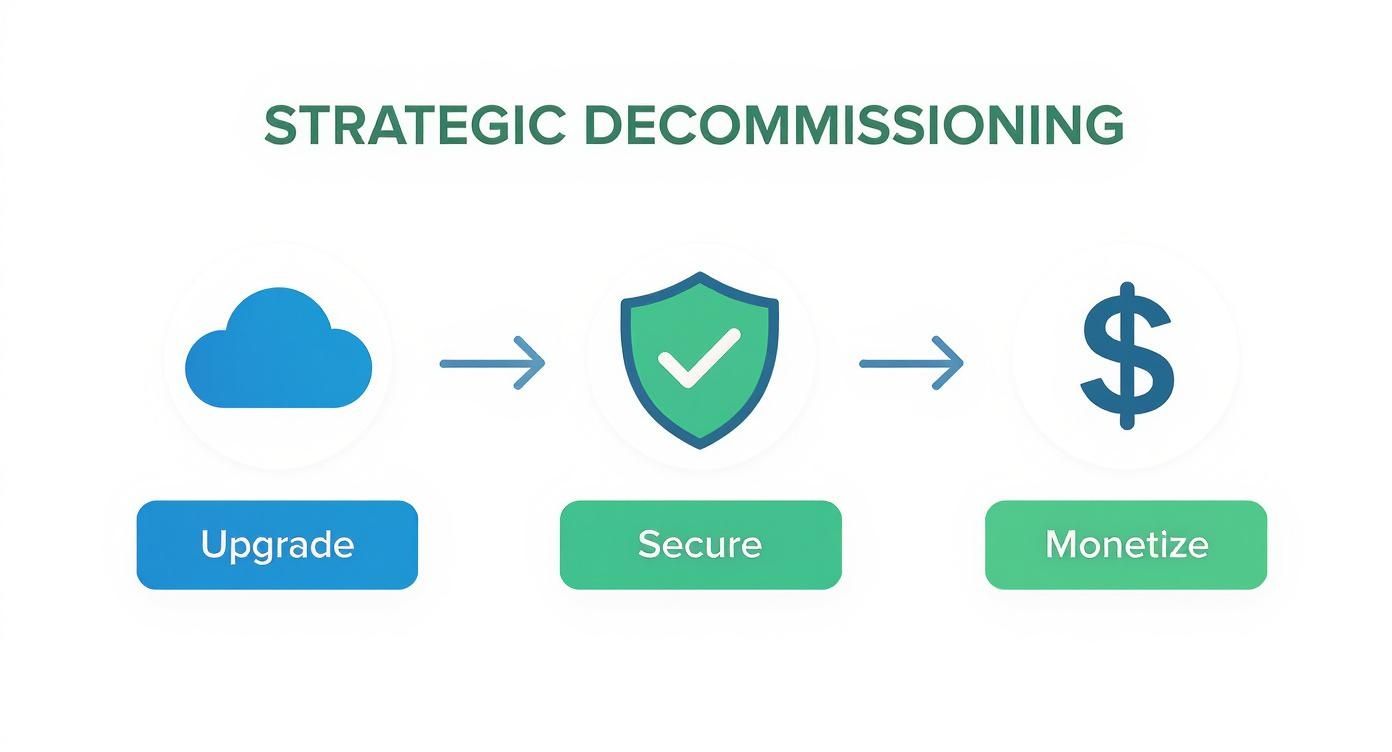
As you can see, a well-planned process isn't just about getting rid of old gear; it's about upgrading technology, securing data, and monetizing what you no longer need.
Building a Realistic Timeline and Budget
With your team and scope figured out, it's time to map out a realistic timeline with clear milestones. A phased approach breaks the project into digestible chunks: planning, inventory, data destruction, physical teardown, and final reporting. Make sure every task has a clear owner and a firm deadline. It’s the only way to keep things moving.
An accurate budget is just as important. Costs can get out of hand in a hurry if you don't plan for them.
A common mistake is underestimating "soft costs." The budget must account not only for the ITAD vendor's fees but also for internal labor, potential overtime, specialized transportation, and any necessary site repairs after equipment removal.
Your budget should be comprehensive, covering all potential expenses, such as:
- Labor for inventory, de-racking, and packing
- Certified data destruction services (wiping or shredding)
- Specialized logistics and secure transport
- E-waste recycling and disposal fees
- Project management overhead
Performing a Thorough Risk Assessment
Finally, a detailed risk assessment is completely non-negotiable. You have to sit down and identify every potential hurdle that could throw your project off the rails. Good planning means thinking about what could go wrong before it actually does; there are great lessons to be learned about mastering project risk management from other complex industries.
Look for logistical bottlenecks like having only one freight elevator or security gaps like an unsecured loading dock during equipment removal. By spotting these risks early, you can build mitigation strategies to keep your decommissioning project on track, on time, and on budget.
Once your project plan is locked in, the real hands-on work begins. This is where your careful strategy meets the cold, hard reality of the data center floor. It’s all about wrangling two things: the hardware itself and, far more importantly, the sensitive data living on it. Getting this part wrong simply isn't an option—it can lead to serious financial losses and security breaches that are the stuff of nightmares.
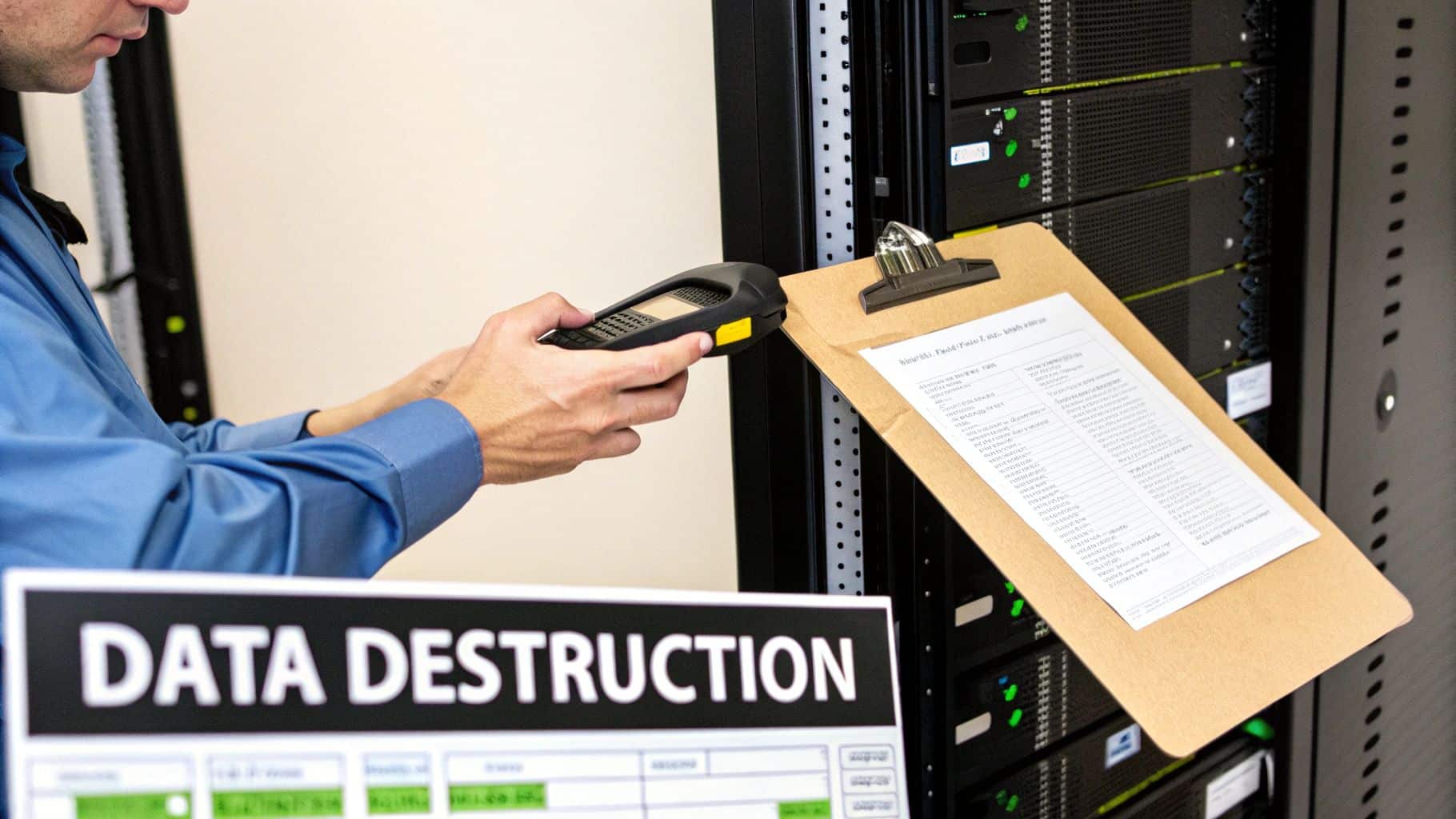
A successful decommissioning all comes down to two things: a perfect asset inventory and ironclad, verifiable data destruction. This is the heart of the operation, and it demands painstaking attention to detail and zero deviation from your protocols.
Building a Meticulous IT Asset Inventory
You can't manage, sell, or destroy what you haven't tracked. The first order of business is creating a comprehensive inventory of every single piece of equipment you’re pulling out. And that means everything—this goes way beyond just the servers and storage arrays.
Your inventory list needs to be incredibly granular. For every asset, you should be capturing:
- Core IT Gear: Servers, storage area networks (SANs), network-attached storage (NAS), and tape libraries.
- Networking Equipment: Switches, routers, firewalls, and load balancers.
- Infrastructure Hardware: Racks, cabinets, power distribution units (PDUs), and uninterruptible power supplies (UPS).
- Cabling: Often overlooked, but all that copper and fiber optic cabling can have some recovery value.
For each and every item, you need to log the make, model, serial number, and any internal asset tags. This detailed record is the foundation for everything that comes next, from valuing the gear to creating the final chain-of-custody documentation. It’s how you maintain accountability and ensure nothing gets left behind.
Assessing Fair Market Value and Making Smart Decisions
With a complete inventory in hand, it’s time to figure out what everything is worth. This is where leaning on an experienced ITAD partner really pays off. They have the real-time market data to tell you if that five-year-old server is a hot commodity on the secondary market or if it's better to scrap it for parts.
This valuation process is what lets you make smart, financially sound decisions. You can then strategically sort your assets into two main buckets: gear with resale potential that can offset your project costs, and everything else that’s headed for secure, environmentally-friendly recycling.
The Uncompromising Priority of Secure Data Destruction
Let's be clear: your data is your most valuable—and most vulnerable—asset. Making sure it’s completely and permanently destroyed is the single most critical task in any decommissioning project. A slip-up here can lead to massive regulatory fines, messy legal battles, and brand damage that’s almost impossible to repair.
You’ve got three main options for data sanitization, and the right one depends on your security needs and the type of asset.
- Data Wiping (Erasure): This is a software-based approach that overwrites a drive with random characters, usually following strict standards like the NIST 800-88 guidelines. It's the perfect choice for newer, high-value drives that you want to resell, as it allows you to maximize your financial return while ensuring security. To really get into the weeds on these critical standards, you can learn more about NIST SP 800-88 compliance.
- Degaussing: This method uses an incredibly powerful magnet to scramble the magnetic field on hard disk drives (HDDs) and tapes, making the data totally unrecoverable. It’s fast and effective, but it also renders the drive useless afterward.
- Physical Shredding: This is the ultimate solution for data security. The drive is fed into an industrial shredder that grinds it into tiny metal fragments. It’s the go-to method for drives with highly sensitive information or any media that is obsolete or has failed.
Crucial Takeaway: No matter which method you use, always demand a serialized Certificate of Data Destruction. This legal document is your auditable proof that every single data-bearing device was sanitized correctly, effectively transferring the liability off your books.
Given its massive infrastructure footprint, this focus on data security is especially relevant in the United States. The U.S. is home to 5,381 data centers as of March 2024, dwarfing countries like Germany, which has just 521. This leadership position comes with a huge responsibility for American companies to set the global standard for secure and responsible data center decommissioning.
Managing Logistics and Environmental Compliance
Once your asset inventory is locked in and every last byte of data has been securely wiped, the project pivots from the digital to the physical world. This is where the real heavy lifting begins—dismantling, packing, and moving thousands of individual components out the door. Getting the logistics right during a data center decommission is all about precision, coordination, and a serious commitment to both physical security and environmental rules.
The sheer scale of this phase can feel overwhelming. It's not just a matter of unplugging servers. You need a systematic power-down sequence, planned in lockstep with facility managers, to avoid blowing a breaker or causing chaos for the building's infrastructure. When it's time to physically pull the gear, following strict electrical safety protocols is non-negotiable to keep everyone safe.
Every single piece of equipment, from a massive server rack down to a single switch, needs to be de-installed with care, palletized, shrink-wrapped, and prepped for a secure journey. This is a critical security checkpoint. An unsecured loading dock or a sloppy handoff to a logistics partner is all it takes to break the chain-of-custody, opening the door to massive risk.
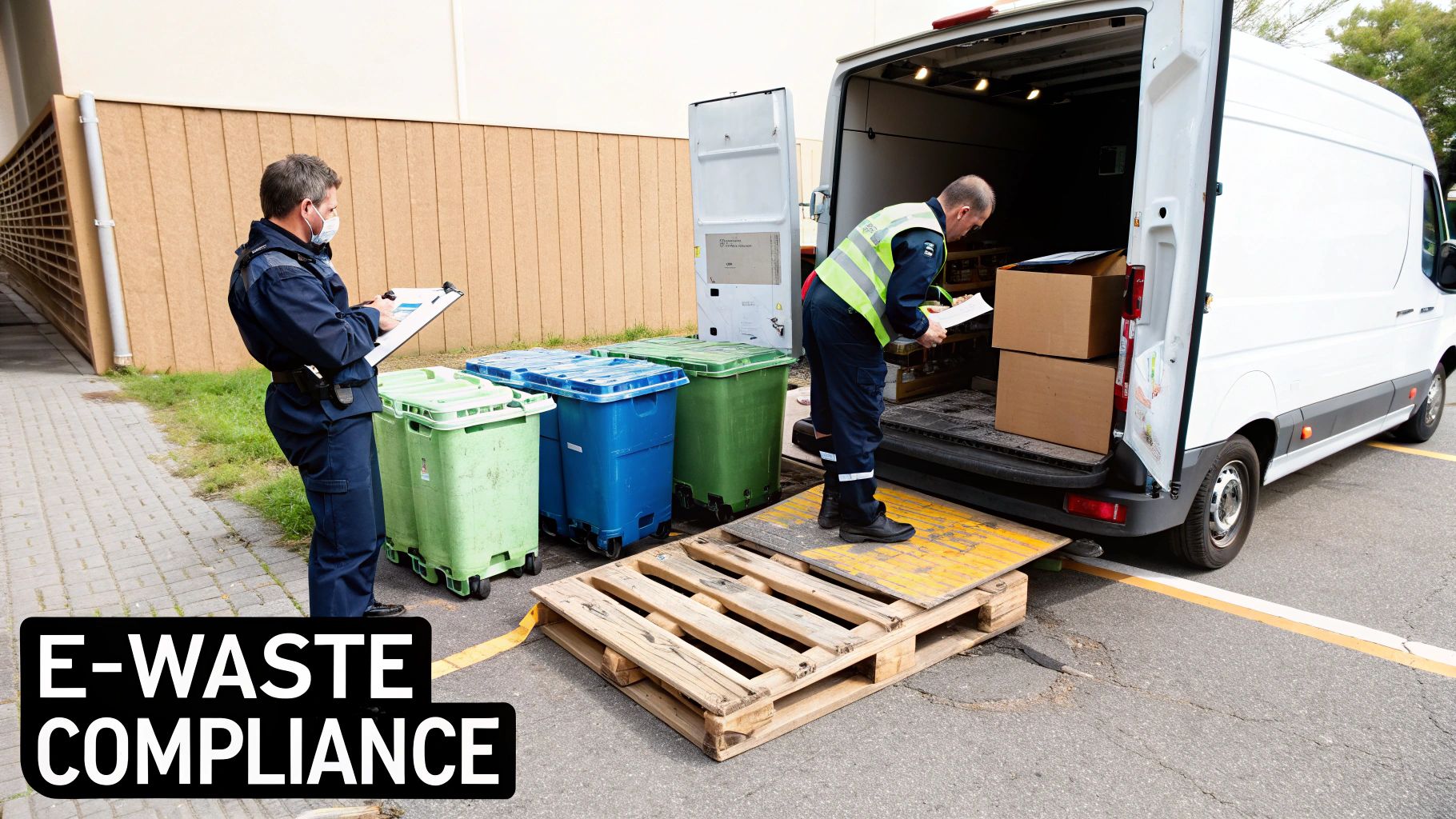
Navigating the Complex Web of E-Waste Regulations
The moment that equipment leaves your facility, you are still on the hook for where it ends up. Improperly dumping electronic waste can trigger huge fines, a PR nightmare, and long-term damage to your brand's reputation. Environmental compliance isn't just a box to check; it’s a non-negotiable part of the project.
The regulatory landscape for e-waste is a confusing patchwork of federal, state, and even local laws. Here are a few you absolutely need to know about:
- The Resource Conservation and Recovery Act (RCRA): This is the main federal law that governs hazardous waste. Many old electronic parts, like CRT monitors or certain batteries, fall right into that category.
- State-Level E-Waste Laws: More than half the states have their own specific electronics recycling laws. If you're a national organization, this creates a tangled compliance map you have to navigate.
- Industry-Specific Mandates: If you're in healthcare (HIPAA) or finance (GLBA), those regulations have specific rules for the secure and compliant disposal of electronic media.
This complex environment is exactly why partnering with a certified ITAD vendor is not just a good idea—it’s a business necessity. You can get a much clearer picture by navigating electronics recycling regulations with an expert who lives and breathes this stuff.
The Role of Certifications Like R2v3 and e-Stewards
How do you know if your ITAD partner is actually handling your old gear responsibly? The answer is third-party certifications. These aren't just fancy badges; they provide a clear, audited benchmark for excellence in electronics recycling.
The two gold standards in this industry are R2v3 (Responsible Recycling) and e-Stewards. A partner holding these certifications has gone through the wringer, proving through rigorous audits that they meet the highest standards for environmental protection, data security, and worker safety.
Making these certifications a requirement when selecting your vendor is the single most important piece of due diligence you can do. It's your proof that the partner has a documented process for tracking all materials downstream, preventing shady exports of hazardous e-waste, and maintaining a secure facility. This validation is what will protect your company from the liability that comes with an environmental screw-up.
Selecting Your ITAD Partner to Maximize Value
Choosing the right IT Asset Disposition (ITAD) partner is probably the most critical decision you'll make during the entire data center decommissioning project. This isn't just about hiring someone to haul away old servers. You're bringing on a strategic partner to protect your data, shield you from massive liability, and squeeze every last dollar of value out of your retired equipment.
Picking the wrong partner can be catastrophic. We're talking data breaches, hefty environmental fines, and a completely broken chain of custody. On the flip side, a top-tier ITAD provider is like an extension of your own team. They bring certified processes and deep expertise that transform a logistical nightmare into a secure, compliant, and often profitable process.
Differentiating Certified Partners From Basic Recyclers
The market is flooded with companies that claim to handle e-waste, but very few have the credentials needed for an enterprise-level data center cleanout. The first thing you absolutely must do is filter for non-negotiable industry certifications.
These aren't just fancy logos for a website; they represent a serious commitment to rigorous, third-party audited processes that protect you.
- R2v3 (Responsible Recycling): This is the gold standard for electronics recycling. It guarantees that a vendor is handling everything from environmental protection and data security to worker health and safety by the book.
- e-Stewards: Another top-tier certification, e-Stewards puts a heavy emphasis on preventing the illegal export of hazardous e-waste. They hold partners to the highest global standards for responsible recycling.
- NAID AAA: This one is all about secure data destruction. A partner with NAID AAA certification has proven—through surprise audits—that their methods for wiping and shredding hard drives are secure and completely tamper-proof.
A vendor that lacks these core certifications is a major red flag. It's a sign they don't have the audited, proven processes to handle sensitive corporate data and ensure environmental compliance. If something goes wrong, that liability falls squarely on your shoulders.
Beyond Certifications: Financial Stability and Security Protocols
Once you have a shortlist of certified vendors, it's time to dig deeper. A true partner needs to be on solid ground both operationally and financially. Start by asking for proof of their insurance—you want to see comprehensive policies for general liability, errors and omissions (E&O), and pollution liability. Think of this as your financial safety net if the worst happens.
Next, get granular about their data security protocols. Ask them specific questions. How do they secure their facility? What kind of background checks do their employees undergo? Ask them to walk you through your chain-of-custody documentation. Every single asset should be tracked by serial number from the second it leaves your loading dock until it's either resold or destroyed. No exceptions.
Analyzing Contracts and Fee Structures
The last piece of the puzzle is the partnership agreement itself. A transparent ITAD contract will clearly lay out the scope of work, service level agreements (SLAs), and a full breakdown of the fee structure. Watch out for vague language or hidden charges. A reputable partner will have no problem showing you exactly what they charge for logistics, data destruction, and recycling, and they'll offer a clear, easy-to-understand profit-sharing model for any gear they resell.
For any business diving into this, getting a firm handle on the full scope of these services is key. It helps to understand what IT Asset Disposition is and how all the pieces fit together in a decommissioning project. This knowledge gives you the power to ask the right questions and build a partnership that really pays off.
To help you compare potential ITAD vendors and make a smart choice, use this checklist. It covers the crucial points you need to evaluate.
ITAD Vendor Evaluation Checklist
| Evaluation Criteria | What to Look For | Red Flags to Avoid |
|---|---|---|
| Industry Certifications | R2v3, e-Stewards, and NAID AAA are non-negotiable. | No certifications or relying on vague "eco-friendly" claims. |
| Data Security Protocols | Documented on-site/off-site destruction, secure facilities, vetted staff. | Lack of detailed security procedures or unwillingness to allow a site audit. |
| Chain-of-Custody | Serialized, end-to-end asset tracking and reporting. | Vague tracking methods or reports that lack individual asset detail. |
| Financial Value Recovery | Established global resale channels and a transparent profit-sharing model. | Unrealistic promises of high returns or a complex, opaque fee structure. |
| Reporting & Documentation | Certificates of Data Destruction and Recycling, detailed inventory reports. | Incomplete documentation or delays in providing final project reports. |
| Insurance & Liability | Proof of sufficient liability, E&O, and pollution insurance coverage. | Minimal or no insurance coverage, shifting all liability to the client. |
Ultimately, this checklist should guide your conversations and help you identify a partner who is not just a service provider, but a true guardian of your assets and reputation.
Got Questions About Data Center Decommissioning? We've Got Answers.
Even the most buttoned-up decommissioning plan can leave experienced IT directors and facility managers with a few lingering questions. When you're dealing with high-stakes variables like data security, compliance, and financial returns, you can't afford any gray areas.
Let's clear things up and tackle some of the most common questions we hear from business clients.
How Long Does a Typical Decommissioning Project Take?
There’s no magic number here. The timeline for a data center decommissioning can swing wildly depending on the scale of the job. Shutting down a small server closet? You might be done in a couple of days. Decommissioning a massive enterprise facility? That could easily stretch into several weeks or even months of careful, coordinated work.
A few key things really drive the schedule:
- Size and Density: This is the big one. The sheer number of racks, servers, and switches is the primary factor. A high-density room packed with thousands of assets is a different beast entirely than a small, sparse setup.
- Scope of Services: Are we just pulling gear, or is this a full-service job? A project that includes on-site data wiping, tearing out all the cabling and PDUs, and prepping the site for its next life will naturally take longer.
- How Prepared You Are: The quality of your initial planning makes all the difference. If you come to the table with a detailed, verified asset list, things will move smoothly. If your ITAD partner is discovering assets on the fly, expect delays.
Ultimately, a solid project plan, built with your ITAD vendor, is your best bet for setting a realistic timeline with clear milestones you can actually hit.
What Are the Biggest Risks Involved?
The two things that should concern any business are data breaches and non-compliance. It only takes one hard drive that wasn't properly sanitized to trigger a full-blown data breach. The fallout can be devastating—think massive fines, legal battles, and a brand reputation that's suddenly in shambles.
Non-compliance is just as dangerous. This can impact your business in a couple of ways. First, you could run afoul of environmental laws like the Resource Conservation and Recovery Act (RCRA) for e-waste. Or, you could violate industry-specific data rules like HIPAA or PCI DSS.
Beyond those two heavy hitters, you've also got to watch out for:
- Operational Snafus: Logistics are tricky. A delayed truck or mishandled equipment can throw your whole project off schedule and over budget.
- Personnel Safety: Tearing down a data center involves real physical risks, from electrical hazards to heavy lifting. Strict safety protocols are a must.
- Incomplete Paperwork: If you can't produce an auditable trail, like a Certificate of Destruction for every drive, you could fail your next compliance audit.
The smartest way to handle these risks? Offload them. A certified ITAD partner has audited processes, insurance, and compliance expertise specifically designed to absorb these liabilities for your business.
Can We Recover Costs from Our Old Equipment?
You absolutely can—and you absolutely should. This is what we call IT asset value recovery, and it’s a core service that turns a decommissioning project from a pure cost center into something much more palatable.
Even equipment that’s a few years old can have significant value on the secondary market. We see strong demand for items like:
- Enterprise-grade servers and CPUs
- High-capacity RAM modules
- SSDs and large-capacity HDDs
- High-speed networking gear
A good ITAD partner has established global resale channels to get the best possible price for these assets. The revenue they generate can be used to offset the project costs. In many cases, it can cover the entire bill, making the decommissioning financially neutral or even profitable.
What Kind of Documentation Should We Expect?
Meticulous, comprehensive documentation isn't just nice to have—it's non-negotiable. This is your official, auditable proof that every asset was handled correctly and in full compliance with all regulations.
When the project wraps up, your ITAD partner needs to hand over a complete documentation package. No exceptions.
This package must include:
- Serialized Certificates of Data Destruction: This is the crown jewel. It needs to list the unique serial number of every single data-bearing device and confirm how and when it was sanitized (wiped or shredded).
- A Complete Chain-of-Custody Report: This document provides an unbroken trail, tracking every asset from the moment it left your building to its final destination.
- A Detailed Asset Reconciliation Report: This report squares the final disposition of every item against your initial inventory list. Nothing should be missing or unaccounted for.
- Certificates of Recycling: For any e-waste that couldn't be resold, this proves the materials were processed in an environmentally responsible way, according to standards like R2v3 or e-Stewards.
This final paperwork is your ultimate shield. It's the proof of due diligence that will protect your organization long after the last server is gone.
Navigating the complexities of data center decommissioning requires a partner with proven expertise in security, logistics, and value recovery. Contact Beyond Surplus for certified electronics recycling and secure IT asset disposal. Learn more at https://www.beyondsurplus.com.