
A 1,200-employee company is replacing laptops across nine offices in six states. The refresh schedule looks manageable until local teams reveal that every branch uses a different haul-away provider. One vendor wipes drives, another only collects equipment, and a third sends a generic recycling receipt weeks later. Meanwhile, untagged assets disappear into branch storage, and the security team can't complete its audit because nobody can produce a consistent chain-of-custody record.
That situation is why nationwide computer recycling services matter to business IT teams. The requirement isn't merely finding a truck in every state. It's creating one accountable process for pickup, asset identification, data sanitization, reuse, recycling, and documentation. The Global E-waste Monitor reports that the world generated 62 billion kg of e-waste in 2022, while only 22.3% was formally collected and recycled in an environmentally sound way (Global E-waste Monitor 2024). Distributed enterprises need stronger controls because their retired laptops, servers, networking equipment, and peripherals enter a waste stream that continues to expand.
Table of Contents
- When a Multi-Site IT Refresh Turns Into a Logistics Problem
- What Nationwide Computer Recycling Services Actually Do
- Secure Data Destruction Methods and What They Prove
- Pickup and Logistics Models for Distributed IT Fleets
- Compliance, Chain of Custody, and Documentation
- Pricing Factors That Move a Recycling Quote
- Real-World Scenarios From Regulated and Enterprise IT Teams
- Choosing the Right Vendor and Moving Forward
When a Multi-Site IT Refresh Turns Into a Logistics Problem
The first failure usually happens before the equipment leaves the building. Local office managers pack laptops into whatever boxes are available, technicians record some serial numbers but not others, and each site follows its own interpretation of “wiped.” A central IT team may believe every drive has been sanitized, yet lack the evidence to prove which method was used on each asset.
The security review exposes the gap. Auditors ask for serialized pickup manifests, transport records, certificates of destruction, and final disposition reports. The branch teams provide email confirmations and pallet counts. That paperwork may show that something was collected, but it doesn't establish what happened to each drive or who controlled the assets at every stage.
The hidden cost of inconsistent branch processes
A local hauler can remove boxes efficiently and still be the wrong fit for enterprise disposition. Generic e-waste handling doesn't necessarily include per-drive sanitization records, verified resale decisions, or named downstream processors. It also leaves procurement managing multiple contracts, insurance requirements, service levels, and reporting formats.
A nationwide program standardizes the work without forcing every location to become a logistics expert. The provider should issue the same instructions, inventory templates, packaging standards, pickup records, and final reports for every site.
Operational rule: If the security team can't reconcile the asset inventory to the final certificate, the disposal process isn't auditable.
The strongest programs also reduce the number of custody transfers. Assets get tagged before pickup, counted against a serialized manifest, transported through controlled channels, and processed under a documented disposition workflow. That structure supports both speed and accountability during laptop refreshes, data center decommissioning, medical equipment disposal, laboratory equipment disposal, and product destruction.
For a practical framework for coordinating distributed technology retirement, review the complete IT asset recovery guide for distributed workforces. The central recommendation is straightforward. Treat every location as part of one ITAD program, not as an independent recycling job.
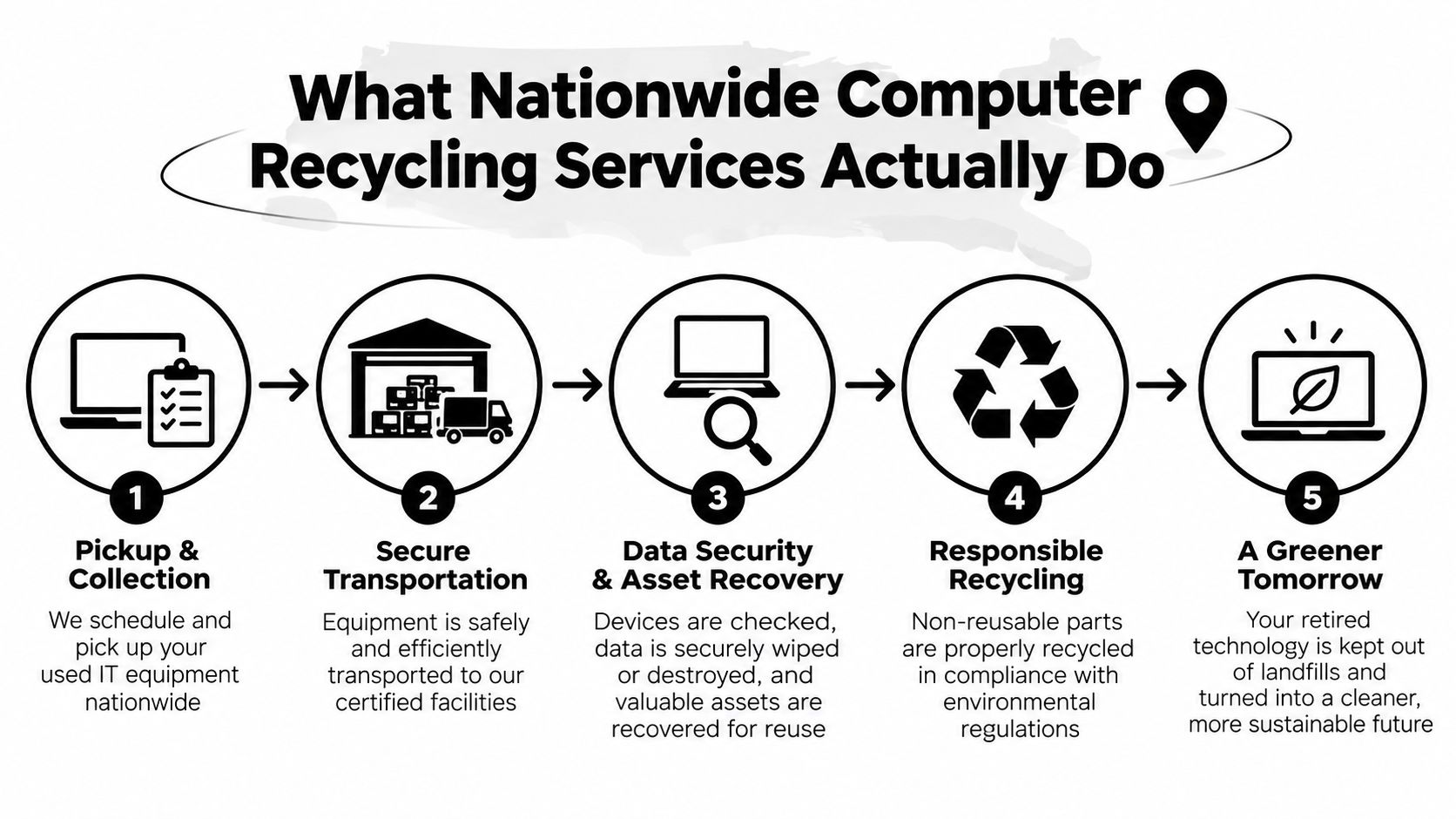
What Nationwide Computer Recycling Services Actually Do
A professional nationwide program is an IT Asset Disposition service, not merely a scheduled collection of obsolete electronics. It manages the asset after retirement and produces evidence of the outcome. That distinction should guide the vendor evaluation.
The operating model
A capable provider combines coordinated pickup logistics, secure data destruction, resale or remarketing, responsible downstream recycling, and audit-ready reporting. One contract and service-level agreement should define the requirements across locations, even when regional transportation or processing partners support the work.
The process should normally follow this sequence:
- Inventory and tagging: Staff identify desktops, laptops, servers, storage devices, networking gear, peripherals, and other equipment. Serial numbers and internal asset tags become the control record.
- Pickup planning: The provider matches scheduled routes, on-demand collections, shipping kits, pallets, or de-installation crews to each site.
- Sanitization decision: Functional equipment gets evaluated for Clear or Purge treatment when reuse is appropriate. Assets leaving organizational control without a viable reuse path may require Destroy-level treatment under the applicable policy.
- Disposition: Tested equipment can move to redeployment, resale, parts recovery, or recycling. Non-reusable material moves through controlled recycling channels.
- Reporting: The customer receives inventory reconciliation, data-destruction documentation, recycling certificates, and final disposition reporting through a consistent delivery method.
What separates ITAD from a local pickup
A local scrap hauler may weigh a pallet and provide a receipt. That receipt doesn't necessarily identify individual drives, confirm sanitization, or show whether reusable equipment was evaluated before recycling. An ITAD provider should explain how it captures serials, controls access, assigns disposition status, and documents downstream processing.
Organizations should also ask whether the vendor can handle more than computers. Enterprise projects often combine laptop disposal with server recycling, data center de-installation, laboratory equipment disposal, medical equipment disposal, and product destruction. A single operational model is valuable only when it covers the actual asset mix.
Review secure ITAD services before comparing quotes. The right question isn't “Can you pick up our equipment nationwide?” It's “Can you prove the final outcome of every serialized asset nationwide?”
Secure Data Destruction Methods and What They Prove
Data destruction must match both the media and the asset's next destination. NIST SP 800-88 Rev. 2 classifies sanitization as Clear, Purge, or Destroy, with Destroy methods such as shredding or pulverizing rendering media unrecoverable even with state-of-the-art laboratory techniques (NIST SP 800-88).
Match the method to the reuse decision
Clear uses logical techniques intended to remove ordinary access to data. Purge applies stronger physical or logical methods that make recovery infeasible. Destroy eliminates the media as a usable information carrier, which is appropriate when the drive won't be reused, resold, or retained.
Software-based erasure can preserve a functional drive for redeployment or remarketing when the device and sanitization method support the required outcome. Cryptographic erase can address encrypted media when the implementation and policy permit it. Degaussing applies to magnetic media, not solid-state storage. Shredding or pulverizing is the more definitive route for end-of-life drives, including SSDs that won't follow a reuse path.
The certificate matters as much as the technique. A destruction record should connect the method to the specific serial number, processing date, responsible technician, and final disposition. A bulk statement saying “all drives destroyed” is weaker than a serialized report that lets an auditor trace each device.
| Method | Media Type | Reuse Path | Certificate Type |
|---|---|---|---|
| Clear | Supported functional media | Redeployment or resale when policy permits | Serialized sanitization report |
| Purge | Supported media requiring stronger logical or physical treatment | Redeployment or remarketing when verified | Serialized Purge certificate |
| Destroy | Hard drives, SSDs, and other media designated for destruction | Parts recovery or material recycling | Serialized Certificate of Destruction |
| Degaussing | Magnetic media only | Generally no device reuse | Degaussing record tied to serialized media |
For a focused comparison of physical and logical options, see secure SSD destruction methods compared. Don't approve a vendor that uses one method for every asset without inspecting the media type and intended disposition.
Pickup and Logistics Models for Distributed IT Fleets
Pickup design affects cost, speed, and evidence quality. The right model depends on volume, site access, equipment condition, and whether technicians need to remove rack-mounted infrastructure.
Four practical models
Scheduled route pickups fit steady enterprise refreshes. A provider visits locations according to a planned calendar, consolidates assets through defined regional workflows, and maintains recurring manifests. This model works well when offices retire equipment in predictable waves.
On-demand single-site pickups suit irregular closures, acquisitions, and urgent decommissions. They provide flexibility, but procurement should confirm packaging, minimum volume, appointment windows, and the point at which serial numbers get captured.
Mail-in and palletized shipping work for remote branches or low-volume locations. The provider supplies packaging and shipping instructions, but the handoff needs tight controls. A box leaving a branch without a signed manifest or tracking record creates an avoidable custody gap.
Dedicated de-installation crews belong at data centers and large facilities. Rack servers, storage arrays, networking equipment, batteries, and cabling may require trained personnel, coordinated dock access, equipment lists, and a defined removal sequence.
| Model | Best Fit | Minimum Volume | Chain of Custody Strength |
|---|---|---|---|
| Scheduled route | Recurring multi-site refresh | Agreed route threshold | Strong when assets are serialized before loading |
| On-demand pickup | Irregular or urgent site work | Provider-defined site minimum | Strong if manifests and signatures are complete |
| Mail-in or palletized shipping | Remote or low-volume branches | Shipment-level threshold | Variable, depends on packaging and tracking controls |
| Dedicated de-installation | Data centers and large facilities | Project-based scope | Strong when crew inventories assets during removal |
The vendor should document dock access, packaging requirements, pickup thresholds, serial capture, and regional consolidation. Consolidation can simplify processing, but it must not turn separate site inventories into an untraceable mixed load.
Organizations operating in Georgia can use nationwide electronics recycling in Georgia as a reference point for how local coordination can fit into a broader commercial program. Geography is useful only when the records travel with the equipment.
Compliance, Chain of Custody, and Documentation
A disposal decision becomes defensible when the organization can show who controlled each asset, what sanitization occurred, and where the material went. NIST guidance applies sanitization to information-system media designated for disposal or reuse and requires a process that prevents information from being retrieved or reconstructed (NIST media sanitization guidance).
Build the evidence trail before pickup
The documentation chain should start at the employee desk or equipment room, not at the recycler's dock. IT or facilities staff should record the asset tag and serial number, then reconcile those records to a pickup manifest. The transport stage should preserve the handoff with signatures, tracking information, and controlled delivery to the processing location.
The compliance framework varies by industry. Healthcare teams commonly assess HIPAA and HITECH obligations. Financial organizations may align controls with GLBA and SOX requirements. Schools and universities may need to address FERPA, while consumer-facing businesses should review the FTC Disposal Rule under the Safeguards Rule.

What procurement should require
A strong audit pack can include:
- Asset inventory: Serialized equipment list tied to internal tags and site locations.
- Pickup evidence: Signed manifests, shipment records, transport details, and receiving confirmation.
- Processing records: Sanitization method, date, technician or witness, and exception handling.
- Final disposition: Certificates of destruction, recycling certificates, resale reports, and downstream documentation.
- Processor credentials: Current certifications and a clear account of subcontractors or downstream recyclers.
A generic recycling receipt proves that material was accepted. An ITAD-grade certificate ties a specific asset to a specific result. For an operational checklist, use chain of custody for IT asset disposal. If a vendor won't name its downstream accountability model or explain its exception process, stop the evaluation.
Pricing Factors That Move a Recycling Quote
A recycling quote is only comparable when the scope is comparable. The headline pickup price can conceal major differences in serialization, sanitization, reporting, and value recovery.
The primary cost drivers
Asset count affects labor, transport, processing, and reporting. Asset class matters just as much. Laptops are handled differently from rack servers, storage arrays, mobile devices, medical equipment, and laboratory equipment. Data sanitization requirements can also change the work, particularly when a project requires witnessed destruction, special handling, or individual certificates.
Resale value should appear as a documented credit, not an informal promise. Functional equipment may be tested, graded, and remarketed, while damaged or obsolete assets may have only material value. The vendor should explain the testing criteria and show how the credit connects to the final inventory.
| Pricing Factor | Effect on Quote | Why It Matters |
|---|---|---|
| Total asset count | Can reduce average handling cost at larger volumes | Labor and transport become easier to plan |
| Asset class mix | Changes removal, testing, packaging, and processing effort | Servers and storage gear need different handling from laptops |
| Sanitization method | Adds processing, equipment, labor, and documentation requirements | The method must match media and risk |
| Resale credit | Can lower the net project cost | Reuse may preserve value that recycling would eliminate |
| Pickup frequency | More visits generally require more coordination | Route density affects logistics efficiency |
| Serialization depth | Detailed records require more intake work | Asset-level evidence supports audits |
| On-site work | Raises the quote when crews or witnessed destruction are required | Secure facilities often need controlled de-installation |
| Certificate level | More detailed reporting requires more validation | Generic receipts don't equal ITAD documentation |
Be skeptical of a low quote that omits serial capture, drive-level certificates, downstream processor details, or testing before recycling. Ask for a line-item scope and a sample final report. Enterprise refreshes can receive tiered commercial pricing, but the vendor should state the conditions rather than assuming volume automatically resolves every cost.
Real-World Scenarios From Regulated and Enterprise IT Teams
Representative engagements show why one logistics model rarely fits an entire fleet. The following scenarios reflect common enterprise ITAD requirements, not published performance claims.
Scenario A, regional health system
A regional health system retires 1,200 desktops and 90 servers across 14 clinics in three states. The buyer requires on-site NIST 800-88 Purge or physical destruction for every drive, HIPAA-aligned business associate agreements with the recycler, serialized certificates of destruction within 10 business days, and an R2v3 downstream audit trail.
The project team separates functional equipment from failed drives before pickup. Technicians record serial numbers at each clinic, use scheduled collections for dense locations, and reserve witnessed destruction for media that can't support an approved reuse path. The buyer's success measures are the audit result, the amount of residual value recovered from eligible equipment, and the time from purchase order to final certificate.
Scenario B, distributed SaaS company
A SaaS company refreshes 3,400 laptops at 22 offices and two data centers. High-density offices use scheduled route pickups, while branches with fewer than 25 units receive mail-in kits. Data center de-installation is consolidated into one engineering weekend so rack equipment, storage devices, and networking gear leave under one controlled project plan.
The disposition team tests eligible laptops for resale rather than sending every unit directly to recycling. The buyer tracks the same three outcomes, audit readiness, value recovered, and the timeline from purchase order to complete documentation.
| Scenario | Asset Profile | Primary Logistics Model | Data Destruction Requirement | Critical Compliance Need | Outcome |
|---|---|---|---|---|---|
| Regional health system | Desktops, servers, clinic equipment | Scheduled routes and controlled site work | Purge or physical destruction | Serialized records, agreements, R2v3 trail | Audit-ready certificates and documented disposition |
| Distributed SaaS company | Laptops, servers, storage, networking gear | Routes, mail-in kits, and de-installation | Method matched to reuse or destruction path | Consistent multi-site reporting | Reuse evaluation and consolidated project records |
The point isn't that every project needs the same controls. It's that the buyer should define the controls before the first pickup, then measure the vendor against them.
Choosing the Right Vendor and Moving Forward
Require every nationwide computer recycling vendor to demonstrate three essential requirements on one page.
First, request a current R2v3 or e-Stewards certification and a clear explanation of downstream accountability. Second, require a documented NIST SP 800-88 Rev. 1 sanitization methodology, including how the provider handles HDDs, SSDs, encrypted media, failed drives, and exceptions. Third, demand a serialized certificate of destruction supported by chain-of-custody tracking.
The vendor should also explain whether it offers witnessed on-site destruction for regulated data, how it evaluates equipment for reuse, and which downstream processors receive material. Vague resale partnerships, generic recycling receipts, and an unwillingness to identify processing partners are disqualifiers.
Use a controlled buying sequence:
- Request a sample certificate, inventory report, and complete audit pack.
- Run a 25-unit pilot at one site.
- Validate pickup controls, turnaround, serial reconciliation, sanitization evidence, and final reporting.
- Scale through a master service agreement that standardizes terms, insurance, service levels, and documentation across every location.
Beyond Surplus provides business electronics recycling, IT equipment disposal, secure data destruction, IT buyback, product destruction, data center de-installation, and nationwide pickup coordination. It should be evaluated against the same evidence requirements as any serious ITAD provider.
Contact Beyond Surplus to discuss a nationwide computer recycling program built around serialized asset tracking, secure data destruction, responsible value recovery, and audit-ready final documentation. Request a sample certificate and plan a controlled pilot before expanding the process across your business locations.


