A warehouse full of retired servers, laptops, switches, and storage devices creates an uncomfortable question for every IT manager: what happens next? Leaving equipment in a staging area delays the risk, but it doesn't remove it. Sending everything straight to a recycler may protect the schedule, yet it can destroy resale value and create avoidable waste.
The right answer depends on more than whether a device still powers on. Data sensitivity, hardware condition, compliance obligations, environmental impact, logistics, and recovery value all shape the correct disposition path. This guide explains what to do with end-of-life IT equipment using a practical decision framework for enterprises, healthcare organizations, financial institutions, government agencies, schools, and data center operators.
Table of Contents
- The Growing Problem of Retired Technology
- Assessing Your End-of-Life IT Assets
- Secure Data Destruction Methods Compared
- Regulatory Compliance for IT Disposal
- Environmental Disposal and Value Recovery
- Logistics and Chain of Custody
- Operational Checklist for IT Equipment Disposal
The Growing Problem of Retired Technology
A typical retirement project starts with a familiar scene. A refresh has finished, the replacement servers are in production, and older equipment has been moved into a locked room or warehouse. Asset tags may still be attached, but the inventory is incomplete. Some drives contain production data, some devices might be reusable, and nobody can say with confidence which items have already been sanitized.
That uncertainty is the operational problem. Retired technology remains an active responsibility until the organization documents its condition, controls the data, and confirms its final disposition. A server that no longer supports a workload can still contain credentials, customer records, configuration files, cached databases, or forensic evidence of how internal systems operate.
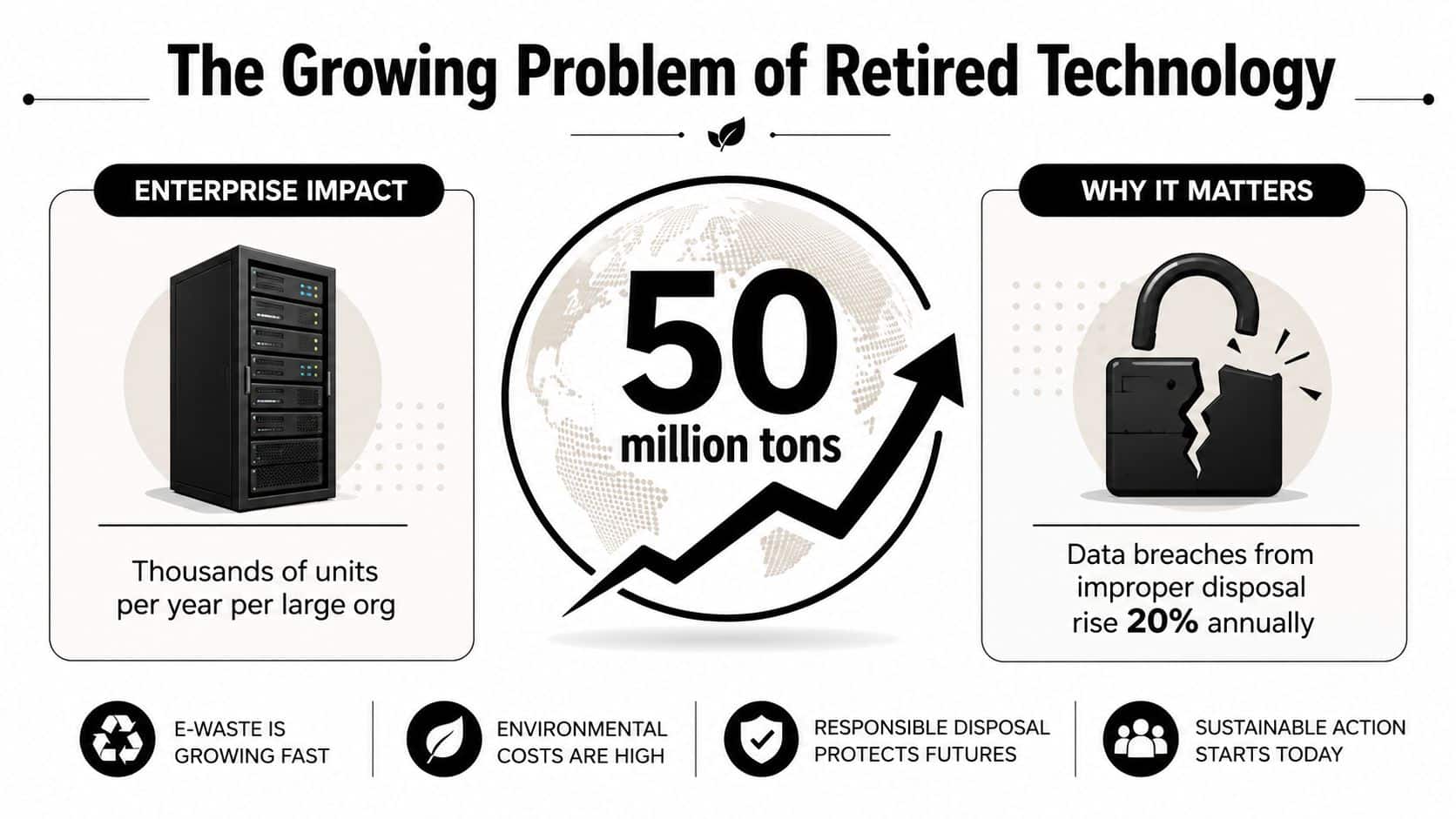
The environmental scale makes informal storage and undocumented disposal impossible to treat as minor housekeeping. Global e-waste reached a record 62 million tonnes in 2022, equal to 7.8 kg per person, and only 22.3% was formally collected and recycled in an environmentally sound manner, according to the 2024 Global E-waste Monitor. The same source reports that this mass rose 82% since 2010 and projects 82 million tonnes by 2030, making retired IT equipment part of a rapidly expanding waste stream.
Why reactive disposal fails
A reactive process usually begins when a facilities team needs space, an audit is approaching, or a vendor offers a quick pickup. That timing encourages shortcuts:
- Unverified wiping: Staff delete files or perform a basic format without confirming that data is unrecoverable.
- Mixed asset streams: Reusable laptops travel with damaged drives and obsolete peripherals, so every device receives the least useful treatment.
- Weak documentation: Serial numbers, handoffs, processing dates, and final outcomes aren't tied together.
- Unplanned storage: Equipment sits long enough for ownership, condition, and data status to become unclear.
For practical context on local planning, review Atlanta IT asset disposal trends, particularly when a refresh involves multiple facilities or a large equipment staging area.
A structured ITAD program changes the sequence. The organization inventories first, classifies data, tests function, selects a sanitization method, and then assigns each asset to reuse, refurbishment, recycling, or destruction. That approach reduces security exposure while preserving options that disappear once equipment is shredded or mixed into an uncontrolled load.
Assessing Your End-of-Life IT Assets
You can't choose a disposition path for equipment you haven't identified. Start with a complete inventory that connects each physical asset to its serial number, asset tag, model, location, owner, condition, storage media, and current data status. The record should also capture whether the device is under warranty, support, lease, litigation hold, or another contractual restriction.
The assessment doesn't need to be complicated, but it must be consistent. A laptop, medical workstation, network appliance, and storage array shouldn't enter the same workflow just because they occupy the same loading dock.
A practical triage framework
Use four disposition streams. The decision should be recorded per asset, not applied broadly to an entire truckload.
Redeploy or refurbish. A device belongs here when it passes functional testing, has a viable use case, and can be sanitized using a method appropriate for its media and risk. Confirm that ports, memory, storage, power supplies, batteries, displays, and firmware behave as expected. A laptop with cosmetic wear may still be suitable for internal redeployment after repair and testing.
Recover through resale or transfer. Some equipment no longer fits the original environment but retains market value. Servers, networking hardware, monitors, and enterprise components may be candidates for an IT asset recovery process when demand, condition, and data controls support a defensible sale.
Recycle for material recovery. Place non-reusable equipment here after removing or separately controlling storage media. Recycling is appropriate for hardware that fails testing, lacks a practical reuse market, or costs more to restore than its likely value. The downstream processor should identify how materials are handled rather than treating “recycling” as a sufficient final answer.
Destroy. Physical destruction is appropriate for damaged media, devices with uncertain data states, and equipment whose information can't be reliably sanitized. It also fits assets where reuse isn't required and the data sensitivity justifies eliminating recovery potential.
Record the reason, not just the result
An audit-ready record explains why an asset entered a particular stream. Document test results, data classification, sanitization method, verification outcome, destination, and certificate reference. If a storage device is marked defective and scrapped, retain evidence that the organization tested or destroyed it rather than assuming a defect erased the data.
The equipment condition assessment process can help teams establish consistent grading criteria before a pickup. A clear process prevents a common failure: declaring equipment worthless before checking whether it can be safely reused or recovered.
Practical rule: Separate assets by condition and data risk before selecting a treatment method. Mixed pallets create mixed liabilities.
Secure Data Destruction Methods Compared
Deleting a folder, emptying a recycle bin, or reformatting a drive doesn't establish that information is gone. For end-of-life IT equipment, the relevant question is whether data is unrecoverable for the intended level of attack and the device's technology.
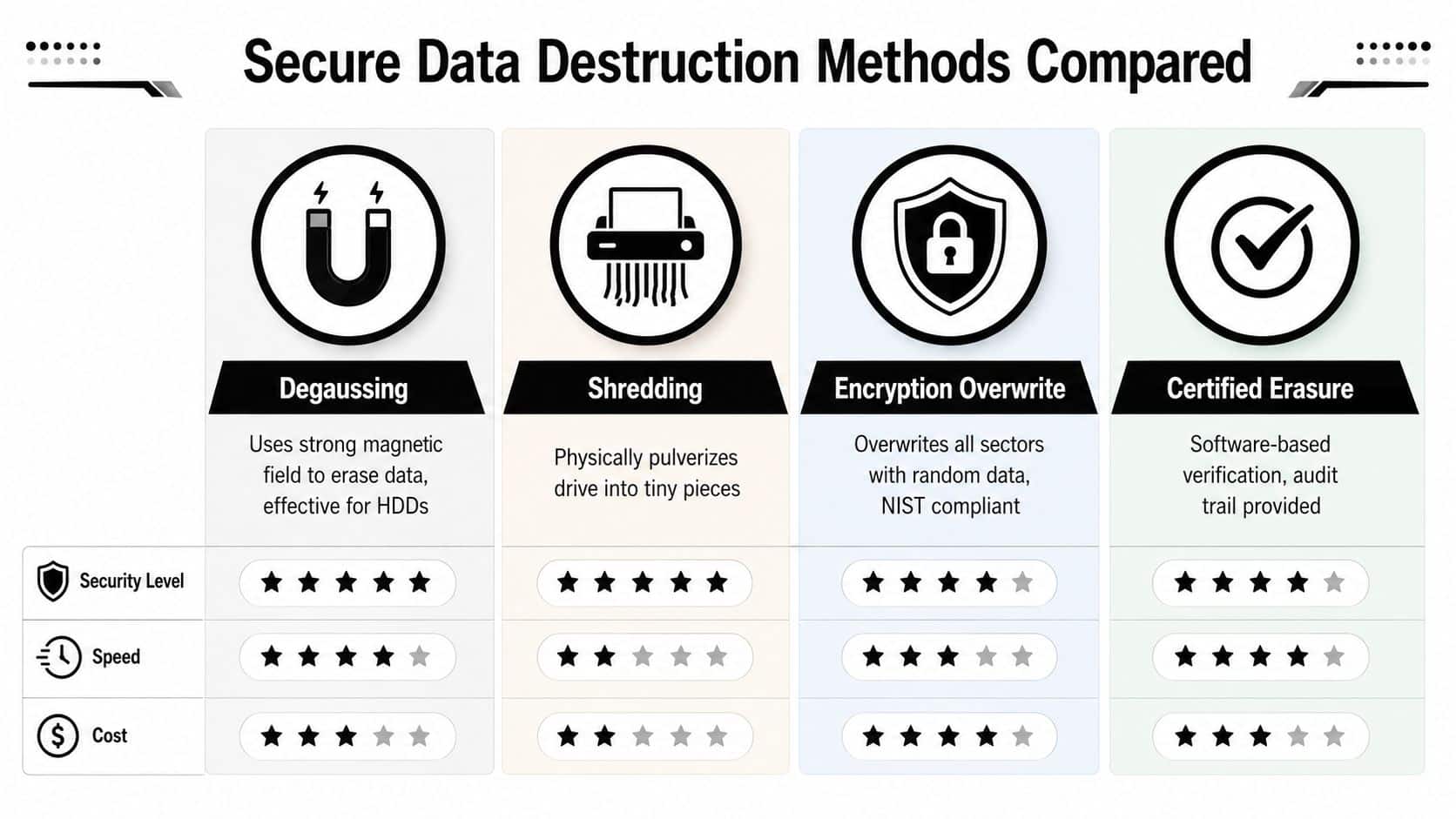
NIST's media-sanitization guidance treats simple file deletion as insufficient. Organizations should clear, purge, or destroy media so data is unrecoverable for the intended attack level, and physical destruction such as shredding is the default-safe option when reuse isn't required.
Match the method to the media
| Method | Appropriate use | Main trade-off |
|---|---|---|
| Clearing | Lower-risk media intended for controlled reuse, when the method matches the device | May not satisfy higher threat levels or every media type |
| Purging | Media leaving organizational control or requiring stronger assurance, including verified cryptographic erasure where suitable | Requires compatible technology, process control, and verification |
| Shredding | Damaged, high-risk, or non-reusable media | Eliminates resale and refurbishment value |
| Degaussing | Certain magnetic hard disk drives, subject to device compatibility | Isn't a universal solution for SSDs, NVMe, or embedded flash |
Clearing and purging preserve more recovery value than destruction, but only when the organization can prove that the selected method works for the specific device. Modern solid-state storage complicates generic overwrite assumptions because controllers, wear leveling, overprovisioning, and flash architecture can prevent a conventional overwrite from addressing every physical location.
SSD and NVMe decisions require media-specific controls
SSDs, NVMe drives, and embedded flash deserve separate treatment. A process designed for spinning hard drives may not produce the same assurance on flash media. For reusable equipment, consider verified cryptographic erasure or another standards-aligned method supported by the device, then retain per-device logs and verification results.
For drives that can't be reliably sanitized, physical destruction removes the residual recovery question, but it also removes the hardware's resale value. The comparison of secure SSD destruction methods is useful when deciding whether a drive should be erased for reuse or destroyed.
Verification is part of destruction
A certificate without asset-level evidence is weak. The record should connect the serial number to the method used, operator or processing event, verification result, date, and final disposition. NIST also treats sanitization as a lifecycle control applied before disposal or release for reuse, so the decision belongs inside the retirement workflow, not after equipment has already left the facility.
The strongest workflow is selective. Segregate reusable assets, apply an approved clearing or purging method, verify the outcome, and destroy only the media that requires destruction. That protects data without turning every recoverable device into scrap.
Regulatory Compliance for IT Disposal
IT disposal compliance starts with the information stored on the equipment, then expands to the organization's sector, location, contracts, and downstream processing route. A company handling employee or customer information may face different obligations from a government contractor, hospital, bank, or manufacturer, but every organization needs a defensible explanation of how it protected sensitive data.
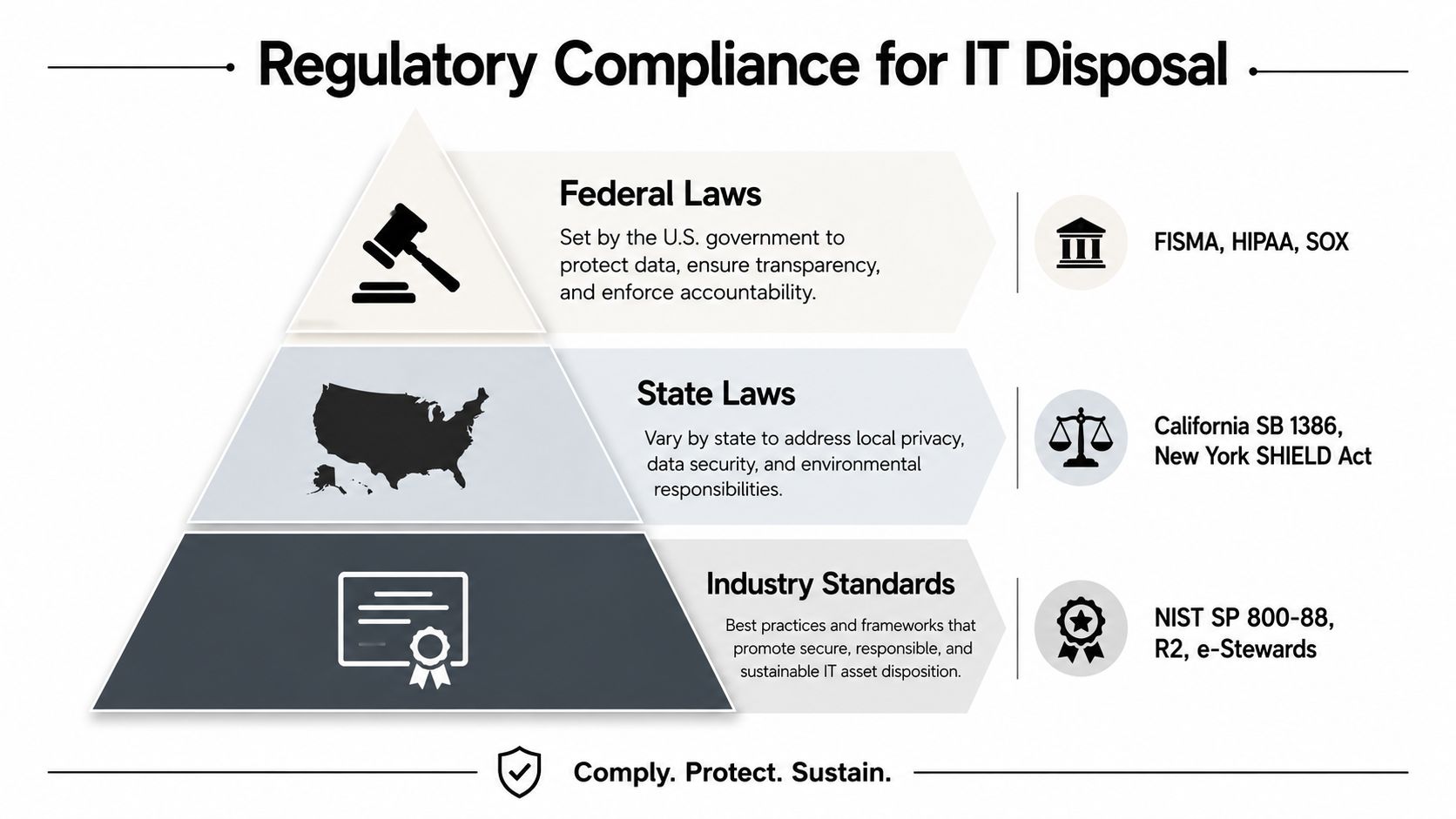
The FTC Disposal Rule under FACTA applies to any business or individual that uses a consumer report for a business purpose. It requires proper disposal of consumer report information to protect against unauthorized access or use.
Use a layered decision tree
Ask these questions before equipment moves:
- Does the asset contain regulated or confidential information? If it stores consumer reports, health information, financial records, credentials, or government data, assign a documented sanitization requirement before pickup.
- What technical method fits the media? Use NIST-aligned clearing, purging, or destruction based on the device type, sensitivity, and reuse plan.
- Which state rules apply? Review the requirements in the state where the equipment is stored, processed, and transported. E-waste obligations vary, and a national policy doesn't automatically satisfy every local requirement.
- Does the contract impose additional controls? Leases, customer agreements, insurance policies, and procurement terms may require specific certificates, approved vendors, or destination restrictions.
- Can the organization prove the outcome? Retain inventory records, chain-of-custody documents, sanitization logs, certificates, and downstream reports.
Separate law from operating standards
Federal and state laws establish obligations, while technical standards and processor certifications help organizations execute and document those obligations. NIST SP 800-88 provides the technical foundation for media sanitization. Environmental programs and downstream controls address how equipment is processed after data risk has been managed.
Healthcare, financial, education, and government teams should involve privacy, security, legal, procurement, and facilities stakeholders before a large retirement project begins. The disposal vendor can't decide your data classification or regulatory interpretation for you, but it should provide enough evidence for your internal reviewers and auditors.
A useful local reference is this overview of electronics recycling laws and ITAD compliance in Georgia. Treat it as part of a broader review, not as a substitute for checking the rules that apply to your organization and destination.
Environmental Disposal and Value Recovery
The most sustainable IT asset disposition decision is often the one that keeps a working device in service. Reuse preserves the labor, materials, manufacturing effort, and embedded value already invested in the equipment. Recycling remains important, but it shouldn't become an automatic destination for assets that can be tested, sanitized, repaired, and redeployed.
The EPA's federal electronics guidance places reuse, redeployment, and refurbishment ahead of material recovery, with incineration and landfilling as the least preferred outcomes. It also says electronics should be declared for abandonment or destruction only after reuse, transfer, donation, or sale are impractical or not cost-effective.
Value recovery begins with testing
A device can't be valued accurately from its age alone. Functional testing should cover the components that determine whether the hardware has a realistic second use. For a server, that may include processors, memory, storage bays, network interfaces, power supplies, and remote-management functions. For a laptop, it includes battery health, display, keyboard, ports, wireless connectivity, storage, and operating-system readiness.
Data sanitization must happen alongside this assessment. A device with strong resale demand still requires an approved data process, and a device that fails sanitization may need destruction even when its chassis and components appear valuable.
Recycling is a recovery process, not a disposal label
When reuse isn't practical, qualified recycling recovers metals, plastics, circuit boards, and other materials through controlled downstream processing. Electronics also contain strategically important materials that remain under-recovered. The Global E-waste Monitor identifies that only about 1% of rare earth element demand is met by e-waste recycling.
That gap gives procurement and sustainability teams a concrete reason to demand transparent reporting. Ask what happens to circuit boards, batteries, displays, and storage media, and whether the processor can document downstream destinations. A certificate of recycling should describe the completed process rather than confirm that a vendor received a pallet.
Reuse and recycling aren't competing goals. Good triage sends reusable equipment back into service and routes the remainder to controlled material recovery.
An electronics circular economy approach in Georgia connects asset recovery, refurbishment, resale, and responsible recycling. It also helps sustainability reporting reflect actual disposition outcomes instead of treating every retired device as identical waste.
Logistics and Chain of Custody
The handoff from a business facility to a processor is where many otherwise sound disposal programs become difficult to defend. Equipment may pass through staging areas, loading docks, transportation partners, warehouses, testing stations, destruction lines, resale channels, and recycling facilities. Each transition should be visible in the records.
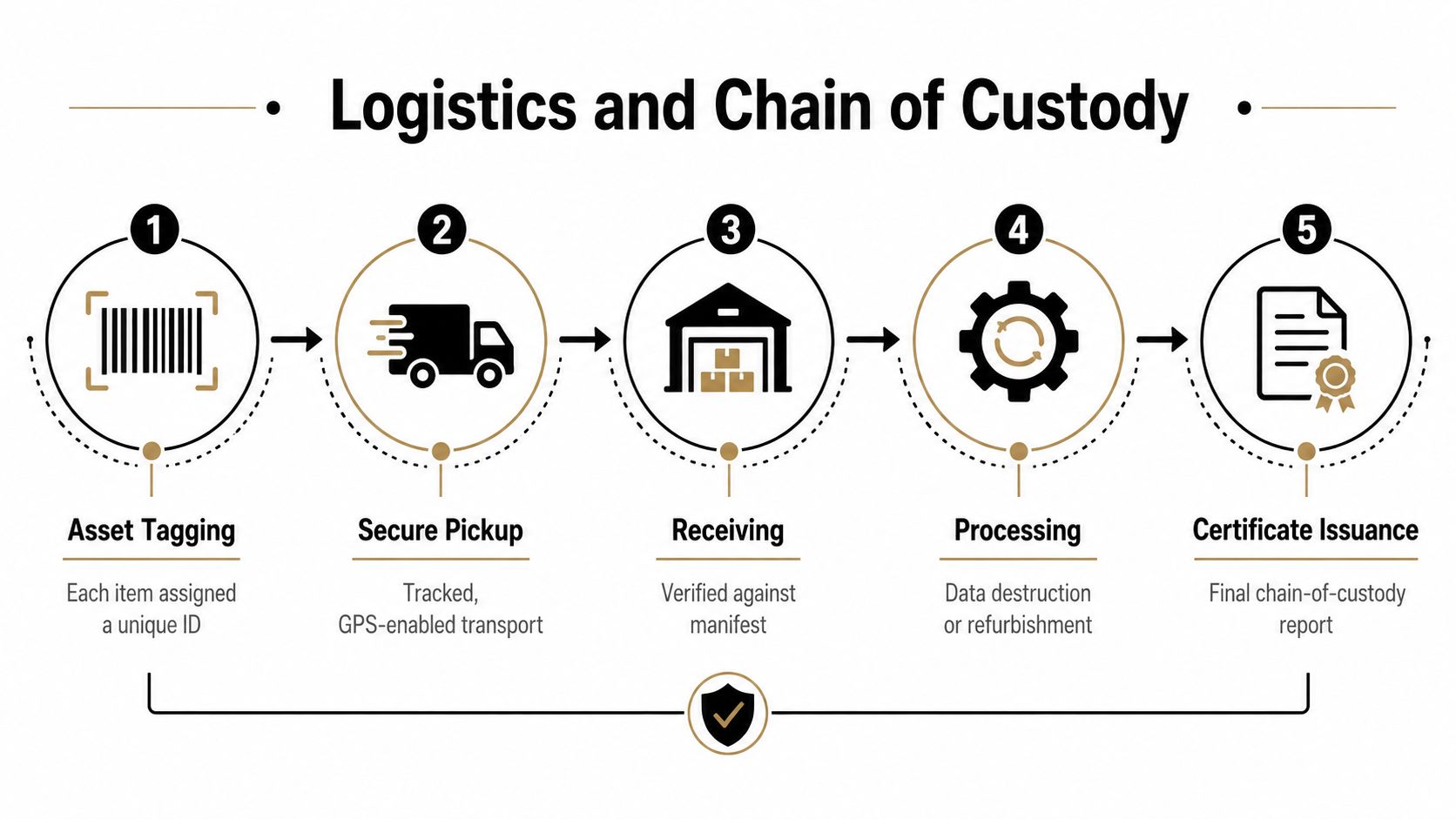
A chain of custody starts before pickup. Build the manifest, confirm asset counts and serial numbers, identify storage media, define the authorized recipient, and establish how exceptions will be handled. If the driver collects equipment that doesn't match the manifest, the discrepancy should be recorded rather than corrected informally later.
Large projects need a movement plan
Data center decommissioning and cloud infrastructure refreshes create concentrated volumes of servers, hard drives, networking equipment, racks, cables, and power components. The project plan should define work zones, equipment sequencing, elevator and dock access, packaging, serialized scanning, security controls, and the timing of data destruction.
Hyperscale decommissions can also provide resale value, but buyers and processors need credible assurance that data residue has been addressed. Bulk volume doesn't justify bulk assumptions. Each asset class still needs an inventory rule, a sanitization rule, and a documented destination.
Cross-border shipments add another control layer
The 2025 Basel Convention amendments require prior informed consent for all cross-border e-waste shipments, not only shipments classified as hazardous material. Organizations moving equipment internationally therefore need destination controls, export documentation, carrier coordination, and confirmation that the receiving facility is authorized to process the shipment.
A domestic project can still require careful destination review when a provider uses multiple facilities or downstream processors. Ask where assets will go, who controls each handoff, how rejected or damaged items are handled, and when certificates are issued.
What a defensible record contains
- Asset identity: Serial number, tag, model, quantity, and original location.
- Movement history: Pickup date, carrier, receiving confirmation, and exception notes.
- Processing result: Reuse, resale, recycling, erasure, shredding, or another approved outcome.
- Evidence package: Sanitization logs, certificates, downstream documentation, and final reports.
The logistics decision is inseparable from compliance. A low-cost pickup that provides no reliable record can create more exposure than it removes.
Operational Checklist for IT Equipment Disposal
Use this checklist before approving an IT equipment disposal project. It works for a small office refresh, a medical equipment retirement, a laptop disposal program, or a full data center decommissioning.
Before pickup
- Build the inventory: Record asset tags, serial numbers, models, locations, owners, condition, and storage media.
- Classify the data: Identify devices containing regulated, confidential, proprietary, or unknown information.
- Test function: Separate reusable and refurbishable equipment from failed, damaged, or uneconomical assets.
- Set disposition rules: Define which assets will be redeployed, resold, recycled, erased, or physically destroyed.
- Review the provider: Ask about data methods, media-specific SSD and NVMe handling, certifications, downstream processors, insurance, transportation, and reporting.
- Confirm the destination: Check whether equipment stays domestic or crosses borders, and identify any required approvals.
During processing
- Control the staging area: Restrict access and keep serialized assets separated by disposition stream.
- Verify every handoff: Compare pickup quantities with the manifest and document discrepancies immediately.
- Sanitize before release: Don't allow reusable equipment to leave organizational control until the approved method is complete and verified.
- Destroy exceptions: Route damaged or uncertain media to physical destruction when reliable sanitization can't be established.
- Track outcomes: Tie each result to the asset record, operator, method, date, and certificate.
After completion
- Reconcile the report: Confirm every item has a final status. Investigate missing, duplicate, or unresolved serial numbers.
- Collect certificates: Retain certificates of data destruction, recycling, resale, or other final disposition.
- Review value recovery: Compare recovered value and avoided handling costs with the original forecast.
- Improve the next cycle: Record failures such as missing tags, incomplete manifests, untested equipment, or unsuitable wipe tools.
Beyond Surplus provides commercial IT asset disposition, secure data wiping and hard drive shredding, electronics recycling, product destruction, data center de-installation, logistics coordination, certificates, and IT buyback services. Visit Beyond Surplus to discuss a documented disposition plan for your organization's retired servers, laptops, storage media, medical equipment, or laboratory hardware.