

An Atlanta data center manager rarely gets a clean, convenient retirement window. More often, a refresh deadline is approaching while racks remain active, storage arrays contain sensitive information, and facilities teams are trying to coordinate loading access, transport, vendor approvals, and audit records. A pallet of retired servers may look like scrap, but it can contain recoverable equipment, storage media, and evidence that your organization still needs.
Data center equipment recycling in Atlanta is therefore an operational control, not a final cleanup task. Secure IT asset disposition must keep business operations moving while separating reusable hardware from compromised media, documenting every handoff, and directing equipment to verified downstream channels. The right workflow protects data, supports compliance, and gives finance and sustainability teams a defensible record of what happened to each asset.
Table of Contents
- The Reality of Data Center Decommissioning
- Secure IT Asset Disposition Workflows Explained
- NIST Media Sanitization Standards and Methods
- On-Site Versus Off-Site Data Destruction Options
- Vendor Selection Checklist for Atlanta Businesses
- From Decommissioning to Circular Value Recovery
The Reality of Data Center Decommissioning
The pressure usually starts with a short email: a server fleet must be removed before a lease expires, a cooling upgrade begins, or a new hardware standard goes into production. The Atlanta data center manager now has to retire servers, switches, storage arrays, racks, and power equipment without interrupting live systems. At the same time, security wants proof that no data leaves the facility, finance wants an asset-value estimate, and procurement wants the vendor selected quickly.
That combination makes routine electronics recycling a poor fit. Data centers contain equipment with different risk profiles and different recovery paths. A working switch may be suitable for remarketing. A failed solid-state drive may require physical destruction. A server can have reusable memory and processors alongside storage media that must be handled separately.
The scale of the wider waste problem reinforces the need for disciplined controls. Global electronic-waste generation reached approximately 62 million metric tonnes in 2022. The United States generated about 7.2 million tonnes, while only about 4.05 million tonnes was formally collected, according to the Global E-waste Monitor country data for the United States. Those figures describe a broad waste stream, but they also show why an organization needs asset-level evidence instead of a generic recycling statement.
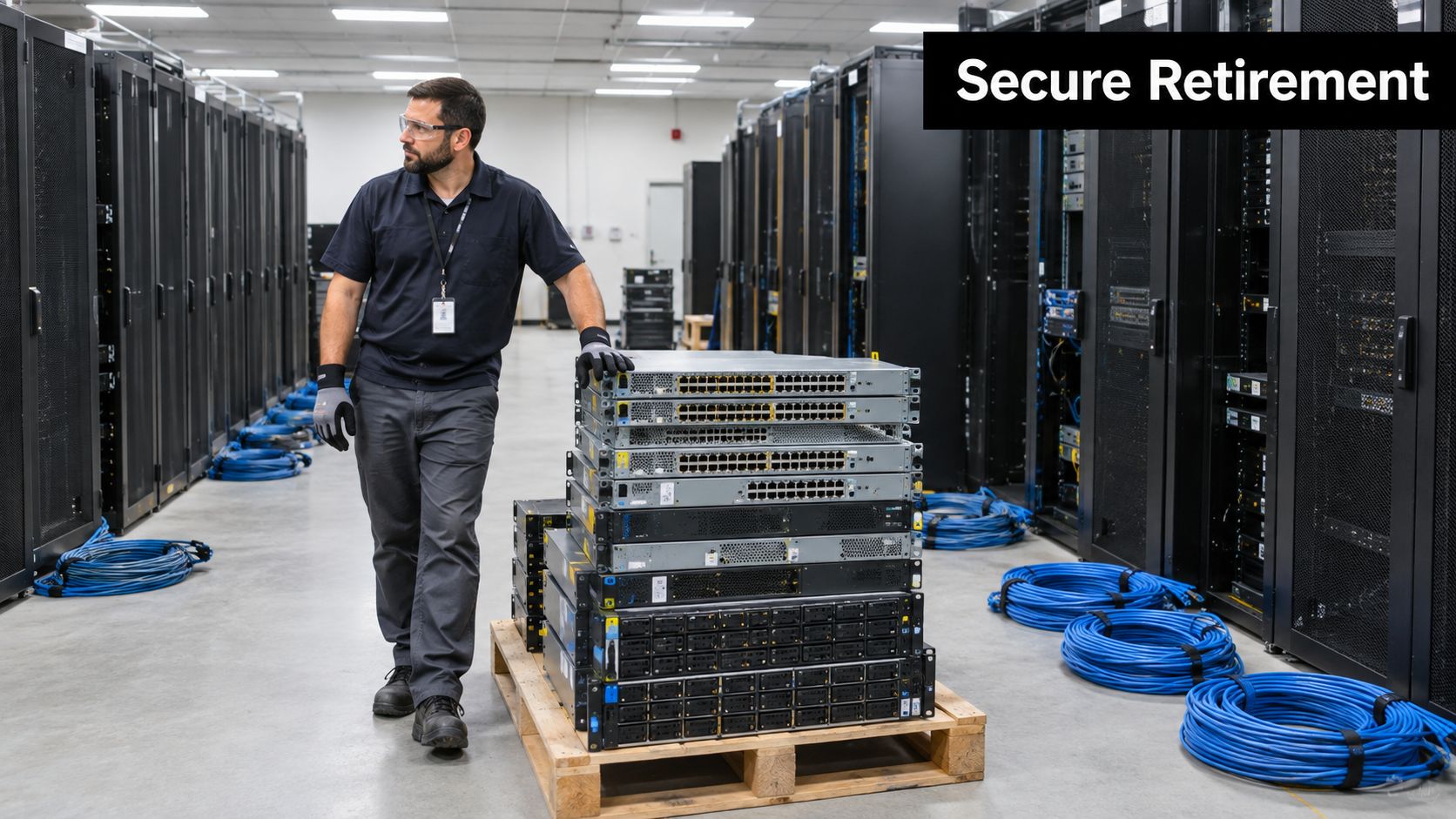
Why ordinary recycling processes fail
A general recycler may be equipped to weigh mixed electronics and route commodities to a processor. That doesn't answer the questions a data center operator must answer:
- Which asset was removed from which rack?
- Which storage device held sensitive information?
- Who accepted the equipment at pickup?
- What sanitization method was applied?
- Was the hardware reused, remarketed, recycled, or destroyed?
The Atlanta data center decommissioning resource is useful context for understanding why regional infrastructure changes create specialized disposition requirements. A decommissioning plan should connect change management, physical removal, data security, logistics, and final reporting.
Operational rule: Never allow a mixed pallet to become the inventory record. Reconcile serial numbers before equipment leaves controlled space.
A professional team also plans around facility conditions. Loading docks may have limited access, active security checkpoints, raised-floor restrictions, or strict scheduling rules. Liquid-cooling retrofits introduce additional concerns involving manifolds, cold plates, coolant loops, and mixed-material components. Atlanta policy analysis recommends waterless or near-waterless cooling because evaporative systems can consume as much as 9 million gallons per day, while closed-loop systems typically use about 5,000 to 50,000 gallons per day, according to North Georgia Water's data-center community considerations. Those operational water figures don't determine the end-of-life route, but they illustrate why infrastructure changes should include a removal and environmental-handling plan.
Secure IT Asset Disposition Workflows Explained
A secure ITAD project begins before the truck arrives. The service provider and client should agree on the asset population, access requirements, data policy, reuse criteria, transport plan, and reporting format. If those decisions are postponed until equipment reaches a processing facility, the organization loses control over the most important information.
1. Build the inventory before removal
Start with a serialized inventory. Record manufacturer, model, serial number, asset tag, location, condition, ownership, and storage-media status. For servers and storage arrays, record drive identifiers separately where practical. A single chassis-level record may be insufficient if individual drives follow different disposition paths.
The inventory also creates the baseline for value recovery. Working servers, CPUs, memory modules, power supplies, switches, and racks may have reuse or remarketing potential. Damaged equipment, obsolete components, and media that can't be reliably sanitized require a different route. Photographing rack positions and pallet condition can strengthen the record when a project involves multiple rooms or facilities.
2. Establish controlled custody
Removal should follow a signed handoff process. The client representative confirms the equipment released, the service team confirms receipt, and transport records identify the shipment and destination. Access controls matter during staging. Keep data-bearing assets in a restricted area rather than allowing them to accumulate in an open loading zone.
Transportation planning should account for pallet stability, shock protection, weather exposure, vehicle security, and arrival confirmation. A chain-of-custody log isn't a substitute for secure handling, but it gives auditors a time-based record of who controlled the equipment.
3. Triage hardware at the processing point
Triage determines whether the equipment is reusable, repairable, recyclable, or destined for destruction. Technicians inspect physical condition, confirm identifiers, test components where appropriate, and separate storage devices from reusable chassis components. They should also identify failed, encrypted, damaged, or inaccessible media before selecting a sanitization method.
A vendor's downstream process should be clear. Ask whether reusable equipment is tested and graded, whether components are remarketed, which processors receive commodities, and how exceptions are recorded. The goal isn't to force every device into resale. The goal is to make each disposition decision traceable and proportionate to risk.
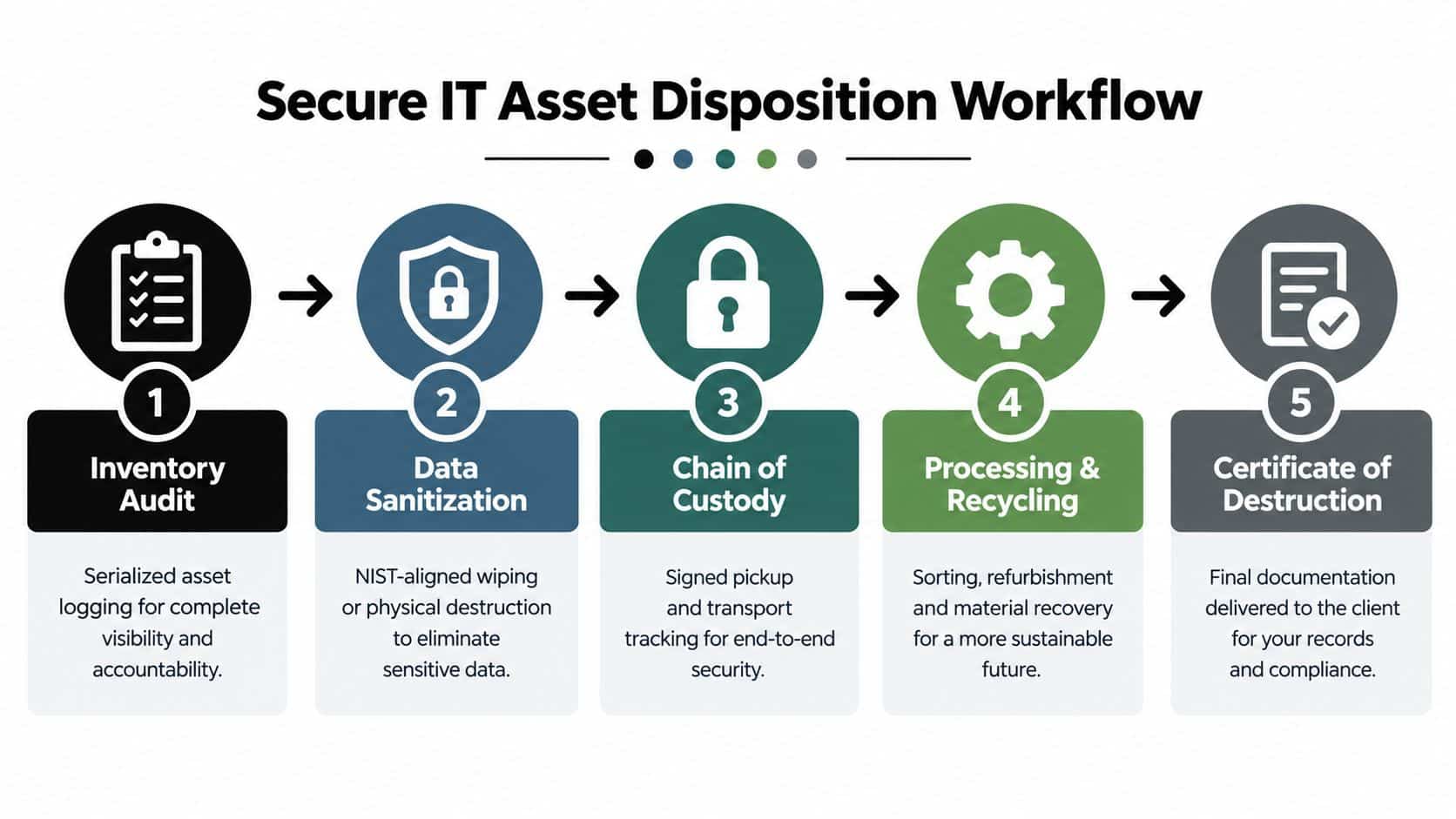
4. Apply documented sanitization
The method must match the media and confidentiality requirement. A factory reset on a network appliance may address its configuration, but it doesn't automatically sanitize attached hard drives, flash storage, or removable media. Record the method, operator, date, verification result, and device identifier.
The IT asset disposition service overview provides a useful reference point for the kinds of inventory, logistics, data destruction, and reporting controls a commercial workflow may include. Organizations working with aerospace suppliers may also need to review related supply-chain obligations, including this practical resource on Section 889 for aerospace OEMs, when evaluating equipment handling and vendor controls.
5. Close the project with evidence
Final reporting should reconcile the original inventory with the actual outcome. A useful report can show asset identifier, device type, condition, sanitization result, final disposition, and any value-recovery amount. Certificates of data destruction and recycling should support the report rather than replace it.
The Federal Trade Commission's Disposal Rule has applied since June 1, 2005 and requires reasonable measures to prevent unauthorized access to consumer-report information during disposal. The FTC recognizes electronic-file destruction or erasure and due diligence over specialized contractors as appropriate practices in covered situations, as explained in its Disposal Rule guidance. That makes documented vendor oversight particularly important for organizations handling regulated information.
NIST Media Sanitization Standards and Methods
Calling every process “wiping” creates ambiguity. NIST SP 800-88 Rev. 1 distinguishes three sanitization outcomes, Clear, Purge, and Destroy. The correct choice depends on the confidentiality of the information, the media technology, the device condition, and whether the organization needs to preserve the medium for reuse.
Clear
Clear uses logical techniques such as standard read and write commands or a supported factory-reset function. It protects against ordinary, non-invasive recovery from user-addressable storage. Clear may fit a low-risk redeployment scenario when the device is functioning, the storage technology is understood, and the organization has verified that the process completed successfully.
Clear isn't a universal answer for enterprise retirement. A reset on a router may remove configuration data, but it shouldn't be treated as proof that every attached drive or flash device has been sanitized. Similarly, a software process that works on a healthy hard disk may not provide reliable coverage for a failed drive.
Purge
Purge uses approved logical or physical methods intended to make recovery infeasible even with state-of-the-art laboratory techniques, while potentially preserving the media for reuse. This is often the more suitable outcome when an organization wants to remarket an operational drive or retain a reusable device without accepting ordinary recovery risk.
The process must account for the media type. Hard-disk drives, solid-state drives, RAID members, removable media, and flash-based storage don't necessarily respond to the same technique. Overwriting user-addressable areas may not address inaccessible cells or device-specific behavior on flash storage. A defensible procedure identifies the technology first and records the method selected.
Destroy
Destroy makes recovery infeasible and renders the storage medium unusable for future data storage. It is the practical route for failed, encrypted, damaged, or inaccessible media when a purge result can't be reliably verified. Physical destruction can include industrial shredding or another approved method that leaves the medium beyond reuse.
NIST's SP 800-88 Rev. 1 media sanitization guidance also emphasizes trained and authorized personnel, safety controls, and special-disposition requirements. Destruction shouldn't be improvised in a data center aisle. The provider should control the process, document the device identifiers, and record the result.
Match the outcome to the asset
A practical decision sequence looks like this:
- Identify the storage technology and condition. Confirm whether the device is an HDD, SSD, removable medium, RAID member, or embedded flash component.
- Classify the information risk. Consider the sensitivity of the data and the recovery resistance required by policy.
- Choose Clear, Purge, or Destroy. Select the least destructive outcome that still meets the risk requirement.
- Verify and record the result. Capture the method, date, operator, identifier, and verification outcome.
- Escalate exceptions. If the device fails, is inaccessible, or can't be verified, route it to Destroy.
For corporate server retirement, precision matters more than a generic “secure wipe” label. The NIST-aligned service explanation can help IT managers frame vendor questions around outcomes rather than marketing language.
On-Site Versus Off-Site Data Destruction Options
The destruction location changes the logistics, the visibility, and the way a project team manages perceived risk. Neither option is automatically more secure. The better choice depends on media condition, volume, site constraints, confidentiality, schedule, and the evidence the client needs.
On-site destruction
On-site service keeps the storage media at the client facility until destruction occurs. A mobile shredding unit can process eligible drives near the data center, allowing the client to observe the activity and reconcile devices before they leave. This approach can reduce anxiety around transport for healthcare, government, financial, and other sensitive environments.
The trade-off is operational complexity. The site needs enough space for the equipment, safe vehicle access, weather planning, power or staging arrangements, and a schedule that doesn't interfere with facility operations. On-site destruction may also be less practical when equipment is spread across several Atlanta locations or when the provider must process a large mixed inventory through testing and refurbishment.
Off-site destruction
Off-site processing moves the equipment under controlled custody to a specialized facility. There, technicians can use established shredding, sanitization, testing, sorting, and material-recovery workflows. Consolidation often simplifies transport for multi-site programs and makes it easier to route reusable hardware separately from destroyed media.
The primary concern is the custody gap between pickup and destruction. That risk is managed through serialized inventories, signed handoffs, secure transport, restricted receiving areas, arrival confirmation, and destruction records tied to specific identifiers. A certificate without those supporting controls is weak evidence.
Compare the decision factors
| Decision factor | On-site option | Off-site option |
|---|---|---|
| Visibility | Client can observe destruction at the facility | Client relies on documented receiving and processing controls |
| Transport exposure | Media remains on-site until destruction | Media travels under a controlled chain of custody |
| Mixed equipment | Best suited to immediate media destruction | Better suited to testing, reuse, remarketing, and material sorting |
| Site requirements | Needs staging space, access, and safe operating conditions | Needs approved logistics and secure facility controls |
| Multi-site work | Can require repeated mobilization | Can consolidate shipments through a central process |
| Reporting | Destruction records can be issued by load or device | Broader reports can combine destruction, reuse, and recycling outcomes |
The comparison of on-site and off-site ITAD services in Georgia offers a useful framework for evaluating these trade-offs. In practice, hybrid projects often work well. Destroy high-risk or failed media on-site, then send verified reusable hardware and non-data-bearing equipment to an off-site processing facility.
Vendor Selection Checklist for Atlanta Businesses
A low quote doesn't tell you whether a provider can manage a live data-center decommissioning project. Vendor evaluation should test the process, the evidence, and the commercial terms before equipment is scheduled for pickup.
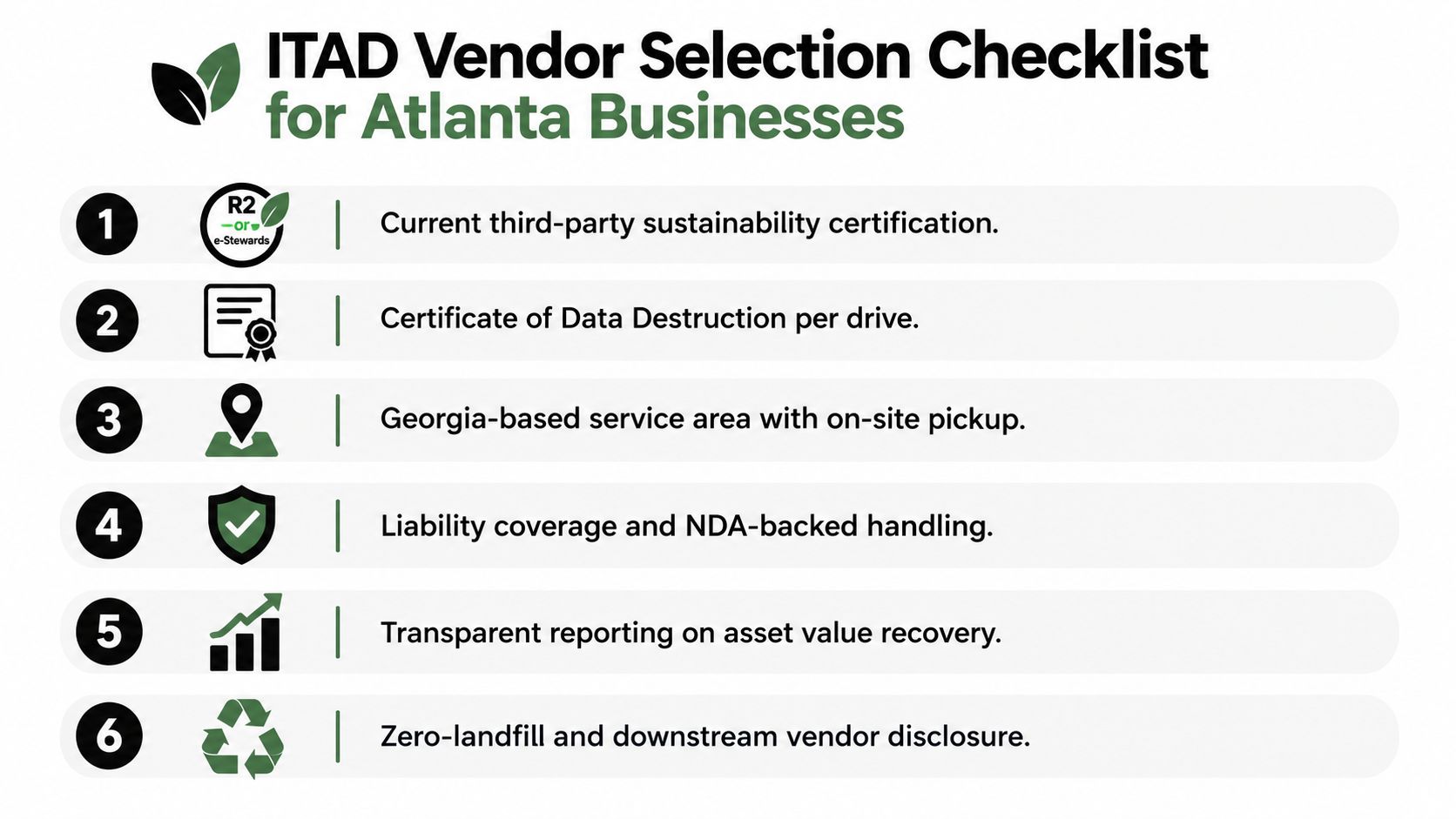
Verify certifications and scope
Ask for current evidence of relevant third-party certifications, including R2 or e-Stewards where applicable. Don't stop at a logo. Confirm the certification scope, facility location, covered processes, and expiration status. A vendor may use downstream processors, so ask how those partners are qualified and monitored.
The provider should also explain how it handles equipment outside the standard stream. Servers, network appliances, batteries, liquid-cooling components, and specialized power equipment may require different processing decisions.
Inspect the audit trail
Request a sample certificate of data destruction and a sample recycling report. Check whether the documents include:
- Asset identifiers: Serial numbers, asset tags, or another method of device reconciliation.
- Method details: Clear, Purge, Destroy, shredding, or another defined outcome.
- Verification fields: Date, operator, location, and completion result.
- Disposition records: Reuse, remarketing, material recycling, or destruction.
- Exception handling: A documented process for missing, failed, or unverified assets.
A certificate should be the final layer of evidence, not the only evidence. Ask to see the pickup manifest, transport handoff, receiving record, and reconciliation process.
Test value-recovery transparency
A credible ITAD vendor should explain how it estimates resale value, grades equipment, deducts processing costs, and calculates any buyback or revenue-sharing payment. Request a clear schedule for reporting and payment. Ask whether value is assessed at the chassis level or by recoverable components such as CPUs, memory, power supplies, and storage devices.
Ask operational questions
Use the vendor interview to expose weak points:
- Who performs the inventory and when is it reconciled?
- Which tasks occur on-site, and which occur at the processing facility?
- How are failed SSDs, encrypted drives, and inaccessible media handled?
- Can the provider manage racks, structured cabling, and equipment removal?
- How are downstream processors disclosed and reviewed?
- What happens when a serial number is missing or an item arrives damaged?
Vendor test: If the representative can't explain what happens to an unverified drive, the process isn't ready for a data center.
From Decommissioning to Circular Value Recovery
A mature disposition program starts by asking whether equipment should be reused before it asks how to recycle it. That doesn't mean every old server belongs in a resale channel. It means the team should test working components, evaluate security requirements, and document why an item was reused, remarketed, materially recycled, or destroyed.
This distinction matters because recycling a functional enterprise component can discard embedded manufacturing value. Reuse may be the better environmental outcome when the hardware passes testing, retains warranty or support value, and can be transferred securely. The result is only credible when the provider documents erasure, testing, grading, destination, and downstream controls.
Measure circularity at the component level
A generic recycling certificate can't show whether a memory module was reused or whether a failed drive was destroyed. Ask for a project-level disposition report that separates:
- Reusable assets: Servers, switches, memory, processors, power supplies, and other components that pass inspection.
- Remarketed equipment: Hardware prepared for a secondary market with data security and condition records completed.
- Material recovery: Equipment dismantled for metals, plastics, and other recoverable materials.
- Destruction: Media or components that can't be safely reused or reliably sanitized.
- Exceptions: Missing assets, failed tests, damaged equipment, and unresolved identifiers.
A 2025 circularity roadmap found that more than two-thirds of surveyed data-center operators lacked fleetwide quantitative data on reuse, recycling, and landfill diversion, while none of six major hyperscalers had published current facility-level e-waste metrics. The finding appears in the 2025 circularity roadmap. For an Atlanta operator, that gap is a practical reporting opportunity. Request facility- or project-level evidence instead of accepting an unqualified recycling claim.
Connect recovery with infrastructure planning
The U.S. Department of Energy reported that data centers consumed approximately 176 terawatt-hours of electricity in 2023, equal to about 4.4% of national electricity use. Its projection places data-center consumption between 325 and 580 terawatt-hours by 2028, or roughly 6.7% to 12% of total U.S. electricity demand, as described in the DOE data-center electricity report. The scale of that infrastructure makes equipment retirement a strategic logistics issue rather than an occasional cleanup.
Cooling changes add another layer. A facility replacing air-cooled racks with direct-liquid-cooled equipment should plan how technicians will drain, contain, transport, and document coolant loops, manifolds, cold plates, and related materials. Operational sustainability and end-of-life sustainability are connected, but they aren't the same control.
Make the outcome auditable
The strongest program links four records: the original inventory, the sanitization result, the disposition decision, and the downstream evidence. Finance can review recovered value. Security can confirm media handling. Sustainability can report reuse and material recovery. Facilities can close the decommissioning project without leaving undocumented equipment behind.
The enterprise circular-economy approach to IT equipment provides additional context for connecting secure disposition with reuse and material recovery. The practical standard is simple: preserve value where risk allows, destroy what can't be trusted, and document the reason for every outcome.
Beyond Surplus provides Atlanta-area and nationwide business services for data-center decommissioning, secure data destruction, equipment pickup, IT asset disposition, recycling, and value recovery. Visit Beyond Surplus to discuss a serialized inventory, on-site or off-site destruction plan, and auditable disposition report for your retired infrastructure.


