

For businesses in Delaware, managing end-of-life IT equipment is a critical operational challenge. This process extends far beyond freeing up storage space; it is a matter of stringent data security, environmental compliance, and legal liability. Standard recycling programs are not equipped to handle the complex needs of a commercial enterprise, exposing your company to significant financial and reputational risks. This guide provides a clear framework for secure and compliant Delaware electronics recycling for businesses.
A Guide to Compliant IT Asset Disposal in Delaware
Navigating IT asset disposal is a primary concern for companies across Delaware. When a server, computer, or piece of laboratory equipment reaches the end of its useful life, it cannot be discarded through residential collection channels. This is not a viable or legally permissible option for a business. The process requires a strategic approach that addresses key organizational concerns directly.
This guide is designed to clarify the complexities of electronics recycling for businesses and explain why a specialized service, known as IT Asset Disposition (ITAD), is essential for protecting your organization. We will explore the risks associated with improper electronics disposal and outline a clear strategy for managing your retired technology responsibly and securely.
Moving Beyond Basic Recycling
For a commercial entity, "recycling" must satisfy strict regulatory and security requirements. Unlike residential programs, a business-grade solution must account for the sensitive data residing on corporate devices and the hazardous materials they contain. Failure in either area can lead to severe consequences.
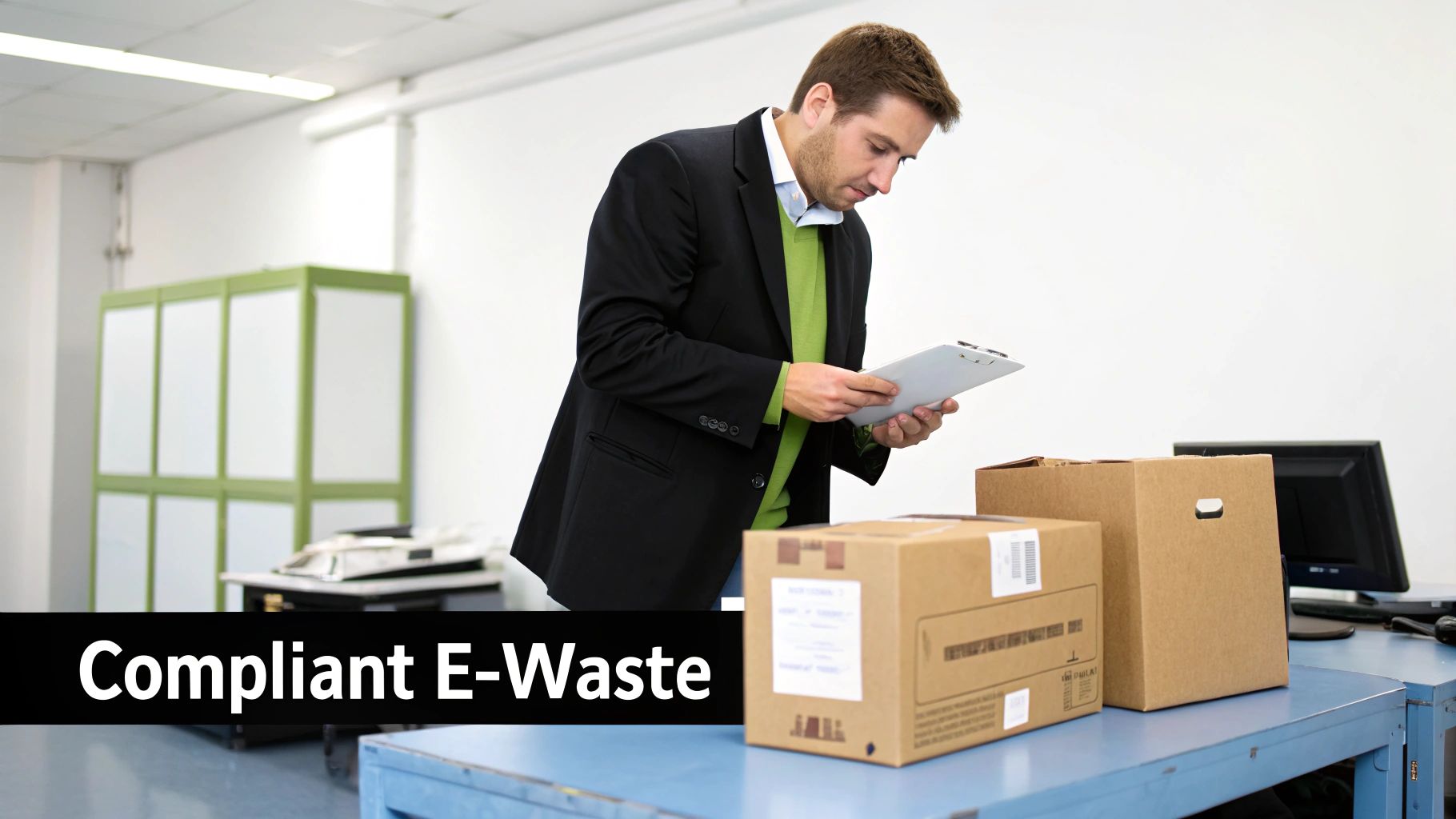
Key considerations for Delaware businesses include:
- Secure Data Destruction: Every hard drive, server, and smartphone contains confidential corporate and client information. Ensuring this data is permanently and verifiably destroyed is non-negotiable for preventing data breaches and complying with privacy laws.
- Environmental Compliance: End-of-life electronics contain hazardous materials like lead, mercury, and cadmium. State and federal regulations mandate specific handling protocols to prevent environmental contamination.
- Chain of Custody: From the moment equipment leaves your facility, a documented audit trail is necessary to prove it was managed securely at every stage. This documentation is your defense against potential legal challenges.
- Liability Transfer: Partnering with a certified ITAD provider transfers the legal responsibility for the equipment from your company to the vendor, protecting you from future downstream issues.
This guide serves as a roadmap for transforming a complex operational burden into a secure, streamlined, and compliant process. The core principles of a robust ITAD strategy apply whether you are retiring a single server rack or decommissioning an entire data center.
To understand the comprehensive nature of this service, you can learn more about what IT asset disposition is and how it provides a complete solution for retired enterprise technology. A certified partner ensures that everything from data center hardware to sensitive medical equipment is handled correctly, keeping your Delaware business protected and compliant.
Understanding Delaware's E-Waste Regulations for Businesses
For businesses in Delaware, disposing of obsolete electronics is not as simple as using a local recycling service. The state's legal framework is multifaceted, and maintaining compliance is mandatory. Organizations must navigate a complex web of regulations covering everything from hazardous materials management to the secure handling of data on retired devices.
While the Universal Recycling Act provides a foundation, it is merely the starting point for commercial enterprises. Both state and federal laws classify certain electronic components—such as circuit boards and CRT monitors—as hazardous waste. This designation prohibits them from being sent to landfills and requires specific protocols for handling, storage, and processing to prevent toxic materials from entering the environment.
Failure to comply can result in substantial fines, legal action, and significant damage to your company's reputation.
The Critical Role of Data Security Laws
Beyond environmental regulations, data security is the most significant challenge for any Delaware business managing IT asset disposal. Retired hard drives, servers, and even office multifunction printers can contain vast amounts of confidential information, including customer PII, financial records, and trade secrets.
The Delaware Personal Data Privacy Act (DPDPA) places the responsibility for protecting this information squarely on the business. When a device is retired, this legal obligation persists. The DPDPA mandates that any personal data on the device must be rendered completely unreadable and unusable through secure data wiping or physical destruction. Simply deleting files is insufficient and leaves the organization vulnerable.
A single improperly discarded hard drive can become a catastrophic liability. Compliance is not merely about following regulations; it is about fundamentally protecting your business, clients, and brand from the severe consequences of a data breach.
This is reinforced by federal laws like the FTC Disposal Rule, which applies to nearly every business handling consumer information. These regulations underscore the importance of partnering with a certified IT Asset Disposition (ITAD) provider that can furnish documented proof of complete data destruction.
Navigating the Regulatory Maze with a Certified Partner
The sheer volume of e-waste generated highlights the importance of this issue. According to official reports, the Delaware Solid Waste Authority (DSWA) program collected 1,184 tons of e-waste in FY2023. While Delaware maintains a commendable municipal solid waste recycling rate of 37.5%, the specific legal requirements for businesses demand a highly specialized solution. For a deeper analysis of state-level data, you can explore the official Delaware recycling data.
This is where a certified ITAD partner becomes indispensable. A professional vendor does not just recycle hardware; they manage your corporate liability. Here is what that partnership entails:
- Guaranteed Compliance: A certified vendor is an expert in laws like the DPDPA and ensures every action taken is fully compliant.
- Secure Chain of Custody: From the moment your equipment leaves your premises, it is tracked and documented, eliminating security gaps where a device could be lost or stolen.
- Certified Data Destruction: You receive a formal Certificate of Data Destruction, a legal document confirming data was destroyed in accordance with NIST 800-88 standards. This certificate is your official proof of compliance.
Engaging an expert is your strongest defense against non-compliance, transforming a significant legal risk into a secure, managed, and fully documented process. To better understand the broader legal landscape, our guide on navigating electronics recycling regulations offers more detailed insights for commercial organizations. This strategic approach ensures every retired asset is handled correctly, protecting your Delaware business from every angle.
Why Secure Data Destruction Is Non-Negotiable
When your Delaware business disposes of a computer, server, or mobile device, it is also discarding the sensitive data stored on it—customer information, financial records, and proprietary intellectual property. For this reason, secure data destruction is the most critical step in any corporate electronics recycling plan. It is an absolute imperative for protecting your company from a potentially catastrophic event.
Failure to properly destroy this data exposes your business to enormous risk. A single hard drive recovered from a dumpster could contain enough information to trigger a massive data breach, leading to significant financial penalties, irreparable reputational damage, and a complete loss of client trust. Laws such as the Delaware Personal Data Privacy Act (DPDPA) and the federal FTC Disposal Rule do not suggest—they mandate—that this data be rendered completely unrecoverable.
This decision tree clarifies the proper disposal path for all e-waste generators in Delaware, directing them to a single endpoint: a certified recycler qualified to handle these materials.
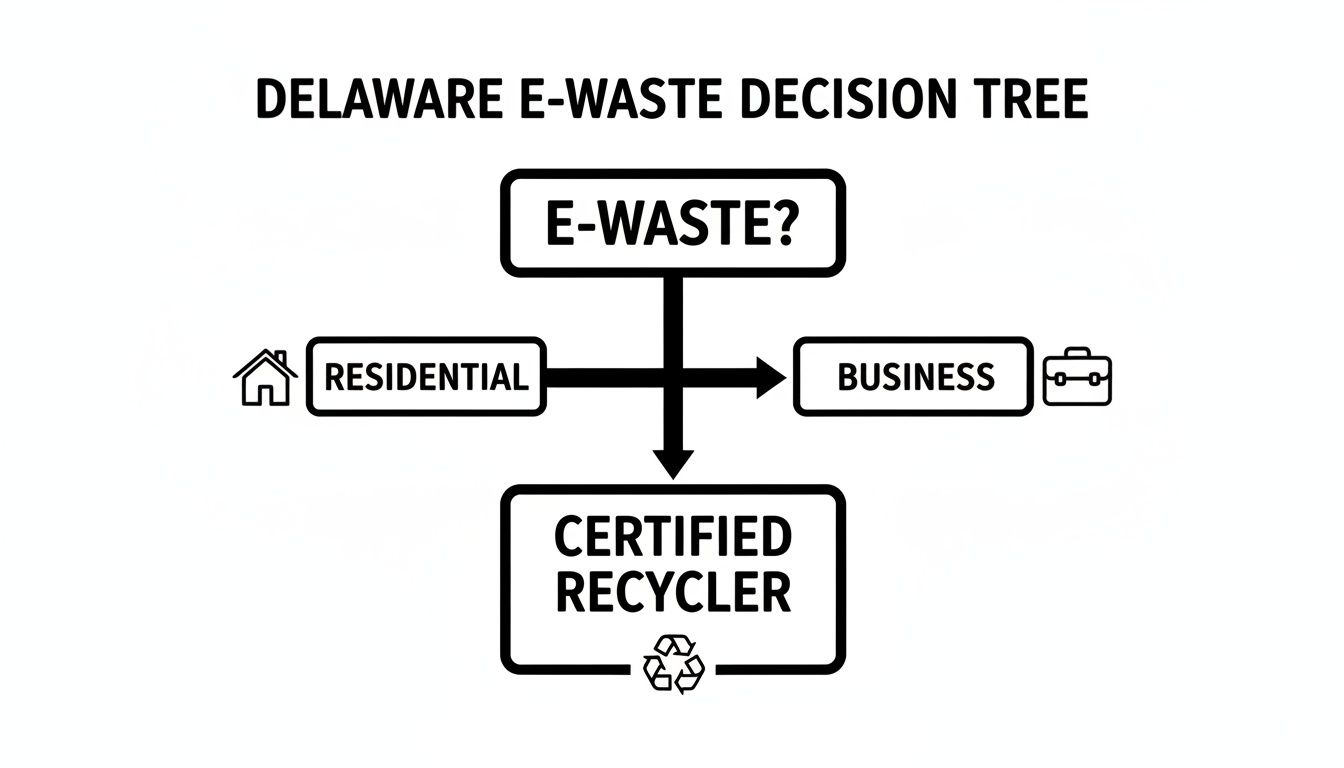
As the diagram illustrates, regardless of the source, certified recycling is the only responsible pathway, particularly for businesses that must guarantee both data security and environmental compliance.
Comparing Data Destruction Methods
To ensure data is irretrievably destroyed, businesses can choose from several certified methods. Each offers a distinct level of security suitable for different device types and compliance requirements.
-
Data Wiping (Sanitization): This method uses specialized software to overwrite all data on a storage device with random characters, adhering to strict standards like NIST 800-88. It is the ideal choice for devices intended for refurbishment and resale, as it preserves the hardware's functionality while ensuring the original data is unrecoverable.
-
Degaussing: This process employs a powerful magnetic field to scramble the data on magnetic storage media like hard drives and tapes. The intense field disrupts the drive's magnetic domains, rendering it permanently unreadable. Degaussing is fast and effective but also destroys the drive.
-
Physical Shredding: This is the most definitive method of data destruction. The hard drive or storage device is fed into an industrial shredder that grinds it into small, unrecognizable metal fragments. Data recovery is physically impossible, making this the preferred method for highly sensitive information.
The appropriate method depends on your company's security policies and whether you aim to recover value from the assets. However, for maximum security and complete peace of mind, physical shredding is the undisputed gold standard.
The Certificate of Data Destruction: Your Legal Shield
Upon completion of the destruction process, a certified ITAD partner issues a Certificate of Data Destruction. This is not merely a receipt; it is a critical legal document that serves as your official proof of compliance.
This certificate is your liability shield. It formally transfers the responsibility for the destroyed data from your organization to the vendor, proving you met your legal obligations under state and federal privacy laws.
A valid certificate includes key details that create a robust, auditable trail:
- A unique serial number for tracking purposes.
- The date and location of the destruction service.
- The specific method used (e.g., shredding, wiping).
- An inventory of the serialized devices that were destroyed.
This documentation is indispensable during an audit and demonstrates your due diligence in protecting sensitive information. For any organization serious about data security, understanding professional security and data destruction services is the first step toward building an airtight asset retirement plan. This process is ultimately about safeguarding your business's future.
Strategic ITAD Solutions for Delaware Industries
Today, Delaware businesses require more than a simple pickup service for their retired electronics. A strategic IT Asset Disposition (ITAD) plan is a comprehensive framework designed to maximize security, ensure compliance, and recover value from retired equipment. It transforms a potential liability into a well-managed, secure, and often profitable process.
A complete ITAD program manages the entire asset lifecycle, from the moment of retirement to final, documented disposition through destruction or resale.
Specialized Services for Complex Needs
Different industries generate unique types of e-waste, each with distinct risks and regulatory requirements. A one-size-fits-all approach is inadequate and can leave a business exposed. For this reason, true ITAD partners offer services tailored to specific industry challenges.
Key specialized services include:
- Full Data Center Decommissioning: This is a large-scale, project-managed service that covers the complete shutdown of data center infrastructure. Services include de-racking servers and networking equipment, securely sanitizing all data-bearing devices, and inventorying every asset for remarketing or recycling.
- Medical and Laboratory Equipment Disposal: Hospitals, clinics, and research facilities use specialized equipment that often contains protected health information (PHI) and may include hazardous biomaterials. Certified disposal is essential to comply with HIPAA and environmental regulations, protecting both patient privacy and public safety.
- Proprietary Product Destruction: In cases of product recalls, counterfeit goods, or obsolete inventory, secure product destruction ensures these items never re-enter the market. This service protects brand reputation and intellectual property.
These are not optional add-ons but critical services for maintaining operational security and regulatory compliance.
Turning Retired Assets into Revenue
One of the most valuable components of a strategic ITAD plan is an IT asset buyback program. Not all retired equipment is without value. In fact, newer-generation laptops, servers, networking switches, and other enterprise hardware often retain significant resale value. Instead of paying for disposal, a buyback program allows you to sell these assets.
A well-managed ITAD strategy doesn't just mitigate risk; it actively seeks opportunities to recover value. This transforms the IT disposal process from a cost center into a potential revenue stream, directly improving your bottom line.
The process is straightforward. An ITAD specialist assesses your inventory of retired assets, evaluating their functional and cosmetic condition. Based on current fair market values, they will extend a purchase offer. This not only returns capital to your IT budget but also supports the circular economy by extending the life of functional electronics.
Delaware's commitment to recycling is evident in its collection data. In fiscal year 2024, the Delaware Solid Waste Authority (DSWA) program collected 1,109 tons of electronic materials. These numbers underscore the volume of devices being retired and the importance of responsible management. While residential programs are effective, businesses handle high-volume, high-risk assets that require secure processing in compliance with laws like the Delaware Personal Data Privacy Act (DPDPA). You can review the state's official recycling metrics by reviewing Delaware's official annual report.
Partnering with the right ITAD provider is critical, and the benefits of a well-executed plan are undeniable for any modern business.
ITAD Service Solutions for Delaware Businesses
For businesses, navigating the complexities of ITAD requires a partner who can provide specialized solutions tailored to industry-specific needs. The right services not only ensure compliance and security but also unlock hidden value in retired assets.
| Service | Description | Primary Beneficiary Sectors | Key Benefit |
|---|---|---|---|
| Data Center Decommissioning | Complete project management for shutting down data centers, including asset inventory, data destruction, and logistics. | Tech, Finance, Cloud Providers | Securely and efficiently handles large-scale infrastructure retirement, maximizing asset value recovery. |
| Secure Data Destruction | On-site or off-site services that use certified methods to permanently erase data from hard drives and other media. | Healthcare, Legal, Government | Guarantees compliance with data privacy laws like HIPAA and DPDPA, preventing data breaches. |
| IT Asset Buyback & Remarketing | Assessment and purchase of retired but still valuable IT equipment for refurbishment and resale. | All sectors with regular tech refreshes | Converts obsolete equipment from a disposal cost into a revenue source, improving the IT budget. |
| Certified Electronics Recycling | Environmentally compliant recycling of non-functional or valueless electronics, adhering to R2 or e-Stewards standards. | Manufacturing, Education, Retail | Ensures responsible disposal, avoids environmental fines, and supports corporate sustainability goals. |
| Proprietary Product Destruction | Secure and documented destruction of branded products, prototypes, or recalled items to prevent them from re-entering the market. | Consumer Goods, Pharmaceuticals | Protects brand integrity, intellectual property, and prevents liability from faulty or counterfeit products. |
This table illustrates how a strategic approach to ITAD can be customized to the unique risk profile and operational needs of various industries across Delaware. By partnering with a certified provider like Beyond Surplus, businesses can ensure their obsolete IT assets are managed responsibly, transforming a complex obligation into a streamlined and secure process.
Our Commercial E-Waste Pickup Process for Delaware Businesses
For an IT director or facility manager in Delaware, managing a complex e-waste disposal project is a significant logistical burden. You require a process that is not only efficient but also secure and fully documented, transforming a potential operational headache into a smoothly executed project.
This is the playbook for professional IT asset disposal. The process begins with a consultation to understand your inventory and concludes with certified proof of proper disposition, with a secure chain of custody maintained throughout.
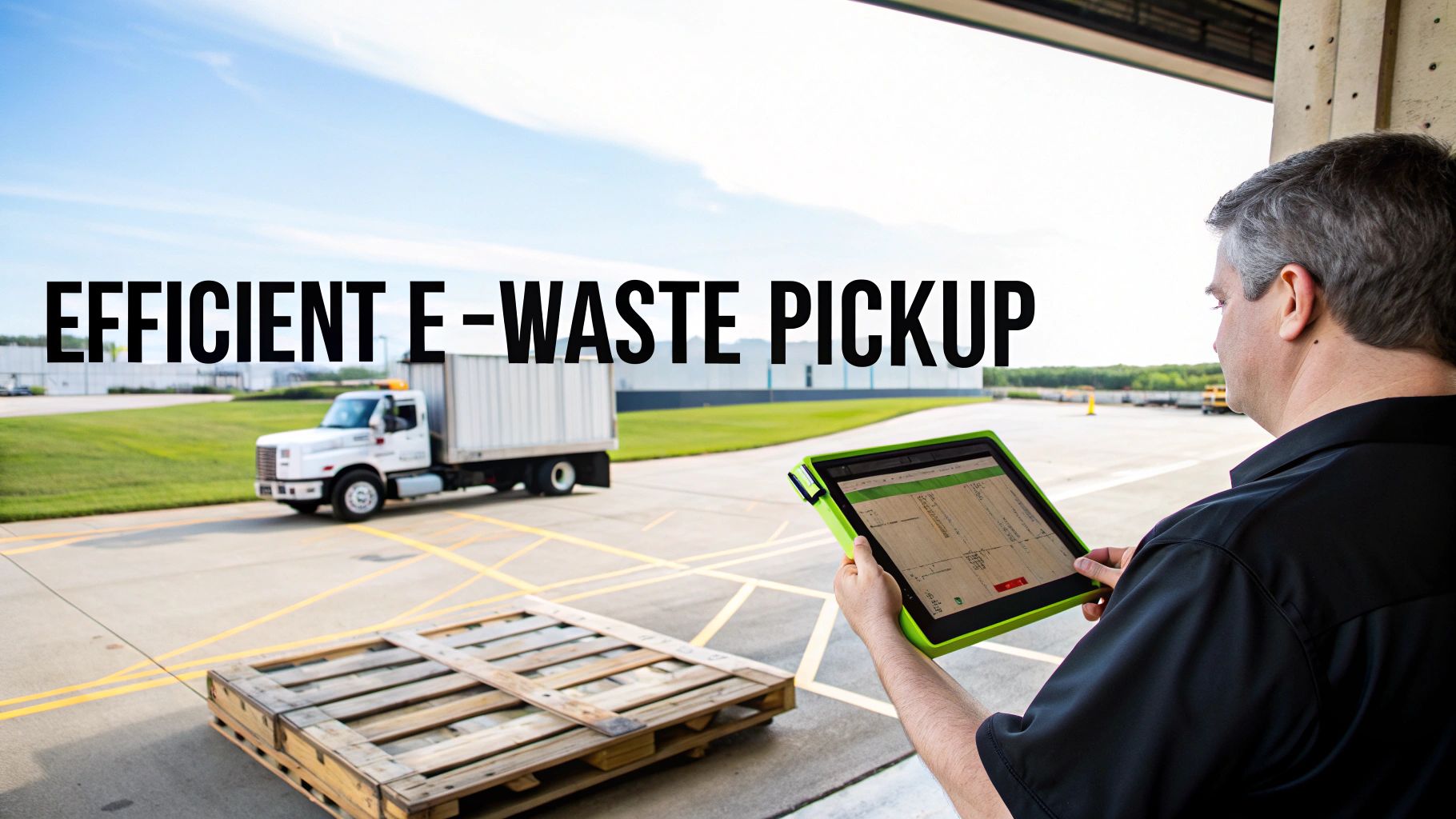
The Step-by-Step Pickup Process
A certified ITAD partner adheres to a strict, documented protocol. This process is designed to guarantee that every asset is accounted for and handled in accordance with industry best practices and legal standards.
-
Initial Quote & Scope Definition: The process begins when you contact us with an inventory of the equipment you need to retire. We will provide a preliminary quote outlining the services for logistics, data destruction, and recycling.
-
On-Site Inventory & Asset Tagging: Upon quote approval, our logistics team schedules a visit. We conduct a detailed on-site inventory, applying serialized tags to every device. This step establishes the chain of custody, creating a documented trail that follows your equipment from your facility to final disposition.
-
Secure Packing & Removal: Our team professionally packs all equipment onto pallets and shrink-wraps them for secure transport. We operate efficiently to minimize disruption to your staff. Whether you have a loading dock or require a ground-level pickup, our team manages all logistics.
Maintaining a Secure Chain of Custody
The moment your equipment leaves your Delaware facility, the chain of custody becomes paramount. This is not merely a logistical step; it is a security protocol designed to protect your sensitive data and ensure regulatory compliance.
A seamless chain of custody is the backbone of a secure ITAD process. It provides an unbroken, auditable record that proves your assets were managed responsibly at every stage, transferring liability away from your organization.
This secure journey is maintained through several key measures:
- Locked & Sealed Transport: Your equipment travels in locked, dedicated trucks.
- GPS Tracking: We monitor the vehicle’s journey in real-time from pickup to delivery.
- Secure Facility Check-In: Upon arrival at our processing facility, pallet seals are verified before being broken. Each serialized asset is then scanned into our inventory management system.
This meticulous approach ensures there are no security gaps where a device could be lost or compromised. While commercial pickups are our core service for businesses, it is worth noting that some companies with smaller batches of equipment may find our electronics drop-off locations to be a suitable alternative.
Ultimately, a streamlined pickup service is more than a convenience. It is a critical component of your company's risk management strategy, providing complete confidence that your retired IT assets are handled with the highest level of security and professionalism.
Choosing Your Certified ITAD Partner in Delaware
Selecting the right IT Asset Disposition (ITAD) partner is a critical decision for your Delaware business. This is not about simple equipment removal; it is about entrusting a partner to manage corporate risk, protect sensitive data, and ensure full compliance. The choice you make is a foundational element of your overall security and compliance strategy.
An ideal partner provides a complete, end-to-end solution covering the entire asset lifecycle. This begins with certified data destruction and is supported by robust nationwide logistics capable of handling any project, all while navigating federal and state laws like the DPDPA.
Core Pillars of a Reliable ITAD Service
When vetting potential vendors, there are several non-negotiable criteria.
- Certified Data Destruction: The vendor must adhere to NIST 800-88 guidelines for media sanitization. Whether you choose on-site or off-site shredding, a Certificate of Data Destruction must be provided for every project as proof of compliance.
- Comprehensive Compliance: Your partner must be an expert in environmental regulations and data privacy laws, acting as your compliance shield to protect your business from costly errors.
- Nationwide Logistics: Whether you have a single office in Wilmington or a large-scale data center decommissioning, the provider must have the logistical capabilities to manage the project smoothly and professionally.
- Commitment to Sustainability: The best ITAD companies prioritize refurbishment and reuse before recycling, ensuring no hazardous e-waste ends up in a landfill. A zero-landfill policy is the industry gold standard.
The most crucial deliverables you will receive are the official Certificates of Recycling and Data Destruction. These documents are your legal proof of proper disposal, serving as essential evidence for internal audits, compliance checks, and corporate responsibility reports. They formally transfer liability from your organization to the vendor.
Evaluating the numerous IT asset disposition companies requires a careful review of their certifications and, equally important, their industry track record.
Let's build a secure, compliant, and efficient ITAD strategy for your Delaware organization. We invite business owners, IT directors, and facility managers to connect with Beyond Surplus for a custom consultation.
Delaware E-Waste: Your Questions Answered
When addressing commercial electronics recycling in Delaware, business and IT leaders frequently have the same fundamental questions. Understanding costs, required documentation, and the scope of services is essential for making informed decisions that protect your company. Here are the most common inquiries we receive from businesses across Delaware.
Does My Delaware Business Have to Pay for Electronics Recycling?
Yes, businesses and other commercial organizations are required to pay for certified electronics recycling and IT asset disposal services. This is often a point of confusion for those familiar with state-subsidized residential drop-off programs.
Commercial services operate under a different framework, involving secure logistics, certified data destruction, serialized asset tracking, and comprehensive compliance reporting. This fee should be viewed as an investment in risk management. The payment ensures the legal transfer of liability and guarantees compliance with environmental regulations and data privacy laws like the Delaware Personal Data Privacy Act (DPDPA) .
What Is a Certificate of Data Destruction?
A Certificate of Data Destruction is a formal legal document that serves as proof that your data-bearing devices were professionally destroyed in accordance with strict standards, such as those outlined in NIST 800-88. It is an essential component of your compliance documentation.
This certificate acts as your liability shield and documents critical details of the process, including:
- The specific method used (e.g., shredding, wiping, degaussing).
- A serialized inventory of the devices that were destroyed.
- The date and location where the destruction occurred.
By creating a clear, auditable trail, this document formally transfers the responsibility for the data from your organization to your ITAD vendor. It is your official proof that you have met your obligations under the FTC Disposal Rule and state privacy laws, protecting you from potential fines in the event of an audit or data breach.
Can You Handle a Full Data Center Decommissioning in Delaware?
Absolutely. We specialize in managing large-scale, complex data center decommissioning projects nationwide, including in Delaware. Our team handles the entire process from start to finish, with a focus on minimizing operational disruption while maintaining the highest level of security.
Our comprehensive service includes:
- Project Management: A dedicated project manager oversees every phase of the project.
- On-Site Services: We manage all on-site logistics, including de-racking servers, inventorying assets, and securely packing all equipment for transport.
- Certified Data Destruction: We offer the option of on-site data destruction at your facility for maximum security, or at our secure processing center.
- Logistics & Recycling: We handle all transportation and ensure every component is recycled responsibly.
How Does Your IT Asset Buyback Program Work?
Our IT asset buyback program is designed to help your Delaware organization recover monetary value from retired equipment that is still functional and marketable. This service can convert a disposal cost into a revenue stream, helping to offset overall ITAD expenses.
The process is straightforward. We evaluate your inventory of assets—such as newer-generation laptops, servers, or networking equipment—and provide a fair market value quote based on their condition and current market demand. This is not only a financially prudent decision for your IT budget but also supports the circular economy by extending the life of usable technology.
Contact Beyond Surplus for a professional consultation on your Delaware electronics recycling needs. We provide certified, secure, and compliant IT asset disposal services for businesses nationwide. Learn more at https://www.beyondsurplus.com.


