

At its core, a degausser is a machine that unleashes an incredibly powerful magnetic field to permanently wipe data clean from magnetic storage media like hard disk drives (HDDs) and tapes.
Think of it as hitting an electromagnetic “reset” button. This process violently scrambles the underlying magnetic structure of a drive, rendering the data completely and permanently unrecoverable. It effectively makes the drive and all its contents unreadable without physically smashing it to pieces.
The Role of Degaussing in Modern IT Asset Disposition
For any business responsible for safeguarding sensitive information, understanding what a degausser is goes way beyond a simple definition—it’s a critical piece of a secure IT Asset Disposition (ITAD) strategy.
When a computer or server is finally retired, just deleting files or reformatting the drive is nowhere near enough. That data is still lingering on the hard drive, just waiting for someone with the right tools to come along and recover it.
Degaussing provides a definitive, final answer for magnetic media. By generating a magnetic force thousands of times stronger than the drive’s own, it completely overwrites the original magnetic pattern—the 1s and 0s that make up your data—with a chaotic, random one. This isn’t just deletion; it’s total magnetic sanitization.
The risks of getting this wrong are huge. Improper disposal of IT assets can lead to significant data breaches and non-compliance penalties. Certified destruction methods like degaussing are essential for mitigating these risks. You can dig deeper into the history and technical standards of degaussing to see how the technology has evolved.
Before we dive deeper, let’s quickly summarize the key concepts of a degausser in the table below. This will give you a solid foundation for understanding its role in data security.
Degausser At a Glance Key Concepts
| Attribute | Description |
|---|---|
| Function | Generates a powerful magnetic field to permanently erase data from magnetic media. |
| Primary Use | Data sanitization for HDDs, magnetic tapes, and other magnetic storage devices. |
| Effectiveness | Irreversibly destroys data, making it completely unrecoverable. |
| Key Advantage | Much faster than software wiping and effective on non-functional drives. |
| Limitation | Renders the hard drive unusable and is ineffective on flash-based media like SSDs. |
This table captures the essence of a degausser, but its real-world application is where its value truly becomes clear, especially when it comes to speed and compliance.
Key Functions of a Degausser
- Permanent Data Erasure: A degausser guarantees that data is gone forever. It even works on damaged or non-functional hard drives where software-based wiping would simply fail.
- Speed and Efficiency: A degausser can sanitize a drive in a matter of seconds. This makes it the perfect tool for processing large volumes of retired IT assets without creating a massive bottleneck.
- Compliance and Security: This method is a cornerstone for meeting strict data privacy regulations like HIPAA, GDPR, and FACTA. It provides a verifiable destruction process that stands up to audits.
Ultimately, degaussing acts as a powerful final line of defense. It ensures that when your company’s old hardware leaves your facility, the sensitive data it once held is absolutely, positively gone for good. This is fundamental to preventing data breaches and maintaining a secure chain of custody for all your retired IT gear.
From Naval Warfare to Data Centers: The Unlikely History of Degaussing
The story of the degausser doesn’t start in a sterile data center—it begins on the high seas during the intense naval battles of World War II. This powerful technology was born from a critical need to protect ships from a terrifying new threat: magnetic sea mines.
These mines were engineered to detonate when they sensed the massive magnetic field created by a ship’s steel hull passing overhead. To fight back, Allied forces came up with a brilliant defense. They wrapped the hulls of their ships in huge electrical coils, generating an opposing magnetic field that essentially neutralized the ship’s signature. This process, known as degaussing, made the vessels “invisible” to the mines waiting below.
A Life-Saving Military Innovation
The technology gets its name from Carl Friedrich Gauss, a brilliant 19th-century mathematician whose work laid the groundwork for understanding magnetism. Applying his principles turned into a life-saving military strategy. After British scientists recovered and analyzed a German magnetic mine in 1939, they quickly engineered degaussing coils.
During the pivotal Dunkirk evacuation in 1940, degaussing stations worked nonstop for four straight days to protect the flotilla of rescue boats. This historical context is so important because it shows that degaussing isn’t some new IT trend but a proven scientific solution with decades of history. You can dive deeper into this dramatic story and see how wartime necessity sparked this innovation.
The same fundamental principle used to shield a battleship is now used to protect a company’s most valuable asset: its data.
Below is a photo showing the degaussing coils fitted to the hull of a naval ship during the war.
You can clearly see the external cables wrapped around the ship, which generated the counter-magnetic field needed for protection. It’s a powerful visual that shows the scale and importance of the technology in a high-stakes environment.
From the Battlefield to the Boardroom
The journey from battlefield defense to corporate data protection really underscores the robust, time-tested principles behind the technology. The immense magnetic force needed to neutralize a ship’s signature is conceptually the same as the overwhelming force required to permanently scramble the data on a hard drive’s magnetic platters.
This evolution proves that degaussing is a mature, reliable method grounded in established physics. For IT asset managers today, that history provides a lot of confidence. You’re not banking on some new or experimental technique, but on a powerful, scientifically validated process that’s been adapted for the challenges of the digital age. It’s a guarantee that sensitive corporate data is completely and irreversibly gone.
How a Degausser Actually Works
To really get how a degausser pulls off irreversible data destruction, picture it as a controlled, hyper-focused electromagnetic storm. The whole point is to completely overwhelm the delicate magnetic structure holding your data, scrambling it into nothing but random magnetic noise. This guarantees that even the most sophisticated forensic tools can’t piece together a single byte of the original information.
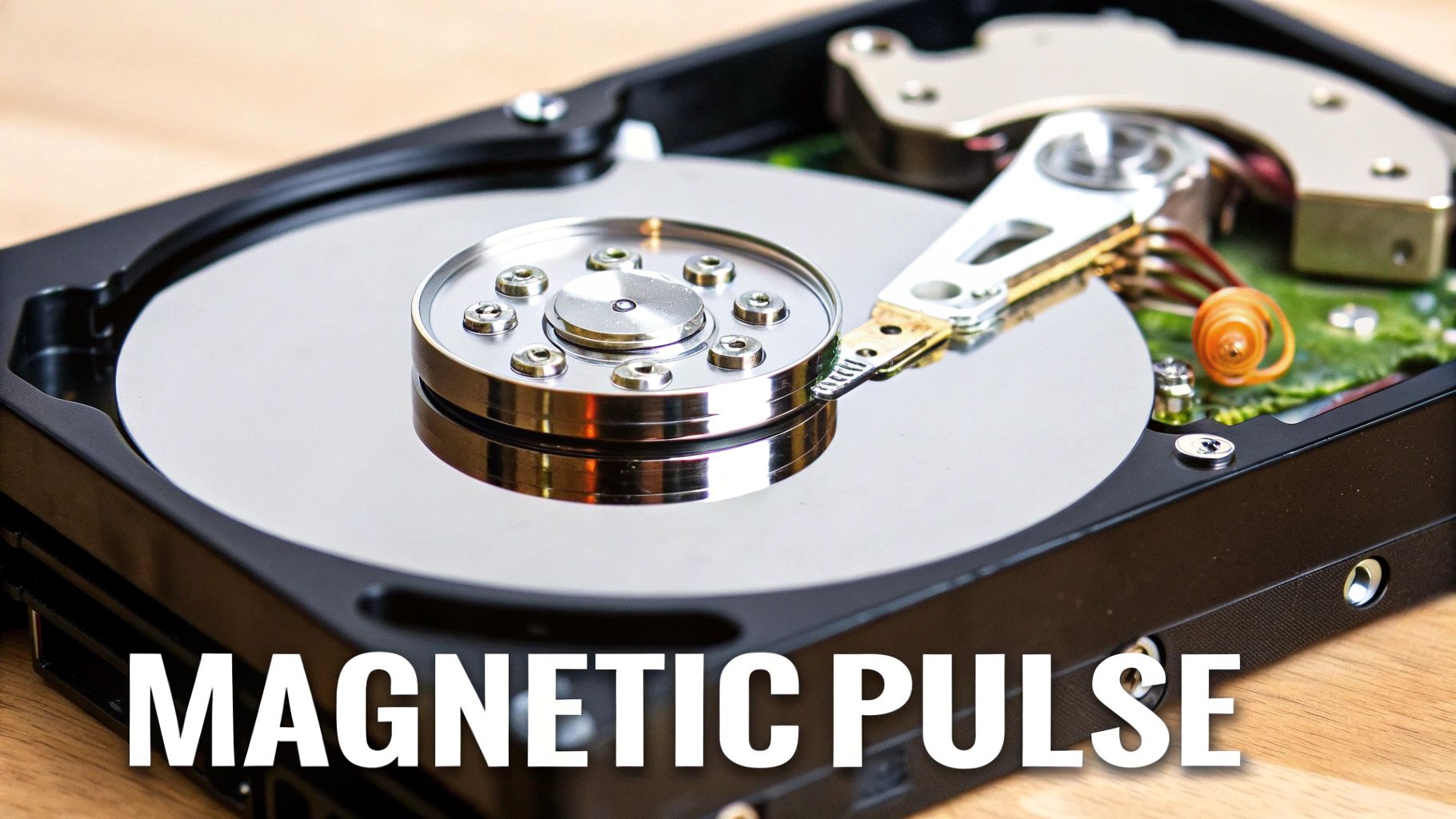
The mechanics behind this are pure physics. A hard disk drive (HDD) stores information by arranging tiny magnetic particles on its spinning platters into specific patterns of ones and zeros. A degausser blasts the drive with an electromagnetic pulse thousands of times stronger than the magnetic field that wrote the data in the first place.
Think of an intricate sandcastle on the beach. A powerful wave doesn’t just knock down a few towers; it flattens and rearranges every single grain of sand, completely wiping out the original design. In the same way, the degausser’s intense magnetic field washes over the drive’s platters, violently reorienting all the magnetic particles into a chaotic, uniform mess.
This process doesn’t just delete files—it obliterates the underlying magnetic blueprint that makes data retrieval possible. If you’re curious about the deeper principles, you can explore the core concepts of a strong Magnetizer.
Degausser Types: Pulse vs. Permanent Magnet
While the end goal is always total data sanitization, degaussers get there using two main methods. Knowing the difference is a big deal when building a solid data destruction policy. You can get the bigger picture by exploring different secure data destruction methods and seeing how they all fit together.
The two main types you’ll encounter are:
- Pulse Degaussers: These are the workhorses for IT assets. They work by storing a massive electrical charge in capacitors and then unleashing it in a single, incredibly powerful electromagnetic pulse that lasts only a fraction of a second. That intense burst is more than enough to sanitize modern, high-coercivity hard drives.
- Permanent Magnet Degaussers: These machines use powerful rare-earth magnets to create a constant, strong magnetic field. The media is simply passed through this field to be erased. While they work well, they are often designed for lower-coercivity media like older tapes and might not pack enough punch for today’s enterprise-grade HDDs.
Which Devices Can a Degausser Erase?
Knowing which devices you can and can’t degauss is one of the most important parts of a secure IT asset disposal plan. The technology’s effectiveness comes down to one simple question: does the device store data magnetically? Get this wrong, and you could be leaving massive security holes in your data destruction process.
For traditional magnetic storage, degaussing is the gold standard. It works perfectly on these devices because it goes straight to the source, scrambling the magnetic fields they use to hold onto data.
Ideal Candidates for Degaussing
You’ll want to make degaussing a core part of your process for these specific media types:
- Hard Disk Drives (HDDs): This is the classic use case, especially in the enterprise world. A single pass from a powerful degausser instantly and permanently wipes every bit of data from the magnetic platters inside a traditional spinning hard drive.
- Magnetic Backup Tapes: All those old backup tapes—formats like LTO, DLT, and even ancient reel-to-reel tapes—are perfect for degaussing. It’s the only way to be absolutely sure the archived data on them is gone for good.
- Floppy Disks and Zip Disks: They might feel like relics, but if you have any legacy systems using these magnetic formats, they need to be degaussed for secure disposal.
For this kind of hardware, a degausser is fast, auditable, and completely foolproof. It even works on drives that are physically damaged or won’t power on.
Devices Immune to Degaussing
On the flip side, a degausser is completely useless against modern storage that uses flash memory. These devices don’t store data with magnets, so a degausser’s powerful magnetic pulse does absolutely nothing to the information they hold. Trying to degauss them only creates a false sense of security while leaving your sensitive data perfectly intact.
It is critical to physically destroy these media types instead:
- Solid-State Drives (SSDs): SSDs use NAND flash memory chips, which store data electronically. There are no magnetic parts for a degausser to target.
- USB Flash Drives: Just like SSDs, these little drives rely on flash memory and are completely unaffected by magnetic fields.
- Smartphones and Tablets: These devices also use embedded flash memory, rendering degaussing completely ineffective.
- Optical Media: CDs, DVDs, and Blu-ray discs store data in a physical layer that a laser reads. They aren’t magnetic at all.
This is a common but dangerous mistake. For a deeper look into the right approach for different technologies, you can learn more about how to completely clean a hard drive. A solid data destruction policy has to account for this fundamental difference—pairing degaussing for HDDs with physical shredding for SSDs and other flash-based devices.
To make this crystal clear, here’s a quick breakdown of which destruction methods work for common media types.
Data Destruction Methods by Media Type
| Media Type | Degaussing | Shredding | Software Wiping |
|---|---|---|---|
| HDDs (Hard Disk Drives) | Highly Effective | Highly Effective | Effective (If functional) |
| SSDs (Solid-State Drives) | Ineffective | Highly Effective | Effective (If functional) |
| Magnetic Tapes | Highly Effective | Highly Effective | Ineffective |
| Smartphones/Tablets | Ineffective | Highly Effective | Effective (If functional) |
| USB Flash Drives | Ineffective | Highly Effective | Effective (If functional) |
| Optical Media (CD/DVD) | Ineffective | Highly Effective | Ineffective |
As you can see, there’s no single magic bullet for data destruction. Shredding is the universal solution that works on everything, but degaussing offers a faster, cleaner alternative for the right kinds of magnetic media. The key is knowing which tool to use for the job at hand.
Degaussing vs. Shredding vs. Wiping: Choosing the Right Method
When it’s time to retire old IT assets, getting rid of the data permanently is non-negotiable. IT managers have three main tools in their arsenal: degaussing, physical shredding, and software wiping. Each one has its place, and choosing the right one depends entirely on your security needs, operational workflow, and budget. Making the wrong call isn’t just inefficient—it can be a serious compliance risk.
Degaussing is all about speed and brute force for magnetic media. It unleashes an incredibly powerful electromagnetic pulse that completely scrambles the data on a hard disk drive (HDD) in just a few seconds. This makes it a fantastic option for quickly processing huge batches of retired drives. But here’s the catch: it’s a one-trick pony. Degaussing does absolutely nothing to SSDs or other flash-based media.
Physical shredding, on the other hand, is the great equalizer. It doesn’t care if you have an HDD, SSD, or an old smartphone—it just grinds the device into tiny, useless fragments. This method offers the ultimate, tangible proof that the data is gone for good. Of course, this level of destruction means there’s zero chance of ever reusing or reselling the asset.
Then there’s software wiping. This method uses specialized programs to overwrite every bit of data on a drive with random characters, sometimes multiple times over. The biggest advantage here is that the drive remains physically intact and fully functional. This preserves its value, making it perfect for remarketing or redeploying within your organization. The trade-off is time. Wiping can take hours per drive and is completely useless on hardware that’s already failed or damaged.
Security, Speed, and Reuse: A Head-to-Head Comparison
To really get a feel for which method fits your needs, it helps to see them compared side-by-side on the metrics that actually matter in an enterprise setting.
- Security: Shredding is king here, as physical destruction is the one thing that’s truly irreversible. Degaussing provides the same level of security for magnetic media but is completely ineffective for SSDs. Wiping is secure if it completes successfully, but it can fail on drives with bad sectors or other issues.
- Speed: Degaussing wins the race by a mile, sanitizing a drive in under a minute. Shredding is also quite fast, especially when processing devices in bulk. Wiping is the slowest of the bunch and can easily create bottlenecks in large-scale ITAD projects.
- Asset Reuse: This one is simple. Software wiping is the only method that allows for asset reuse and value recovery. Both degaussing and shredding render the drive totally inoperable.
This decision tree gives you a straightforward way to think about whether a device is even a candidate for degaussing based on its core technology.
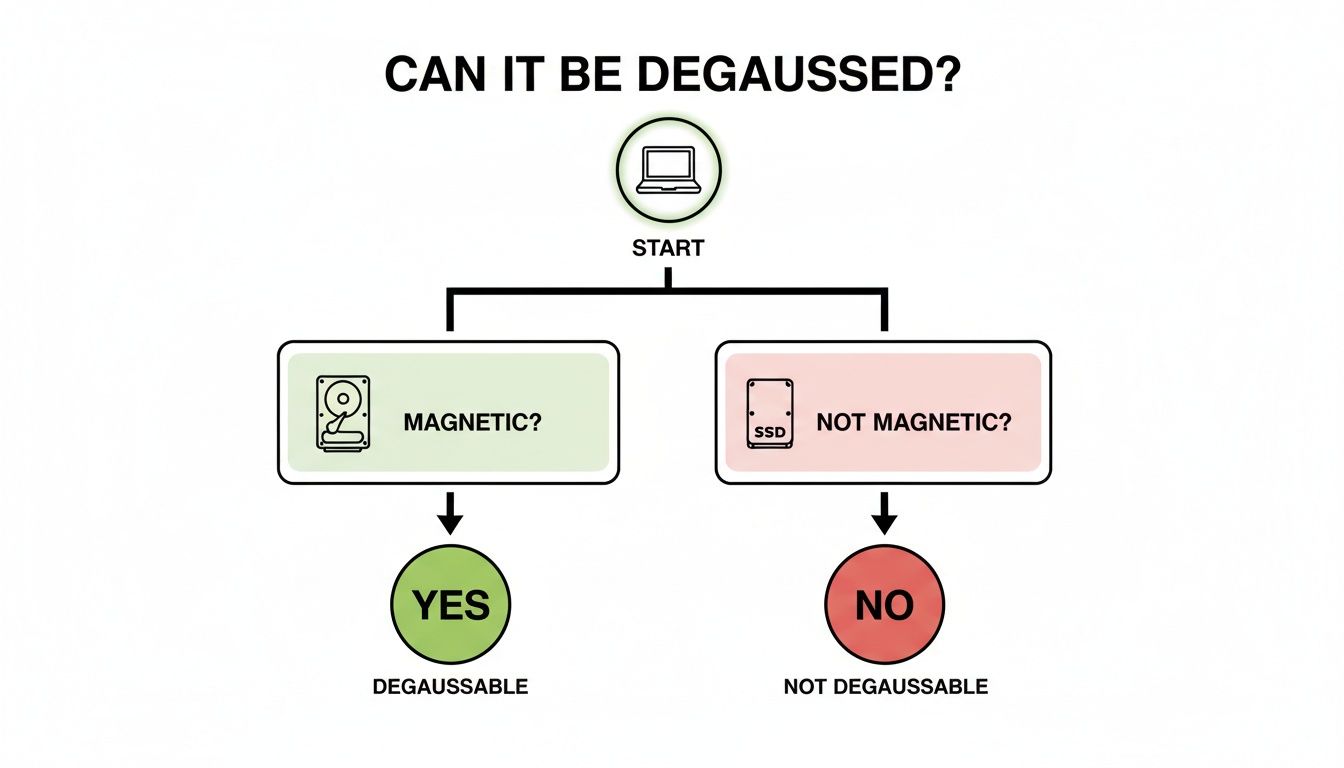
As the flowchart shows, the first question you have to ask is whether the storage is magnetic (like an HDD) or solid-state (like an SSD). That single answer points you down the right path for data destruction.
Making the Strategic Choice
For most organizations, the smartest plan is a hybrid approach. You can’t rely on a single method to handle the diverse mix of assets in a typical IT environment. A solid strategy uses degaussing for large batches of old HDDs and tapes, physical shredding for all SSDs and any non-functional drives, and software wiping for newer, high-value assets you plan to resell.
Sometimes, these methods are even combined for extra security. For instance, some high-security protocols require degaussing a drive before it gets shredded. To learn more about how these approaches work together, check out these professional security and data destruction services.
Ultimately, the goal is to strike the right balance between risk, cost, and sustainability. When you consider the growing volume of e-waste generated each year, the need for efficient and secure data destruction methods becomes crystal clear.
Why Degaussing Is Critical for Compliance
For any business that handles sensitive information, getting rid of old data isn’t just a security step—it’s a legal requirement. Degaussing is a big part of meeting those obligations, giving you a provable and final way to sanitize magnetic media that lines up with the strictest industry standards.
This process is absolutely fundamental for staying on the right side of a whole slew of data privacy laws. Think of regulations like HIPAA (for healthcare), GDPR (for personal data), FACTA (for consumer credit info), and GLBA (for financial institutions). They all demand that organizations have secure procedures to protect information from cradle to grave, including its final disposal.
Establishing an Unbreakable Chain of Custody
This is where working with a certified IT Asset Disposition (ITAD) provider makes all the difference. A professional vendor puts a documented chain of custody in place, which is basically a detailed, auditable trail that follows every single asset from the second it leaves your control to its final destruction.
This unbroken paper trail is meticulous. It includes things like:
- Serialized asset tags for every hard drive or tape.
- Secure, GPS-tracked transportation logs.
- Documented steps taken at a secure processing facility.
- Final confirmation that the data was sanitized or the device was physically destroyed.
This careful documentation effectively shifts the liability from your shoulders to your ITAD partner. If an auditor ever comes knocking, you’ll have clear, verifiable proof that you followed industry best practices for data security.
The Importance of a Certificate of Destruction
The final, and arguably most critical, piece of the compliance puzzle is the Certificate of Destruction. This is a legally binding document that acts as your official proof that all your data-bearing media was sanitized according to established guidelines.
A Certificate of Destruction is so much more than a receipt. It’s an essential legal document that shields your business from potential fines, lawsuits, and the brand damage that comes with a data breach or compliance failure.
It’s the document that confirms your company did its due diligence, giving you a powerful defense against any regulatory questions. For IT managers, that certificate is the ultimate peace of mind, proving that retired assets won’t come back to haunt you.
If you want to dive deeper into the specific frameworks that guide these processes, check out our detailed guide on NIST SP 800-88 standards for media sanitization.
Partnering With an Expert for Secure Data Destruction
Knowing what a degausser does is one thing, but putting it to work securely is what really protects your business. Degaussing is a fantastic way to wipe magnetic media like HDDs and tapes—it’s fast, powerful, and permanent. But it’s just one piece of the puzzle. That process has to fit into a bigger IT asset disposition strategy that knows what to do with everything else, especially SSDs that can’t be degaussed and need to be physically destroyed.
Trying to manage all this in-house is loaded with risk. It’s easy to mishandle different types of media or end up with patchy documentation that won’t pass an audit. Bringing in a certified ITAD partner takes that entire weight off your shoulders.
The Value of Certified ITAD Services
Working with a professional ITAD service just makes sense. Here’s what you get:
- Comprehensive Logistics: A good partner handles everything from secure transportation and asset tracking to processing everything at a certified facility. You don’t have to worry about the details.
- Guaranteed Compliance: Certified partners provide a fully auditable chain of custody and a Certificate of Destruction. This officially transfers the liability away from you and proves you’ve met all regulatory standards.
- Mixed Media Handling: They have the right tools for the job. Pros are equipped to degauss all your magnetic drives while also physically shredding SSDs and other flash-based media, so nothing gets missed.
When you outsource this process, you’re free to focus on your actual business, trusting that your data is being handled securely and responsibly. To see how this fits into the bigger picture, it’s worth exploring what IT asset disposition entails and how it shields your organization from risk.
At the end of the day, bringing in an expert is the smartest way to make sure your company’s old IT gear is managed securely, compliantly, and efficiently from start to finish.
Don’t leave your company’s data security to chance. Contact Beyond Surplus for certified electronics recycling and secure IT asset disposal. Schedule your nationwide business pickup today.


