

For any business in Delaware, a surplus of old servers, laptops, and hard drives isn't just clutter—it’s a significant liability. Proper Delaware data destruction isn't merely a best practice; it's a non-negotiable legal requirement designed to protect consumer data and shield your company from severe financial and reputational damage. This guide outlines the essential regulations, methods, and best practices for creating a compliant data destruction plan for your Delaware-based enterprise.
The Business Case for Secure Data Destruction in Delaware
As a major corporate hub, Delaware upholds exceptionally high standards for managing sensitive information. Your retired IT equipment likely contains employee records, customer lists, financial statements, and valuable trade secrets. Simply hitting "delete" or reformatting a hard drive is insufficient, as data recovery tools can easily restore information you thought was gone permanently.
Every piece of lingering data is a potential security incident. A single improperly discarded device could trigger a catastrophic data breach, leading to massive fines, protracted lawsuits, and irreparable damage to your company's reputation.
Delaware's Proactive Stance on Data Security
Recognizing these risks, Delaware enacted a comprehensive data destruction law that went into effect on January 1, 2015. It mandates that all commercial entities take "reasonable steps" to securely destroy a consumer's personal identifying information (PII) before disposing of any records. This law covers everything from paper files to electronic media, requiring methods like shredding or complete erasure to render data "entirely unreadable or indecipherable."
This legislation underscores a critical point for modern businesses: your responsibility for data security doesn't end when a device is decommissioned. It extends throughout the asset's entire lifecycle to its secure and verifiable end.
For any Delaware business, a compliant IT Asset Disposition (ITAD) strategy is not an optional expense but a core component of risk management. It transforms a potential liability into a verified, secure process that protects your customers, employees, and bottom line.
Partnering with a certified data destruction provider allows your business to meet these legal obligations head-on. This isn't just about disposing of old hardware; it's about implementing a defensible process that protects you from internal and external threats. Understanding the crucial reasons you need data destruction services is the first step toward building a compliant data destruction plan in Delaware.
Decoding Delaware's Data Destruction Laws
Navigating the legal framework for data disposal in Delaware is critical for any commercial enterprise. The state has established clear expectations for handling sensitive information, and non-compliance can result in significant penalties and reputational harm. Understanding these rules is the first step to developing a secure and fully compliant IT asset disposal plan.
The foundation of this framework is Delaware's data destruction law, which requires businesses to take "all reasonable steps" to destroy records containing personal identifying information (PII) before disposal. This legal mandate applies to all formats, from paper files to the hard drives, SSDs, and servers that power your business operations.
What Counts as Personal Identifying Information (PII)?
To ensure compliance, you must understand what Delaware defines as PII. The definition is intentionally broad to protect consumers from identity theft and fraud.
Here’s the breakdown:
- Core Identifiers: A person's first name (or initial) and their last name.
- Paired with Sensitive Data: This basic information becomes protected PII when linked with any of the following:
- Social Security number
- Driver's license or state ID card number
- Bank account, credit, or debit card numbers
- Passport number
- Usernames or email addresses, especially when combined with a password or security question that unlocks an online account.
In practice, this means old customer lists, employee HR files, and financial records stored on retired IT assets are all subject to these strict rules. The law is clear: the information must be made "entirely unreadable or indecipherable."
Federal Regulations: The FTC Disposal Rule and HIPAA
Delaware's law does not exist in a vacuum. It complements federal regulations that many businesses must also follow, most notably the FTC Disposal Rule and HIPAA.
The FTC Disposal Rule, part of the Fair and Accurate Credit Transactions Act (FACTA), applies to nearly any business handling consumer reports, including employers, landlords, and financial institutions. It mandates the proper disposal of consumer information to prevent unauthorized access.
For healthcare organizations, the Health Insurance Portability and Accountability Act (HIPAA) imposes even stricter requirements. The HIPAA Security Rule specifies safeguards for electronic protected health information (ePHI), and this protection extends to the final disposal of the storage media. Failure to properly shred a drive containing ePHI can result in severe penalties.
The legal landscape requires a multi-layered approach to compliance. A Delaware business must satisfy state-specific mandates while also adhering to any applicable federal laws like the FTC Disposal Rule or HIPAA, creating a complex but non-negotiable set of security obligations.
The Steep Price of Non-Compliance
The penalties for ignoring these laws are substantial. Under Delaware law, if a violation leads to a data breach, a court can award treble damages—triple the amount of actual damages suffered by a victim. Additionally, the Delaware Attorney General has the authority to investigate and take action against non-compliant businesses.
The real-world consequences are significant. The 2015 Experian data breach affected 36,857 Delaware residents and resulted in a major multistate settlement. The breach occurred not on Experian's primary servers but through a vendor that mishandled applicant data—a classic supply chain security failure. Delaware's law aims to prevent such vulnerabilities by making it clear that your data security responsibility extends to all partners. You can review the state’s official report on the 2015 Experian data breach settlement.
This legal reality makes partnering with a certified provider essential. Professional Delaware ITAD services deliver the documented, verifiable destruction processes needed to transfer liability and protect your business.
Choosing Your Method for Secure Data Destruction
Understanding Delaware's data destruction laws is the first step, but selecting the right method to ensure compliance is crucial. For businesses in Delaware, the choice typically comes down to two industry-standard approaches: physical destruction and certified data wiping.
Each method serves a specific purpose, and the best choice depends on your security requirements, the lifecycle stage of your IT assets, and your company's sustainability goals. Physical destruction offers absolute finality, while certified wiping provides a forensic-level deep clean that prepares an asset for a new life.
The Ultimate Fail-Safe: Physical Destruction
Physical destruction, most commonly hard drive shredding, involves industrial-grade equipment that grinds hard drives, SSDs, backup tapes, and other media into small, confetti-like fragments. This process completely obliterates the platters and memory chips where data is stored, making it physically impossible to reassemble or recover any information.
This method delivers the highest level of security and is the ideal solution for devices that are at the end of their useful life, have failed, or contain highly sensitive intellectual property. There is no ambiguity—the data is permanently gone.
For assets holding top-tier sensitive data or those with no resale value, physical shredding provides undeniable proof of destruction. It eliminates all doubt and creates a clear, documented end to that data's lifecycle, which is a cornerstone of any solid risk management strategy.
The Value-Preserving Alternative: Certified Data Wiping
Certified data wiping, or data erasure, uses specialized software to overwrite all existing data on a storage device with random binary code. This is not a simple delete function; the process is repeated multiple times according to strict protocols like the NIST 800-88 "Purge" standard, rendering the original data unrecoverable even with advanced forensic tools.
The primary advantage of data wiping is that the hard drive or SSD remains physically intact and functional. This makes it the ideal choice for IT assets intended for resale, internal redeployment, or donation. It allows your business to capture residual value from retired equipment while still meeting the stringent compliance requirements for Delaware data destruction. A certified process provides a verifiable, documented audit trail confirming that the erasure was performed correctly.
To learn more about these processes, you can learn more about secure data destruction services and how they protect your business from liability.
This flowchart illustrates the decision-making process for handling devices containing personally identifiable information (PII).
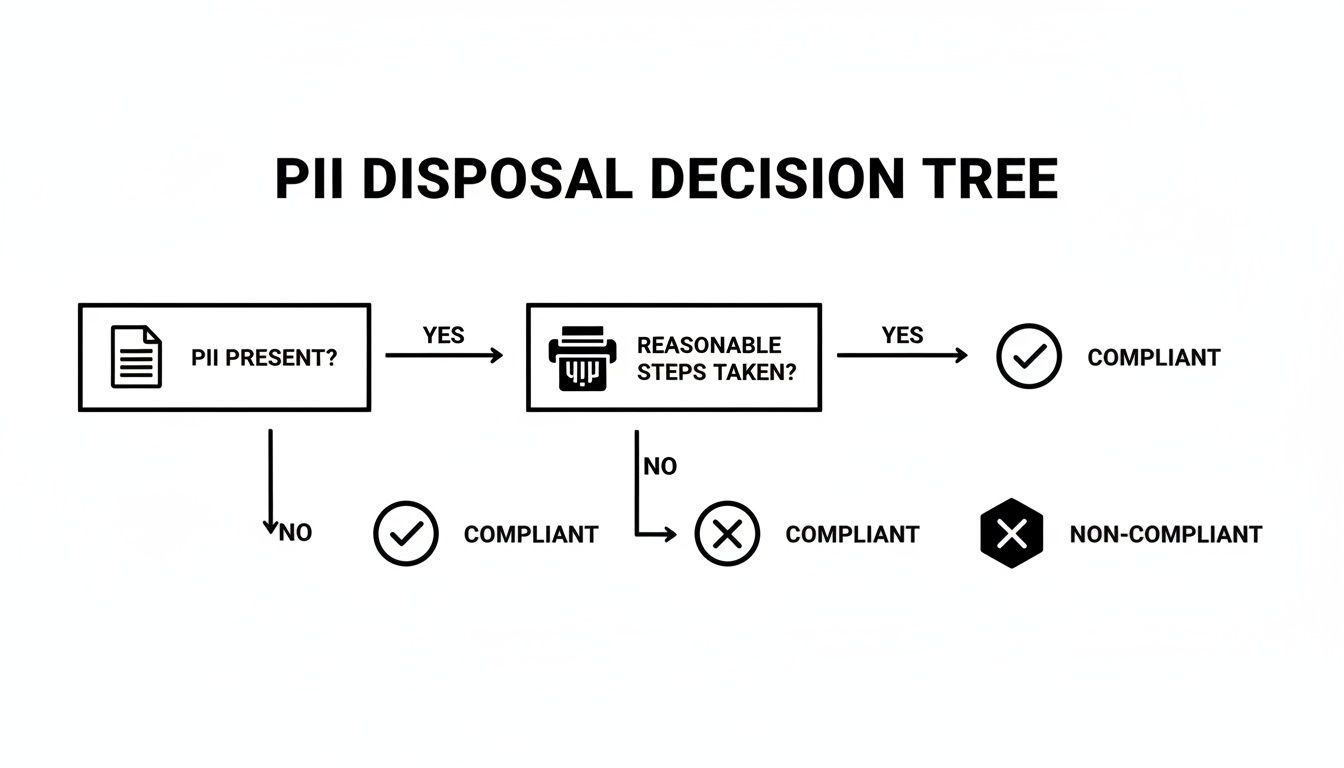
As shown, the presence of PII requires compliant steps like shredding or certified wiping to ensure the data can never be recovered.
Here is a quick comparison of the two primary methods to help you visualize the differences.
Comparison of Data Destruction Methods
| Feature | Physical Hard Drive Shredding | Certified Data Wiping (NIST 800-88) |
|---|---|---|
| Asset Condition | Renders device completely unusable | Keeps device intact and functional |
| Best For | Obsolete, damaged, or non-functional assets | Functional assets with resale/reuse value |
| Security Level | Absolute. Data is physically obliterated. | Extremely high. Data is forensically unrecoverable. |
| Sustainability | Materials are recycled after shredding | Promotes reuse and extends asset lifespan |
| Verification | Certificate of Destruction, visual confirmation | Certificate of Erasure with detailed logs |
| Cost | Generally lower per-unit cost for loose drives | Can be higher due to labor and software costs |
This table makes it clear that the "right" choice is situational, not universal.
Making the Right Choice for Your Assets
So, how do you decide which method to use? It typically comes down to a straightforward cost-benefit and risk analysis for each asset type.
-
Choose Physical Shredding When:
- The devices are obsolete, broken, or have no resale value.
- The data is exceptionally sensitive, such as classified information, trade secrets, or critical financial records.
- Your corporate policy mandates the physical destruction of all retired media for maximum security.
- You require the fastest method for disposing of a large batch of loose drives.
-
Choose Certified Wiping When:
- The IT assets are newer and retain significant remarketing value.
- You plan to redeploy laptops, servers, or storage arrays within your organization.
- Your sustainability goals prioritize reuse over recycling raw materials.
- The devices are being returned at the end of a lease agreement.
Ultimately, most comprehensive IT asset disposition (ITAD) strategies utilize a combination of both methods. A certified partner can help evaluate your inventory, segregate assets based on their reuse potential, and apply the optimal destruction method for each category. This blended approach ensures you maximize both security and value recovery while maintaining a perfect compliance record.
Finding the Right Certified ITAD Partner in Delaware
Selecting a partner for your IT Asset Disposition (ITAD) is a critical business decision. It goes beyond comparing prices—you are entrusting them with your company's sensitive data. Choosing the right team for Delaware data destruction means finding a provider who can shield you from the significant legal and financial consequences of a data breach.
A certified partner acts as your compliance shield, possessing the expertise, specialized equipment, and auditable processes to navigate stringent state and federal regulations. Without this verified partnership, the full liability for a breach remains with your company long after the equipment has been discarded.
Vetting Your Vendor: The Essential Certification Checklist
Before engaging a partner, it is crucial to verify their credentials. Industry certifications are not just logos; they are hard-earned proof that a vendor meets the highest standards for data security, environmental responsibility, and transparent operations. These are awarded only after rigorous inspections by independent, third-party auditors.
Here are the non-negotiable certifications to inquire about:
- R2 (Responsible Recycling): This is the gold standard for the electronics recycling industry. An R2-certified vendor has demonstrated a commitment to secure data destruction, environmental protection, and worker safety.
- e-Stewards: Developed by the Basel Action Network, the e-Stewards standard is known for its strict prohibition against exporting hazardous e-waste to developing nations. It guarantees that your assets are managed with complete environmental integrity.
- NAID AAA Certification: Issued by the National Association for Information Destruction, this certification focuses exclusively on data security. A NAID AAA certified partner has passed exhaustive, unannounced audits of their hiring practices, facility security, and destruction processes.
Insisting on these certifications ensures you are working with a vendor whose operations are designed to withstand legal scrutiny.
A vendor’s certifications are a direct reflection of their commitment to quality and security. They represent a proven, audited framework for handling your sensitive assets, which is essential for any business operating under Delaware's strict data protection laws.
Chain of Custody: The Unbroken Line of Liability
One of the most critical elements of any secure ITAD program is an impeccable chain of custody. This is the detailed, unbroken log that tracks your assets from the moment they leave your facility to their final destruction. Every touchpoint is documented.
A robust chain-of-custody process must include:
- Serialized Asset Tracking: Every device, from a large server to an individual hard drive, should be scanned and inventoried by serial number before leaving your premises.
- Secure Logistics: The vendor must use sealed, GPS-tracked vehicles, and transport personnel must be vetted and background-checked.
- Controlled Facility Access: Their processing facility should be under 24/7 surveillance, with strict access controls and secure, monitored areas for devices containing data.
This is more than just paperwork; it's your defense. In the event of an audit or legal challenge, a complete chain-of-custody report serves as your proof of due diligence.
The Certificate of Data Destruction: Your Legal Shield
Upon completion of the service, your ITAD partner must provide a Certificate of Data Destruction. This legally binding document is your official proof of compliance and the final step in transferring liability away from your company. It is far more than a simple receipt.
A legitimate certificate must clearly specify:
- A unique serial number for the certificate itself.
- The exact destruction method used (e.g., shredding, NIST 800-88 compliant wiping).
- An itemized list of every asset destroyed, matched to its individual serial number.
- The date and location where the destruction occurred.
- An official signature from an authorized representative of the ITAD company.
Do not consider a vendor who cannot provide this level of serialized detail. The Certificate of Data Destruction is the legal document that confirms you have met your obligations under Delaware law. For companies seeking a reliable local expert, exploring comprehensive Delaware electronics recycling services that bundle certified data destruction is the smartest path to full compliance.
Balancing Data Security and Environmental Responsibility
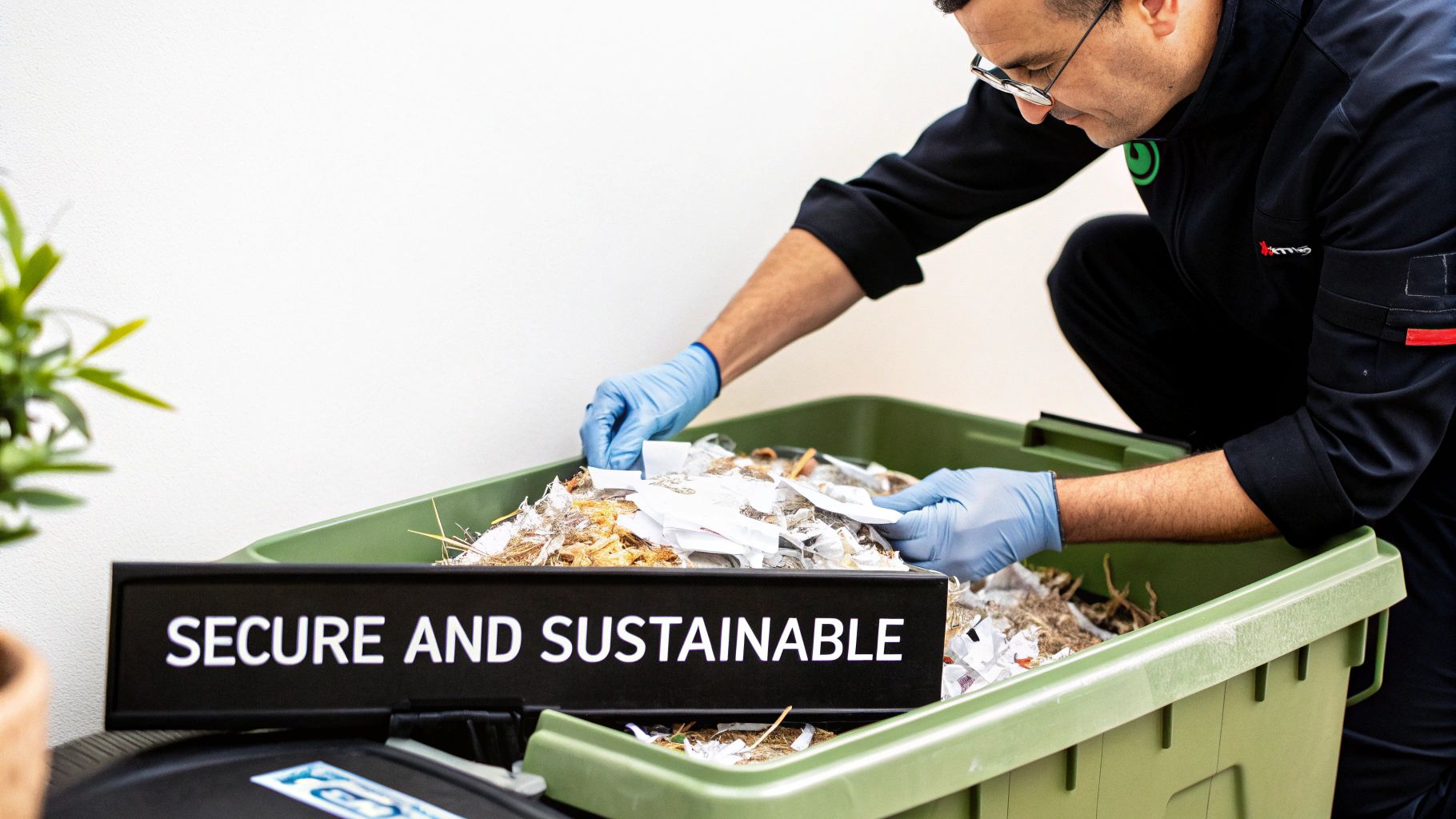
For any business in Delaware, secure data destruction and responsible e-waste recycling are two sides of the same coin. A truly compliant IT asset disposition strategy is not just about data sanitization; it's also about ensuring the physical hardware is managed in a legally sound and environmentally friendly manner.
These two objectives are not in conflict—they are deeply interconnected.
Improperly discarded servers, laptops, and networking gear contain hazardous materials like lead, mercury, and cadmium. If these items end up in a landfill, these toxins can leach into the soil and groundwater, creating long-term environmental problems. This is where a certified ITAD partner proves their value.
The Intersection of Security and Sustainability
The most effective approach to Delaware data destruction integrates security protocols directly into a sustainable recycling plan. This means that after a hard drive is shredded or wiped to NIST standards, the remaining components are processed in an environmentally responsible way.
This dual focus offers several key benefits to your business:
- Boosts Corporate Social Responsibility (CSR): A documented zero-landfill policy for your e-waste enhances your company’s public image and aligns with the values of modern customers and investors.
- Ensures Environmental Compliance: Delaware has robust recycling regulations. A certified partner ensures you meet these obligations alongside your data security duties.
- Recovers Hidden Value: Not all retired IT equipment is waste. A skilled ITAD partner can identify functional components and devices suitable for refurbishment and resale, turning a disposal cost into a revenue opportunity.
Delaware's data destruction laws have evolved alongside its recycling initiatives. The state's Universal Recycling Law was a major factor in increasing the diversion of recyclables from landfills from 32.6% in 2006 to 44.5% by 2016. This effort reduced landfill tonnage and enhanced the recovery of materials from e-waste, which often contains sensitive data.
From Destruction to De-Manufacturing
Once data has been verifiably destroyed, the recycling process begins. A certified electronics recycler follows a meticulous de-manufacturing process to extract valuable commodities and safely manage hazardous materials.
True IT asset disposition extends beyond data erasure. It encompasses a full-circle responsibility for the physical device, ensuring that every component is recycled, reused, or disposed of in an environmentally safe and legally compliant manner.
This is a critical distinction. An uncertified vendor might export your e-waste, creating environmental issues abroad and breaking the chain of custody you worked to establish. In contrast, a certified partner provides transparent reporting that tracks the entire journey of your assets, from secure destruction to final material recovery.
Understanding this full lifecycle is key to building a comprehensive risk management strategy. For a closer look at the de-manufacturing journey, explore our guide on what happens to recycled electronics. A certified process protects your brand from both data breaches and environmental liability, providing peace of mind and demonstrating a tangible commitment to corporate responsibility.
Your Top Delaware Data Destruction Questions, Answered
Even after understanding the laws and methods, practical questions often arise when developing a data destruction strategy. This section addresses the most common questions from IT managers and business owners in Delaware, providing clear answers to resolve any remaining uncertainties.
What Kinds of Business Records Actually Fall Under Delaware's Law?
Delaware's data destruction law is intentionally broad, applying to nearly any commercial business that maintains "personal identifying information" (PII), whether in paper or electronic form. This includes more than just financial institutions or healthcare providers; if you collect data on customers or employees, this law applies to your business.
Legally, PII is defined as a person's first name (or initial) and last name combined with another sensitive data point, such as a Social Security number, driver's license number, or financial account details. This means a wide range of everyday business documents requires secure destruction.
Consider the scope in your daily operations:
- Customer Files: Old invoices, service contracts, and contact lists often link names with addresses or account numbers.
- Employee Records: HR folders, payroll stubs, and past job applications are filled with PII.
- Financial Documents: Expired credit applications, old accounting ledgers, and paid invoices are all covered.
The bottom line is straightforward: if a document or hard drive contains information that could identify an individual and put them at risk, it is covered by Delaware law and must be properly destroyed, not simply discarded.
Why Is a Certificate of Data Destruction Such a Big Deal?
A Certificate of Data Destruction is more than a receipt; it is your official, legally-defensible proof of compliance. This formal document, provided by your certified ITAD partner, serves as the official record confirming that your data was destroyed using irreversible methods.
Its most critical function is the transfer of liability. In the event of a data breach traced back to discarded equipment, this certificate is your primary line of defense. It demonstrates that you took the "reasonable steps" required by Delaware law and acted in good faith by adhering to industry best practices.
Think of a serialized Certificate of Data Destruction as the legal firewall between your business and the fallout from a downstream data breach. Without it, your company is still on the hook in the eyes of regulators.
A legitimate certificate is always detailed, listing the exact destruction method used (e.g., shredding or a NIST 800-88 compliant wipe), the date of service, an itemized list of each asset's serial number, and an authorized signature from the vendor. This is what makes your compliance efforts fully auditable and bulletproof.
Can't We Just Handle Data Destruction In-House to Save Money?
Attempting to manage data destruction internally may seem like a cost-saving measure, but it often introduces significant risks and hidden expenses that can easily negate any savings. Compliant data destruction is not as simple as drilling a hole through a hard drive or running a basic format command.
First, there are equipment costs. Proper destruction requires industrial-grade machinery like commercial shredders or certified software that meets stringent standards like NIST 800-88. This equipment is expensive to purchase and maintain.
More importantly, the entire burden of creating and maintaining a flawless, auditable record for every device falls on your team. A single mistake, a gap in the chain of custody, or incomplete paperwork means your company is fully liable if a breach occurs. Working with a certified vendor offloads this risk, providing you with audited processes and the legally-defensible certificate needed to prove compliance.
What's the Real Difference Between On-Site and Off-Site Shredding?
The primary difference between on-site and off-site shredding is the location where the physical destruction occurs. Both are highly secure options when performed by a certified vendor, but they are designed for different security postures and logistical needs.
On-Site Shredding:
This service involves a mobile destruction truck—essentially a shredder on wheels—coming directly to your location. Your team can witness the entire process, from asset collection to their fragmentation.
- Maximum Security: Your data never leaves your property in a readable format.
- Zero Chain-of-Custody Risk: There is no transport risk, as the drives are destroyed before the truck leaves your premises.
- Total Transparency: You get visual confirmation that the process is completed correctly.
This is the preferred choice for businesses in highly regulated industries like finance, healthcare, or government, where absolute certainty is required.
Off-Site Shredding:
This service involves the secure and documented transport of your IT assets to the vendor's specialized, high-security facility for destruction. A certified partner uses locked containers, GPS-tracked trucks, and background-checked staff to maintain security throughout the journey. It can be a more efficient option for very large quantities of assets, and a detailed chain-of-custody log tracks everything from pickup to final destruction, providing a complete audit trail.
Your IT assets hold sensitive data that requires a certified, defensible disposal process. Protect your Delaware business from legal and financial risks by partnering with an expert. For certified electronics recycling and secure IT asset disposal, contact Beyond Surplus.
Learn more and schedule a consultation at https://www.beyondsurplus.com.


