
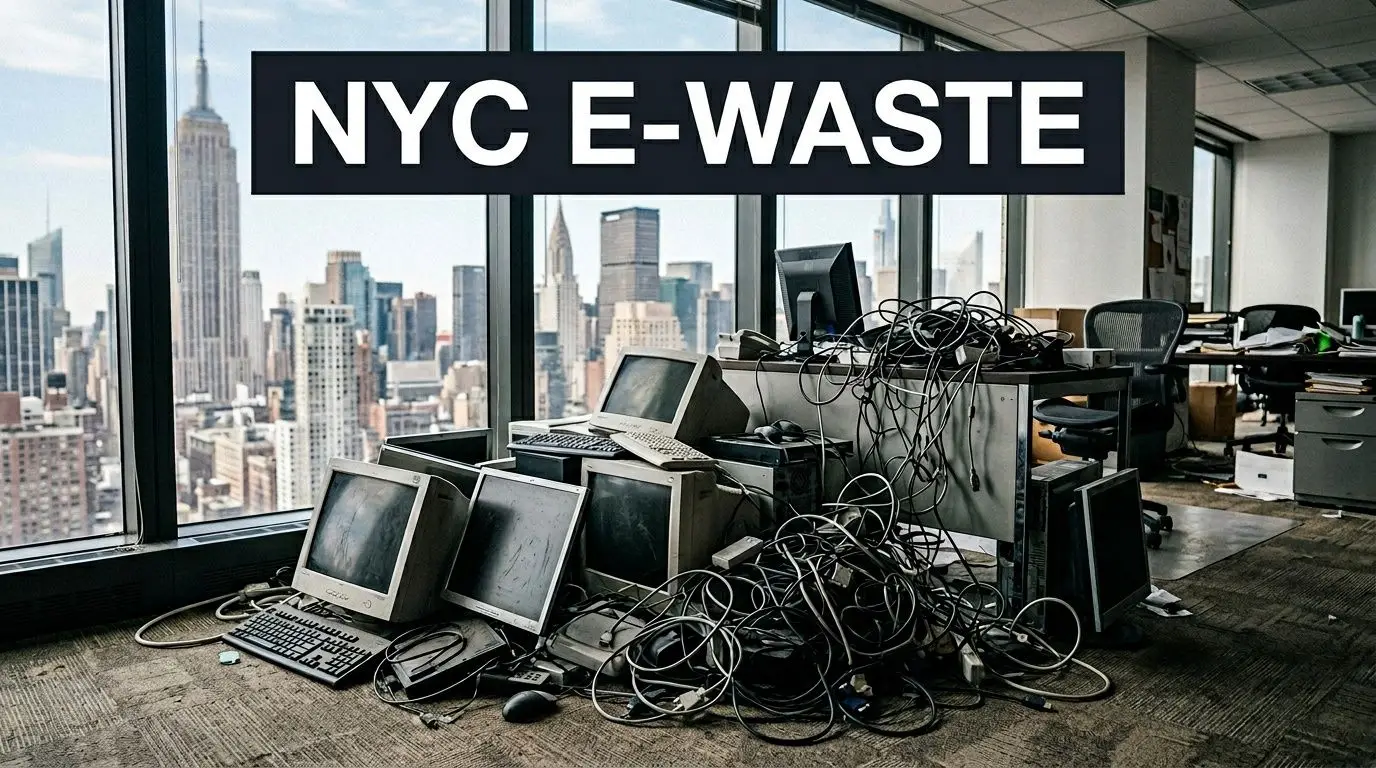
Your office lease is ending, the refresh project is overdue, and a storage room in Manhattan is packed with retired laptops, monitors, docks, phones, and a few mystery servers no one wants to claim. That’s a familiar ewaste nyc problem for IT managers and facilities teams. It looks like a cleanup job. It isn’t.
For a medium or large business in New York City, old electronics create three risks at once. You have disposal rules to follow, sensitive data sitting on devices, and building logistics that can turn a simple pickup into a failed move if the vendor isn’t prepared. The wrong choice shows up later, during an audit, after a landlord complaint, or when someone asks for destruction records you never received.
The E-Waste Challenge for New York City Businesses
NYC moves through technology fast. Offices replace endpoints, clinics retire workstations, financial firms cycle hardware, and shared workspaces accumulate abandoned gear. The result is volume, and volume changes everything.
New York City generates about 14 million tons of electronic waste annually, while the New York City Department of Sanitation collects only 25,000 tons each year, which shows the scale of the management gap in the city’s waste stream, according to this NYC e-waste overview.
That gap matters for commercial organizations because public collection visibility can create a false sense that disposal is simple. It isn’t simple once assets belong to a business, carry regulated information, or need documented disposition.
Why this hits businesses harder
A commercial tech refresh creates a chain of obligations:
- Asset control: Someone has to identify what’s leaving the site.
- Data handling: Drives, phones, and network equipment may still hold sensitive information.
- Transport security: Equipment has to move from office floor to truck without disappearing into an undocumented handoff.
- Final documentation: Procurement, legal, security, and facilities may all need records.
A janitorial approach fails because it treats electronics like bulky trash. Commercial ewaste nyc projects need an ITAD process.
Commercial e-waste isn’t just a sustainability issue. It’s an asset control issue with compliance consequences.
Many NYC teams also run into a guidance gap. Public instructions are easy to find. Enterprise instructions usually aren’t. That’s why organizations planning an office closure, relocation, or staged refresh often end up looking for a provider that can handle NYC e-waste pickups and business asset removal instead of relying on consumer-facing programs.
Understanding New York State E-Waste Regulations
The first question isn’t where to bring the equipment. It’s whether your organization is even eligible for free recycling under state rules.
New York’s Electronic Equipment Recycling and Reuse Act creates a manufacturer-responsibility framework, but it doesn’t treat every organization the same. Under New York regulations, for-profit businesses with fewer than 50 full-time employees and nonprofits with fewer than 75 can use free recycling options. Larger enterprises are excluded and must use commercial recycling arrangements, as outlined by the New York State Department of Environmental Conservation electronic waste rules.
What that means in practice
If your company is over the eligibility threshold, stop assuming a resident or small-business pathway applies to you. For larger organizations, compliant disposal means hiring a vendor that can manage the work as a documented commercial service.
That affects procurement, scope, and timing.
| Organization type | Typical path |
|---|---|
| Eligible small for-profit business | Manufacturer-funded or other qualifying free program |
| Eligible nonprofit | Qualifying free recycling option |
| Medium or large business | Contracted commercial recycler or ITAD provider |
| Regulated organization with sensitive data | Commercial ITAD process with destruction records |
The mandatory commercial checklist
For NYC businesses that don’t qualify for free programs, the disposal workflow should include:
Inventory the assets
Build a clear list before pickup. Include device type, location, and whether the item stores data.Classify data-bearing equipment
Separate laptops, desktops, servers, storage arrays, phones, copiers, and network gear from non-data peripherals.Define the destruction standard
Decide which assets can be sanitized and which require physical destruction based on your internal policy and legal obligations.Require documentation
Your vendor should provide asset lists, destruction records, and recycling certificates.Review environmental handling
Electronics often fall into broader waste and end-of-life compliance planning. Teams that manage this through a wider universal waste and EPA compliance framework usually avoid ad hoc disposal decisions.
Where companies get into trouble
The common mistake is treating the state’s e-waste law as permission to use any convenient program. The law creates access for some groups and responsibility for others. If you’re a larger business, your obligation is to arrange a compliant commercial process. That’s the part many NYC teams miss until a move, audit request, or security review forces the issue.
Why Municipal Programs Are Not for Your Enterprise
A lot of companies start with the same idea. Find a city drop-off, load a van, and get the old gear out of the office. That sounds efficient. For an enterprise, it usually creates more risk than it removes.
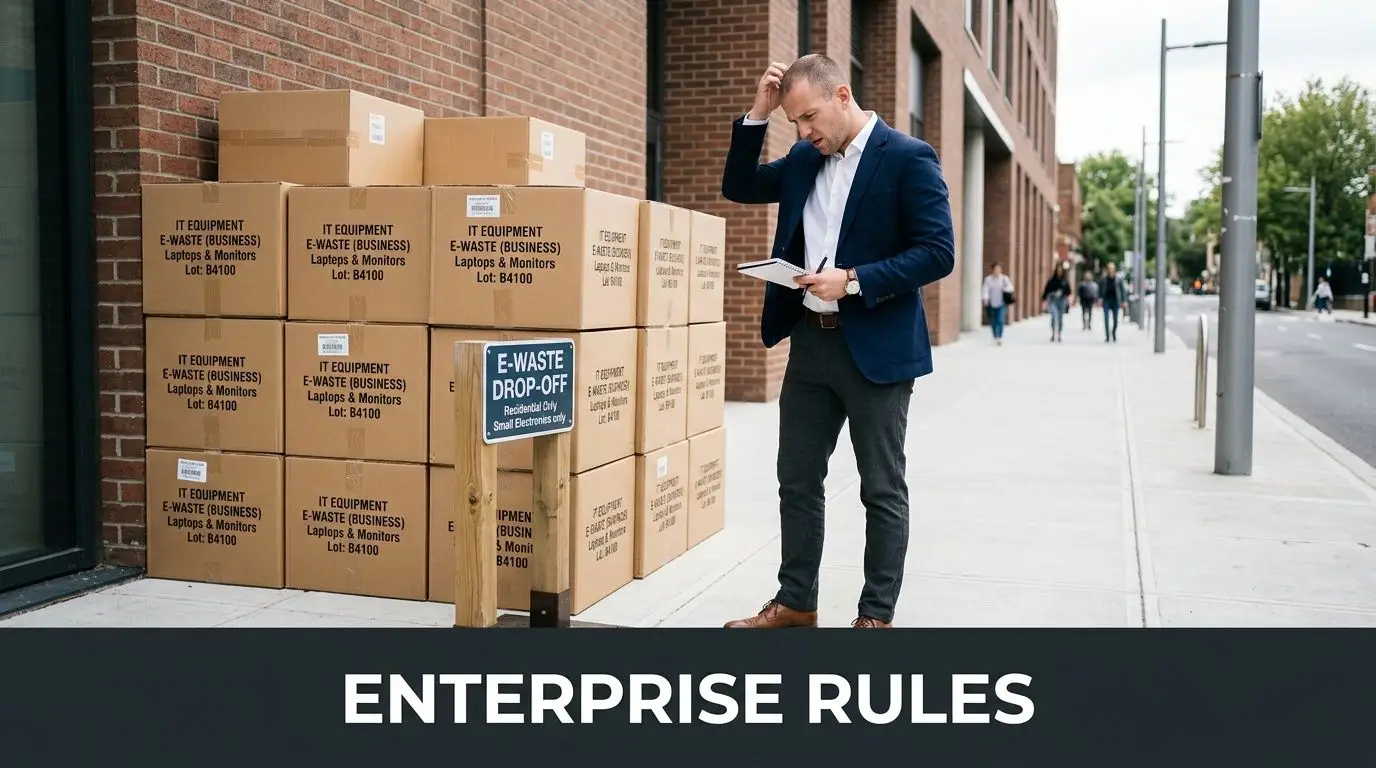
There’s a documented lack of detailed guidance for NYC businesses with more than 50 employees. Public resources focus on residents and small businesses, leaving larger organizations to work out secure and scalable disposal on their own, according to this review of New York e-waste rules for larger organizations.
The mismatch is operational, not just legal
Municipal programs are built for convenience. Enterprise disposal is built around control.
A public program usually won’t solve the issues that matter most to a corporate office:
- No reliable chain of custody: You need to know who handled the devices from pickup through processing.
- No project management for office clear-outs: Buildings often require coordination that public programs don’t provide.
- No volume planning: A few items are one thing. A floor decommission or branch closure is another.
- No integration with security policy: IT and compliance teams need consistent procedures, not one-off drop-offs.
NYC buildings make the gap wider
Commercial real estate adds friction fast. Freight elevators need reservations. Loading docks have rules. Building management may require certificates of insurance and narrow pickup windows. A public collection model doesn’t address any of that.
If your disposal plan depends on employees carrying company equipment to a public drop-off site, it isn’t an enterprise process.
There’s also a policy problem inside many organizations. Once a team uses an informal path one time, it becomes the unofficial standard. That’s how sensitive assets end up moving without inventory, approval, or audit records.
For companies that need business-grade options, it helps to compare consumer-facing channels with commercial services before anyone defaults to retail or public programs. Even a simple review of how store drop-off models differ from business recycling needs usually makes the limits obvious.
The Critical Role of Secure Data Destruction
Every ewaste nyc project should start with one question. Which of these devices can expose customer, employee, patient, financial, or internal business data if they leave the site intact?
That question decides the disposal method.
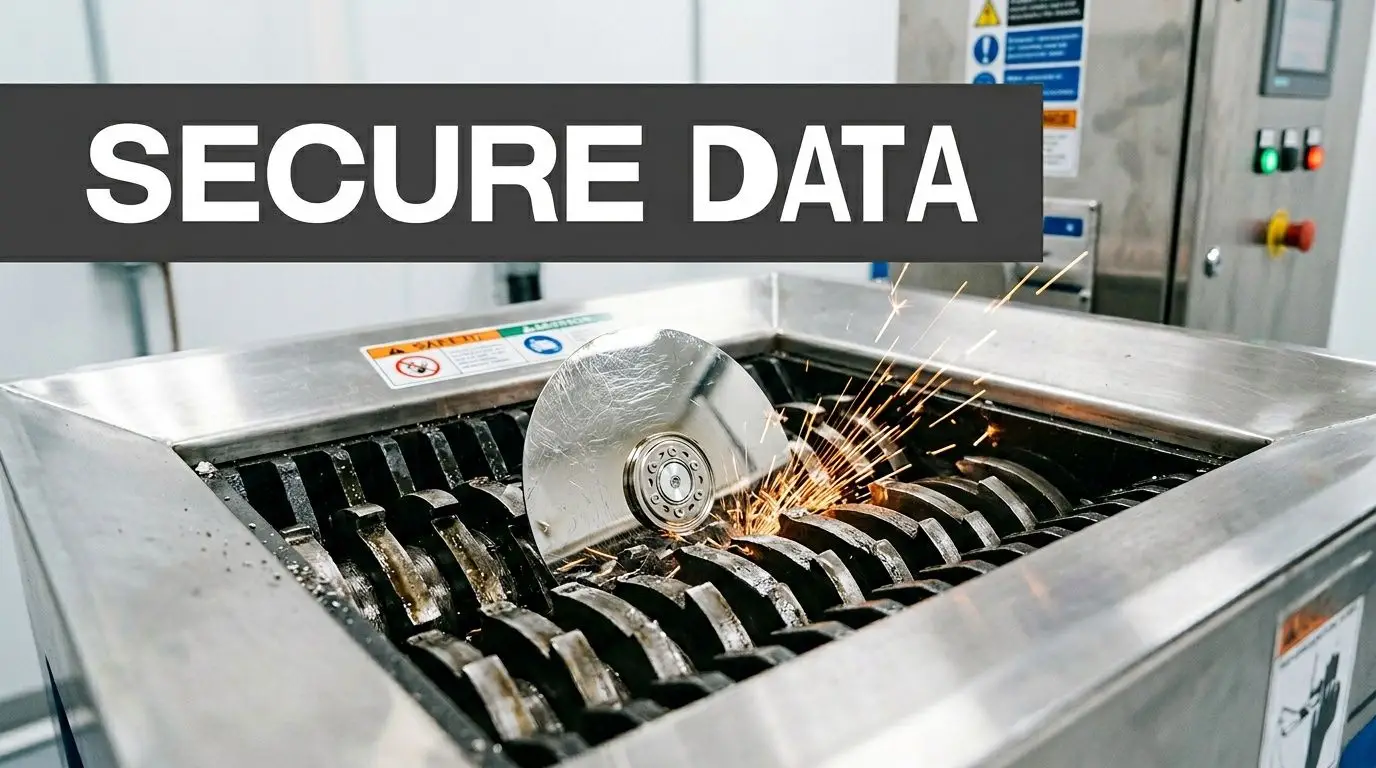
Free NYC drop-off sites may reference data security, but often don’t specify NAID certification or provide auditable Certificates of Destruction, which creates a liability gap for businesses with compliance obligations, as discussed in this article on NYC drop-off security limitations.
Wiping and shredding are not interchangeable
Businesses often use the phrase “destroy the data” loosely. Your policy should be more precise.
- Logical sanitization: Appropriate when policy allows reuse or resale and the method is documented.
- Physical destruction: Appropriate when the risk profile, device condition, or internal requirement demands irreversible destruction.
- Certificates and logs: Necessary if you need to prove what happened later.
For many organizations, the issue isn’t choosing one method forever. It’s choosing the right method by asset class.
Why the paperwork matters
A certificate is more than a courtesy document. It supports your audit trail. If legal, compliance, or an outside assessor asks what happened to a retired drive or laptop, you need more than “the recycler took it.”
A strong destruction record should support:
- Device identification
- Date of service
- Method used
- Chain of custody
- Final confirmation of destruction or recycling
Practical rule: If a vendor can’t explain its destruction workflow in plain language and document it after the job, don’t hand over data-bearing assets.
Organizations aligning internal controls with NIST SP 800-88 data sanitization practices usually make better disposition decisions because they separate convenience from defensibility. That’s what matters when laptops contain HR files, printers store scanned records, or retired servers still hold client data no one remembered to purge.
E-Waste Logistics for NYC Commercial Buildings
The hardest part of business e-waste disposal in New York usually isn’t the recycling. It’s getting equipment out of the building securely, on schedule, and without creating a mess for your operations team.
Enterprise-grade providers work at a different scale. Operations such as ERI’s can process over one billion pounds of electronics annually across their facilities, which shows the industrial capacity often required for commercial asset disposition and material recovery, according to ERI’s electronics recycling service information.
What a workable pickup plan looks like
A competent commercial process usually starts before the truck arrives.
First, someone confirms scope. That means location count, device types, whether there are loose drives, whether pallets or carts are needed, and whether any equipment is still installed.
Then the building constraints get handled:
- Freight elevator booking
- Loading dock access
- Pickup windows
- Certificates of insurance
- After-hours rules
- Contact points with property management
If those details are ignored, the crew may show up and sit. Or leave.
The handoff has to stay controlled
Once movement starts, the project should follow a visible chain:
| Stage | What should happen |
|---|---|
| Office staging | Equipment grouped by type and risk |
| Removal from suite | Managed by trained crew, not random staff trips |
| Dock transfer | Count and custody maintained |
| Transportation | Secure movement to processing location |
| Intake and reporting | Records matched to collected assets |
| Experienced providers distinguish themselves from haulers at this point. The work isn’t only lifting and loading. It’s controlling custody while minimizing disruption to your office, clinic, lab, or data room. |
What doesn’t work in NYC
Three approaches fail repeatedly:
Employee self-hauling
Staff members aren’t a disposal chain of custody.Unscheduled cleanout days
If facilities, IT, and building management aren’t aligned, the job stalls.Mixed-load pickups
Combining scrap, furniture, paper, and data-bearing electronics without a clear process creates confusion and bad records.
One practical option for organizations with multi-site operations is a vendor that can coordinate pickups beyond one city. Beyond Surplus, for example, offers nationwide business pickup, secure transportation, certificates of recycling, and documented data destruction for commercial electronics loads. For larger NYC companies, that kind of model can simplify regional refreshes and office closures.
How to Choose a Certified ITAD Partner
Most vendor selections go wrong in one of two ways. Procurement buys on price alone, or IT picks a recycler without checking whether logistics and reporting fit the building and the policy.
The better approach is a short due-diligence review built around evidence.
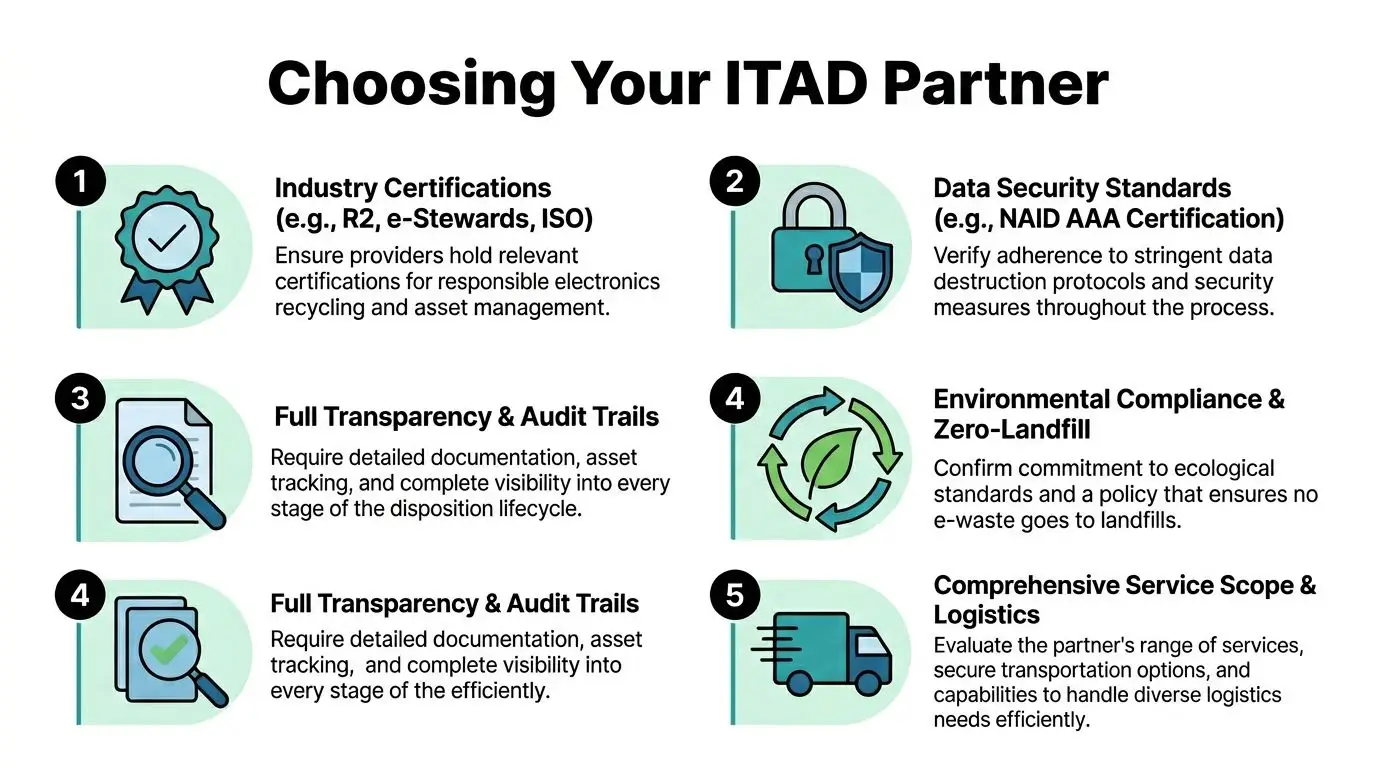
The five checks that matter
Certifications
Ask what third-party certifications the vendor holds for recycling operations and data destruction. Don’t accept vague claims of being secure or eco-friendly.Audit trail quality
You need to know whether they provide serialized reporting, destruction records, and recycling certificates in a format your team can retain.Downstream transparency
Ask where the material goes after pickup. A serious ITAD partner should be able to describe downstream handling, not just the first truck movement.Service scope
Some vendors can process material but can’t manage a commercial building pickup. Others can pick up but offer weak reporting. You need both.Project fit
A good vendor should ask about elevators, COI requirements, dock access, packaging, data-bearing assets, and timing. If they don’t ask, they probably don’t manage NYC projects often.
Questions worth asking on the first call
- What documentation will we receive after pickup?
- How do you handle loose drives and embedded storage?
- Can you support on-site or off-site destruction options?
- Who maintains custody from our office to final processing?
- How do you handle assets with potential resale or recovery value?
Choose the vendor that can explain the process cleanly, document it completely, and execute it without improvising in your lobby.
A written evaluation sheet helps. Teams that formalize the review usually avoid the usual weak points. Missing certificates, unclear custody, and building-day confusion. If you need a starting point, this ITAD vendor due diligence checklist is a useful framework for internal review.
Secure Your Compliance with Professional E-Waste Management
For medium and large organizations, ewaste nyc isn’t a consumer recycling issue. It’s a business process with legal, security, and operational consequences. If your company is above the state eligibility thresholds for free programs, the obligation shifts to you. That means controlled pickup, secure data destruction, and documentation that holds up when someone asks for proof.
The strongest programs share the same traits. They inventory assets before removal. They separate data-bearing devices from basic peripherals. They plan around building constraints. They require auditable records at the end.
That’s why IT asset disposal should sit with the same seriousness as records management, access control, and vendor risk review. Old hardware still carries business risk until custody is transferred and final disposition is documented.
If your team is preparing for an office move, technology refresh, storage room cleanout, clinic closure, or data center decommission, treat disposal as a managed project. Not an errand.
Contact Beyond Surplus for certified electronics recycling and secure IT asset disposal for NYC business locations, including documented pickup, data destruction, and compliance-focused reporting.