

A stroller rolls past a cyclist near Ponce City Market. A few feet away, someone is photographing a mural while runners thread through the crowd on their morning loop.
That everyday scene says a lot about the atlanta beltline. It isn’t just a trail. It’s one of Atlanta’s biggest experiments in turning old infrastructure into something useful, social, and durable.
Welcome to the Atlanta BeltLine
Where the energy comes from
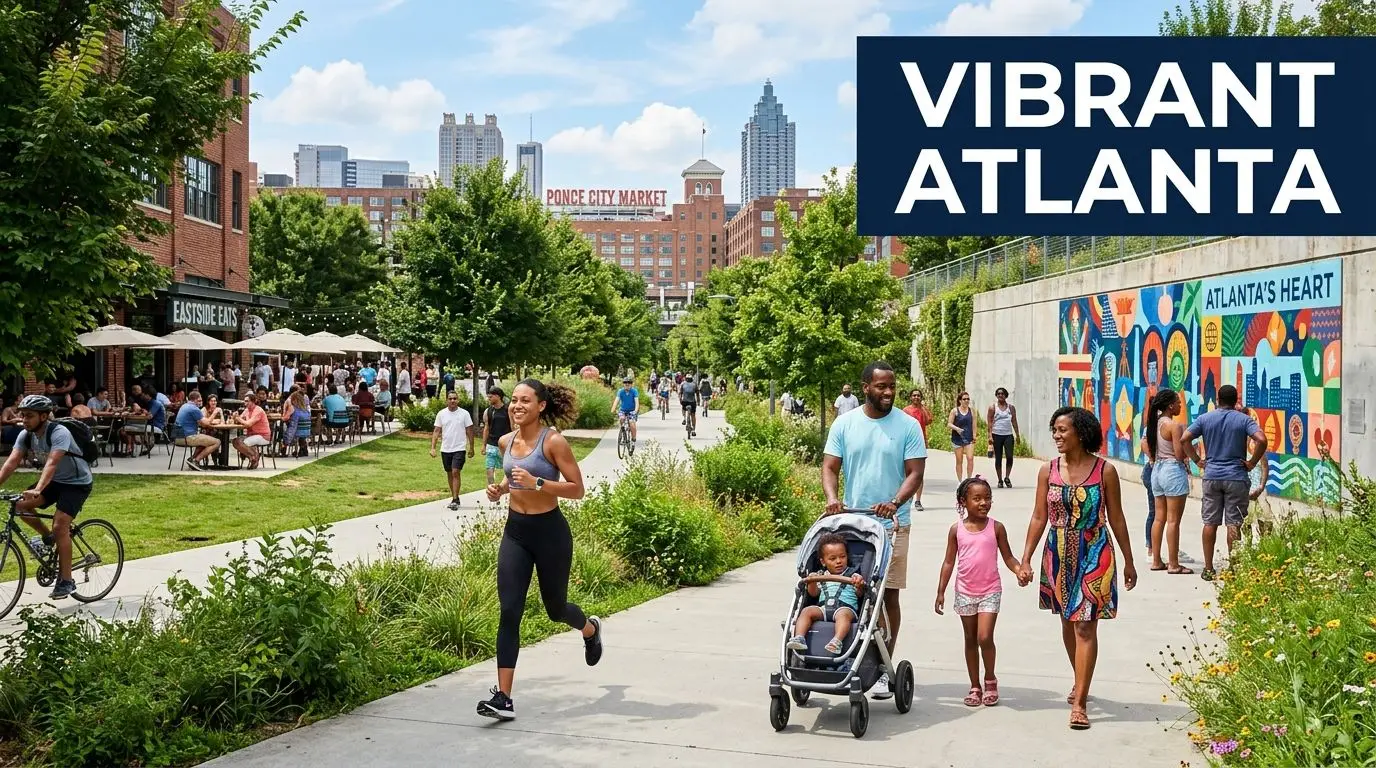
Early on a Saturday, the BeltLine can feel like Atlanta in fast-forward. Parents push strollers. Cyclists ring their bells. Friends drift from coffee to murals to patios without ever getting in a car. What makes that scene so interesting is not just the activity. It is the setting. All of it is happening in a former rail corridor that the city chose to reuse instead of abandon.
That idea of adaptive reuse sits at the center of the Atlanta BeltLine. The project turns old freight infrastructure into a connected public asset: trails for daily movement, parks for public life, and redevelopment that reshapes how nearby land is used. Atlanta BeltLine, Inc. describes it as a 22-mile network intended to connect 45 neighborhoods through trails, transit, parks, and community spaces on historic rail lines.
A lot of visitors first meet the BeltLine through one crowded stretch, usually near restaurants or breweries, and assume that is the whole story. It helps to break the project into three working parts:
- A mobility network for walking, biking, and future transit connections
- A park system that adds green space, shade, and room for public gathering
- A redevelopment framework that guides how former industrial edges can become active neighborhood fronts
That third piece matters more than people sometimes realize. The BeltLine is one of Atlanta’s clearest examples of how a city can recover value from an obsolete asset. In practical terms, it follows the same basic logic as responsible industrial reuse or Atlanta technology reuse services for retired business equipment. You start with something outdated, assess what still has value, remove what no longer serves the public, and rebuild around long-term use instead of short-term disposal.
Why locals care so much
Locals care because the BeltLine changed how parts of Atlanta connect. Blocks that once turned their backs to rail lines now face paths, plazas, public art, and small businesses. That shift is physical, but it is also social. The corridor gives neighborhoods a shared edge instead of a leftover one.
You can see the urban design lesson block by block. Old infrastructure does not have to stay old in function. With planning, funding, and public access, it can become the spine for a healthier city.
The BeltLine also carries a business lesson. Reuse is not only about preserving the past. It is about managing resources wisely, reducing waste, and building something more useful from what already exists. That is why the project resonates far beyond recreation. It shows how thoughtful renewal can strengthen communities while asking a hard, modern question: when a system has outlived its original purpose, do you discard it, or redesign it for the future?
From a Student's Thesis to a City's Heartbeat
A lot of Atlanta stories start with a freeway, a subdivision, or a tower crane. The BeltLine story starts with a student looking at an overlooked rail corridor and asking a better question. What if the scraps of old infrastructure circling the city were not dead space at all, but the frame for a different Atlanta?
How the idea started
In 1999, Georgia Tech graduate student Ryan Gravel proposed the BeltLine in his master’s thesis. His idea was ambitious from the start. He saw a loop of largely underused historic rail lines around the urban core and argued that Atlanta could stitch them back into public life through trails, parks, transit, and redevelopment.
That matters because people often remember the BeltLine as a popular place to walk or bike and assume the larger vision came later. It did not. The original concept treated the corridor like a city-scale retrofit. In the same way a company might reassess an aging facility instead of clearing it out, Gravel’s proposal asked Atlanta to examine what could be reused, what needed rebuilding, and how old assets could serve new needs.
The thesis became public policy over time, not overnight. Voters approved BeltLine funding through the Tax Allocation District in 2005, a major turning point documented by Atlanta BeltLine, Inc.'s history and timeline. Construction followed in phases, with years of design work, land assembly, engineering, and public debate shaping what residents now experience as a familiar part of city life.
Why the thesis mattered
Gravel changed the mental map of Atlanta.
Before the BeltLine, many Atlantans saw those rail corridors as leftovers. His thesis reframed them as connectors. That is a big urban design shift. A corridor once treated like the back side of neighborhoods could become shared frontage, public space, and transportation spine all at once.
The project also offered a lesson that reaches beyond city planning. Adaptive reuse is really a discipline of attention. You study what is already there, separate lasting value from obsolete parts, and build a second life that fits current needs. That same logic helps explain why business districts near the corridor, including places tied to startup growth such as Atlanta Tech Village and its surrounding innovation ecosystem, keep appearing in conversations about access, investment, and long-term infrastructure choices.
What turned vision into reality
A strong thesis can open a door. Institutions have to carry the project through it.
The BeltLine needed public agencies, nonprofit leadership, engineers, designers, neighborhood advocates, and private investment working over many years. It also had to endure two periods that slowed or killed many large projects, the Great Recession and the COVID-19 era. The reason it kept advancing is not mysterious. Long-horizon civic work survives when funding tools, land strategy, and public support are built to last.
Several features made that possible:
- Public funding created a path from concept to construction
- Phased buildout let residents see and use completed pieces while other segments remained in planning
- Coordination across housing, parks, mobility, and economic development kept the corridor from becoming a single-purpose amenity
- Ongoing debates about affordability and displacement kept equity tied to the project’s success, even when the results have remained contested
One practical detail helps first-time visitors understand the BeltLine’s staying power. It was never only a path. It was designed as a system. That is why conversations about it often jump from public art to housing to transit to access. The project works more like a full urban renewal framework than a stand-alone trail.
Even the everyday user experience reflects that broader vision. A runner choosing between pavement, gravelly edges, and busy mixed-use sections may start thinking about different types of running shoes for various terrains. City planners make a similar set of choices at a larger scale. Surface, speed, access, durability, and who the space is for all shape the final design.
The clearest sign of success is cultural. Atlantans no longer talk about the BeltLine as a speculative idea from a thesis paper. They talk about meeting friends there, commuting along it, debating its future, and judging nearby development by how well it connects to the corridor. That is when infrastructure becomes part of a city’s heartbeat.
A Segment by Segment Guide to the Trails
A good first BeltLine trip starts with one simple idea. Do not picture it as one uniform ribbon around the city. Read it the way you would read a historic building that has been renovated room by room. Each segment reveals a different stage of Atlanta’s larger experiment in adaptive reuse.
That is part of what makes the BeltLine so interesting for Beyond Surplus readers. An old rail corridor was not cleared away and forgotten. It was studied, repurposed, and put back to work. Businesses face a similar question when they retire equipment, close facilities, or sort through obsolete electronics. The smart move is rarely simple disposal. It is figuring out what still has value, what can be reused, and how infrastructure can serve a second life.
Atlanta BeltLine Trail Segments Overview
| Trail Segment | Status | General Feel | What Stands Out |
|---|---|---|---|
| Eastside Trail | Open and heavily used | Social, energetic, polished | Restaurants, public art, dense foot traffic, easy first impression |
| Westside Trail | Open | More spacious, reflective, neighborhood-centered | Industrial character, adaptive reuse story, stronger sense of corridor history |
| Northside Trail | Open and connected to nearby paths | Calmer, practical, fitness-friendly | Good for longer walks or rides, less tourist-driven atmosphere |
| Southside Trail | Open in parts with ongoing evolution nearby | Transitional, exploratory, future-facing | A clearer view of the BeltLine as a long-term buildout rather than a finished product |
| Connector and spur sections | Phased and still expanding | Variable by project | Best for repeat visitors curious about how the network is being stitched together |
Eastside Trail
The Eastside is the section many people meet first, and you can feel why within minutes. Cafes spill toward the path, murals compete for attention, and the traffic is mostly human. Walkers, runners, families, skaters, and people headed to dinner all share the same corridor.
For a first-time visitor, this stretch explains the BeltLine’s popularity fast. It feels active and visible. It also shows the upside and tension of successful urban renewal. Reused infrastructure attracts people, then investment follows, and then the city has to keep asking who benefits and who gets priced out.
If you want the social version of the BeltLine, start here. If you want speed or solitude, choose a different segment or arrive early.
Westside Trail
The Westside Trail gives you a better view of the project’s bones. The corridor feels wider in places, the surrounding neighborhoods shape the experience more directly, and the old transportation route is easier to read in the surroundings.
That matters. On the Westside, the BeltLine feels less like an entertainment district and more like a case study in urban systems reuse. You can see how obsolete infrastructure can become public infrastructure with a new job to do. For companies thinking about decommissioned offices, warehouse cleanouts, or responsible asset recovery, the lesson is familiar. Waste is often a design failure before it becomes a disposal problem.
If your route to Atlanta begins through Hartsfield-Jackson Atlanta International Airport and its surrounding transportation network, the Westside offers a useful contrast. One part of the city is built around constant throughput. The BeltLine shows what happens when Atlanta slows down and reuses a corridor for community life instead.
Northside and related connections
The Northside portions and nearby linked paths usually feel more functional than performative. People are out for exercise, neighborhood travel, or a quieter walk. The mood is steadier.
Repeat visitors often end up appreciating these stretches more than they expected. After the Eastside introduces the BeltLine as a destination, Northside sections show how it works as everyday city fabric. That distinction matters in urban design. A place becomes durable when residents use it on ordinary Tuesdays, not only on sunny weekends.
Southside and future links
The Southside teaches patience. Some visitors arrive expecting the same finish level everywhere and leave confused when one stretch feels polished while another feels interim or still in transition.
That unevenness is not a flaw in understanding. It is part of the BeltLine’s real story. Large reuse projects happen in phases, with funding, land assembly, engineering, and public debate all moving at different speeds. In that sense, the Southside is one of the most honest segments because it lets you see the project as a work in progress.
Atlanta BeltLine project pages and planning materials are the best place to check current buildout details and trail conditions before you go, especially for connectors and future-facing segments.
What to wear and how to choose your route
Surfaces change more than many newcomers expect. Some entries feel smooth and almost streetlike. Others feel mixed, with transitions that matter more if you are running several miles or trying a less familiar section.
That is why it helps to understand different types of running shoes for various terrains before a longer outing. The word “trail” can sound uniform. On the BeltLine, it is not.
A simple route guide works well:
- For a lively first visit: choose the Eastside Trail
- For urban design and reuse history: spend time on the Westside Trail
- For a quieter workout: try Northside-linked stretches
- For a look at the project still taking shape: explore Southside areas and connector sections carefully
The best segment depends on what you want to notice. Some people come for patios and people-watching. Others come to study how a city can reclaim an aging corridor and turn yesterday’s industrial footprint into tomorrow’s shared public asset.
How to Access and Navigate the BeltLine
Start with your purpose
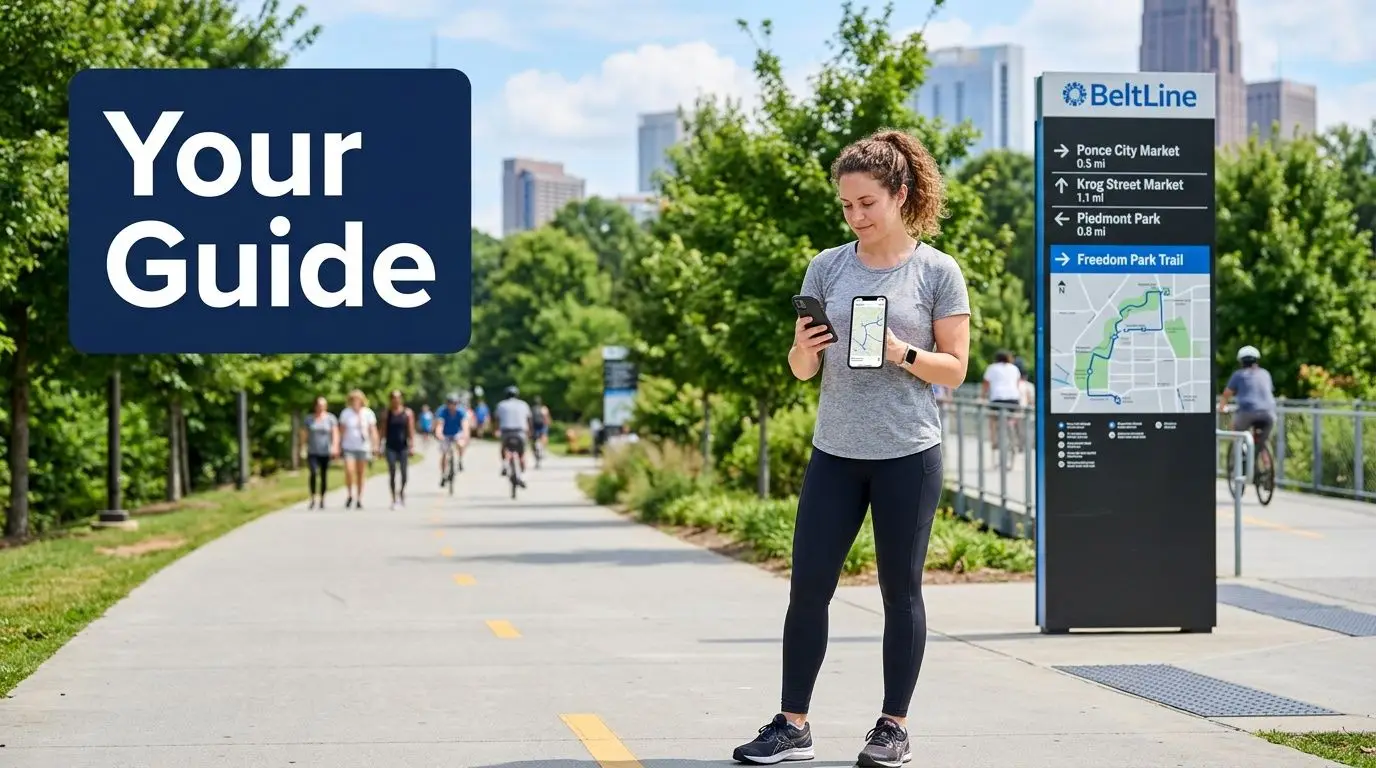
The easiest way to get around the atlanta beltline is to decide what kind of trip you want before you leave. Are you walking to dinner, logging workout miles, meeting friends, or scouting a neighborhood?
That one decision changes where you should enter.
For a social first visit, an Eastside access point near major destinations is a common choice. For a more relaxed outing, neighborhood entries on less crowded segments can feel much easier.
Getting there by car
Parking is often the part people overcomplicate. In practice, the best strategy is to park near the experience you want, not “near the BeltLine” in the abstract.
Try this approach:
- For restaurants and people-watching: Use parking tied to major commercial nodes near the Eastside
- For park access: Enter near larger public green spaces where wayfinding is simpler
- For lower-stress starts: Choose a less crowded segment and begin away from peak dining hours
Street parking can work, but it requires patience and awareness of local restrictions. If you’re new to the area, give yourself extra time rather than circling.
Using transit and ride connections
MARTA is a practical option if you don’t want to deal with parking. Depending on your destination, transit plus a short walk often feels easier than driving into one of the busiest sections.
That’s especially true for visitors already passing through major Atlanta gateways such as Hartsfield-Jackson Atlanta International Airport. If you’re visiting for work and adding a BeltLine stop to your schedule, a rail-plus-rideshare plan can be the least stressful choice.
If you’re meeting a group, pick a landmark business or market near your entry point. “Meet on the BeltLine” sounds simple until everyone lands at a different block.
Navigation tips that actually help
A few habits make the trail much easier to use:
- Pin your exit point on your phone before you start walking
- Look for cross streets rather than relying on trail memory alone
- Set a turnaround point if you’re exercising and don’t want the walk back to surprise you
- Check the time of day because the same segment can feel completely different in the morning and at dinner hour
The BeltLine is intuitive once you’re on it. The only hard part is choosing the right entry.
Top Activities and Attractions
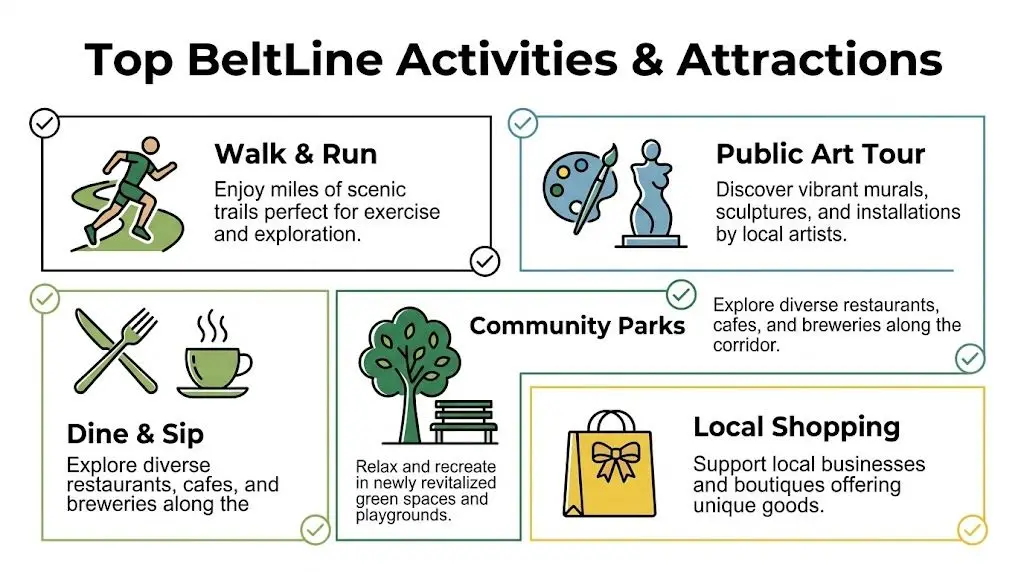
A good BeltLine outing often starts with a simple plan and turns into something bigger. You head out for a walk, pause at a mural, end up sharing tacos with friends, then realize you just spent three hours inside one of Atlanta’s best examples of adaptive reuse. That mix is the point. The BeltLine succeeds because it gives old infrastructure a new civic job.
Art and culture
Public art is one of the easiest ways to understand the BeltLine’s character. On a typical city sidewalk, you move from point A to point B. Here, the route itself asks you to look around. Murals, sculpture, and temporary installations break up the journey the way windows break up a long hallway. They make the corridor feel legible, human, and worth lingering in.
If you want the best version of that experience, slow down on purpose. The BeltLine rewards attention.
A few approaches work especially well:
- Mural walks give you a reason to cover ground slowly instead of rushing through a segment
- Photo outings work best where art, landscaping, and industrial remnants share the same view
- Repeat visits often reveal something new because installations and street-level details change over time
That last point matters for residents. The BeltLine is not a finished museum piece. It behaves more like a living studio layered onto a former rail corridor.
Food and drink
Food on the BeltLine is part of the design experience, not just a side benefit. Restaurants, patios, food halls, and coffee stops create small gathering nodes along the trail. Urban designers sometimes talk about “activation,” meaning giving people a reason to stay. A busy patio beside a trail does exactly that.
The easiest strategy is to choose one destination and let the walk shape the rest of the outing. Start with coffee, plan dinner as a midpoint, or use a market stop as your anchor. That keeps the day flexible, which fits the BeltLine better than a rigid schedule.
If you are visiting Atlanta around a game or adding the BeltLine to a sports-focused weekend, nearby city attractions such as the Atlanta Braves also show how much local identity now connects to movement, gathering, and shared public space.
Fitness and recreation
The BeltLine works because different activities can coexist. Walkers, runners, cyclists, skaters, and families with strollers all use the same corridor for different reasons. In planning terms, that is efficient use of space. In everyday terms, it means one trail can serve as gym, commute link, social route, and weekend reset.
You can feel that flexibility at almost any hour.
Some people use the trail for short exercise breaks between meetings. Others build longer bike rides that connect multiple neighborhoods. Businesses thinking about employee wellness or better first mile last mile transportation can learn something here too. A corridor becomes more valuable when it supports many small trips well, instead of forcing every movement to depend on a car.
That same principle shows up in responsible business operations. Reusing a rail corridor for daily public life is a city-scale version of a practical habit companies face all the time. Find new value in existing assets before sending them to waste streams.
Community events and rituals
The BeltLine’s biggest events show how infrastructure can become tradition. The Atlanta BeltLine Lantern Parade, described by organizers as one of the city’s signature annual gatherings, brings thousands of people together in a shared nighttime procession, according to the official Atlanta BeltLine Lantern Parade event page.
That kind of event changes how people relate to a place. A trail stops feeling like a project on a map and starts feeling like a civic room.
Smaller rituals matter too. Weekend vendor pop-ups, meetup walks, family bike rides, and casual people-watching all add texture to the experience. For longtime Atlantans, that may be quite a surprise. A corridor built for freight now carries culture, recreation, commerce, and everyday connection. It is a strong local lesson in sustainable renewal. Cities and businesses both face the same question: what can be repaired, reused, and given a second life instead of thrown away?
A Model for Sustainable Urban Renewal
Adaptive reuse in plain language
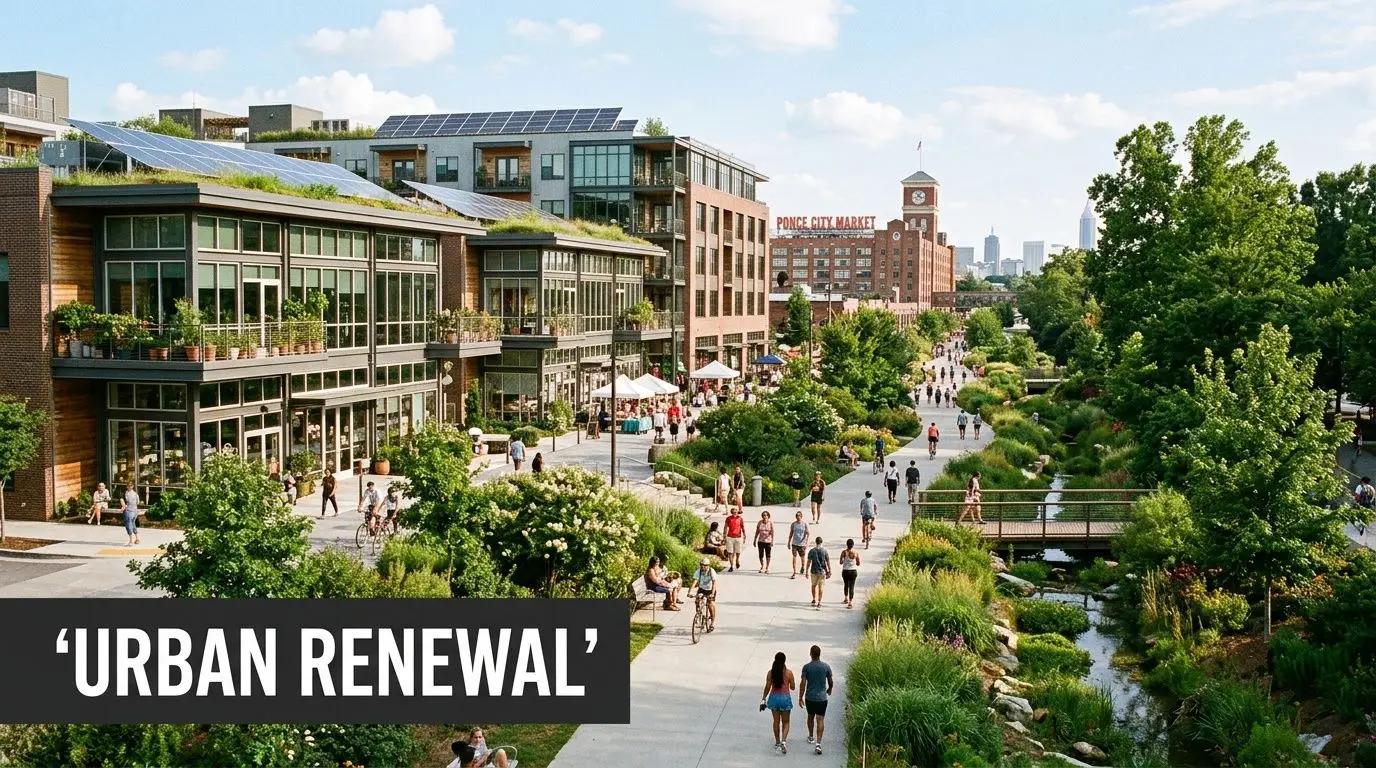
The BeltLine is one of Atlanta’s clearest examples of adaptive reuse. That phrase can sound academic, but the meaning is practical. You take an obsolete asset and give it a new function instead of abandoning it.
In this case, that meant converting a historic rail corridor into trails, parks, future transit, and development space. The corridor also required substantial remediation and phased work. One federally funded project segment described by Perkins&Will involves over $42M in capital investment and an expected construction duration of 42 months, showing how complex this kind of transformation can be in real urban conditions, according to their project page.
Where technology enters the picture
The BeltLine isn’t only concrete, landscaping, and mobility planning. It also includes smart-city elements. Atlanta BeltLine’s Digital Inclusion and Smart Cities Initiative deploys technology such as free public Wi-Fi and smart trash cans, as noted in this BeltLine announcement.
That creates an overlooked sustainability question. If a corridor adds connected devices, public tech infrastructure, and new business growth, what happens when those devices reach end of life?
There’s a gap here. The public discussion celebrates greener infrastructure, but it offers little guidance on handling the resulting e-waste from smart deployments or from the business upgrades that often follow redevelopment.
Worth remembering: A city doesn’t become sustainable just by installing new technology. It also needs a plan for retiring that technology responsibly.
Why this matters to businesses
The BeltLine holds particular relevance for facility managers, IT teams, and operations leaders. Urban renewal often triggers office moves, buildouts, consolidations, and equipment refresh cycles.
That’s true for organizations near major redevelopment corridors. It’s also true for institutions trying to align growth with responsible resource management.
The BeltLine’s role in improving urban connectivity also fits into the broader idea of first mile last mile transportation. Good city systems don’t stop at the main route. They depend on all the smaller operational links that make access work.
The same logic applies to sustainability. Reuse, decommissioning, and end-of-life planning are part of the system, not an afterthought. That’s one reason local conversations around social impact recycling in Georgia resonate with the BeltLine story. Responsible renewal only counts when the back-end handling is responsible too.
Frequently Asked Questions About the BeltLine
Is the BeltLine safe at night
It depends on the segment, the time, and how busy the area is. Popular stretches with active businesses usually feel more comfortable than quieter sections.
Use the same judgment you’d use in any city setting. Travel with awareness, stay in active areas, and know your entry and exit points before you go.
Can you bring a dog
Yes, many people do. The practical issue isn’t permission so much as courtesy.
Keep dogs controlled, be mindful in crowded stretches, and remember that some sections can get tight when runners, strollers, bikes, and pets all mix together.
Is the BeltLine finished
No. That’s one of the biggest points of confusion.
People often experience one polished segment and assume the entire loop feels the same. It doesn’t. The BeltLine is a long-running city project delivered in phases, with some areas feeling complete and others still clearly in development.
Has the BeltLine helped Atlanta
Yes, but the answer isn’t simple. It has improved access, public space, and neighborhood connectivity, and it has helped drive redevelopment. It has also intensified debate about affordability and displacement.
Those two realities exist at the same time.
What about gentrification and displacement
This is the hardest question, and it deserves a direct answer. The BeltLine has brought investment and attention to areas that had long been overlooked. That can improve parks, mobility, and business activity. It can also increase pressure on longtime residents.
The project’s affordable housing work is part of the response, but concern hasn’t disappeared. On the Westside, for example, groups including “Westside for Economic Justice” have opposed a proposed 900-bed homeless shelter, arguing that social services are being concentrated unevenly in communities already facing displacement pressure, according to Urbanize Atlanta’s coverage.
The BeltLine is easiest to love when you’re walking it. It’s harder, and more important, to ask who gets to stay nearby as it improves.
That tension is part of the BeltLine story. Ignoring it doesn’t make the project stronger. Facing it does.
If your organization in Atlanta needs secure, compliant help with retired IT equipment, decommissioned hardware, or surplus electronics, contact Beyond Surplus for certified electronics recycling and secure IT asset disposal.


