
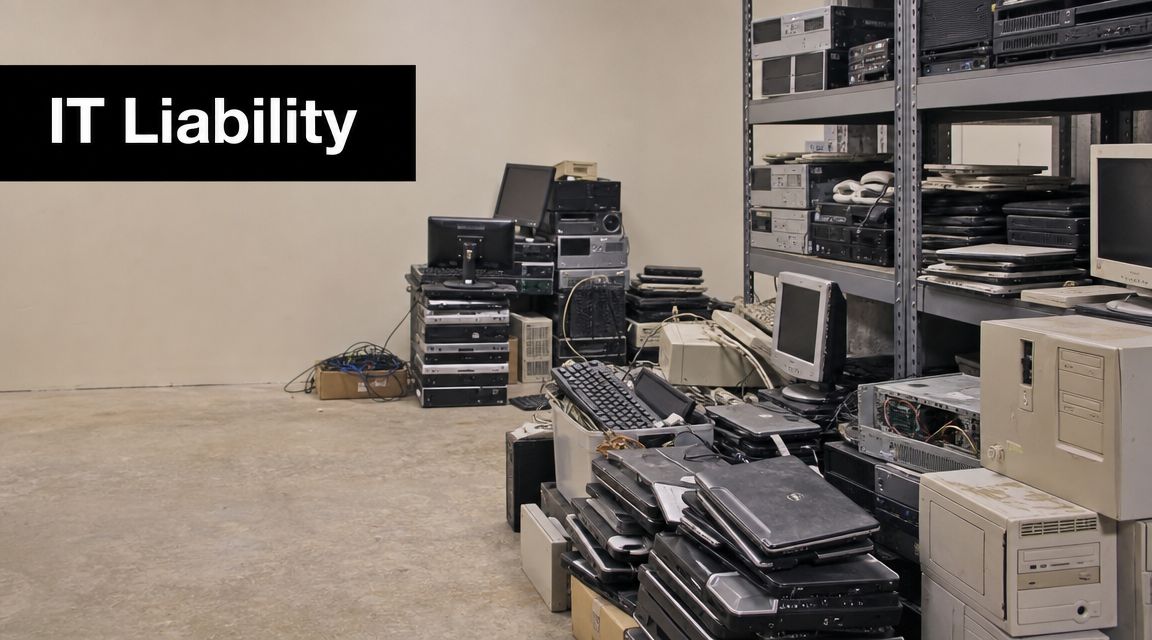
If you're the IT manager staring at a locked room full of retired laptops, old switches, and a few servers nobody wants to touch, you're not dealing with clutter. You're dealing with stored risk. In Peachtree City, that usually means a mix of aging endpoints, failed drives, and forgotten mobile devices that still carry business data, user credentials, or regulated records.
Most mistakes happen because companies treat end-of-life hardware like scrap removal. It isn't. Secure IT disposal is a control process. The job goes beyond getting equipment off-site. The job is to retire every data-bearing asset in a way you can prove later.
Your Guide to Secure IT Disposal in Peachtree City
A proper ITAD program starts when you stop calling this “recycling” and start calling it asset disposition. Industry guidance describes IT asset disposition as a full process that combines secure data destruction, serialized asset tracking, compliance documentation, and value recovery through resale or refurbishment, which is why it applies to servers, storage arrays, laptops, desktops, and networking gear rather than simple scrap handling, as outlined in this ITAD versus recycling overview.
That distinction matters in Peachtree City because many organizations have a mixed retirement stream. One pickup may include office PCs, failed SSDs, network appliances, and data center equipment from a refresh. Each one needs a documented path.
For local organizations looking at Peachtree City computer and electronics recycling services, the smart move is to define the outcome before the truck arrives.
What secure disposal actually includes
A business-grade process should answer four questions:
- What is the asset and where did it come from?
- What data risk exists on that device or component?
- What happened to it at each handoff?
- What record proves final disposition?
Practical rule: If you can't map a serial number to a final outcome, the job isn't finished.
What works and what fails
What works is a controlled workflow with inventory, triage, sanitization, transport controls, and final reporting.
What fails is the common shortcut. A facilities cleanout. A pallet with no serial list. A verbal promise that drives were shredded. Those approaches create a paper gap, and that's usually where compliance trouble starts.
Assess Your Assets and Compliance Obligations
Before you call any vendor, build your own internal map. If you don't know what you have, you can't choose the right sanitization method, pickup scope, or reporting requirement.
In Peachtree City's commercial market, provider descriptions already reflect what buyers expect: pickup and logistics, asset tracking from pickup through final disposition, NIST 800-88 aligned wiping or hard drive shredding, and certificates or final disposition reports. That local pattern shows modern ITAD is built around auditability as much as recycling, as described in Peachtree City secure disposal service expectations.
Build the inventory the right way
Start with a working list, not a perfect one. Pull from your CMDB, endpoint manager, procurement records, and storage room walk-throughs.
Track assets by:
- Device type such as laptop, desktop, server, firewall, phone, or tape
- Data role such as user endpoint, backup media, shared infrastructure, or test gear
- Condition including working, failed, incomplete, or physically damaged
- Disposition path such as redeploy, resale review, recycle, or destroy
Don't stop at whole devices. Many compliance failures come from overlooked components like loose drives, replacement SSDs, and removable media sitting in drawers.
Match assets to obligations
You don't need to write a legal memo. You do need a practical risk view.
Ask:
- Does this asset hold customer, patient, employee, or financial data?
- Is the device encrypted, and can that be verified?
- Does your policy require destruction, or allow sanitization and remarketing?
- What records would an auditor expect you to keep?
Healthcare, finance, government, and any company handling sensitive customer information usually need tighter evidence, not just faster pickup.
The vendor should fit your policy. Your policy shouldn't get rewritten to fit a generic truck route.
If you need a baseline for evaluating providers, review what to know about R2 certified ITAD providers in Georgia. It helps frame the questions that separate disciplined operators from generic recyclers.
Choosing the Right Data Destruction Method
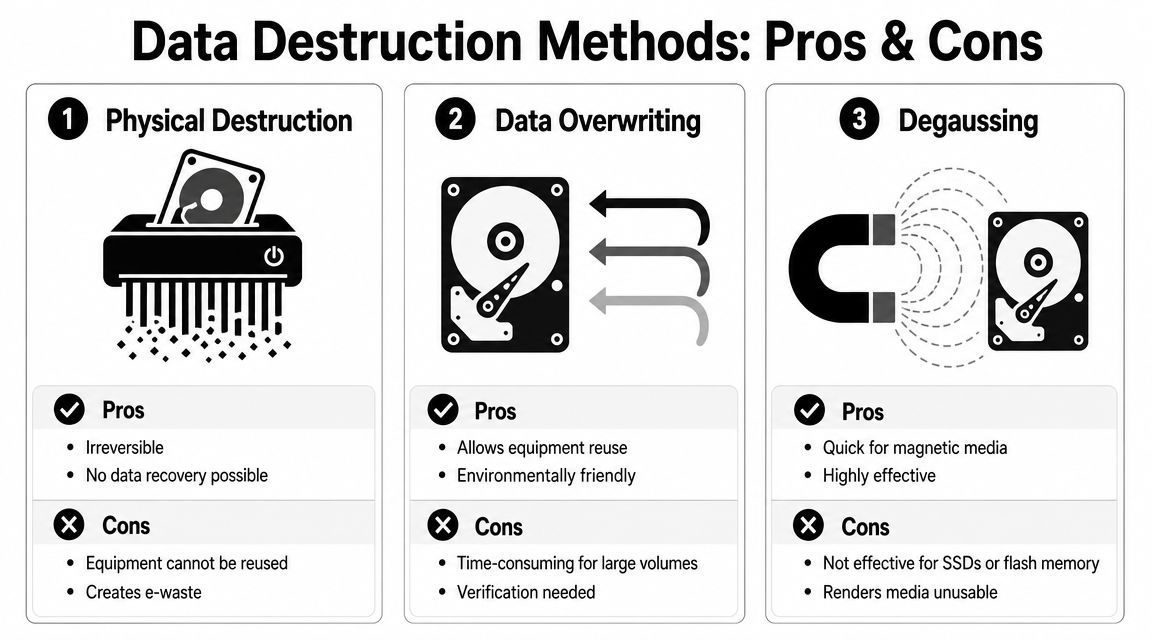
The wrong question is “Do you wipe or shred?” The right question is “What method fits this media type, this risk level, and this downstream disposition?”
That's where many disposal plans break. A mixed-device environment doesn't behave like a pallet of old hard drives. Neutral industry guidance emphasizes that secure disposition now requires choosing the right method for each media type because NIST 800-88 treats sanitization differently across devices, and overwrite, purge, and physical destruction are not interchangeable, as explained in this overview of mixed-device ITAD data destruction.
Compare the main options
| Method | Best fit | Main trade-off |
|---|---|---|
| Overwrite or software sanitization | Reusable devices that support verified erasure | Preserves reuse value, but requires reliable verification |
| Physical destruction | Failed media, highly sensitive assets, or devices not suitable for reuse | Strong finality, but eliminates resale or redeployment |
| Degaussing | Certain magnetic media | Not suitable across all device types |
A seasoned ITAD team won't force one answer across every asset class.
Mixed media changes the decision
For example, an older server with magnetic drives may fit one path. A failed laptop SSD may need another. Phones, backup tapes, and removable flash media each bring different technical and documentation issues.
Use this decision lens:
- If reuse matters, choose a sanitization path with verified reporting.
- If the media is damaged or unsupported, physical destruction is usually cleaner and easier to defend.
- If staff can't identify the media confidently, pause and classify before processing.
A lot of IT managers still need a practical reference for how to erase a hard drive, but don't let the question stop there. Hard drives are only part of the estate now.
A defensible process doesn't rely on one favorite method. It matches the method to the media and leaves evidence behind.
Managing Logistics and Chain of Custody
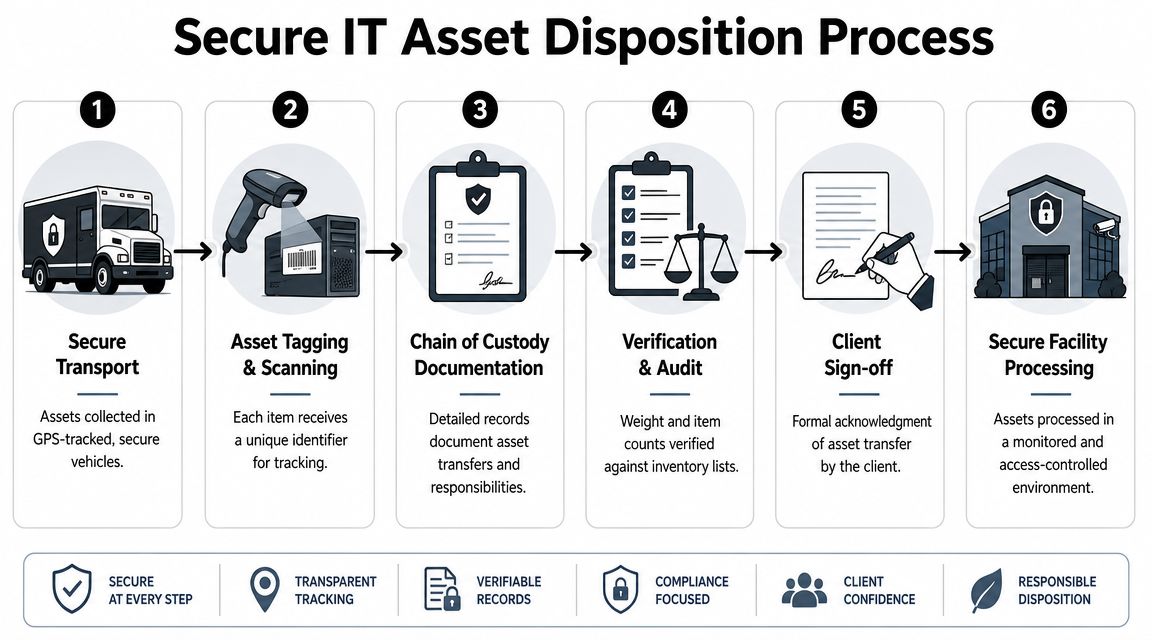
The highest-risk moment is often not destruction. It's transfer. The minute assets leave a rack, office, closet, or branch location, your exposure shifts to logistics.
A rigorous ITAD workflow follows a strict sequence: inventory and classification, policy-based triage, NIST 800-88 aligned sanitization or physical destruction, secure transport with chain-of-custody controls, and final documentation such as a Certificate of Destruction. That end-to-end structure is the standard way to reduce loss, theft, and compliance gaps in regulated environments, according to this ITAD workflow guidance.
What chain of custody should look like
At minimum, you want a record of who released the assets, what was transferred, when custody changed, and how those items were tracked through processing.
A solid chain-of-custody program includes:
- Release records signed at pickup
- Serialized tracking tied to each asset or media item
- Transport controls that prevent mix-ups and undocumented handling
- Receiving verification at the processing facility
- Exception handling for missing tags, damaged devices, or count mismatches
Questions to ask before pickup day
Don't ask whether a provider has chain of custody. Ask how it works.
Use plain questions:
- How are assets packaged and scanned at pickup?
- What happens if a serial tag is missing?
- Can on-site destruction be combined with off-site processing?
- What report do you issue when a device is recycled instead of remarked?
For higher-security jobs, some organizations use on-site data destruction in Georgia for selected media while sending non-data-bearing hardware or sanitized equipment through facility processing. That hybrid model often makes sense when legal, operational, and value-recovery needs aren't identical across the load.
Balancing Value Recovery and Environmental Responsibility
Value recovery decisions should follow evidence, not optimism. In Peachtree City, the hard part is not deciding whether an old laptop might sell. The hard part is proving why one device was sanitized and resold, another was harvested for parts, and another was destroyed because the media risk or condition did not support reuse.
A good ITAD program separates assets into lanes early and documents the reason for each outcome. That matters for audit defense just as much as it matters for revenue. If an SSD in a damaged laptop cannot be sanitized to your standard, the resale value of the chassis should not drive the decision. If a batch of corporate phones has activation locks, cracked screens, or missing identifiers, processing time can erase any recovery upside.
Industry reporting on refurbishment trends points to continued demand for reusable business hardware, as discussed in this analysis of ITAD and refurbishment trends. That creates opportunity, but only for assets that can move through a documented process without weakening your data destruction record.
When resale makes sense
Resale works when the device still has market demand, the media can be handled with a defensible method, and the final record shows exactly what happened to that asset.
Common examples include:
- Business laptops that are still serviceable and can be sanitized successfully
- Desktops and workstations with complete components and clear serial identification
- Servers and networking gear with secondary-market demand and practical testing value
- Parts harvest candidates where memory, CPUs, power supplies, or other components retain value
The trade-off is time and process overhead. Testing, grading, data sanitization, parts handling, and exception review all cost money. If the audit trail is weak, recovered dollars can be outweighed by compliance exposure.
When destruction or recycling is the better call
Some assets should leave the value-recovery lane quickly. Damaged drives, unsupported encrypted devices, failed SSDs, swollen batteries in phones, and incomplete systems often create more handling risk than resale value.
This is especially true for mixed loads. A pallet may include reusable monitors, obsolete desktops, locked mobile devices, and failed storage media. Treating all of it as resale inventory usually creates processing delays and reporting gaps. Treating all of it as scrap leaves money on the table.
Controlled triage is what works.
One factual example in the market is Beyond Surplus, which provides ITAD, pickup, serial-level reporting, data destruction, and buyback services. That service mix is useful when a business needs both asset recovery and records that support a later certificate of destruction process for retired IT assets.
Environmental responsibility has the same documentation problem. Saying equipment was recycled is not enough. You want downstream handling that shows whether equipment was reused, dismantled for parts, or sent through compliant recycling channels. For an IT manager, the best outcome is not maximum resale at any cost. It is a disposition record that protects data, supports compliance review, captures reasonable value, and shows that non-reusable equipment did not drift into informal scrap streams.
Final Verification and Your Certificate of Destruction
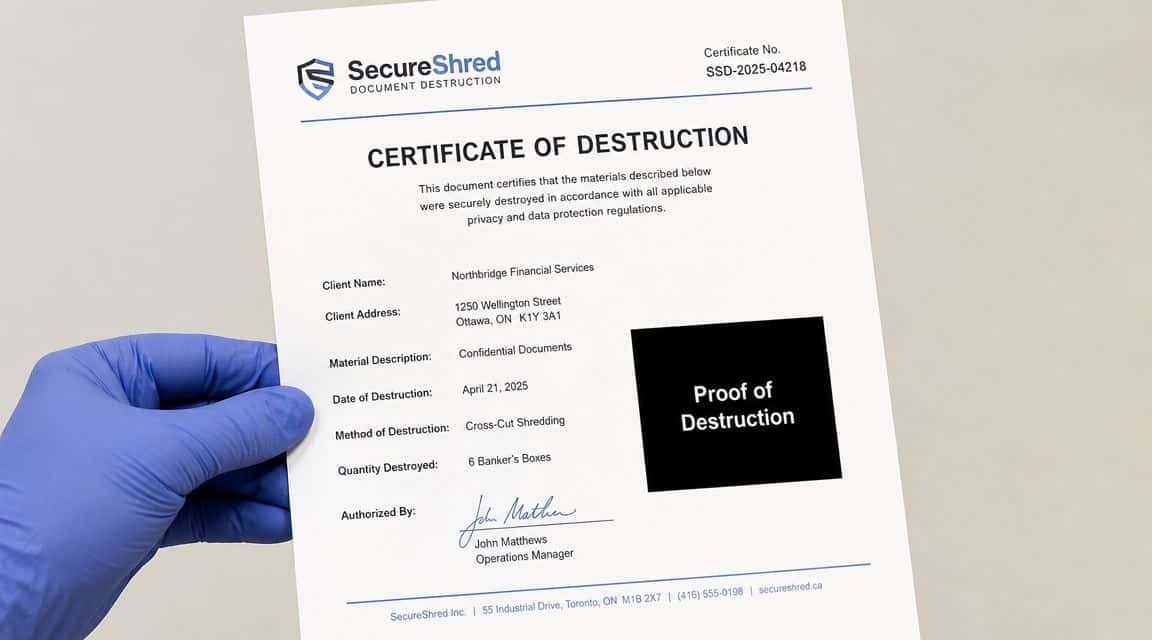
The truck leaving your site is not the finish line. The finish line is documentation that closes the loop on every tracked asset.
Many companies realize too late that they bought removal, not proof. Industry guidance puts the focus on verification coverage, not a single wipe metric. Serialized tracking and audit-ready reporting for every asset matter because a missing chain-of-custody record or incomplete certificate set can undermine compliance even if media destruction happened correctly, as explained in this discussion of ITAD verification coverage.
What the final package should prove
Your records should let you answer a specific question years later: what happened to this exact asset?
Look for documentation that ties together:
- Serialized inventory from intake through final outcome
- Method used for sanitization or destruction
- Final disposition such as remarketed, recycled, or destroyed
- Certificate set that supports audit and liability transfer
If those records live only in email threads or partial spreadsheets, your process is weaker than it looks.
Why the certificate matters most
The certificate is the legal and operational closeout. It converts a process into evidence. Without it, you're relying on memory, vendor assurances, and fragmented logs.
Review what a certificate of destruction should include and compare it against your current process. If your provider can't produce complete, serialized, audit-ready records for mixed devices, you still have exposure.
The most important deliverable in Peachtree City ITAD solutions for secure IT disposal isn't pickup. It's proof.
If your team needs a defensible process for retiring laptops, servers, storage, phones, and other data-bearing equipment, contact Beyond Surplus for certified electronics recycling and secure IT asset disposal.