

Old laptops in a locked closet don't look like a major risk until someone asks for an asset list, a certificate of destruction, or proof that no drive left the building with data still on it. That's the point where “we'll deal with it later” turns into a compliance project, a security problem, and a budget question at the same time.
For Georgia organizations, IT equipment recycling works best when it's treated as IT asset disposition, not office cleanout. A proper program has to decide what gets wiped and resold, what gets shredded, what gets recycled, and how every device is documented from pickup through final disposition. That's the difference between clearing space and reducing risk.
Why Your Georgia Business Needs a Formal IT Recycling Plan
Most IT managers inherit some version of the same backlog. Retired laptops from a refresh cycle. Old monitors from a department move. Network gear nobody wants to touch because no one is sure whether it still holds configs, logs, or credentials. Without a formal plan, those assets sit too long, move informally, and create blind spots.
The volume problem is real. The United States generates 3.4 million tons of e-waste each year, and less than 20% of mobile devices are recycled, according to the University of Georgia CAES Field Report. The same report says recycling 1 million cell phones saves enough energy to power over 185 million households for one year.
What a formal plan fixes
A written IT recycling process does four things immediately:
- Defines ownership: Someone approves retirement, someone inventories assets, someone signs release to the vendor.
- Separates security from haul-away: Data destruction becomes a tracked control, not an assumption.
- Protects value: Reusable assets can be wiped and remarketed instead of scrapped by default.
- Creates evidence: Certificates, inventory logs, and disposition records support audits and internal reviews.
Practical rule: If a device has storage, treat it as a data risk until sanitization or destruction is documented.
A lot of programs fail because they start at the loading dock. They should start earlier, when equipment is first tagged for retirement. Once devices are mixed on pallets without asset-level decisions, you usually lose value recovery options and make documentation harder.
What doesn't work
Informal cleanouts cause the same avoidable problems over and over:
- Bulk assumptions: “These are probably empty” is not a control.
- Mixed handling: Working laptops get shredded with failed drives, or dead assets get stored indefinitely because no one wants to classify them.
- Weak records: A pickup receipt is not the same as a serialized disposition trail.
A formal program gives you a repeatable answer to a simple question. For each asset, are you trying to destroy risk, recover value, or both?
Understanding Georgia's E-Waste and Data Disposal Rules
Georgia businesses need to treat electronics recycling as a compliance matter, not just a sustainability initiative. Georgia's rules are shaped by the Georgia Computer Equipment Disposal and Recycling Act, which effectively bans core computer equipment from landfills, including desktops, laptops, monitors, and printers, according to this Georgia electronics recycling guide. The same source notes that only 17.4% of e-waste is formally collected and recycled globally.
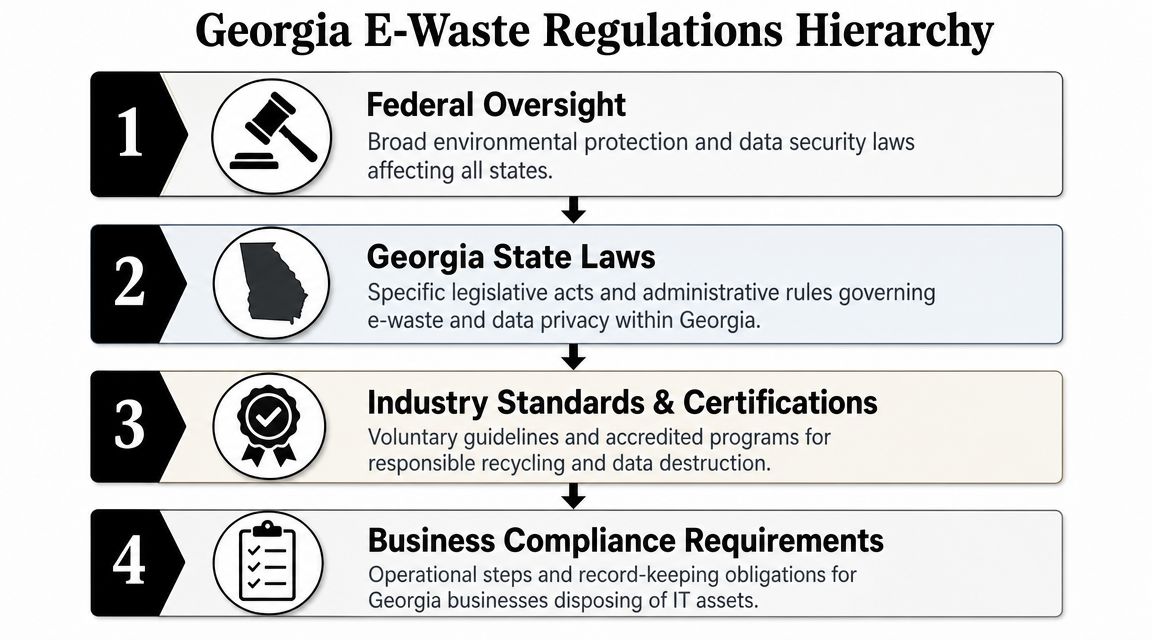
What that means in practice
The legal takeaway is straightforward. Covered equipment can't be treated like ordinary trash, and data-bearing devices can't leave your control without a defensible handling process.
That means your disposal workflow should include:
- Pre-removal review for asset type and data risk.
- Serialized inventory before pickup.
- Sanitization or destruction decision based on media type and sensitivity.
- Documented downstream disposition through a qualified recycler.
For organizations that want a local operational model, compliant IT disposal in Georgia typically centers on those controls rather than on simple collection.
Where companies get exposed
The common mistake is assuming compliance starts when the truck arrives. It starts when your team decides an asset is leaving service.
A recycler can process material correctly and you can still have a problem if your internal inventory, release approvals, and chain of custody are weak.
Another issue is over-focusing on environmental handling while under-managing data exposure. A monitor and a laptop shouldn't move through the same risk lens. Neither should a failed SSD and a clean, working notebook that still has remarketing value.
A practical compliance standard
If you want a defensible baseline, require all retired devices to move through a written intake and release process. For each unit, identify whether it is:
- Non-data equipment headed to recycling
- Reusable equipment that can be sanitized and remarketed
- High-risk media that must be physically destroyed
That structure reduces ambiguity. It also makes vendor instructions clear, which is where many otherwise solid recycling programs break down.
Your Guide to Certified Data Destruction Methods
Data destruction decisions should follow asset condition and data sensitivity, not habit. A sound ITAD program separates NIST 800-88-aligned sanitization from physical shredding, because the choice affects both security posture and cost recovery, as outlined in this Georgia ITAD computer recycling reference.
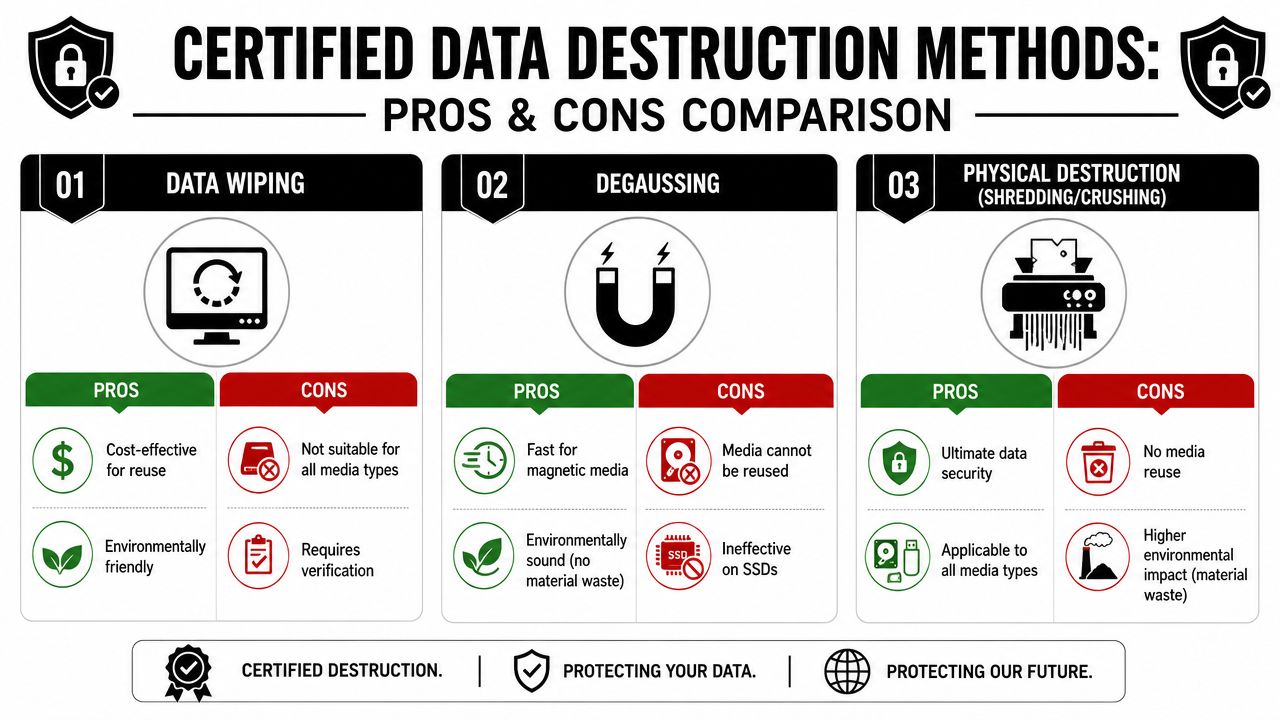
When wiping makes sense
Software-based sanitization is the right path when the asset still works, the storage media can be processed reliably, and there's resale or redeployment value worth preserving. This is the route for many business laptops, desktops, and some server drives that are still functional.
The advantage is obvious. You remove data while keeping the device marketable.
Use wiping when:
- The device is operational
- The media supports verified sanitization
- The asset has resale, redeployment, or donation potential
If your team needs a process reference, secure data destruction in Georgia for ITAD compliance is one example of how providers frame the wipe-versus-destroy decision.
When shredding is the right call
Physical destruction is the end state for failed drives, legacy media, and high-sensitivity environments where reuse isn't worth the risk. If you can't verify sanitization, don't build your process around hope.
Destroy media when the drive is damaged, the storage type is problematic, or the data class makes residual risk unacceptable.
Shredding also fits situations where chain of custody has been interrupted or the device history is uncertain. In those cases, preserving resale value should not outrank certainty.
A simple decision matrix
| Asset condition | Data sensitivity | Best path |
|---|---|---|
| Working device | Standard business data | Verified sanitization, then remarket or redeploy |
| Working device | High sensitivity | Sanitization only if policy allows and verification is strong |
| Failed or inaccessible media | Any sensitivity | Physical destruction |
| Unknown device history | Elevated risk | Physical destruction |
Degaussing can still appear in discussions, but most organizations today get more practical value from a binary policy. Wipe assets that can be safely reused. Shred media that can't.
How to Document Your IT Asset Disposition Process
The most defensible benchmark for IT equipment recycling is asset-level inventory logging and chain-of-custody tracking. Georgia Tech guidance emphasizes logging devices by make, model, serial number, and status so organizations can reduce the risk of loss, misrouting, or mishandling during recycling and transport, as noted in this Georgia Tech electronics recycling guidance.
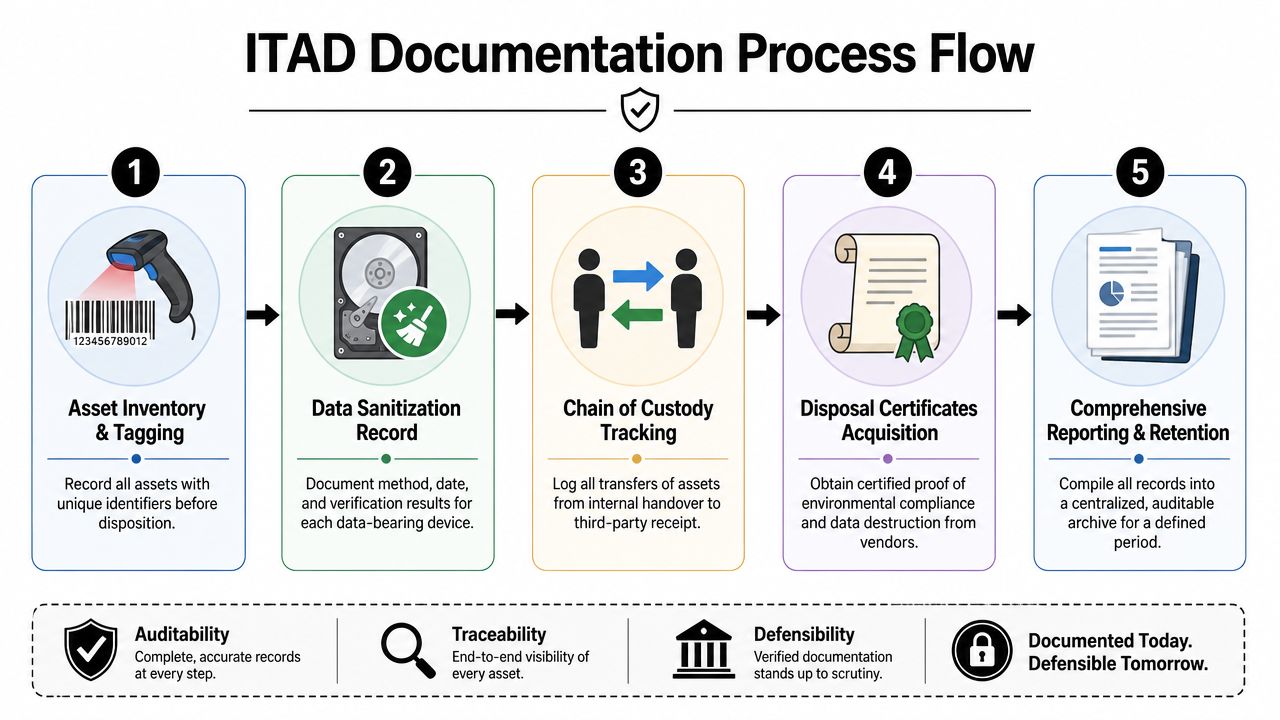
What should be in the record
At minimum, every asset record should answer five questions:
What is it
Make, model, serial number, and internal asset tag.Who released it
Department owner or authorized custodian.How was data handled
Wiped, shredded, removed for destruction, or no media present.Where did it go
Pickup reference, receiving vendor, and downstream status.What was the final outcome
Remarketed, recycled, destroyed, or returned to service.
Why paperwork changes liability
A lot of teams think the certificate at the end is the key document. It matters, but it only proves final handling. Your internal inventory and transfer logs prove control before the vendor took possession.
Audit view: If a serial number appears on the retirement list but nowhere in transport or final disposition records, you have a gap even if the pallet count looks right.
That's why bulk counts are weak. “Twelve laptops collected” doesn't help if one of those units contained regulated information and never appears again in your records.
Build a retention habit
Keep disposition records in one place. Don't split them across procurement, facilities, desktop support, and the vendor's portal if you can avoid it. A centralized archive works better, and a destruction certificate template can help standardize what your team expects back from vendors.
The process doesn't need to be bureaucratic. It needs to be searchable, consistent, and complete.
Vendor Selection Criteria for IT Equipment Recycling
Price matters, but it's a poor first filter for ITAD. The cheapest quote often assumes loose inventory, offloaded transport responsibility, limited reporting, and a recycling-first model that ignores residual asset value. That may work for scrap metal. It doesn't work well for data-bearing business equipment.

Questions worth asking before you sign
Use the vendor interview to test process maturity, not just service availability.
- How do you track assets? Ask whether they log by serial number or by pallet and weight.
- How do you handle data-bearing devices? You want a clear wipe-or-shred policy, not a vague promise to “destroy everything securely.”
- What reports do you issue? Look for itemized disposition records, not only summary certificates.
- Who controls transportation? If multiple third parties touch the load, ask how custody is documented.
- Can you support value recovery? A recycler that only knows scrap processing may leave money on the table.
For internal procurement teams, a vendor due diligence checklist helps formalize those questions so selection isn't based on email claims alone.
Red flags that show up early
Watch for vendors that resist serialized reporting, avoid discussing downstream processing, or push immediate destruction on every asset regardless of age and condition. That usually means they're set up for convenience, not optimization.
A more capable provider can explain the trade-offs. For example, an Atlanta-based company like Beyond Surplus offers ITAD services that include secure data destruction, electronics recycling, and IT buyback, which is relevant when an organization needs both compliance handling and a path for value recovery. The important point isn't the brand. It's whether the provider can support multiple end-of-life paths under one documented process.
What good vendors do well
Good vendors are specific. They can show sample reports, explain media handling rules, and describe how assets move from your dock to final disposition without hand-waving. If they can't explain the workflow clearly before pickup, the reporting usually won't improve after pickup.
Turning Surplus IT Equipment into Revenue
Most recycling guides stop at safe disposal. That's only half the decision. The harder and more useful question is whether a retired asset should be recycled at all.
A critical gap in many ITAD programs is the lack of a framework for remarket versus destroy. That choice directly affects cost, sustainability, and value recovery, as discussed in this Georgia corporate IT recycling perspective.
Use a practical triage model
When I review surplus inventories, I sort equipment into three lanes:
Resale lane
These are clean, working assets with market demand. Think recent business laptops, late-model desktops, enterprise network gear, and some mobile fleets. They should be sanitized, tested, graded, and remarketed.
Redeploy or donate lane
Some devices won't return much cash but still have useful life. If they fit an internal refresh need or an approved donation program, sanitization keeps that option open.
Destruction and recycle lane
Failed storage, obsolete hardware, broken screens, missing parts, or anything carrying a sensitivity profile that rules out reuse belongs here.
Don't ask whether an asset is old. Ask whether it is functional, wipeable, and marketable.
What drives the decision
You don't need a complex scoring model. You need consistent criteria:
- Condition: Does it power on, pass testing, and present well?
- Storage risk: Can the media be sanitized and verified?
- Marketability: Is there still buyer demand for this model class?
- Internal policy: Does your organization allow resale for this asset type?
- Handling cost: Will processing outweigh likely recovery?
That's where many teams oversimplify. They assume shredding everything is safer, but blanket destruction can turn recoverable equipment into a pure cost center.
Why buyback belongs in the recycling conversation
The strongest Georgia programs combine secure recycling with IT buyback. Assets with remaining value should move through a resale path after verified sanitization. Assets without value or without safe reuse potential should move to destruction and material recovery.
If your organization wants to evaluate that split more deliberately, IT equipment resale in Georgia is the kind of service model to look for. The strategic benefit is simple. You lower disposal cost on some assets by recovering value from others.
Implementing Your Georgia IT Recycling Program
A workable program doesn't need to be complicated. It needs to be disciplined.
Start with a written policy that defines which assets require serialized tracking, who approves disposition, and how your team decides between sanitization, destruction, and recycling. Then build the workflow around actual device handling, not around the pickup date.
A rollout plan that works
Use this sequence:
Create retirement rules
Define when equipment leaves service and who owns the decision.Segment by risk and value
Separate reusable assets from failed media and low-value scrap before pickup.Require documentation at unit level
Track serials, transfer points, sanitization method, and final outcome.Align the vendor to your policy
Don't let the vendor define your internal control standard.Review results after each project
Check missing serials, certificate quality, and how much equipment was remarketed versus destroyed.
The standard to aim for
Good IT equipment recycling in Georgia protects the business in four ways:
- Compliance: Assets move through a process that fits Georgia disposal expectations.
- Security: Data-bearing media are wiped or destroyed based on risk.
- Auditability: Chain of custody and final disposition are documented.
- Cost control: Reusable devices are evaluated for buyback before they become scrap.
That's the operational core of IT Equipment Recycling in Georgia: Best Practices Guide in real life. Not cleaner storage rooms. Better control over assets, data, and downstream outcomes.
If your organization needs a documented path for electronics recycling, secure data destruction, IT buyback, or data center equipment disposition, contact Beyond Surplus. They provide business-focused ITAD services in Georgia with chain-of-custody documentation, certificates of recycling and data destruction, and options for both secure recycling and value recovery.


