

Your team is probably facing a familiar problem right now. Finance wants clean ESG reporting. Legal wants proof that retired laptops and drives won't create a data breach. IT wants old equipment out of closets, labs, and server rooms without turning the project into a weeks-long fire drill.
That's where sustainable IT disposal in Georgia stops being a back-office chore and starts acting like an operating control. Old hardware touches three things at once: environmental accountability, information security, and governance discipline. If any one of those is weak, the disposal event becomes a risk event.
The global backdrop is hard to ignore. The world generated 62 million tonnes of electronic waste in 2022, but only 22.3% was formally collected and recycled, and annual e-waste is projected to reach 82 million tonnes by 2030, according to the Global E-waste Monitor 2024 summary cited here. For Georgia companies, that puts pressure on procurement, IT, and sustainability leaders to show a documented path for reuse, refurbishment, secure data destruction, and responsible recycling.
The ESG Imperative for Georgia's Tech-Driven Businesses
Georgia businesses sit in a market where growth brings hardware turnover. Office expansions, cloud migrations, laptop refreshes, medical device upgrades, and data center changes all create a steady stream of retired assets. The mistake is treating those assets as scrap too early.
An ESG program needs operational evidence. Boards and customers don't want vague statements about responsibility. They want to know whether equipment was reused when possible, whether data was destroyed correctly, and whether disposal records can stand up to review.
Why obsolete hardware belongs in ESG discussions
Retired equipment affects all three ESG pillars at once:
- Environmental performance depends on whether devices are refurbished, remarketed, or recycled through a documented downstream process.
- Social responsibility shows up in how vendors manage labor practices, handle community impact, and avoid informal disposal channels.
- Governance strength comes down to policy, approvals, chain of custody, and audit-ready records.
For many organizations, the fastest way to improve this area is to stop thinking in terms of junk removal and start thinking in terms of asset disposition policy.
Practical rule: If your disposal vendor can't tell you where each serialized asset ended up, your ESG story has a documentation gap.
Georgia companies that want stronger sustainability narratives often start with practical workflows, not glossy reports. A useful example is social impact recycling programs in Georgia, which show how disposition choices can support both operational cleanup and broader corporate responsibility goals.
Connecting ITAD to Your ESG Strategy
ITAD, or IT asset disposition, is the execution layer of ESG for retired technology. ESG sets the direction. ITAD is the machinery that makes the direction real.
To illustrate: ESG is the policy map, while ITAD is the route your equipment takes. If the route isn't controlled, the map doesn't matter.
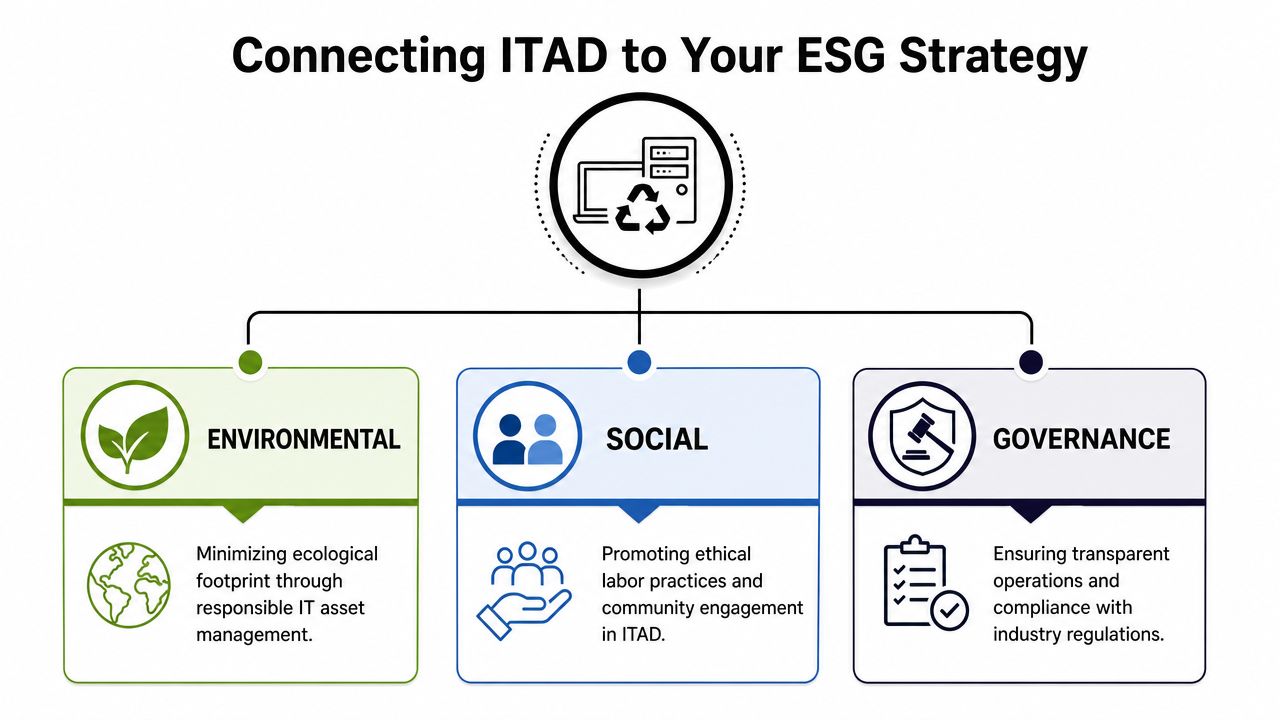
What each ESG pillar means in practice
Environmental
The initial goal for many organizations is reducing landfill exposure and achieving more responsible processing. This translates in practice to triaging assets for reuse before recycling, separating reusable hardware from commodities, and maintaining records that show final disposition.
Social
This pillar is often overlooked in disposal planning. It includes who handles the work, how responsibly the vendor operates, and whether your disposition program supports legitimate reuse channels instead of opaque secondary markets.
Governance
Mature ITAD programs are distinguished by comprehensive governance. Governance encompasses policy enforcement, documented approvals, serialized tracking, secure transport, destruction evidence, and reporting that a compliance team can use.
What strong ITAD adds to ESG reporting
A disciplined ITAD process gives businesses records they can use internally and externally:
- Asset-level tracking for laptops, servers, drives, and network gear
- Disposition outcomes that separate reuse, resale, destruction, and recycling
- Certificates and logs that support audits and internal reviews
- Chain-of-custody evidence for security and accountability
If your organization is selecting a vendor for this work, it helps to evaluate providers that position themselves as an ESG recycling partner in Georgia rather than a basic hauling service.
A mature ITAD program doesn't just remove equipment. It creates evidence.
Navigating Data Disposal Regulations in Georgia
Compliance drives disposal decisions more than many teams expect. In Georgia, that matters because businesses operate inside a large technology and logistics corridor where equipment moves quickly, but legal responsibility doesn't disappear when the truck leaves the dock.
The federal baseline is clear. The FTC's Disposal Rule, which implements FACTA, requires businesses and other covered entities to take reasonable measures to protect consumer information when disposing of records. The Georgia-focused compliance summary here connects that rule directly to ITAD programs that issue certificates of data destruction and maintain chain-of-custody documentation.
What “reasonable measures” should mean operationally
For IT teams, “reasonable measures” can't stay abstract. It needs to show up in the workflow:
- Inventory control before anything leaves the site
- Media identification so drives, SSDs, backup devices, and embedded storage aren't missed
- Approved sanitization or destruction methods based on reuse potential and risk profile
- Document retention for certificates, manifests, and serial reports
A surprising number of disposal failures happen before destruction. Assets sit in unsecured staging areas. Pallets are built without serialization. Drives are removed but not logged. Contractors touch equipment without clear custody rules.
Which organizations should care most
Any business with consumer, patient, student, financial, or public-sector data should treat IT disposal as a compliance issue. Healthcare, finance, education, and government teams usually understand this immediately because they already live with audit pressure. But mid-market firms face the same exposure when retired devices still contain customer information, login artifacts, cached files, or archived records.
A practical review should ask:
| Question | Why it matters |
|---|---|
| Who signs off on disposition? | Governance starts before pickup. |
| Are assets serialized at collection? | You need traceability for each device. |
| What proof do you receive after processing? | Certificates and reports support audits. |
| Can your process align with recognized sanitization standards? | Security controls need a repeatable method. |
For organizations tightening policy, guidance tied to NIST SP 800-88 is a useful benchmark when setting expectations for media sanitization and documentation.
Disposal compliance isn't a paperwork exercise. It's how an organization proves it handled sensitive information with care at end of life.
Secure Data Destruction and Chain of Custody
Data destruction fails when companies focus only on the final step. Shredding matters. Wiping matters. But the whole process can still break if nobody can prove where the asset was, who handled it, and what happened to it between pickup and final disposition.
That's why chain of custody is essential. It creates a documented trail from decommissioning through transport, processing, and final reporting.
The three methods businesses usually evaluate
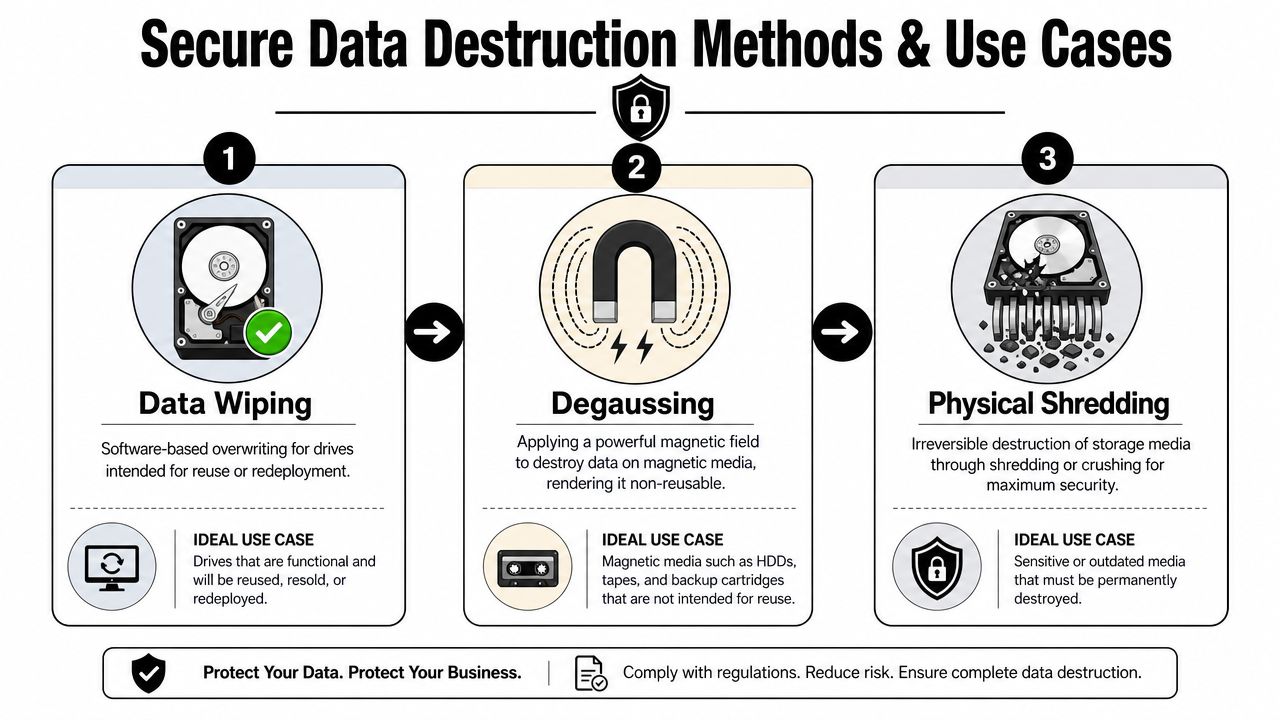
Data wiping works when a drive will be reused or redeployed. The advantage is obvious. You preserve the asset for remarketing or internal reassignment.
Degaussing applies to magnetic media where the goal is destruction through magnetic disruption. It's useful in narrower cases and generally removes reuse from the table.
Physical shredding is the right call when media is damaged, non-redeployable, highly sensitive, or outside policy for reuse. It is final, simple to understand, and easy to verify when managed properly.
What chain of custody should look like
A serious process usually includes these controls:
- Serialized intake: Each asset is logged by make, model, and serial number.
- Secure packaging and transport: The handoff is documented, not informal.
- Controlled processing areas: Access is limited to authorized staff.
- Disposition matching: Each item is tied to its final path, whether wiped, shredded, remarketed, or recycled.
Here's what doesn't work. Mixed pallets with no asset list. Loose drives in banker boxes. Pickup receipts that only say “miscellaneous electronics.” Those practices create blind spots your compliance team can't defend later.
Why the certificate matters
A certificate of data destruction is not a ceremonial attachment to an invoice. It's evidence that the organization completed a defensible process and can show auditors, customers, insurers, or counsel what happened.
One Georgia option that provides this type of documentation is Beyond Surplus, which offers certified data wiping, shredding, and reporting for business IT assets. If you're comparing vendors, review what a hard drive certificate of destruction should contain before you approve a contract.
A Checklist for Vetting Your Georgia ITAD Vendor
Most vendor evaluations fail because the wrong questions get asked. Teams compare pickup speed, commodity payouts, or whether the vendor “does recycling,” then discover later that reporting is thin and security controls were assumed rather than verified.
Use a procurement checklist that forces specifics.
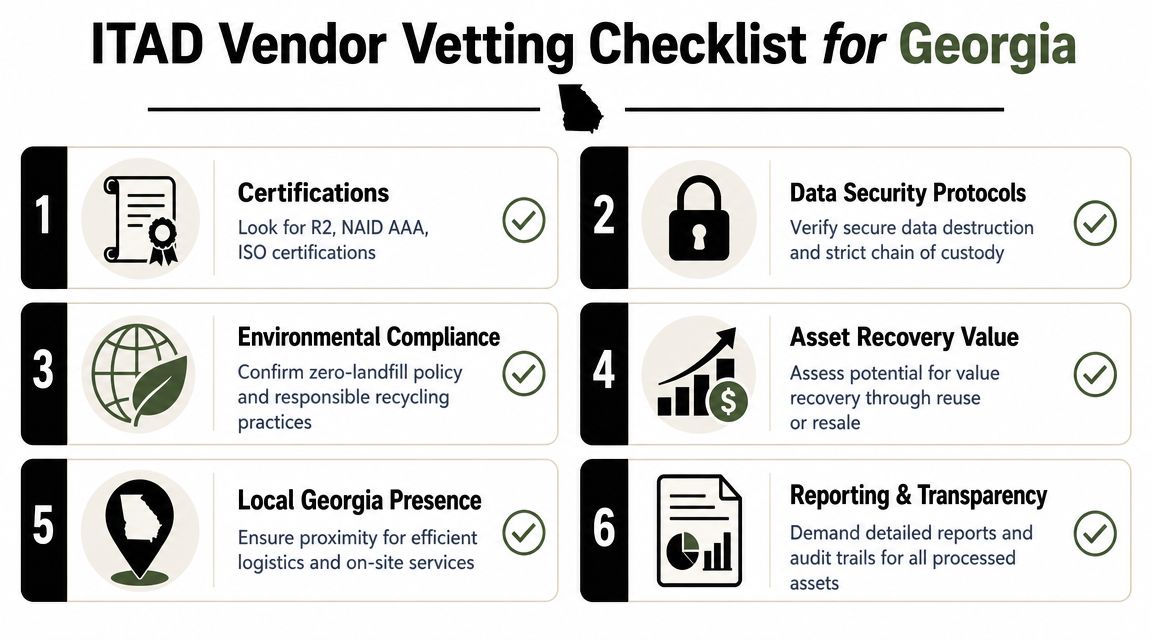
Questions worth asking before you sign
Certifications and operating discipline
Ask which certifications the vendor maintains and how they apply to your scope of work. Then ask a better question: how do those controls show up in day-to-day handling, employee access, downstream management, and reporting?
Data security process
Don't settle for “we wipe everything.” Ask which assets are wiped, which are shredded, who makes that decision, and how exceptions are documented.
Reporting quality
You want more than a pickup receipt. Ask for sample reports that show serial numbers, asset categories, disposition paths, and certificates tied to the completed job.
The practical shortlist
- Chain of custody must start at pickup, not at the processing dock.
- Reuse capability should exist, because a shred-everything model wastes recoverable value.
- Downstream transparency matters if equipment or commodities leave the primary facility.
- Local service capacity helps when your project includes multiple Georgia sites, tight timelines, or on-site work.
- Clear liability language should appear in the service agreement and final documentation.
A vendor due diligence process should be formal, especially for healthcare, finance, education, and government buyers. This vendor due diligence checklist is the kind of tool procurement and IT can review together before approving an ITAD relationship.
The wrong ITAD vendor usually sounds fine in the sales call. The problem shows up later, when you ask for proof.
From Cost Center to Value Driver ESG Reporting
The strongest ITAD programs follow one rule: reuse first, recycling second. That's not just an environmental position. It's also the most practical financial model.
According to the ITAD and ESG guidance summarized here, an effective program starts with serialized intake, triage for refurbishment, and certified data sanitization because extending device life preserves embodied energy and reduces downstream e-waste. The same guidance notes that the highest-value environmental and financial outcome comes from remarketing working hardware before shredding it, with chain-of-custody logs and certificates supporting ESG reporting and compliance.
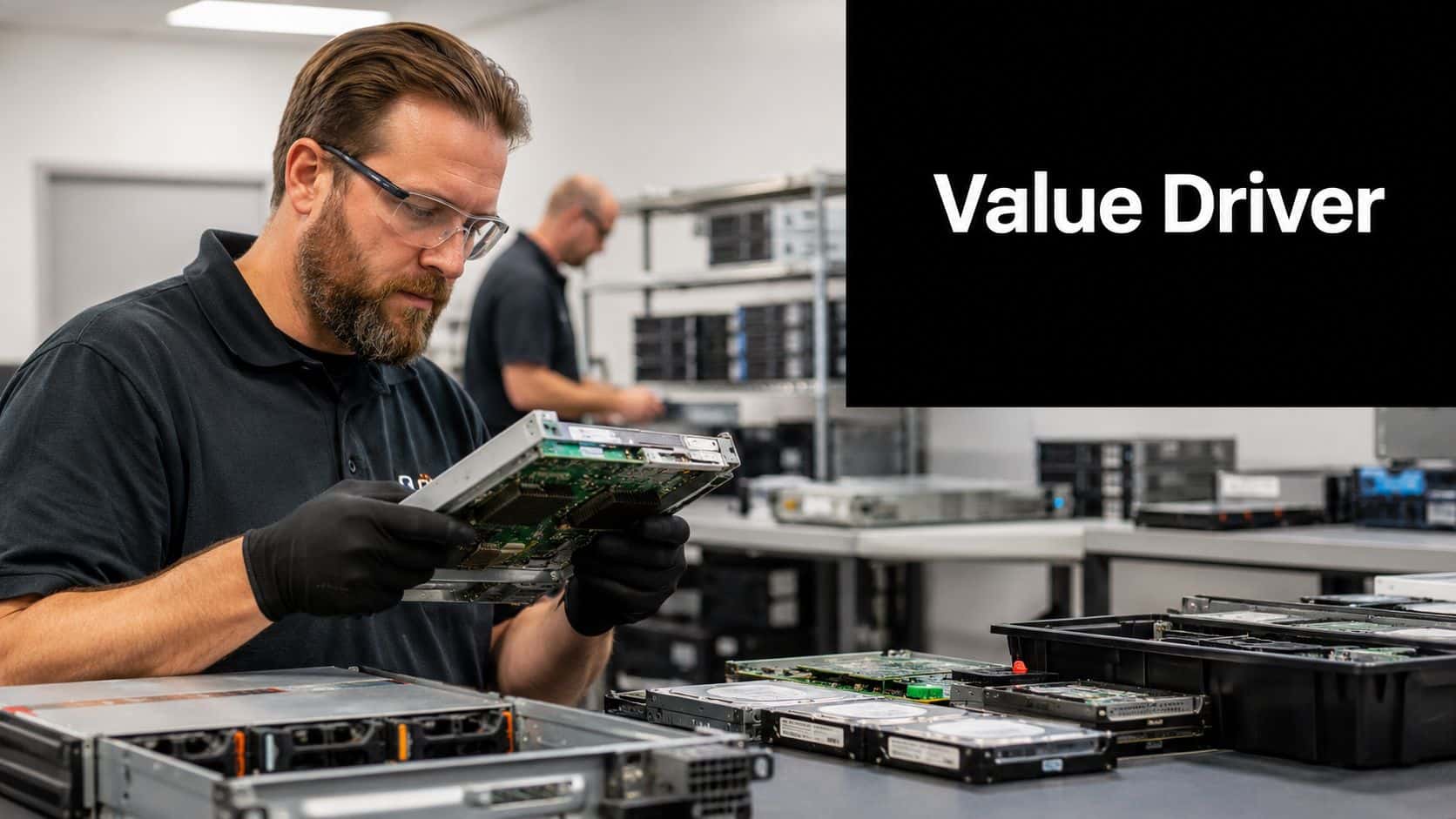
What value recovery really means
Value recovery isn't just a resale check. It includes avoided processing costs, cleaner warehouse space, fewer ad hoc disposal events, and better audit trails. But the direct commercial upside usually starts with refurbishable assets such as current-model laptops, servers, network gear, and mobile devices that still have market demand.
A weak program destroys too much too early. A strong one separates equipment into categories:
| Asset condition | Best path |
|---|---|
| Working and marketable | Sanitization, testing, remarketing |
| Functional but low value | Reuse internally or controlled recycling |
| Failed or non-compliant media | Physical destruction |
| End-of-life commodities | Documented material recycling |
Why this improves ESG reporting
Sustainability reporting gets easier when disposition data is structured. Instead of broad statements, you can report what happened to specific classes of assets, which were reused, which were destroyed, and which were recycled under documented controls.
That gives ESG teams better support for internal disclosures because the ITAD process produces evidence, not just invoices.
Take Control of Your IT Assets Today
Sustainable IT disposal in Georgia is really a management issue disguised as a recycling task. If the process is loose, your company carries unnecessary exposure across data security, compliance, and ESG reporting. If the process is disciplined, the same retired hardware becomes a source of audit evidence, operational cleanup, and potential value recovery.
Most organizations don't need a dramatic overhaul to get started. They need a repeatable disposal policy and a vendor process that stands up under scrutiny.
Immediate next steps
- Inventory what's sitting idle: closets, storage rooms, labs, branch offices, and data center cages
- Separate assets by risk: storage media, regulated devices, reusable systems, and scrap
- Review your current policy: confirm who approves disposition and what proof must be retained
- Set a chain-of-custody standard: no pickup without serialization and documented transfer
- Align IT and finance: decide when remarketing, destruction, or recycling is the right path
The companies that handle this well don't wait for a relocation, audit request, or breach scare. They build the process before the next refresh cycle lands.
Georgia businesses that need secure, documented, and practical IT asset disposition can contact Beyond Surplus to discuss electronics recycling, certified data destruction, value recovery, and compliant pickup logistics for commercial equipment.


